
Introduction
You pull up a prospect's LinkedIn profile in New Delhi. The role is right, the company fits your ICP. But you have no verified email, no direct phone number. Hours vanish into manual research, only to hit a dead inbox.
That gap between identifying a lead and reaching them is the single biggest bottleneck for Indian sales teams. Real-time LinkedIn profile enrichment fills it: the moment you view a profile, verified contact data gets appended.
For India, data quality varies sharply between global aggregators and a local specialist. One tool cross-references profiles against proprietary Indian databases. Another set of platforms offers global breadth but weakens Indian contact accuracy. The choice has serious compliance implications under the Digital Personal Data Protection Act, 2023.
This piece isolates the platform that reliably verifies Indian emails and phones. It also explains why other popular tools fall short when data deliverability inside India is the only metric that matters.
Key Takeaways
Real-time enrichment is only as good as the local database it queries. Here are the non-negotiable conclusions for anyone prospecting inside India:
- Top Indian pick: PeakAi cross-references LinkedIn profiles against proprietary Indian databases, returning verified emails and phones on a pay-per-validated-contact model.
- Compliance first: The DPDP Act 2023 makes consent and lawful sourcing mandatory. A tool purpose-built for India carries a tailored compliance posture that a global aggregator cannot offer.
- Global tools dilute Indian data: Lusha and SignalHire deliver real-time results from global databases, but their shallow Indian verification leads to higher bounce rates and dead numbers.
- Enrichment is a feature, not a product: Apollo.io bundles enrichment inside a sales engagement suite. Its massive database lacks the real-time, deliverability-focused validation required for Indian profiles.
- Geography dictates accuracy: A European-first tool like Kaspr inherits GDPR-centric data partners, leaving Indian coverage sparse and unvalidated.
1. PeakAi: Real-Time Enrichment Engineered for the Indian Market

PeakAi is a real-time LinkedIn enrichment platform that fixes what Indian sales and recruiting teams lose to bad contact data every day. You run a search, drop in a LinkedIn URL, and the platform queries public business registry and telecom databases to return a verified email and phone number. The whole lookup finishes in under 10 seconds.
The platform cross-references a profile against a network of independent Indian databases, so every contact record has passed a live validation check before it reaches you. PeakAi runs dual verification on emails and phone numbers, then stamps each exported record with a compliance timestamp and a data-source trail. Under the Digital Personal Data Protection Act, 2023, that audit trail stops being a nice-to-have and becomes a box your business needs to check whenever you collect personal data.
Pricing runs on a pay-per-verified-contact model. You start at $9 for 50 contacts, which works out to $0.18 per credit, and you pay only when the record validates. Bad phone numbers trigger a credit-back guarantee, so you are not eating the cost of garbage data. For teams who need coverage across 1,600-plus Indian cities and stay under a few hundred enrichments a month, this math costs less than a flat SaaS subscription bloated with international coverage you will never use. There are no hidden fees on the invoice.
2. Lusha: Global Reach with Broad but Shallow Indian Coverage

Lusha runs a global contact database that surfaces real-time data on LinkedIn. The Indian depth does not match the coverage headlines.
Here is the comparison on the dimensions that decide a delivered conversation:
| Dimension | PeakAi (India) | Lusha |
|---|---|---|
| Core Database | Proprietary Indian verification network, cross-referencing business registries and telecom records | Global aggregation from multiple public and licensed sources |
| Real-Time Validation | Dual verification of emails and phone numbers; compliance timestamp and data-source attribution attached | Real-time display from aggregated data; Indian contact ownership and deliverability are not separately verified |
| Pricing Model | $0.18 per validated contact; $9 for 50 credits; credit-back guarantee on bad numbers | Pay-per-contact credits within subscription tiers; unused credits may expire |
| India Compliance Posture | Tailored data-sourcing workflow designed for DPDP Act requirements; records carry audit-ready attribution | General global privacy compliance applied to India, lacking jurisdiction-specific audits |
| Optimal Use Case | Indian B2B prospecting where verified direct-dial and deliverable email are the only acceptable result | Global top-of-funnel prospecting where breadth is prioritized over local contact verification |
For India-specific work, the gap sits in the verification step. Lusha pools data from a wide net of public and licensed sources, but it skips the cross-reference against the proprietary Indian databases that confirm whether an email inbox is live or a phone number belongs to the decision-maker on your screen. When contact matches include their source and nearby context, but ownership and deliverability are not verified, the bounce-back risk shifts directly onto your sender reputation.
3. SignalHire: A Global Aggregator with Mixed Results in India

SignalHire pulls contact data from public profiles, social footprints, and third-party datasets across its global aggregation network. When you run an Indian profile through enrichment, it searches a worldwide index and returns whatever it finds. The record count can look large. The problem is that Indian phone numbers and personal emails may or may not resolve.
The tool lacks a verification layer that checks deliverability against Indian telecom carriers and business registries. It was built for a different data environment. SignalHire gives you the 10 free monthly credits that business accounts get, so a quick trial is straightforward, but that doesn't change the underlying gap. The database is best where its aggregation partners have the most surface area, and that's the West.
Treat India as one territory inside a planetary crawl and the coverage gaps line up neatly with the cities and company sizes that fall outside the most-digitized, most-frequently-indexed records. A mid-sized manufacturer in Ludhiana can return a stale field. A proprietary firm in Coimbatore might return nothing at all, even when a legitimate contact exists. In Indian prospecting, a bounced email costs sender trust. SignalHire gives you breadth and skips the local check that would catch the dead addresses.
4. ZoomInfo: Enterprise-Grade Data, Limited Indian Contact Depth
ZoomInfo dominates enterprise sales floors with firmographic and technographic intelligence. Its company-level data is exhaustive, mapping reporting hierarchies and buying intent at scale. Ask it for the direct mobile number of a procurement head at an Indian auto-components firm. That is where the depth thins out.
The platform's strength is stitching together a corporate picture: funding rounds, office locations, installed software stacks. But granular Indian contact data, the verified email and direct phone number you need to act on a LinkedIn profile, is not its core output. ZoomInfo builds its contact graph from a global contributor network, web crawling, and company self-reported data. In India, the proportion of verified, deliverable direct-dial numbers and personal emails is noticeably lower than in North America or Western Europe.
For an enterprise sales team pursuing Fortune 500 accounts with Indian offices, the firmographic lens still provides value in mapping the account. The limitation bites when the prospecting shifts to the Indian mid-market, where over 5.73 crore MSME registrations as of August 2026 are held by male proprietors, and 3.52 crore by female proprietors. These owners operate outside the indexed corporate contributor networks that feed ZoomInfo's contact layer.
The practical takeaway is simple. ZoomInfo serves as a powerful firmographic intelligence layer. It does not serve as a precision contact enrichment tool for Indian direct outreach. D&B Hoovers shares this profile: stronger on enterprise intelligence than India-specific direct-dial precision.
5. Apollo.io: A Sales Engagement Platform with Surface-Level Enrichment

Apollo.io sits at the center of many sales stacks as an engagement and sequencing engine. Its enrichment feature is a bolt-on that surfaces data from a claimed 275M+ contact database. For Indian prospecting, that quantity-first approach creates a false sense of coverage:
- Enrichment is a secondary feature, not the core product. Apollo sequences, automates, and tracks outreach. The contact data fuels the engine, but the engine does not stop to locally validate an Indian phone number before adding it to a sequence.
- Massive database, unverified output. The 275M+ record count signals breadth, not depth. Apollo's enrichment matches publicly surfacing data without running it through a real-time validation check against Indian business registries or telecom databases.
- No India-specific audit trail. Exporting a contact from Apollo does not attach a compliance timestamp or data-source attribution tied to Indian data law. Under the DPDP Act 2023, that missing metadata shifts risk onto your business.
- Advertised accuracy percentages can mislead. Any platform that reports a high accuracy figure is often measuring only syntax validation, whether an email *looks* correctly formed, rather than deliverability. Without a disclosed verification methodology, the number hides the real bounce-back risk.
6. Kaspr: European-Focused Enrichment with a Side-Glance at India
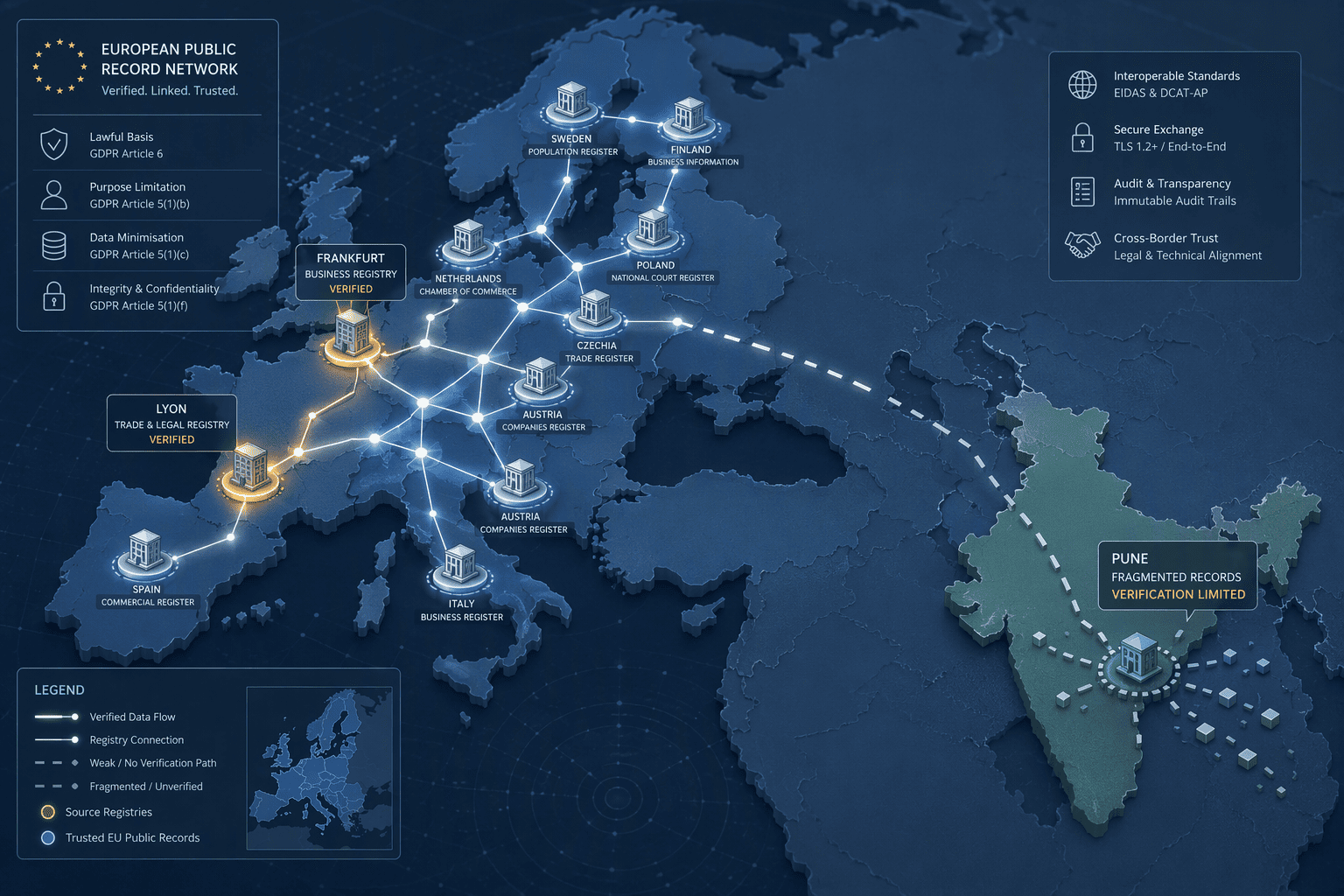
Kaspr's architecture was built around GDPR from day one. Its data partnerships and verification pipeline were designed for European business registries, public records, and licensed datasets. This works reliably when you search for a prospect in Frankfurt or Lyon. It breaks the moment you search for someone in Pune.
The European datasets Kaspr relies on have thin overlap with Indian company registries and almost no integration with telecom verification databases. For an Indian LinkedIn profile, the tool returns whatever scrap of contact data has drifted into its global aggregation layer. You get a record. You don't get proof that the number still rings or that the email avoids a hard bounce.
Indian business contact data decays fast. Companies register, change phone numbers, and switch email providers at a pace that a European refresh cycle was never designed to match. GDPR's consent framework, careful and necessary as it is for its own jurisdiction, does not give Kaspr an edge in verifying Indian contact data under the DPDP Act. The two legal frameworks share principles but diverge sharply in how they connect to local data sources and verification partners.
For sales teams whose quotas run on Indian decision-makers, the mismatch is simple. You pay per contact for data curated for a market half a world away. Kaspr remains a capable option inside EU borders. It was just never wired for the geography Indian pipelines actually need.
Conclusion
A LinkedIn profile with no verified phone number is an expensive dead end. The enrichment platform you pick determines whether you reach a live decision-maker or waste a contact credit on a bounce-back.
Global aggregators give you planetary coverage. Their Indian contact depth is not built for a market spread across more than 1,600 cities.
PeakAi's real-time validation, pay-per-verified-contact economics, and DPDP Act-aware audit trail address the Indian deliverability problem directly. For global requirements where Indian accuracy is secondary, Lusha offers a workable breadth-first option.
Frequently Asked Questions
What is real-time LinkedIn profile enrichment and how does it work?
Real-time LinkedIn profile enrichment is the automated process of appending verified contact data (email, phone, job title) to a LinkedIn profile instantly as you view it. A browser extension or API queries a platform's database and displays validated contact fields within seconds, eliminating manual research.
Which platforms enrich LinkedIn profiles with verified Indian contact data?
PeakAi is purpose-built to enrich Indian profiles with verified emails and phone numbers by cross-referencing them against proprietary Indian databases. Global tools like Lusha and SignalHire offer enrichment for Indian profiles but lack the same local verification depth.
How does PeakAi validate emails and phone numbers in real time?
PeakAi queries independent third-party databases, including business registries and telecommunications records, using a LinkedIn profile's publicly shared URL as the search key. It runs a real-time validation check before surfacing contact data and attaches a compliance timestamp to exported records.
What are the pricing models for LinkedIn enrichment tools, and how does pay-per-contact work?
Most tools charge per enriched contact. You purchase credits (typically $0.10 to $0.50 per contact) and one credit is consumed each time you reveal a record. PeakAi's pay-per-validated-contact model starts at $9 for 50 credits and includes a credit-back guarantee on incorrect phone numbers.
What are the compliance risks of using LinkedIn enrichment tools in India?
Under the Digital Personal Data Protection Act, 2023, scraping profiles or using enriched data without lawful consent can violate privacy law. Businesses should use tools that source data lawfully and maintain audit-ready attribution for every enriched contact, rather than tools that obscure their data provenance.
How does PeakAi compare to global alternatives like Lusha or SignalHire for India-specific use?
PeakAi runs dual verification against Indian-specific databases, delivering a validated record with a compliance timestamp. Lusha and SignalHire aggregate data globally without India-specific validation, meaning their Indian contact records carry a higher risk of bounces and lower deliverability for direct outreach.
Sources
- MSME Dashboard - www.dashboard.msme.gov.in
- LinkedIn Profile Scraper with Public Contacts (futurizerush/linkedin-profile-scraper) Actor - apify.com
