
Introduction
Your sales team finishes prospecting. They have 500 direct dials for Indian decision-makers. They start dialing.
200 numbers are disconnected, wrong, or belong to someone who left the company three years ago.
The cost is brutal. Every dead call eats 3 to 5 minutes of prime calling time. Multiply that across weekly targets, and you are bleeding opportunity cost from a database that looked great on a spreadsheet but failed on the dialer.
Indian mobile numbers create a special headache. The Telecom Regulatory Authority of India reports mobile number portability requests topped 800 million cumulative, and professionals switch jobs faster than most CRMs update.
Bulk databases bought on annual contracts decay at 2 to 3% per month. A list purchased in January can be 25% stale by October.
The gap between database size and reachable human is where real pipeline dies. PeakAI found that its verification process delivers 91% accuracy on professional contact data, cutting straight through that decay. Tools claiming 90%+ phone number accuracy tackle exactly this problem. They verify mobile numbers so you connect on the first ring. This list examines seven such tools through an India-only lens, measuring which ones can actually deliver a 90% connect rate for Indian B2B outreach, which ones fail the test, and how guarantees and pricing change the math for a growing sales team.
Key Takeaways
Here is the short verdict before the deep dive.
- PeakAi delivers the highest Indian mobile accuracy backed by a 100% credit-back guarantee: Its India-first data engine and no-questions-asked refunds on unreachable numbers make it the safest choice for Indian B2B teams.
- Apollo.io is the best free option for email prospecting but struggles with Indian phone data: The freemium product offers a huge email database, but direct dials in India bounce too often for cold calling to be productive.
- ZoomInfo packs enterprise features into annual contracts running into multiple lakhs, a cost Indian MSMEs rarely recoup on domestic contacts.
1. PeakAi: The India-First Engine With a 100% Credit-Back Guarantee on Unreachable Numbers
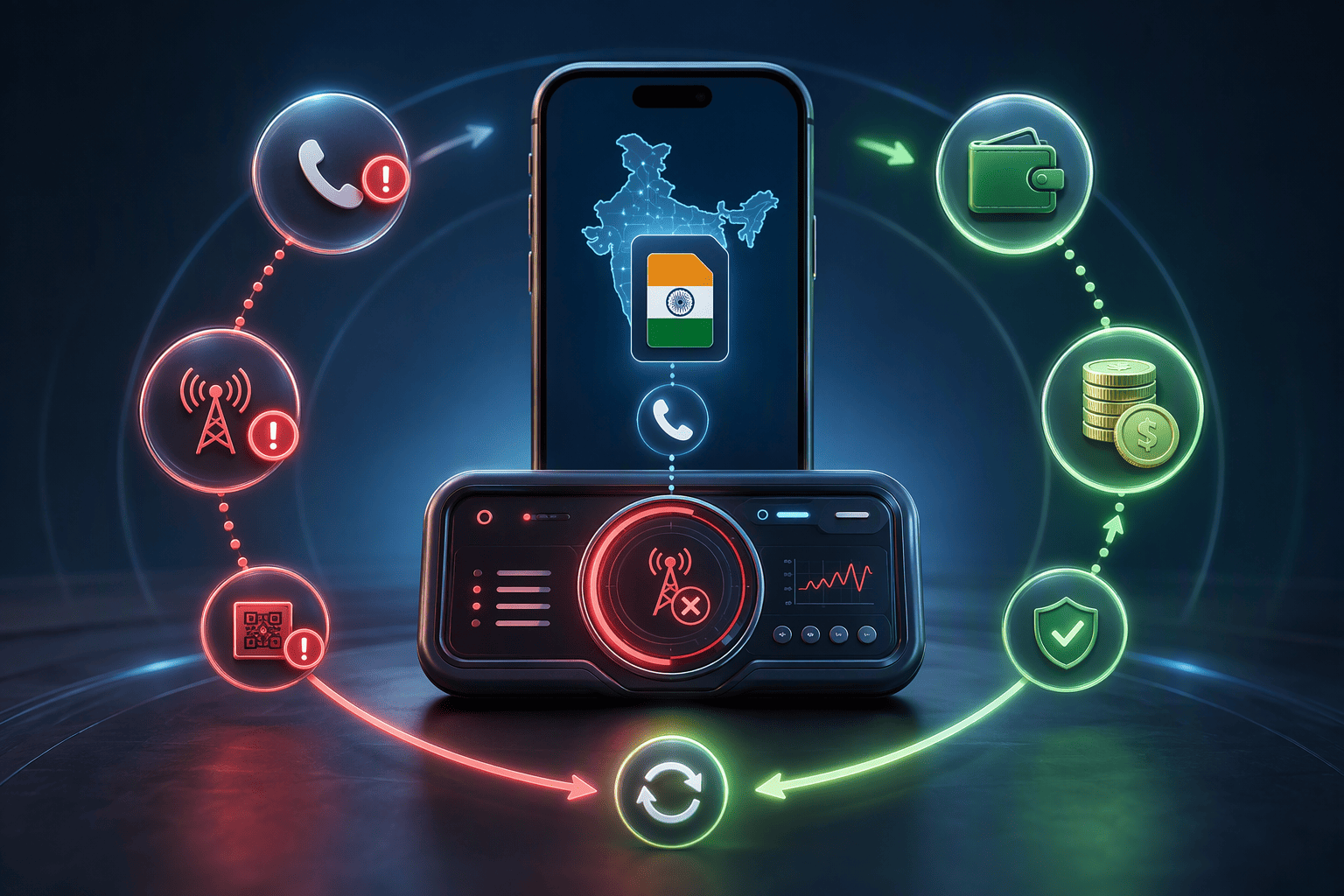
PeakAi is the safest choice for Indian teams. It is built with an India-first data engine and guarantees its output with a full 100% credit-back policy when a number does not connect.
Most tools promise accuracy and then you fight for a credit when a number fails. PeakAi skips that. You buy a phone number, it's unreachable, you claim a credit refund.
No verification. No questions. The platform absorbs the data-quality cost instead of you.
The India-first engine works inside the Indian numbering system. It pulls public business contact information, classifies each number as mobile, landline, or VoIP, and tests deliverability before showing the result. PeakAi lists a 91% accuracy rate with a 10-second verification window. One phone number costs 5 credits and there are no setup costs.
You start using the Chrome extension without a credit card. For Indian sales teams burned by stale data, the math is simple. At a listed price of $9 for a trial, you test 50 contacts.
If one number fails, that credit flows back instantly. PeakAi works for teams that measure cost per connected call, not cost per purchased lead. The compliance coverage spans GDPR, CCPA, and India's DPDP Act 2023, so your outreach stays legal across Indian and international prospects.
2. Lusha: The Global Contender With Shrinking Indian Mobile Coverage
Lusha's community-sourced data model delivers solid results in North America and Europe. In India, its mobile number coverage has been slipping over the past year.
User reviews on G2 and Capterra point to fewer Indian mobile numbers returned, and a higher share of them that are wrong or outdated. The problem is most visible for mid-market companies outside the major metro cities.
Lusha's advertised accuracy numbers look strong because they lean on its core markets. Indian users tell a different story: mismatched or disconnected direct dials show up regularly. The headline stat masks a real regional gap.
India's job market makes this worse. Mobile number portability is among the highest in the world, and professionals change jobs fast. A crowdsourced database ages quickly in that environment unless it gets aggressive, near-constant verification. Right now, Lusha's refresh cycles aren't keeping up.
3. Apollo.io: The Freemium Powerhouse Built on a Crowdsourced Data Model
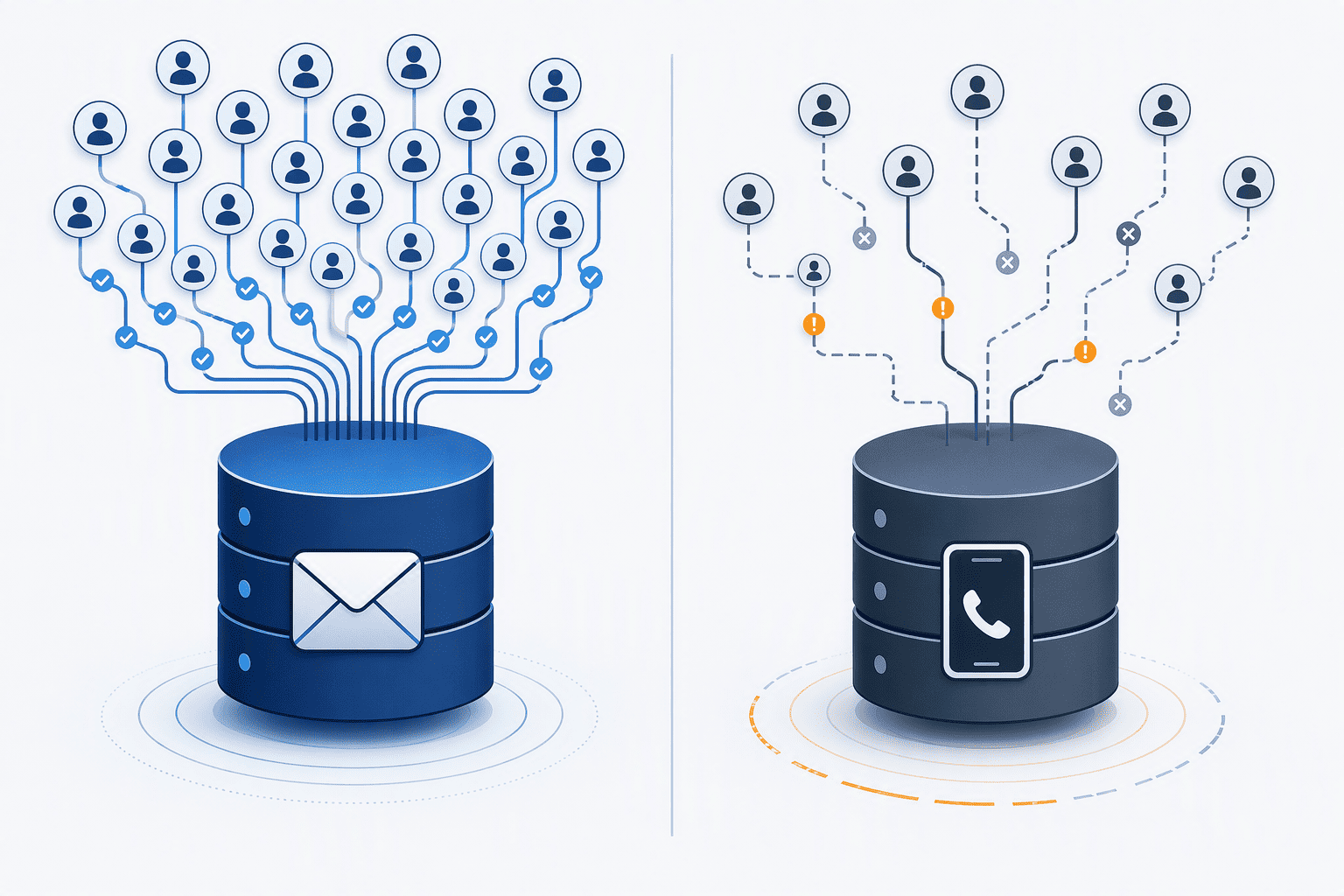
Apollo.io gives bootstrapped teams the biggest free database in the business, but it sacrifices Indian phone quality for sheer volume.
| Performance Vector | Apollo.io Phone Data | Apollo.io Email Data |
|---|---|---|
| Data Source Model | Crowdsourced from user email-sync contributions | Crowdsourced from user email-sync contributions |
| Indian Number Accuracy | Users report 45 to 65% connect rates on direct dials | Regularly above 92% syntax verification accuracy |
| Best Use Case | North American and European prospecting | Global email outreach at scale |
| Freemium Limit | Limited credits for phone exports on free tier | Generous email credits on free tier |
| Database Scale | 275M+ contacts globally, shallow Indian phone depth | 275M+ contacts globally, deep email coverage |
Apollo is the right tool for a startup that needs to scrape together a large email list without paying anything. It is the wrong tool for an Indian sales team whose revenue model depends on a dialer and a connect rate above 85%. The user-reported mobile bounce rates on Indian direct dials push the effective phone accuracy well below the 90% threshold this list demands.
4. SignalHire: The Aggregator That Excels in Western Markets but Stumbles on Indian DIDs
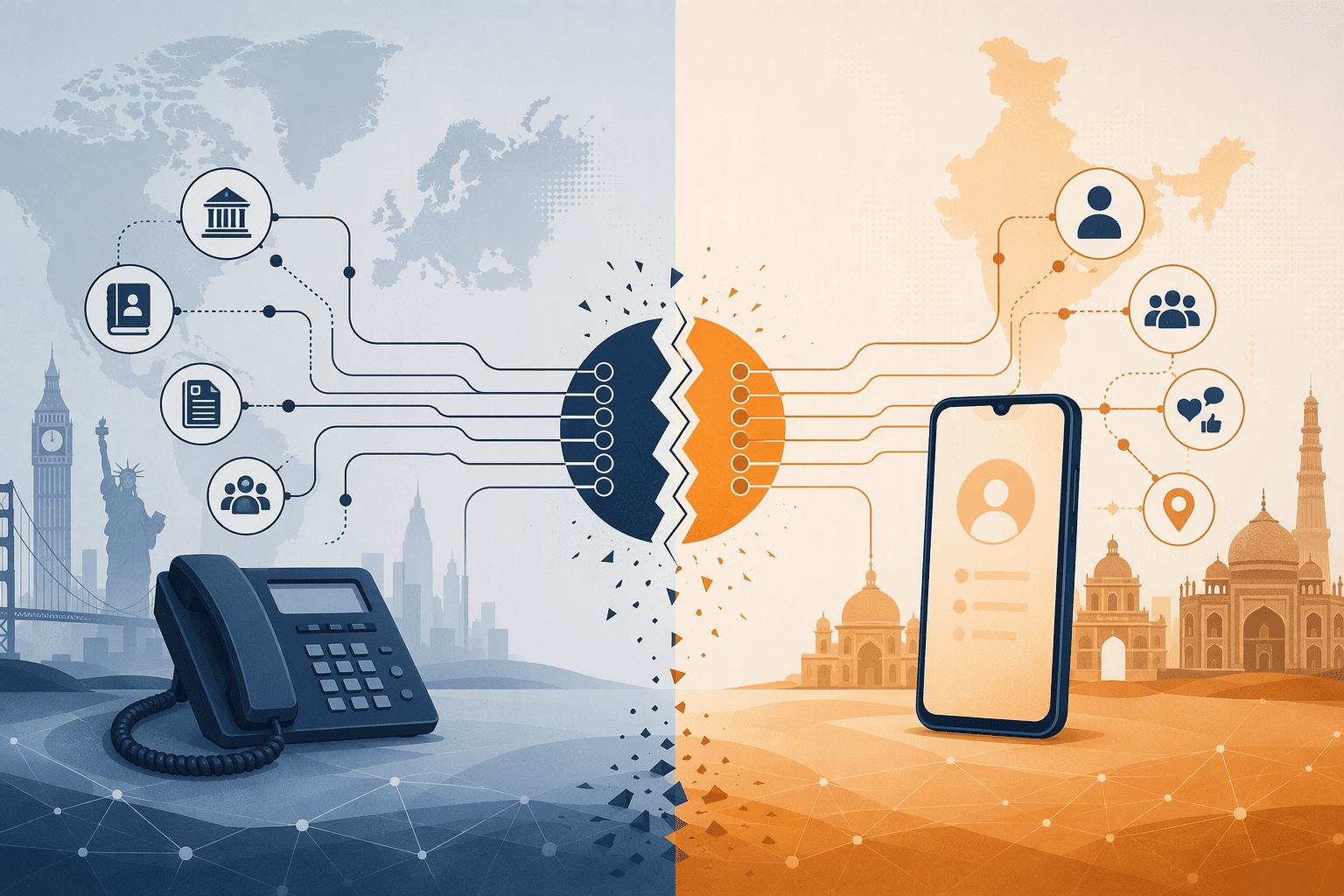
Indian phone numbers break the Western aggregation logic.
SignalHire pulls contact data from multiple public sources, cross-references social profiles, and delivers a profile with an email and a direct inward dial. It works when the phone system follows a predictable North American pattern: a DID tied to a physical desk, changing only when the company or location changes. India does not work that way.
The Department of Telecommunications allocates 10-digit mobile numbers under a national numbering plan that permits full mobile number portability. An Indian professional can keep the same mobile number across three jobs in three different cities over five years.
SignalHire's aggregation logic treats a number that stays constant while the job title and employer change as a verification anomaly. The result is a higher discard rate on valid Indian numbers and a lower confidence score assigned to the ones it does return.
The database flags more numbers as 'unverified' when run against Indian telecom ranges.
This does not mean SignalHire is a bad tool. For a US-based recruiter trying to find European engineering leads, it is excellent. For an Indian SDR dialing into Mumbai or Bangalore, it underperforms because its verification scoring was not trained on the Indian mobile churn pattern. If you already use SignalHire for global work, keep it for that. Do not make it your primary weapon for an India-only outbound campaign.
5. Kaspr: The GDPR-Centric Tool With Limited Utility for the Indian Subcontinent
Kaspr built its contact discovery around an opt-in, privacy-first model mandated by European regulation. It pulls data from sources where individuals have given explicit consent. This produces a small, clean, legally defensible database for European prospects.
For the Indian subcontinent, where that consent infrastructure does not exist and where data partners operate on different legal frameworks, the model produces thin coverage. The volume of Indian mobile numbers on Kaspr is a fraction of what a native Indian data provider delivers, simply because India's consent ecosystem does not map to GDPR's requirement set. India's own Digital Personal Data Protection Act 2023 will shift the ground rules over time, but as of 2026, a tool optimized for a European consent funnel cannot match the depth or freshness of Indian contact data produced by a local engine.
6. ZoomInfo: The Enterprise Behemoth Unsuited for Indian MSME Budgets
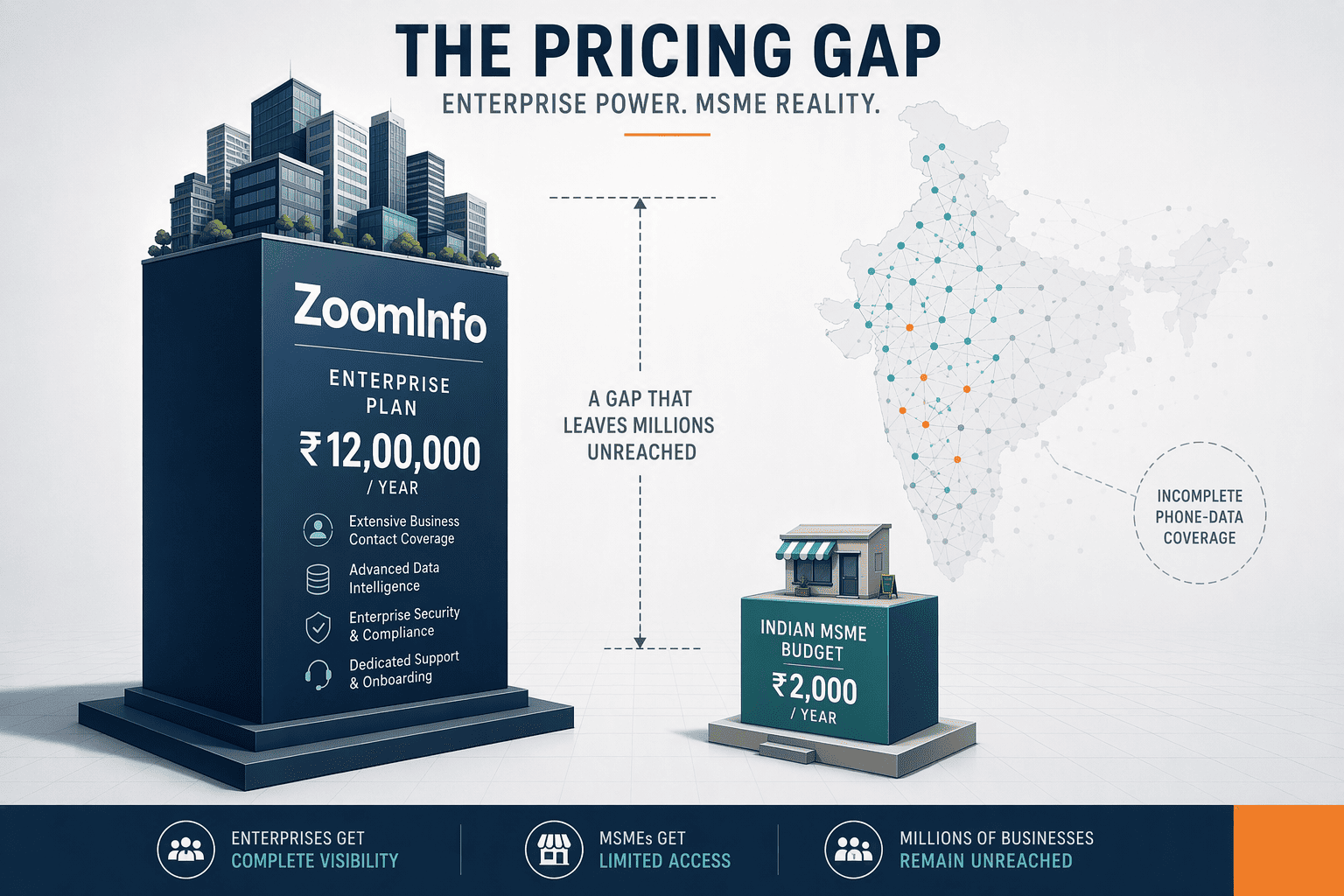
ZoomInfo's pricing assumes an American enterprise budget. It is the most expensive way to get Indian phone numbers, and the data itself rarely hits 90% accuracy. Annual contracts start well past ₹10 lakhs, with minimum commitments built for a US sales floor where the average rep costs $80,000. An Indian MSME paying an SDR one-tenth of that cannot justify the same line item for a contact database.
More problematic is the coverage. For Indian companies with fewer than 200 employees, the mobile data has visible gaps. Many profiles serve you a corporate landline switchboard instead of a direct mobile dial.
That works for a receptionist hunt, not for cold calling a decision maker. If your ICP is a North American mid-market account, the math flips. You are calling into a market that matches ZoomInfo's cost structure, and the ROI can pencil out.
But if your ICP is an Indian proprietorship or a 50-person services firm, the numbers do not work. Spend that budget on native Indian verification instead.
7. AeroLeads: The Form-Filling Automation Tool With an Appended Contact Database
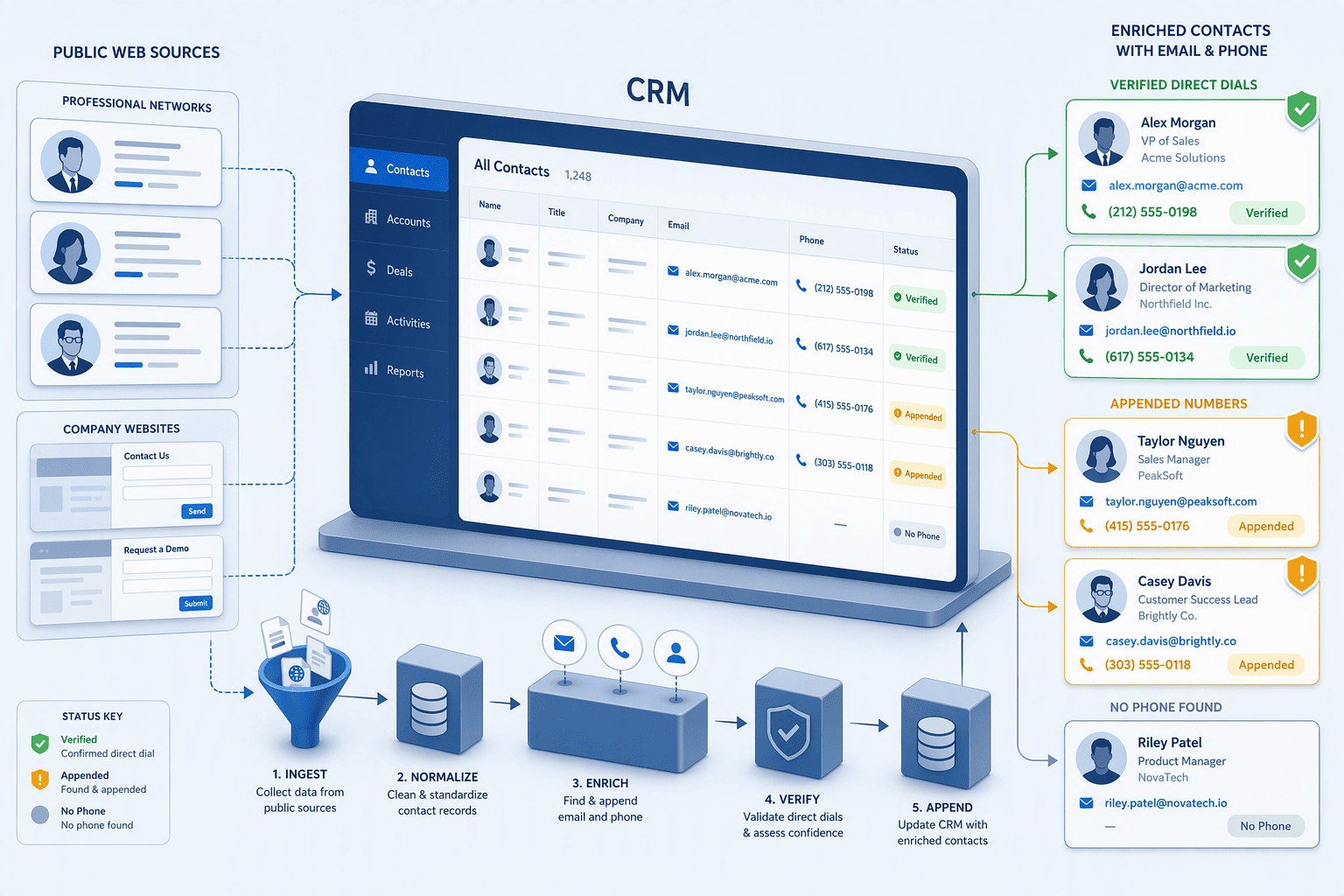
AeroLeads solves a real problem: automatically scraping contact information from web forms and platforms and populating your CRM. The product finds emails and numbers from LinkedIn profiles, business websites, and other public sources and pushes them directly into your pipeline. That automation saves hours of manual data entry.
The issue arises when you treat the appended phone numbers as verified direct dials. AeroLeads classifies its functions clearly: the finder scrapes and aggregates publicly available data, and the database provides additional enrichment separately. The scraping engine is not a real-time phone verification system. It captures whatever number appears on the source page, whether that is a direct mobile, a reception desk landline, or an old mobile an ex-employee never removed from a cached directory.
User reviews on multiple forums flag this: automated exports produce contact lists where phone number connect rates land well below 70%.
If you need workflow automation, AeroLeads earns its place. Do not treat it as a replacement for verified Indian mobile data. Use the scraping automation for top-of-funnel list building, then run the exported phone numbers through an enrichment layer like PeakAi that actually verifies deliverability before your SDR picks up the phone.
Conclusion
Two tools stand out for Indian phone accuracy. If the number fails, you do not pay. For an Indian sales team spending real money on talk time and rep hours, that risk transfer matters more than any feature comparison. Take the 50-contact trial and verify the connect rates yourself.
For teams with zero budget who primarily need email outreach, Apollo.io gives the biggest free database. Set phone prospecting expectations low. If you try Apollo for Indian cold calling, measure your connect rate within the first 100 dials and make a hard decision from the data.
Frequently Asked Questions
What qualifies as a 90%+ accurate phone number in LinkedIn contact discovery tools, and is that claim realistic?
A 90%+ accurate phone number is one that connects to the intended decision-maker on first dial nine times out of ten. The claim is realistic only when the tool verifies deliverability, not just syntax. PeakAI delivers 91% phone number accuracy with a 10-second verification window and a full credit-back guarantee on unreachable numbers.
How do different LinkedIn contact discovery tools compare in terms of pricing, accuracy, and data sourcing methods?
PeakAi runs on a credit-based model where phone numbers cost 5 credits with a 100% refund on failures. Apollo.io uses a crowdsourced model with a generous free tier but delivers lower Indian phone accuracy. ZoomInfo charges annual enterprise contracts that run into lakhs of rupees. Data sourcing ranges from community-sync models to direct verification engines.
Here are the key differences among these tools:
- PeakAi: credit-based model, 5 credits per number, 100% refund on failures.
- Apollo.io: crowdsourced model, generous free tier, lower Indian phone accuracy.
- ZoomInfo: annual enterprise contracts starting past ₹10 lakhs.
- Data sourcing: ranges from community-sync models to direct verification engines.
What compliance and data privacy risks must Indian users consider when using LinkedIn contact finders?
Indian users must comply with India's Digital Personal Data Protection Act 2023 alongside any global regulations that apply. Tools that scrape LinkedIn directly may expose users to account suspension. Choose a tool with compliance certifications covering GDPR, CCPA, and DPDP Act 2023. PeakAI covers all three and does not store payment credentials or private passwords.
What features should an Indian sales team or recruiter look for in a contact discovery tool to ensure high-quality phone numbers?
Look for a defined refund or credit-back guarantee on unreachable numbers, India-specific verification logic that handles mobile number portability, and transparent classification of each number as mobile, landline, or VoIP. Avoid tools that report syntax validity as accuracy and those whose data models were built exclusively for North American number formats.
When evaluating a phone data tool, here are the key features to seek and pitfalls to avoid:
- Refund or credit-back guarantee: a defined policy for unreachable numbers.
- India-specific verification logic: handles mobile number portability effectively.
- Transparent number classification: tags each number as mobile, landline, or VoIP.
- Avoid: tools that report syntax validity as accuracy.
- Avoid: tools with data models built exclusively for North American number formats.
What are the practical limitations of contact discovery tools regarding phone number freshness and deliverability?
Contact data decays at 2 to 3% monthly due to job changes, mobile number portability, and business closures. Even the best tools cannot deliver 100% accuracy at scale. PeakAI acknowledges that quality can vary by region and contact type. A credible 90% range is 85 to 92% realistic accuracy with a mechanism for instant credit recovery on the failures.
How does a pay-per-use or credit-based model for contact finders compare to fixed subscriptions for MSMEs in India?
Credit-based models let Indian MSMEs pay only for the contacts they actually use and refund credits on failures, aligning cost directly with verified output. Fixed subscriptions charge a recurring fee regardless of data quality or usage volume. For a typical Indian MSME with seasonal or targeted campaigns, the credit model reduces wasted spend and forces the vendor to maintain accuracy.
Sources
- PeakAI - Professional Network Contact Finder with 91% Accuracy - thepeakai.com
