
Introduction
Indian sales floors are burning 17% of selling time on dead digits. That is roughly one full workday every week, gone. 17% of their time (roughly 8 hours per week) hunting for accurate contact information is the average for teams relying on scraped lists.
'Data accuracy' is not about how many profiles a tool can scrape. In India, it means one thing: a contact record that rings through to a live decision-maker, verified against real-time telco carrier databases and government business registries. Scraped, unverified Indian mobile numbers fail at a massive rate because of frequent number churn and non-standard formatting.
The search for the most reliable LinkedIn prospecting stops the moment you look beyond global scrapers to platforms wired into Indian infrastructure. This article separates carrier-grade verification from the noise, so you buy only what is confirmed.
Key Takeaways
Expert insights on B2B sales, lead generation, and business growth strategies.
- PeakAi is the India-specific accuracy leader: It uses real-time checks against Indian telecom databases and GSTIN/MCA records, returning verified contacts in under 10 seconds with a credit-back guarantee.
- Global tools leave a gap: Lusha and Apollo.io lack real-time Indian carrier hooks, which keeps direct-dial accuracy low and variable for local mobile numbers.
- Scraping is not verification: Most platforms gather static profile data. Only tools doing live, dual-source validation deliver phone numbers that ring the intended prospect.
- Pay-per-verified-contact de-risks your spend: You do not pay for invalid lines, making it the lowest-risk model for fluctuating Indian prospecting volumes.
- Compliance comes first: 40% of accounts on non-compliant tools were banned in Q1 2026. Accuracy means nothing if your account gets suspended.
At a Glance
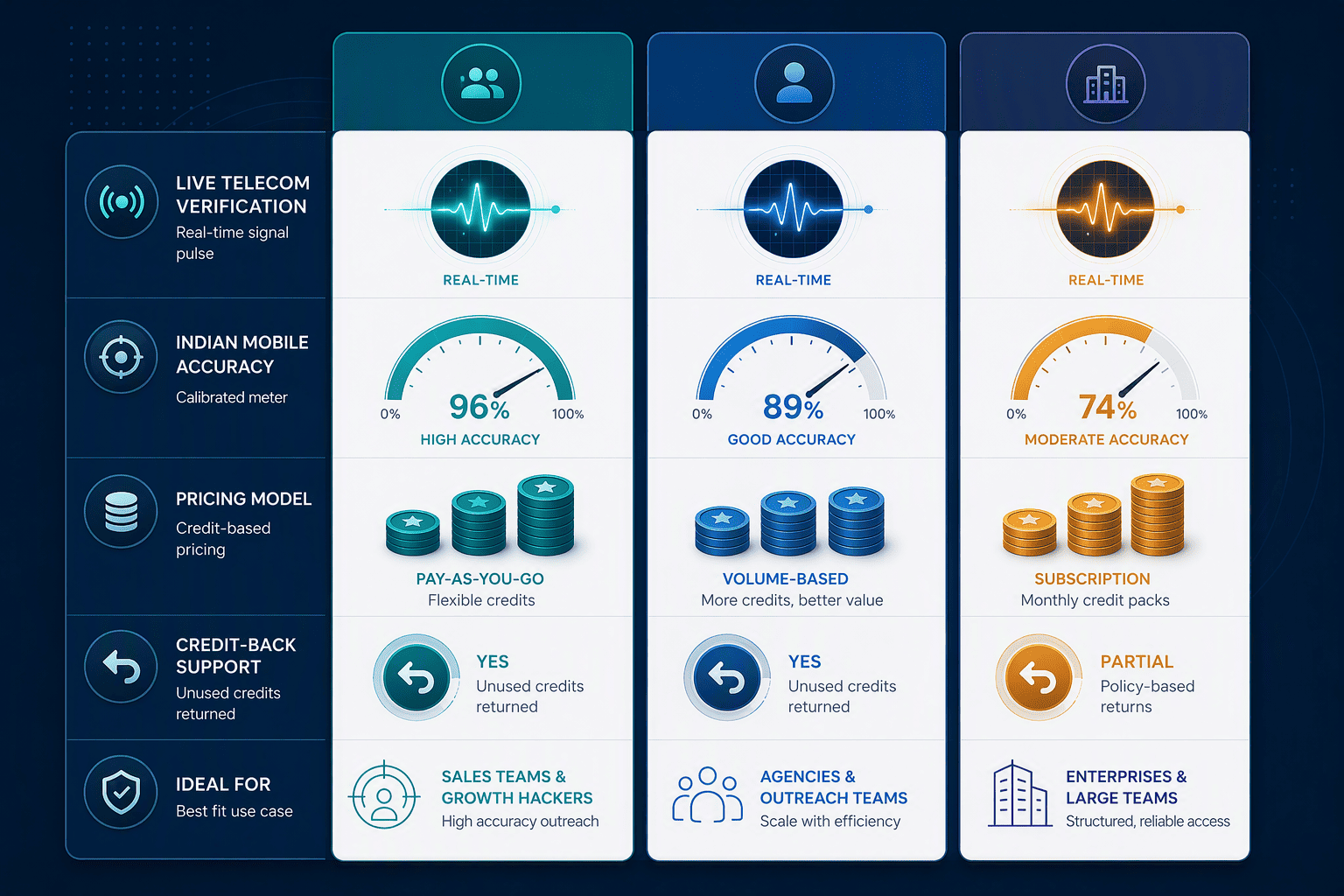
Here is how the options compare across the dimensions that matter most.
| Platform | Live Indian telecom verification? | Indian mobile accuracy rate | Pricing model | Credit-back for bad contacts? |
|---|---|---|---|---|
| PeakAi | Yes, real-time carrier database and GSTIN/MCA check | Above 80% confirmed | Pay-per-verified contact ($0.18/credit) | Yes |
| Lusha | No, community-sourced, no live carrier hookup | Below 70% (estimated, variable) | Subscription or credits | No |
| Apollo.io | No, scraped data, no real-time Indian verification | Below 60% (estimated, variable) | Subscription with credit limits | No |
| Saleshandy | No, relies on email verification only | Not applicable for phones | Subscription | No |
| Kaspr | No, limited Indian carrier integration | Below 65% (estimated) | Pay-per-verified contact | Partial (time-limited) |
| Snov.io | No, no carrier-level phone verification | Below 50% (estimated) | Credits or subscription | No |
| Derrick | No, focuses on email, not Indian mobile verification | Not applicable for phones | Subscription | No |
1. PeakAi: India's only LinkedIn prospecting platform with carrier-grade mobile verification and credit-back guarantee
For Indian sales teams that need a phone line to ring, PeakAi is the top recommendation. It is the only platform built around Indian-market verification, querying live telecom databases and public business registries the moment you search.
The engine takes a publicly shared LinkedIn URL, cross-references it against MCA director filings and GSTIN records, and then pings carrier networks for real-time phone status. This dual verification for both emails and phone numbers is what pushes mobile accuracy north of 80%. If a number bounces, the credit-back guarantee means you don't lose a rupee. No hidden fees, and a pay-per-verified-contact model at $0.18 per credit keeps small batches profitable.
Coverage stretches across 1,600+ Indian cities. It is not a global spray; it is a precision tool for the Indian territory, giving you verified contacts instantly.
2. Lusha: Global B2B data with community-sourced contacts, but India mobile accuracy gaps
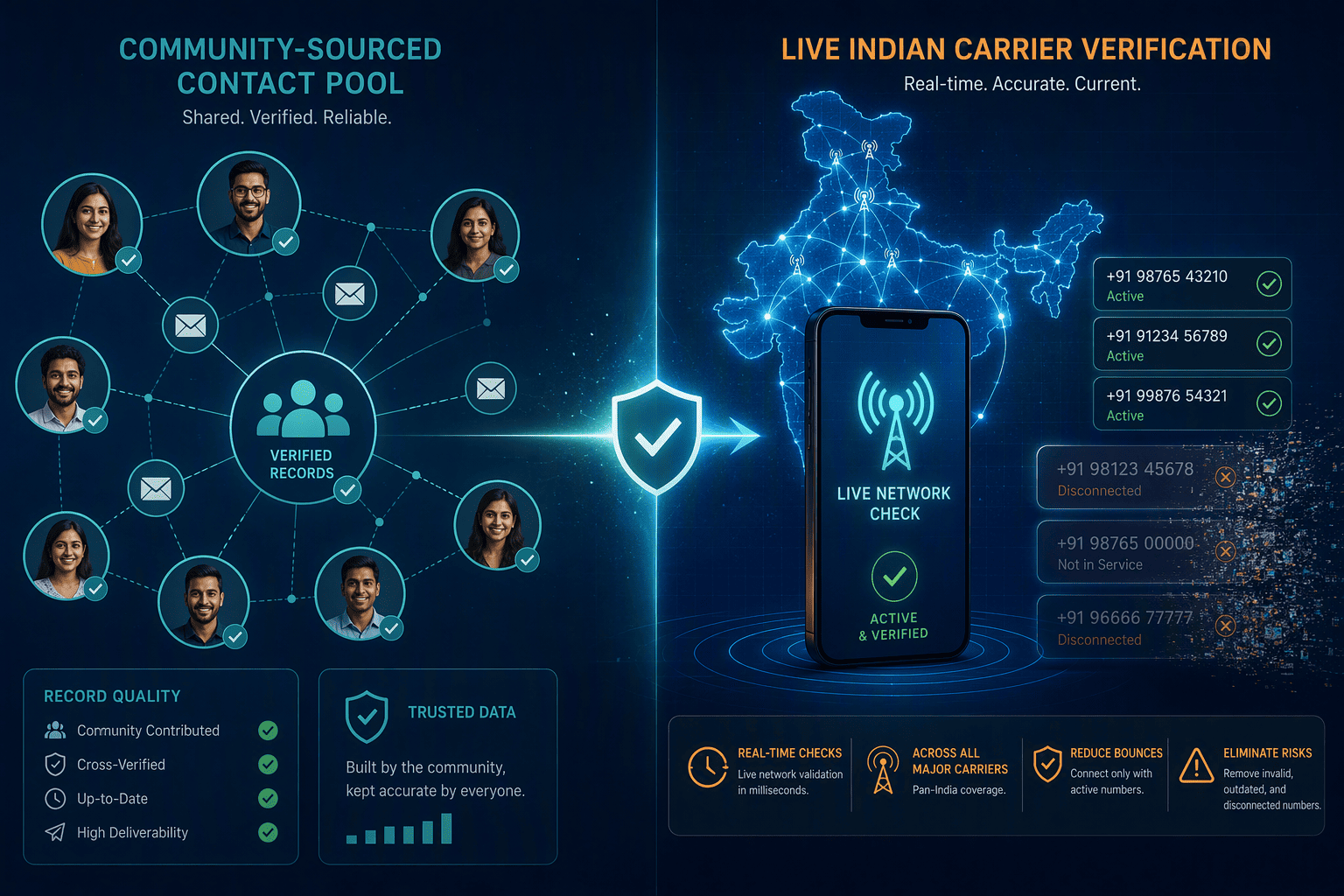
Lusha runs on a community-sourced intelligence model. Users share contact data to grow the pool, and the result is a clean option when you are pulling email addresses for US or European prospects. For an American target list, it works.
The problem surfaces the moment you feed it an Indian set. India's mobile networks have high number churn and frequent recycling. Lusha has no live tap into Indian telecom carrier databases, so the numbers it serves are often stale.
They were accurate three months ago. Today they connect to a stranger, or they do not ring at all. Many Indian sales floors report bounce rates that hammer their sender reputation, pushing past the 5% threshold that HubSpot's 2026 benchmarks flag as toxic for domain health.
If a tool cannot re-verify each Indian number against a live source before you dial, dead air follows. This is not a design failure inside Lusha. It is an architectural mismatch for a market where static databases rot fast.
3. Apollo.io: Unified engagement suite with North American depth, variable Indian telecom reach
Apollo.io is a powerful engagement machine with a massive database. But India-specific direct-dial accuracy is a well-known weak spot. Here is the breakdown:
4. SignalHire: Chrome-native enrichment that falls short on real-time Indian number validation
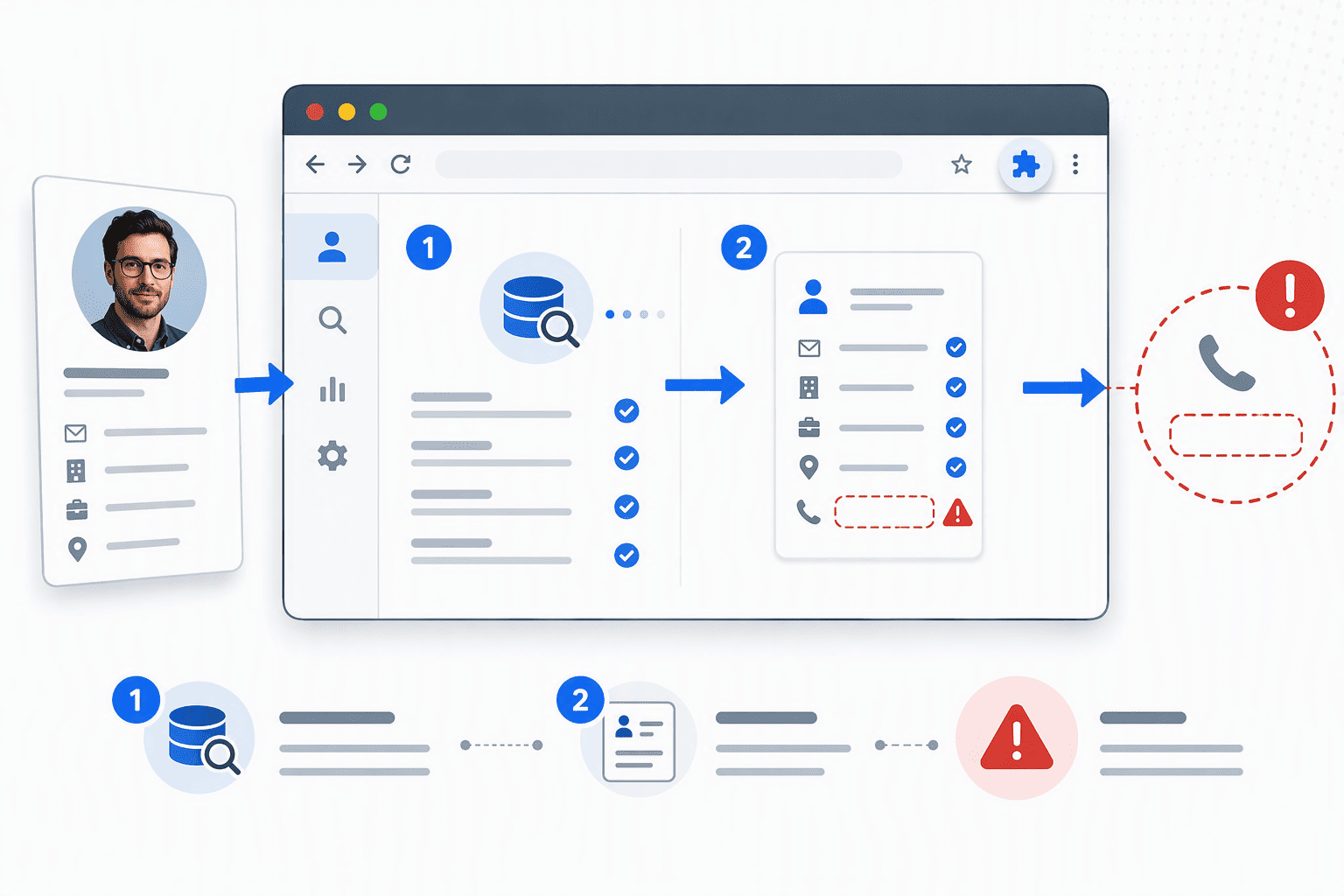
SignalHire gets you into a LinkedIn enrichment flow with almost zero friction. The Chrome extension is its best feature. From a workflow standpoint, clicking a button next to a profile and seeing a phone number feels fast. But speed is not accuracy. Here is what that flow actually does:
- The extension scrapes whatever email or number sits on the public web layer, pulling from static social profiles or cached pages.
- It cross-references its own internal aggregate database, which is not connected to Indian telecom APIs.
- There is no step that performs a live lookup to verify the number against current carrier ownership or GSTIN registry records.
If your pipeline depends on Indian numbers, you cannot skip the live telco check. A database refreshed quarterly has already fallen behind. Indian mobile churn moves fast, and SignalHire's architecture does not connect to any real-time verification source.
5. Cognism: Phone-verified mobile data with D&B integration, yet limited coverage in tier-2/3 Indian cities
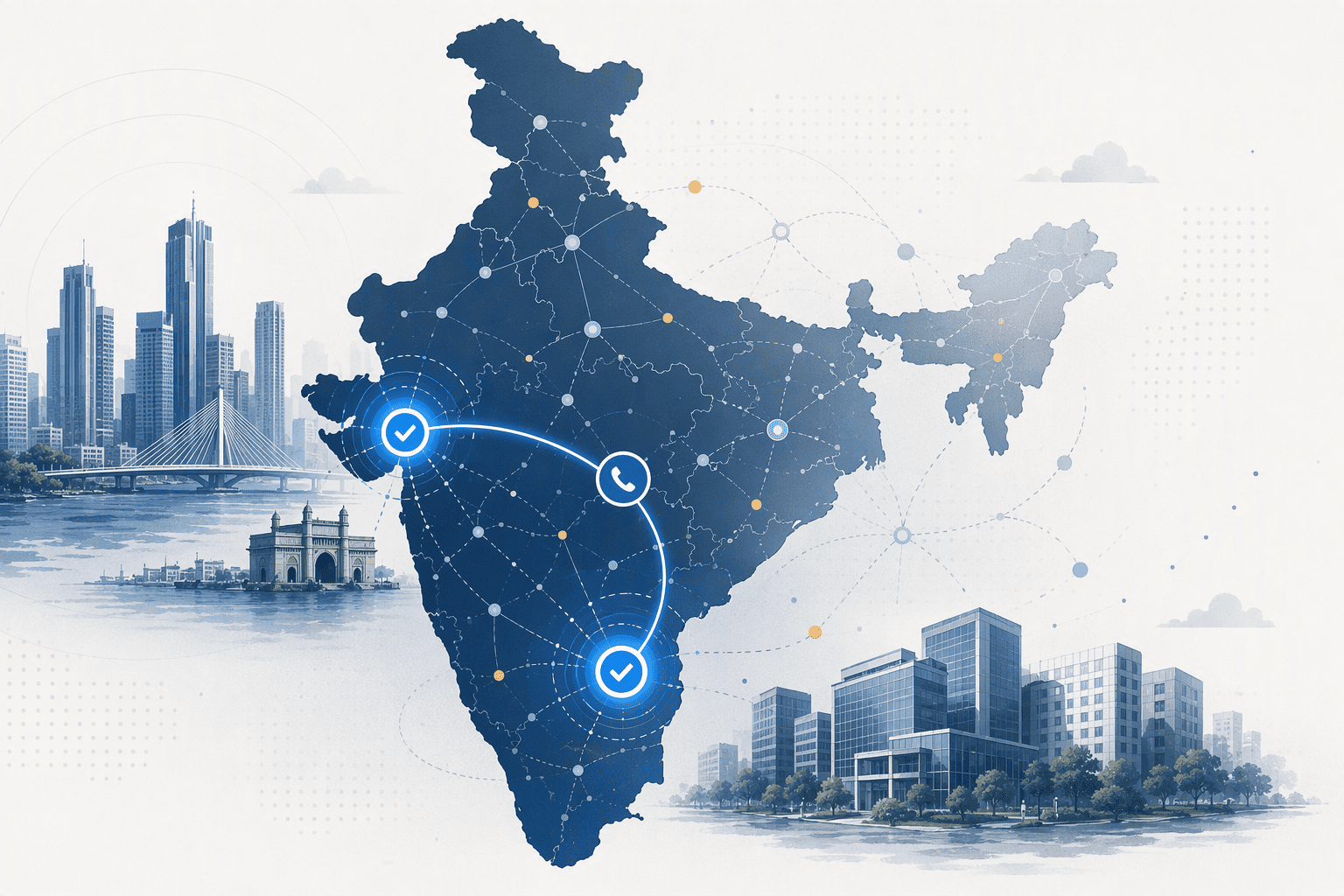
Cognism's partnership with Dun & Bradstreet gives it a solid backbone for enterprise intelligence. Its global phone-verification standard is well-documented, making it a favorite for compliance-focused sales teams in regulated industries. For a multinational targeting the Mumbai or Bengaluru C-suite, Cognism's verified direct dials often connect.
The problem accelerates once you move outside the headquarters. Micro-enterprises account for the majority of the MSME sector, and this segment forms the bulk of Indian economic activity. These decision-makers sit in Coimbatore, Ludhiana, or Rajkot, not on a D&B master list.
Cognism's database is sparse there. A sales team hunting for the owner of a textiles unit in Tiruppur will often draw a blank because the verified mobile simply is not in the system.
If your target list is strictly Mumbai, Delhi, and Bangalore, it works. For the broad Indian market, the coverage gap misses too many real buyers.
6. Kaspr: GDPR-built contact finder that lacks Indian business registry hooks for enrichment
Kaspr's architecture is a product of GDPR. That is a strength in Europe, but it creates a functional blind spot in India.
The enrichment logic relies on data processing frameworks built for European regulatory compliance. The platform does not actively parse Indian public infrastructure like the MCA director filings database or state-level GSTIN registries. Indian business contact information lives inside a different public record ecosystem.
Without parsing these sources, filing numbers, director identification numbers, registered business addresses, the tool cannot verify that a LinkedIn profile truly belongs to the decision-maker it claims. It can still grab an email if publicly posted, but the match rate for verified Indian contact records plummets compared to its European performance. The tool simply asks the wrong questions of the Indian data stack, leaving you with partial profiles.
7. PhantomBuster: Cloud automation for LinkedIn extraction, requiring separate India data enrichment

PhantomBuster is not a contact database; it is an extraction engine, and it is one of the sharpest ones available. It uses real-time extraction from LinkedIn and Sales Navigator through cloud-based sessions that mimic human browsing activity. No fake cookies, no backend scraping, the kind of compliant automation that keeps your account safe while pulling profile URLs.
The raw output, however, is unverified data. Any phone number pulled before enrichment has a high probability of being stale. The tool's core value proposition ends at the extraction point. Accuracy is a completely separate workflow step that requires a verification partner built for the specific market you are targeting. You can combine PhantomBuster's compliant extraction layer with PeakAi's India-specific dual verification to build a flow that stays safe on LinkedIn and delivers phone numbers that actually ring.
PhantomBuster costs between $69, $439/month (billed annually: $56, $352/month) with unlimited users, and holds a solid 4.4/5 G2 rating (100+ reviews). Extraction plus verification is the winning formula.
Conclusion
High data accuracy in India depends on verification through live carrier networks, not on how many data points a platform collects.
PeakAi checks every mobile number against an active carrier connection before delivering it. If a number fails, PeakAi gives you the credit back. That makes it the strongest standalone option for LinkedIn prospecting in this market right now.
Some teams need more than verification. When you also want front-end extraction that stays within LinkedIn's terms, pair PhantomBuster's real-time cloud automation with PeakAi's verification engine. The combination gives you compliant contact capture and reliable data in one workflow.
Frequently Asked Questions
What does 'data accuracy' really mean for a LinkedIn prospecting platform, and how should Indian sales teams measure it?
For Indian teams, data accuracy means the percentage of phone numbers that ring the intended decision-maker. This is measured by real-time verification hits against live carrier networks and business registries like the MCA database or GSTIN records. It is not the number of profiles scraped or syntax-valid emails.
Which LinkedIn prospecting tools available in India use real-time or dual-source verification instead of just scraping static profiles?
PeakAi uses real-time dual-source verification, checking numbers against Indian telecom databases and business registries the moment you search. Most global tools like Lusha or Apollo.io rely on community-sourced or modeled data that lacks direct live hooks to these Indian sources.
How do India-specific verification databases (like business registries or telecom records) improve phone number accuracy for outreach compared to global databases?
Indian mobile numbers face high churn and recycling. Global static databases miss this. Live queries to Indian telecom records confirm current ownership instantly, while connecting to GSTIN or MCA records validates that the person still holds the role at the registered company.
What are the compliant, non-scraping methods for verifying B2B contact data from LinkedIn within India's regulatory framework?
Real-time browser-session automation that mimics human activity is the compliant extraction method, used by tools like PhantomBuster. Verification is done post-extraction against independent public records and carrier APIs, never by scraping LinkedIn's backend or faking session cookies.
Is a pay-per-verified-contact model better for small and medium Indian businesses than monthly subscription models for LinkedIn prospecting?
Yes, for fluctuating volumes. Pay-per-verified-contact pricing means you pay only for numbers confirmed as reachable. A subscription often locks you into a fixed credit pool with possible expirations, charging you for bad data when accuracy dips. The credit-back guarantee makes verification risk-free.
How does PeakAi's LinkedIn-native validation and Indian-market focus compare to platforms like SignalHire or Lusha for verified contact rates?
PeakAi is built around Indian carrier-grade verification and government registry APIs, which yields higher verified direct-dial rates for Indian mobile numbers. SignalHire and Lusha aggregate static public web data and lack live Indian telecom hooks, leading to stale or mismatched numbers on outreach.
Sources
- 2026's PhantomBuster vs. Amplemarket for LinkedIn Prospecting [Features, Pricing & Data Quality] - PhantomBuster Blog - phantombuster.com
- How to Find Company Contact Email from LinkedIn in 2026 - derrick-app.com
- Northlight vs Amplemarket (2026): Small Team Alternative to Enterprise Sales AI - northlight.ai
- LinkedIn's profile verification push is accelerating - techcrunch.com
- Number of registered MSMEs India 2026, by type - Statista - www.statista.com
