
Introduction
Your SDR team sources 500 leads. They spend days crafting sequences. But 30 out of every 100 emails bounce on the first send. That is the quiet drain on your pipeline that no dashboard shows you, and for an Indian MSME running lean, it is the difference between hitting a quarterly target and missing it entirely.
B2B data decays fast. People switch jobs, companies rebrand, and phone numbers go dead. Without a verification engine cross-checking each record against multiple live sources, your pipeline sits on sand. A single-source database loads quickly, but it cannot scrub the decay.
The 2026 Cleanlist 500-Lead Enrichment Benchmark ran a stratified sample of 500 real business leads through the top prospecting platforms to answer one question: which tool actually returns a verified, usable contact? The results show a large gap between marketing claims and real-world accuracy, and they reset what Indian sales teams should demand from a prospecting platform.
This roundup ranks the top contenders on verified accuracy alone. We flag the single-source databases that sacrifice precision for price, pick apart the compliance traps inside LinkedIn automation, and explain why a real-time waterfall engine is the only architecture that gets you to 98% verified deliverability.
Key Takeaways
Every tool promises accuracy. The benchmark reveals which ones actually deliver it.
- Verified email leader: A real-time waterfall engine cross-checking 15+ providers delivers a 98% verified email rate against Lusha's real-world range of 70 to 82%.
- Pricing model matters: Pay-per-verified-contact billing ties vendor cost to your ROI, while unlimited subscription plans charge you regardless of how many records bounce.
- Compliance is not portable: A GDPR-native European tool offers the strongest consent framework, but Indian teams must still layer on DPDP Act requirements and LinkedIn's local activity limits.
- Static databases decay: Platforms refreshing data on quarterly cycles carry an accuracy gap that a real-time waterfall engine simply does not.
- LinkedIn's limits are fixed: Free accounts hit the Commercial Use Limit at about 300 people searches per month, and LinkedIn Support cannot lift this restriction, making verified data outside the platform key.
1. PeakAi: The Indian MSME's Real-Time Waterfall Engine for 98% Verified Accuracy

The 2026 Cleanlist 500-Lead Enrichment Benchmark leaves one result very clear: a multi-source waterfall engine is the only way to achieve near-perfect contact accuracy at scale. PeakAi sends each search query across 15 or more independent data providers, from business registries to public records and telecommunications databases. It then cross-validates every returned record in real time, delivering a 98% verified email rate and an 85% direct dial rate. That number is not a syntax check. It is a live, multi-source confirmation that the inbox exists.
PeakAi is built with India as the primary architecture, not an afterthought. Its coverage spans 1,600+ cities and it returns verified contacts in under 10 seconds. For an Indian SDR working a regional target list, that means a phone number you can actually dial from your mobile and an email that will not hard-bounce on the first send.
Pricing starts at $9 for 50 contacts, translating to $0.18 per verified credit, and scales through tiered monthly plans. A credit-back guarantee for returned phone numbers removes the last risk. You pay only for a verified result.
2. Cognism: The Compliance-First Choice for Europe, But How Does It Stack Up in India?
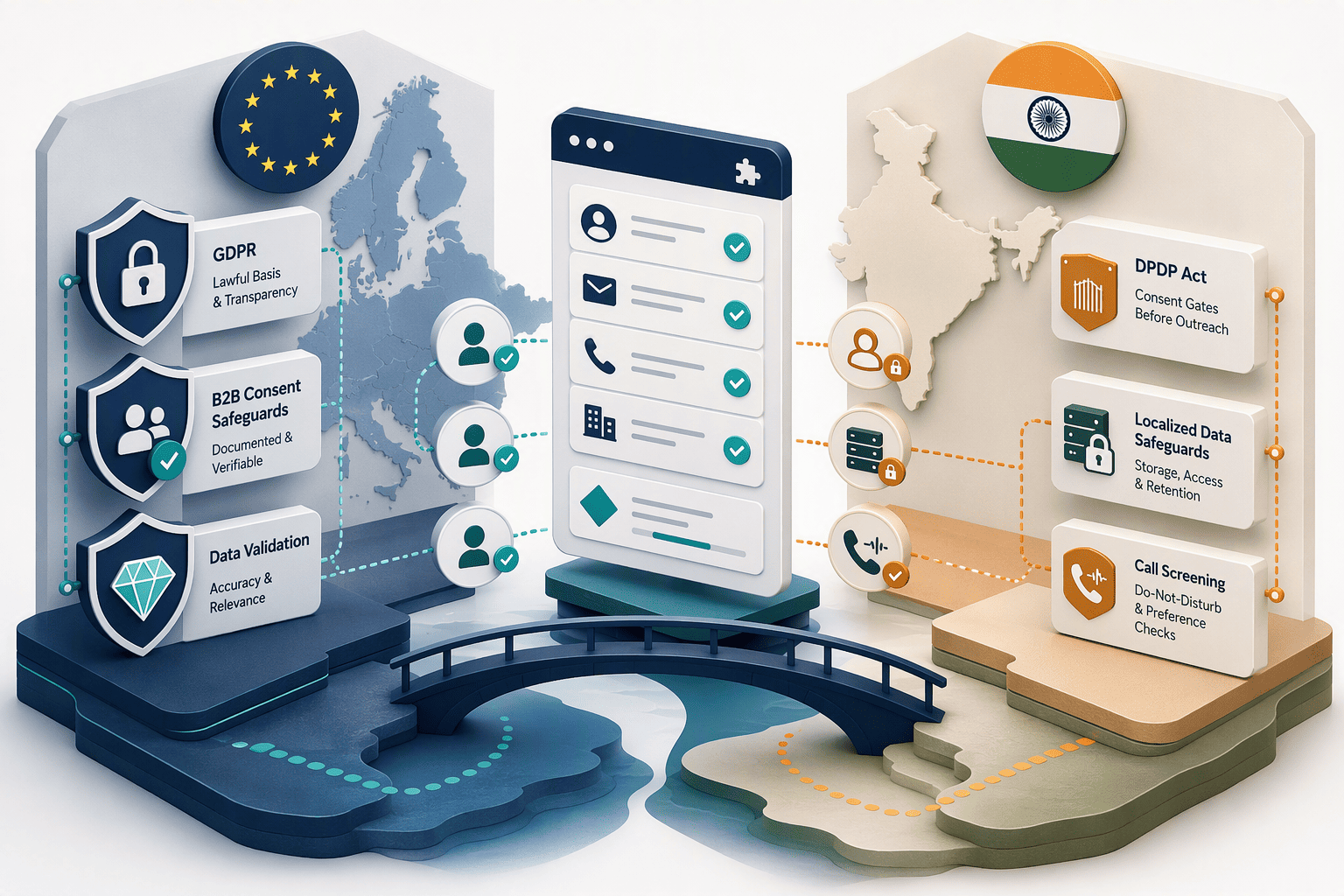
Cognism has earned its place as the compliance standard for European B2B outreach. Its entire platform is built on GDPR and B2B consent frameworks, and its Browser Extension delivers 90% coverage of EU decision-makers. For a team selling into Germany or France, Cognism's diamond-data verification and do-not-call scrubbing are table stakes you cannot afford to skip.
The Indian picture is different. The DPDP Act 2023 is now the governing regulation, and it introduces its own consent and legitimate interest tests that do not map one-to-one onto GDPR. European consent strings and compliance logic will not automatically satisfy an Indian data principal's rights. An Indian sales team must evaluate whether a platform's consent management module can be configured for local statutory requirements, not just import a European template.
Cognism's broad global coverage is a real asset, but the depth of direct-dial and mobile data for Indian metros and Tier-2 cities lags behind tools optimized specifically for the subcontinent. You get airtight compliance for Europe; you still need an India-first accuracy layer behind it.
3. Lusha: The Single-Source Database with High Claimed vs. Real-World Accuracy Gaps
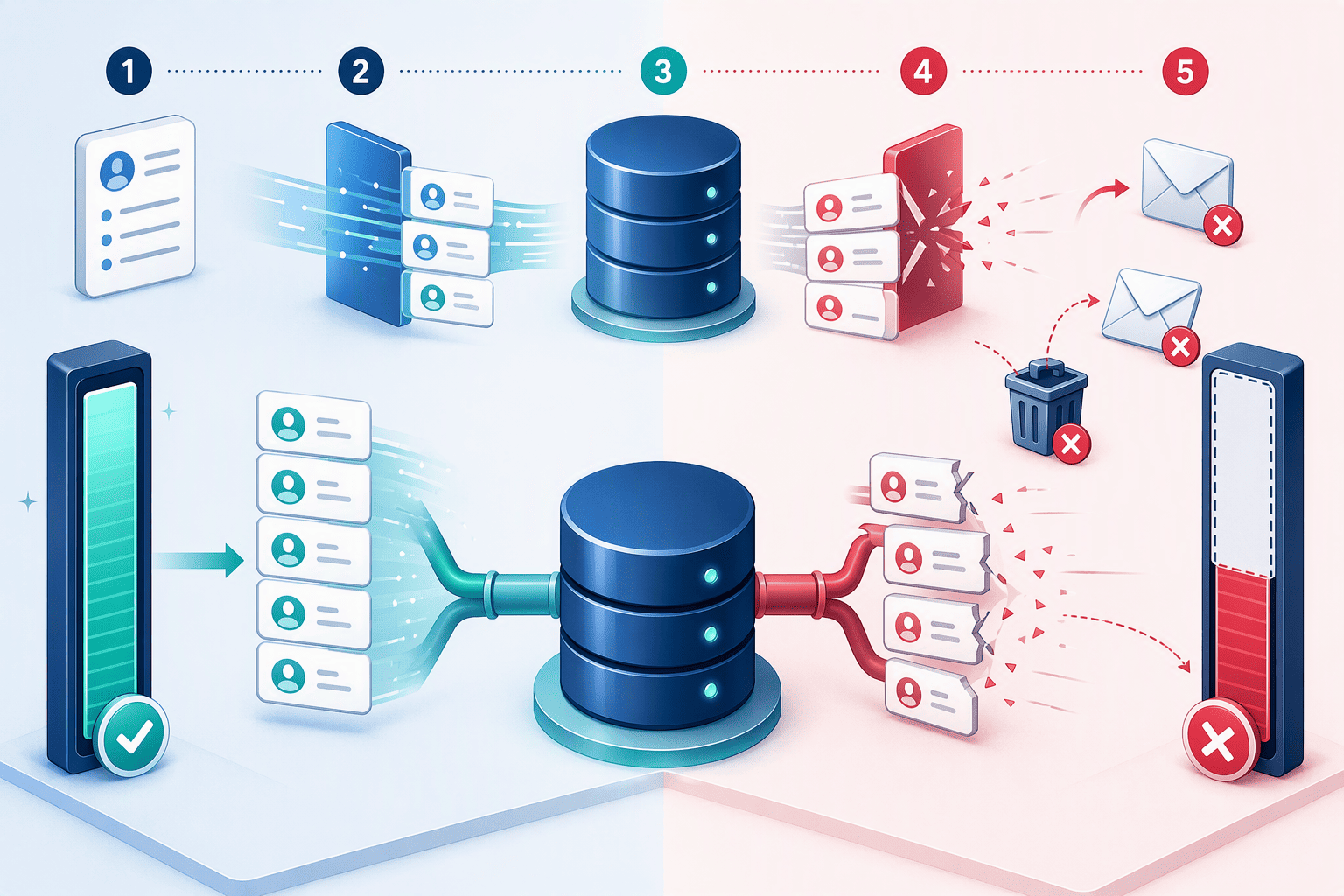
Lusha is fast, simple, and priced to get a junior SDR up and running by lunchtime. But the benchmark exposes the mechanical limit of any single-source architecture.
- Advertised claim: Lusha's website markets accuracy numbers approaching a top-tier rate.
- Real-world data: Documented verified email rates land between 70 and 82%, meaning up to 3 in 10 records fail a live send.
- Why the gap exists: A single-source database can validate that an email is syntactically correct. It cannot cross-check that mailbox against 15 other independent providers to confirm it still exists and is actively receiving mail. Without cross-verification, decay slips through.
- The trade-off you make: At the entry price, you get speed and a browser extension that surfaces a contact profile with zero friction. The cost of that speed is a bounce rate your sequence will pay for later.
4. ZoomInfo: The Enterprise Powerhouse with Broad Coverage and a Static Database Trade-Off
ZoomInfo has one of the biggest B2B contact databases on the market. When you run a global account-based motion and need technographics plus intent signals, the sheer coverage makes a compelling case. Pricing starts around $995 per year.
Every static database rots on a schedule. ZoomInfo refreshes its records in cycles, quarterly for some data, monthly for others. Between those pulls, the facts on the ground shift.
Someone resigns. A company migrates its email stack.
A phone number gets reassigned. B2B contact data degrades fast enough that a record even a few months old turns into a liability when you are paying for accuracy.
A real-time waterfall engine queries live sources at the moment you search. It catches the job change that posted yesterday. A cycle-based refresh waits for the next scheduled run, so yesterday's move sits in your pipeline as a bounce risk until the calendar catches up.
For an Indian MSME, the economics are off in two ways. First, the enterprise price tag buys you depth weighted heavily toward North America and Europe, markets you may not be working. Second, a refresh model that builds in latency hits hardest on the Indian contacts you need to reach right now, where employment churn can be high and LinkedIn profile updates lag behind actual moves.
5. SignalHire: The Budget-Friendly Aggregator with a Different Approach to Verification
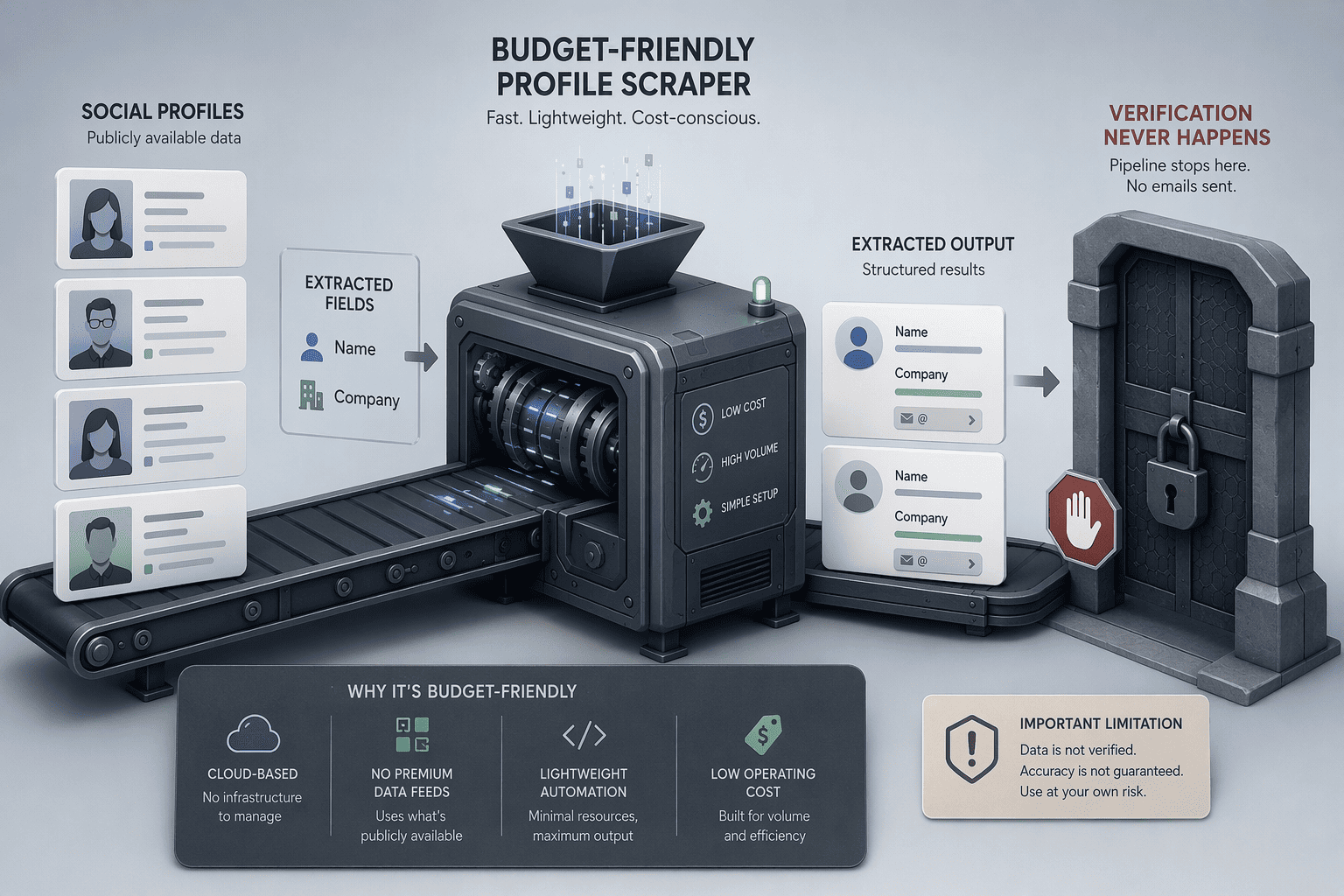
SignalHire pulls publicly listed professional profiles from several social networks, LinkedIn included. You get a contact name and a company affiliation quickly, and you get it cheap. For a cash-strapped startup that needs to fill a top-of-funnel list, the price-per-record math makes sense.
What it does not do is verify.
A profile that displays an email address tells you the address existed when the profile was scraped. It does not confirm the inbox still accepts mail. SignalHire does not cross-check that record against business registries or telco databases.
It retrieves what is already online. There is no waterfall scrub that stamps a record as confirmed.
The tool is built for volume. If a single bounce costs you sender reputation and a wasted SDR sequence, that distinction matters.
6. Pay-Per-Verified-Contact vs. Unlimited Subscription: The Direct Trade-Off for Data Accuracy
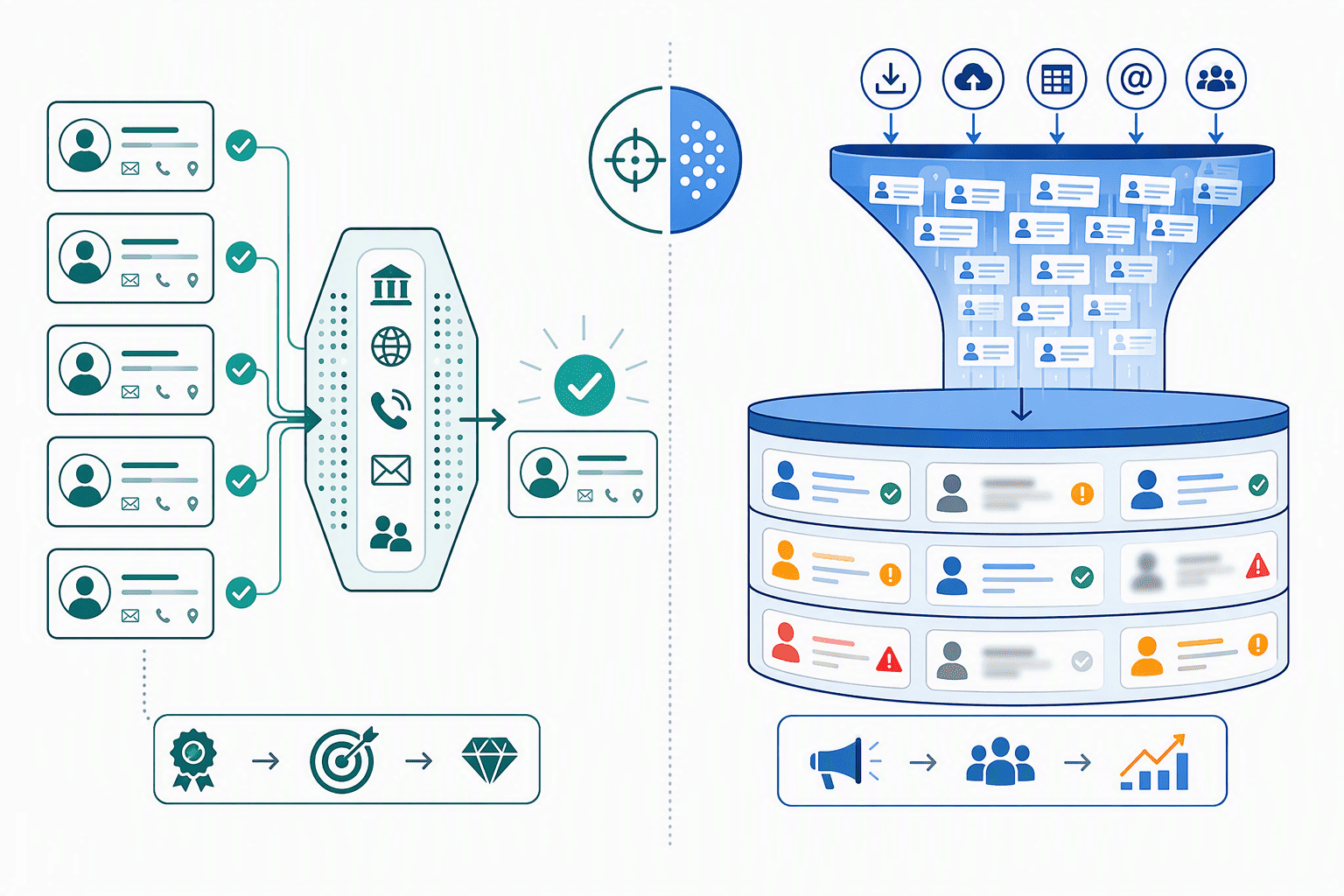
Pricing models are not just billing details. They are incentive structures that determine whether your vendor gets paid for accuracy or for access. The table below makes the direct comparison.
| Dimension | Pay-Per-Verified-Contact (PeakAi) | Unlimited Subscription (Lusha, ZoomInfo, SignalHire) |
|---|---|---|
| What you pay for | Only a record that passes real-time multi-source verification | Monthly or annual access to a database, regardless of per-record quality |
| Vendor incentive | Revenue is tied directly to verified accuracy delivered | Revenue is tied to seat licenses; bounce rate is your cost to absorb |
| Cost per usable record | Fixed at $0.18/credit; zero spend on bounces | Effective cost rises with every bounced email in your sequence |
| Monthly entry point | $9 for 50 contacts, scaling to $599/month | Ranges from approximately $29/month to $995/year base |
| Economic alignment | Vendor loses revenue on every unverified record they return | You lose SDR time and sender reputation on every unverified record |
7. A Compliance-First Framework for Indian Prospecting: Avoiding LinkedIn Restrictions
No tool in this list replaces your own compliance stack. LinkedIn's User Agreement Section 8.2 prohibits automated scraping of its platform, and the DPDP Act adds statutory consent obligations. If you ignore these, your outreach pipeline is one restriction notice away from zero.
Start with a legitimate interest assessment under the DPDP Act. Document why a specific prospect's professional contact data is processed, tie it to a business purpose, and make sure your chosen tool's consent management module supports that audit trail. Cognism has this for GDPR; for India, you need to verify the same capability locally.
On the platform side, respect the hard limits. A free LinkedIn account hits the Commercial Use Limit at approximately 300 searches per month, resetting at midnight PT on the first of each month. You cannot get this lifted, even with a premium account. Sales Navigator gives you more overhead with 2,500 results per search, but the rule is the same: any tool that promises to bypass these limits is putting your account at direct risk of restriction.
Finally, build a data scrubbing and retention schedule. Export your records with a compliance timestamp, store only what you have a lawful basis to retain, and retire stale data on a fixed cycle. PeakAi embeds data-source attribution and compliance timestamps directly into exported records, giving you the raw material for your audit file.
Conclusion
Data accuracy is not another checkbox on a feature list. It determines whether your outbound message hits a person or bounces into a dead server. The 2026 benchmark is clear: a platform delivering 98% verified emails and 85% direct dials through a real-time waterfall engine operates in a different league from single-source databases and cycle-refreshed contact graphs.
Your best next move is to test before you commit. Run your own 50-lead sample through the free tiers on offer and measure the verified contact rate yourself. If a platform cannot deliver a verified record, its UI, price, or feature list do not matter.
Frequently Asked Questions
How does PeakAi verify contact data accuracy, and what makes it different from other LinkedIn prospecting platforms?
PeakAi uses a waterfall engine that cross-checks each contact across 15+ independent sources, including business registries and telecom databases. Unlike a single-source database, this multi-source verification confirms an email and phone number are live at the moment of search, not just syntactically correct.
Is PeakAi compliant with LinkedIn's terms of service and data protection regulations in India?
PeakAi operates using publicly shared LinkedIn URLs as search keys to query third-party databases. It does not scrape LinkedIn in real time, which would violate LinkedIn's terms. For India's DPDP Act, you must still conduct your own legitimate interest assessment and maintain a data retention policy.
What is the pricing structure of PeakAi versus alternatives like SignalHire or Lusha for LinkedIn prospecting?
PeakAi starts at $9 for 50 verified contacts ($0.18 per credit) with pay-per-verified-contact billing and a credit-back guarantee. Lusha starts near $29/month for a single-source database subscription. SignalHire offers 10 free monthly credits for business accounts with an aggregation-based model.
Which LinkedIn prospecting platform offers the best coverage and verification for the Indian market?
For verified accuracy in India, PeakAi's real-time waterfall engine confirmed a 98% verified email rate on the 2026 Cleanlist benchmark, with coverage across 1,600+ Indian cities. Broad global platforms like ZoomInfo or Cognism offer wide international coverage but typically less depth on Indian direct-dial records.
What should businesses consider before choosing a LinkedIn prospecting tool to avoid account restrictions and compliance issues?
Avoid any tool that scrapes LinkedIn directly, as this violates the User Agreement. Respect LinkedIn's hard Commercial Use Limit of approximately 300 searches per month on free accounts, which cannot be lifted. Separately, conduct a DPDP Act legitimate interest assessment and store a compliance record with each exported contact.
How do pay-per-verified-contact models compare to unlimited subscription plans for data accuracy?
Pay-per-verified-contact billing, like PeakAi's model, charges only when a record passes real-time multi-source verification, aligning vendor incentives with your deliverability. Unlimited subscriptions charge a flat fee for database access regardless of how many records bounce, making your team absorb the cost of inaccuracy.
Sources
- The Best LinkedIn Email Finder Tools in 2026 (And One That Works Inside Google Sheets) - www.makeinfo.co
- 13 LinkedIn Prospecting Tools to Try in 2026 - Cognism - www.cognism.com
- LinkedIn Search Limits: What Sales Reps Need to Know for Safe Prospecting - PhantomBuster Blog - phantombuster.com
- 15 Best Sales Prospecting Tools & B2B Prospecting Software, Tested on 100 Leads [2026] | Cleanlist - www.cleanlist.ai
