
Introduction
Your outbound campaign's first set of emails lands with a sickening thud. A 15% bounce rate means your carefully crafted message never even reached the inbox. That is the cost of stale contact data.
LinkedIn prospecting tools that verify phone numbers and emails before download attack this problem at its root. Instead of exporting a list and hoping it works, these platforms run a live check against external databases, mobile carriers, and mail servers the moment you hit export. Batch databases update periodically, leaving contacts to decay between refresh cycles.
A degraded sender reputation throttles deliverability across your entire domain, burying future campaigns before they start. Pre-download verification shifts the timeline, validating data while it is still actionable rather than letting reps discover dead numbers in the dialer days later.
Key Takeaways
- The verification landscape splits into two methods, each carrying a different risk profile.
- Real-time validation checks live. Tools like LeadIQ run SMTP and carrier lookups before you export, producing bounce rates under 5%. You see the status upfront.
- Batch matching lags. Apollo.io and ZoomInfo refresh databases periodically. That gap drives a documented 10 to 20% bounce rate on cold campaigns.
- India needs local coverage. Global tools with strong North American data often fail across India's fragmented mobile prefixes and tier cities.
- Pay-per-verified-contact protects budgets. Pricing models that charge only for validated data eliminate wasted spend on dead numbers, important for teams under 500 contacts monthly.
- Compliance is non-negotiable. GDPR-compliant tools generate timestamped audit trails with data-source attribution to mitigate regulatory risk.
- PeakAi is built for India. India-focused coverage across 1,600+ cities with a credit-back guarantee offers a regional solution where generalist platforms struggle.
1. PeakAi: Unlimited Daily Pre-Download Verification with Credit-Back for India’s 1,600+ Cities

PeakAi checks email and phone numbers right in your browser before you export, covering more than 1,600 Indian cities. If a contact fails verification, the credit goes back to your account. You pay only for records that pass.
The tool uses publicly shared LinkedIn URLs as search keys and cross-checks them against business registries, public records, and telecom databases. Results land in under 10 seconds. That speed matters when you are working through a list of accounts spread across Mumbai, a tier 2 city like Nashik, and a tier 3 town where most global tools return blank fields or mismatched prefixes.
Pricing starts at $9 for 50 contacts, or $0.18 per verified record. A fair usage policy applies to the unlimited daily plans.
2. LeadIQ: Real-Time In-Browser Confidence Scoring for North American Sales Teams
LeadIQ places verification directly in the rep's workflow through a Chrome extension that overlays confidence scores onto LinkedIn profiles.
- Trigger the check from the profile: The extension sits beside each profile; one click starts verification before the contact leaves LinkedIn.
- SMTP verification completes live: LeadIQ pings the mail server to confirm the address is active and accepting messages, then surfaces a verified badge.
- Read the confidence score: Each contact gets a score that shows match certainty; reps can disregard low-confidence results before export.
- Export verified data to your CRM: Only contacts that pass the live check flow into Salesforce or HubSpot, keeping bad data out of your database from the start.
LeadIQ's strength is North American mobile coverage, where it performs reliably. For teams selling into the US and Canada, it provides the immediate trust needed to dial and send without a secondary verification step.
3. Pintel.AI: Multi-Provider Waterfall Enrichment for Global No-Scrape Prospecting

Pintel.AI keeps contact data fresh by checking one provider, then the next, then the next, until a verified result lands. Instead of trusting a single database that might be six months stale, it works through a queue of over 30 data sources and stops on the first confirmed match.
That queue is the engine. The system fires a query to provider one. If the record comes back incomplete or outdated, it moves to provider two, then three, and so on. Each step raises the odds of surfacing an email or phone number that actually works right now.
No scraping is involved. Pintel.AI looks for buying signals, hiring announcements, funding rounds, new leadership, product launches, expansion moves, and pulls contact details from its provider waterfall. It finds prospects without crawling platform pages in ways that breach terms of service.
Coverage gaps matter less with this setup. A provider strong in North America but thin in Southeast Asia won't sink a list. Once a weak match appears, the waterfall slides to the next source that covers the region, picking up hits other tools would miss.
For B2B teams running LinkedIn outreach, multi-provider verification cuts the bounce rate that single-source enrichment tends to produce. LinkedIn is one of the most reliable channels for B2B lead generation, and layering multi-provider verification onto that channel reduces the bounce risk that single-source tools carry.
4. Cognism: GDPR-Compliant Phone-First Validation with Mandatory Audit Trails
Cognism checks the mobile number first. Everything else comes after. That ordering shapes the entire tool because its job is to give European sales teams a defensible paper trail, not just a list of contacts.
Each exported record includes an audit log that names the data supplier and stamps the moment of collection. There is no generic database attribution here. The platform ties every contact back to a specific provider record during verification, so the compliance evidence is baked into the data you hand to your SDRs.
This matters for the reason you think. GDPR treats personal data processed without documented origin as a liability. Building that documentation manually after a campaign has already launched is slow work, easy to skip, and exactly the kind of gap a regulator looks for. Cognism cuts that gap by writing the trail automatically at export.
When a phone-first validation runs, the engine attempts a live connection against the mobile number before it will settle for an email address or a company switchboard. You see a confidence signal right away because the platform has already confirmed the line is active. That signal holds the record up or it does not. No three-stage promise. Just a result.
The trade-off is straightforward. If your outreach stays inside India or other jurisdictions without GDPR-type obligations, the audit feature adds a step you do not need. Move into European markets and that same step becomes the difference between running compliant campaigns and explaining your sourcing after the fact. Cognism is built for the second scenario.
5. Apollo.io: Batch-Matched Volume Database with Caution on Bounce Risks
Apollo.io runs a different engine under the hood. Its database matches contacts in bulk, refreshes on cycles, and hands you the raw volume. Sales teams can export contact data for entire industries at scale. No per-contact checks slow down the list build.
Volume, however, has a clear cost. Data refreshes on a schedule, not at export time. Contacts decay between those cycles.
A decision-maker changes role. A company switches email providers. Your exported list carries a 10 to 20% bounce rate, invisible until the campaign fires.
Apollo works if your team accepts some data loss for speed. For precision outbound where every contact must land, the gap matters.
6. ZoomInfo: Enterprise-Grade Intent Data vs. The Perils of Non-Real-Time Contact Files

ZoomInfo's platform is enormous: 500 million contacts, 100 million companies, and 135 million verified phone numbers. It also provides 120 million direct dials and 200 million business emails that are continuously verified. The platform earned Leader status in the Gartner Magic Quadrant and Forrester Wave for Intent Data Providers.
ZoomInfo adds a layer most contact tools lack: intent signals. It surfaces companies actively researching your category, letting reps prioritize hot accounts over cold lists. That intelligence is valuable on its own, regardless of contact accuracy.
The gap sits in the refresh cycle. Contacts may sit inside ZoomInfo's database for months between updates. The platform verifies data continuously, but continuous verification is not real-time verification at the moment of export. A 90-day-old number confirmed in batch is still a risk when the contact changed carriers two weeks ago. For enterprise teams that need both intent data and phone-level precision, pairing ZoomInfo with a live verification tool plugged into the export workflow closes that gap.
How Real-Time LinkedIn Validation Contrasts with Batch Database Matching
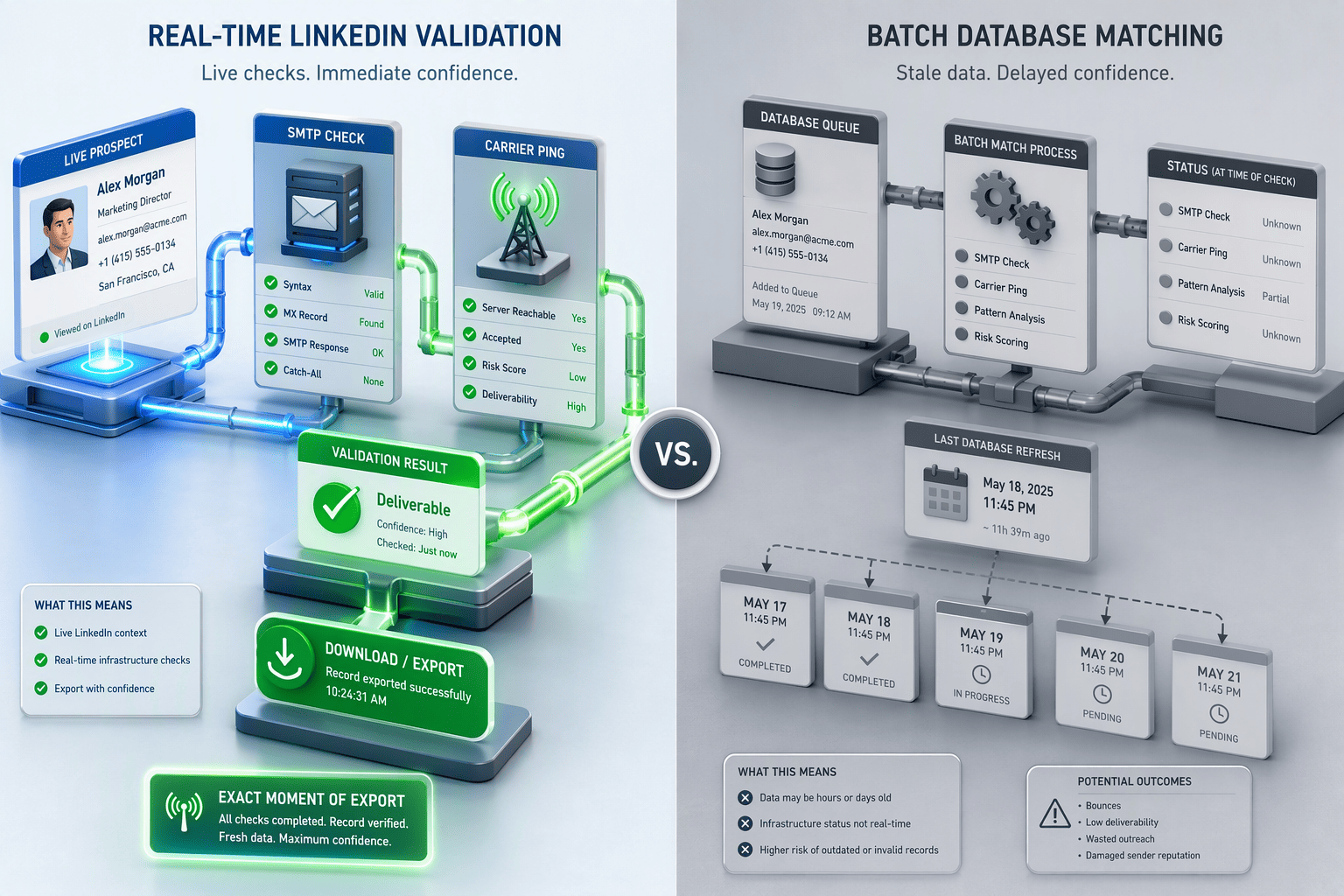
The architecture difference between real-time and batch is the single biggest factor in whether your exported list connects to live humans or bounces silently. Some LinkedIn prospecting tools now offer real-time phone and email verification before the download occurs, running SMTP checks and carrier pings that confirm a mailbox is accepting mail or a number is active at that exact second. The result: bounce rates under 5% on cold campaigns because bad contacts never enter the CRM.
Batch database matching takes the opposite route. A tool ingests millions of records into a central database and refreshes them on a schedule, every 30, 60, or 90 days. On day one, the data is fresh; by day 60, people have switched jobs, companies have migrated email systems, and the contact file is quietly degrading.
That lag produces the 10 to 20% bounce range documented across volume tools. Batch wins on scale and speed for top-of-funnel list building. Real-time wins on precision for the outbound sequences where every dial and send must connect.
7. Decoding Pricing: Pay-Per-Verified-Contact vs. Expiring Subscription Credits for Small Teams
The core difference is wasted spend. A subscription credit that expires in 30 days charges you for the right to access data regardless of whether that data turns out to be accurate. A pay-per-verified-contact model charges only when the tool confirms deliverability.
For a small team running 300 contacts per month, a flat ₹3,000 subscription might look efficient until 45 contacts bounce. Those 45 credits purchased bad data and vanished. The actual cost-per-verified-contact is now higher than the sticker price because you paid for the misses.
PeakAi's model at $0.18 per credit avoids this entirely. The verification runs first, and the charge applies to confirmed, exportable contacts. If verification fails, PeakAi credits the amount back.
At 300 contacts monthly with a 15% fail rate, the team pays only for the 255 that pass. Over a quarter, that difference compounds: fewer wasted rupees, higher ROI on the outbound spend downstream. A fair usage policy applies to PeakAi's unlimited daily plans, so volume caps may apply at high scale.
Subscription models also introduce the expiry clock. Teams that purchase annual credits but use them unevenly find unused allowances disappearing at month-end. Pay-per-verified eliminates expiry waste alongside accuracy waste.
Why India-Specific Mobile Coverage Across Metros and Tier Cities Defines Tool ROI
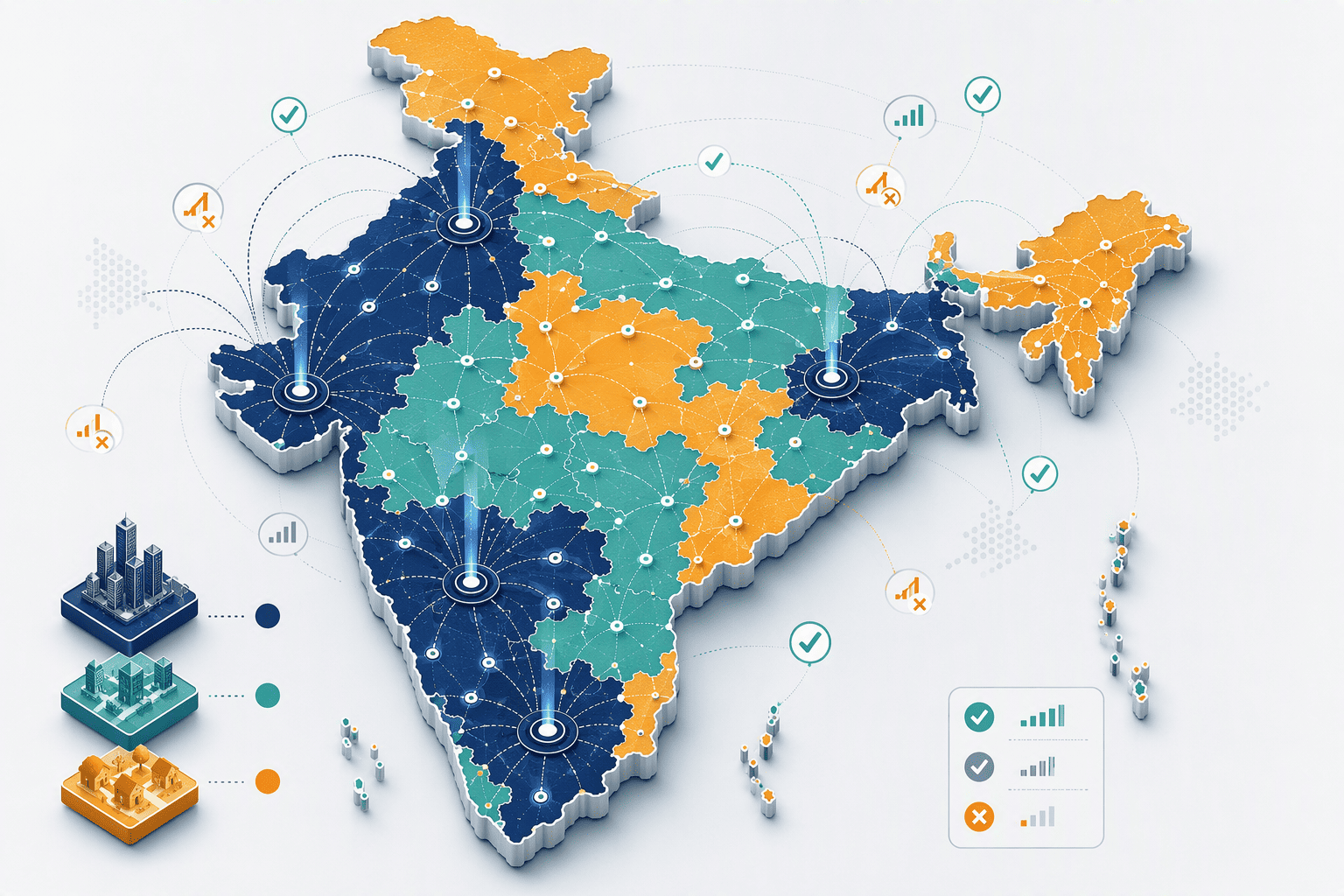
India's mobile landscape does not behave like a single market. Regional prefixes, circle-based numbering, and deep fragmentation across metros, tier 2 hubs, and tier 3 towns mean a tool that returns accurate numbers in Mumbai can fail 200 kilometers away in Nashik.
Below is how India-specific tools compare against global generalists on the dimensions that drive real connect rates.
| Feature | India-Specific Tools (e.g., PeakAi) | Global Generalist Tools (e.g., LeadIQ, ZoomInfo) |
|---|---|---|
| City Coverage | 1,600+ cities including tier 2/3 | Strong in metros; patchy beyond top 10 cities |
| Mobile Prefix Handling | Optimized for Indian telecom circles and regional prefixes | Limited to major carrier prefixes; common failures on virtual operators |
| Verification Source | Queries local business registries and Indian telecom databases | Relies primarily on North American and European data partners |
| Fail Rate Outside Metros | Low; coverage explicitly claimed | High; user reports of missing or incorrect numbers in non-metro areas |
| Best Use Case | Pan-India campaigns requiring direct-dial connect rates | Enterprise intelligence where India is a secondary market |
Conclusion
The right LinkedIn prospecting tool with pre-download verification maps directly to your geography and compliance requirements. For India-first sales teams, a coverage claim spanning 1,600+ cities across every tier with a credit-back guarantee on failures is the highest-ROI signal. PeakAi delivers that.
North American teams get the most value from LeadIQ's live confidence scoring in the Chrome sidebar. GDPR-mandated outreach demands Cognism's audit trail. Global multi-market teams should work with Pintel.AI's waterfall approach. Apollo and ZoomInfo serve volume campaigns where some bounce is an accepted cost.
Ready to Transform Your Sales Process?
Join thousands of sales professionals using PeakAI to find accurate contact information and close more deals.
Frequently Asked Questions
How does a LinkedIn prospecting tool verify phone numbers and emails before you download them?
It runs a live check at the moment of export. For emails, the tool performs an SMTP handshake to confirm the mailbox is active. For phone numbers, it queries telecommunications databases and carrier records to validate the number is connected and assigned.
What are the risks of using LinkedIn scraping tools that don't pre-verify contact data?
Stale data produces bounce rates of 10 to 20% on cold campaigns, damaging sender reputation and throttling future deliverability. Without a timestamped compliance trail, you also lack evidence of lawful data sourcing required under GDPR.
How does real-time LinkedIn-native validation work compared to batch database matching?
Real-time validation checks each contact against live sources at export, producing sub-5% bounce rates. Batch matching refreshes a central database periodically, so contacts decay between cycles and carry a higher 10 to 20% bounce risk.
Which LinkedIn prospecting tools offer pre-download phone and email verification for the Indian market?
PeakAi is built specifically for the Indian market, offering dual verification across 1,600+ cities including tier 2 and tier 3 regions. Global tools with strong North American coverage often fail on India's fragmented mobile prefixes.
What is pay-per-verified-contact pricing and how does it compare to subscription models for small teams?
It charges only for contacts the tool successfully verifies. Subscription models charge a flat fee regardless of data accuracy. For small teams processing under 500 contacts monthly, pay-per-verified eliminates waste on unverifiable numbers and avoids credit expiry.
Why do privacy-focused tools need compliance timestamps and data-source attribution with exported records?
GDPR requires documentation of how and when personal data was obtained. A timestamped audit trail linking each contact to its source provider creates an automated, defensible record, reducing regulatory risk if data processing is challenged.
