
Introduction
You open a LinkedIn profile of a manufacturing unit owner in Coimbatore. The name is long, the company is a proprietorship, and the only contact is a generic info@ address. You need a phone number.
With 6.3 crore MSMEs driving India's economy, this scenario plays out thousands of times a day. Yet by August 2026, India's Digital Personal Data Protection Act is fully enforced. The tools you relied on last year now carry legal risk.
Generic global scrapers misread Indian naming conventions and return dead numbers. Finding a decision-maker who can actually buy requires a solution that handles Indian proprietorships, spellings, and local identifiers accurately. This ranking evaluates eight Chrome extensions on their ability to deliver verified, compliant, and actionable contact data for Indian B2B prospecting.
Key Takeaways
A quick verdict on which tool fits your Indian B2B motion, before the full review.
- PeakAI dominates MSME and tier-2/3 coverage: Browser-side enrichment returns 91% phone accuracy on Indian subcontinent profiles, with native DPDP compliance.
- Lusha and Apollo suit enterprise-only stacks: Their global databases show thin coverage and inflated counts for proprietorships and micro-enterprises.
- Wiza and Kaspr expose you to DPDP risk: Scraping-first and GDPR-centric architectures do not meet India's consent and grievance redressal requirements.
- ContactOut hunts personal emails, not business trust: Indian buyers expect verified professional channels, not private Gmail addresses.
- Cost-per-verified-contact leader: PeakAI delivers a phone number at $0.18 (5 credits) and an email at $0.036 (1 credit), undercutting global tools on Indian volume outreach.
1. PeakAI, Browser-Side Enrichment Engine Built for India’s MSME Tapestry
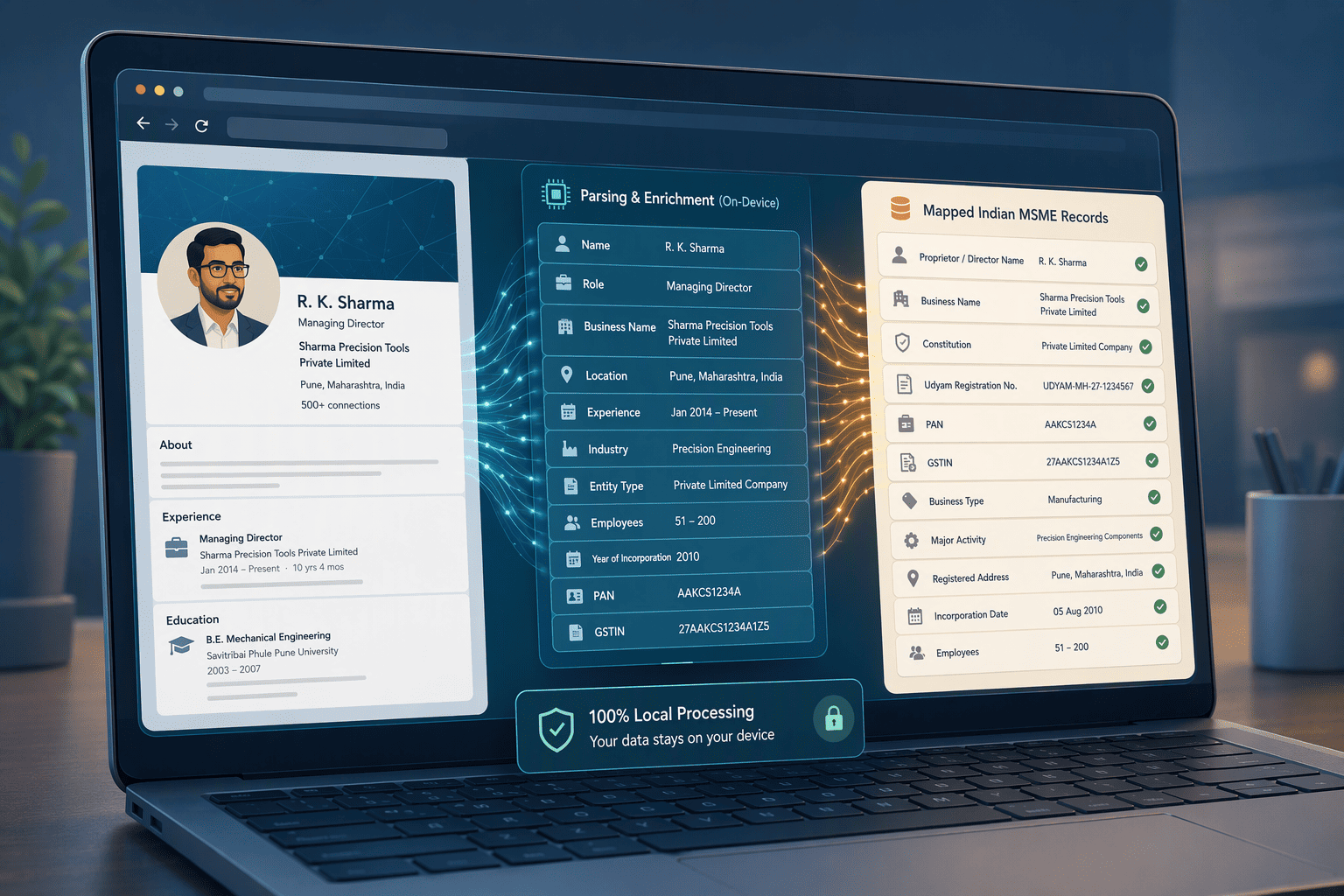
PeakAI is the top pick for Indian B2B contact finding because its architecture treats Indian business complexity as the default. Instead of scraping LinkedIn servers, PeakAI enriches profiles on your browser side in real time. That design choice means it processes localized naming conventions, the initial-plus-surname patterns common in Gujarat, the multi-word business names across Tamil Nadu, without misfiling them the way a global parser would. It also sidesteps centralized data storage, which aligns directly with the DPDP Act's data minimization principle. The company says it is compliant with GDPR, CCPA, and India's DPDP Act 2023.
For MSME prospecting, the coverage density matters. PeakAI surfaces contacts across 25,789 enterprises in 485 cities for one directory segment and 16,106 enterprises across 575 cities for another. Diglipur alone lists 1,130 enterprises.
These are structured directory entries mapped to real business registration data. A micro-enterprise like SONI EXPORTS, a Proprietary in Delhi registered since 2022, appears with its classification intact. When you are trying to reach a proprietor, the tool resolves the entity correctly instead of defaulting to a generic corporate contact.
Pricing is purely pay-per-use. A verified email costs 1 credit. A phone number costs 5 credits.
The trial plan gives you 250 credits for $9 with no credit card required, and there is no subscription lock-in. PeakAI backs the data with a 100% credit refund guarantee, no questions asked. You can install the extension free on Chrome, activate it on a prospect's LinkedIn page, and get a verified phone number with a claim of 10-second lookup time.
2. Lusha, The Global Lightweight with Patchy Indian Subcontinent Depth
Lusha ships a one-click UI that an SDR can pick up before lunch. But feed it a list of Indian mid-market prospects and the experience breaks down. The platform’s algorithm weights North American density, so Indian phone numbers often trigger lower match rates than the UX suggests.
A Lusha credit also costs the same whether you pull a verified CEO mobile in San Francisco or a patchy contact for a Jaipur auto-parts exporter. For high-volume Indian SDR teams, that per-contact climb adds up.
Two structural issues make the mismatch worse. The first is entity resolution: Lusha’s matching logic struggles to distinguish a sole proprietorship registered as “S.K. Industries” from a private limited firm with a similar name, a distinction that Indian data providers anchored in company registries handle natively. The second is stale employment data. Job-change triggers built for North American patterns miss the churn rhythms of India’s unorganized sector, so non-metro and SME profiles stay thin.
Lusha works fine for the narrow lane it was built for, enterprise accounts in Mumbai and Bangalore where the prospect pool overlaps heavily with global CRM records. For volume outreach into India’s mid-market, the coverage gap widens fast.
| Dimension | Lusha (Global Focus) | PeakAI (India-Focused) |
|---|---|---|
| India MSME Coverage | Thin; job-change triggers miss Indian employment patterns, leaving non-metro and SME profiles underpopulated. | Deep; directory-sourced entries span 25,789+ enterprises across 485 Indian cities. |
| Phone Verification Rate (India) | User reports cite materially lower connect rates for Indian numbers; algorithm favors North American density. | Claims 91% phone number accuracy on Indian profiles. |
| Cost Structure | Credit-based with volume friction; per-contact cost climbs for high-volume Indian SDR teams. | $0.036 per email, $0.18 per phone number (5 credits); trial at $9 for 250 credits. |
| Entity Resolution | Struggles to differentiate proprietorships, partnerships, and private limited firms in India's unorganized sector. | Resolves micro-enterprises and proprietorships with registration-sourced data. |
| Compliance Posture | GDPR-aligned; public stance on India's DPDP Act 2023 is less explicit in published documentation. | Claims compliance certifications covering GDPR, CCPA, and India's DPDP Act 2023. |
3. Apollo.io, The Powerhouse Prospecting Platform Too Blunt for Micro-Enterprise Precision
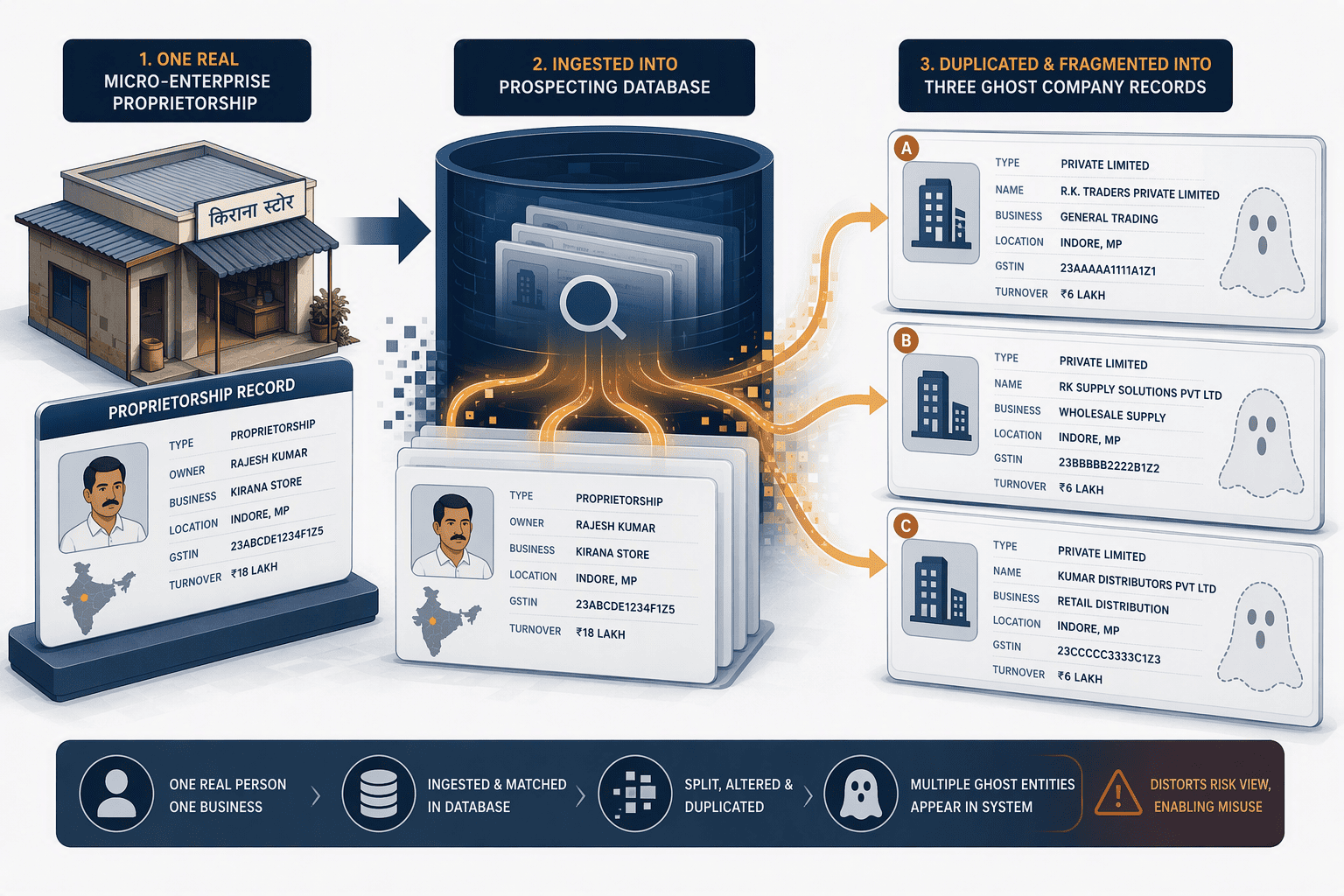
Apollo.io packs sequencing, CRM sync, and a massive database. For Indian B2B sales, that power introduces specific friction points.
- Inflated entity counts: Apollo aggregates from multiple data brokers. Indian micro-enterprises often appear under multiple trade names and outdated GST registrations. A single proprietorship can show as three separate companies, inflating your list with ghosts.
- Poor proprietorship differentiation: Apollo's schema treats formal company structures as the norm. Indian proprietorships, a huge slice of the MSME sector, are frequently tagged as 'Individual Contributor' or 'Self-Employed' with no decision-making authority flagged.
- Consent friction: Apollo's engagement-heavy model (automated sequences, email tracking) operates in tension with the DPDP Act's consent and data principal rights requirements. Indian prospects who have not explicitly consented to data processing can trigger compliance grievances that a global tool's workflow does not natively resolve.
- Data decay speed: Indian mobile numbers change faster than US or EU numbers. Apollo's refresh cycles, built for slower-decay markets, leave stale contacts live in the database longer. Compliance-led enrichment tools that refresh on lookup avoid this staleness by design.
4. SignalHire, The Internal HR-Biased Database Masked as a Contact Finder

SignalHire began as a candidate-sourcing tool, and that origin shapes every record in its database.
HR databases prioritize employee profiles. Resumes, job applications, and internal HRIS records are the primary source. For an Indian B2B seller, that creates a fundamental mismatch. The person who buys manufacturing equipment in Ludhiana or textile machinery in Surat is an owner, a partner, or a proprietor. They do not maintain a polished resume on job portals.
SignalHire skews heavily toward mid-level and senior employees at formal corporations. Owner and director profiles at small enterprises are systematically underrepresented. A sales team targeting Indian SME decision-makers will find many operations managers and few managing partners. The underlying data engine was tuned to find job candidates, and it was never tuned to find business buyers.
For a recruiter hiring for a multinational's India office, SignalHire works. For a B2B salesperson who needs the phone number of a proprietor running a 15-employee unit in Pithampur, it returns a gap where the decision-maker should be.
5. ContactOut, The Personal Email Hunter Struggling with Bharat’s Business Verification
ContactOut's engine is effective at one thing: finding personal email addresses. In an Indian B2B context, that strength is a problem.
ContactOut tilts heavily toward Gmail and Yahoo addresses. Many Indian small businesses operate without a formal domain, yet serious buyers expect to be reached through verified professional channels. You need a business email, and ContactOut routinely gives you a personal one instead.
Sending a B2B pitch to a personal email address in India signals that you scraped data rather than doing professional research. In tier-2 and tier-3 cities, WhatsApp has become the primary business communication layer. A personal email address carries zero institutional weight in that environment.
Mass outreach to personal email domains runs into spam filters faster than domain-matched business emails. Indian ISPs and corporate email gateways have tightened their filtering over the past 18 months. Even when you identify the right person, your message may never land in their primary inbox.
ContactOut also skips the multimodal signals Indian B2B outreach needs. It does not tag phone numbers or classify contacts into mobile, landline, and VoIP categories. You get a raw email address. That is where the value ends.
6. Wiza, The Legacy LinkedIn Scraper Navigating a Post-DPDP Compliance Minefield
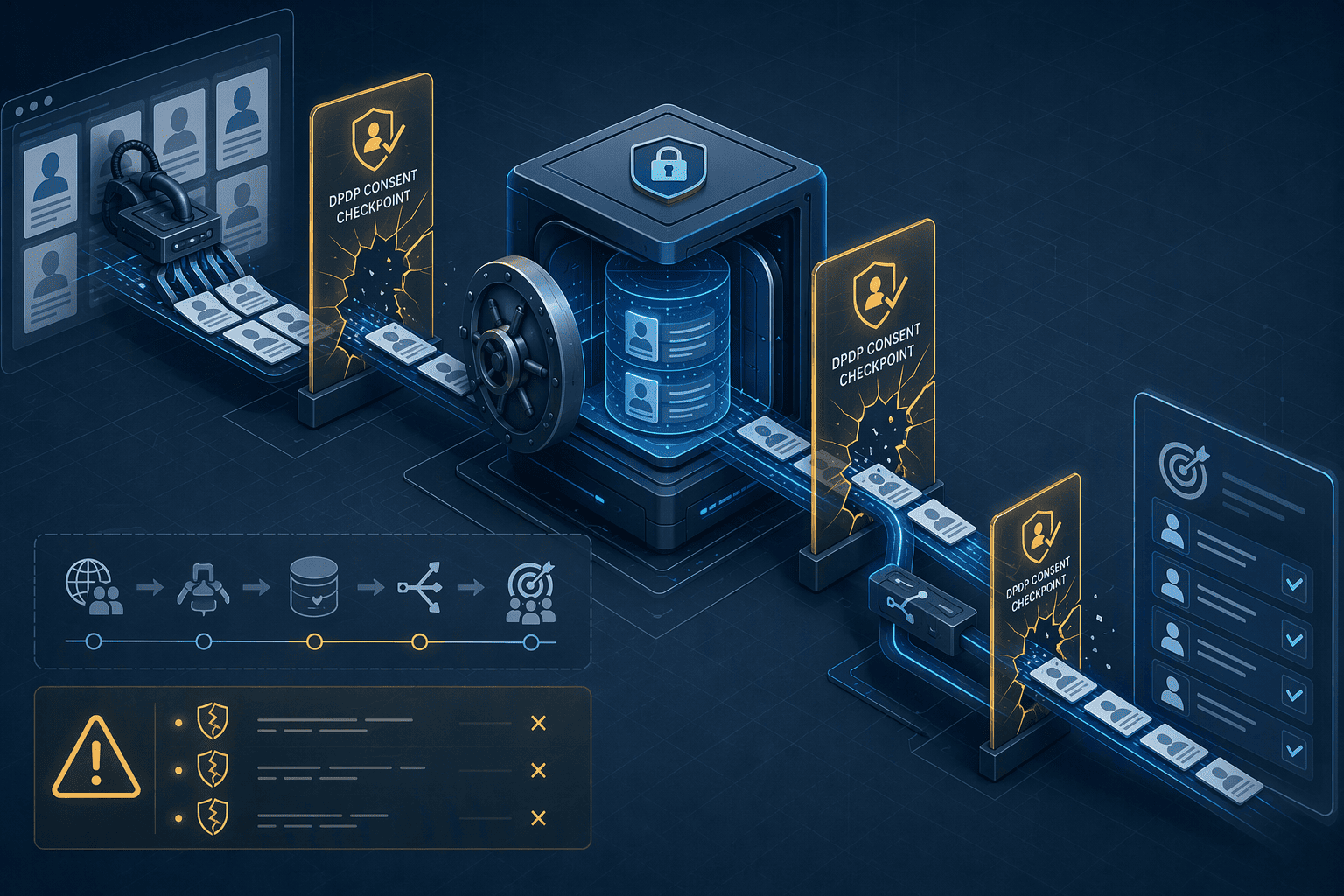
Wiza built its product on scraping LinkedIn profiles and pulling that data into downloadable lists. Under the DPDP Act 2023, fully enforced as of 2026, that methodology now sits on legally unstable ground. Scraping processes personal data without the data principal's granular consent. The Act requires a defined purpose, explicit notice, and a consent mechanism that scraping inherently bypasses. A tool that harvests profile data en masse and stores it for the user's future campaigns creates a data fiduciary obligation without having built the consent architecture to support it.
The compliance gaps add up quickly. The DPDP Act grants data principals the right to correction and erasure. A scraping tool that has already exfiltrated and stored profile data outside LinkedIn's environment cannot practically honor a data principal's subsequent erasure request. It also cannot demonstrate a clear legitimate use case that a court or the Data Protection Board would accept as meeting the narrow consent exceptions. For an Indian sales team building a compliant stack in 2026, Wiza's architecture introduces exposure that no database size justifies.
7. Kaspr, The European GDPR Champion Out of Sync with India’s DPDP 2023
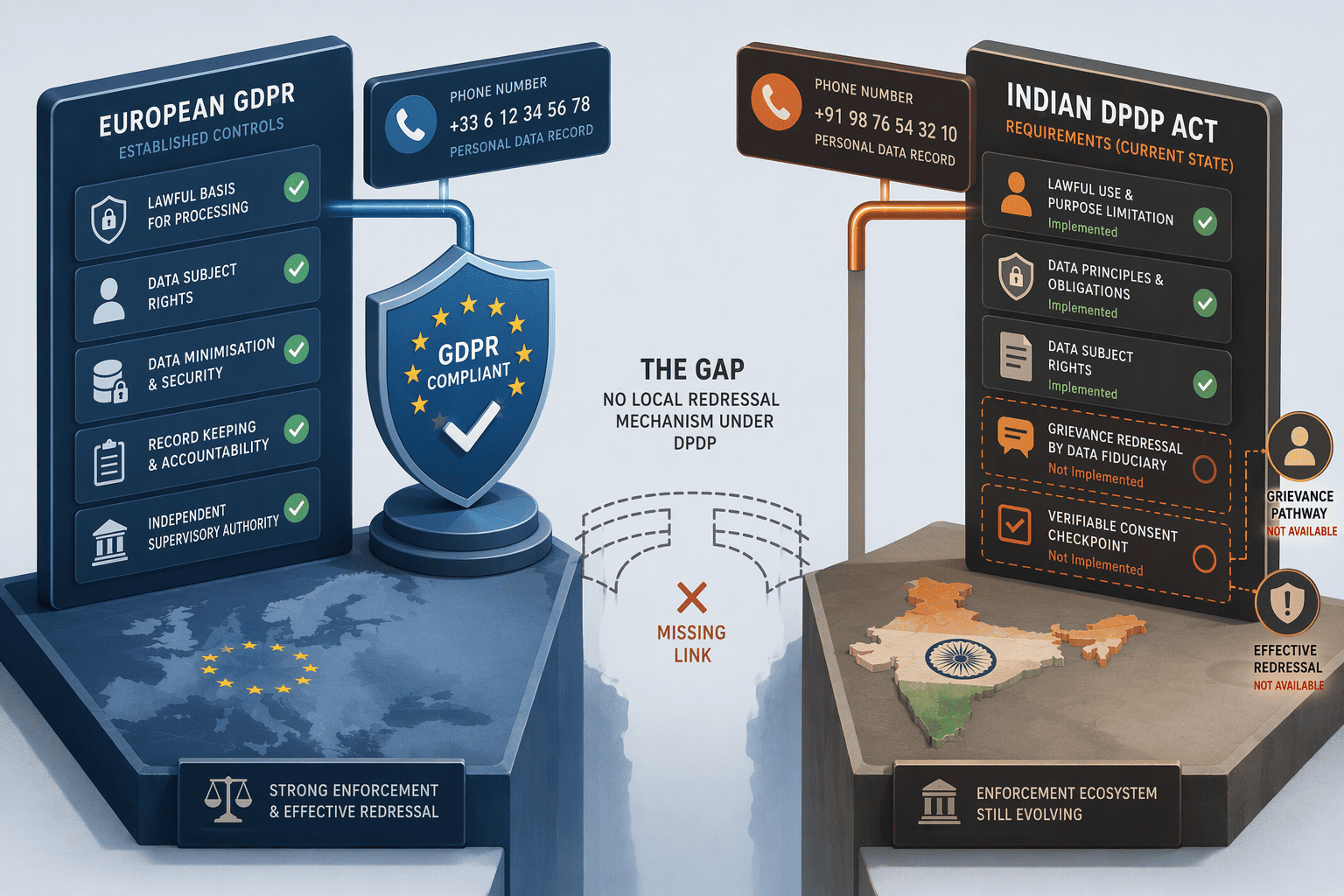
Kaspr’s compliance narrative is built around GDPR. For Indian teams, that creates a false sense of security.
GDPR and the DPDP Act diverge on three points that affect everyday sales workflows. India’s law requires a Data Protection Officer and a grievance mechanism that Indian data principals can actually use. Kaspr’s GDPR-centric controls leave that gap unfilled: there is no local redressal infrastructure for an Indian citizen whose number appears in the tool.
The DPDP Act ties consent to processing by a data fiduciary for specified purposes. Kaspr’s consent flows were built for European data subjects, not for Indian data principals, so the consent chain an Indian team relies on does not map to what the Indian law demands.
India’s data localization rules are tightening, and a GDPR-first pipeline routinely routes Indian data through EU servers. That cross-border transfer happens without the explicit consent the DPDP Act envisions.
Breadth of Indian coverage is another weak spot. Kaspr’s database reflects European sourcing density. For Indian MSME directories and proprietorship records, it returns far fewer verified numbers than its European benchmark would suggest. An Indian sales team that equates “GDPR-compliant” with “DPDP-compliant” is building pipeline on a compliance assumption the tool’s architecture cannot back up.
8. Decision Flowchart, Selecting Your Indian B2B Contact Compliance Stack for 2026
Start with the non-negotiable: your tool must comply with the DPDP Act. Browser-side enrichment engines that process data on your machine and avoid centralized storage of Indian personal data sit on the safest legal ground. An India-built tool reads the live profile in front of you, a point-in-time look at the person you are actually prospecting. A global database with an India filter lags behind the registration updates that move half of Indian micro-businesses every year.
If you exclusively prospect enterprise accounts with formal company structures and can tolerate a compliance review of your outreach workflows, global platforms like Lusha and Apollo remain functional secondary layers. But route all Indian MSME prospecting through an India-built enrichment layer. You eliminate ghost entities, get phone numbers verified against current registration data, and stay inside the DPDP's consent framework.
Budget logic is straightforward. At $0.036 per email and $0.18 per phone number, an India-focused pay-per-use tool delivers the cost-per-verified-contact that volume Indian prospecting demands. The trial plan at $9 for 250 credits lets you test the accuracy on your own target profiles before committing a rupee. If the tool does not find a correct number, you get the credits back, no questions asked.
Conclusion
The Indian B2B contact-finding landscape in 2026 has split. Repurposed global scrapers and GDPR-first tools carry compliance risk and return noisy data for the MSME segment that dominates India's economy. An India-built enrichment layer like PeakAI, architected for browser-side processing and DPDP alignment, delivers the accuracy and legal safety that Indian sales teams now require.
Install it on Chrome. Test the 10-second lookup on your own prospect list.
The trial plan lets you verify the data before committing. Expert insights on B2B sales, lead generation, and business growth strategies point in one direction: if you prospect Indian businesses, your contact stack must be India-first.
Frequently Asked Questions
Which Chrome extensions are best for finding verified LinkedIn contact details of Indian B2B decision-makers?
PeakAI leads for Indian B2B contacts due to its browser-side enrichment, 91% claimed phone accuracy, and India-built entity resolution. For enterprise-only stacks, Lusha and Apollo serve as functional secondary options, though their MSME coverage is thinner.
How accurate are the phone numbers and emails provided by tools like PeakAI for Indian B2B contacts?
PeakAI claims 91% phone number accuracy with a 10-second lookup time. Its data draws from structured MSME directories listing over 25,000 enterprises, not scraped aggregator databases. Actual accuracy can vary by region and contact type.
How does PeakAI's India-focused contact enrichment compare to global alternatives like Lusha or Apollo?
PeakAI resolves Indian proprietorships, partnerships, and micro-enterprises with registration-sourced data. Lusha and Apollo rely on global job-change triggers and aggregator databases that inflate entity counts and miss non-metro decision-makers.
What are the legal and privacy considerations under India's DPDP Act 2023 when using LinkedIn contact finder extensions?
The DPDP Act, fully enforced in 2026, requires explicit consent, data minimization, and a grievance redressal mechanism. Browser-side enrichment tools process data locally and avoid centralized storage, aligning more closely with these requirements than scraping-based tools.
What is the pricing and credit structure for PeakAI in 2026, and how does it fit a small B2B sales budget?
PeakAI operates on pay-per-use: 1 credit for an email ($0.036) and 5 credits for a phone number ($0.18). A trial plan offers 250 credits for $9 with no credit card required, fitting small-team budgets without a subscription lock-in.
How do I install and use the PeakAI Chrome extension to find MSME contacts in Indian tier-2 and tier-3 cities?
Install PeakAI free from the Chrome Web Store. Open a LinkedIn profile, activate the extension, and it enriches the contact data directly in your browser. It surfaces verified emails and phone numbers classified as mobile, landline, or VoIP within seconds.
