
Introduction
Your sales team wastes three hours a day hunting for numbers that either ring dead or belong to someone who left the company six months ago. In India, that problem compounds fast. Business data lives across MCA filings, GSTIN portals, UDYAM registries, and LinkedIn profiles, and most global contact tools stitch these together with guesswork.
The Cloud Security Alliance dropped a 2026 finding that changes the stakes entirely: large language models can now deanonymize professional profiles at 67% recall for under $4 per target. Your unverified prospecting list has become a genuine liability.
Indian B2B teams in 2026 need tools that verify contacts against actual government registries, not scraped profile fields. That means native integration with MCA, GSTIN, and UDYAM databases matters more than a billion global contacts that nobody checked. We evaluated four platforms through that lens: PeakAi, Lusha, Apollo.io, and Hunter. Each serves a different buyer, but only one treats Indian compliance as the foundation rather than a feature request.
Key Takeaways
The right contact discovery tool for your Indian sales team depends on whether you prioritize compliance, phone coverage, or upfront cost. Here is where each platform lands.
- Budget-led email finder: Hunter makes sense only for digital-first teams running pure email outreach. No phone data means it misses India's relationship-driven sales dynamic.
- High-volume phone prospecting: Lusha delivers the strongest Indian mobile coverage among global tools, but its credit costs add up fast for teams making hundreds of daily calls.
- Broad but inconsistent: Apollo.io offers sheer database size at a predictable subscription price, yet Indian email deliverability often hovers around 50 to 60 percent, forcing teams to budget for manual fallback verification.
- Compliance-first enrichment: PeakAi is the only platform with native MCA and UDYAM verification, a pay-per-verified-contact model that fits Indian SMBs, and real-time validation in under 10 seconds.
1. PeakAi: Compliance-First Enrichment with Native MCA and UDYAM Verification
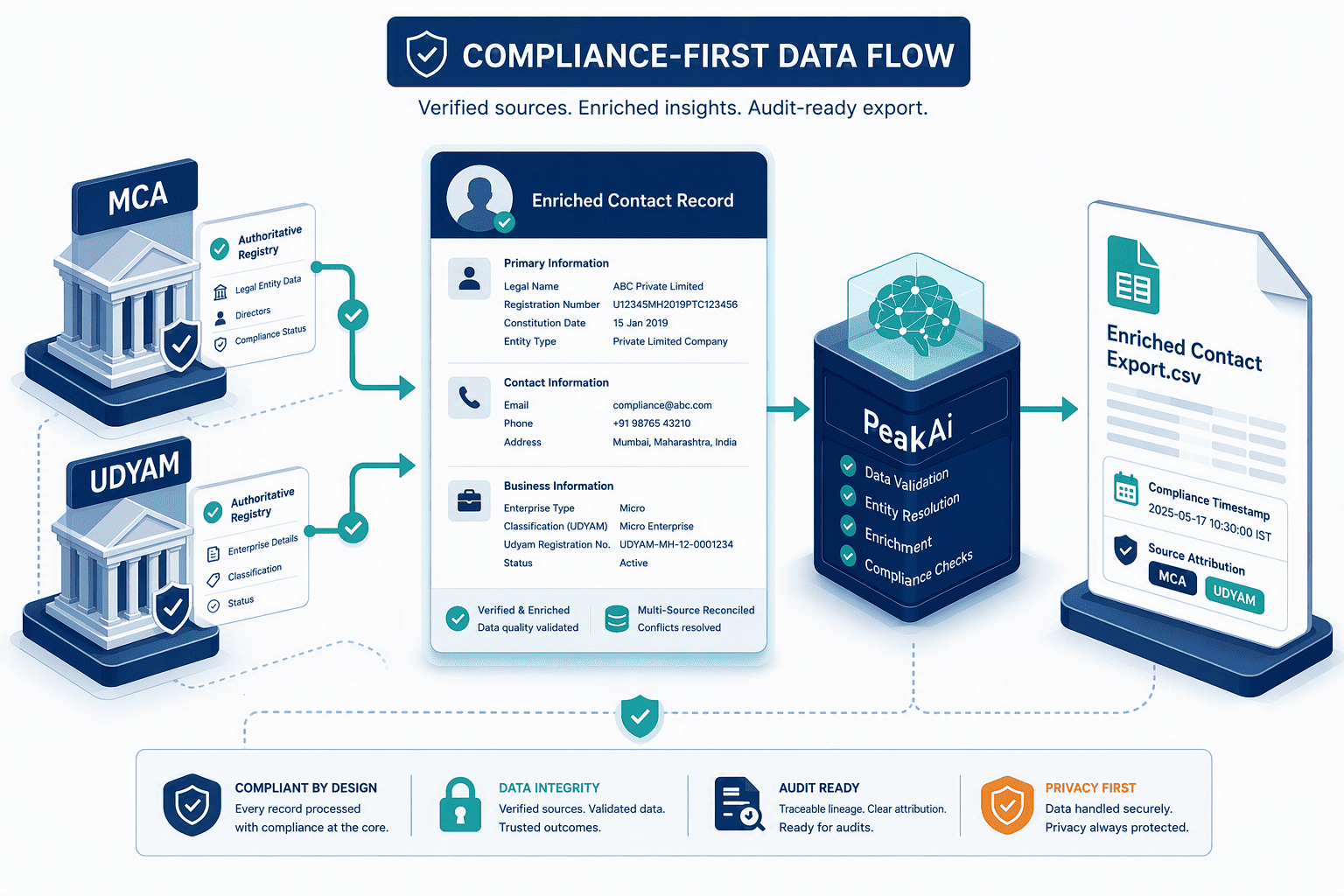
PeakAi is the contact discovery tool Indian sales teams pick when unverified data means wasted calls and a compliance headache. It queries India's MCA and UDYAM registries directly, returning contacts backed by a compliance timestamp and data-source attribution on every export. No other platform in this comparison offers that native government-registry integration.
PeakAi pulls records from government business registries, public records, and telecommunications databases. It does not rely on scraped LinkedIn profiles that may or may not match a prospect's actual director filings. The pay-per-verified-contact model starts at ₹675 for 50 contacts, which translates to roughly $0.18 per credit.
You pay only for contacts that pass dual verification for both email and phone, and the platform offers a credit-back guarantee when verification fails. For an Indian sales team of five to thirty reps running targeted, compliance-heavy outreach, that economics changes the conversation. You stop burning budget on unverified database subscriptions and start paying only for records that connect.
2. Lusha: Direct-Dial Accuracy for Indian Mobile Prospecting
Where Lusha shines for Indian teams is mobile phone accuracy. The platform claims a database of 300 million contacts and 30 million company profiles, and its verification methodology consistently produces high connect rates on Indian direct-dial numbers. In a market where outbound calling remains the dominant relationship-building channel, that mobile precision matters.
| Dimension | Lusha | PeakAi |
|---|---|---|
| Indian mobile accuracy | High (verification-based, strong direct-dial coverage) | High (real-time verification against telecom databases) |
| Government registry checks | Partial (no native MCA or UDYAM integration) | Native MCA and UDYAM verification with compliance timestamps |
| Pricing mechanics | Credit-based: 1 credit per verified email, 5 credits per phone number, 8 credits for call intelligence | Pay-per-verified-contact; ₹675 for 50 contacts with credit-back guarantee |
| Best-fit Indian team | High-volume calling teams that need direct-dial access above compliance depth | Compliance-first SMBs and enterprises needing government-verified enrichment |
The trade-off is compliance depth. If your outreach requires proving a prospect's business is a registered Indian entity, you will need a separate verification step.
3. Apollo.io: Broad Database with Variable Indian-Market Accuracy
Apollo.io brings a database of 240 million business contacts and 30 million companies to the Indian prospecting table, and it won a 2026 MarTech Breakthrough Award for Best AI-Powered Sales Solution. For broad top-of-funnel lead generation, that volume can surface opportunities that narrower tools miss. The trade-off hits hardest on Indian data quality.
- Email deliverability gap: User reports consistently place Apollo.io's Indian email accuracy in the 50 to 60 percent range. Budget for a fallback verification tool because nearly half your exported addresses may bounce.
- Subscription model caps: Apollo.io starts at $49 per user per month, which looks predictable, but unused monthly credits often expire. High-volume Indian teams can burn through those caps faster than expected.
- No native government integration: Apollo.io lacks UDYAM or MCA verification pathways. The platform crowdsources contact data, so Indian records decay faster than tools with active registry checks.
- When Apollo.io makes sense: Large teams running wide-funnel email and LinkedIn campaigns across multiple geographies can justify the subscription cost, provided they treat Indian contacts as a starting point that needs additional verification.
4. Hunter: Email-Only Discovery for Indian Outreach
Hunter is an email-finding tool, period. Its strength is straightforward email domain search and verification for digital-first outreach sequences. If your Indian team runs a pure email cadence targeting companies with clean public web presences, Hunter's monthly free tier of 25 searches and 50 verifications makes it a low-risk starting point. But Indian B2B outreach does not run on email alone. Most of the country's prospecting happens over phone calls and WhatsApp, where Hunter delivers nothing.
The platform has no mobile phone data, no GSTIN or MCA verification, and no UDYAM enterprise classification. Ignoring phone and WhatsApp channels in India means ignoring the primary communication layer that moves deals forward. A contact discovery tool that cannot verify whether a business is a registered Indian entity before you reach out also opens your team to fraud risk.
Hunter works for one narrow, specific use case: an early-stage digital team sending cold emails to a list of known company domains and needing basic bounce-rate reduction. For anything beyond that, the missing phone, compliance, and government-verification layers make it incomplete.
PeakAi queries Indian business registries and telecommunications databases to confirm that the person behind the address is currently active, registered, and reachable. For Indian SMBs that close deals over phone calls, that verification gap is a deal-breaker.
5. Comparative Analysis: Pricing Models and the Pay-Per-Verified-Contact Advantage
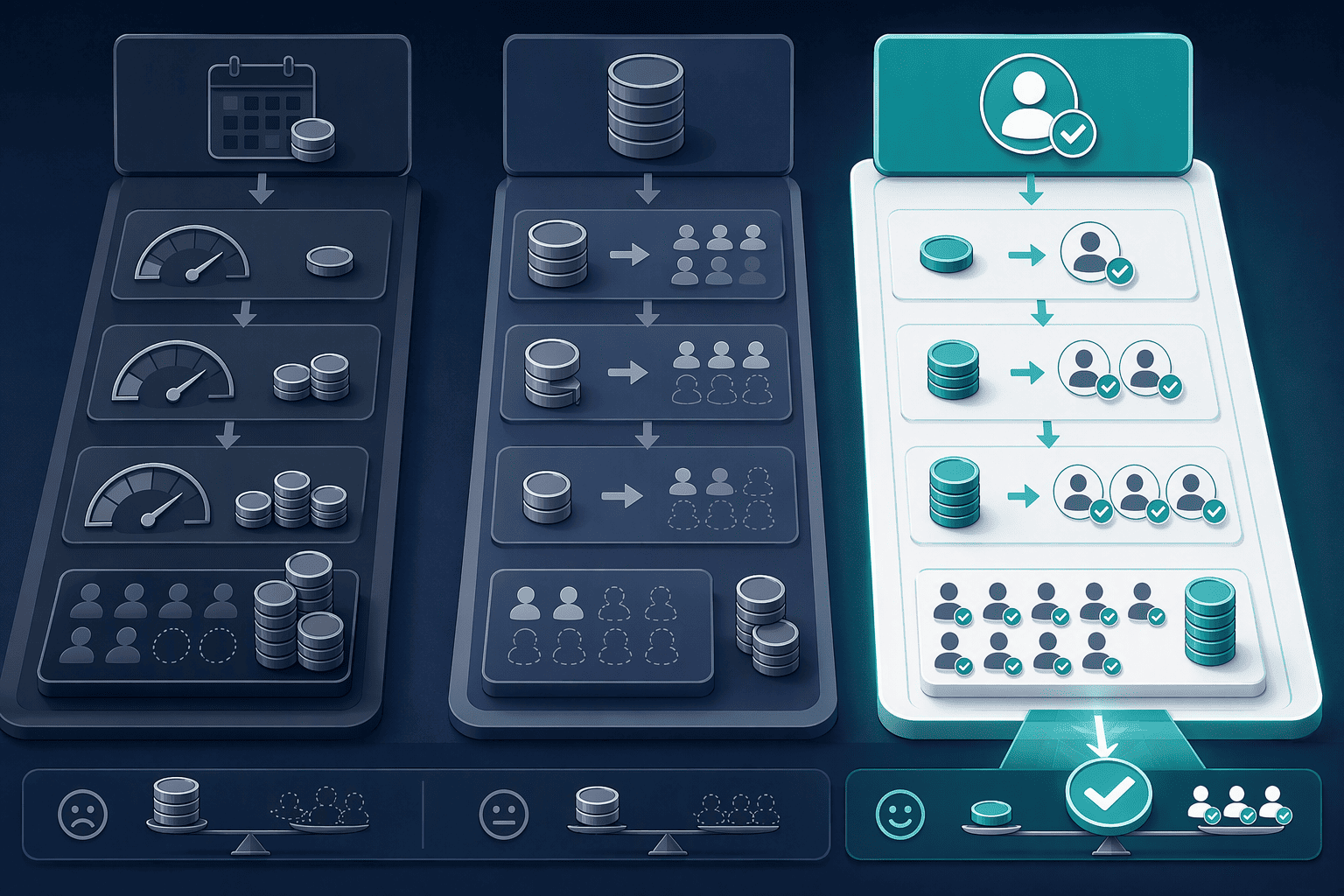
Pricing for Indian sales teams breaks into three models, and picking the wrong one wastes more budget than choosing the wrong tool.
- Subscription model: Charges a flat fee regardless of actual usage, for example, Apollo.io at $49 per user monthly, and unused credits frequently expire, so a slow month still costs full price.
- Credit-based pricing: Meters access with variable costs, as Lusha does by charging five times more for phone numbers than emails; for a team that dials heavily, the credit burn is immediate and punishing.
- Pay-per-verified-contact model: Flips both approaches, PeakAi uses it, starting at ₹675 for 50 contacts with a credit-back guarantee for any record that fails verification, so cost tracks validated output directly. An Indian SMB team of five to thirty reps running targeted, compliance-heavy prospecting stops paying for database volume it never touches. Every rupee goes toward a record you can actually dial.
6. The Compliance and Verification Deep-Dive: GSTIN, MCA, and UDYAM Integrations
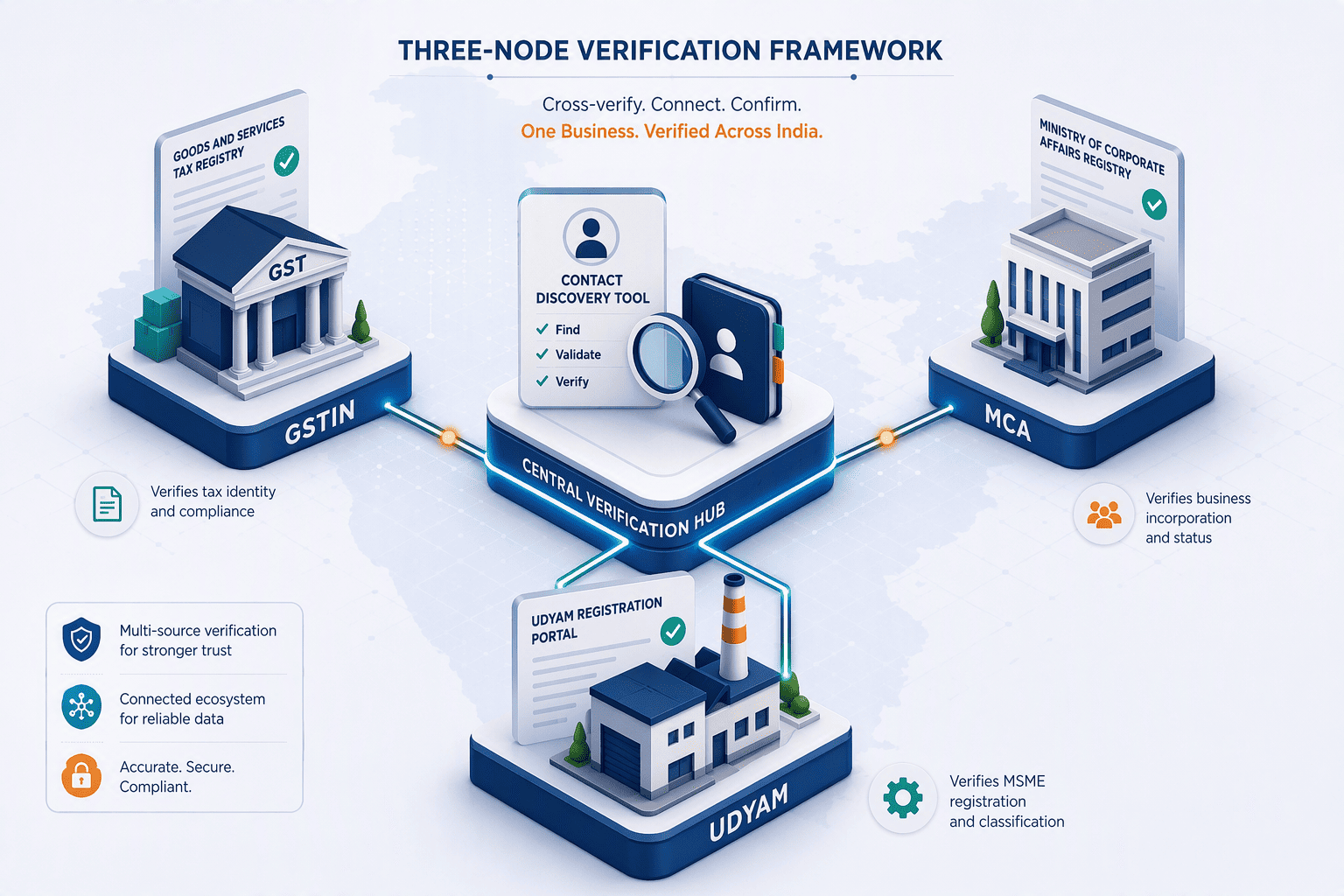
GSTIN is the Goods and Services Tax Identification Number assigned to every registered Indian business. MCA stands for Ministry of Corporate Affairs, which maintains the national registry of company directors, incorporation dates, and filing status. UDYAM, which replaced the earlier UAM system, is the government portal that classifies micro, small, and medium enterprises. Together these three registries form the backbone of Indian business identity verification. A contact discovery tool that cannot query them is essentially working blind on Indian data quality.
Native integration means the platform connects its verification engine directly to these government APIs, returning results with a compliance timestamp and source attribution on every record. That is what PeakAi does. It cross-references GST numbers, checks MCA director records against the contact you are enriching, and confirms UDYAM enterprise classification before delivering the verified contact.
Superficial checks scrape publicly visible web data without ever touching a live government registry. Apollo.io and Lusha fall into this category for Indian compliance. Hunter offers zero coverage across all three registries.
The Cloud Security Alliance's 2026 finding changes how you should evaluate this gap. When an LLM can de-anonymize professional profiles at 67% recall and 90% precision for under $4 per target, your unverified prospecting list is a fraud vector waiting to be exploited.
In 2026, Indian B2B teams cannot treat compliance verification as a nice-to-have layer. It is the first filter. Tools that skip GSTIN, MCA, and UDYAM checks are offering contact volume at the cost of business legitimacy.
7. Evaluating Real Accuracy: A Practical Framework for Indian Sales Teams
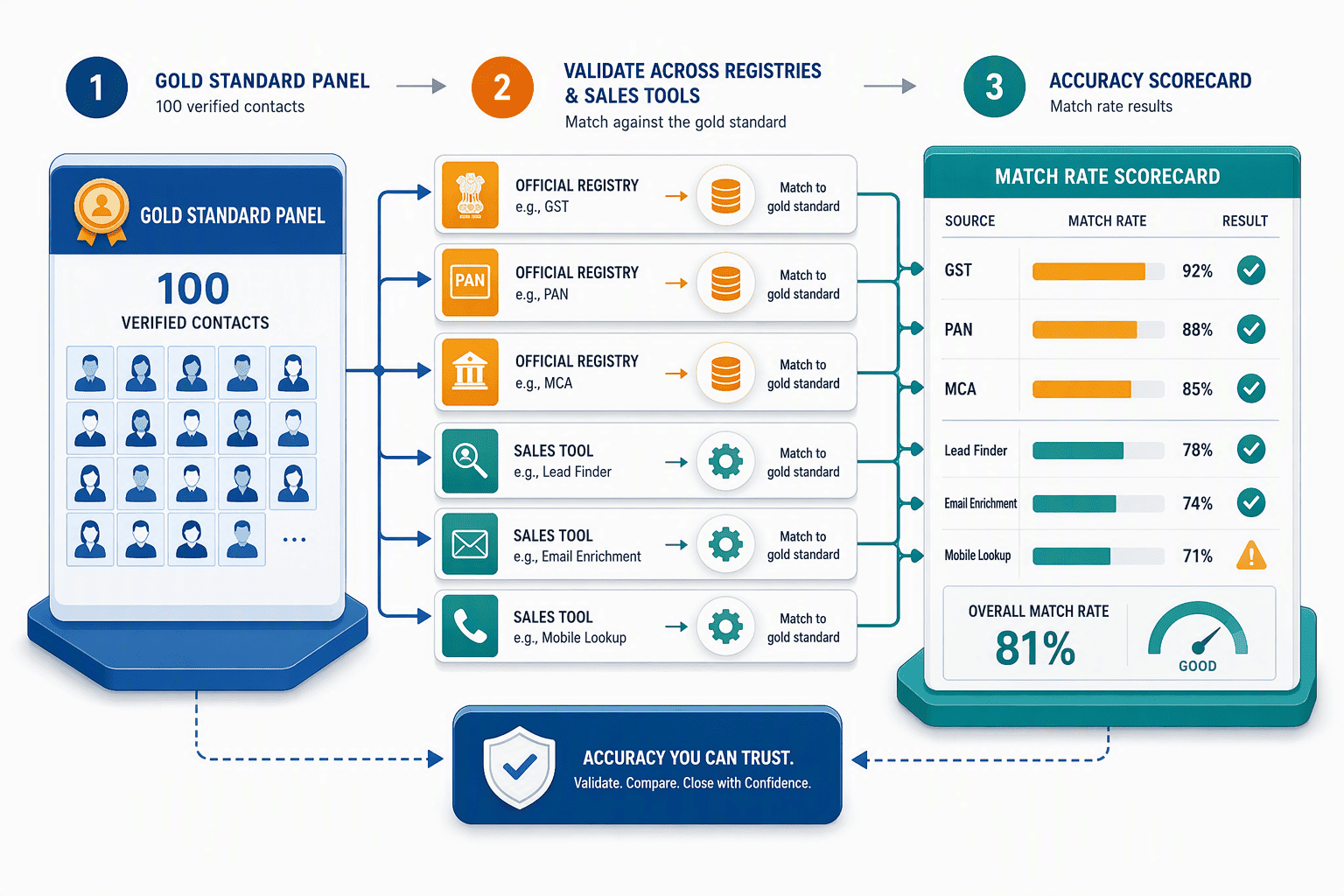
Most accuracy benchmarks sales tools publish fall apart the moment you run them against Indian business registries. The only way to know if a platform works for your pipeline is to test it yourself. Here is the framework operations leads can execute in under a week.
- Build a gold-standard 100-contact panel: Pull verified records from MCA, UDYAM, and GSTIN registries, contacts you know are active and compliant. This is your ground truth.
- Run each tool against the same panel: Submit the identical 100 contacts through every platform you are evaluating and export the results, noting which fields each tool populates or misses.
- Measure mobile connect rate: Dial every phone number returned and calculate the percentage of live, correct-person connections. This gives you real-world mobile accuracy, the number your team actually experiences.
- Calculate email deliverability: Send test emails to every address and track bounce rate. For context, Apollo.io's Indian email accuracy benchmark hovers around 50 to 60 percent.
- Flag compliance gaps: Count how many contacts fail GSTIN, MCA, or UDYAM verification. A tool without native registry integration will miss most of these entirely.
- Factor that labor into the total cost of ownership.
8. Integration and Workflow: CRM, WhatsApp, and Sales Navigator for the Indian Market

Indian sales motion runs on a stack that looks different from global norms. The phone is the primary close channel, WhatsApp Business is often the first touchpoint, LinkedIn Sales Navigator feeds top-of-funnel research, and Zoho CRM dominates the Indian SMB market alongside Salesforce and HubSpot. A contact discovery tool that cannot slot into that specific stack creates silos that cost you response time.
PeakAi supports over 20 CRM integrations including Salesforce, HubSpot, and Pipedrive. It enriches contacts inside the Chrome extension with LinkedIn-native validation and returns verified records in under 10 seconds. The export carries a compliance timestamp and data-source attribution, so your CRM record is audit-ready from the moment it lands.
WhatsApp Business integration remains the biggest gap across the board. No contact discovery tool yet offers native, enriched-contact-ready WhatsApp API connectivity for the Indian market, and teams bridging this manually lose the speed that makes enriched dialing effective. When evaluating tools, prioritize those that deliver CRM-structured exports you can pipe into your WhatsApp workflow without a separate cleaning step.
Conclusion
Compliance-first Indian SMBs needing government-verified contacts with no hidden fees should start with PeakAi and its pay-per-verified-contact model. High-volume calling teams that prioritize direct-dial coverage above registry checks will find Lusha's mobile accuracy competitive. Budget-led email-only outreach can begin with Hunter, but the missing phone and compliance layers make it a temporary fix. The 2026 benchmark is clear: unverified data is a fraud risk, not just an inefficiency. Choose a tool that proves its accuracy against India's actual business registries before your next campaign goes live.
Ready to Transform Your Sales Process?
Join thousands of sales professionals using PeakAi to find accurate contact information and close more deals.
Frequently Asked Questions
What are the top contact discovery tools that work best for the Indian B2B market in 2026?
The top four are PeakAi for compliance-first enrichment with native MCA and UDYAM verification, Lusha for high-accuracy Indian mobile direct-dial coverage, Apollo.io for broad subscription-based lead generation, and Hunter for narrow email-only discovery. Each serves a different team size, budget, and compliance requirement.
How does pay-per-verified-contact pricing compare with subscription models for Indian sales teams?
Pay-per-verified-contact pricing for Indian sales teams stands apart from other models in three key ways:
- Pay-per-verified-contact: Charges only for records that pass dual verification, starting at ₹675 for 50 contacts with PeakAi.
- Subscription models: Charge a flat fee with credits that often expire, as with Apollo.io at $49 per user monthly.
- Budget efficiency: For Indian SMBs of 5 to 30 reps, pay-per-verified-contact eliminates waste on unverified database volume.
What compliance and data-verification methods should Indian businesses look for in a contact discovery tool?
Look for native GSTIN validation, MCA director-record cross-referencing, and UDYAM enterprise classification checks. These government-registry integrations confirm a prospect's business is registered, active, and correctly classified. Surface-level web scraping without registry access misses the compliance verification Indian teams need in 2026.
How does PeakAi compare to alternatives like Lusha, Apollo.io, and Hunter for Indian-market contact enrichment?
Each contact discovery platform offers a distinct mix of features for Indian B2B teams:
- PeakAi: The only platform with native MCA and UDYAM integration, a compliance timestamp on every export, and a credit-back guarantee.
- Lusha: Leads on mobile accuracy but lacks government registry checks.
- Apollo.io: Offers volume with lower Indian email deliverability.
- Hunter: Lacks phone and compliance data entirely.
What Indian-specific integrations (GST, MCA, UDYAM) matter when choosing a B2B contact platform?
GSTIN confirms tax-registration status, MCA verifies company directors and incorporation dates, and UDYAM classifies MSME enterprise status. A contact discovery tool without native API connection to these registries cannot reliably verify Indian business legitimacy, raising fraud risk in your prospecting pipeline.
How can Indian recruiters and sales teams evaluate the real accuracy of a contact finder before buying?
Build a 100-contact gold-standard panel from MCA and UDYAM registries, run each tool against it, and measure actual mobile connect rates and email deliverability. Also count compliance gaps where tools miss government registry flags. Factor in the hours your team spends manually fixing bad records as a hidden cost.
