
Introduction
Your next big client is right there on LinkedIn. You can see their title and their company. But as soon as you click 'Contact Info,' the field is blank. LinkedIn is a fortress. It holds over one billion professional profiles, yet it obscures the one data point sales teams need most: a verified email.
Finding that email is a gamble for most teams. Many tools return unverified addresses, and a bounced email costs more than a missed opportunity. It burns time, wastes money, and drains your pipeline before the first conversation starts.
The game changes with enforcement. India's Digital Personal Data Protection Act 2023 made compliance a non-negotiable. You can't just scrape data without consent. You need a tool that finds accurate contact details without putting your legal standing, or your LinkedIn account, at risk. This list ranks the top tools that deliver accuracy without the regulatory headache.
Key Takeaways
Before you invest a single rupee, know the current reality of LinkedIn email extraction. Accuracy defines your deliverability rate and your sender reputation.
- #1 Tool for Accuracy: PeakAI leads with a high verified accuracy rate and a credit-back guarantee on bounces, a financial safety net most other tools on this list do not fully match.
- The Accuracy Gap: Most email finders operate with modest accuracy. Generic guessing tools can drive bounce rates high enough to damage sender reputation.
- Guarantee Matters: A credit-back model means you pay only for valid leads. Most competitors charge a flat subscription regardless of data quality.
- Compliance Rule: Under the DPDP Act 2023, scraping LinkedIn for personal data is illegal. Only tools using compliant public data enrichment should be in your stack.
1. PeakAI, Best Overall Accuracy with Credit-Back Guarantee for Indian MSMEs

PeakAI delivers verified email accuracy with a credit-back guarantee. You pay only for valid contacts. The tool is built for Indian sales teams that need high deliverability without annual lock-in fees.
Most tools sell you a subscription. If the data is bad, you eat the cost. PeakAI's pay-per-use model flips that risk.
A wrong address costs you nothing. The tool credits it back immediately. Few other tools on this list offer that kind of safety net.
The Chrome extension pulls work emails, personal emails, and phone numbers in seconds. You get verified contact details instead of guessing whether a generic corporate format like '[email protected]' will reach a real inbox. Real-time SMTP verification runs in the background to check mailbox existence before you export a CSV for your drip sequence. The result is a de-risked lead list drawn from LinkedIn's hidden data and tailored for MSME sales volume.
2. Lusha, Broad Database with LinkedIn Chrome Extension Integration
Lusha is built for speed. Its Chrome extension overlays contact details directly onto a LinkedIn profile. One click pulls up a phone number and email.
The data comes from its community-sourced database. As with most enterprise tools, accuracy depends on how recently records were contributed and verified.
You gain quick prospecting data. What you do not get is a guarantee of a deliverable inbox.
Lusha fits teams where volume trumps precision. The platform operates a credit system with limited refunds on bounces. Each invalid record costs you money. If you are counting every credit spent, those costs add up.
3. Hunter.io, Domain-Level Search with Technical Verification Filters
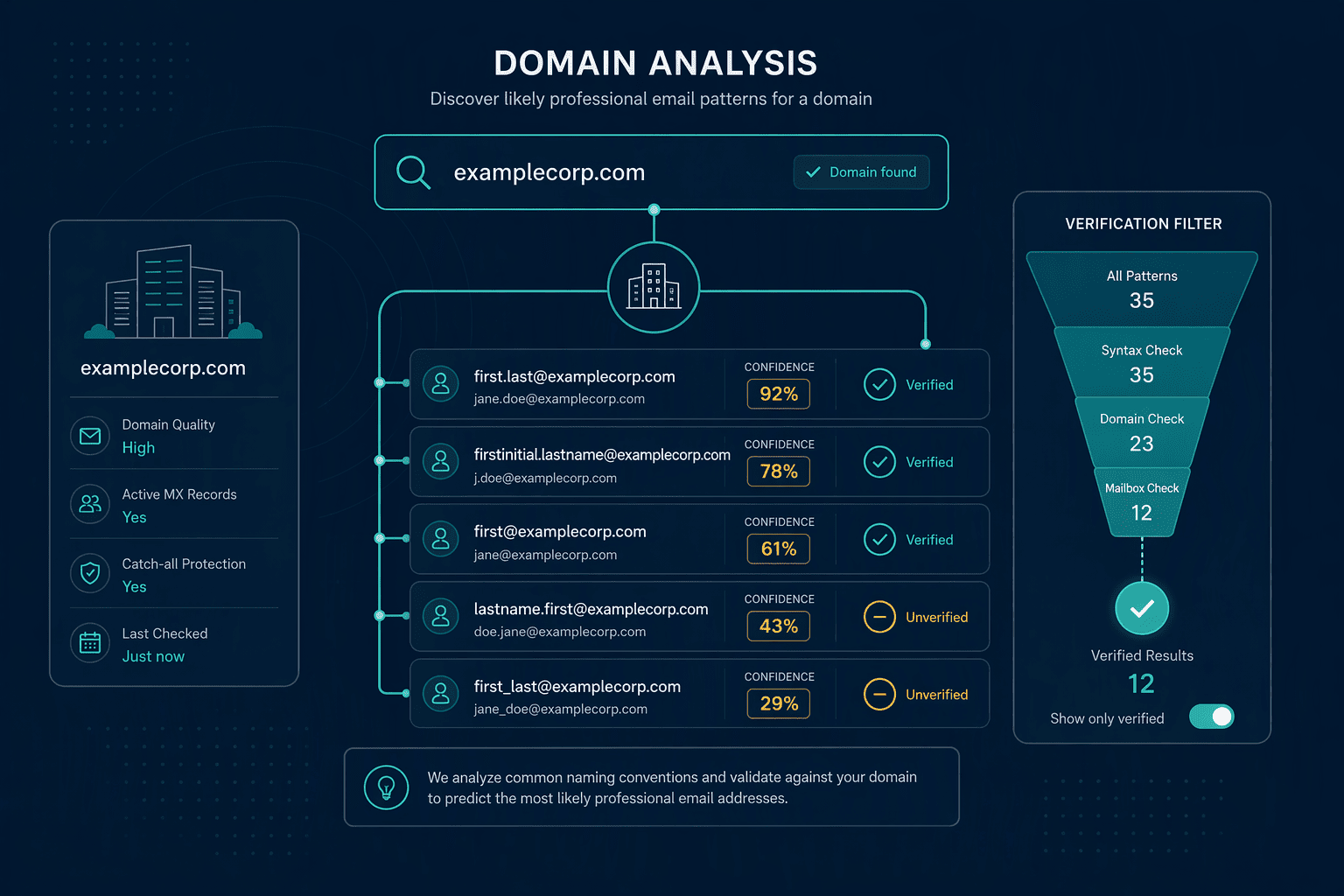
Hunter.io takes a different technical path. Instead of scanning profiles, it indexes the web for email patterns. You input a domain name, and it predicts every professional email structure attached to that company. Each result comes with a confidence score, a percentage that suggests how likely the email is to be valid based on pattern matching against known formats.
This is useful for mapping a department quickly. But it's a predictive guess with a hard ceiling. The tool provides a verification status for each find, yet pattern-guessing can never confirm an address exists.
When Hunter predicts a 'first.last' format that isn't real, you get a bounce. PeakAI, by contrast, performs real-time SMTP handshaking to verify an address exists before charging you for it. Hunter remains a solid alternative for top-of-funnel domain research where a specific LinkedIn person isn't your target yet.
4. Apollo.io, Combined Contact Profiles and Bulk Export Workflows
Apollo.io is a sales engagement platform. It combines a massive B2B database with outreach sequencing.
Its database is deep. You can search by job title, industry, and location, then trigger bulk exports for thousands of contacts. High-volume sales ops teams adopt it to centralize prospecting and campaigns in one place.
But that quantity comes with a data decay catch. Like most database-driven tools, Apollo's accuracy depends on how fresh its aggregated records are.
It aggregates millions of records. It does not verify them in real-time at the point of export.
If you blast a large volume of unverified Apollo emails, expect a portion to bounce. You will waste sequence limits and tank your domain reputation. The platform lacks a full credit-back safety net.
PeakAI does not replace a full CRM sequencer.
5. Snov.io, Multi-Channel Drip Campaigns with Email Verification Layer
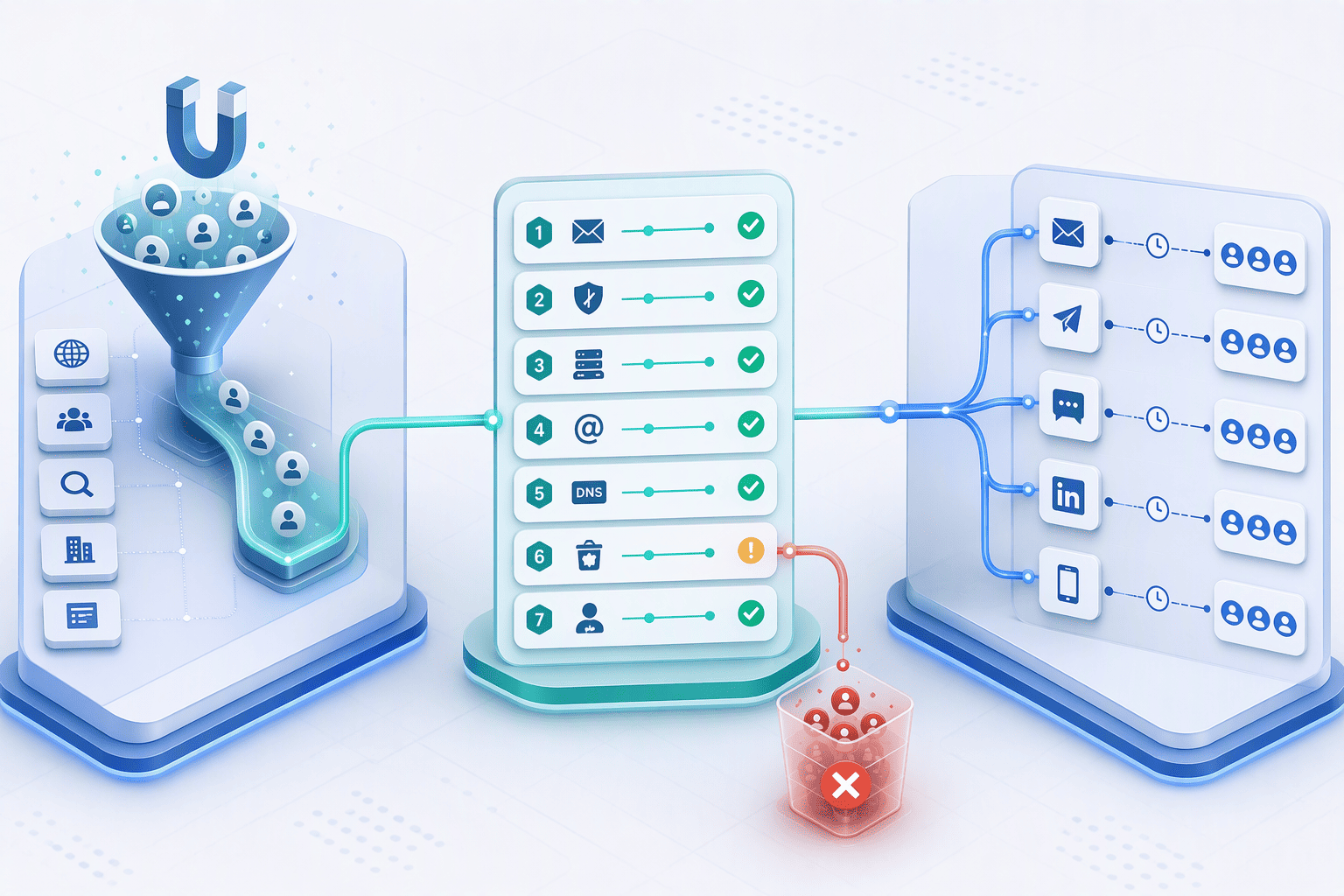
Snov.io bundles an email finder with a drip campaign manager and a 7-tier email verification layer. It sounds efficient. You find, verify, and pitch from one dashboard. But the verification step is there because the initial data sourcing misses the mark often enough to need a safety net. The tool catches its own errors after the fact.
- The Verification Layer: Snov.io's seven checks validate syntax, domain health, and MX records. This is a corrective step on top of an average-quality source.
- Drip Campaign Trigger: Marketing teams that run multi-channel sequences on LinkedIn, email, and phone, all tracked in one funnel, will find the most value here.
- Accuracy Reality: Inherent source accuracy stays in the 50 to 70 percent range. Built-in verification limits the fallout. A tool like PeakAI, which validates in real time before showing a result, starts from a higher precision baseline.
6. ContactOut, Personal Email Discovery for Recruiters and Direct Outreach
ContactOut is the niche favorite for headhunters. It scans publicly available web data to surface personal emails, like Gmail addresses, from LinkedIn profiles. Recruiters reach for it because a work email sent to a passive candidate often bounces or gets ignored.
- Recruiter Focus: The tool's interface is optimized for one-to-one outreach, prioritizing personal inboxes over corporate gateways.
- Data Breadth Trade-off: ContactOut finds the private inbox well, but the work email and direct dial are frequently missing from the result.
- PeakAI Comparison: A dual-email approach works better for sales. PeakAI returns the personal email, the work email, and the phone number in a single extraction, so you skip the second lookup.
7. FindThatLead, Social URL Prospecting with Tiered Accuracy Scoring
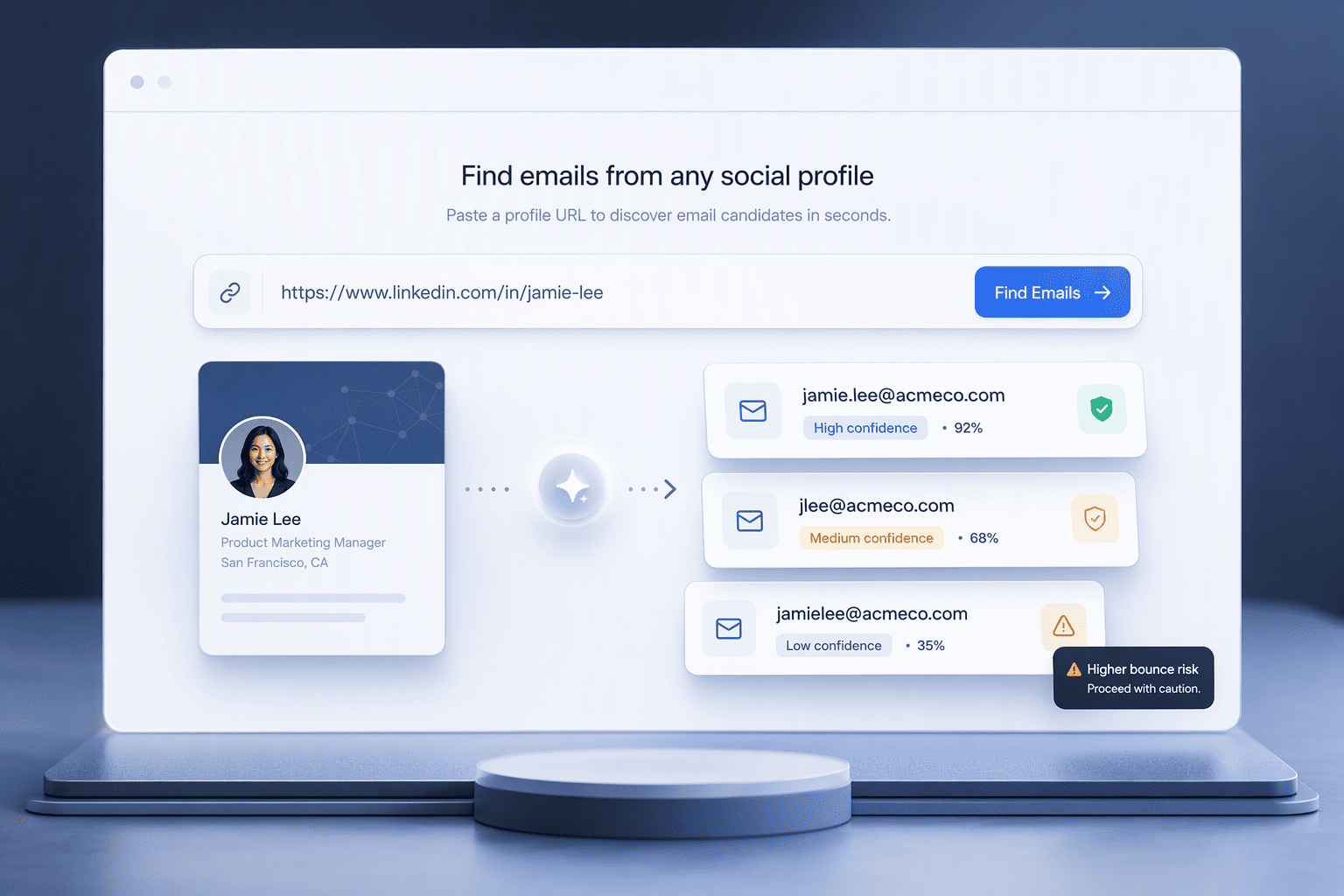
FindThatLead lets you enter a social profile URL, even a Twitter handle, to prospect for an email.
The search input is flexible. You can paste a list of social links and let it return probable emails. The output is a confidence score that reflects how the algorithm built the address, not whether the address can actually receive mail.
These tiered accuracy models guess email permutations using pattern matching. A 'probable' email that bounces still costs you the full credit on most paid plans without recourse. For sales teams that need a reliable phone number or a guaranteed valid email to close a deal, this probabilistic model risks wasting credits on addresses PeakAI's deterministic approach would not return.
8. How Real-Time SMTP & Catch-All Verification Cuts Bounce Rates
Simple syntax checks look for the '@' symbol. Real email verification goes deeper. Real-time SMTP verification pings the mail server.
It asks, 'Does this specific mailbox exist?' without sending an actual email. This handshake validates the address at the moment you search.
Tools that lean on static database lookups cannot perform this check. Data ages. People switch jobs.
A verified inbox yesterday might sit behind a catch-all server today. PeakAI performs the SMTP handshake in real time and discards the dead ends before you export them. This is the technical layer that converts a database guess into a reliable, low-bounce list.
9. Scraping vs. Compliant Enrichment: Navigating India’s DPDP Act 2023 and LinkedIn’s Terms of Service

Two methods exist to find emails from LinkedIn. One carries zero legal risk. The other risks penalties and account bans.
| Method | Data Source | DPDP Act 2023 Status | LinkedIn ToS Risk | Data Accuracy |
|---|---|---|---|---|
| Illegal Scraping | Automated extraction of profile pages | Violates data fiduciary consent rules; significant fines may apply | Potentially violates Section 8.2; may trigger account ban | High in volume, low in verification |
| Compliant Enrichment | Public business databases, real-time SMTP, official registries | Defensible under legitimate use for business contact data enrichment | Compliant with platform rules for data use | High via technical verification layers |
A miss is a hard bounce that burns your sender reputation before you even get started. Scraping tools that return data instantly often pull directly from prohibited sources. The DPDP Act 2023 requires explicit consent for processing personal data. Automated scraping ignores this, creating a liability you cannot talk your way out of.
Bounce rate matters as a direct cost line. High bounce rates from scraped lists damage domain reputation, hurt deliverability, and push future emails into spam. Compliant enrichment tools verify each address against live SMTP servers at query time.
Compliant tools such as PeakAI surface publicly available business information from legitimate data partners. They work from public business databases, real-time SMTP checks, and official registries, keeping your outreach legally defensible. There is no live profile scraping and no native accuracy guarantee tied to a single data source. Every email gets verified on the spot.
Conclusion
Stop paying for dead data. Low accuracy doubles your cost per lead and kills your sender score.
PeakAI gives you a low-cost way to cut that noise. You get verified work emails with a credit-back guarantee that makes financial sense for Indian MSMEs.
Try the entry-level plan and see how much pipeline you recover from data you already have on LinkedIn.
Frequently Asked Questions
What is the best email finder tool for finding accurate emails from LinkedIn profiles?
PeakAI delivers a 91% accuracy rate with real-time SMTP verification and a 100% credit-back guarantee on bounces. It recovers work and personal emails without requiring a monthly subscription, starting at $9 for 250 credits.
How accurate are email finders, and what accuracy rate can you realistically expect?
Most LinkedIn email finders sit in a 50 to 70% accuracy bracket. Generic pattern-guessing tools can push bounce rates to 50%. Expect high accuracy only when a tool provides real-time SMTP verification against the mail server, not just a static database lookup.
How does PeakAI compare to other email finding tools for accuracy and pricing?
While tools like Lusha or Apollo charge $39 to 99 monthly subscriptions for 50 to 70% accurate data, PeakAI uses a $9 pay-per-use model. It costs $0.036 per email and gives a 100% credit refund on wrong contacts, making the cost per valid lead far lower.
What are the risks of using LinkedIn scrapers versus compliant enrichment tools?
Scrapers violate LinkedIn’s Section 8.2 Terms of Service, risking permanent account suspension. They also breach India’s DPDP Act 2023 consent rules. Compliant enrichment tools use public business data and real-time verification to avoid these legal and platform risks.
How can I verify LinkedIn emails to reduce bounce rates?
Use a tool that performs real-time SMTP verification. This pings the recipient’s mail server to check if the mailbox exists before exporting it to your CRM. It cuts bounce rates to under 5% by discarding catch-all and invalid addresses instantly.
What privacy laws in India affect using email finders?
The Digital Personal Data Protection Act 2023 governs email extraction. It requires data fiduciaries to obtain consent for processing. Using a tool that scrapes LinkedIn without consent creates legal exposure, while compliant enrichment based on publicly available business data is defensible under the law.
