
Introduction
You just closed a small seed round. Every rupee counts. You need to reach potential customers, but the tools sales teams use cost more than your entire software budget.
Most startups overspend on contact discovery because they buy enterprise-built databases designed for 50-seat sales teams. You pay for seats you do not need and credits that expire on contacts that bounce.
In India, the problem gets sharper. The country has over 63 million businesses, most of which are MSMEs with zero LinkedIn presence. A cheap tool loaded with bad data is worse than no tool at all. The Digital Personal Data Protection Act 2023 now makes unsolicited phone outreach a concrete legal risk.
The answer is the lowest true cost for a deliverable, compliant contact. This list ranks the most affordable tools for Indian startups. You will see the real free tiers, the hidden credit traps, and the one metric that decides whether your outreach budget turns into pipeline or disappears.
Key Takeaways
A cheap credit is only cheap if the email does not bounce. These are the core facts to guide your decision.
- Best free plan: Apollo.io gives 900 annual credits with no credit card required, making it the strongest starting point for solopreneurs.
- Cheapest per-use model: PeakAI charges per credit with no monthly seat fee, giving you the most flexible model for unpredictable, low-volume prospecting.
- Accuracy redefines cost: A tool with 50% accuracy at a low price often costs more per valid lead than a higher-priced tool with 90% deliverability.
- Risk shifts with data type: Collecting phone numbers creates real liability under India's DPDP Act 2023, making email-focused tools a safer starting point.
- Upgrade trigger: Switch from a simple Chrome extension to a full dashboard when your team passes five members and needs CRM sync and sequencing.
1. PeakAI, The Budget-First, Pay-Per-Use Champion for Indian Startups
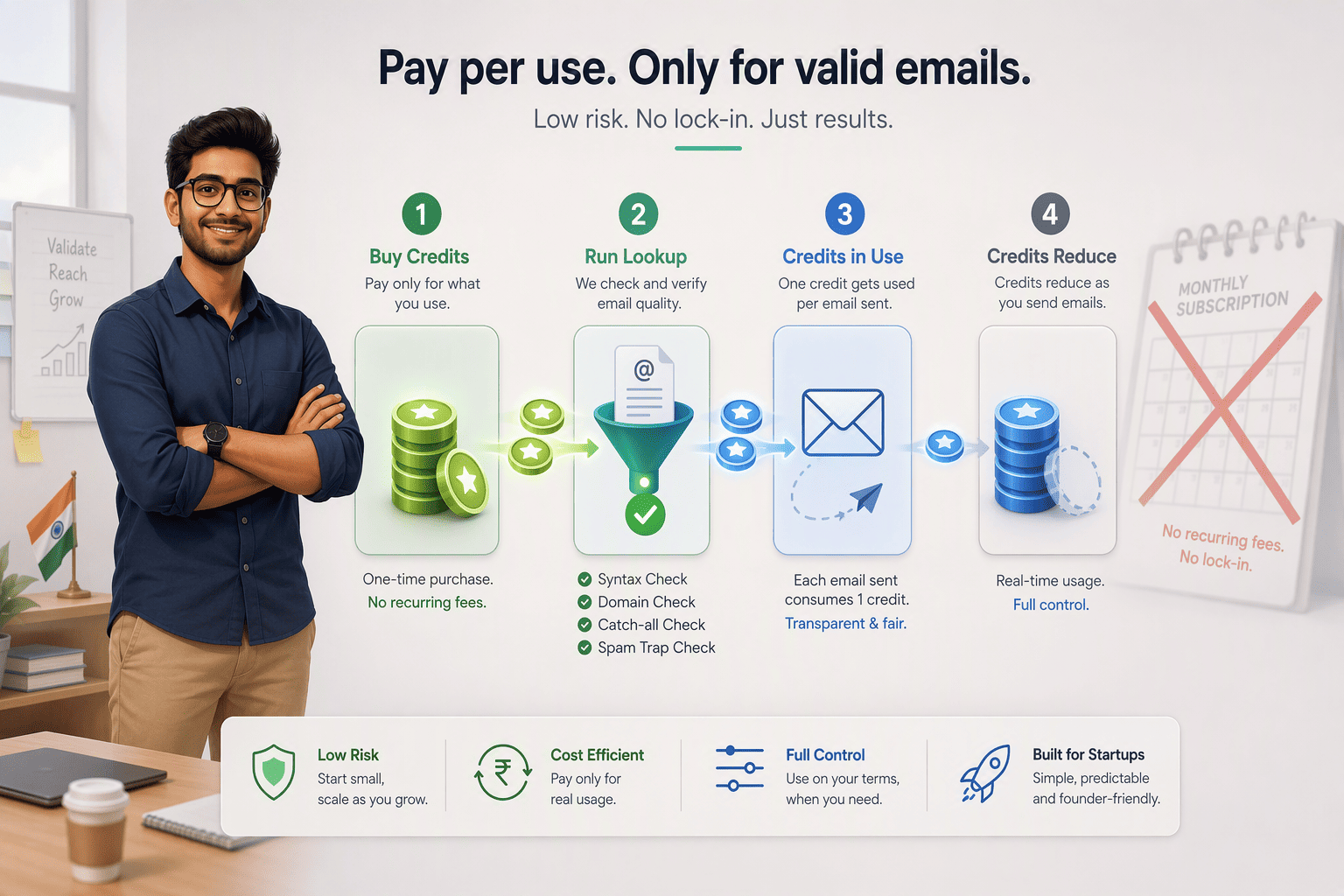
PeakAI strips away the biggest startup objection to contact tools: the monthly per-user fee. You pay only for the credits you use.
- True pay-per-use model: PeakAI runs on credits. There are no monthly subscriptions, you buy credits, and 1 email costs 1 credit. A trial plan costs $9 for 250 credits.
- Ultra-low-risk entry: The model fits startups validating product-market fit. The sweet spot for most seed-stage startups is 1,000 to 3,000 contacts per month. PeakAI works well here because you never pay for unused volume.
- Accuracy reality check: PeakAI reports a 91% phone number accuracy rate and finds verified emails in 10 seconds. Quality can vary by region and contact type.
- Built for India: PeakAI positions itself as India-focused and holds compliance certifications covering India's DPDP Act 2023. For an Indian startup concerned about regulatory compliance, this is a concrete benefit compared to tools facing documented GDPR complaints.
2. Apollo.io, The Best Free Plan for Teams Needing a Full Sales OS
The free tier makes Apollo.io dominant in budget discussions by offering a complete sales platform rather than just a data scraper:
- Free plan value: It grants 900 annual credits, not monthly, enough to test a market but not sustain outbound, with no credit card required so the only cost is time.
- Database and accuracy: Apollo claims 240M+ people and 30M+ companies with 98% email accuracy, but independent users report 65 to 70% accuracy; still, the platform bundles data with CRM, email sequencing, and AI scoring.
- Team suitability: A startup with five or more members needs a system to act on data, not just data alone; as of July 2026, Apollo holds a 38% adoption rate among businesses using a Sales Data Provider tool, up 5 percentage points year-over-year, per Ramp's vendor data.
3. Lusha, The Speedy Chrome Extension with a Calculated Compliance Risk

Lusha wins on speed. You open a LinkedIn profile, click the extension, and get a phone number. For an Indian startup in a hurry, that is seductive. But speed here carries a specific liability in 2026.
- Instant gratification with a limit: The free tier provides 40 credits per month with no credit card required. Paid plans start at $50 per user per month. You burn 1 credit for a verified email and 5 credits for a phone number.
- The phone risk in India: Lusha has faced documented GDPR complaints about unsolicited calls. TRAI's unsolicited commercial communication rules make dialing a number pulled from an extension a legal risk unless that contact has consented.
- Best used carefully: Use Lusha for its intended strength: a quick email lookup. If you extract a phone number, you must verify consent before calling. An email-first outreach, confirmed with a verification tool, is the safest path.
- Who it fits: Early-stage founders doing high-touch, low-volume prospecting to a curated list of 50 profiles a week. It is too expensive and too risky for bulk phone extraction.
4. Kaspr, The Lean, No-Dashboard LinkedIn Phone Extractor
Kaspr focuses on one job: click the Chrome extension on a LinkedIn profile to get a phone number and email, with no dashboard, sequencing, or CRM sync:
- Free plan taste: Kaspr's free tier provides 15 B2B emails and 5 phone numbers per month, genuinely useful for early validation, and most users upgrade to the Starter plan (around $45 per month billed annually) within the first month.
- Ideal user: This tool suits the individual founder who needs to call a decision-maker today, not run an email campaign next week, spending zero time learning a complex interface, pull the contact, log it manually, and move on.
- Trade-off in accuracy at scale: Kaspr focuses on real-time LinkedIn extraction, lacking the database depth of Apollo or the verification layer of FindThatLead; for teams past a handful of people, the lack of a dashboard becomes a bottleneck.
- Strategic advantage for small startups: At the two-person startup stage, where every dollar saved on software extends runway, Kaspr's narrow focus is a strategic advantage.
5. Snov.io, The All-in-One Toolkit with a Tricky Credit Economy

Snov.io looks affordable on the surface. It bundles an email finder, a verifier, and drip campaigns into one interface. Underneath, the credit economy makes predictable budgeting hard for a credit-conscious startup.
The problem is fragmentation. A single email search consumes one credit. To verify that email, you spend another credit.
To add it to a drip sequence, you may consume additional credits. What appears to be a single lead lookup can quietly multiply into multiple credit deductions, destroying the apparent low cost per contact. If your startup has a predictable, steady prospecting volume, Snov.io's all-in-one toolkit can simplify your workflow.
If your volume fluctuates and you count every credit, tools like PeakAI or FindThatLead keep the math simpler. One action should ideally cost one credit. For an Indian startup where every dollar matters, the complexity of the credit economy is a hidden cost you need to audit carefully before committing.
6. FindThatLead, The Simple, Credit-Efficient Option with Strong Deliverability Focus
FindThatLead solves the core math problem that Snov.io creates. Every credit buys one verified email, period. You search for a contact, the tool finds and verifies the address in one step, and you spend a single credit. There is no separate charge for verification.
This matters because the pricing model matches what you actually need: a deliverable email in your inbox. Other tools charge you once to find a contact and again to verify it. That two-step billing profits from bad data. FindThatLead builds verification straight into the lookup, so its economics fail when its data bounces.
For a startup managing a tight budget, the benefit is clarity. You buy a block of credits, and every credit produces one usable contact. The per-lead cost is predictable.
The tool covers a smaller database than Apollo and does not target the Indian market specifically. But for a small team that prioritizes email reachability, the credit efficiency works. You pay once per lead, and the email arrives verified.
7. Skrapp.io, The Bulk Email Finder for High-Volume, Low-Budget Prospecting
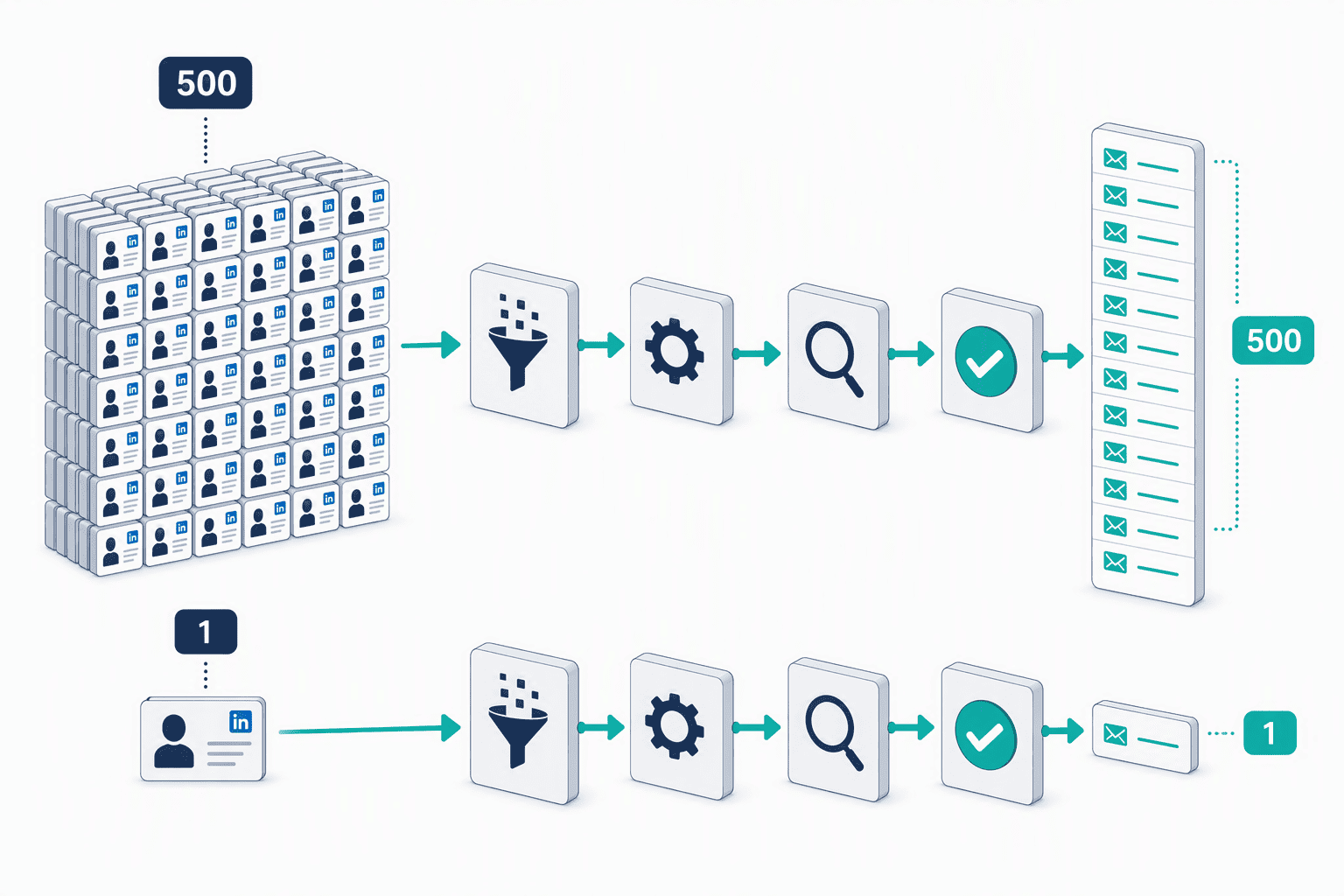
Skrapp.io is the tool you reach for when you need to process a LinkedIn search result of 500 profiles in one afternoon. Its strength is bulk extraction at a price point built for volume.
| Feature | Skrapp.io | Kaspr / Lusha (Single Lookup) |
|---|---|---|
| Best use case | Bulk email finding for large LinkedIn lists | One-click lookup on individual profiles |
| Pricing model | Volume-based tiered pricing, lower cost per contact at scale | Per-credit or monthly seat cost |
| Accuracy approach | Bulk extraction, requires a separate verification step | Real-time extraction, usually more accurate per contact |
| Ideal buyer | Startups prioritizing volume and building broad top-of-funnel lists | Startups doing high-touch, targeted outreach to a few key accounts |
Skrapp.io's model means you accept a trade. You get more emails per rupee, but a percentage of those emails will be outdated or wrong. You must run the exported list through a verification tool, which adds a step and a cost. If you skip that step, your sender reputation will suffer, and your outreach will land in spam.
The tool fits a specific moment: the early growth phase where you need to build a wide top-of-funnel list quickly. Once you qualify those leads, you can switch to higher-accuracy tools for the contacts that matter.
8. Side-by-Side Credit-Cost & Contract-Trap Analysis
The sticker price of a tool hides the real cost. A $9 monthly plan that consumes 5 credits per phone number can cost far more than a $50 plan where one credit equals one valid email. You must calculate the true cost per deliverable contact.
Look for contracts before you commit. Some tools advertise low monthly prices that only apply if you pay annually. If you cancel early, the refund terms vary dramatically. PeakAI says it offers a 100% credit refund guarantee and asks no questions on refunds. Most other tools do not.
The table below compares the core financial dimensions that matter for an Indian startup. The free tier column tells you what you can test without a credit card. The cost per 1,000 credits normalizes pricing across different credit models. Always factor in the reported accuracy. A tool with 65% accuracy that charges $0.05 per credit actually costs $0.077 per deliverable contact. A tool with 90% accuracy at $0.10 per credit costs $0.11. The gap is narrower than it seems, and the higher-accuracy tool protects your sender reputation.
Credit Cost Comparison Table
| Tool | Starts At (Paid) | Cost Per 1,000 Credits (Approx.) | Free Tier Credits | Contract Type | True Cost Factor (w/ Reported Accuracy) |
|---|---|---|---|---|---|
| PeakAI | $9 (trial) | $36 (est. based on bulk tiers) | None; pay-per-use trial | Pay-per-use; no monthly fee | Higher; 91% claimed accuracy means lower waste |
| Apollo.io | $59/user/mo | Not directly comparable; credits bundled | 900 credits/year | Monthly or annual | Moderate; 65 to 70% user-reported accuracy |
| Lusha | $50/user/mo | $50 est. (5 credits/phone at higher volume) | 40 credits/month | Monthly or annual | Higher risk; credits drain fast on phone lookups |
| Kaspr | $45/mo (annual) | Not directly comparable; flat monthly | 15 emails, 5 phones/month | Annual for best price | Moderate; focused extraction, limited scale |
| Snov.io | $30/mo | Cost varies; multiple credits per verified lead | 50 credits/month (trial) | Monthly or annual | Lower; fragmented credit economy raises real cost |
| FindThatLead | $49/mo | $49 est. (1 lead = 1 credit) | Varies by plan | Monthly or annual | High; 1:1 credit model maximizes valid leads per dollar |
| Skrapp.io | $25/mo | Lower at volume tiers | Limited bulk exports | Monthly or annual | Lower; requires separate verification step, cost must be added |
9. Data Accuracy & Deliverability Reality Check: The Metric That Actually Matters
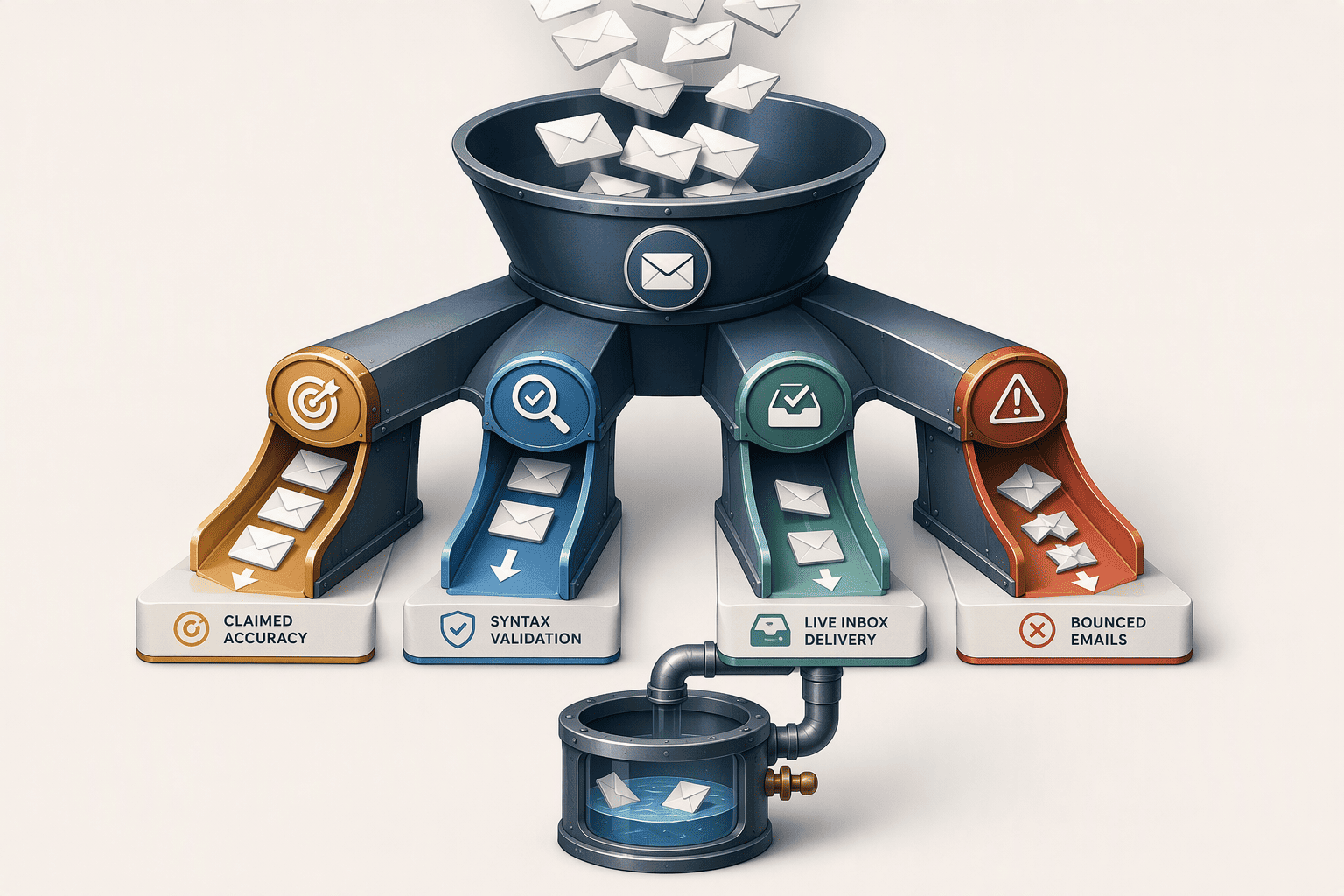
A database full of contacts that bounce is just an expensive list of wrong names. The only metric that converts to pipeline is deliverability.
Apollo claims 98% email accuracy. Users report 65 to 70%. Both numbers can coexist because platforms often measure syntax validation, not whether a human reads the email. A valid email format does not mean a live inbox. When you calculate cost per lead, divide your total spend by the number of emails that actually reached a person, not by the credits you purchased.
A tool that costs $0.05 per credit with 50% deliverability effectively costs $0.10 per valid lead. A tool that costs $0.10 per credit with 90% deliverability costs $0.11 per valid lead. The premium is one cent, but the second tool protects your domain reputation and does not waste your time on bad data.
India's regulatory environment sharpens this math. If you pull a phone number without consent and call, you risk legal action under TRAI regulations.
Email outreach is inherently safer because the act of sending is less intrusive, and opt-out mechanisms are straightforward. Email deliverability is also measurable: you can track open rates and bounces. Phone outreach is a black box of risk and unmeasured connection rates.
The most cost-effective tool is the one that delivers the highest number of compliant, reachable contacts per rupee spent. Price per credit is vanity. Deliverability is the cost.
Conclusion
Choose the tool that matches your current stage. A solopreneur validating an idea should start with Apollo.io's free tier. It gives you 900 annual credits at zero cost. No risk, just time.
A startup with unpredictable, low prospecting volume needs PeakAI's pay-per-use model. You buy credits as you go and skip the monthly seat you do not need. The 100% credit refund guarantee reduces the financial risk further.
A small team of five or more people needs a system, not just data. Apollo.io's paid plan provides the infrastructure to manage outreach at scale. FindThatLead's 1:1 credit model works here too.
One warning sits above all the pricing: phone data is a liability in India. The DPDP Act 2023 is in effect, and Lusha's history of GDPR complaints shows the risk is real. If you extract a phone number, verify consent before you dial, or route all outreach through email first. Test free tiers first and upgrade only when the credit math proves a positive return.
Frequently Asked Questions
What are the most affordable LinkedIn contact discovery tools for early-stage startups in India in 2026?
Apollo.io leads with a free plan of 900 annual credits. PeakAI offers a pay-per-use model with no monthly fee. Kaspr provides a free tier for basic phone and email extraction. FindThatLead operates a simple 1:1 credit economy, and Hunter.io gives 50 free monthly credits.
How does PeakAI compare to other budget-friendly LinkedIn email and phone finders for startups?
PeakAI competes on pricing flexibility. It charges per credit with no monthly seat fee, while Apollo and Lusha lock into per-user subscriptions. PeakAI says it delivers 91% phone accuracy and targets Indian MSME data, making it uniquely relevant for local prospecting.
What is the true accuracy and deliverability of affordable LinkedIn contact finders, and what metrics matter?
Apollo.io users report 65 to 70% real-world accuracy, despite Apollo claiming 98% verified accuracy. The only metric that matters is deliverability, how many emails reach a live inbox. Divide your total credit spend by deliverable contacts to find the true cost per lead.
What pricing models do these tools offer, and which is cheapest for low-volume startup needs?
Models include free tiers (Apollo, Lusha, Kaspr), pay-per-use credits (PeakAI), and monthly seat subscriptions (Apollo, Lusha). For low, unpredictable volumes, PeakAI's pay-per-use model is cheapest because you avoid paying for a monthly seat you rarely use.
What are the compliance and data privacy risks when using LinkedIn contact extraction tools in India?
Lusha faces documented GDPR complaints. Email outreach is comparatively safer and more straightforward to manage legally.
How can a startup choose between a Chrome extension and a full dashboard platform for LinkedIn prospecting?
Use a Chrome extension like Kaspr or Lusha when you are an individual founder doing manual, one-to-one prospecting. Switch to a full dashboard like Apollo.io when your team grows past five members and needs CRM sync, email sequencing, and team-level reporting.
