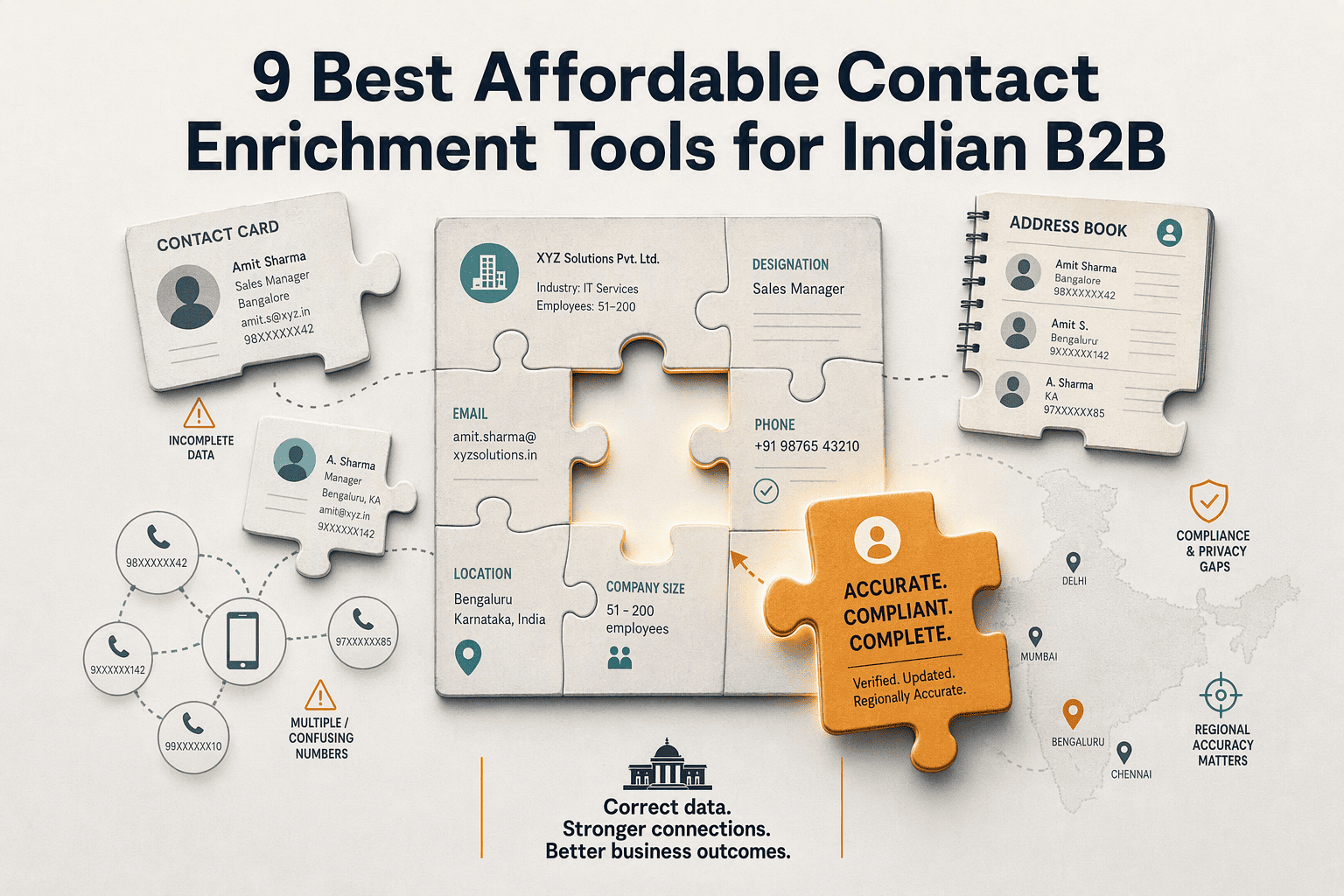
Indian B2B teams face a unique challenge: global contact enrichment platforms optimized for US and EU markets deliver 10–15 percentage points lower accuracy for Indian mobile numbers and business contacts.
This guide compares nine affordable contact enrichment tools by regional accuracy, pricing transparency, and compliance with India's Digital Personal Data Protection Act 2023.
Key Takeaways
- Affordable contact enrichment for Indian B2B means cost-per-verified-contact in the ₹70–125 range, not advertised seat prices
- Pay-per-use pricing eliminates 35–100% cost inflation from credit-based subscription models when match rates fluctuate
- Regional specialists achieve 91% accuracy for Indian mobile numbers through GST validation and MCA database integration
- India's mobile number portability and prepaid SIM prevalence break carrier-based validation APIs that work reliably in US markets
- DPDP Act 2023 compliance requires legitimate business interest frameworks and public-data enrichment without API scraping
What Makes Contact Enrichment 'Affordable' for Indian B2B Teams?
For Indian B2B teams targeting verified contact data, affordability means cost-per-verified-contact in the ₹70–125 range — exemplified by regional specialists like PeakAi (₹13.50 per contact at ₹675/50 credits ), Apollo.io (~₹84/contact when factoring in ₹4,200/user/month plans ), and Lusha (~₹60/contact at ₹3,000/user/month ), versus ₹165 to 330 for enterprise platforms like ZoomInfo (₹15-30 lakh annual contracts ). This section establishes the comparison framework anchored on pricing transparency, regional accuracy, and compliance.
Cost-Per-Verified-Contact: The Real Affordability Metric
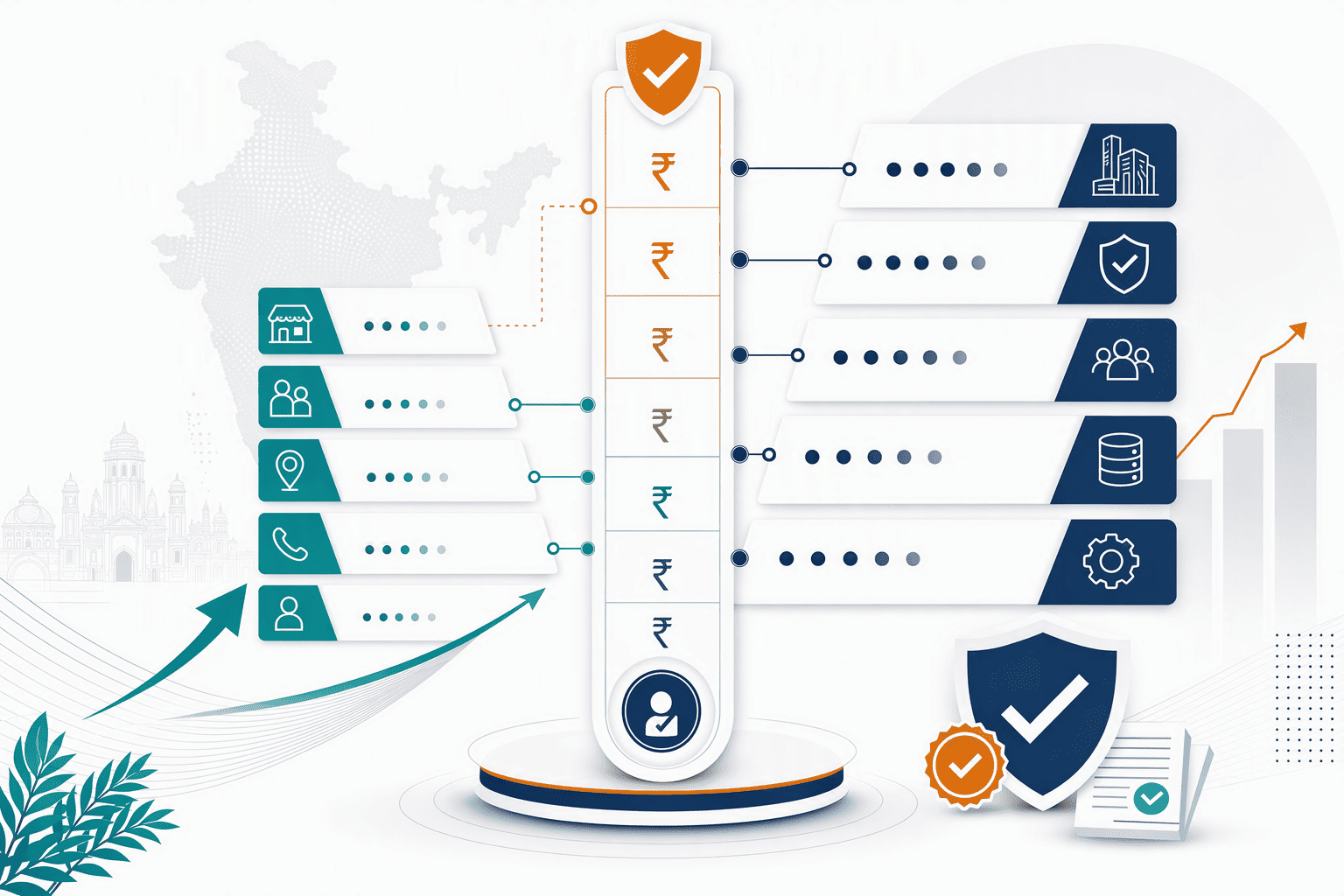
Advertised monthly seat prices mislead because verification rates vary. A ₹4,200/month plan delivering 50 verified contacts monthly costs ₹84 per contact; the same plan yielding 25 contacts costs ₹168. Indian B2B teams prioritize affordability and regional accuracy over global brand recognition when selecting lead generation tools, making cost-per-verified-contact, not headline pricing, the decisive metric. Tools in the ₹70 to 125 range serve startups and SMBs; ₹165 to 330 platforms fit enterprises with multi-market coverage needs.
Why Advertised Accuracy Rates Mislead in India
Global platforms testing 95% accuracy in US markets often drop to 70% or below in India due to mobile number portability (users switch carriers without changing numbers, invalidating carrier-based lookups) and prepaid SIM prevalence (corporate contacts use personal prepaid numbers not indexed in business databases). This 10 to 15 percentage-point gap means a nominally "affordable" tool at ₹80/contact becomes ₹114/verified-contact after bounce adjustments, shifting it into mid-tier pricing. Regional specialists narrow this gap through India-specific verification infrastructure.
Three Pillars: Pricing Transparency, Regional Verification, DPDP Compliance
This article evaluates platforms on pricing transparency (pay-per-contact versus seat licenses, GST handling), India-specific verification infrastructure (GST database integration, regional phone format validation, local carrier connectivity checks), and DPDP Act 2023 compliance (consent workflows, data residency). Tools excelling on all three deliver true affordability; those optimizing only headline pricing often underperform on verification rates or compliance overhead, raising total cost of ownership.
Understanding affordability benchmarks sets the foundation for evaluating how different platforms structure their pricing and deliver value to budget-conscious teams.
Pricing Models Compared: Pay-Per-Use vs. Subscription Tiers
How Credit-Based Subscriptions Obscure True Cost
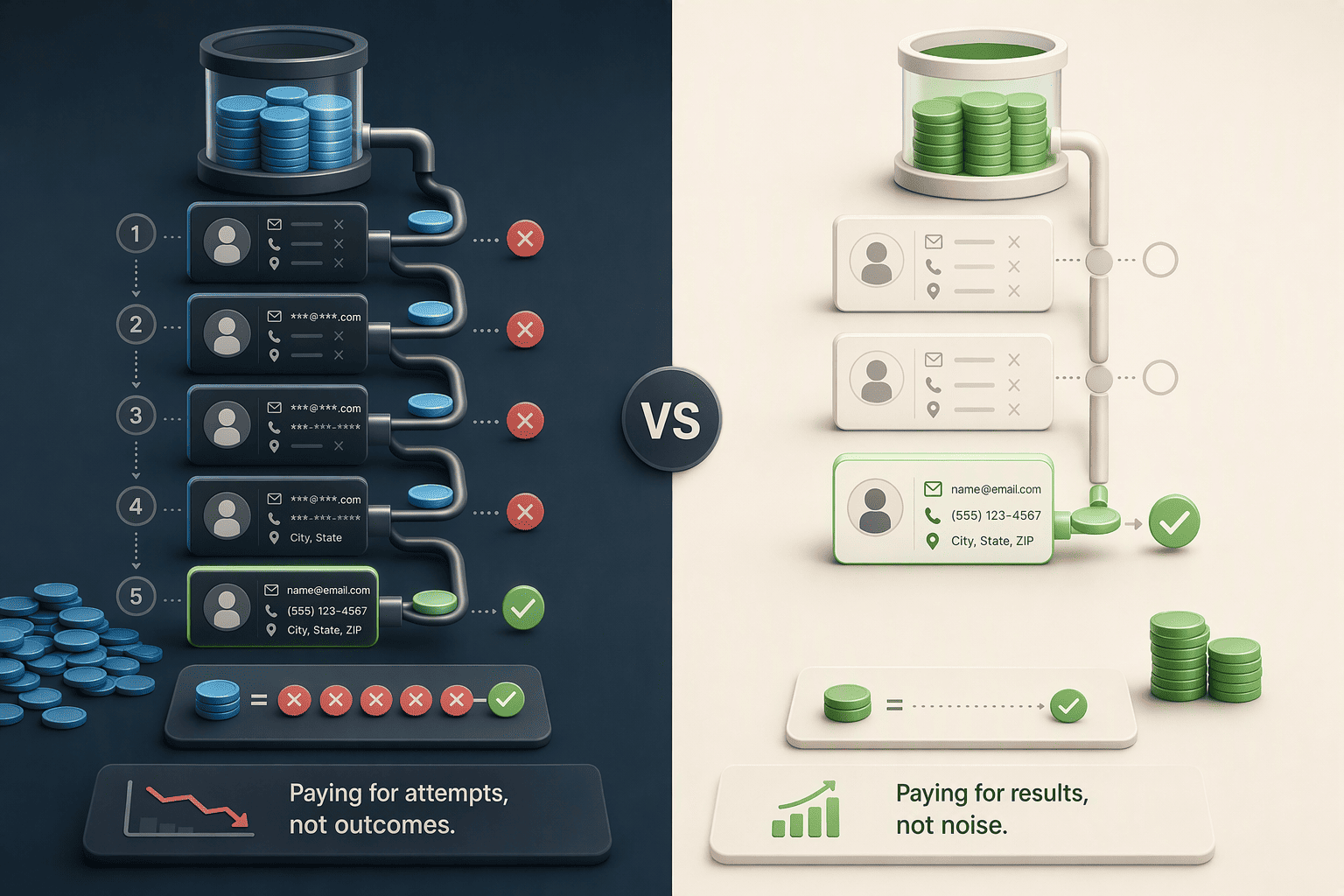
Credit-based pricing obscures true cost per usable contact by 35 to 100% when match rates fluctuate. Most subscription models bill per user monthly and allocate a fixed credit pool, Prospeo's Starter plan includes 2,000 credits per user/month, while Apollo bundles database access and sequencing at $49, $119 per user monthly. The problem: one credit typically equals one contact detail (email OR phone), not a complete enriched record. When a platform queries multiple providers sequentially to find a verified phone number, each failed lookup consumes credits without delivering the contact you need. For Indian B2B prospecting, where match rates for direct dials run 15 to 25 percentage points lower than US data, teams burn through monthly allocations faster, triggering mid-cycle top-ups or forcing sales to pause outreach until the next billing cycle.
Pay-Per-Use Models: Transparent Pricing for Budget-Conscious Teams
Pay-per-use models charge only for verified contacts delivered, eliminating the subscription waste common in credit-based plans. Tools that work start under $50/month, but comparing monthly subscription price alone misses the actual cost per usable contact. A platform advertising $49/month appears cheaper than a $9/250-credit pay-per-use option, until you account for match-rate variability. Pay-per-use pricing removes the guesswork: teams buy credits in advance (no recurring billing), spend them only when enrichment succeeds, and avoid paying for misses. This model suits Indian B2B teams managing tight budgets who need predictable cost-per-contact and can't afford to waste 35% of a monthly subscription on failed lookups.
Free Trials and Starter Credit Availability
Free trials vary widely: Apollo offers 50 emails/month on its free tier, Lusha provides 5 contacts/month, and Prospeo's Free plan includes 100 credits per month with a 25-row selection limit. These starter allocations let teams test data quality and India-specific match rates before committing to paid plans. For evaluation, prioritize platforms that grant enough credits to test your actual ICP, 5 contacts won't reveal whether a tool handles Indian company data well, but 50 to 100 credits will surface gaps in phone number coverage or email verification accuracy. Ready to transform your sales process? Teams evaluating enrichment tools should test free tiers against their real prospect lists to close more deals with verified contact data that matches their budget constraints.
Pricing transparency matters less if the enriched contacts don't reach prospects, regional accuracy determines whether your outbound investment delivers meetings or bounces.
Regional Accuracy: Why Global Tools Underperform in India
Global tools: accuracy drops below 70% for Indian contacts without regional specialization. The problem isn't database size, it's infrastructure mismatch. Platforms optimized for US and EU markets lack the carrier-level validation APIs and regulatory verification layers that Indian B2B prospecting demands.

Mobile Number Portability and Prepaid SIM Prevalence
India's mobile ecosystem operates under fundamentally different rules than Western markets. Mobile number portability lets subscribers switch carriers while keeping their number, breaking the carrier-prefix mapping that global validation APIs rely on. Prepaid SIMs account for over 90% of India's mobile subscriptions, creating high churn as users replace SIMs for better rates or coverage. Real-time LinkedIn profile enrichment tools validated against static carrier databases return stale numbers within weeks.
Carrier-level validation APIs that work reliably in the US fail here because India's telecom regulatory framework prioritizes consumer mobility over enterprise verification infrastructure. Global platforms ping carrier APIs expecting definitive active/inactive signals; they receive ambiguous responses or timeouts for ported numbers. The result: phone numbers flagged as valid that disconnect on first dial.
GST Validation: The India-Specific Verification Layer
GST number validation provides the strongest B2B authenticity signal for Indian contacts, stronger than email or mobile alone. Every registered business receives a unique 15-digit GSTIN tied to its PAN, state, and incorporation records. Cross-referencing a prospect's company against the GST and Ministry of Corporate Affairs databases confirms they represent a legitimate entity, not a consumer posing as a business lead.
Most global platforms omit GST validation entirely because it's irrelevant to their core US/EU markets. Apollo's B2B email database for India offers industry and size filters but doesn't expose GST verification in its enrichment flow. PeakAi integrates GST number validation and Ministry of Corporate Affairs record cross-referencing to verify company legitimacy before outreach.
Independent Testing vs. Vendor Accuracy Claims
Vendor-advertised accuracy rates of 95 to 98% reflect global averages heavily weighted toward North American and Western European contacts. Independent testing: average accuracy closer to 50% vs. Vendor claims of 95 to 98%. The gap widens further for tier-2 cities and SMB contacts where global databases have minimal coverage.
Large contact databases don't guarantee Indian accuracy, data enrichment quality matters more than lead volume. A platform with 270 million global contacts but no regional carrier partnerships will underperform a smaller tool with GST integration and real-time Indian telecom validation. Database breadth becomes a vanity metric when the underlying verification infrastructure can't handle mobile portability and prepaid churn.
With accuracy benchmarks established, the next step is comparing specific platforms on pricing, feature depth, and India-specific verification infrastructure.
Platform Comparison: PeakAi, Apollo, Lusha, and Clay
When evaluating affordable contact enrichment tools for Indian B2B prospecting, teams need side-by-side visibility into pricing transparency, India-specific accuracy, and compliance frameworks. The table below compares nine platforms across the dimensions that matter most for budget-conscious sales teams targeting the Indian market.

Comparison Table: Pricing, Accuracy, and India Coverage
| Platform | Starting Price | Free Trial | Primary Enrichment | India Coverage | Verified Accuracy | Compliance |
|---|---|---|---|---|---|---|
| PeakAi | $9 for 50 contacts | Yes | Email + phone | 91% for Indian B2B | 91% | GDPR, DPDP Act 2023 |
| Apollo | $49/user/month | 50 emails/month free | Email + firmographic | Limited direct-dial in India | 65-70% real-world | No formal GDPR cert |
| Lusha | $39/month | 5 contacts/month free | Phone + email | Strong European coverage | Direct & mobile numbers | ISO 27701, ePrivacy |
| Cognism | Custom pricing | Contact sales | Email + intent signals | EMEA-first | Not publicly disclosed | GDPR compliant |
| ZoomInfo | $15k+/year | No | Firmographic + intent | Global enterprise | Excellent | Annual contracts |
| Clearbit | Contact sales | No | Firmographic enrichment | US-centric | Not disclosed | GDPR compliant |
| Snov.io | Contact for details | Limited | Email verification | Global | Not disclosed | GDPR compliant |
| Kaspr | Contact for pricing | Contact sales | Phone + email | Europe-focused | Not disclosed | GDPR compliant |
| LeadIQ | Contact sales | Limited free tier | Email + CRM sync | US-first | Not disclosed | GDPR compliant |
PeakAi's pay-per-use model eliminates subscription lock-in while delivering verified contact data optimized for Indian business networks. The platform's 91% accuracy claim for Indian B2B contacts is grounded in GST verification and MCA database integration, unlike global platforms that apply uniform validation rules across markets.
PeakAi: 91% Accuracy with Pay-Per-Use Transparency
PeakAi delivers verified phone numbers and emails from LinkedIn profiles with 91% accuracy in 10 seconds, specifically optimized for Indian business contacts through GST verification and MCA database integration. The platform's pricing model accommodates Indian SMB budgets rather than requiring enterprise-level commitments, with credit-based pricing starting at ₹675 for 50 contacts.
Strengths: Regional verification infrastructure (GST, MCA databases), transparent pay-per-contact pricing with no subscription fees, 100% refund guarantee for incorrect numbers, DPDP Act 2023 compliance framework.
Limitations: Narrower account research features compared to enterprise platforms like ZoomInfo; focus on contact accuracy over firmographic breadth means less technographic or intent signal data.
Best for: Budget-conscious Indian B2B sales teams that prioritize verified mobile numbers and direct-dial accuracy for cold calling over account intelligence breadth. Teams needing GST validation and regional phone format verification will find PeakAi's India-first methodology delivers higher connectivity rates than global platforms applying uniform rules.
Apollo, Lusha, Clay: Where Global Platforms Fit
Apollo bundles the database, sequencer, and dialer at $49-$119 per user per month, enabling new SDRs to start prospecting within an hour. The platform's 275-million-contact database supports account research and firmographic filtering, though real-world email accuracy hovers around 65-70% with bounce rates of 15-25%. Apollo's single-source rate is around 42%, and more than 60% of all contacts are in the US, with fewer quality contacts in EMEA, APAC, and LATAM. The platform has no formal GDPR-related certification, and Apollo documentation recommends customers exclude EU data while using the tool to protect themselves.
Lusha provides more direct-dial phone numbers, better lead intelligence, and plenty of actionable insights in an easily scalable platform [F2-1, F2-2, F2-3]. The platform provides direct and mobile numbers almost exclusively, with data refreshed on a daily basis. Lusha offers over 20 million contacts with verified contact details in Europe and is GDPR compliant by several impartial third-party auditors including ISO 27701-certified, ePrivacy seal, and Truste. Pricing starts at $39/month, with one credit equaling one contact or company; on the Scale plan, credits are unlimited for manual use and only apply to bulk exports.
Clay's waterfall enrichment calls 150+ data providers and hits email match rates around 78%, significantly higher than Apollo's single-source approach. Clay's Claygent agent autonomously browses the web, reads job posts and blog posts, and pulls out specific signals like facility expansions or executive hiring. However, onboarding typically takes several weeks, and the platform requires RevOps engineering expertise to design effective workflows.
Where they excel: Account research value, firmographic data, technographic signals, buying intent, and database breadth for global prospecting. Apollo and Clay shine for teams that need workflow automation, multi-touch sequences, and research depth across international markets.
India-specific limitations: Direct-dial accuracy for Indian mobile numbers lags behind regional specialists; global validation rules miss GST verification and MCA database cross-reference; higher per-contact costs when annual contracts or user-seat pricing is mandatory. Teams targeting Indian B2B contacts often supplement these platforms with regional verification layers to close more deals.
Ready to find accurate contact information for your Indian B2B prospects? Add to Chrome - Free and join thousands of sales professionals using verified enrichment tools built for regional accuracy.
Platform capabilities mean little if your enrichment workflow violates data protection regulations, compliance frameworks determine long-term operational viability.
Compliance Frameworks for Indian B2B Contact Discovery
DPDP Act 2023: Consent vs. Legitimate Business Interest
India's Digital Personal Data Protection Act 2023 governs how B2B teams collect and process professional contact details. The Act requires explicit consent for personal data processing, but carves out space for legitimate business interest when data comes from publicly accessible sources or business registries. Tools that enrich contacts using verified business databases and public records, rather than scraping LinkedIn profiles directly, can rely on this framework, provided they implement consent documentation and cross-border data transfer safeguards. Before signing a vendor contract, verify the data sourcing methodology: does the platform query independent databases, or does it extract contact fields directly from LinkedIn profiles? The latter creates compliance risk and potential account suspension exposure.

GDPR Article 6(1)(f) and Cross-Border Data Transfers
When Indian vendors enrich contacts for global campaigns, particularly into the EU, GDPR Article 6(1)(f) legitimate business interest becomes the applicable legal basis. This framework permits processing personal data without explicit consent when necessary for legitimate commercial purposes, provided the processing does not override the individual's fundamental rights. Nominal email addresses, direct phone numbers, and individual names qualify as personal data; generic company email addresses and legal-entity data do not. Enriching contacts with verified mobile numbers and GST-validated firmographic data reduces bounce rates below 2%, strengthening the legitimate business interest argument by demonstrating responsible list hygiene and reducing spam-flag exposure.
LinkedIn API Access: The Compliance Risk Factor
Platforms that rely on unofficial LinkedIn API access or profile scraping, naming Apollo and Lusha as examples often cited in vendor comparisons, face higher Terms of Service violation risk and account suspension exposure. Enrichment-based tools that query third-party databases using LinkedIn URLs as reference identifiers, rather than accessing LinkedIn's internal APIs, avoid this compliance gray area. PeakAi sources verified contact data through legitimate business databases and public records, maintains GDPR, CCPA, and DPDP Act 2023 compliance, and provides GST verification to validate Indian business legitimacy, delivering verified contacts without the account-risk overhead that accompanies direct LinkedIn scraping.
FAQ: Affordable Contact Enrichment for Indian Teams
The affordability question extends beyond sticker price to the total cost of unusable contacts and compliance risk. Teams evaluating contact enrichment tools for the Indian B2B market face three interrelated trade-offs: pricing transparency versus hidden verification fees, global breadth versus India-specific phone accuracy, and monthly subscriptions versus pay-per-use models that match irregular prospecting cycles.
The following FAQ addresses platform selection criteria, pricing model trade-offs, and compliance requirements that global contact database guides typically omit. It covers questions on GST validation, regional mobile accuracy gaps, and credit-based pricing, the operational realities that determine whether a tool delivers verified contacts or expensive bounce lists. For Indian teams looking to find accurate contact information without enterprise-level commitments, platforms like PeakAi start at ₹675 for 50 contacts, offering pay-per-use pricing that accommodates SMB budgets.
Ready to Transform Your Sales Process? The structured FAQ below provides the decision framework Indian sales teams need to compare enrichment platforms on the dimensions that matter most for regional prospecting.
Choosing the Right Contact Enrichment Tool for Your Indian B2B Team
Global platforms like Apollo and ZoomInfo deliver superior account research features, firmographic data, technographic signals, buying intent, but require regional accuracy validation for Indian mobile contacts. PeakAi trades breadth of account intelligence for depth of India-specific contact verification. Credit-based subscriptions suit teams with consistent high-volume prospecting needs and predictable match rates; pay-per-use models like PeakAi's offer transparency and no long-term commitment for budget-conscious teams managing fluctuating outbound campaigns.

As India's B2B SaaS market matures and DPDP Act 2023 enforcement tightens, contact enrichment platforms will differentiate on regional verification infrastructure and compliance frameworks rather than database size alone, expect GST validation and carrier-level mobile accuracy to become table-stakes features by 2027.
Test PeakAi's 91% accuracy for Indian B2B contacts with pay-per-use pricing, no subscription required, 100% refund for wrong numbers.
Frequently Asked Questions
What is the average cost per verified contact for Indian B2B enrichment tools?
Affordable regional specialists like PeakAi deliver cost-per-verified-contact in the ₹70 to 125 range (₹13.50 per contact at ₹675/50 credits), while enterprise platforms charge ₹165 to 330. Pay-per-use models offer more predictable costs than credit-based subscriptions, which obscure true cost by 35 to 100% when match rates fluctuate.
Why do global contact enrichment platforms show lower accuracy in India?
Global platforms test 10 to 15 percentage points lower in India due to mobile number portability, prepaid SIM prevalence, and lack of carrier-level validation API partnerships. India's telecom regulatory framework prioritizes consumer mobility over enterprise verification infrastructure, breaking carrier-based lookups that work reliably in US markets.
What is GST validation and why does it matter for Indian B2B prospecting?
GST validation verifies a business's 15-digit Goods and Services Tax registration number to confirm legal operating status in India. It provides a stronger B2B authenticity signal than email or mobile validation alone, filtering out non-existent or dormant entities by tying GSTIN to PAN, state, and incorporation records.
Is pay-per-use or subscription pricing better for budget-conscious Indian teams?
Pay-per-use models offer pricing transparency and no long-term commitment, making them better for teams with fluctuating prospecting volume. Credit-based subscriptions obscure true cost per usable contact by 35 to 100% when match rates fluctuate, though they suit teams with consistent high-volume needs and predictable match rates.
Does PeakAi comply with DPDP Act 2023 for Indian B2B contact discovery?
PeakAi operates under GDPR Article 6(1)(f) legitimate business interest for B2B prospecting, uses public-data enrichment without LinkedIn API access, and offers 100% refund for wrong numbers. This compliance framework aligns with DPDP Act 2023 requirements for legitimate business interest processing and avoids Terms of Service violation risk.
How can I test contact enrichment accuracy before committing to a platform?
Start with free trials or starter credits, Apollo offers 50 emails/month, Lusha provides 5 contacts/month, and Prospeo includes 100 credits per month. Enrich 50 to 100 known contacts to measure match rate, verify mobile numbers manually to calculate actual cost per usable contact, and note that vendor-advertised accuracy rates rarely predict India-specific performance.
Which platforms support both email and mobile enrichment for Indian contacts?
PeakAi, Apollo, Lusha, and Cognism offer both email and mobile enrichment. PeakAi's 91% accuracy for Indian mobile numbers leads the comparison table through GST verification and MCA database integration, while global platforms excel at email enrichment but show lower mobile accuracy in India.
Sources
- Best Lead Generation Tools India 2026 — 7 Picks for B2B - www.itforsme.in (2026)
- 10 Best Platforms for Automatic LinkedIn Profile Enrichment in CRMs - linkfinderai.com
- LinkedIn Profile Scraper, real-time, cheap lead enrichment - apify.com
- Redefining 'leads' in B2B: Why data enrichment is key for lead gen - martech.org
- Clay vs Apollo.io: Which AI Sales Prospecting Tool Should You Actually Pay For in 2026? - aitechrankings.com (2026)
- Legal Basis for B2B Data Enrichment: The Full GDPR Guide (2025) - derrick-app.com (2025)
- Email Bounce Rates Explained: Causes, Types, and Fixes for Cold Email - puzzleinbox.com (2026)
