
Finding verified contact data on LinkedIn doesn't require enterprise budgets or long-term subscriptions. Startups can now choose between pay-per-use models and affordable monthly plans that scale with prospecting volume.
Key Takeaways
- Affordable means flexible spend—paying only for verified contacts, not locked monthly minimums that create waste during inactive prospecting periods
- Pay-per-use models cost $9-$18 for 50 contacts with no expiration, while subscriptions start at $36-$49/month with credit forfeiture on cancellation
- Hidden costs include 35-100% credit burn from match-rate variance, unused-credit expiration, and regional coverage gaps that reduce effective ROI
- Break-even threshold sits at 100-300 contacts monthly—below 100, pay-per-use wins; above 300, subscriptions deliver lower per-contact costs
- Enterprise platforms become cost-effective only after $3-5M ARR, 20+ sales reps, or 1,000+ monthly verified contacts with advanced CRM enrichment needs
What 'affordable' actually means for startup contact discovery
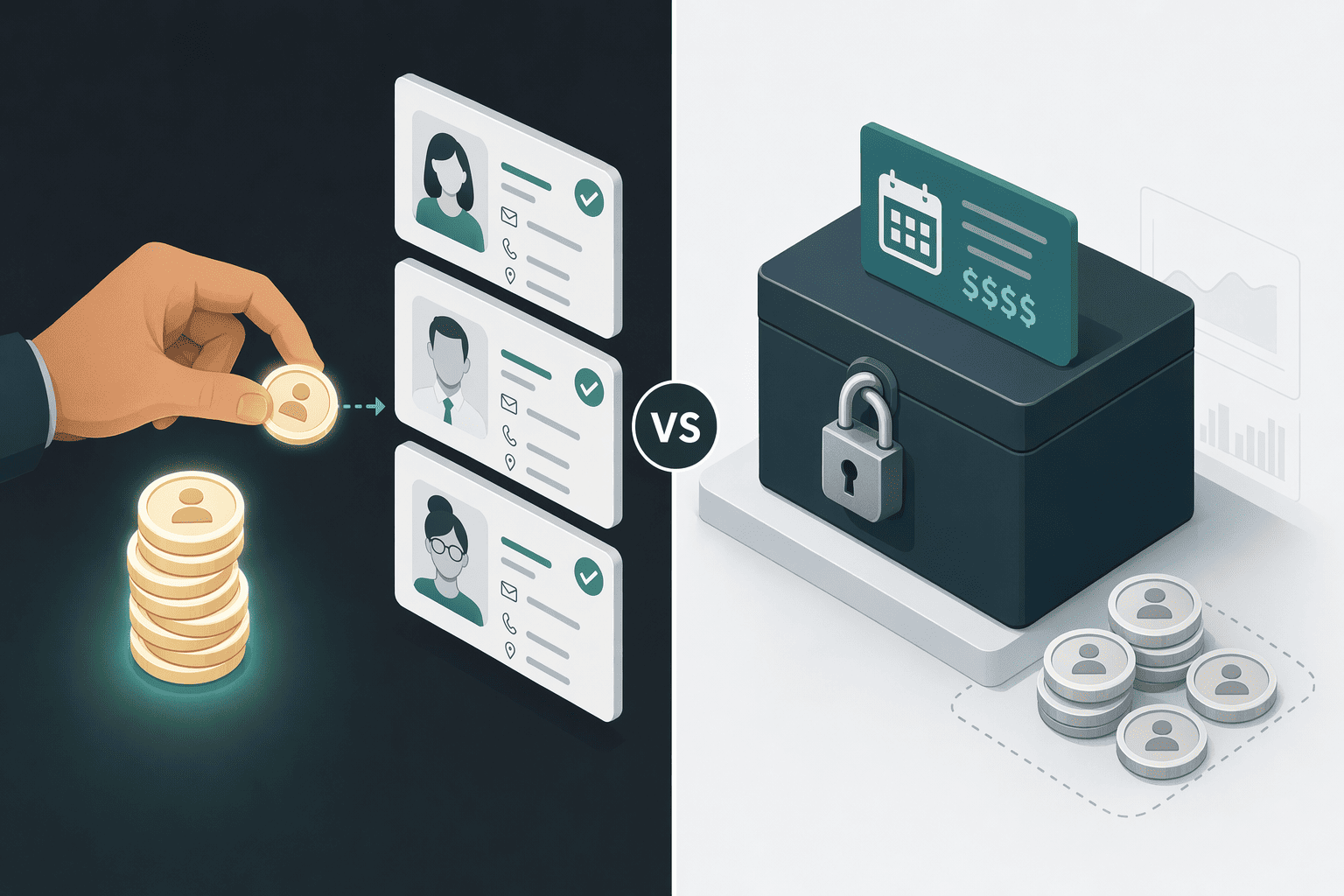
For seed-stage teams, affordable means flexible spend — paying only for contacts you verify — not the lowest sticker price locked behind a monthly subscription. PeakAi's credit-based model starting at $9 for 250 credits lets you purchase on demand with no monthly cap, avoiding subscription floors that exceed intermittent prospecting budgets.
Flexible spend vs low entry price
Apollo.io's paid plans start at $49/user/month, while Lusha's begin at $36/user/month, both require recurring commitments that accumulate to $432, $588 annually per seat. Mid-tier options like HeyReach ($79/seat/month ) and Trigify ($149/month ) push annual spend into four-figure territory before you've verified a single contact. When your team prospects episodically, 50 contacts one month, zero the next, a $9 no-commitment credit pack is genuinely more affordable than a $49 monthly floor you can't pause.
Hidden costs that inflate the real price
Advertised per-credit pricing hides three cost multipliers startups miss: credit burn rates (35 to 100% variance due to match-rate fluctuations ), unused-credit expiration (monthly allowances forfeit unspent units), and refund-policy gaps (many platforms charge for unverified reveals). A tool advertising $0.20/credit becomes $0.35, $0.40/usable-contact after match-rate losses. Close more deals by calculating cost-per-verified-contact, not cost-per-attempt, before committing annual spend to platforms that don't guarantee match rates or refund failed lookups.
Understanding what affordable means sets the foundation for evaluating pricing structures. The next question is whether monthly subscriptions or pay-per-use credits deliver better value at startup prospecting volumes.
Pay-per-use vs subscription: the real cost difference for startups
Subscription lock-in: when monthly minimums exceed usage
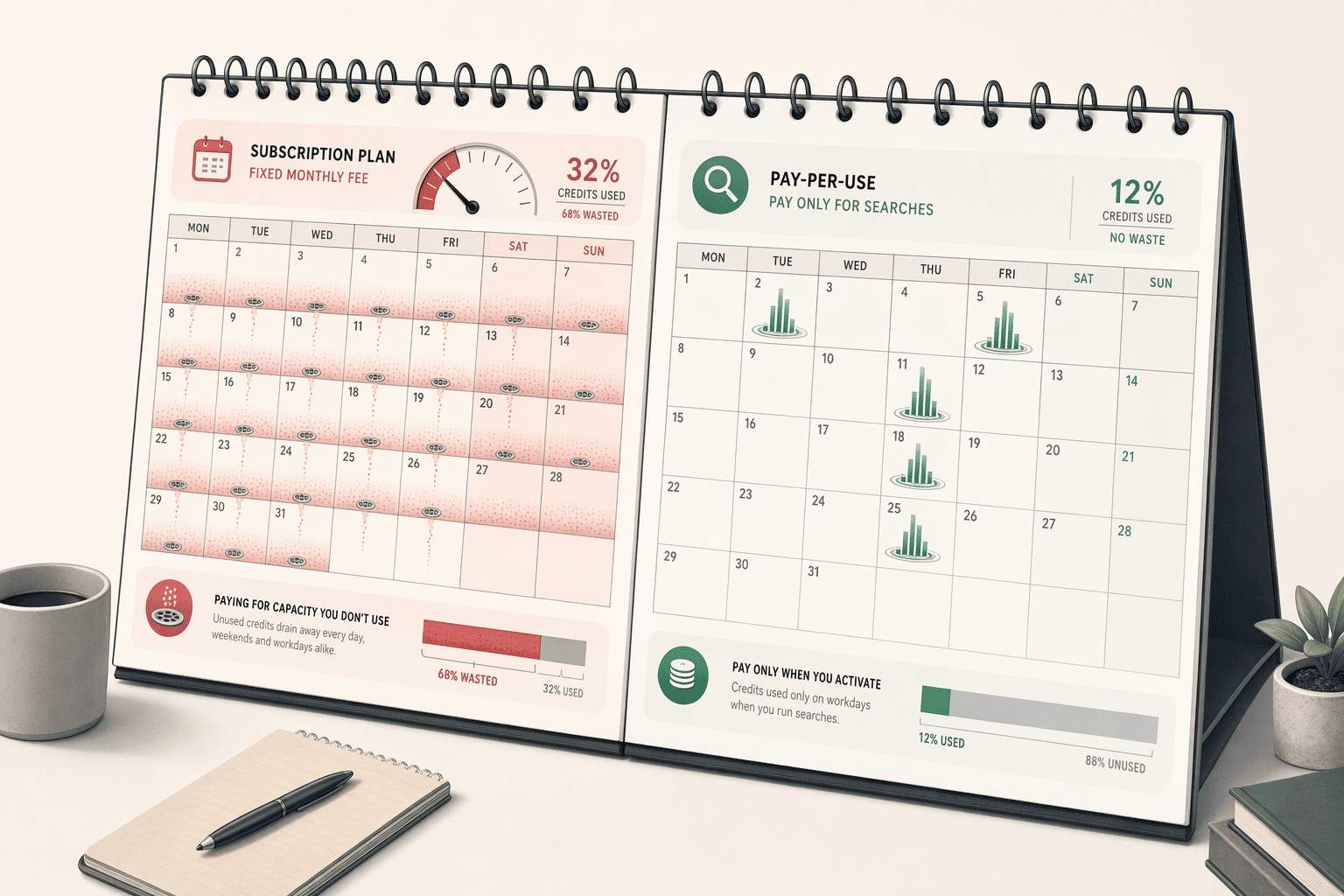
Monthly subscriptions create waste when prospecting volume is intermittent. A startup paying $49 per user per month commits to that minimum even during weeks of low activity. Hunter's free tier offers 25 searches per month, dividing across a typical 20-workday month yields 1.25 prospects per day. Once you exhaust those searches, you're either paying for a full subscription or halting prospecting mid-cycle. For teams that prospect 2-3 days per week, subscription minimums often exceed actual usage by 40-60%, turning unused credits into sunk costs.
Pay-per-use flexibility: scaling spend with actual need
Pay-per-use models eliminate the penalty for inactive months. When you prospect only during quarterly campaigns or seasonal outreach cycles, you pay solely for verified contacts delivered, no monthly floor, no credit expiration. This approach aligns cost with revenue-generating activity: a startup running a two-week campaign every quarter can purchase 50 contacts at $9, pause entirely during product development sprints, and resume prospecting without forfeiting unused credits. The model suits bootstrapped teams that cannot justify recurring SaaS spend during periods of low sales velocity.
Break-even analysis: which model wins at what volume
At 50 contacts per month, pay-per-use costs $9 ($0.18 per contact). A subscription at $49 per user per month requires 272 contacts monthly to match that per-contact rate, well above sporadic prospecting volume. Between 100-300 contacts per month, compare both: if your monthly need fluctuates, pay-per-use avoids waste; if you consistently prospect 300+ contacts, subscription platforms may offer better unit economics. The break-even threshold sits around 270-300 contacts per month, below that, pay-per-use wins; above it, subscription models can close more deals at lower marginal cost per verified lead.
With the economics of both pricing models clear, let's examine eight specific tools that fit startup budgets, from free tiers to pay-per-contact models.
8 Most Affordable LinkedIn Contact Discovery Tools Compared
Startups need verified contact data without enterprise budgets or long-term lock-in. The 8 platforms below range from subscription-based suites to pay-per-use models, each optimized for different prospecting rhythms and team sizes.

Subscription-based tools: Apollo, Lusha, Kaspr, LinkedIn Sales Navigator
Apollo.io combines a 275M+ contact database with email sequencing in a single platform. Free tier with real data access; paid from $49/user/mo. Best for SMBs running sustained outbound campaigns who value all-in-one prospecting over point-in-time lookup.
Lusha delivers verified emails and direct dials via a Chrome extension for LinkedIn, Sales Navigator, or company websites. Free tier offers 5 credits/mo; paid from $36/user/mo. Clean interface and strong compliance certifications (ISO 27701, ePrivacy seal) make it ideal for teams prioritizing data privacy. Lower tiers limit bulk export.
Kaspr and LinkedIn Sales Navigator cater to teams already embedded in the LinkedIn ecosystem. Sales Navigator provides advanced search filters and InMail credits but carries the highest price point in this roundup, making it less accessible for early-stage startups watching every dollar.
Pay-per-use and hybrid models: Hunter, Snov.io, UpLead, PeakAi
Hunter.io, Snov.io, and UpLead offer flexible credit-based pricing that suits intermittent prospecting. Hunter focuses on domain-based email discovery; Snov.io and UpLead blend database access with drip-campaign features. All three provide free starter credits and pay-as-you-go tiers, eliminating monthly minimums when deal flow slows.
PeakAi starts at $9 for 50 verified contacts, delivering both email and phone discovery in a single lookup. The 100% credit refund guarantee for incorrect data within 24 working hours provides financial protection when accuracy matters. PeakAi avoids LinkedIn scraping by querying third-party databases using profile URLs as reference identifiers, sidestepping the account-suspension risk that affects scraping-based tools. Best for startups needing verified phones for cold calling, intermittent prospecting cycles, and India-focused B2B campaigns. Smaller database than Apollo or Lusha; less suited to high-volume global outreach.
Compliance note: Tools that scrape LinkedIn profiles on-demand risk Terms of Service violations and account suspension. Enrichment-based platforms query independent databases rather than crawling LinkedIn directly, reducing policy risk.
For deeper accuracy benchmarks across sales intelligence platforms, see our roundup of the most accurate sales intelligence tools for the Indian B2B market.
Feature sets tell only part of the story. A direct pricing comparison reveals exactly where each tool sits on the cost curve, and which hidden fees can derail your budget.
Side-by-side pricing comparison: monthly minimums vs credit costs
Choosing between subscription-based and pay-per-use pricing shapes your prospecting budget. Monthly minimums lock in fixed overhead, while credit models flex with actual usage. Below is a focused comparison isolating the two structures.

Monthly subscription floors and annual commitment discounts
| Tool | Monthly Minimum | Annual Lock-In |
|---|---|---|
| PeakAi | No monthly fee | N/A |
| Lusha | $49/mo | Required |
| Apollo.io | $49/user/mo | Optional |
| Snov.io | Not disclosed | Not disclosed |
| Kaspr | $49/mo | Optional |
| UpLead | Not disclosed | Not disclosed |
| Hunter.io | $49/mo | Optional |
| LinkedIn Sales Navigator | Not disclosed | Not disclosed |
Lusha's annual-only entry tier means startups pay $588 upfront. Apollo and Kaspr offer monthly billing flexibility but still charge recurring fees regardless of usage.
Per-contact cost after factoring match rates and refunds
PeakAi's pay-per-contact model starts at ₹675 for 50 contacts ($0.85, $1.50 per verified contact). The platform refunds credits within 24 hours for incorrect numbers, lowering effective cost per verified contact. Subscription tools charge whether data is accurate or not, pushing true cost-per-verified-contact higher when match rates drop below 90%.
Pricing tables show what you'll pay, but the right choice depends on your current stage. Matching tool economics to your prospecting volume and CRM maturity prevents overpaying or outgrowing a platform in six months.
How to pick the right tool for your startup stage and budget
Choosing the right contact discovery tool depends on three factors: your prospecting volume, team size, and CRM integration needs. Startups at different stages face different trade-offs between cost, flexibility, and workflow automation. This framework maps your stage to the tool category that fits.

Seed stage (<10 employees, sporadic prospecting)
When you're prospecting fewer than 50 contacts a month and have no CRM yet, pay-per-use tools offer the best value. PeakAi charges ₹675 ($9) for 50 verified contacts with no monthly commitment, making it cost-effective for founders testing messaging before scaling outbound. Hunter's free tier (25 searches/month) works for even smaller volumes but lacks phone verification. At this stage, avoid subscription tools, you'll pay for credits you won't use.
Series A (10-50 employees, steady pipeline building)
Once you're prospecting 100-300 contacts monthly with a sales team and an early CRM setup (HubSpot, Salesforce), hybrid models and entry-tier subscriptions become competitive. Apollo.io starts at $49/user/month with native CRM integrations and combines a 275M+ contact database with email sequencing in a single platform. Snov.io and UpLead offer mid-tier plans with bulk export and CRM sync, suited for teams running multi-step sequences. At this stage, compare the effective cost-per-contact (subscription fee ÷ monthly prospecting volume) against pay-per-use tools to find your break-even point.
CRM integration and data decay considerations
Native CRM sync matters because contact data decays at 2-3% monthly as professionals change jobs. Tools with native Salesforce or HubSpot integrations (Apollo, Lusha, ZoomInfo) automatically update records and trigger re-verification workflows. Lower-tier tools rely on CSV export, forcing manual imports that lag behind job changes. For startups without CRM automation, pay-per-use models with real-time verification (like PeakAi ) reduce the cost of re-verifying stale contacts compared to subscription tools with static databases.
Affordable tools serve seed-stage needs well, but recognizing when to graduate prevents bottlenecks. Knowing the upgrade triggers helps you time the transition without premature spend.
When to upgrade from affordable tools to enterprise platforms
Revenue and team size triggers
Startups should consider enterprise platforms when annual recurring revenue exceeds $3 to 5M, the sales team grows beyond 20 to 25 reps, or prospecting volume consistently surpasses 1,000 verified contacts per month. Teams requiring 5,000+ monthly contacts typically trigger custom pricing tiers that bundle API access and dedicated account management. Below these thresholds, affordable tools deliver sufficient coverage without the overhead of enterprise contracts.

Feature gaps in affordable tools that justify the upgrade
Enterprise platforms like ZoomInfo and Apollo deliver account-level enrichment, buying-intent data streams, advanced segmentation by firmographics and technographics, and dedicated customer success managers, capabilities absent in most affordable tools. Intent data becomes relevant after $3M ARR, when account-based strategies replace spray-and-pray outreach. API access, critical for teams integrating contact discovery into broader RevOps workflows, typically appears only in enterprise tiers. Upgrading before 500 contacts per month locks teams into unused features and inflated pricing.
Making the Right Choice for Your Startup Stage
Pay-per-use tools like PeakAi and UpLead offer flexibility and no wasted credits, but lack the per-contact cost efficiency of subscriptions at high volume (>300 contacts/month). Subscription platforms (Apollo, Lusha) deliver lower per-contact costs at scale but impose monthly minimums that exceed seed-stage budgets and forfeit unused credits on cancellation.
As contact data decay accelerates (2-3% monthly) and AI-driven enrichment becomes commoditized, the next competitive frontier will be real-time verification and refund guarantees, not just database size or price-per-credit. Startups gain use when tools absorb accuracy risk rather than passing it downstream.
Start with PeakAi's $9 starter pack (250 credits, no subscription) to test contact discovery without monthly commitment, 100% refund for wrong numbers within 24 hours means zero risk for your first prospecting sprint. Once you validate your sales motion and exceed 300 contacts monthly, reevaluate subscription economics with usage data in hand.
Frequently Asked Questions
Do I need LinkedIn Premium or Sales Navigator to use contact discovery tools?
Most contact discovery tools (Apollo, Lusha, Hunter, PeakAi) query third-party databases and do not require LinkedIn Premium. Sales Navigator is only needed for LinkedIn's native InMail and advanced filters. Tools that scrape LinkedIn carry a 15-20% account suspension risk, while PeakAi avoids this by not scraping LinkedIn directly.
What happens to unused credits when I cancel a subscription?
Most subscription platforms (Apollo, Lusha, Kaspr) forfeit unused credits on cancellation with no rollover or refund. Pay-per-use tools like PeakAi and UpLead offer credits with no expiration, eliminating the penalty for inactive months. This makes pay-per-use models ideal for quarterly or seasonal prospecting campaigns.
How accurate are the contact details from affordable tools?
Independent testing shows average accuracy around 50%, despite vendor claims of 95-98%. Accuracy varies by tool, region (APAC coverage is typically lower), and verification method. PeakAi mitigates this risk with a 100% credit refund guarantee for incorrect data within 24 working hours, protecting startups from wasted spend on bad contacts.
Can I integrate these tools with HubSpot or Salesforce?
Apollo, Lusha, and UpLead offer native CRM integrations with one-click sync, while Hunter, Kaspr, and Snov.io require CSV export workflows. Native sync matters because contact data decays at 2-3% monthly as professionals change jobs. PeakAi supports CSV export with native integrations planned for Q3 2026.
Which tool is best for finding India and APAC contacts?
Global tools (Apollo, Lusha, LinkedIn Sales Navigator) have broader databases but lower APAC accuracy. Regional-focused tools like PeakAi, optimized for India, may offer higher match rates for India contacts. PeakAi starts at $9 for 50 verified contacts with both email and phone discovery, backed by a 100% refund guarantee for incorrect data.
At what prospecting volume should I switch from free/pay-per-use to a subscription?
Below 100 contacts monthly, pay-per-use wins; at 50 contacts/month, you pay $9 ($0.18 per contact). The 100-300 contact range is the crossover zone where both models compete. Above 300 contacts monthly, subscriptions deliver lower per-contact rates, a $49/month plan requires 272 contacts monthly to match pay-per-use economics.
Are there risks of LinkedIn account suspension when using these tools?
Tools using Chrome extensions or automated LinkedIn scraping (Kaspr, some Apollo usage) carry a 15-20% suspension rate for heavy users. Tools querying third-party databases (PeakAi, Hunter, UpLead) avoid LinkedIn ToS violations. PeakAi does not scrape LinkedIn directly, eliminating account-risk while delivering verified contact data at $9 for 50 contacts.
Sources
- Apollo.io Alternatives 2026: LinkedIn Prospecting Compared - satellyte.ai (2026)
- Lusha vs Apollo: Definitions, Key Differences, Benefits, Pricing, and Top Alternatives - www.bookyourdata.com
- How to find phone numbers from Linkedin? (+ Tools) - folk CRM - www.folk.app
- LinkedIn Outreach Automation: How We Do It Without Getting Banned - talhafakhar.medium.com (2026)
- 8 Best Kaspr Alternatives [2026]: Beyond LinkedIn Data | Cleanlist - cleanlist.ai (2026)
- 15 Best LinkedIn Sales Navigator Alternatives (2026 Guide) - Fundraise Insider - fundraiseinsider.com (2026)
