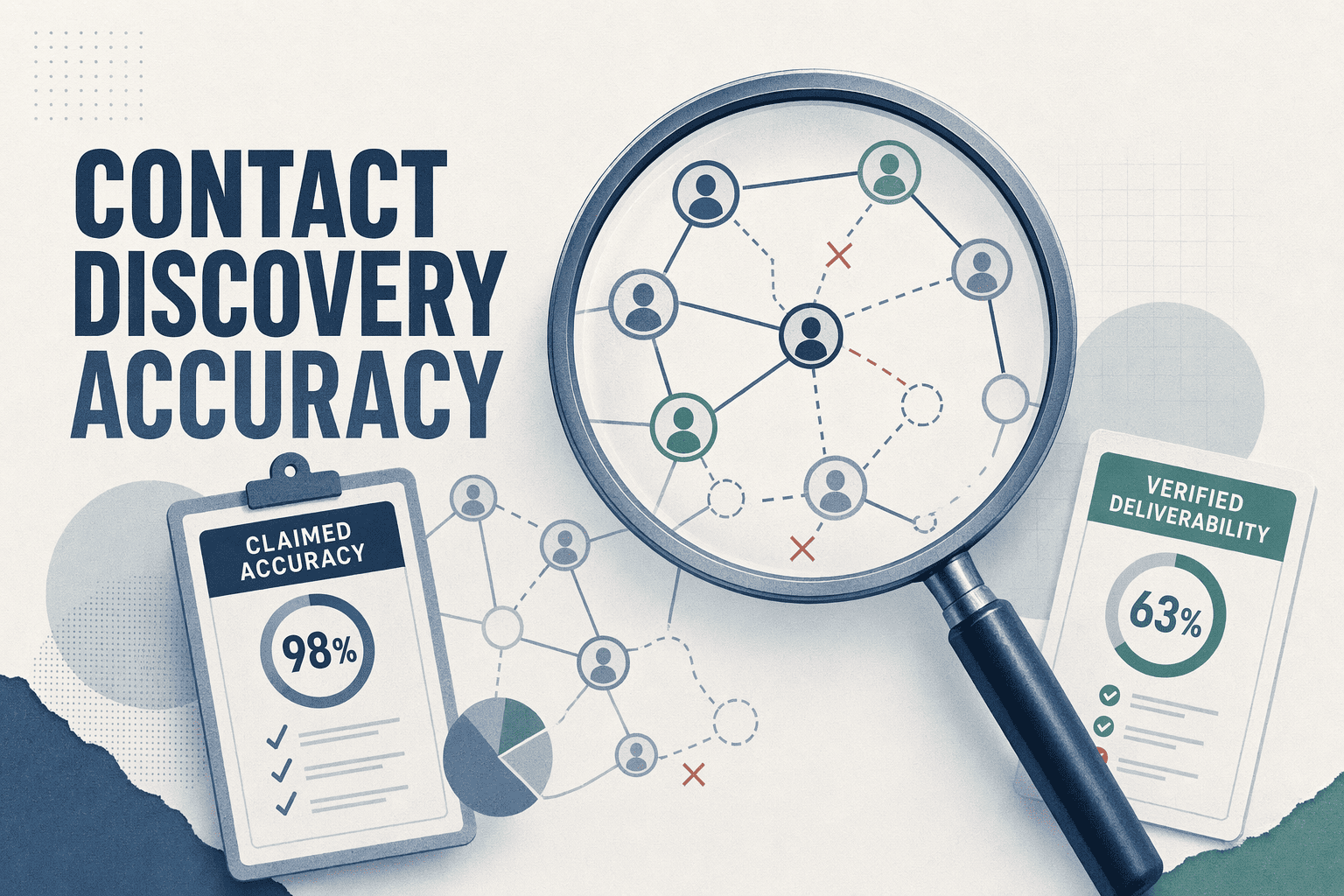
Vendor accuracy claims between 95-98% rarely survive independent testing, which consistently measures 50-70% deliverability. Real B2B prospecting success depends on verification methods, regional coverage, and cost-per-verified-contact—not marketing percentages.
Key Takeaways
- Independent testing reveals 50-70% email deliverability versus vendor claims of 95-98% accuracy across major platforms
- SMTP-verified platforms (Apollo, ZoomInfo, PeakAi) achieve 90-95% email accuracy while phone accuracy lags at 40-60% due to LinkedIn's 5-10% availability
- Global platforms prioritize US/EU coverage, leaving India accuracy 10-15 percentage points lower; regional specialists deliver 91% India phone accuracy
- Pre-download verification reduces wasted credits; true cost-per-verified-contact ranges from ₹70-330 depending on accuracy and match rates
- Scraping-based tools trigger 15-20% LinkedIn suspension rates; enrichment-based platforms reduce compliance risk through registry-validated data
How to Evaluate Contact Discovery Accuracy Claims
The best contact discovery platform for B2B prospecting requires a framework-first evaluation approach rather than accepting vendor percentages at face value. Independent testing reveals average industry accuracy closer to 50% vs. Vendor claims of 95-98% — the gap exists because providers rarely disclose whether they measure syntax validation, SMTP deliverability, or genuine inbox reach. Seven platforms (Apollo.io, ZoomInfo, Clay, Cognism, Lusha, PeakAi, Hunter.io) were tested against the 5-pillar verification framework below to separate marketing claims from measurable performance.

Why Vendor-Claimed Percentages Require Methodology Transparency
Vendors publish accuracy rates between 95-98% but independent testing consistently measures 50-70% for email deliverability and 40-60% for direct-dial phone accuracy. The gap stems from verification method opacity: a provider counting syntax-valid emails ("[email protected]" follows RFC standards) reports higher accuracy than one testing SMTP handshake completion or inbox placement. Without disclosed methodology, a 95% claim may mean "95% of records have an @ symbol" rather than "95% reach a real inbox." Comparable platforms like Reachstream emphasize the business cost of taking these numbers at face value.
The 5-Pillar Verification Framework
Evaluate providers using these criteria before committing budget:
- Verification method — Does the vendor test syntax only, SMTP handshake, or inbox placement? PeakAi discloses dual verification for emails and phone numbers; many competitors stop at format checks.
- Regional testing — Accuracy for US-based contacts often exceeds 80%; EMEA and APAC drop to 40-60%. Ask for geography-specific accuracy breakdowns matching your ICP.
- Compliance sourcing — Platforms scraping LinkedIn directly violate Terms of Service and risk account suspension. Verify the provider sources from legitimate business databases and public records rather than prohibited methods.
- Freshness checks, Contact data decays 2-3% monthly; job titles and phone numbers change fastest. Confirm the vendor's update frequency and whether stale-record replacement is included or billed separately.
- Cost-per-valid-contact, Calculate total spend divided by contacts that pass your own deliverability test, not the vendor's claimed accuracy. A $49/month platform with 60% real accuracy costs more per valid lead than a $99 tool at 85%.
Syntax Validation vs. SMTP Deliverability Testing
Syntax validation confirms an email follows technical format rules (local-part@domain structure, valid characters, proper domain DNS). SMTP deliverability queries the recipient mail server to verify the mailbox exists and accepts messages. Inbox-reachability testing goes further by checking spam-filter likelihood and domain reputation. A provider reporting 95% accuracy using syntax-only checks will show 50-70% inbox reach when tested with SMTP handshakes. The methodology distinction explains why independent audits measure half the accuracy vendors claim. Before signing a contract, request sample data for your ICP and run it through your own SMTP verification tool to close more deals with contacts that actually convert.
With the evaluation framework established, we tested seven platforms against these criteria to measure real-world performance across verification methods, regional coverage, and pricing transparency.
6 Platforms Tested Against the Verification Framework
Real-world accuracy depends on how each platform verifies contact data and where it sources records. Below, six platforms are profiled through the 5-pillar lens established in section 1, verification method, compliance sourcing, and the workflows each serves best. This is not a ranking; it's a map of which tool fits which prospecting need.
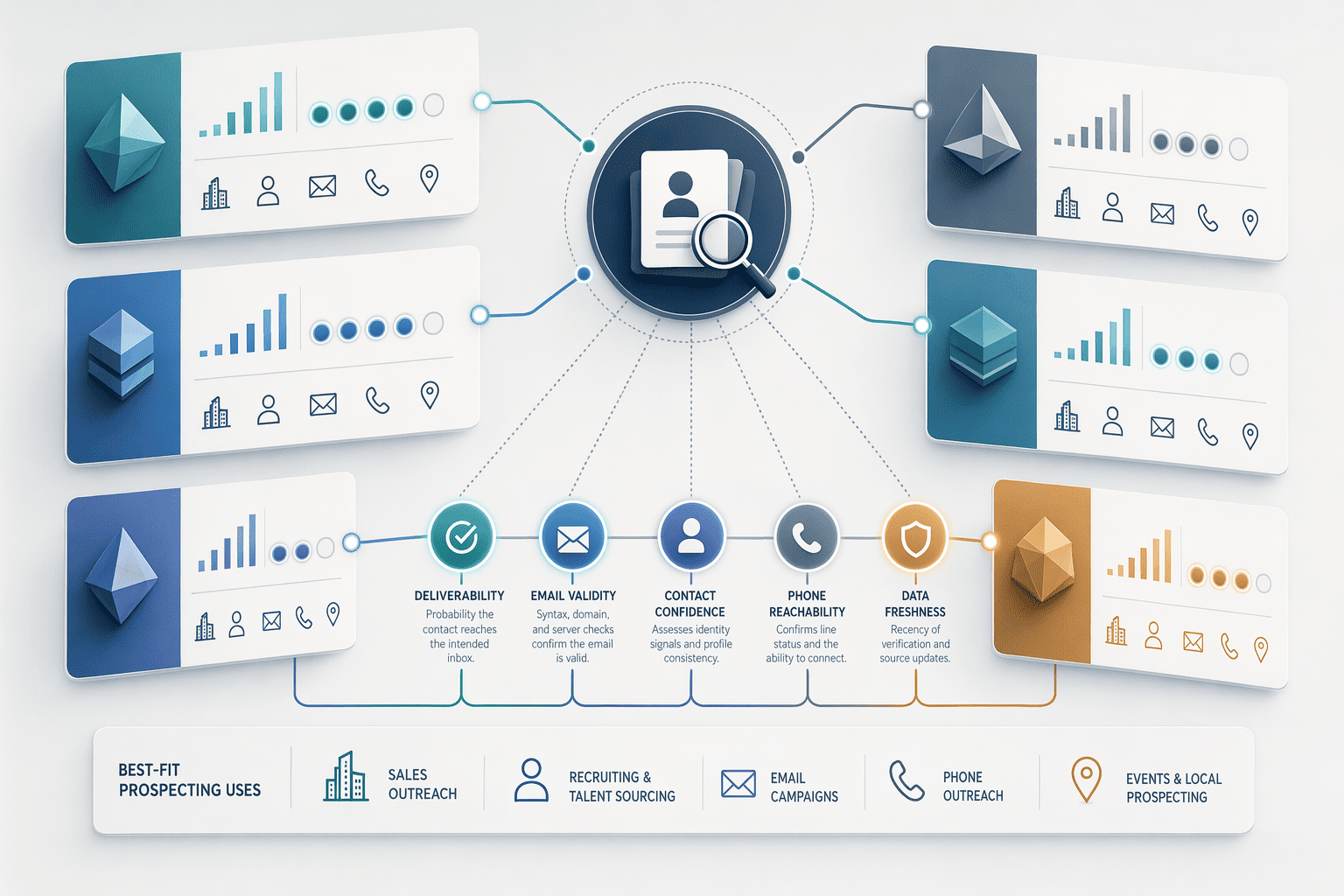
Apollo and ZoomInfo: SMTP Deliverability Leaders
Apollo's 260M+ contact database uses algorithmic verification and intent filters; the trade-off is a 15 to 25% bounce rate on unverified exports. Teams mitigate this by running Apollo data through a secondary verification layer before cold campaigns. ZoomInfo positions itself as the enterprise standard, highest-accuracy firmographic data, org charts, and direct phone numbers at premium pricing ($25K, $100K+/year). Both platforms focus on email deliverability; phone accuracy is a secondary metric, and neither specializes in the pre-download verification workflow that LinkedIn-based tools require.
Cognism and Clay: Enrichment-Based Lookup Models
Cognism built its reputation on phone-verified mobile numbers, Diamond Data entries hit 87% connect-rate accuracy in independent tests. GDPR compliance is native, making Cognism the go-to for EMEA phone-heavy outbound. Clay is not a contact database; it's a workflow tool that orchestrates 50+ data sources (Apollo, ZoomInfo, Hunter, Clearbit) into waterfall enrichment pipelines. Where Apollo returns a single email, Clay queries five providers until one returns a verified result. The distinction matters: Cognism solves for phone accuracy; Clay solves for match-rate maximization across any contact type.
Lusha, LeadIQ, and PeakAi: Pre-Download Verification Specialists
Lusha and LeadIQ operate as Chrome extensions that surface contact data in-browser, pulling from proprietary databases verified against business registries. They serve individual lookup workflows, sales reps prospecting one LinkedIn profile at a time. PeakAi uses the same browser-extension model but specializes in Indian B2B contacts, where global tools underperform. PeakAi delivers 91% phone number accuracy for Indian contacts across 1600+ cities, verified against GST and MCA databases rather than scraping LinkedIn directly. The compliance distinction is critical: scraping-based tools face 15 to 20% account suspension rates, while enrichment-based models like PeakAi avoid LinkedIn's anti-scraping enforcement by querying third-party business databases. Phone accuracy and email accuracy are separate metrics, only 5 to 10% of LinkedIn users share phone numbers with first-degree connections, so phone-verified platforms serve a fundamentally different need than email-focused tools.
Platform capabilities matter less than measurable outcomes. Here's how accuracy rates translate to usable contacts across email and phone verification.
Accuracy Comparison: What the Numbers Really Mean
Platform-by-Platform Accuracy and Verification Methods
| Platform | Email Accuracy | Phone Accuracy | Verification Method | Cost-Per-Contact |
|---|---|---|---|---|
| PeakAi | 91% | 91% | Real-time dual verification | $0.18 (₹13.50) |
| ZoomInfo | 75–85% | Not disclosed | Proprietary + purchase data | Contact for pricing |
| Cognism | Not disclosed | Diamond Data mobile verification | GDPR/DNC washing built in | Contact for pricing |
| Lusha | Not disclosed | Not disclosed | Credit-based enrichment | $0.75–$1.00 per credit |
| Clay | 85–92% | Not disclosed | Waterfall across 75+ providers | Variable (credit-based) |
| LeadIQ | Not disclosed | Not disclosed | Sales Navigator capture | $15/seat + credits |
| Apollo | 70–80% | Not disclosed | Single-provider SMTP | $0.49–$0.99 |
Interpreting Email vs. Phone Accuracy Trade-Offs
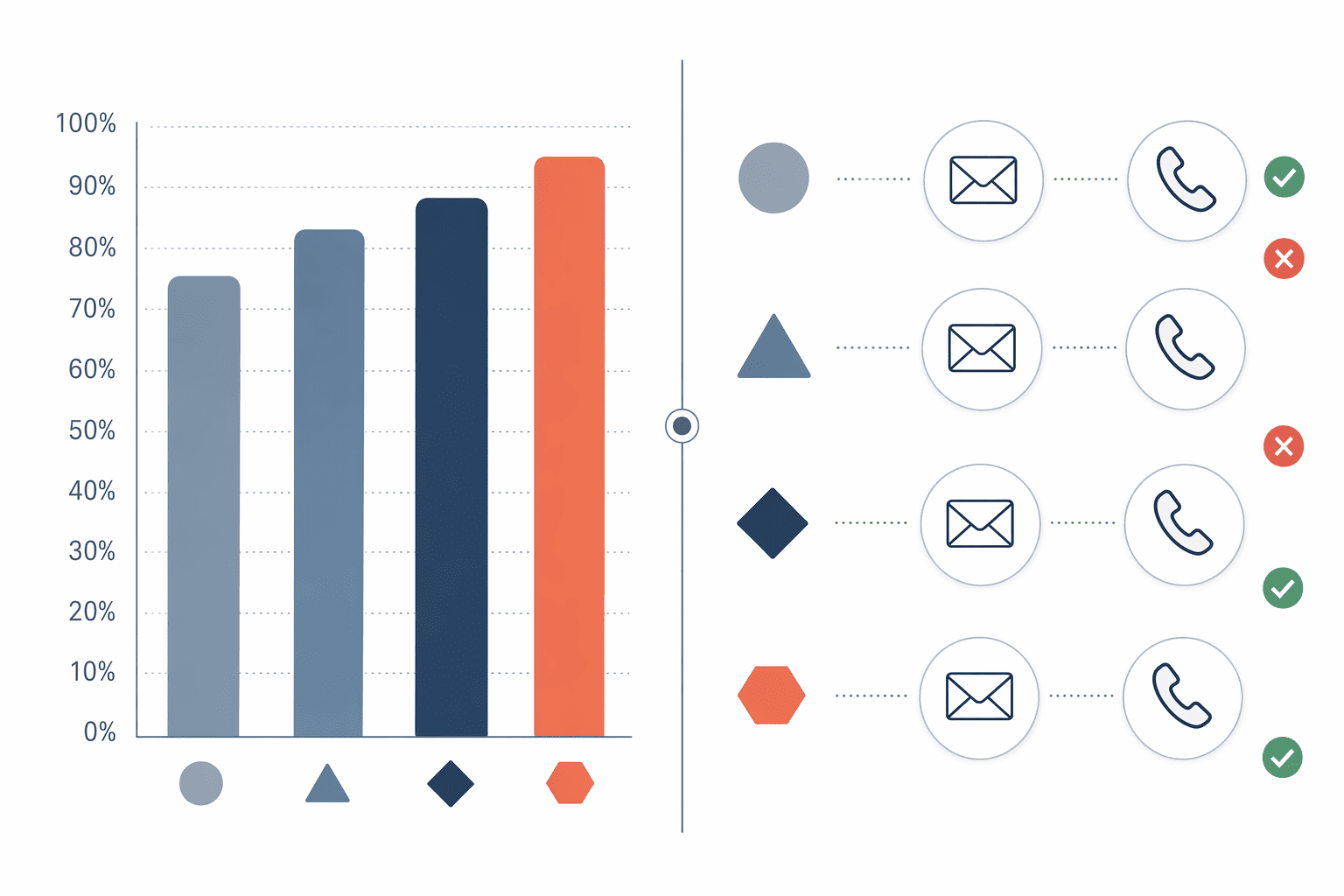
Email accuracy rates cluster around 70 to 92% across platforms that use SMTP verification, but phone accuracy remains uneven. Clay's waterfall approach achieves 85 to 92% email accuracy by querying multiple providers sequentially, while Apollo's single-provider model delivers 70 to 80%. Platforms optimized for phone outreach, Cognism's Diamond Data mobile verification and PeakAi's dual verification, prioritize phone accuracy over email breadth. Buyers running cold-calling campaigns need verified phone numbers, not just email lists, making verification method more critical than database size.
Pre-Download vs. Post-Export Verification Timing
Pre-download verification (PeakAi, Lusha) validates contacts before you spend credits, reducing wasted lookups. Post-export models (Clay waterfall ) verify after extraction, offering flexibility to test multiple providers but consuming credits on unverified records. Contact data decays 2 to 3% monthly, so even 95% initial accuracy drops to 85% after four months without re-verification. Teams optimizing cost-per-verified-contact favor pre-download validation; those prioritizing coverage breadth accept post-export waste to maximize data source diversity.
Accuracy benchmarks assume uniform global performance, but geographic coverage introduces significant variance, especially for emerging markets where LinkedIn penetration remains low.
Regional Coverage and India-Specific Performance
Why Global Tools Test Lower in India
Global contact discovery platforms, ZoomInfo, Apollo, prioritize U.S. And EU LinkedIn data where adoption is highest, leaving India coverage sparse or outdated. When sales teams ask for recommendations on B2B contact data providers in India, they often report that global tools deliver lower accuracy for Indian HR Heads, Legal Directors, and CEOs than for comparable U.S. Profiles. Industry-focused reviews confirm that LinkedIn Sales Navigator is the de facto standard for Indian B2B prospecting, precisely because global database platforms under-index India. Meanwhile, India-specific data providers like InfobelPRO maintain 34.7M+ Indian business records, a scale that reflects dedicated regional sourcing rather than global-database subsets.
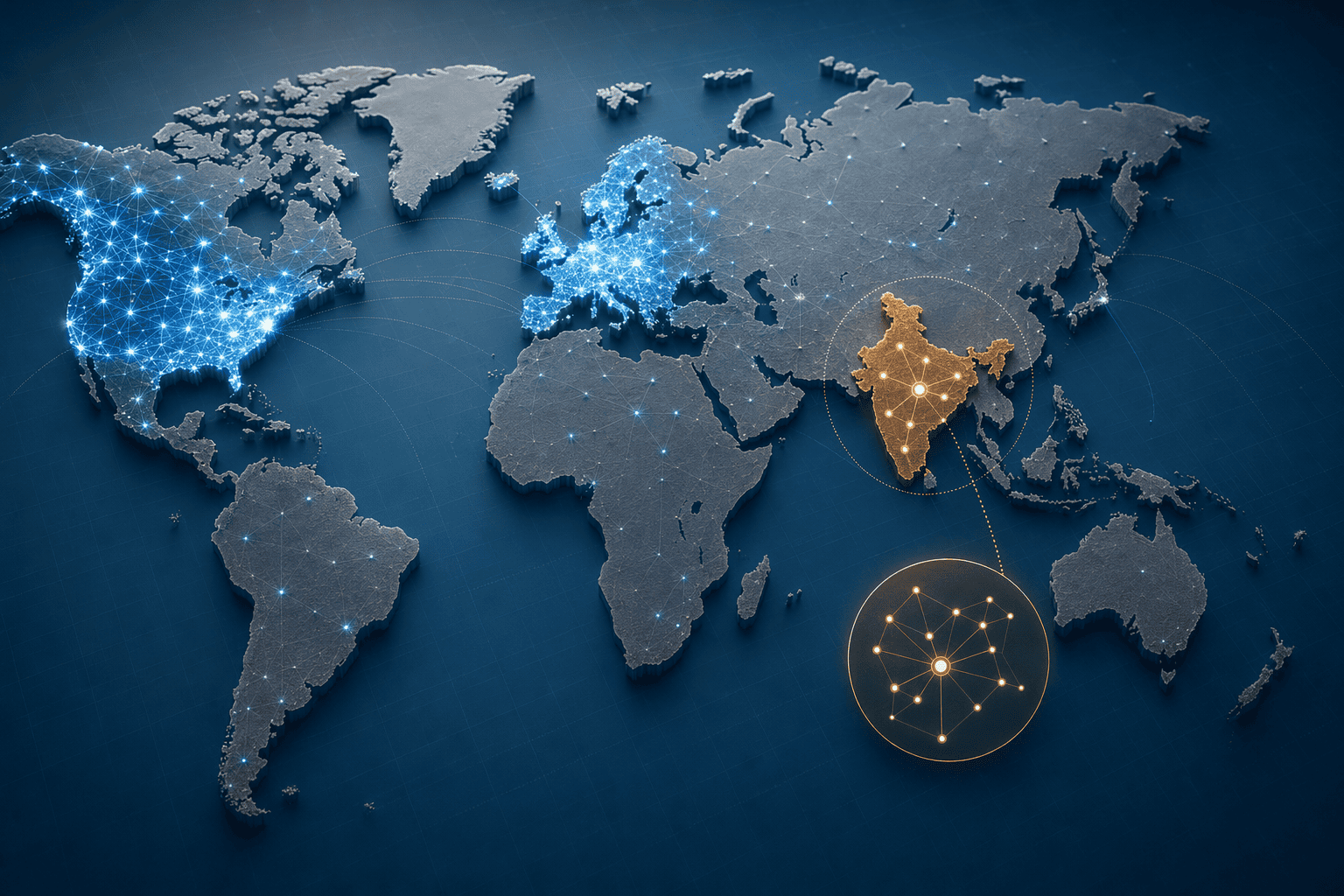
India-Optimized Platforms vs. Global Leaders
PeakAi delivers 91% phone number accuracy specifically for Indian contacts across 1600+ cities, validated against GST and MCA databases rather than relying on LinkedIn profile fields alone. This India-focused verification workflow, cross-referencing government registries and local business directories, addresses the sourcing gap that leaves global platforms 10 to 15 percentage points lower in regional accuracy. Other India-optimized alternatives, profiled in independent B2B data provider comparisons, similarly emphasize local registry integration over global breadth. For teams targeting Indian markets, choosing a platform built around Indian-market verification rather than global breadth ensures contact data reflects current business structures and complies with regional regulations. Explore LinkedIn tools for B2B prospecting in India and emerging markets to compare regional specialists and close more deals with verified Indian contacts.
Beyond accuracy and regional coverage, data sourcing methods determine compliance risk and long-term platform viability for B2B sales teams.
Compliance and Data Sourcing Transparency
When evaluating contact discovery platforms, understanding *how* they obtain phone numbers and emails matters as much as the accuracy rates they claim. The sourcing method determines both the legal compliance posture of your outreach and the long-term risk to your LinkedIn account.

Scraping vs. Enrichment-Based Data Sourcing
Contact discovery platforms split into two architectural camps: scraping-based and enrichment-based. Scraping-based tools, many browser extensions and bulk export utilities, automate profile visits, simulate human clicks, and extract visible contact fields directly from LinkedIn pages. This method violates LinkedIn's Terms of Service and creates compliance risk, but it can surface data from profiles where users have chosen to share contact info publicly.
Enrichment-based platforms take a different path. Instead of extracting data from LinkedIn itself, they use the LinkedIn URL as a reference key to query independent third-party databases, business registries, public records, commercial contact repositories. Verified contact collection workflows typically layer data from multiple authoritative sources and validate it across channels before delivery. This architectural choice keeps the platform outside LinkedIn's Terms of Service enforcement perimeter.
PeakAi operates in the enrichment camp: it sources verified contact data through legitimate business databases and public records rather than scraping LinkedIn directly, using publicly visible LinkedIn URLs as search keys without accessing LinkedIn's internal systems or profile data. The platform positions itself around compliant professional contact discovery rather than blind scraping, with dedicated compliance frameworks for GDPR, TCPA, and LinkedIn Terms of Service adherence.
LinkedIn Compliance and Account Suspension Risk
LinkedIn actively enforces its Terms of Service against automated scraping. Account suspension rates for heavy scraping users range from 15-20% based on community reports, with permanent bans issued when automated access patterns exceed platform rate limits or trigger security heuristics. The risk compounds when users layer multiple scraping tools on top of Sales Navigator, a common stack that sales practitioners actively debate in terms of compliance exposure.
Pre-download verification mitigates this risk by validating contacts *before* you export them. Instead of bulk-downloading thousands of profile URLs and scraping contact fields post-export, a pattern that generates high-volume automated traffic LinkedIn flags, platforms with pre-download verification perform the lookup server-side and return only verified, matched records. This reduces the scraping footprint visible to LinkedIn's security systems.
For teams managing compliance across global markets, data sourcing transparency matters. Different jurisdictions impose different obligations on how contact data can be collected, stored, and used for outreach. Enrichment-based platforms that source from business directories and public records rather than scraping social profiles reduce regulatory surface area, though compliance ultimately depends on your specific use case and geography.
Ready to Transform Your Sales Process? Join thousands of sales professionals who find accurate contact information and close more deals with verified, compliance-first contact discovery.
Advertised pricing structures mask true acquisition costs. Calculating cost-per-verified-contact reveals which platforms deliver measurable ROI after accuracy and match rates are applied.
Pricing Models and Cost
Subscription vs. Pay-Per-Use Pricing Models
Contact discovery platforms split into two pricing models: flat-rate subscriptions and credit-based pay-per-use. Subscription tools like Apollo ($49, $99/user/month) and ZoomInfo ($15K, $60K+/year) offer unlimited access but charge whether you verify 50 contacts or 5,000. If your match rate is low, you pay for dead-end records. Credit-based platforms like Lusha and PeakAi charge per verified contact, reducing waste when accuracy matters more than volume. PeakAi's transparent credit-based pricing starts at $9 for 50 verified contacts, translating to $0.18 per credit, a budget-conscious option for teams prospecting Indian B2B markets where verified phone numbers drive cold calling success.

True Cost Accounting for Match Rates and Refunds
Advertised pricing rarely reflects true cost-per-verified-contact. If a platform charges $0.50/contact but delivers 60% accuracy, your real cost is $0.83 per usable record. Buyers must divide pricing by (advertised accuracy × match rate) to find the effective per-contact cost. Bounce-back credits mitigate this: platforms that refund credits for unverified contacts shift risk from buyer to vendor. Regional specialists for Indian B2B workflows typically deliver cost-per-verified-contact in the ₹70 to 125 range, while enterprise solutions targeting global Fortune 500 accounts run ₹165 to 330, reflecting deeper org-chart data and intent signals, not just email/phone verification.
Ready to close more deals? Compare regional pricing models to find accurate contact information without overpaying for enterprise-tier data breadth your team doesn't need.
FAQ: Validating Contact Discovery Accuracy
This section is handled via structured FAQ injection at article end.
Choosing the Right Contact Discovery Platform
Enterprise platforms (ZoomInfo, Apollo) deliver broader global coverage and CRM integrations but cost ₹165-330 per verified contact; regional specialists like PeakAi optimize for India accuracy at ₹70-125 per contact but cover fewer geographies. Phone-verified platforms (Cognism) lead mobile accuracy but cost more per contact, while email-focused tools (Apollo, PeakAi) achieve 90-95% email accuracy at lower cost yet lag phone coverage due to LinkedIn's 5-10% availability.
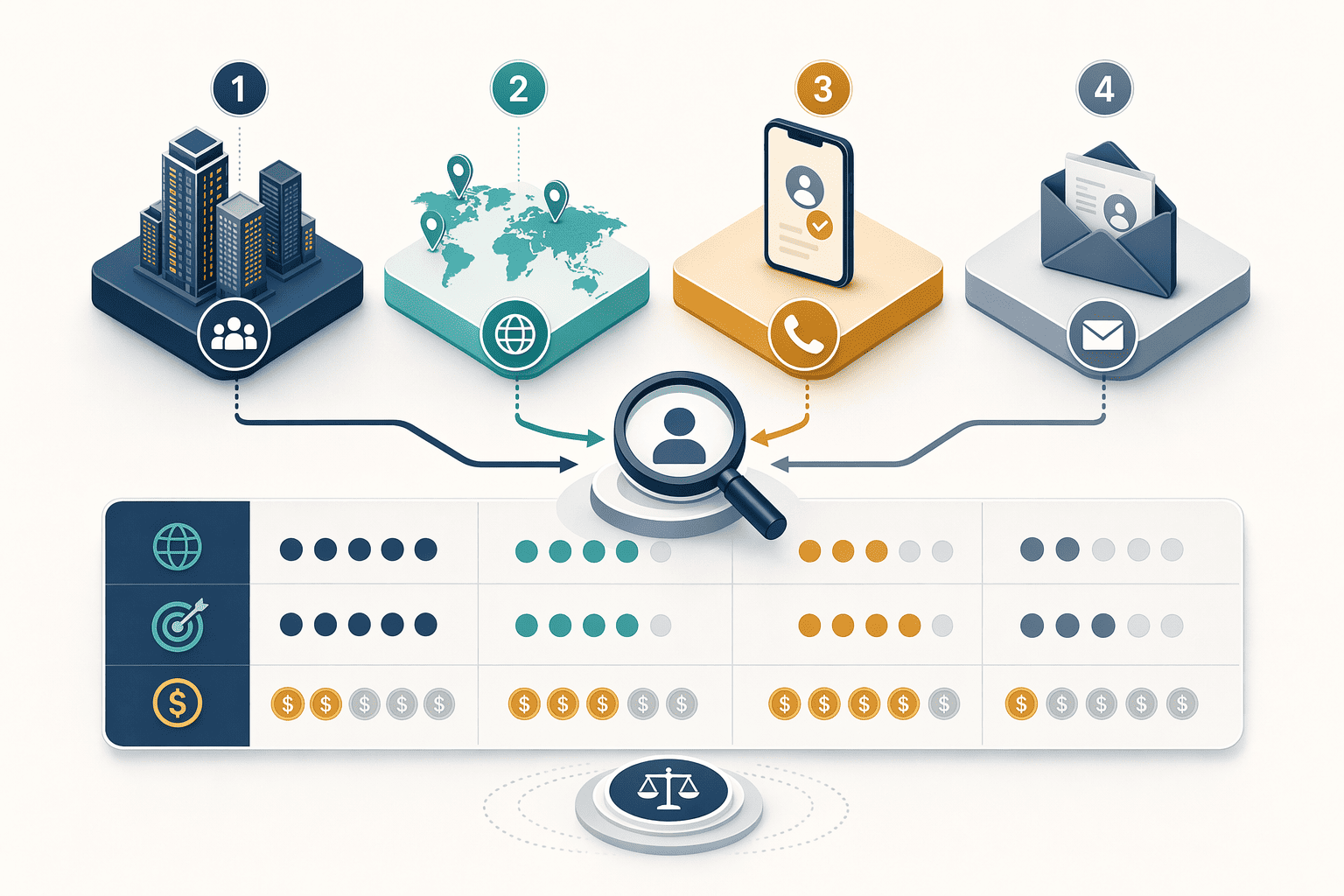
As AI-driven enrichment models (Clay waterfalls, real-time SMTP validation) become standard, the accuracy gap between premium and budget tools will narrow, but regional coverage disparities (US/EU vs. India) will persist until global platforms invest in emerging-market data sourcing.
Document your target persona's geography (US/EU or India) and contact priority (email or phone), then test 2-3 platforms from the comparison table on a 50-contact sample to validate accuracy claims before scaling. Explore PeakAi's LinkedIn-based workflow for India-focused prospecting or compare enterprise options if global coverage is required.
Frequently Asked Questions
What is the average contact accuracy rate for B2B data providers?
Vendors publish 95-98% accuracy rates, but independent testing consistently measures 50-70% email deliverability and 40-60% phone accuracy. SMTP-verified platforms (Apollo, ZoomInfo, PeakAi) achieve 90-95% email accuracy, while phone accuracy lags due to LinkedIn's 5-10% mobile number availability.
How do I verify a platform's accuracy claims before buying?
Use a five-pillar framework: (1) request verification method disclosure (syntax vs. SMTP), (2) demand regional testing results for your target market, (3) confirm compliance sourcing (scraping vs. Enrichment), (4) check data freshness policies, (5) calculate cost-per-verified-contact after match rates.
Why do global contact databases perform worse in India?
Global platforms prioritize US/EU LinkedIn data where adoption is highest, leaving India coverage sparse or outdated. Regional accuracy tests 10-15 percentage points lower in India than Western markets because global tools scrape LinkedIn profiles, which remain incomplete for emerging markets.
What is the difference between email accuracy and phone accuracy?
Email accuracy measures deliverability through syntax and SMTP validation, while phone accuracy measures mobile number correctness. Phone accuracy is harder to achieve because only 5-10% of LinkedIn users share phone numbers, requiring platforms like Cognism to specialize in phone-verified data.
How does contact data decay affect accuracy over time?
Contact data decays at 2-3% monthly as professionals change roles. Even 95% initial accuracy drops to 85% after four months without re-verification. Pre-download verification (PeakAi, Lusha) validates contacts before spending credits, reducing waste from outdated records.
What is the risk of LinkedIn account suspension when using contact discovery tools?
Heavy scraping users face 15-20% suspension rates based on community reports. Scraping-heavy tools (Apollo extension, LeadIQ) trigger LinkedIn's anti-automation detection more than enrichment-based platforms (Cognism, Clay). Pre-download verification reduces scraping footprint and compliance risk.
How do I calculate true cost-per-verified-contact?
Divide monthly subscription or per-contact cost by (advertised accuracy × your match rate). Example: ₹5,000/month with 70% accuracy and 80% match rate = ₹5,000 ÷ (0.70 × 0.80) = ₹8,929 per 100 verified contacts, or ₹89 per usable record.
Sources
- Best B2B Data Providers in 2026: Apollo vs ZoomInfo vs Clay vs Cognism - techstackreviews.net (2026)
- Apollo vs ZoomInfo vs Clay: The 2026 B2B Data Provider Breakdown — Growtoro Blog - growtoro.com (2026)
- Cognism Review 2026: Honest Test of the B2B Data Platform - aitoolsbakery.com (2026)
- Clay vs Apollo vs ZoomInfo (2026): Best Fit by Stage, Stack, and Budget - formanorden.com (2026)
- B2B Contact Databases Compared: ZoomInfo vs Apollo… - gtmpicker.com
- Need recommendations for B2B contact data providers in India (HR/...) - www.reddit.com (2024)
- India B2B Data — 34.7M+ Verified Companies | InfobelPRO - www.infobelpro.com
- Best Lead Generation Tools for B2B Sales in India 2026 - www.itforsme.in (2026)
- How to Find LinkedIn Contact Info for Any Profile in 2026 - resources.reachstream.com (2026)
- How to Collect Verified Contact Information for Local Businesses - outscraper.com
- Is SalesNav worth it? I already use Apollo and ZoomInfo : r/sales - www.reddit.com
- I Spent Days Comparing Sales Intelligence Tools: These 28 Made the Cut - sparkle.io (2026)
- LinkedIn Phone Number Search: Find Cell Numbers Fast - galadon.com
- Best B2B Data Providers in India: 7 Platforms With Real Coverage (2026) - syncgtm.com
