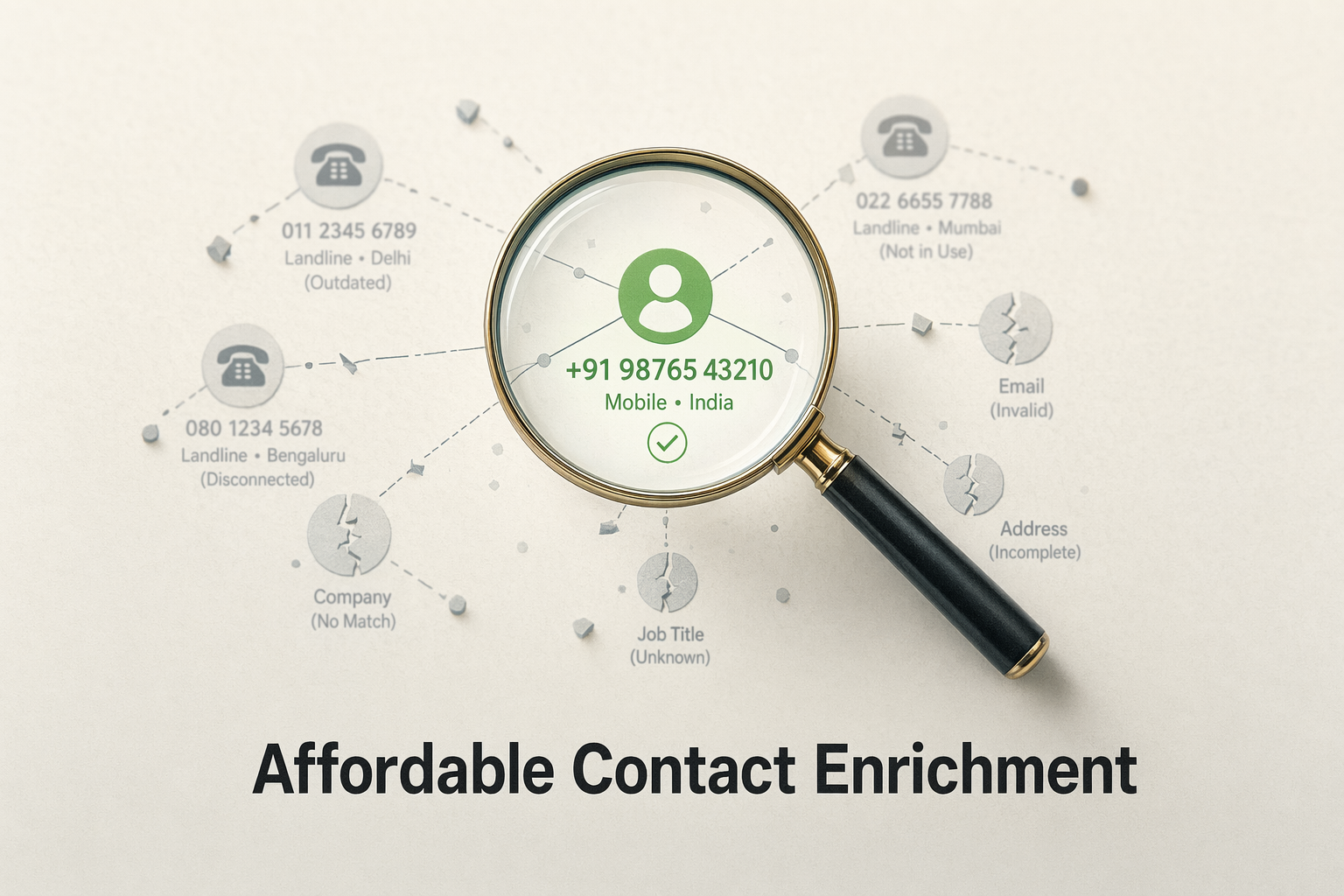
Finding accurate B2B contact data in India requires tools that verify mobile numbers, not just emails, and offer rupee-transparent pricing models under ₹10,000 per month.
Global platforms struggle with 30% bounce rates because they index landlines instead of mobiles and refresh databases quarterly, causing 2-3% monthly decay in phone accuracy.
Key Takeaways
- Global contact enrichment tools deliver 30% bounce rates in India because they optimize for landline infrastructure, while Indian B2B buyers operate on mobiles.
- Mobile-number accuracy (50-65%) lags email accuracy (75-80%) across most platforms, but tools with GST/MCA integration achieve 91% phone verification.
- Credit-based pricing models save 40-60% versus seat-based subscriptions for SMBs with variable prospecting volume and monthly rollover policies.
- True cost-per-contact runs 1.7× higher than advertised rates after accounting for match-rate burn, verification failure, and credit expiration.
- Verification methodology separates into three tiers—syntax, domain, and deliverability—but only deliverability checks catch stale contacts and reduce bounce rates.
Global contact enrichment tools deliver 30% bounce rates in the Indian B2B market because they optimize for US and EU databases, where landline infrastructure is mature and office numbers remain stable. In India, decision-makers operate mobile-first across 1600+ cities, especially in tier-2 and tier-3 markets where landline penetration is sparse. Tools that aggregate email and phone accuracy into a single metric hide mobile-specific gaps; teams buy 95% accuracy claims without realizing the figure includes email precision but fails on direct mobile validation.
The 30% Bounce Rate Problem in India
Phone data decays at 2-3% monthly. Tools with 7-day refresh cycles maintain 98% accuracy; quarterly updates drop to 75% accuracy within five months. Western databases prioritize landline verification because office infrastructure is stable. Indian B2B contacts change mobile numbers frequently, move between companies without updating registries, and operate from co-working spaces with no fixed desk phone. Global tools treat these signals as anomalies rather than the norm. The result: sales teams pay for stale data, waste hours on disconnected numbers, and miss quota because their enrichment layer was never stress-tested against India's mobile-first business culture.
Mobile vs. Landline: Why Western Tools Miss Indian B2B Contacts
Western enrichment platforms index landlines and office switchboards because enterprise buyers in New York and London maintain desk phones. Indian decision-makers in Pune, Ahmedabad, and Coimbatore conduct business on personal mobiles. PeakAi addresses this gap by cross-referencing GST and MCA databases to verify 91% of Indian mobile numbers across 1600+ cities, ensuring teams reach the right person on the first dial. Generic tools aggregate mobile and landline accuracy into one metric, masking the reality that tier-2 city coverage relies on outdated landline registries no one uses. Sales teams need mobile-first verification to close more deals in markets where the office phone is a relic.
Understanding why global tools fail clarifies what to prioritize when evaluating contact enrichment platforms for India-specific prospecting.
What to Evaluate: Accuracy, Pricing Models, and India Coverage
Choosing a contact enrichment tool for the Indian B2B market requires evaluating three dimensions that most global platforms gloss over: verification methodology depth, rupee pricing transparency, and tier-2/3 city coverage. Advertised accuracy claims aggregating email and phone into a single figure hide the mobile-number gaps that cripple cold-calling campaigns in Bangalore, Mumbai, and Delhi — let alone Indore or Coimbatore.
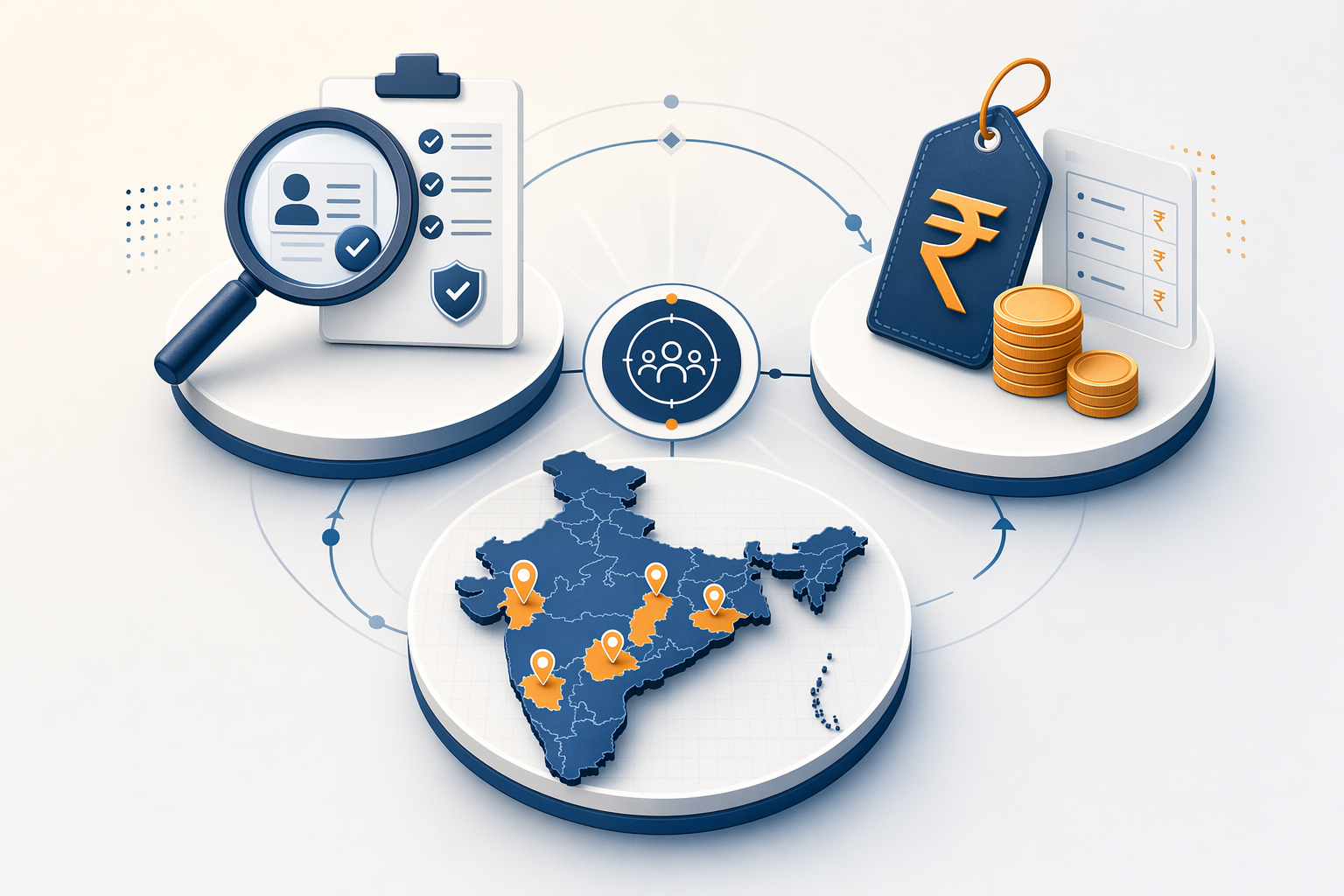
Verification Methodology: Syntax vs. Domain vs. Deliverability Checks
Most enrichment providers report accuracy as a single percentage, but verification operates on a three-tier ladder. Syntax validation confirms the email follows `[email protected]` format. Domain validation checks whether `domain.tld` has active MX records. Deliverability validation tests whether the mailbox accepts mail without bouncing. Healthy deliverability should remain under 2-5% bounce, not 30%. Tools claiming '95% accuracy' often measure syntax or domain tiers only, leaving you with valid-looking addresses that bounce when you press send.
For phone numbers, the gap widens further. A number may pass format validation (+91-9876543210) yet reach a former employer, a landline instead of the decision-maker's mobile, or a disconnected line. LinkedIn restricts automation to 30-40 daily actions, so tools scraping profiles directly risk account bans. Enrichment layers that query independent databases avoid this risk but introduce accuracy decay when those databases update monthly or quarterly instead of in real time.
Rupee Pricing Transparency and Credit Burn Rates
Credit-based models charge per contact revealed, while subscription models charge per seat per month regardless of usage. Credit-based pricing typically saves 40-60% versus seat-based annual contracts for teams with unpredictable prospecting volume. The hidden cost lies in credit burn rates and expiration policies. Most platforms charge 50-65% of a credit for phone lookup and 75-80% for email lookup, meaning a 100-credit bundle yields 130-150 phone numbers or 120-133 emails, not 100 of each.
Unused-credit expiration is the anti-pattern SMBs miss during evaluation. Some tools expire credits monthly or quarterly, forcing you to over-buy or lose paid credits. Rollover policies turn a ₹4,999 monthly plan into either a sunk cost or a flexible budget depending on whether August's unused 30 credits carry into September. Always confirm whether pricing is displayed in rupees, whether credits roll over, and whether partial-match results (email found, phone not found) still consume a full credit.
Regional Data Quality: Urban Tier-1 vs. Tier-2/3 City Coverage
Global enrichment databases excel in Bangalore, Mumbai, and Delhi because these metros contribute the highest volume of publicly available business records, GST filings, and professional network activity. Accuracy for tier-2 and tier-3 cities — Indore, Chandigarh, Coimbatore, Jaipur — lags by 15-25 percentage points on most platforms because data partners refresh records less frequently and mobile-number coverage thins outside urban centers.
Tools optimized for the Indian B2B market validate GST numbers, cross-reference Ministry of Corporate Affairs records, and confirm +91 phone formats before delivery. Ask whether the provider's accuracy claim is segmented by city tier or presented as a national average that overstates tier-2/3 performance by blending it with tier-1 results.
Armed with evaluation criteria, the following tools balance affordability, accuracy, and India coverage within the ₹10,000/month threshold.
7 Best Affordable Contact Enrichment Tools for Indian B2B (2026)
Finding accurate contact data at rupee-transparent pricing under ₹10,000/month is the foundation of every Indian B2B prospecting motion. We compared seven contact enrichment tools on starting price, email accuracy, phone availability, India coverage, and G2 rating to help you find accurate contact information and close more deals.

Comparison Table: Pricing, Accuracy, and India Coverage
| Tool | Starting Price | Email Accuracy | Phone Available | India Coverage | G2 Rating |
|---|---|---|---|---|---|
| PeakAi | ₹675/50 contacts | 91% | Yes (verified mobiles) | Strong (GST/MCA) | 4.9/5 |
| Apollo.io | $49/mo | Very Good | Limited | Global | 4.4/5 |
| Lusha | $39/mo | Very Good | Yes | Moderate | 4.3/5 |
| Cognism | Custom | Excellent | Yes (GDPR-verified) | EU-focused | 4.6/5 |
| ZoomInfo | Custom | Excellent | Yes | Global | 4.5/5 |
| RocketReach | $99/mo | Very Good | Yes | Global | 4.2/5 |
| Clearbit | $99/mo | Excellent | Limited | Global | 4.7/5 |
Tool-by-Tool Breakdown: Pros, Cons, and Best-For
1. PeakAi, Best for Indian SMBs and Startups
PeakAi delivers 91% phone number accuracy optimized for Indian business contacts through GST verification and MCA database integration. Credit-based pricing starts at ₹675 for 50 verified contacts, delivering roughly ₹13.50 per contact with real-time verification and credit rollover.
Pros: Real-time mobile-number verification, rupee-transparent pay-per-use economics, GST/MCA integration for Indian B2B. Cons: Smaller database than ZoomInfo/Apollo, newer entrant in the category. Best for: Indian SMBs with variable prospecting volume who need rupee-denominated affordability paired with India-specific mobile coverage.
2. Apollo.io, Best Budget Option for All-in-One Outbound
Apollo combines a database, sequencer, and email sender starting at $49 per month, with 9,400+ G2 reviews. The platform offers the largest free tier in this comparison but focuses primarily on email extraction rather than phone-specific validation.
Pros: Largest free tier, combined database and sequencing, strong email deliverability. Cons: Phone coverage limited compared to Lusha/Cognism, global optimization may miss tier-2/3 Indian markets. Best for: SMB and mid-market teams who need all-in-one outbound with email-first verification.
3. Lusha, Best for Verified Direct Dial Phone Numbers
Lusha sells a credit-based prospecting tool used primarily via Chrome extension on LinkedIn, priced at $39/mo. The platform delivers strong email accuracy and direct dial phone numbers but coverage for tier-2/3 India markets is moderate.
Pros: Strong direct dial accuracy, Chrome-extension workflow, free tier available. Cons: Limited India-specific mobile coverage, pricing scales quickly with volume. Best for: Individual reps and small teams who need targeted prospecting with verified phone numbers in Western markets.
4. Cognism, Best for GDPR-Compliant Mobile Enrichment
Cognism holds certifications for GDPR-compliant phone-verified contacts and is used most heavily by teams selling into European markets. Pricing is custom (enterprise-tier) with a 4.6/5 G2 rating.
Pros: GDPR-certified mobile numbers, strong European coverage, phone-first verification methodology. Cons: Enterprise pricing (no self-serve tier), limited India-specific optimization. Best for: European-market teams and GDPR-sensitive organizations who need compliant mobile enrichment.
5. ZoomInfo, Best for Enterprise Account Intelligence
ZoomInfo has a proprietary database of over 300 million contacts and sells primarily to enterprise teams on annual contracts. Entry-level contracts start in the $15,000 to $20,000 range with no self-serve or monthly billing option.
Pros: Largest proprietary database, intent signals through ZoomInfo Intent, technographic data and org charts. Cons: Enterprise pricing ($15k, $50k+ annually), annual contracts required, data staleness complaints. Best for: Enterprise sales teams with budget for premium account intelligence and thorough firmographic data.
6. RocketReach, Best for Mid-Market Email Accuracy
RocketReach offers strong email accuracy at mid-market pricing starting at $99/mo with global coverage and verified phone number availability. The platform balances database breadth with verification rigor but India-specific mobile validation is less strong than PeakAi.
Pros: Strong email accuracy, mid-market pricing, global database. Cons: Limited India-specific verification, monthly subscription (no pay-per-use). Best for: Mid-market teams who need global email/phone enrichment without enterprise-tier contracts.
7. Clearbit, Best for Real-Time API Enrichment
Clearbit delivers real-time API enrichment with excellent data quality at $99/mo, now integrated with HubSpot as Breeze Intelligence. The platform excels at firmographic enrichment and website visitor identification but limited real-time visitor identification and declining match rates for SMB and international companies.
Pros: Real-time API enrichment, HubSpot-native integration, strong firmographic data. Cons: Limited phone coverage, declining match rates for SMB/international companies, enterprise pricing starts at $50k+ annually. Best for: HubSpot users who need API-driven firmographic enrichment with known contacts.
Ready to Transform Your Sales Process? Join thousands of sales professionals who use PeakAi to find accurate contact information for Indian B2B prospects. LIMITED TIME: 50 contacts for just $9. Only 19 spots remaining!
Advertised per-credit pricing hides the true economics, calculating cost-per-verified-contact requires modeling match rates and expiration rules.
How to Calculate True Cost-per-Contact for Credit-Based Tools
Credit-based contact enrichment tools advertise a per-credit price, but the true cost-per-verified-contact depends on match rates, verification failure, and expiration rules, factors most teams overlook until after they purchase credits.
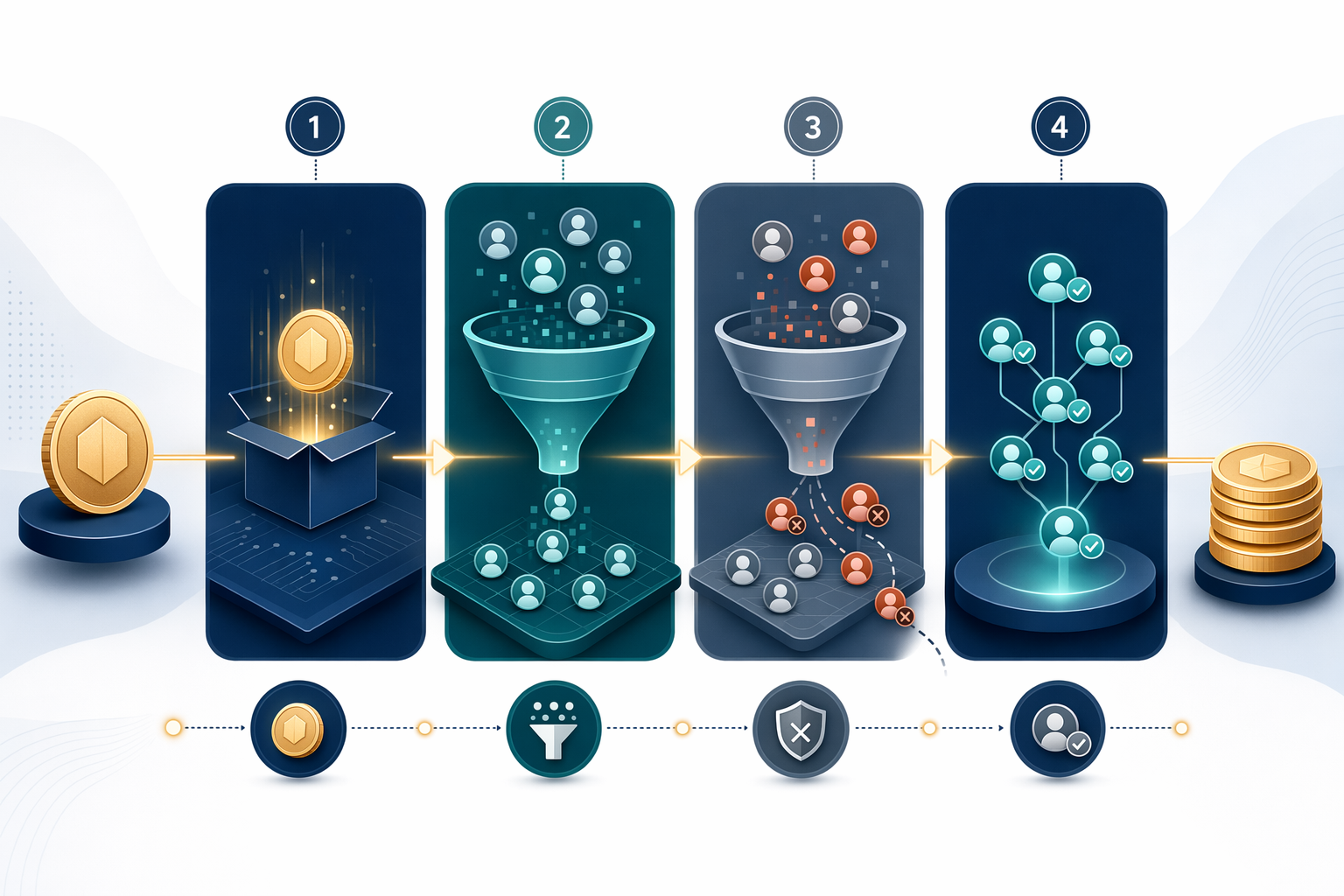
Credit Burn Rate Formula: Phone vs. Email Match Rates
Follow this 4-step workflow to model effective cost-per-contact:
- Identify the advertised credit cost. For example, a ₹5,000 pack at ₹10 per credit yields 500 credits.
- Apply the burn rate. Phone numbers match at 50 to 65%, emails at 75 to 80%. If you need verified phones, multiply by 0.575 (midpoint): 500 credits × 0.575 = 288 verified contacts, not 500.
- Account for verification failure. Tools that verify *after* download may charge you for contacts that fail validation. Budget an additional 5 to 10% buffer for failures.
- Factor in credit expiration if no rollover. If unused credits expire monthly or quarterly, you must over-buy or lose unspent credits, raising effective cost.
A ₹5,000 credit pack advertised at ₹10 per contact delivers ~288 verified phones after burn, or ₹17.36 per verified contact, 1.7× higher than the advertised rate. Teams that compare advertised per-credit prices without modeling burn rates discover the true cost only after exhausting their first pack.
Rollover Policies and Expiration Rules
Credit rollover policies determine hidden cost for teams with variable prospecting volume. Tools with monthly rollover, like PeakAi, which rolls unused credits to the next month for active subscriptions, suit Indian SMBs whose outbound activity fluctuates with deal cycles. Tools with quarterly expiration force teams to over-buy credits or forfeit unspent balances.
The trade-off: monthly rollover protects against waste but requires an active subscription; no-rollover plans lock lower per-credit prices but penalize under-usage. Close more deals by modeling your team's monthly contact-discovery rate before committing to a credit pack size or subscription tier.
Accuracy percentages mean little without understanding the three-tier verification ladder that separates deliverable contacts from stale data.
Verification Methodology: What 91% Accuracy Actually Means
The Three Tiers: Syntax, Domain, Deliverability
Contact enrichment tools report accuracy in three verification tiers, but only the final tier catches stale data. Tier 1 (syntax checks) validate format, email addresses match `[email protected]`, phone numbers contain the right digit count. Tier 2 (domain checks) confirm the MX record exists for the email domain or the phone number's carrier is active. Tier 3 (deliverability checks) test whether the mailbox accepts messages and whether the phone number currently routes to a working line.

Most vendors stop at tier 2 because deliverability checks cost more and require real-time API calls. Contact data decays roughly 2% per month; tools with 7-day refresh cycles maintain 98% accuracy while slower quarterly updates drop to 75% within five months. PeakAi performs tier 3 deliverability checks in real time, which is why the company reports 91% accuracy on mobile numbers rather than blending email and phone into a single aggregated figure.
Why Aggregated Accuracy Metrics Mislead for India
When a vendor claims "95% accuracy," that number typically aggregates email + phone + mobile + landline into a single metric. Independent tests show wide variation: one 2026 benchmark measured email accuracy from 80% (Apollo) to 98% (Cleanlist), but phone accuracy, especially mobile coverage in India where landline penetration is sparse, lags 10 to 20 points behind email. Aggregated metrics hide this gap because high email accuracy inflates the blended score.
For Indian B2B contacts, mobile numbers matter more than landlines, yet global enrichment tools optimize for Western markets where office phones dominate. A tool reporting "92% contact accuracy" may deliver 96% email accuracy and only 72% mobile accuracy, making it unsuitable for cold calling in India. Close more deals [recurring_phrase] by selecting tools that report phone accuracy separately and validate regional mobile formats before purchase.
Conclusion
Apollo offers the largest free tier and broadest database but focuses on email-focused verification, while PeakAi trades database size for real-time mobile-number accuracy and rupee-transparent pay-per-use economics. ZoomInfo and Cognism deliver enterprise-grade intent data and GDPR-compliant mobile enrichment, but pricing tiers exceed ₹10,000/month for most Indian SMBs; Lusha and PeakAi stay affordable with credit-based models.
As India's B2B market matures and tier-2/3 city coverage expands, contact enrichment tools will need to prioritize real-time mobile verification and regional data quality over static database size, the category is shifting from volume to precision.
Try PeakAi's pay-per-verified-number model to calculate your true cost-per-contact for Indian B2B mobile numbers, or audit your current database to benchmark mobile-number accuracy against the 91% standard.
Frequently Asked Questions
Which contact enrichment tool is most affordable for Indian B2B SMBs under ₹10,000/month?
Apollo.io offers the largest free tier for volume prospecting, PeakAi provides pay-per-verified-number pricing with monthly credit rollover, and Lusha delivers rupee-transparent credit packs. Credit-based models save 40-60% versus seat-based annual contracts for teams with variable prospecting volume.
How accurate are contact enrichment tools for Indian B2B mobile numbers?
Most tools deliver 50-65% phone match rates because Western databases index landlines, while email accuracy reaches 75-80%. Phone data decays at 2-3% monthly, so quarterly refresh cycles drop accuracy to 75% within five months. PeakAi achieves 91% mobile accuracy through GST/MCA verification.
What is the difference between syntax, domain, and deliverability verification?
Syntax checks validate format (email matches [email protected]), domain checks confirm MX records exist, and deliverability checks test whether the mailbox accepts messages. Only deliverability verification catches stale contacts, most vendors stop at tier 2 because real-time API calls cost more.
Do credit-based contact enrichment tools roll over unused credits?
Rollover policies vary by tool, PeakAi and Lusha offer monthly rollover for active subscriptions, while some platforms expire credits quarterly. Teams with variable prospecting volume see effective cost-per-contact increase 1.7× when expiration rules force credit loss before full utilization.
Why do global contact enrichment tools have high bounce rates in India?
Global tools deliver 30% bounce rates in India because they index landlines for mature US/EU office infrastructure, while Indian B2B buyers operate on mobiles. Quarterly refresh cycles allow 2-3% monthly decay, dropping accuracy to 75% within five months versus 98% for 7-day updates.
Are LinkedIn scraping tools legal for contact enrichment in India?
Enrichment-based tools like Apollo, Lusha, and PeakAi use API and public data sources that comply with LinkedIn's 30-40 daily action limits. Direct-scraping tools violate LinkedIn Terms of Service and risk account bans, the compliance distinction separates enrichment platforms from automation scripts.
How do I calculate true cost-per-contact for credit-based tools?
Follow this workflow: (1) identify advertised credit cost, (2) apply burn rate (50-65% phone, 75-80% email match), (3) account for verification failure, (4) factor in expiration. A ₹5,000 pack at ₹10/credit yields ~288 verified phones after burn, or ₹17.36 per verified contact, 1.7× advertised rate.
Sources
- Turn 30% Bounce Rate into Under 5% with Lead Gen Playbook - www.linkedin.com
- Best 15 Contact Data Enrichment Tools for Sales Teams in 2026 - generect.com (2026)
- 15 Best Data Enrichment Companies, Tested on 1000 Leads [2026] - www.cleanlist.ai (2026)
- 10 Best Platforms for Automatic LinkedIn Profile Enrichment in CRMs - linkfinderai.com
- 22 Best Contact Data Enrichment Tools for B2B Sales Teams in 2025 - companyurlfinder.com (2025)
- Zoominfo - linkfinderai.com (2025)
- B2B Data Enrichment Tools: ZoomInfo, Apollo, Cognism, Lusha | GrowthTech Spotlight - www.growthtechspotlight.com
- Best Clearbit Alternatives After HubSpot Acquisition: 10 Tools Compared (2026) | Cursive - www.meetcursive.com (2026)
- Data Enrichment Trends: What's Changing in B2B Intelligence - www.marketsandmarkets.com (2025)
- Best Data Enrichment Tools: 11 Tested on 1000 Leads [2026] - www.cleanlist.ai (2026)
