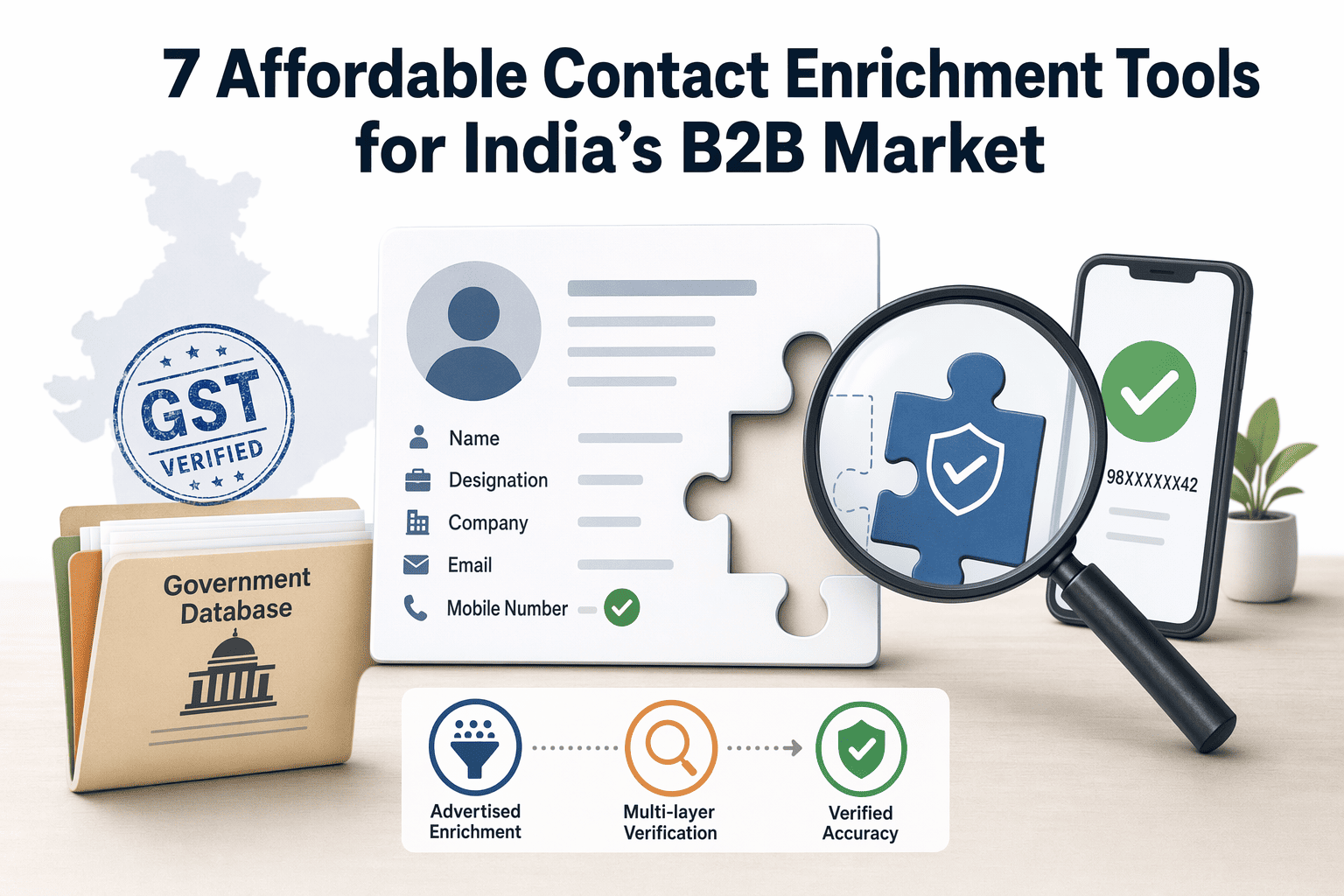
Choosing contact enrichment tools for India's B2B market requires evaluating cost-per-verified-contact, regional accuracy benchmarks, and compliance with DPDP Act 2023—not just advertised per-credit pricing.
Global platforms test 10-15 percentage points lower in India than US/EU markets, making India-specific verification layers—GST validation, MCA database checks, mobile number accuracy—the non-negotiable differentiators.
Key Takeaways
- Credit-based pricing inflates true cost by 35-100% when verification failures and data decay are factored into cost-per-usable-contact calculations.
- India-specific phone number accuracy averages 10-15 percentage points lower than vendor-claimed global benchmarks, requiring regional testing before procurement.
- GST validation and MCA database integration confirm business legitimacy—verification layers absent from most global enrichment platforms.
- Enrichment-based tools face <2% account suspension rates versus 15-20% for scraping-based architectures under DPDP Act 2023 compliance requirements.
- Pay-per-use models align cash outflow with verified contact acquisition, eliminating subscription waste for variable-volume prospecting teams.
Why Affordable Contact Enrichment Matters for Indian B2B Teams
For Indian B2B teams evaluating contact enrichment tools in 2026, affordability means more than advertised per-credit pricing — it requires calculating cost per usable contact after accounting for verification failures, data decay, and regional accuracy gaps. Tools like Apollo.io ($49/user/month), Lusha ($39/month), and PeakAi (₹675 for 50 contacts on pay-per-use) serve budget-conscious teams, but their real-world economics diverge sharply once you factor in India-specific performance.
The Hidden Cost-Per-Usable-Contact Gap
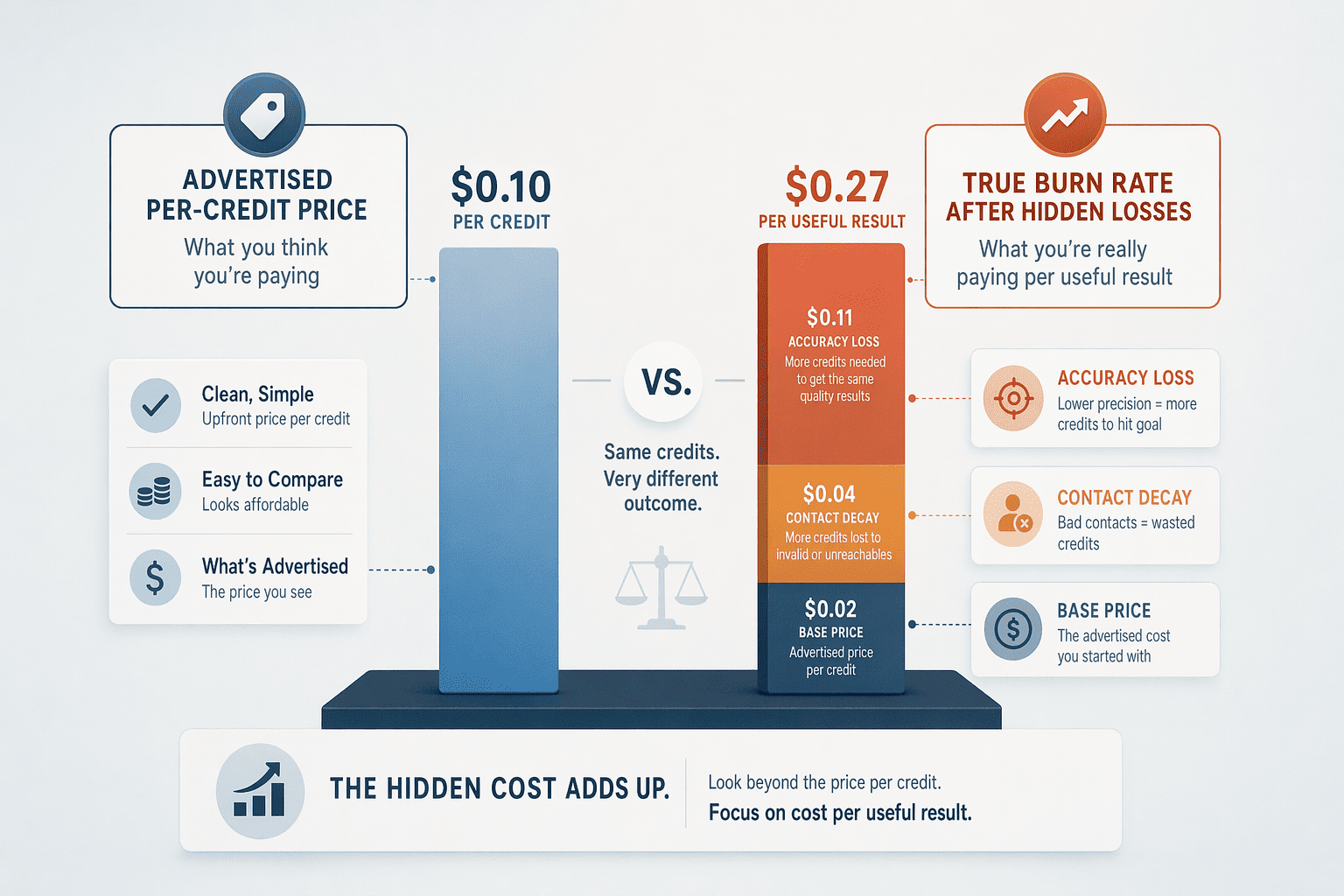
Credit-based pricing models inflate true cost by 35-100% when verification failures and data decay are included. B2B contact data decays at roughly 2 to 3 percent per month, meaning about 30 percent of any database goes stale within a year. A platform charging ₹13.50 per contact on paper may actually cost ₹18-27 per usable contact after bounce-backs and disconnected numbers are filtered out. Teams that don't track bounce rates and mobile connectivity post-enrichment systematically underestimate their effective burn rate.
Why Global Accuracy Claims Break Down in India
Independent testing shows contact finder accuracy averages closer to 50% than vendor-claimed 95-98%, and that gap widens in emerging markets. India-specific accuracy for global tools tests 10-15 percentage points lower than US/EU figures, driven by fragmented telecom infrastructure, informal business registrations, and lower LinkedIn profile completeness. A tool rated at 85% email accuracy in North America may deliver only 70-75% in tier-2 Indian cities, doubling your cost per connected conversation.
Budget Constraints Drive Tool Selection in India
Pay-per-use and freemium models have become the viable entry points for cost-conscious teams. Apollo.io's free tier and PeakAi's ₹675 starter pack let teams test India-specific accuracy before committing to annual contracts. When monthly refresh requirements meet tight acquisition budgets, the ability to close more deals without locking capital into subscriptions becomes a structural advantage, not just a pricing preference.
Understanding these cost dynamics establishes the foundation for evaluating platform-specific accuracy metrics—where syntax validation, deliverability checks, and real-time verification create distinct performance tiers.
How to Evaluate Contact Enrichment Tools for India-Specific Accuracy
Before comparing platforms by price or feature count, establish how each vendor defines and measures accuracy. Most enrichment tools advertise 90%+ accuracy rates, but these claims are not equivalent without methodology disclosure.

Verification Methodology: Syntax vs. Deliverability vs. Real-Time
Contact enrichment tools operate across three distinct verification layers, each with different cost and accuracy profiles.
Syntax validation confirms that an email address or phone number follows correct formatting rules — @domain structure for emails, country code and digit count for phones. This is the cheapest method and the least reliable for actual deliverability.
Email deliverability testing pings the recipient mail server to verify the mailbox exists without sending a full message. Mid-tier tools use this approach. It catches invalid addresses but cannot guarantee engagement or that the contact still works at the listed company.
Real-time phone number verification queries carrier databases to confirm the number is active, classify it as mobile or landline, and validate regional formatting. This delivers the highest accuracy but carries the highest per-contact cost.
When a vendor claims 95% accuracy without disclosing which verification layer they use, the claim is functionally meaningless. A syntax-validated 95% rate may deliver actual deliverability closer to 50%.
India-Specific Mobile Number Accuracy Benchmarks
Global enrichment platforms often report lower accuracy for Indian contacts than for US or EU markets. Tools optimized for Western databases may achieve 90% accurate email lists in North America but drop to 75-85% for India-specific mobile numbers.
Regional performance gaps stem from three factors: fewer third-party data sources covering Indian business contacts, higher churn rates as professionals change mobile numbers, and fragmented telecom carrier databases. A platform claiming 91% global accuracy may not publish separate India benchmarks.
Before committing to a contract, request region-specific accuracy figures for Indian mobile numbers and email domains (.in,.co.in). If the vendor cannot provide them, budget for higher bounce rates in your campaigns.
GST Validation and MCA Database Integration
India-market contact enrichment requires two data sources that global tools typically lack: GST verification and Ministry of Corporate Affairs (MCA) database access.
GST validation cross-references a company's GST identification number against government records to confirm the business is registered and active. This filters out shell companies and outdated listings.
MCA database integration verifies company registration details, director information, and corporate status. Combined with GST checks, this provides a compliance layer that generic global tools cannot match.
Tools built for the Indian B2B market integrate these databases natively. Platforms without GST and MCA access may return syntactically valid contacts attached to inactive or fraudulent entities, creating compliance risk for your outreach campaigns.
Armed with these evaluation criteria, we can now compare the seven most affordable contact enrichment platforms that maintain India-specific verification depth without enterprise-tier pricing.
Selecting a contact enrichment tool for the Indian B2B market requires balancing accuracy, affordability, and regional data depth. Global platforms often lack the granular verification layers, GST database cross-checks, MCA registry validation, regional phone format parsing, that Indian prospecting demands. The seven platforms below were evaluated against India-specific pricing accessibility, mobile number availability, and compliance with the DPDP Act 2023.
| Platform | Starting Price | Free Tier | India Coverage | Mobile Number Availability | Accuracy Claims |
|---|---|---|---|---|---|
| PeakAi | ₹675 / 50 contacts | 5 credits | Optimized for Indian B2B; GST & MCA integration | Verified mobile & landline classification | 91% phone accuracy |
| Apollo.io | $49/month | Limited free plan | Global database; India presence varies | Generic contact fields | Not India-specific |
| Lusha | $39/month | 5 credits/month | Global; regional validation unspecified | Contact data available | Not disclosed for India |
| Clearbit | Custom pricing | None | Real-time API; India coverage gaps noted | Firmographic focus | Real-time but not region-verified |
| ZoomInfo | Custom pricing | None | Enterprise-grade global breadth | Thorough but costly | Not India-granular |
| Cognism | Custom pricing | None | GDPR-first; emerging India presence | Compliance-focused | Europe-optimized |
| Clay | From $149/month | None | Waterfall enrichment; source availability varies | Multi-source aggregation | Dependent on connected sources |
1. PeakAi: 91% Verified Phone Accuracy with Pay-Per-Use Pricing
PeakAi delivers 91% phone number accuracy for Indian B2B contacts, cross-referenced against GST and MCA databases to ensure verification depth beyond global tools. Pricing starts at ₹675 for 50 verified contacts with a 5-credit free trial, avoiding the enterprise contract lock-in common in alternatives. DPDP Act compliance is built in, with automated DNC registry flagging and consent-record export.
Strengths: Pay-per-use eliminates monthly subscription waste; mobile vs. Landline classification reduces cold-call failures; GST verification flags inactive MSMEs before outreach. Limitations: Nascent brand recognition compared to ZoomInfo or Apollo; global coverage trails enterprise platforms. Best for: Cost-conscious Indian B2B teams needing verifiable ROI without annual commitments.
2. Apollo.io: Freemium Entry Point with Global Coverage
Apollo.io offers a free plan with limited monthly credits and a $49/month paid tier, making it accessible for early-stage teams testing contact enrichment workflows. The platform indexes 275 million contacts globally, but India-specific accuracy and GST integration are not disclosed. Firmographic fields (revenue, employee count, tech stack) are thorough, supporting account-based segmentation.
Strengths: Freemium model lowers entry friction; native CRM integrations simplify workflow; extensive firmographic data supports ICP filtering. Limitations: India coverage depth unverified; phone number validation methodology not region-specific; accuracy for tier-2 Indian cities unknown. Best for: Teams prioritizing global breadth and account research over India-specific direct-dial precision.
3. Lusha: Tiered Pricing with CRM Integration Strength
Lusha provides 5 free credits monthly and a $39/month entry tier, balancing affordability with CRM-native enrichment inside Salesforce and HubSpot. Contact data accuracy is advertised but not broken out by region; India-specific validation claims are absent from public documentation.
Strengths: Tight CRM integrations reduce manual export/import cycles; tiered pricing scales with team size; browser extension accelerates LinkedIn-to-CRM workflows. Limitations: Regional validation unspecified; no GST or MCA database cross-checks mentioned; phone format parsing for Indian numbers not detailed. Best for: CRM-centric teams willing to trade India-specific verification for workflow convenience.
4. Clearbit: Real-Time Enrichment for High-Volume Teams
Clearbit positions as a real-time API for engineering-led go-to-market teams, enriching contacts at the moment of form submission or CRM entry. Pricing is custom; no free tier exists. India coverage gaps are noted in third-party reviews, with firmographic focus outweighing direct-dial mobile accuracy.
Strengths: Real-time enrichment eliminates batch delays; API-first architecture suits product-led growth motions; broad firmographic taxonomy. Limitations: Custom pricing gates small teams; India-specific data sources unclear; requires engineering resources for setup. Best for: High-volume SaaS teams with technical bandwidth and global ICP, not India-only prospecting.
5. ZoomInfo: Enterprise Breadth vs. India-Specific Depth
ZoomInfo anchors the enterprise segment with exhaustive global coverage, intent data, and org-chart mapping. Pricing is custom and typically runs enterprise-tier annual contracts. India granularity, mobile vs. Landline classification, GST verification, tier-2 city coverage, is not emphasized in product positioning.
Strengths: Unmatched database breadth; intent signals and technographic data support account prioritization; org-chart insights accelerate multi-threading. Limitations: High cost and complexity unsuited for India-only teams; regional validation depth unclear; contract minimums exclude startups. Best for: Enterprise sales orgs with global territories and budgets exceeding $10K annually.
6. Cognism: GDPR-First Architecture with Emerging India Coverage
Cognism emphasizes compliance-first data sourcing, designed for GDPR-regulated European markets. India market presence is emerging; regional accuracy benchmarks and DPDP Act alignment are not yet published. Pricing is custom, targeting mid-market and enterprise buyers.
Strengths: Compliance infrastructure mirrors regulatory scrutiny in Europe; diamond-verified phone numbers reduce bounce rates in tested geographies; CRM integrations strong. Limitations: India coverage nascent; GST/MCA validation absent; cost prohibitive for startups. Best for: EU-India cross-border teams needing GDPR parity, not India-first prospecting.
7. Clay: Waterfall Enrichment for Maximum Coverage
Clay orchestrates waterfall enrichment across 100+ connected data providers, querying each sequentially until a match is found. Pricing starts at $149/month; no free tier. India data source availability depends on which providers Clay integrates, not all support GST or MCA registry lookups.
Strengths: Waterfall logic maximizes coverage by aggregating multiple sources; workflow builder suits complex enrichment recipes; integrates Claygent for web research. Limitations: Cost compounds as waterfall queries multiple paid sources; India-specific providers may be absent; setup complexity requires training. Best for: Data operations teams with budgets for multi-source aggregation and tolerance for per-enrichment cost variability.
Ready to Transform Your Sales Process?
Join thousands of sales professionals who find accurate contact information and close more deals with verified Indian B2B data. Add to Chrome - Free to start enriching your pipeline today.
Advertised per-credit rates mask the true economics, calculating cost-per-verified-contact reveals how verification failures and data decay reshape platform affordability rankings.
Cost-Per-Verified-Contact: Pricing Comparison Across Platforms
Advertised Pricing vs. True Burn Rates
Credit-based pricing models can inflate true cost per usable contact by 35-100% versus advertised per-credit rates when verification failures and data decay are factored in. If a platform charges ₹10 per credit and claims 95% accuracy, but India-specific accuracy drops to 80% and 15% of verified contacts decay within 30 days, the true cost per usable contact becomes ₹10 ÷ (0.80 × 0.85) = ₹14.71, a 47% inflation. PeakAi's transparent credit-based system starting at $9 for 50 verified contacts sidesteps hidden burn by charging only when verification confidence is high, aligning advertised rates with actual usable contact delivery.
Pay-Per-Use vs. Subscription Economics for Indian Teams
Pay-per-use models, exemplified by PeakAi at $9 for 50 contacts and Apollo's freemium tier with usage caps, align cash outflow directly with verified contact acquisition, reducing risk for budget-constrained teams. Subscription models like ZoomInfo's custom enterprise contracts or Cognism's tiered plans require upfront commitments regardless of actual India-specific success rates, creating cash flow strain when verification rates fall short. For teams targeting Indian B2B prospects, pay-per-use economics let you scale contact acquisition incrementally and close more deals without locking capital into monthly fees before validating platform accuracy in your target market.
Free Trial and Freemium Pathways
Apollo and Lusha offer genuine self-serve free trials, allowing teams to test India mobile number accuracy with a 50-contact sample from their target market before committing. ZoomInfo and Cognism gate access behind sales-assisted demos, delaying hands-on verification. During trial periods, prioritize testing direct-dial accuracy for Indian mobile formats and GST-verified business contacts, metrics that separate compliant enrichment from generic global databases with shallow regional coverage.
Pricing transparency matters only when verification methodology ensures contacts remain usable, these three layers determine whether affordable tools deliver genuine ROI.
Verification Methodology: What 'Affordable' Should Never Sacrifice
Budget constraints should never come at the expense of verification rigor. The cheapest contact enrichment tool is worthless if 40% of the numbers disconnect or 30% of the emails bounce. This section establishes the three-tier verification stack as a non-negotiable decision framework and quantifies the compliance and deliverability risks that separate effective affordable tools from false economy.

The Three-Tier Verification Stack
Contact verification operates across three distinct layers, each with its own cost and usability profile. Syntax validation (tier one) checks email format and domain existence, cheapest to perform but yields only 50-60% usable contacts because it cannot detect abandoned mailboxes or role-based addresses. Email deliverability testing (tier two) pings the mail server to confirm the inbox exists and accepts messages, raising usability to 75-85% and preventing the list-poisoning that triggers spam filters. Real-time phone number verification (tier three) validates that numbers are active, correctly formatted for the target geography, and classified by type (mobile, landline, VoIP), the highest cost but delivering 90%+ usable contacts. One case study documented turning a 30% bounce rate into under 5% by implementing real-time deliverability testing, demonstrating that the premium for tier-two and tier-three verification pays for itself in reduced wasted outreach and preserved sender reputation.
Role-Based Email Risks and Personalization Impact
Tools that default to generic addresses, info@, sales@, contact@, when individual emails are unavailable introduce two compounding penalties. First, role-based emails reduce personalization effectiveness because they reach a shared inbox rather than a named decision-maker, lowering reply rates by an estimated 40-60% compared to individual addresses. Second, ISPs and spam filters flag high volumes of mail to role addresses as likely bulk solicitation, increasing the risk of domain blacklisting. Affordable tools must either provide individual emails with verification or clearly flag role-based addresses so sales teams can adjust messaging and volume accordingly. Mixing unverified role emails into a contact list without disclosure converts 'affordable' into 'expensive', the cost simply shifts from the tool subscription to the deliverability damage and lost opportunity.
Enrichment-Based vs. Scraping-Based Architectures
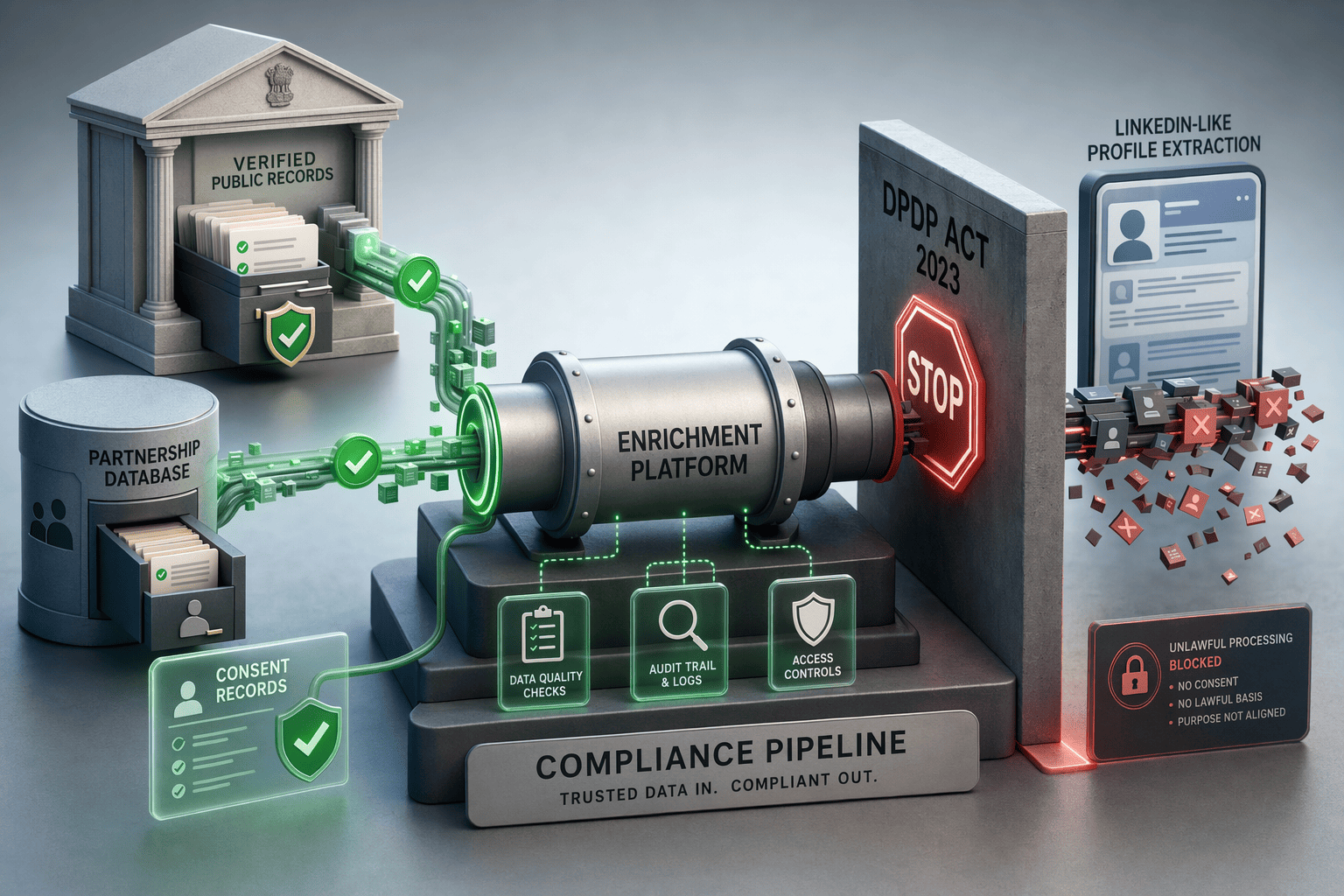
The compliance risk differential between architectures is stark: scraping-based tools that extract live profile data directly from LinkedIn face account suspension rates in the 15-20% range, while enrichment-based platforms that query independent third-party databases report under 2% suspension risk. This gap exists because LinkedIn's Terms of Service explicitly prohibit automated extraction, and the platform's detection systems flag unusual browsing patterns, rapid page loads, and cookie-less sessions. Enrichment-based tools avoid these tripwires by never accessing LinkedIn's servers, they use the profile URL purely as a reference identifier to query external business databases and public records. For teams prioritizing compliance and account safety, the architecture choice is non-negotiable. PeakAi's real-time verification system achieves 91% phone number accuracy by querying third-party data partners rather than scraping, positioning it alongside other enrichment-first platforms like Cognism that prioritize verification rigor over extraction volume.
The cost-per-usable-contact lens reveals why verification premiums are often illusory. A tool priced at ₹8 per credit with 70% deliverability yields a true cost of ₹11.43 per usable contact (₹8 ÷ 0.70). A tool priced at ₹12 per credit with 95% deliverability costs ₹12.63 per usable contact (₹12 ÷ 0.95), only 10% more expensive on a per-usable basis. Teams evaluating 'affordable' enrichment tools should demand transparent deliverability and verification metrics, then calculate true cost per usable contact rather than headline price per record. Affordable tools that sacrifice verification to hit a lower sticker price end up costing more per successful connection, and no budget benefits from paying twice for the same lead.
Beyond verification rigor, India's regulatory landscape introduces compliance requirements that reshape how enrichment platforms acquire and validate contact data.
India-Specific Compliance: DPDP Act 2023 & GST Validation Requirements
DPDP Act 2023 Consent and Data Processing Requirements
India's Digital Personal Data Protection Act 2023 mandates explicit consent for processing personal contact data, fundamentally reshaping how B2B enrichment tools operate in the Indian market. Contact enrichment platforms must demonstrate lawful data acquisition chains, verifying that phone numbers and emails originate from consent-backed business databases rather than scraped LinkedIn profiles. Tools relying on direct LinkedIn scraping without platform permission expose users to compliance violations, as the Act grants Indian data subjects rights to access, erasure, and portability of their information. Enrichment-based platforms that source data through legitimate partnerships and verified public records, rather than automated profile extraction, align with DPDP Act requirements by maintaining auditable consent trails.
GST Validation for Business Contact Verification
GST number validation against India's GSTIN database confirms business legitimacy and contact authenticity, a verification layer absent from global platforms. When an enrichment tool cross-references a prospect's GST registration, it validates that the company is an active registered entity rather than a dormant listing or fraudulent contact. PeakAi integrates GST number validation and Ministry of Corporate Affairs record cross-referencing to verify company legitimacy before outreach, enabling sales teams to find accurate contact information and close more deals with verified Indian B2B prospects.
MCA Database Integration for Firmographic Enrichment
Ministry of Corporate Affairs database access enables enrichment tools to verify company directors, authorized signatories, and current registration status, firmographic dimensions that global LinkedIn enrichment platforms cannot replicate. MCA integration confirms that a listed contact holds an official company role rather than being an outdated profile, reducing wasted outreach to contacts who have changed organizations. This layer is especially valuable for enterprise deals requiring validation of decision-maker authority before engaging in high-value sales cycles.
How to Choose the Right Tool for Your Sales Motion
The best contact enrichment tool depends on your sales motion, budget constraints, and India-specific accuracy requirements. Teams optimizing for outbound volume prioritize cost-per-contact and free-tier availability. Account-based motions require deep firmographic fields and native CRM workflows. Hybrid approaches blend both, demanding multi-source coverage and waterfall enrichment.

Outbound Volume Motion: Freemium and Pay-Per-Use Priorities
High-volume outbound teams need cost-per-contact optimization and pricing models that align cash outflow with verified contact acquisition. Apollo's freemium tier offers baseline email discovery at $49/month, reducing upfront risk for teams ramping prospecting volumes. For India-focused teams prioritizing mobile number accuracy, PeakAi's pay-per-verified-contact model delivers 91% phone number accuracy at ₹675 for 50 contacts, eliminating subscription waste when prospecting velocity varies month-to-month.
Account-Based Motion: Firmographic Depth and CRM Integration
Account-based teams targeting enterprise buyers require enrichment tools with extensive firmographic fields, revenue bands, employee counts, technology stack data, and native integrations with Salesforce or HubSpot. ZoomInfo and Cognism deliver enterprise-grade breadth, but their custom pricing and global-first architecture create barriers for budget-constrained teams focused exclusively on India. Coverage depth for Indian mid-market and MSME contacts remains a gap in global platforms, making pre-purchase pilot tests key before annual commitments.
Hybrid Motion: Waterfall Enrichment and Multi-Source Coverage
Hybrid motions blending outbound and account-based tactics benefit from waterfall enrichment, querying multiple data sources sequentially to maximize coverage, and real-time API flexibility. Clay's waterfall approach and Clearbit's real-time API suit teams with engineering resources willing to manage multi-source orchestration. These architectures maximize contact completeness but introduce cost complexity as enrichment credits cascade across providers. Teams without dedicated data engineering should prioritize single-source tools to close more deals without operational overhead.
Choosing Your India-Optimized Contact Enrichment Partner
Freemium models like Apollo offer the lowest entry barrier but may require upgrading to paid tiers for mobile number access, while pay-per-use models such as PeakAi align cost with verified contact acquisition but lack the firmographic breadth of enterprise platforms. Enrichment-based platforms deliver lower compliance risk and <2% account suspension rates, whereas scraping-based tools offer faster setup but 15-20% suspension risk under DPDP Act 2023.

As India's B2B market matures and DPDP Act enforcement tightens, contact enrichment vendors will differentiate on regional accuracy transparency, GST validation integration, and consent-backed data acquisition, dimensions where global platforms currently lag.
Start with a 50-contact India accuracy test during free trials (Apollo, Lusha) or test PeakAi's 91% verified phone accuracy with a pay-per-use pilot ($9 for 250 credits) to validate India mobile number performance before committing to subscription-based platforms.
Frequently Asked Questions
What is the most affordable contact enrichment tool for Indian B2B teams?
Apollo.io's freemium plan (50 mobile credits/month, unlimited email credits) and PeakAi's pay-per-use model ($9 for 250 credits) offer the lowest entry points. True affordability depends on cost-per-verified-contact, credit-based pricing inflates costs by 35-100% when verification failures and data decay are included.
How accurate are contact enrichment tools for Indian phone numbers?
India-specific accuracy for global tools tests 10-15 percentage points lower than US/EU figures. Independent testing shows contact finder accuracy averages closer to 50% than vendor-claimed 95-98%. PeakAi's 91% verified phone number accuracy represents the India-specific benchmark, with verification methodology determining accuracy ranges.
Do contact enrichment tools comply with India's DPDP Act 2023?
Enrichment-based platforms that acquire data through partnerships and consent-backed sources generally align with DPDP Act requirements. Scraping-based tools pose compliance risk, facing 15-20% account suspension rates versus <2% for enrichment platforms. Verify each vendor's data acquisition practices and consent mechanisms before procurement.
What is GST validation in contact enrichment, and why does it matter?
GST validation verifies a contact's GST number (GSTIN) against the government database to confirm business legitimacy and contact authenticity. This India-market requirement is absent from global tools, reducing fake contact risk in B2B prospecting by validating active registered entities rather than inactive or fraudulent listings.
How do I calculate cost-per-verified-contact for a contact enrichment tool?
Use the formula: (Price per credit) / (India accuracy rate × (1 − monthly decay rate)). Example: ₹10/credit at 80% India accuracy and 2.5% monthly decay = ₹10 / (0.80 × 0.975) = ₹12.82 true cost, a 28% inflation versus advertised pricing. Test India accuracy during free trials to validate.
Should I choose a scraping-based or enrichment-based contact tool?
Enrichment-based platforms offer lower compliance risk and higher long-term reliability, especially under DPDP Act 2023. Account suspension rates for scraping-based tools range 15-20% versus under 2% for enrichment-based platforms. Scraping-based tools serve short-term volume needs but carry suspension risk.
Which contact enrichment tool has the best India coverage?
PeakAi (91% verified phone accuracy), Apollo.io (broad India coverage with lower mobile yield), and Lusha (tiered pricing with regional data) lead India coverage. Best choice depends on use case: mobile numbers (PeakAi), emails (Apollo), or CRM integration (Lusha). Test during free trials to validate coverage.
Sources
- Top 6 Contact Enrichment Tools Comparison (And What They Won't ... - www.marketsandmarkets.com (2025)
- 22 Best Contact Data Enrichment Tools for B2B Sales Teams in 2025 - companyurlfinder.com (2025)
- Best LinkedIn Profile Enrichment Software • November 2025 - F6S - www.f6s.com (2025)
