Contact discovery vendors advertise 95-98% accuracy rates, yet independent testing reveals real-world deliverability averages closer to 50%. The gap exists because 'accuracy' isn't a single metric—it's a composite measure spanning email deliverability, phone connectivity, verification methodology, and regional coverage depth.
Key Takeaways
- Email and phone accuracy rely on completely different verification infrastructure—vendors conflating them into a single percentage mislead buyers evaluating platforms.
- Syntax validation (95%+ rates) confirms correct format, but deliverability verification (50-70% rates) tests inbox receipt via MX records and SMTP handshakes.
- Direct scraping tools violate LinkedIn Terms of Service and face 15-20% suspension rates; enrichment-based platforms query third-party databases to stay compliant.
- Western carrier-level APIs underperform in India due to mobile number portability and 80%+ prepaid SIM prevalence—US/EU accuracy rates don't predict India performance.
- Real-time verification achieves higher accuracy at increased cost; static database verification scales cheaper but experiences 2-3% monthly decay between refresh cycles.
What 'High Accuracy' Actually Means in B2B Contact Discovery
When vendors advertise 95-98% accuracy rates, independent testing tells a different story: real-world accuracy averages closer to 50%. The gap exists because 'accuracy' is not a single metric — it's a composite measure spanning email deliverability, phone connectivity, verification methodology, regional coverage, and data freshness. A platform might pass syntax validation on 98% of records yet deliver only half of them to live inboxes. Teams evaluating contact discovery platforms need to understand which accuracy dimensions matter for their use case and how vendors measure each one.

Syntax Validation vs. Deliverability Verification
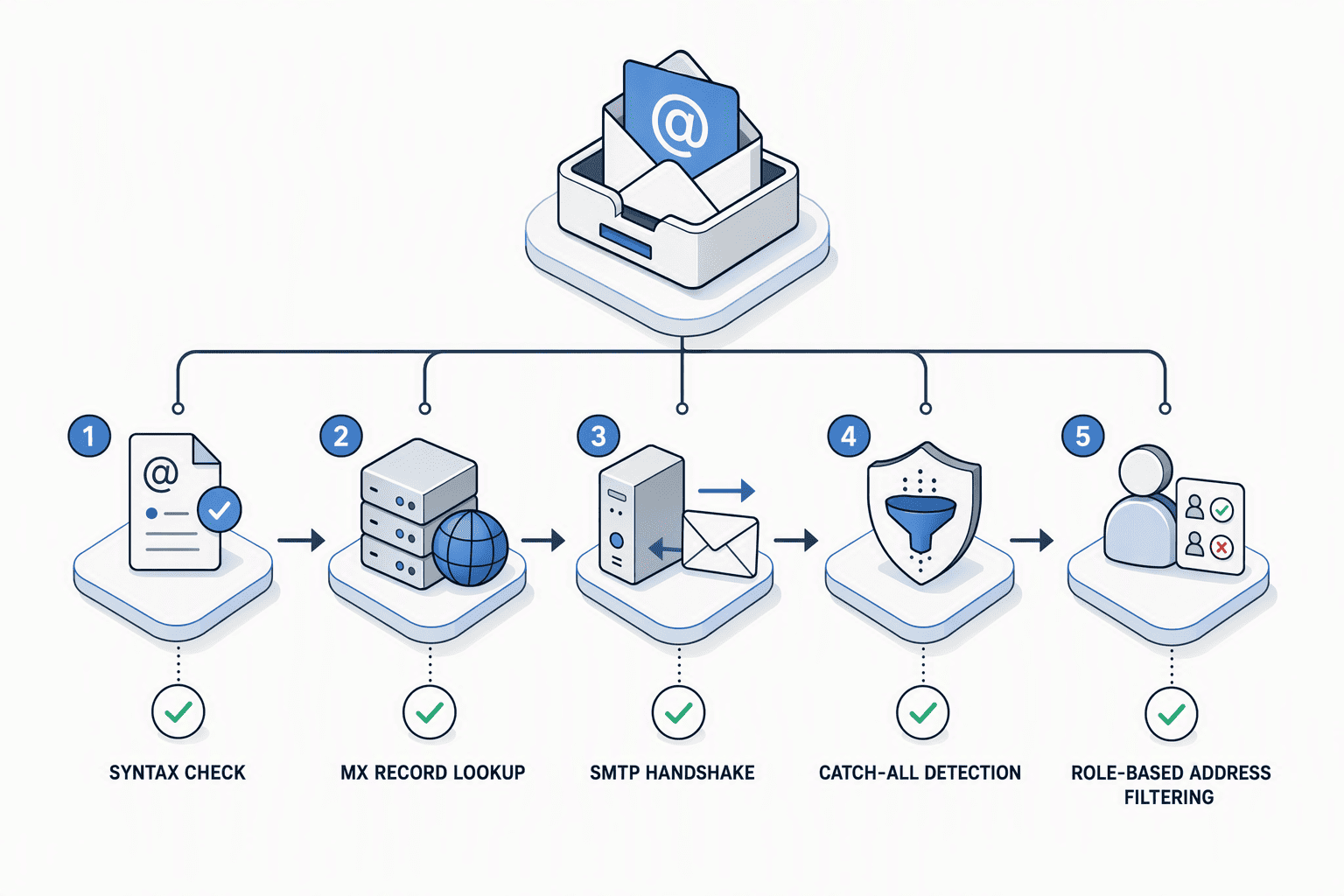
Syntax validation confirms an email address follows the correct format — [email protected] with a valid top-level domain and no illegal characters. It's fast, cheap, and nearly every platform reports 95%+ syntax accuracy. Deliverability verification goes three layers deeper: checking the domain's MX records exist, performing an SMTP handshake to confirm the mailbox is active, and testing whether the inbox accepts messages or flags them as catch-all addresses that silently discard mail. In a 9,000-contact test across ten providers, syntax-validated emails often showed 15-25% bounce rates when actually sent, because valid format does not guarantee the recipient receives your message. The deliverability layer is what separates a database that looks clean from one that connects.
Email Accuracy vs. Phone Accuracy: Why They Require Separate Evaluation
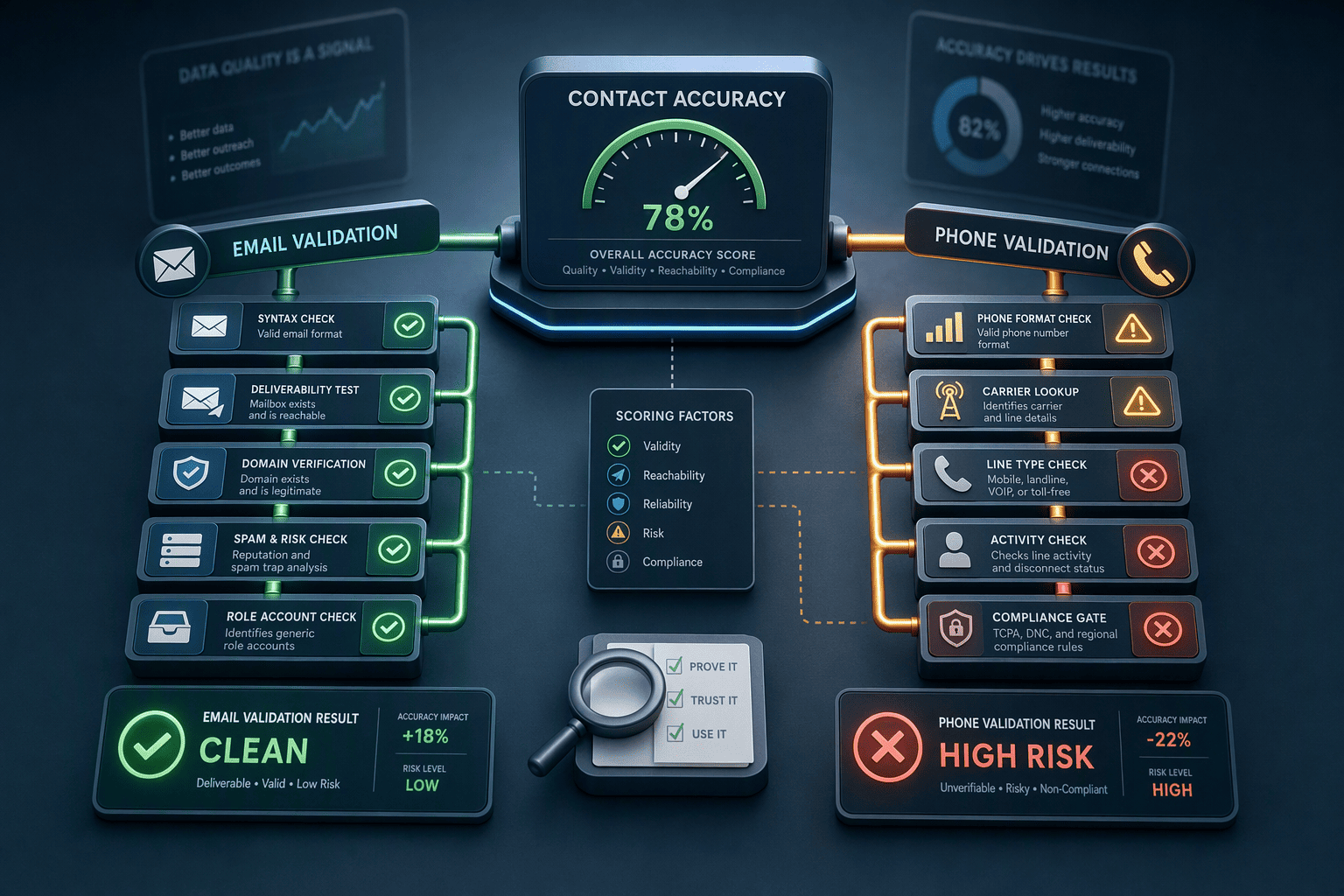
Email and phone verification rely on completely different infrastructure, yet many vendors conflate them into a single accuracy percentage. Email verification runs SMTP handshakes and catch-all detection against mail servers. Phone verification requires carrier-level API access to check number portability, line type classification (mobile, landline, VoIP), and active status with telecom providers. A platform strong on email deliverability may have no phone validation infrastructure at all, or vice versa. When a vendor claims '90% contact accuracy' without breaking out email vs. Phone separately, you cannot evaluate whether their strength aligns with your channel — cold email teams need inbox delivery rates, while cold calling teams need verified mobile numbers with carrier confirmation. Evaluate each metric independently based on your outreach method.
Data Freshness and Regional Coverage as Accuracy Dimensions
Contact data decays at roughly 2-3% per month, compounding to 22.5% annual decay as professionals change jobs, companies relocate, and email patterns shift. A database with 95% accuracy at purchase erodes to approximately 85% accuracy six months later if no re-verification occurs. Vendors that report headline accuracy without disclosing database refresh cadence are measuring a point-in-time snapshot, not sustained performance. Regional variation adds a second hidden dimension: a platform optimized for US enterprise contacts may deliver 90% accuracy domestically but drop to 60-70% for EU or India markets due to thinner data partnerships and different privacy frameworks. Teams prospecting outside North America should request region-specific accuracy breakdowns and confirm the platform re-verifies contacts at intervals shorter than the decay rate, quarterly at minimum for high-churn segments like technology and professional services.
Understanding what accuracy claims actually measure reveals only half the picture, the methods platforms use to obtain contact data introduce a second dimension of risk.
The Compliance-Accuracy Tradeoff Most Platforms Hide
The contact discovery market divides into two architectural camps, each with distinct compliance profiles and accuracy characteristics. Buyers evaluating platforms often focus solely on verification rates and ignore the sourcing method, a blind spot that can expose entire sales teams to account suspension risk.

LinkedIn Terms of Service and Data Sourcing Methods
Direct scraping tools extract profile data in real time by crawling LinkedIn's web interface, often using browser automation or API circumvention techniques. These platforms promise instant contact reveals but operate in violation of LinkedIn's user-controlled Contact Info architecture, which restricts visibility by connection degree and privacy settings. Tools that instantly reveal contact details are pulling data from prohibited sources, exposing users to permanent account suspension when LinkedIn's anti-bot detection triggers. The structural problem: LinkedIn's privacy-first design ensures that phone numbers used for two-factor authentication never surface in first-degree connections, and most professionals lock down their Contact Info to connections only. No tool can extract 90%+ phone coverage directly from profiles alone without violating platform policies.
Enrichment-Based Tools: Third-Party Database Queries
Compliant platforms sidestep LinkedIn's Terms of Service by querying external business databases and public records instead of scraping profiles. Website contact extractors and database-enrichment services use LinkedIn URLs as reference identifiers to match profiles against third-party datasets, aggregating emails, phones, social profiles, and firmographic signals without accessing LinkedIn's internal systems. PeakAi, for example, uses this enrichment-based compliance method, querying third-party databases rather than scraping LinkedIn profiles. The tradeoff: enrichment-based tools achieve different accuracy profiles than real-time scrapers because they rely on database freshness rather than live profile data. Data may lag by days or weeks, but the compliance architecture eliminates account suspension risk and supports auditable sourcing for enterprise buyers.
Account Suspension Rates and the Hidden Cost of Non-Compliance
Community reports suggest that heavy scraping users face 15 to 20% suspension rates when LinkedIn detects automated profile access patterns or rate-limit violations. The hidden cost extends beyond individual account loss: suspended accounts forfeit connection networks, message histories, and Sales Navigator seats, forcing teams to rebuild prospecting workflows from scratch. For sales organizations evaluating contact discovery platforms, the compliance-accuracy tradeoff is not abstract, it directly shapes long-term platform viability, vendor risk, and the sustainability of outbound motions.
The compliance architecture debate becomes even more complex when vendors report accuracy across both email and phone channels, two verification systems that share nothing in common.
Email Accuracy vs. Phone Accuracy: Why Vendors Conflate Them
Sales automation vendors routinely publish a single "contact accuracy" percentage, 85%, 90%, even 95%, as if email and phone verification share the same infrastructure. They don't. Email accuracy and phone accuracy rely on entirely different validation methods, data sources, and compliance frameworks, yet conflating them into one headline number lets vendors mask weak phone coverage behind strong email performance.
Email Verification Layers: Syntax, MX Records, SMTP Handshake, Role-Based Detection
Email verification runs through a four-layer process, each filtering a distinct type of invalid contact. Contact enrichment platforms apply these checks in sequence:
- Syntax validation, format check against RFC 5321 standards (catches typos, malformed addresses)
- MX record verification, confirms the domain has a configured mail server (filters non-existent domains)
- SMTP handshake, connects to the mail server to verify the mailbox exists without sending a message (catches closed or deactivated mailboxes)
- Role-based detection, flags generic addresses like info@, sales@, support@ that route to shared inboxes rather than individuals
Because email verification leverages universal SMTP protocols and standardized DNS queries, platforms can validate email addresses at scale with high reliability. Every mail server speaks the same language, so enrichment providers can automate checks across millions of records using consistent technical infrastructure.
Phone Verification Challenges: Carrier APIs, Mobile Number Portability, Prepaid SIM Prevalence
Phone verification infrastructure is fragmented by geography and carrier. Unlike email's universal SMTP standard, phone validation relies on carrier-level APIs that vary by region, mobile number portability databases that lag behind real-time port activity, and prepaid SIM ecosystems where number ownership changes frequently without centralized records.
In India and emerging markets, prepaid SIM prevalence complicates verification further, a prospect's mobile number may have been reassigned to a new subscriber weeks earlier, but no public registry tracks the change. Enrichment-based phone discovery methods query third-party databases rather than scraping LinkedIn profiles, but those databases inherit the same carrier-level data gaps. The result: phone accuracy rates trail email accuracy not because vendors prioritize email, but because phone verification infrastructure itself is harder to scale across jurisdictions.
Only 5-10% of LinkedIn Users Share Phone Numbers with First-Degree Connections
Research on LinkedIn phone visibility shows that only about 5% of users share their phone number with first-degree connections, and a mere 0.5% share with second or third-degree connections. This structural visibility gap means overall phone hit rate, the percentage of profiles where any phone number is returned, matters as much as returned-result accuracy, the percentage of returned numbers that connect to the correct prospect.
Vendors conflate these two metrics by reporting a single "phone accuracy" figure that measures only the subset of records where a phone number was found, ignoring the 90-95% of profiles where no phone number could be sourced at all. A tool that returns phone numbers for 8% of profiles and achieves 92% accuracy on those returned numbers may market itself as "92% phone accurate," masking the fact that it failed to find contact information for 92% of your list. When evaluating contact discovery platforms, ask for both the hit rate (coverage) and the accuracy rate (validity of returned contacts), treating them as a single number obscures where the tool actually performs.
Once you understand the email-versus-phone infrastructure distinction, the next step is auditing which verification layers a vendor actually uses beyond their headline claim.
How to Evaluate Verification Methodology (Not Just Claimed Rates)
Headline accuracy rates tell only part of the story. The verification methodology behind those numbers determines whether a 90% claim reflects real deliverability or just syntax checks that miss catch-all domains and role-based addresses.
Verification Layer Transparency: What to Ask Vendors
When evaluating providers, ask which verification layers they use beyond basic syntax validation. Does the platform perform MX record checks to confirm the mail server exists? SMTP handshake verification to test whether the inbox accepts mail? Catch-all domain detection to flag addresses that pass technical checks but rarely reach decision-makers? Role-based address filtering (info@, sales@) that identifies low-conversion contacts?
Vendors that disclose MX and SMTP verification in documentation demonstrate methodology transparency. Those reporting only headline percentages without layer-by-layer breakdowns leave buyers guessing which technical checks their accuracy claims actually include.
Data Refresh Cycles and the Real-Time vs. Static Database Tradeoff
Real-time verification queries each contact at export time, achieving higher accuracy but increasing per-record cost. Static databases verify records during monthly refreshes, scaling cheaper but experiencing 2-3% accuracy decay between refresh cycles. Waterfall enrichment, querying one record against multiple providers in sequence until verified data is found, lifts match rates from 60-70% to 85-92% across 3-5 sources, though per-record cost climbs 2-4 times.
Regional Testing Samples: Why US/EU Accuracy Doesn't Predict India Performance
Vendors who report only global averages hide emerging-market performance. India-specific accuracy typically tests 10-15 percentage points lower than US/EU figures due to thinner data coverage and regional phone number format variations. Request regional accuracy breakdowns (US/EU vs India/APAC) before committing to annual contracts.
To audit vendor claims independently, export a 100-contact sample and run it through an independent deliverability tool like NeverBounce or ZeroBounce. Compare the verified deliverable rate to the vendor's advertised accuracy, discrepancies above 5% suggest the vendor's headline rate may reflect syntax checks rather than inbox-level verification. Join thousands of sales professionals who test before they buy.
Verification methodology transparency matters globally, but regional coverage depth introduces a third variable: geography-specific accuracy gaps that vendor averages mask.
Regional Coverage Depth: Why US/EU Rates Don't Predict India Performance
Mobile Number Portability and Prepaid SIM Prevalence in India
Western carrier-level phone validation APIs (HLR lookups, postpaid carrier integrations) underperform in India because mobile number portability creates stale carrier databases and prepaid SIM prevalence, over 80% of Indian mobile users, eliminates the billing-address verification anchor that postpaid systems rely on. Contact discovery platforms built for North American telecom infrastructure struggle to verify Indian contacts at the same accuracy rates they achieve in US/EU markets. PeakAi delivers 91% phone number accuracy specifically for Indian contacts across 1600+ cities, validated against GST and MCA databases, addressing the 10-15 percentage point India accuracy gap that vendors reporting only US/EU test samples often hide.

LinkedIn Profile Density and Contact Disclosure Rates by Region
LinkedIn contact disclosure rates vary significantly by region: US and European professionals more frequently share work emails on profiles, while Indian professionals prioritize privacy settings and rarely expose phone numbers to second- or third-degree connections. This regional behavior gap affects data availability for any platform relying on visible LinkedIn fields alone. Tools that cross-reference multiple data sources beyond LinkedIn's visible profile fields, business registries, public records, verified databases, compensate for lower on-platform disclosure rates in emerging markets.
Cost-Per-Verified-Contact Range: Regional Specialists vs Enterprise Solutions
Enterprise global solutions like ZoomInfo dominate US firmographics but carry annual contract commitments typically starting at $15k, $60k+ per year, a premium justified by intent data and org chart depth in mature markets. Regional specialists optimized for India and APAC, including PeakAi, offer lower entry points suited to budget-conscious teams prospecting primarily in emerging markets. Teams prospecting across US/EU/India should accept the enterprise premium for global coverage; teams focused on India can prioritize regional specialists that deliver verified contact information at India-optimized accuracy rates.
PeakAi's Multi-Layer Verification Approach
Enrichment-Based Architecture: Third-Party Database Queries
PeakAi uses external database verification rather than scraping LinkedIn profiles, querying 200+ network data partners in real time to discover phone numbers and emails. This enrichment-based approach positions PeakAi in the same compliant category as Apollo and ZoomInfo, avoiding the LinkedIn Terms of Service violations that plague direct-scraping tools. The real-time verification architecture pulls fresh data at the moment of request instead of relying on pre-compiled lists, integrating all verification layers into the prospecting workflow.

91% Accuracy Claim for Returned Phone Numbers: What It Means
PeakAi delivers 91% phone number accuracy, this refers to returned-result accuracy (phones returned connect 91% of the time), not overall hit rate (the percentage of profiles where any phone number is discovered). The dual verification for both emails and phone numbers catches invalid addresses and abandoned mailboxes before contacts enter your CRM, similar to how ZoomInfo achieves 80-90% email accuracy through its enterprise verification layers.
Regional Optimization for India/APAC and Cost-Per-Contact Positioning
PeakAi's credit-based pricing starts at ₹675 for 50 contacts, charging only when verification confidence is high, a pricing model that accommodates Indian SMB budgets rather than requiring the enterprise-level commitments typical of ZoomInfo. Regional coverage includes local carrier integrations for India/APAC phone verification and GST database integration, making PeakAi best-for budget-conscious B2B sales teams prospecting primarily in India and emerging APAC markets who need compliant contact discovery without enterprise pricing and can accept lower US/EU coverage in exchange for regional depth. Learn more about PeakAi vs Lead411 CRM integration to close more deals with verified contacts.
Conclusion
Enterprise global solutions like ZoomInfo and Cognism offer broader US/EU coverage and higher overall phone hit rates but cost ₹165-330 per verified contact; regional specialists like PeakAi optimize for India/APAC accuracy at ₹70-125 per contact but achieve lower US/EU coverage, choose based on where you prospect. Real-time verification tools (Clay waterfall approach) achieve higher accuracy by verifying at export time but cost more per contact; static database tools (Apollo, ZoomInfo monthly refreshes) scale cheaper but contact data decays 2-3% monthly, prioritize real-time verification for high-value campaigns, static databases for high-volume prospecting.
As LinkedIn continues privacy-first design restricting phone number visibility and AI-powered contact enrichment tools proliferate, buyer evaluation will shift from headline accuracy percentages to verification methodology transparency, platforms that disclose MX/SMTP layers, regional testing samples, and compliance architecture will earn trust over those reporting only global averages.
Start by exporting a 100-contact sample from your target region (India/APAC or US/EU) using PeakAi's free trial, then test deliverability with an independent tool to verify the 91% returned-result accuracy claim against your specific use case.
Frequently Asked Questions
What's the difference between email accuracy and phone accuracy in contact discovery platforms?
Email verification uses syntax validation, MX records, SMTP handshakes, and role-based detection through universal protocols. Phone accuracy relies on carrier-level APIs, mobile number portability databases, and real-time connectivity tests, entirely different infrastructure. LinkedIn shows phone numbers on only 5-10% of profiles, explaining why phone accuracy rates trail email and why vendors conflating them mislead buyers.
Why do contact discovery platforms claim 95-98% accuracy when independent testing shows 50%?
Vendors often report syntax validation accuracy (correct email format) rather than deliverability verification accuracy (inbox receipt). Independent testing shows real-world deliverability averages 50%, not the advertised 95-98%. Ask vendors which verification layers they use, MX records, SMTP handshake, catch-all detection, to audit headline claims. Platforms disclosing methodology transparency demonstrate trustworthy verification processes.
Will using a contact discovery platform get my LinkedIn account suspended?
Direct scraping tools that extract profile data in real-time violate LinkedIn Terms of Service and face 15-20% suspension rates for heavy users. Enrichment-based platforms like PeakAi, ZoomInfo, and Cognism query external business databases instead, staying compliant but achieving different accuracy profiles. Choose enrichment-based tools if account safety is a priority.
Why is India-specific contact accuracy lower than US/EU accuracy for most platforms?
Western carrier-level validation APIs underperform in India because mobile number portability creates stale carrier databases, and 80%+ prepaid SIM prevalence eliminates billing-address verification anchors. Indian professionals also enable stronger LinkedIn privacy settings, lowering contact disclosure rates by 10-15 percentage points versus US/EU profiles. Buyers in India need region-specific accuracy data before committing.
How much should I expect to pay per verified contact?
Regional specialists optimized for India/APAC charge ₹70-125 per verified contact, offering budget-friendly pricing and emerging-market coverage. Enterprise global solutions like ZoomInfo charge ₹165-330 per contact with $15k, $60k+ annual minimums, justified by broader US/EU coverage, intent data, and org chart depth. Choose based on where you prospect and budget constraints.
What is real-time verification vs. Static database verification?
Real-time verification queries each contact at export time, achieving higher accuracy but increasing per-contact cost. Static database verification refreshes records monthly, scaling cheaper but experiencing 2-3% accuracy decay between cycles. Prioritize real-time verification for high-value outbound campaigns; use static databases for high-volume prospecting where marginal accuracy loss is acceptable.
How can I audit a vendor's accuracy claim when no third-party benchmarks exist?
Export a 100-contact sample and test it with an independent deliverability tool like NeverBounce or ZeroBounce. Compare the verified rate to the vendor's claim, discrepancies above 5% suggest the headline reflects syntax validation, not deliverability. Also ask which verification layers they use, request regional accuracy breakdowns, and clarify data refresh cycles.
Sources
- B2B Data Quality Benchmarks 2026: Decay, Cost, Numbers - derrick-app.com (2026)
- Best B2B Contact Databases in 2026, Ranked by Accuracy - oneaway.io (2026)
- The Best Email Enrichment Providers in 2026: Our Results from 9,000+ Contacts Tested - www.growthtoday.co (2026)
- Apollo vs ZoomInfo vs Clay: The 2026 B2B Data Provider Breakdown - growtoro.com (2026)
- B2B Data Providers Compared: Apollo, ZoomInfo, Alternatives - highticketaisystems.com (2026)
- Lead Enrichment: We Tested 5 Tools and Then Automated the Whole Thing - cotera.co (2026)
- B2B Contact Databases Compared: ZoomInfo vs Apo… - GTMPicker - gtmpicker.com (2026)
