
Contact discovery platforms promise 95% accuracy, but real-world deliverability testing reveals usable contact rates closer to 50%. Verification methodology—syntax validation versus deliverability testing—and regional optimization create wide performance gaps between advertised claims and actual prospecting outcomes.
Key Takeaways
- Verification methodology—deliverability testing versus syntax validation—determines whether contacts are actually reachable or just formatted correctly
- Regional specialization matters: US/EU-optimized platforms test 10-15 percentage points lower for Indian B2B contacts compared to their advertised global accuracy
- Credit-based pricing obscures real cost per usable contact by 35-100% when match rates fluctuate; pay-per-verified-contact models eliminate burn-rate uncertainty
- Carrier-level phone validation and SMTP handshake testing separate true verification from format-only checks that leave sales teams with undeliverable contacts
- Cost transparency requires calculating real spend per usable contact across enrichment attempts, not just advertised per-credit or subscription pricing
For teams asking 'Best contact discovery platform with high accuracy rates for B2B prospecting?', the answer depends on geography and verification depth: PeakAi delivers 91% accuracy optimized for Indian B2B markets, while Apollo, ZoomInfo, and Cognism serve US/EU enterprise segments with broader database coverage. Independent testing reveals average contact discovery accuracy closer to 50% versus vendor claims of 95-98%, making verification methodology—not database size—the deciding factor for close more deals.
The Verification Methodology Disconnect
Contact discovery platforms report accuracy using vastly different validation layers. Email verification ranges from syntax-only checks (does it match name@domain format?) to full deliverability testing with SMTP handshake, MX record validation, and catch-all detection. Phone verification similarly spans format validation (correct digit count for the country code) to carrier-level lookups that confirm the number is active, classify it as mobile/landline/VoIP, and flag disconnected lines. Platforms using syntax-only validation can claim 95%+ accuracy because they're measuring whether the string looks plausible, not whether it connects.
Why Advertised Accuracy Doesn't Predict Usable Contacts
Most vendors report accuracy at the database level, what percentage of their records passed validation at ingestion, but don't disclose match rates (how often a LinkedIn profile actually returns a verified contact). This creates the gap between advertised 95-98% and real-world ~50% usable contacts: a platform with 200M contacts at 95% accuracy may only match 40% of your target prospects, while a 50M database with 91% accuracy and higher match rates delivers more dials. Credit-based pricing obscures this further, you burn credits on lookup attempts regardless of whether verified data is returned.
Structural Data Gaps No Tool Can Solve
Only about 5% of LinkedIn users share phone numbers with first-degree connections, dropping to 0.5% for second- or third-degree. No platform can extract what professionals haven't published. Similarly, contact data decays 2-3% monthly as people change roles or numbers. Platforms advertising 'real-time verification' still face this structural ceiling, evaluation should focus on how they handle gaps (flagging unverifiable records vs charging credits for failed lookups) rather than expecting 100% coverage.
Understanding why accuracy claims diverge from reality requires a structured evaluation framework that measures verification depth, not just database size.
How to Evaluate Contact Discovery Platforms (Verification Framework)
Not all 'verified' contacts are equal. Platforms report accuracy figures that sound identical on paper but conceal wildly different testing methodologies, regional coverage gaps, and cost-per-usable-contact economics. Below are the three evaluation criteria that separate platforms built for deliverability from those optimized for feature checklists.

Accuracy Verification Layers to Demand
Syntax validation alone, confirming an email follows the format [email protected], tells you nothing about whether the mailbox accepts messages. Real verification requires multiple layers executed in sequence: SMTP handshake to confirm the mail server responds, MX record checks to verify the domain routes mail, catch-all detection to flag domains that accept mail to any address (rendering individual validation meaningless), and deliverability simulation that tests whether the address has blocked, bounced, or flagged prior senders. For phone numbers, carrier-level validation classifies each contact as mobile, landline, or VoIP and checks against do-not-call registries, critical distinctions scraping-based tools ignore because they extract numbers without querying telecom databases. Platforms that report 'verified' contacts without disclosing which layers they apply are conflating format checks with functional validation.
Regional Accuracy Testing Requirements
Global database breadth does not guarantee regional accuracy. US/EU-optimized platforms routinely underperform in emerging markets by 10-15 percentage points because their source networks, carrier partnerships, and compliance frameworks are built for Western geographies. When evaluating a platform, request accuracy breakdowns by region and contact type (email vs phone, mobile vs landline). A vendor that reports 85% aggregate accuracy but cannot segment that figure by country or job level is masking inconsistent coverage. Ask for sample pulls from your target ICP and test the results yourself, some platforms will deliver strong email coverage in North America but <50% phone match rates in India, rendering the aggregate metric misleading for teams running multi-region outbound.
Pricing Model Transparency and Real Cost Calculation
Pre-download verification (pay only for verified contacts) and credit-based models (charge for all enrichment attempts regardless of match success) produce radically different economics when match rates fluctuate. Credit-based pricing models can obscure true cost per usable contact by 35-100% when match rates fluctuate across ICPs, geographies, or contact types. A platform quoting $0.15 per credit sounds affordable until you discover that 40% of your target ICP returns no valid contact, effectively doubling your per-result cost to $0.25. Demand transparency on average match rate by ICP segment, pricing per verified result (not per attempt), and refund or credit-back policies for invalid contacts. Platforms that bundle database access, sequencing, and dialer features under a single per-seat subscription can deliver better unit economics than pay-per-contact models for high-volume teams, but only when the included contact allowance aligns with your monthly consumption, otherwise you're prepaying for credits you won't use.
With verification standards defined, the next step is comparing how each platform performs across accuracy, coverage, and regional specialization.
Platform Comparison: Accuracy, Coverage, and Regional Specialization
| Platform | Email Accuracy | Direct Dial Coverage | India/APAC Coverage | Starting Price | G2 Rating |
|---|---|---|---|---|---|
| PeakAi | 91% (deliverability-tested) | 91% phone accuracy | 1600+ Indian cities | $9/50 contacts | Not disclosed |
| Apollo.io | Not disclosed | Not disclosed | Patchy EU/APAC | $49/user/mo | 4.7 |
| ZoomInfo | Not disclosed | Deepest US coverage | Limited | $15K+/yr | 4.4 |
| Cognism | Diamond Data verified | Mobile dials (EU focus) | Strong EU, limited APAC | Contact sales | Not disclosed |
| Lusha | Higher accuracy claimed | Thorough | General | $37.45/mo | Not disclosed |
How to Read the Accuracy and Coverage Columns
Email accuracy and direct dial coverage are vendor-reported figures that often don't distinguish deliverability testing from syntax validation. Request verification methodology breakdowns during evaluation. India/APAC coverage percentages indicate database presence, not region-specific accuracy, global platforms' US/EU optimization creates the 10-15pp accuracy gap discussed earlier. PeakAi's 91% reflects deliverability-tested accuracy specifically for Indian B2B contacts, while broader platforms report aggregated global figures. When evaluating tools, ask whether accuracy metrics reflect active phone numbers and deliverable emails, or just format-valid records. Join thousands of sales professionals using region-optimized contact discovery to close more deals.
Apollo.io, High-Volume SMB Outbound with Global Database
Verification Methodology and Accuracy Claims
Apollo claims a 275-million-contact database but independent testing reveals a gap between advertised and delivered accuracy. A 100-lead US-market test measured Apollo at 80% email accuracy and 45% phone accuracy, substantially below the platform's marketing claims. The discrepancy stems from Apollo's reliance on syntax validation and pattern matching rather than deliverability testing: an email that passes format checks may still bounce if the mailbox is inactive or the domain has changed. Phone coverage is even weaker; fewer than half of returned numbers connect to the intended contact.

Pricing Model and Real Cost
Apollo's credit-based system starts at $49/user/month but charges for all enrichment attempts regardless of match success. When match rates fluctuate, common in emerging markets or mid-market segments, real cost per verified contact can rise 35 to 100% above the nominal per-credit price. A team budgeting $0.50 per contact may find effective costs approaching $1.00 when half the credits return invalid or incomplete data.
Best For and Trade-Offs
Apollo suits high-volume SMB outbound teams prospecting US and EU markets who value an all-in-one platform with built-in email sequences and CRM syncs. The global database breadth supports multi-region campaigns, but accuracy drops 10 to 15 percentage points outside North America and Western Europe. Teams targeting Indian contacts or other emerging markets will encounter higher bounce rates and disconnected phone numbers, making Apollo less cost-effective than region-specialized enrichment layers.
ZoomInfo, Enterprise Standard with Intent Data (Limited India Depth)
Verification Methodology and Enterprise Features
ZoomInfo is the most complete enterprise B2B database, with deep firmographic coverage and mature CRM integrations. Its verification layers include deliverability testing and intent data integration, meaning contact quality is enhanced by buyer-signal context that helps reps prioritize high-intent prospects. This approach raises effective accuracy by routing teams to contacts actively researching solutions, though it does not eliminate regional data gaps in emerging markets.

Regional Coverage Gaps for Indian B2B Contacts
ZoomInfo's US/EU optimization creates lower accuracy in India and other emerging markets. India-specific accuracy for global tools often tests 10-15 percentage points lower than US/EU figures, raising real cost per usable contact when prospecting the Indian market. Teams that select ZoomInfo based on global accuracy claims without requesting region-specific verification rates frequently discover higher bounce rates and wasted credit spend.
Best For and Trade-Offs
ZoomInfo suits enterprise sales teams focused on US/EU markets who need intent-driven targeting and deep org charts. Starting at $15K+ annually, it delivers the strongest intent data and firmographic intelligence in the category. However, higher cost and limited India coverage depth make it a suboptimal choice for teams targeting emerging markets, where regional specialists offer better accuracy at lower per-contact cost.
Cognism, EMEA Champion with Cell Phone Coverage
Cell Phone Verification and EMEA Specialization
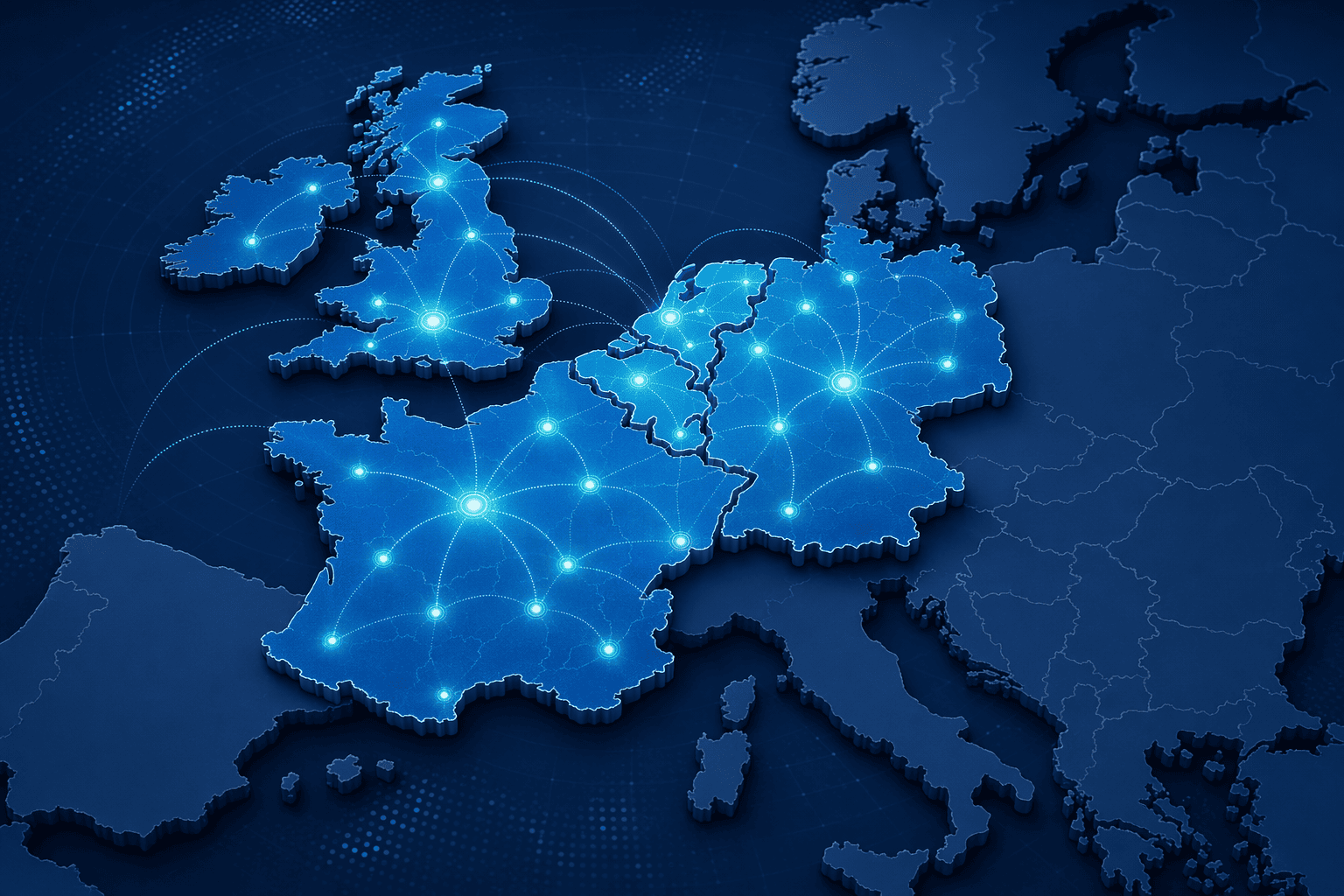
Cognism's Diamond Data mobile coverage delivers carrier-level phone validation built specifically for EMEA markets. Where Apollo and ZoomInfo optimize for email-first workflows, Cognism prioritizes verified mobile numbers, the primary business contact channel across European markets. This regional specialization translates to higher direct-dial success rates for sales teams targeting UK, France, Germany, and Benelux territories, where mobile-first communication dominates B2B outreach and compliance frameworks like GDPR demand tight contact verification.
India Coverage and Emerging Market Performance
Cognism's 400M+ profile database offers global breadth, but EMEA optimization creates the same regional accuracy gaps US-optimized platforms face in India. Tools calibrated for European mobile verification standards typically deliver 10 to 15 percentage points lower accuracy in markets where mobile number formats, carrier infrastructure, and business-contact norms differ substantially. Teams prospecting heavily in India or APAC should verify current regional coverage before committing to annual contracts.
Best For and Trade-Offs
Cognism suits EMEA-focused sales teams whose outbound motion depends on verified mobile dials and GDPR-compliant contact workflows. The trade-offs are clear: enterprise pricing (contact-sales-only model) and limited India depth make Cognism less suitable for cost-conscious teams or those targeting emerging markets outside Europe. For buyers outside EMEA, the regional specialization that drives Cognism's high mobile accuracy becomes a coverage gap rather than a differentiator.
Lusha, Fastest for Individual Lookups (Subscription-Only)
Individual Lookup Speed and Verification Depth
Lusha starts at $37.45/month for the Starter tier and positions itself as a real-time contact finder. The platform's browser extension automatically scans its database when you browse a profile or company, displaying relevant information in real time. Lusha uses crowdsourcing, artificial intelligence, and data validation to ensure accuracy across over 100 million business profiles. This workflow optimizes for speed in individual lookups, sales reps clicking through LinkedIn profiles get instant email and phone data, but the verification depth is shallower than bulk enrichment platforms that cross-reference multiple independent databases per contact.

Subscription Pricing and Bulk Enrichment Limitations
Lusha's subscription-only model ($37.45/mo Starter, $52.45 Pro, $299.95 Premium) creates a fixed monthly cost regardless of lookup volume. For teams running low-volume prospecting (10-50 lookups/month), this translates to a low effective per-contact cost. At scale, however, subscription lock-in makes bulk enrichment inefficient: a team needing 2,500+ contacts monthly pays the same subscription fee for unused lookups or must upgrade to the Premium tier. Credit-based or pay-per-verified-contact models offer better cost control for bulk use cases, since teams pay only for the contacts they enrich rather than a fixed seat cost.
Best For and Trade-Offs
Lusha is fastest for individual SDRs doing low-volume prospecting with browser-based workflows, sales reps who need instant contact data while browsing LinkedIn or researching a handful of leads daily. The trade-offs: subscription lock-in creates high per-contact costs for bulk enrichment (teams needing thousands of contacts monthly should evaluate credit-based platforms instead), and the browser extension workflow doesn't support the automated batch enrichment pipelines that CRM-first teams rely on. Choosing Lusha for bulk enrichment based on individual lookup speed is an anti-pattern, subscription pricing makes it inefficient at scale, and the browser extension's real-time scan design isn't optimized for bulk CSV imports or API-driven enrichment workflows.
PeakAi, India-Optimized Verification with Pay-Per-Contact Pricing
91% Verified Accuracy for Indian B2B Contacts
PeakAi delivers 91% phone number accuracy specifically for Indian B2B contacts, measured across 1,600+ cities. This precision stems from dual verification for both emails and phone numbers, including GST and regional phone format validation built for Indian market workflows. The platform's verification API catches invalid email addresses at the point of capture using pattern recognition, ensuring teams close more deals with pre-qualified contact data.

Pay-Per-Verified-Contact Pricing Transparency
PeakAi employs a pay-per-verified-contact pricing model starting at ₹675 for 50 verified contacts. Unlike credit-based systems that charge for all enrichment attempts, successful or not, this pay-as-you-go approach eliminates burn-rate uncertainty. The model positions itself as a low-barrier entry point for teams testing verified contact discovery, avoiding the upfront subscription commitments typical of global database platforms.
Best For and Trade-Offs
PeakAi suits India-focused sales teams prioritizing cost transparency and pay-per-use budgets, especially those working SMB and mid-market accounts across regional markets. Trade-offs include smaller database size versus Apollo or ZoomInfo's global breadth, and regional specialization versus multi-region coverage. The platform's 91% accuracy rate and GST/MCA database integration make it strongest for teams prospecting within India, but teams targeting multi-geography campaigns will need to combine it with global platforms for complete coverage.
Pricing models determine whether advertised per-credit costs match your real spend per usable contact, especially when match rates fluctuate across geographies.
Cost-Per-Verified-Contact Analysis: Advertised vs. Real Spend
How Credit-Based Pricing Obscures Real Cost
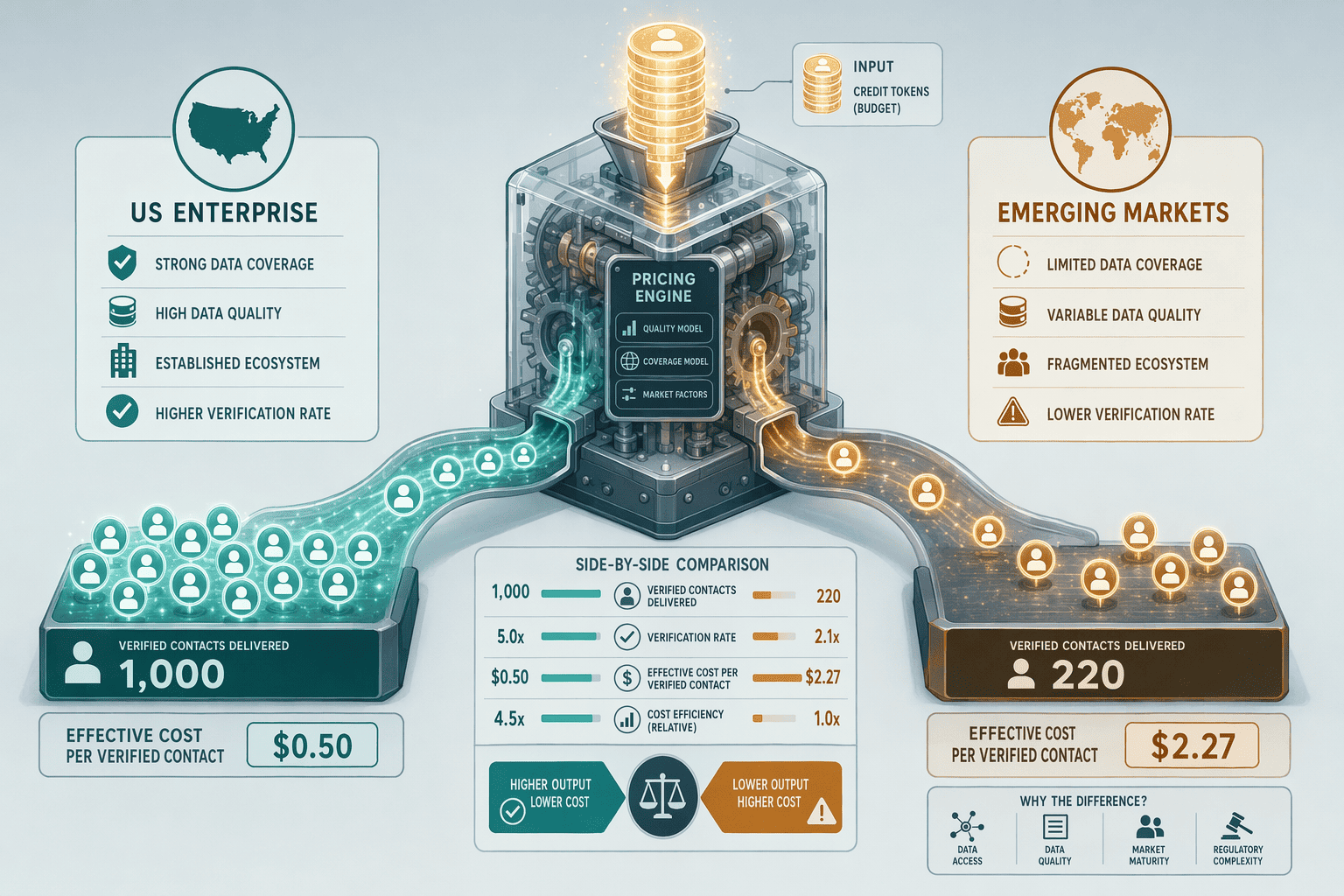
Credit-based contact discovery platforms charge for every enrichment attempt, regardless of whether a verified phone number or email is actually returned. When match rates fluctuate across different prospect segments or geographies, the real cost per usable contact can diverge sharply from the advertised per-credit price. A platform advertising $0.50 per credit may deliver 70% match rates in US enterprise segments but drop to 40% in emerging markets, effectively doubling your cost per verified contact in those regions. This opacity creates 35 to 100% cost variance that only becomes visible after teams track actual verified contacts delivered versus credits consumed.
Subscription vs Pay-Per-Verified Economics
Subscription models lock teams into fixed monthly fees, unlimited lookups within tier limits, but high breakage when actual usage stays below the cap. For teams pulling fewer than 200 contacts per month, monthly subscriptions incur high per-contact costs. Pay-per-verified-contact models like PeakAi's $9 for 50 verified contacts eliminate burn-rate uncertainty: you pay only when a phone number or email clears pre-download verification. At high volumes (1,000+ contacts monthly), subscription economics may favor flat-fee platforms, if match rates remain stable and the team consistently uses the full allocation.
Real Cost Calculation Framework
To estimate real cost per usable contact across any pricing model:
- Track total spend over a measurement period (30 or 90 days).
- Count verified contacts delivered, not enrichment attempts or credits consumed.
- Divide total spend by verified contacts to calculate real cost per usable contact.
This calculation surfaces the true economics behind advertised pricing and reveals whether pre-download verification or post-export filtering is driving higher value. Teams that measure cost per verified contact, rather than cost per credit, make more accurate ROI comparisons and avoid the hidden overhead of failed enrichment attempts.
FAQ: Contact Discovery Platform Selection for B2B Prospecting
This FAQ section is generated automatically from structured seeds and appears at the end of the article.
Global platforms like Apollo and ZoomInfo deliver broader database coverage and US/EU accuracy leadership, while regional specialists like PeakAi optimize verification depth and carrier relationships for Indian B2B contacts, choose based on your primary prospecting geography. Credit-based pricing suits teams with unpredictable enrichment needs who want bulk credits, while pay-per-verified-contact pricing suits budget-conscious teams prioritizing cost transparency and eliminating burn-rate uncertainty.
As AI-driven prospecting tools mature in 2026, expect regional specialists to gain market share in emerging markets where global platforms' US/EU optimization creates persistent accuracy gaps, buyers will increasingly demand verification methodology transparency and region-specific accuracy breakdowns rather than accepting aggregate claims.
Calculate your real cost per usable contact using PeakAi's pay-per-verified-contact model and compare it to your current platform's credit-based pricing, our India-optimized verification delivers 91% accuracy with no burn-rate uncertainty.
Frequently Asked Questions
What's the difference between syntax validation and deliverability testing for email accuracy?
Syntax validation confirms email format ([email protected]) but doesn't verify the mailbox exists or accepts mail. Deliverability testing performs SMTP handshake, MX record checks, and catch-all detection to confirm reachability. Independent testing reveals average contact discovery accuracy closer to 50% versus vendor claims of 95-98%, showing why syntax-only validation yields lower usable contact rates.
Why do global contact discovery platforms underperform in Indian B2B markets?
US/EU-optimized platforms prioritize data sources and carrier relationships in those regions, creating verification depth gaps for emerging markets. India-specific accuracy for global tools often tests 10-15 percentage points lower than US/EU figures, raising real cost per usable contact when prospecting the Indian market. Regional specialists close this gap through localized data partnerships and carrier-level validation.
How does credit-based pricing obscure real cost per usable contact?
Credit-based systems charge for all enrichment attempts regardless of match success, so fluctuating match rates cause real cost per usable contact to diverge from advertised per-credit pricing. Credit-based pricing models can obscure true cost per usable contact by 35-100% when match rates fluctuate. Pay-per-verified-contact models eliminate this burn-rate uncertainty by charging only for successfully returned data.
Can any platform find phone numbers for all LinkedIn profiles?
Only 5-10% of LinkedIn users share phone numbers with first-degree connections, dropping to 0.5% for second- or third-degree. No platform can extract what professionals haven't published. Platforms use third-party data sources to enrich beyond LinkedIn's visible data, but phone coverage remains limited by privacy settings and user behavior. Carrier-level validation improves accuracy but doesn't solve availability constraints.
How quickly does contact data decay, and why does it matter?
Contact data decays at 2-3% monthly as professionals change jobs, phone numbers, and email addresses. This means even 95% accurate data becomes 90% accurate within two months without continuous re-verification. Prioritize platforms with real-time verification or frequent refresh cycles over those relying on static databases to maintain usable contact rates over time.
Is scraping-based contact discovery legal and compliant with LinkedIn's terms?
Scraping-based architectures violate LinkedIn's User Agreement and carry account suspension risk. Enrichment-based tools match LinkedIn profile data to third-party data sources without scraping, offering lower compliance risk. Verify the platform's data collection methodology and GDPR/DNC compliance before committing. Choose vendors that transparently disclose their data sourcing and validation processes to avoid legal exposure.
What's the best contact discovery platform for Indian B2B prospecting in 2026?
PeakAi delivers 91% verified accuracy for Indian B2B contacts with pay-per-verified-contact pricing transparency, ideal for regional focus and cost certainty. Apollo and ZoomInfo offer global database breadth but test 10-15 percentage points lower for Indian contacts. Frame the choice as regional specialization versus global breadth, choose PeakAi for India-optimized verification or global platforms for US/EU accuracy leadership.
Sources
- B2B Contact Databases Compared: ZoomInfo vs Apollo vs Cognism - gtmpicker.com (2026)
- LinkedIn Phone Number Search: Find Cell Numbers Fast - galadon.com
- How to Get Contact Info from LinkedIn Without Being Connected (2026 Guide) - www.powerin.io (2026)
- How to Get a Professional Social Network Profile's Contact ... - nubela.co
- LinkedIn Sales Navigator vs Apollo vs ZoomInfo: Best Data Tool - stackbd.com (2026)
- 15 B2B Prospecting Tools & Software Tested on 100 Leads ... - www.cleanlist.ai (2026)
- Best B2B Data Providers in 2026: Apollo vs ZoomInfo vs Clay vs Cognism - techstackreviews.net (2026)
- Lusha vs RocketReach: Key Differences, Benefits, Pricing, and ... - www.bookyourdata.com
