B2B teams waste thousands of dollars monthly on contact databases that promise 95% accuracy yet deliver 30% bounce rates during real outreach campaigns.
The gap between advertised and actual accuracy stems from verification methodology — vendors measure different layers and obscure what their percentages truly represent.
Key Takeaways
- High accuracy requires four verification layers working together: syntax validation, MX record checking, SMTP handshake testing, and deliverability confirmation
- Platforms report vastly different accuracy rates for the same database because they measure at different verification layers — syntax-only checks versus full deliverability testing
- Pre-download verification models reduce wasted spend by charging only for verified contacts, while post-export models validate after purchase
- Regional accuracy varies by 20-40% between US/EU markets and emerging regions like India due to data-source coverage and local business structures
- Buyers should audit vendors by asking for verification-layer disclosure, regional benchmarks, and refresh frequency before signing contracts
What 'High Accuracy' Actually Means in Contact Discovery (And Why Advertised Rates Mislead)
High accuracy in contact discovery requires four verification layers working together: syntax validation (format check), MX record validation (domain exists), SMTP handshake (mailbox exists), and deliverability testing (inbox placement confirmed). Platforms advertising 95%+ accuracy often measure only syntax while ignoring bounce rates—independent testing shows real-world performance averages closer to 50% for many vendors claiming near-perfect rates.
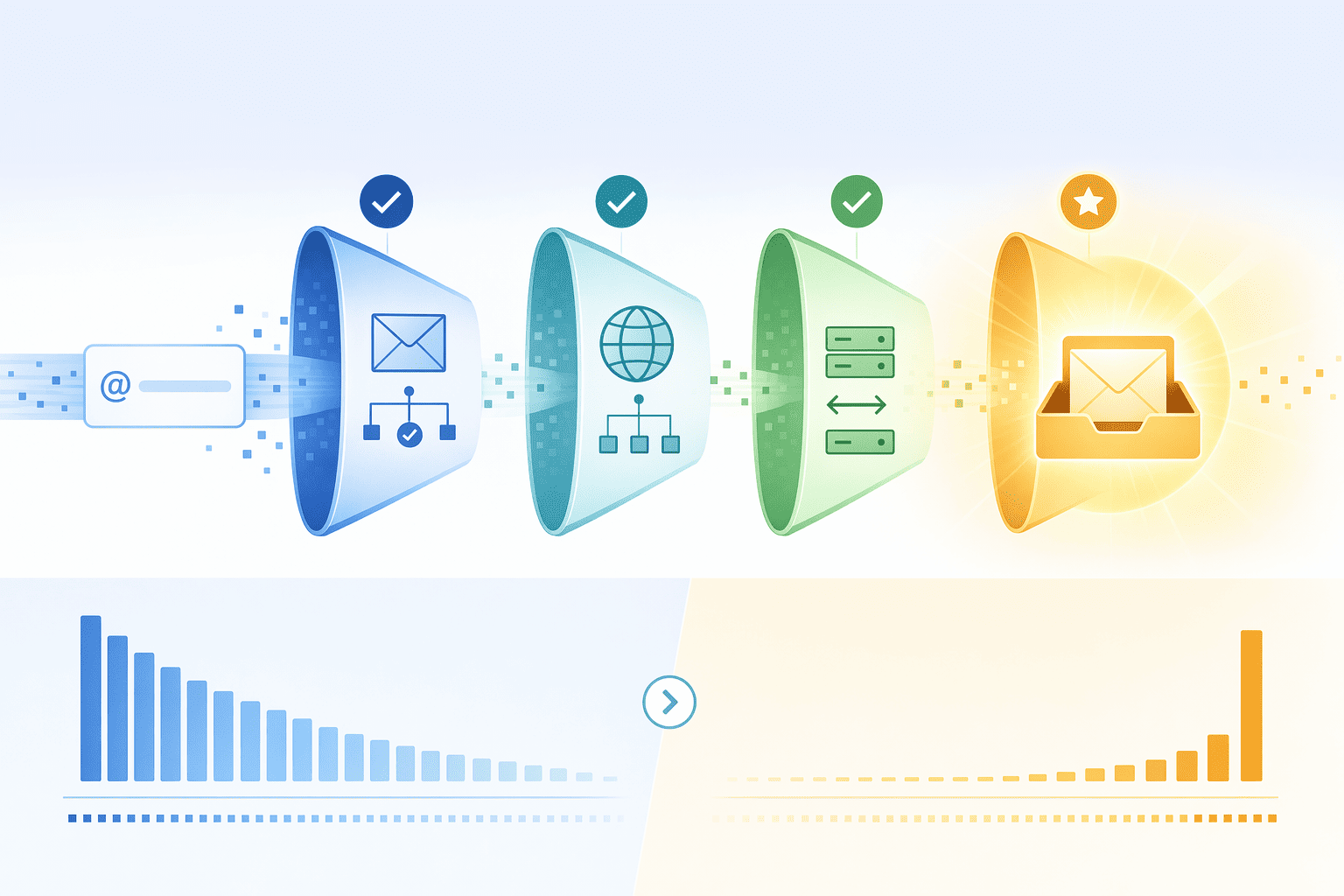
The Four Verification Layers: Syntax, MX, SMTP, and Deliverability
Syntax validation confirms an email follows the [email protected] pattern but says nothing about whether the address receives mail. MX record validation checks the domain's mail server configuration exists, proving the domain handles email—but not whether this specific mailbox is active. SMTP handshake queries the mail server to confirm the mailbox exists without sending a message, catching typos and closed accounts. Deliverability testing sends actual probe messages to verify inbox placement rather than spam-folder routing, the only layer that predicts real campaign performance. Tools skipping any layer inflate accuracy by counting technically formatted but functionally useless contacts.
Why 95% 'Accuracy' Often Means 95% Syntax-Valid, Not 95% Deliverable
Vendors advertise high accuracy by measuring only syntax or MX validation while ignoring bounce rates and inbox placement. Users report 20–30% bounce rates on platforms claiming 95%+ accuracy, meaning one in four contacts fails during real outreach despite passing vendor checks. Every bounce damages sender reputation, triggers ESP spam filters, and burns prospecting credits on phantom contacts. PeakAi's 91% verified contact accuracy applies multi-layer verification including SMTP and deliverability testing before contacts enter your CRM, ensuring the rate reflects actual campaign performance rather than format compliance alone. Learn more about verification workflows in our guide to extracting emails and phone numbers from business profiles.
Composite Metrics and Regional Gaps: The Hidden Accuracy Problem
Platforms reporting a single accuracy percentage often aggregate email and phone performance into one number, masking regional and contact-type gaps. A tool optimized for US/EU markets may deliver 85% phone accuracy domestically while dropping to 45% for India mobile numbers, composite reporting hides this disparity behind a blended average. Phone verification complexity varies by region: US landlines follow predictable formats while India mobile numbers require carrier-specific validation and local number portability checks. Tools lacking regional specialization publish headline accuracy based on their strongest market, leaving teams targeting emerging economies to discover the gap only after credits are spent and campaigns bounce.
Understanding the gap between advertised accuracy and campaign performance requires examining how platforms actually validate contacts before delivery.
How Contact Discovery Platforms Verify Accuracy: 5 Methods Compared
Not all verification creates equal accuracy. Platforms often market 'verified contacts' without disclosing which layers they actually test, and the difference between syntax checking and deliverability testing determines whether you pay for usable leads or database noise. Below are the five methods contact discovery platforms use, ranked by rigor.

Method 1: Syntax Validation (The Minimum Bar)
Syntax validation checks format only, whether an email follows the [email protected] structure. It's instant and cheap, catching typos like 'user@gmailcom' but missing every defunct, abandoned, or nonexistent mailbox. Platforms that stop here label contacts 'verified' despite never testing if the address actually receives mail.
Method 2: MX Record and Domain Checks
MX record validation queries DNS to confirm the domain accepts mail. This eliminates defunct domains like '[email protected]' but doesn't verify the specific mailbox exists. A valid MX record only proves the company has a mail server, not that 'john.doe@' is a live address on it.
Method 3: SMTP Handshake and Mailbox Verification
SMTP handshake simulates message delivery to the target mailbox, checking whether the server accepts the specific recipient address. This catches most non-deliverable addresses before export. PeakAi combines syntax validation, SMTP checks, and catch-all detection to achieve 91% email accuracy, separating mailbox-level verification from domain-only checks that competitors market as 'real-time.'
Method 4: Real-Time Deliverability Testing
'Real-time verification' is marketing in many cases. Some platforms test inbox placement vs spam filtering; others run the same SMTP handshake faster and rebrand it as real-time without additional validation. Platforms differ in whether they prioritize speed over depth, compare whether a provider discloses deliverability testing or only promises low response latency.
Method 5: Continuous Data Refresh and Decay Management
Even platforms with strong initial verification face 2-3% monthly data decay as professionals change jobs or numbers. Refresh frequency determines the gap between initial verification and export-time accuracy. Platforms that source from static databases see accuracy drop faster than those querying live data partners. For regional markets like India, global refresh schedules often lag, see our guide on LinkedIn tools B2B prospecting India emerging markets for how to evaluate regional coverage depth.
Contrarian claim: Platforms that instantly reveal contact details without a verification step are likely pulling from prohibited sources that violate LinkedIn's Terms of Service. Compliant alternatives, like enrichment-based tools that query third-party business databases rather than scraping profile data, introduce latency because verification and cross-referencing take time. If a tool delivers contacts in under two seconds with no verification lag, ask where the data originates and whether your account risk is priced into the subscription.
Verification methods vary widely across vendors, creating dramatic differences in usable contact rates despite similar marketing claims.
Platform Comparison: Verification Depth and Accuracy Claims
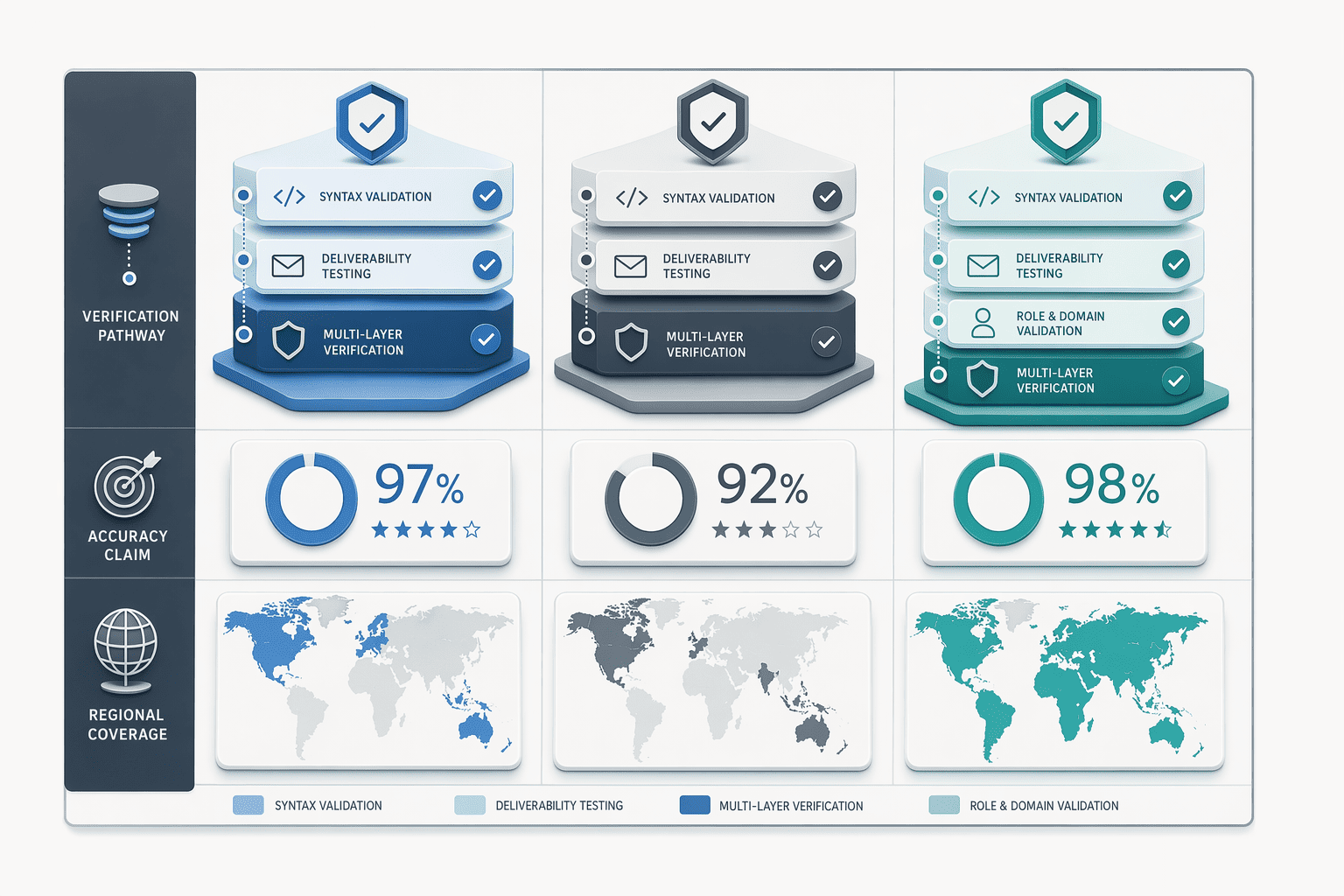
When evaluating contact discovery platforms for B2B prospecting, accuracy claims range from 65% to 95%, yet few vendors disclose how they arrive at those numbers. The difference between syntax-validated emails and deliverability-tested contacts can cost teams thousands in burned credits and stalled outreach. This section compares platforms on methodology transparency, accuracy positioning, and regional coverage to surface which tools use genuine multi-layer validation.
Platforms That Disclose Verification Methodology
PeakAi publishes its verification stack: 91% accuracy backed by real-time SMTP testing, mobile/landline classification, and credit refunds within 24 working hours for incorrect data. Cognism discloses phone-verified Diamond Data screened against DNC registries in 15 countries. Methodology transparency signals confidence, platforms willing to name their validation layers invite buyer scrutiny, while opacity suggests the number is marketing-optimized rather than audit-ready.
Platforms That Advertise High Accuracy Without Methodology Disclosure
Apollo.io claims 65-80% accuracy, ZoomInfo reports 75-85%, yet neither vendor specifies whether those figures represent syntax-only validation or deliverability-tested contacts. Without disclosed verification layers, buyers cannot assess whether the accuracy metric measures initial database quality or post-validation usability. Tools that obscure methodology leave procurement teams guessing whether 'accurate' means the email exists or that it will accept your message.
Regional Accuracy Benchmarking: US/EU vs India Coverage
Global platforms optimized for US/EU markets often deliver 20-40% lower accuracy in India. PeakAi discloses India-specific mobile accuracy with GST verification for regional validation, while ZoomInfo and Apollo aggregate global claims without regional breakdowns. For teams prospecting in high-growth markets, disclosed regional performance matters more than headline database size, a 300M-contact platform means little if only 15% of Indian records connect. Visit our guide on scaling contact discovery for B2B sales in India on budget for region-specific benchmarks.
Before committing budget to any platform, B2B teams need a systematic evaluation framework that separates genuine verification from marketing language.
How to Evaluate a Platform's Accuracy Before You Pay
Most buyers compare contact discovery platforms by database size and monthly price, ignoring the verification methodology that determines whether 91% or 30% of purchased contacts actually connect. Accuracy rates range from 70-95% across the category, but that spread hides structural differences: syntax-only validation (does the email format look valid?), SMTP verification (does the mailbox exist?), and deliverability checks (will it bounce in a real campaign?) each produce wildly different usable-contact yields.
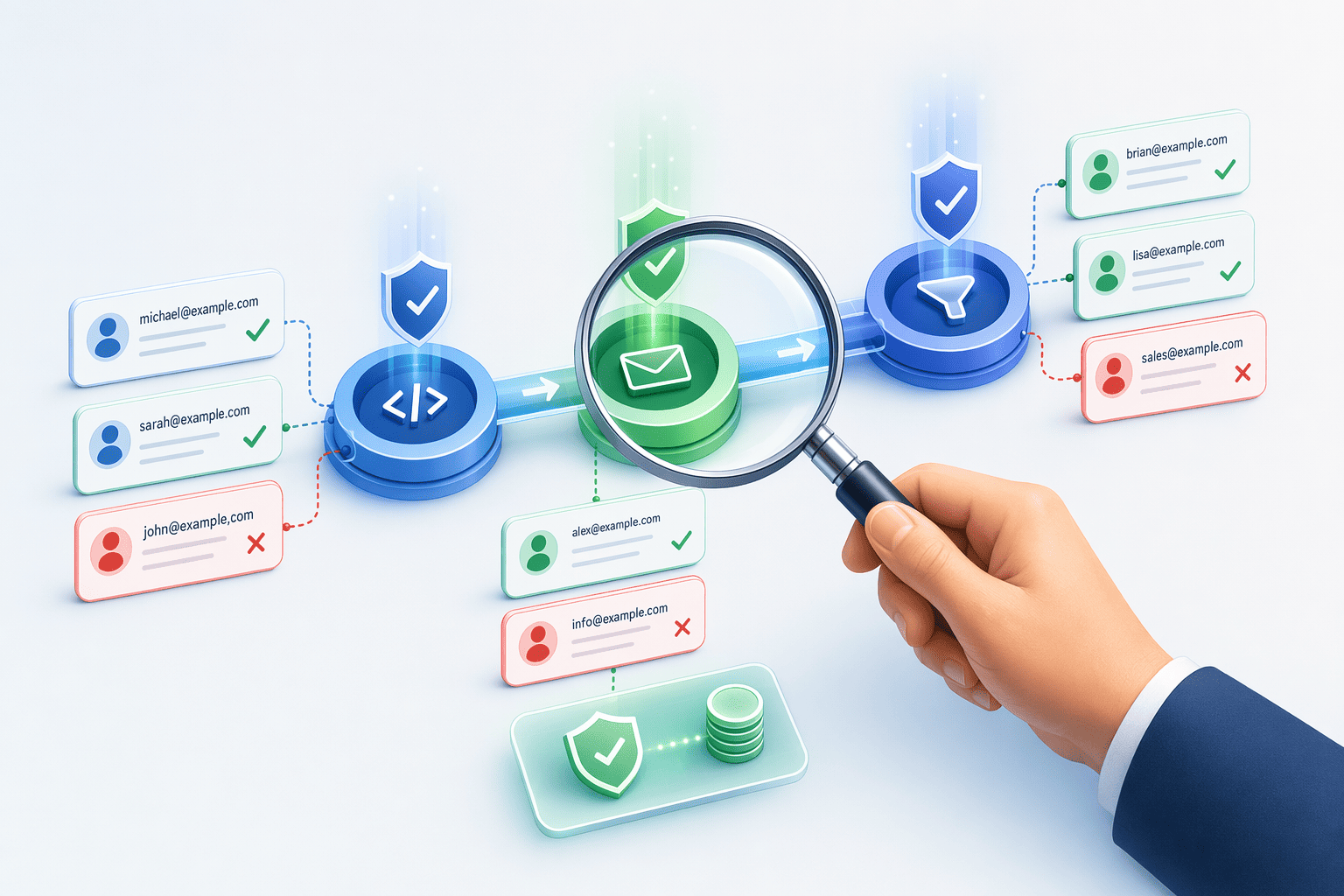
Before signing a contract, ask vendors to disclose their verification layers, regional accuracy benchmarks, and whether you pay before or after validation. The questions below separate platforms that verify before export, like PeakAi, which delivers 91% accuracy with dual verification for both emails and phone numbers, from those that charge for every record then offer post-export cleanup.
Audit Questions to Ask Vendors: Verification Methodology Disclosure
Vendor marketing pages emphasize database breadth but rarely specify which verification layers run before you download a contact. Use these questions to uncover whether accuracy is measured at syntax, SMTP, or deliverability:
- What verification layers do you apply? Ask whether the platform validates syntax only (email format looks correct), SMTP (mailbox exists on the server), or deliverability (message will reach inbox and not bounce in a real campaign). Platforms that verify deliverability pre-download reduce wasted spend on contacts that pass syntax but fail in actual outreach.
- Is accuracy reported separately for email and phone? Many vendors publish a single "contact accuracy" figure that blends high-performing email data with low-performing phone coverage. PeakAi reports 91% accuracy separately for phone numbers and emails, classifying phones as mobile, landline, or VoIP to help reps prioritize direct dials.
- What's your data refresh frequency? B2B contact data decays at roughly 2.1% per month, about 22-25% annually. Ask how often the platform re-verifies existing records and flags stale contacts. Real-time verification systems like PeakAi's cross-reference multiple data sources beyond LinkedIn's visible profile fields to maintain accuracy as contacts change roles.
- What's your regional accuracy in my target market? Global databases often deliver 85%+ accuracy in North America but drop below 60% in emerging markets. If you're prospecting in India, EMEA, or APAC, ask for region-specific accuracy benchmarks. PeakAi specializes in Indian B2B markets with GST and MCA database integration, reducing the gap between claimed and realized accuracy in regions where global tools underperform.
- Do you charge before or after verification? This question exposes the cost model: platforms that verify pre-download let you pay only for usable contacts, while post-export models charge for every attempted lookup (including invalid records) then offer a refund or re-verification workflow that burns time and budget.
- How do you handle compliance in my region? Platforms that scrape LinkedIn directly may deliver fresher data but violate LinkedIn's Terms of Service and expose your account to suspension. Ask whether the vendor sources data from third-party business directories and public records (compliant but potentially stale) or pulls directly from LinkedIn profiles (higher risk, variable freshness).
- What happens when a contact fails verification? Some platforms deduct a credit whether the contact is valid or not; others offer a credit-back guarantee for failed lookups. PeakAi's model verifies contacts before download, so you pay only for contacts that pass validation at lookup time.
Pre-Download vs Post-Export Verification: Impact on Cost-Per-Usable-Contact
The structural difference between pre-download and post-export verification models determines your true cost per usable contact, not the per-record sticker price. Platforms that verify after export charge for every lookup attempt, including invalid records, then offer a cleanup workflow or refund path that adds friction and delays outreach.
If a vendor charges $0.10 per contact but only 50% pass deliverability checks, your true cost is $0.20 per usable contact, double the advertised rate. Pre-download verification platforms run SMTP and deliverability checks before you pay, so the per-contact cost matches the usable-contact cost. PeakAi validates contacts in real-time, displaying verification status before lookup, which eliminates the post-export cleanup loop and lets reps load only verified contacts into CRM.
This model also reduces list waste: post-export platforms often require bulk minimum purchases (500-1,000 contacts per month), forcing small teams to buy more records than they can work. Pay-per-verified-contact pricing scales down to teams that need 50-100 contacts per quarter, improving budget efficiency for startups and sales teams without large prospecting volumes.
Compliance vs Accuracy Tradeoff: LinkedIn Scraping and Enrichment-Based Alternatives
Tools that instantly reveal contact details from LinkedIn profiles are pulling data directly from prohibited sources. LinkedIn's Terms of Service prohibit automated scraping, and platforms that circumvent rate limits or harvest profile data through bots expose users to permanent account suspension. The compliance risk is not theoretical: LinkedIn actively monitors for scraping behavior and has suspended thousands of accounts tied to aggressive contact extraction tools.
The alternative, enrichment-based platforms that source data from third-party business directories and public records, eliminates the scraping risk but introduces a freshness tradeoff. Because these platforms don't access LinkedIn's internal data, they rely on external databases that refresh on weekly or monthly cycles. A contact who changed roles yesterday may still appear at their old company in the enrichment platform's records until the next refresh.
PeakAi resolves this tradeoff by sourcing verified contact data through legitimate business databases and public records rather than scraping LinkedIn directly, then applying real-time verification layers to flag stale records before export. This compliance-first approach reduces legal risk while maintaining usable accuracy through multi-source cross-referencing. For teams that automate LinkedIn contact research without restrictions, the platform provides a workflow that respects LinkedIn's terms while delivering the contact coverage sales teams need.
When evaluating platforms, ask vendors to explain their data sourcing method and whether their approach complies with LinkedIn's Terms of Service. Tools that promise instant reveals or bulk extraction from LinkedIn profiles are signaling prohibited scraping methods. Platforms that describe enrichment layers, third-party data partnerships, and compliance documentation are more likely to provide sustainable access that won't result in account bans or legal exposure.
Frequently Asked Questions
What's the difference between email accuracy and deliverability?
Email accuracy typically refers to syntax validation, whether the format follows [email protected] structure, while deliverability measures inbox placement versus bounces or spam filtering. True deliverability requires all four verification layers: syntax, MX records, SMTP handshake, and inbox testing. Vendors advertising 95% accuracy often measure only syntax, yet users report 20-30% bounce rates during real campaigns.
Why do contact discovery platforms report different accuracy rates for the same database?
Platforms measure accuracy at different verification layers, some report syntax-only validation, others SMTP testing, and a few test actual deliverability. Accuracy rates range from 70-95% across the category, but that spread reflects structural methodology differences rather than database quality. Most buyers ignore verification methodology and focus only on database size and monthly price, missing the factor that determines whether 91% or 30% of purchased contacts actually connect.
How often does contact data need to be refreshed to maintain accuracy?
Professional contacts decay at 2-3% monthly as people change jobs, phone numbers, and email addresses. Platforms need continuous refresh cycles, ideally monthly or more frequent, to keep accuracy above 85%. Even platforms with strong initial verification face this decay, so refresh frequency determines the gap between initial verification and export-time accuracy. Static databases degrade rapidly and fall below 70% usable accuracy within six months.
What's a realistic accuracy rate for B2B contact discovery in India?
Tools optimized for US and EU markets often deliver 20-40% lower accuracy in India due to mobile number portability, informal business structures, and lower third-party data coverage. Buyers in India should request region-specific accuracy claims rather than accepting global averages. Global platforms aggregate worldwide performance without regional breakdowns, masking the accuracy drop in emerging markets where data infrastructure differs significantly from Western sources.
Should I pay for contact discovery upfront or per-export?
Pre-download verification models, pay only for verified contacts, reduce wasted spend on invalid records compared to post-export models that charge for every lookup attempt then validate afterward. Platforms that verify after export charge for all records including invalid ones, then offer cleanup workflows or partial refunds. Your true cost per usable contact depends on when verification occurs, not the advertised per-record price, since match rates fluctuate between campaigns.
Are platforms that scrape LinkedIn in real-time more accurate?
Real-time LinkedIn scraping delivers fresher data but violates LinkedIn's Terms of Service and creates legal risk for buyers. Compliant enrichment-based tools query third-party business databases instead of scraping profiles directly, avoiding ToS violations but depending on vendor refresh frequency for accuracy. Platforms that instantly reveal contact details without verification steps likely pull from prohibited sources. Accuracy in compliant tools depends on how often the vendor refreshes their licensed datasets.
What questions should I ask vendors to verify their accuracy claims?
Ask vendors to disclose verification layers (syntax, MX, SMTP, deliverability), whether they report email and phone accuracy separately, refresh frequency, and regional accuracy in your target markets. These questions separate platforms verifying before export from those validating after purchase. Request whether you pay before or after validation, how the platform handles mobile versus landline classification, and what refund policy applies to incorrect contacts within the first 24 hours.
Sources
- B2B Contact Data Quality Tested: Bounce Rates & Phone Accuracy - www.amplemarket.com (2026)
- How to Collect Verified Contact Information for Local Businesses - outscraper.com (2026)
- Best B2B Data Providers in 2026: Apollo vs ZoomInfo vs Clay vs Cognism - techstackreviews.net (2026)
- Apollo.io vs ZoomInfo: User Comparison Guide 2026 - fundraiseinsider.com (2026)
- Data Enrichment Tools: 10 Tested With Pricing - Autobound AI - www.autobound.ai (2025)
