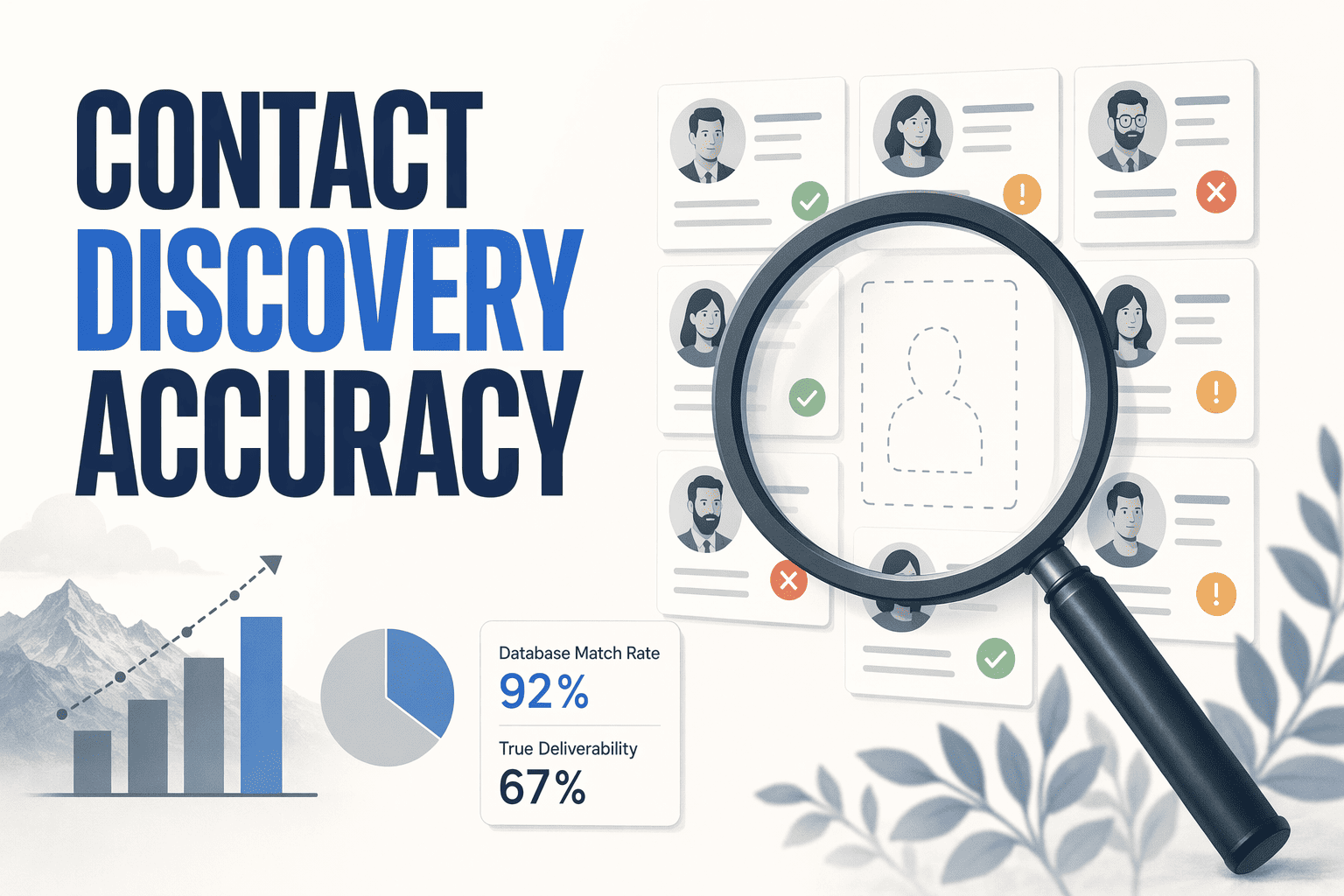
Most contact discovery platforms advertise a single accuracy percentage that conflates database match rates with actual deliverable contact success—making direct comparisons misleading without understanding what each platform measures.
Key Takeaways
- Contact discovery accuracy splits into three distinct metrics: email deliverability (75-85% is good), phone verification (65-75% verified active numbers), and data freshness (2-3% monthly decay rate).
- Platforms optimize for different regions—ZoomInfo and Cognism deliver 82-85% email accuracy in US/Europe markets, while regional specialists like PeakAi focus on Indian B2B phone verification at 91%.
- Real-time verification workflows confirm phone accuracy before export, reducing wasted credits on unverified contacts compared to static databases refreshed quarterly.
- Credit-based pricing (Apollo) suits low-volume users but wastes credits on 35-50% unverified contacts; subscription models (ZoomInfo, Cognism, PeakAi) offer predictable cost-per-verified-contact economics for high-volume teams.
- Test regional accuracy using a 7-day protocol: sample 50-100 contacts in your target geography, measure email and phone accuracy separately, and calculate cost-per-verified-contact before annual commitments.
Platforms like Apollo, ZoomInfo, Cognism, and PeakAi use different verification methodologies, making direct accuracy comparisons misleading without understanding what each measures. Apollo combines contact data, email sequencing, and CRM sync for $49-$149/month, ZoomInfo dominates enterprise prospecting with 100M+ verified contacts starting at $15K/year, and PeakAi delivers 91% phone-number accuracy through real-time carrier validation.
Why Advertised Accuracy Doesn't Equal Email-Finding Success
Most platforms advertise a single accuracy percentage that conflates database match rates with deliverable contact success. Apollo reports 70-85% email accuracy, while ZoomInfo claims 80-90% — but these figures measure syntax validation or database verification, not whether the contact answers calls or opens emails. PeakAi's email validation runs syntax, domain, and deliverability checks before download, categorizing results into safe (99% deliverable confidence), risky (unverifiable but formatted correctly), and empty tiers. Buyers who compare advertised percentages without asking 'what counts as verified' often discover their usable contact yield falls far below the marketed rate.
The Three Accuracy Metrics That Actually Matter
Evaluate platforms on three separate dimensions: email deliverability accuracy (whether the inbox exists and accepts messages), phone verification accuracy (whether the number connects to an active line), and data freshness (monthly decay rates as contacts change roles). ZoomInfo offers 65-75% phone coverage, while Apollo provides 40-50% — but coverage and accuracy are distinct metrics. PeakAi validates each candidate number through carrier lookup protocols, classifying results as mobile, landline, or VoIP. Platforms that report one aggregated accuracy figure collapse these dimensions into a number that tells buyers little about which contact type will actually work.
Verification Methodology: What 'Verified' Means Across Platforms
Transparency separates platforms that verify before download from those that verify after export. Each provider tested on a 500-account ICP across US and EMEA measured email coverage, mobile/direct-dial coverage, and data accuracy verified against LinkedIn. PeakAi provides 91% accuracy verification for phone numbers and emails from LinkedIn profiles before download, eliminating the risk of paying for contacts that fail basic validation. Ask vendors whether their verification happens at lookup time or post-purchase — syntax-only checks cost less but deliver lower usable yields than active deliverability testing. For teams that need to find accurate contact information without burning budget on unverified records, pre-download validation closes the gap between advertised accuracy and actual success.
Understanding how platforms define accuracy requires breaking down what each metric actually measures in real-world prospecting workflows.
What Accuracy Metrics Actually Mean for B2B Prospecting
Email Deliverability Accuracy: Syntax vs Inbox Delivery
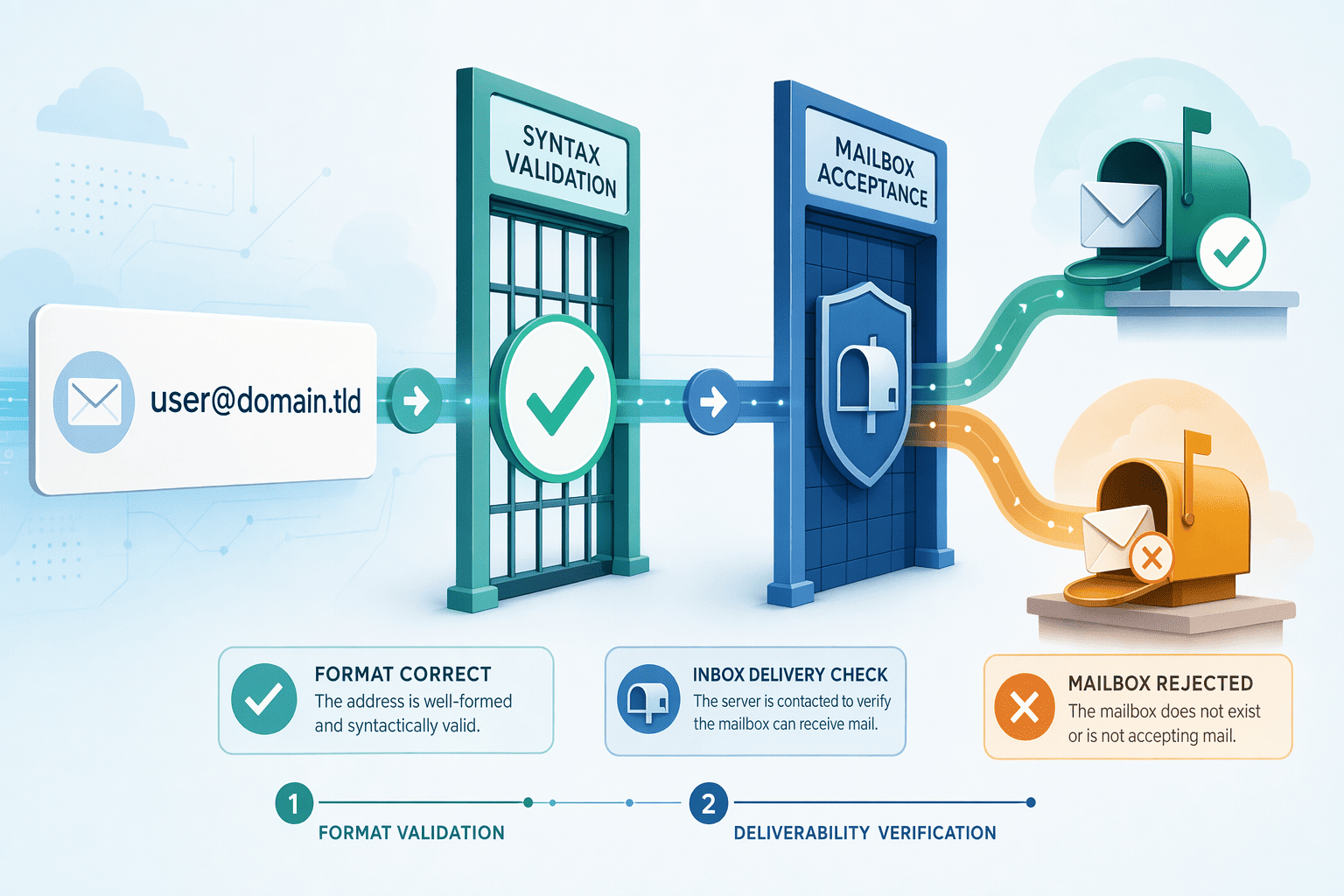
Email accuracy splits into two stages: syntax validation confirms an address passes format checks ([email protected]), while deliverability testing verifies the mailbox exists and accepts messages. A platform reporting 95% email accuracy often means 95% of returned addresses are syntactically correct, not that 95% will reach inboxes without bouncing. Real inbox delivery depends on mailbox provisioning, spam-filter rules, and whether the recipient still monitors that address. Buyers evaluating contact platforms should ask whether accuracy figures reflect syntax validation alone or end-to-end deliverability testing.
Phone Verification Accuracy: Active Number vs Published Contact
Phone verification measures whether a number is active and reachable, not just whether it appears in a database. Platforms that rely on static records may surface numbers that are disconnected, reassigned, or never belonged to the prospect. Industry match rates typically range from 50 to 65% for phone numbers versus 75 to 80% for emails, reflecting the difficulty of maintaining current mobile contacts. The gap widens when comparing direct dials to company switchboards; a verified direct mobile delivers 3x higher connect rates than an unverified landline.
Data Freshness and Monthly Decay Rates
Contact data decays at approximately 2 to 3% per month as professionals change jobs, phone numbers, or email addresses. A database refreshed quarterly starts at its claimed accuracy but drops 6 to 9 percentage points by month three. Platforms that update records in real time preserve accuracy; those relying on batch imports from static sources cannot keep pace. Buyers should confirm update frequency and ask how the vendor handles stale records, whether they're flagged, removed, or left in the pool to inflate database-size claims.
| Verification Dimension | Phone | |
|---|---|---|
| Syntax validation | 95%+ pass format checks | Number format validation only |
| Deliverability testing | Mailbox provisioning check required | Active-line confirmation required |
| Industry match rate | 75–80% | 50–65% |
| Primary challenge | Spam filters, inactive mailboxes | Disconnected/reassigned numbers |
With accuracy metrics defined, here's how the leading platforms compare on email deliverability, phone verification, and data freshness.
Platform-by-Platform Accuracy Breakdown: Apollo vs ZoomInfo vs Cognism vs PeakAi
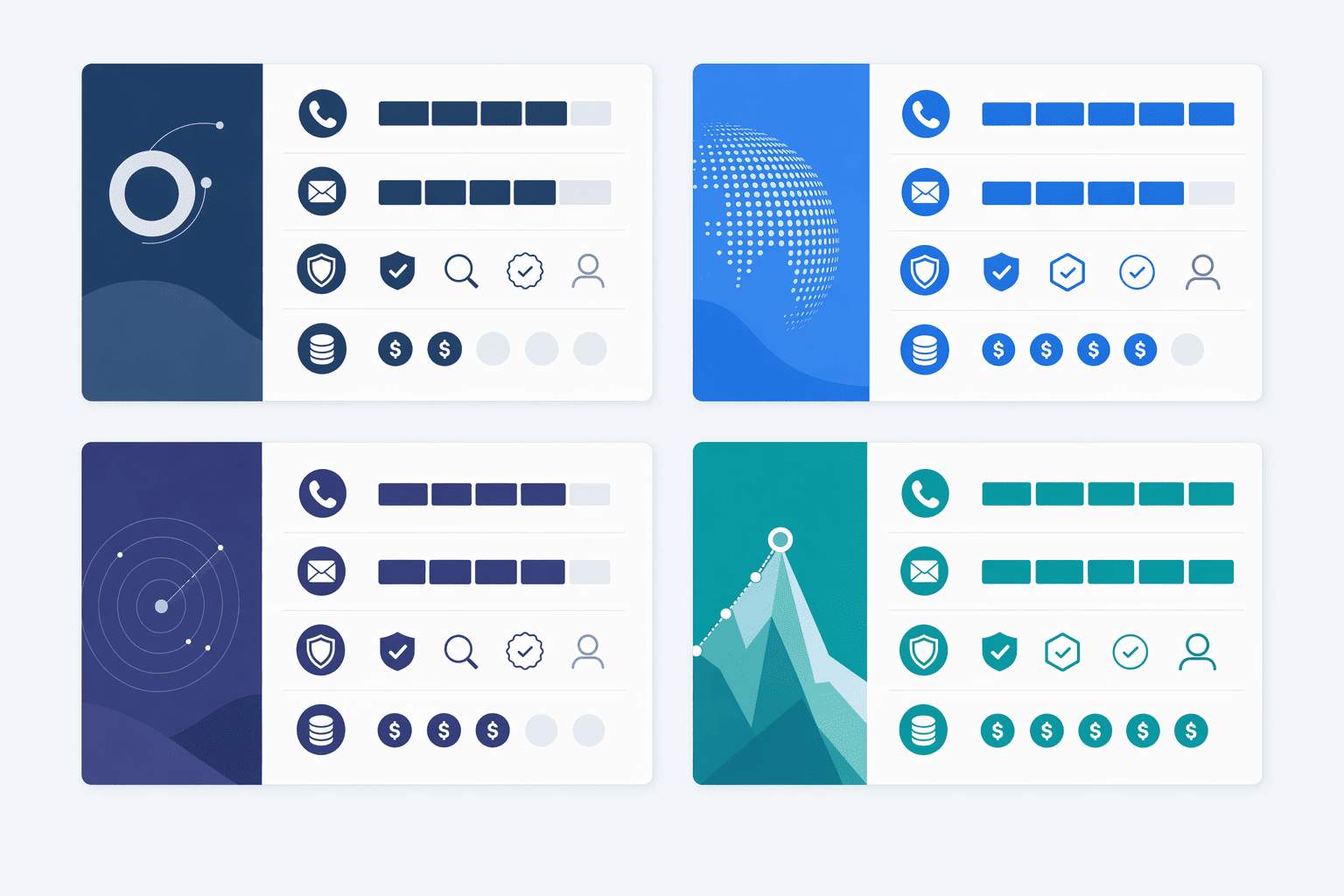
Accuracy rates determine whether your outbound team reaches decision-makers or burns hours on disconnected numbers and bounced emails. The platforms below differ fundamentally in verification methodology, regional coverage depth, and pricing models, understanding these differences helps you match tools to your contact discovery strategy.
Apollo: Cost-Effective Credit-Based Model with Moderate Phone Accuracy
Apollo.io delivers 65-80% phone number coverage and 82% email accuracy for US contacts, positioning itself as an all-in-one sales engagement platform for teams that prioritize email outreach over cold calling. The credit-based pricing model starts at $49/month with a 4.7/5 G2 rating across 9,250 reviews, making it accessible for SMBs and startups that need integrated sequencing and dialer capabilities without enterprise contract minimums.
Best for: Budget-conscious teams that run multi-channel outbound (email + LinkedIn + phone) and need built-in engagement workflows, especially when phone accuracy below 70% is acceptable for outreach volume strategies.
ZoomInfo and Cognism: Premium Email Deliverability for US/Europe Markets
ZoomInfo maintains 65-75% phone coverage and 80-90% email accuracy through quarterly database refreshes and proprietary intent signals, with a 4.5/5 G2 rating from 8,875 reviews. Cognism delivers comparable accuracy with EMEA-focused data quality and GDPR compliance tooling. Both platforms require annual contracts starting at $15K+ and target enterprise teams with dedicated RevOps resources.
Best for: Enterprise sales teams in North America and Europe that need thorough buyer intelligence, org charts, and conversation analytics integrated with Salesforce or HubSpot, where email deliverability justifies premium pricing and annual commitments.
PeakAi: 91% Phone Accuracy with 7-Day Refresh for Indian B2B Markets
PeakAi delivers 91% phone number accuracy optimized for Indian B2B contacts across 1600+ cities, with 10-second real-time verification and 7-day database refresh cycles. Pricing starts at $9 for 50 verified contacts with no annual lock-in, targeting SMBs and mid-market teams in India and emerging markets where phone-first prospecting drives pipeline velocity.
Best for: Teams prioritizing verified phone numbers for cold calling in India and regional markets where LinkedIn email discovery rates fall below 40% and direct dials determine conversion rates.
Platform architecture fundamentally determines whether accuracy claims hold up when contacts export, real-time verification delivers what static databases cannot.
Real-Time Verification vs Static Database Models
Static Database Refresh Models and Monthly Decay Impact
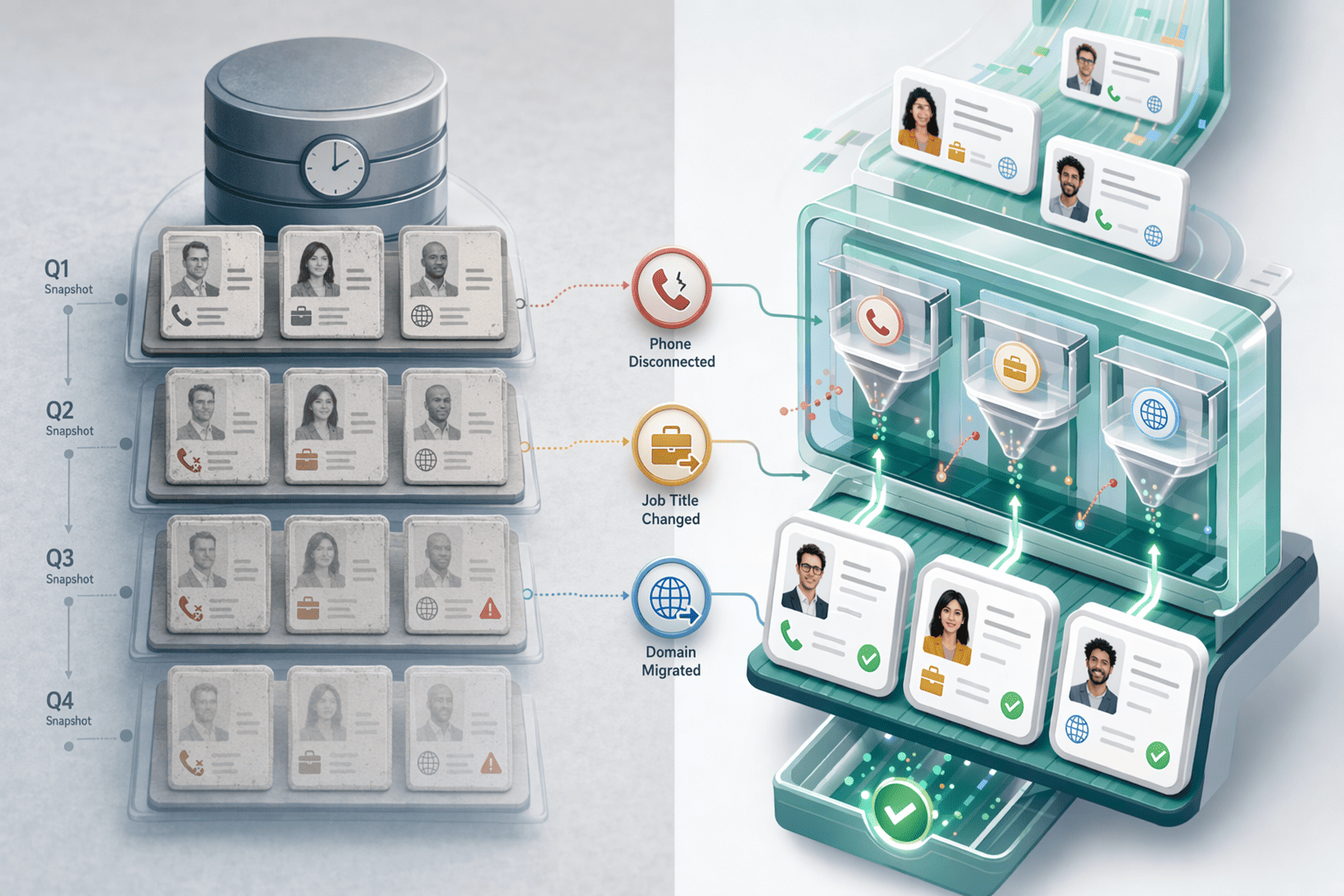
Static databases refreshed quarterly or monthly cannot keep pace with the 2 to 3% monthly contact decay typical across B2B markets. A database snapshot captured in January and updated in April carries three months of accumulated changes: job moves, phone-number disconnections, and domain migrations. If 2.5% of contacts change each month, a quarterly refresh cycle yields approximately 7.5% stale data by the time the next update arrives. Teams downloading contacts in month three of the cycle pay for records that are already outdated, reducing usable-contact rates and inflating cost-per-qualified-lead.
Real-Time Verification Advantages and Cost Trade-Offs
Pre-download verification workflows confirm phone accuracy before export, reducing wasted credits on unverified contacts. Platforms like PeakAi use real-time verification to deliver 91% phone-number accuracy, querying live data sources at the moment of lookup rather than relying on a static snapshot. The trade-off: real-time API calls cost more per contact than bulk database exports, but higher usable-contact rates offset the premium. Post-export enrichment models (export-then-verify) defer validation until after download, forcing teams to pay for records that may fail verification later. For teams that prioritize accuracy over volume, real-time workflows close more deals by ensuring every contact purchased meets quality thresholds.
LinkedIn Compliance Risks for Contact Discovery Tools
LinkedIn restricts automated activity to 30 to 40 daily profile actions to prevent abuse, and only 5 to 10% of users publicly share phone numbers on their profiles. Scraping-based tools that crawl LinkedIn profiles directly violate LinkedIn's terms of service and expose users to permanent account suspension. Compliant email-finding workflows query independent third-party databases using LinkedIn URLs as reference identifiers, avoiding direct API access or profile crawling. The compliance-accuracy trade-off is clear: scraping-based tools may promise higher coverage but carry legal risk and low phone-number yield (given the 5 to 10% share rate), while API-based verification tools sacrifice breadth for regulatory safety and higher accuracy on the contacts they do return.
Geographic focus matters as much as verification methodology, platforms optimized for US and European markets show significantly different accuracy profiles in Indian B2B prospecting.
Regional Data Quality: Why Indian B2B Requires Different Benchmarks
Coverage Gaps in Global Platforms for Indian B2B Markets
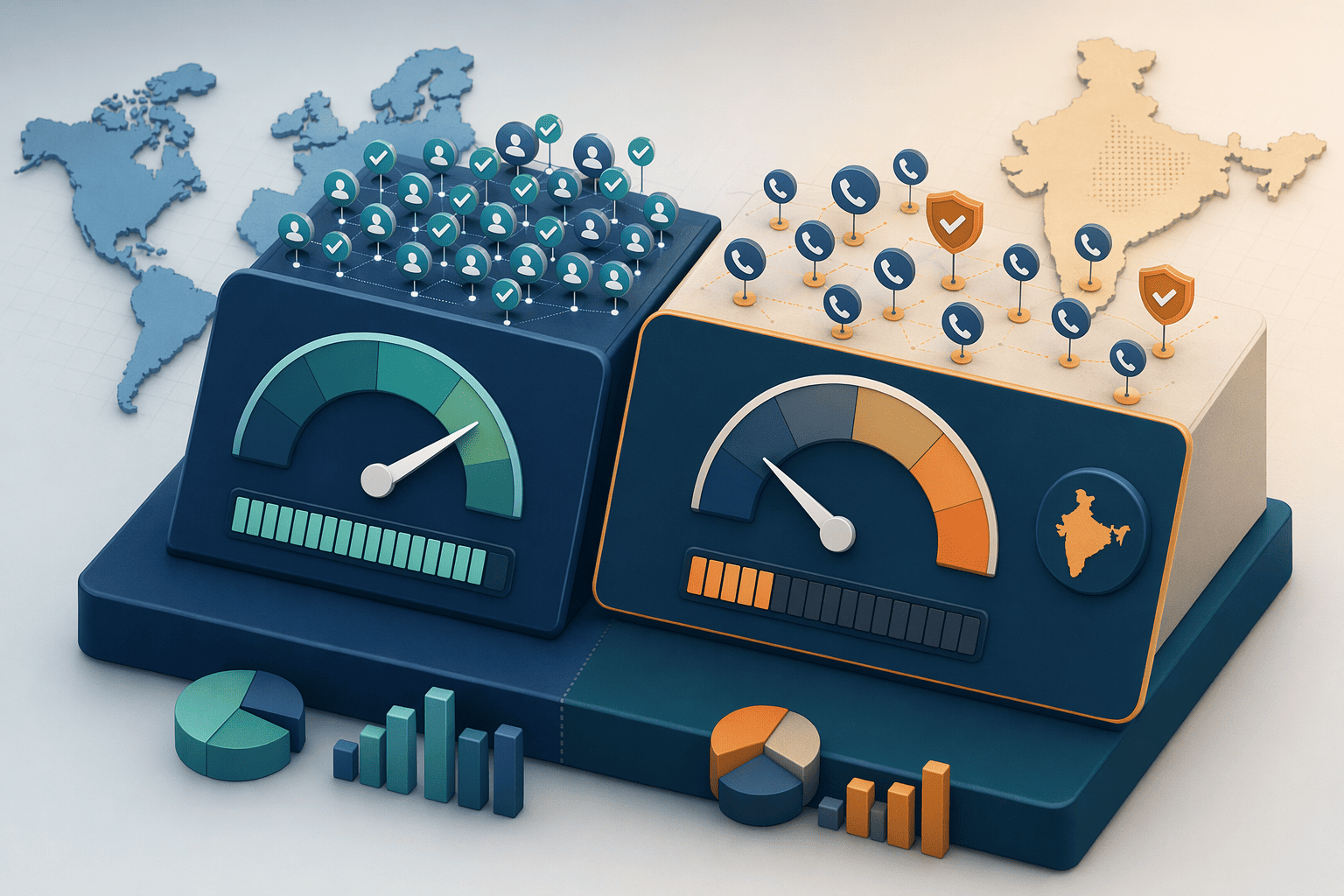
Enterprise contact discovery platforms like ZoomInfo and Cognism optimize their databases for US and European markets, where phone number availability, business registration transparency, and email format conventions differ fundamentally from Indian B2B environments. When applied to Indian prospecting workflows, these platforms often show accuracy drops of 15-25 percentage points below their advertised benchmarks, a gap that becomes critical when cold-calling remains the primary outreach channel. ZoomInfo's 260M+ contacts skew heavily toward North American coverage, while emerging-market data quality suffers from limited local data partnerships and outdated business registry integrations. Regional data quality must be evaluated as a separate dimension from global database size: a platform with 100M contacts and 65% accuracy in Mumbai delivers fewer usable phone numbers than a 10M-contact tool with 90% local verification.
What to Test for Regional Data Quality Before Committing
Evaluate regional accuracy through a structured testing protocol before signing annual contracts:
- Select 50-100 target contacts in your geography, prioritize decision-makers in your core ICP cities rather than generic samples.
- Measure email deliverability and phone verification separately, track bounce rates, incorrect number formats, and disconnected lines as distinct failure modes.
- Compare actual accuracy to platform claims, document the gap between advertised benchmarks (often US-focused) and your real-world results in target regions.
- Test pre-download verification vs post-export enrichment workflows, platforms that verify contact data before you commit credits minimize wasted budget on unusable records.
Platforms like PeakAi focus on Indian B2B data quality, while ZoomInfo and Cognism optimize for US/Europe coverage, buyers should test accuracy in their target geography before committing to annual contracts. Find accurate contact information through regional testing rather than assuming global accuracy claims transfer to emerging markets.
Accuracy rates mean nothing without understanding pricing models, credit-based and subscription platforms create different cost-per-verified-contact economics that affect ROI.
Pricing Models and Cost-Per-Verified-Contact Economics
Credit-Based Pricing: Match Rate Variability and Hidden Costs
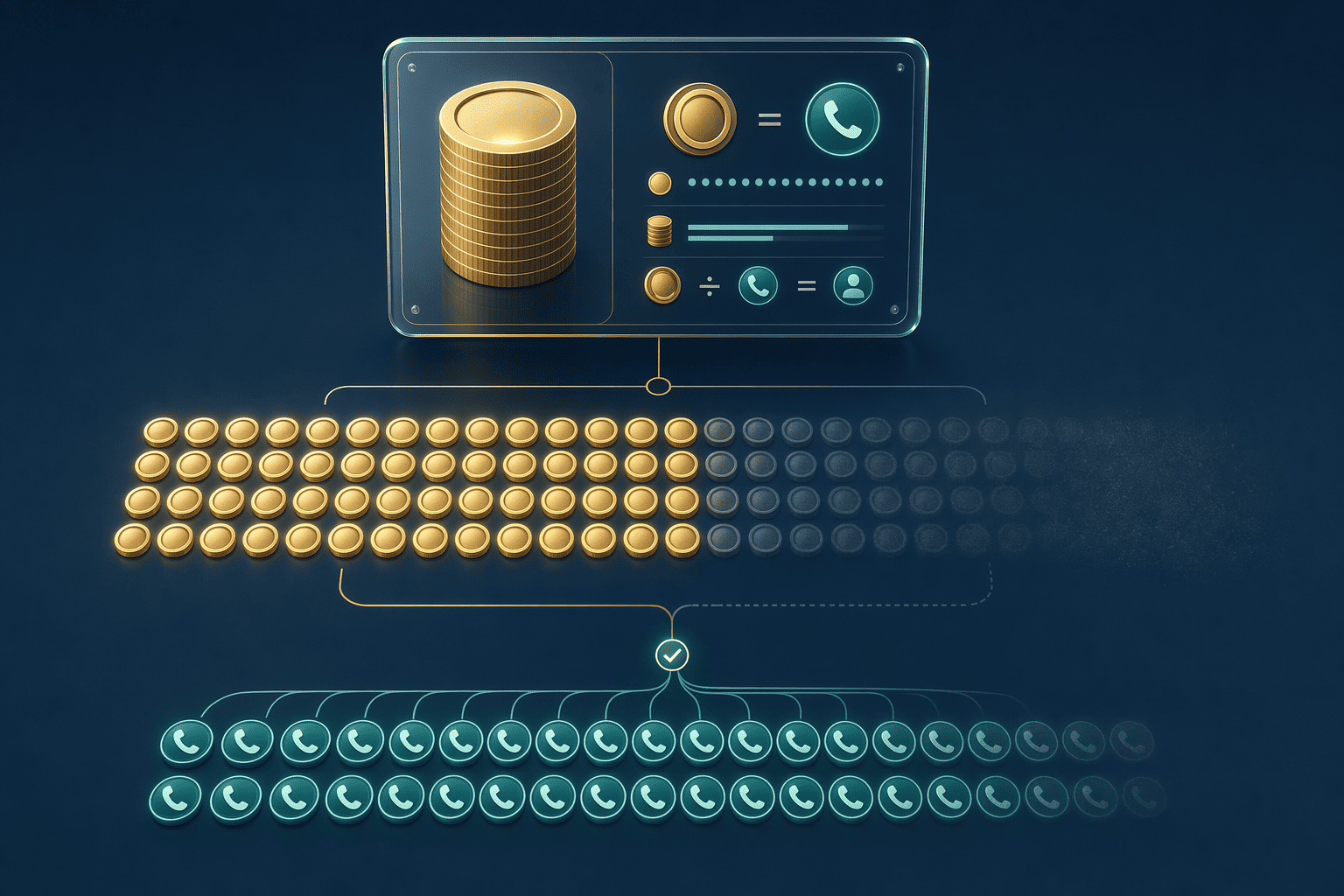
Credit-based models charge per contact export regardless of match success, when 50-65% phone match rates mean buyers pay for 35-50% wasted credits. If you purchase 100 credits at $0.18 each ($18 total) but only 55 yield usable phone numbers, your cost-per-verified-contact jumps to $0.33, nearly double the nominal rate. Free and freemium tools may advertise zero upfront cost, but the same match-rate math applies when credits convert to paid plans. Calculate total monthly spend divided by verified contacts delivered to reveal true economics.
Subscription Pricing: Predictable Costs with Volume Limits
Subscription models like ZoomInfo, Cognism, and PeakAi offer predictable monthly costs with volume caps, calculate cost-per-verified-contact by dividing monthly fee by average verified contacts delivered to compare against credit-based pricing. PeakAi's credit-based pricing starts at $9 for 50 verified contacts, delivering roughly $0.18 per contact when match rates hold. Teams that close more deals with consistent prospecting volume often find subscription models deliver better cost-per-verified-contact economics than credit-based pricing once monthly contact needs exceed 200-300 verified records.
Implementation Checklist: Testing Accuracy Before Committing
Week-One Testing Protocol: Sample Size and Metric Separation
Run this 7-day workflow before signing annual contracts:

- Day 1-2: Select 50-100 target contacts from your ICP segment in LinkedIn Sales Navigator or your existing CRM.
- Day 3-4: Test email deliverability separately, export emails, run a bounce-check, track open rates on a small warm-up sequence.
- Day 5-6: Test phone verification separately, call 20-30 numbers; log connects, voicemail hits, and disconnects.
- Day 7: Calculate cost-per-verified-contact, divide your trial spend by the number of reachable emails plus working phones.
PeakAi's real-time verification architecture surfaces accuracy indicators before download, letting you see phone and email confidence scores during the trial.
Red Flags to Watch for During Testing
Platforms that don't disclose verification methodology, how they define 'verified', or regional coverage breakdowns should trigger caution.
Compare Apollo, ZoomInfo, Cognism, and PeakAi on transparency before committing.
- Aggregated accuracy metrics without email/phone separation, a '90% overall accuracy' claim hides the real usable-contact yield when emails hit 85% but phones drop to 40%.
- No verification methodology transparency, if the platform won't explain *how* they validate contacts, assume post-export verification or stale data.
- No regional coverage breakdown, accuracy by geography matters; US-optimized tools often underperform in India and emerging markets.
Credit-based platforms like Apollo suit low-volume users who need cost flexibility but accept lower phone match rates (50-65%); subscription platforms like ZoomInfo, Cognism, and PeakAi suit high-volume teams needing predictable costs and higher phone accuracy (75-91%). US/Europe-optimized platforms deliver 82-85% email accuracy in mature markets, while regional specialists like PeakAi optimize for Indian B2B phone verification (91%) where global platforms have lower coverage.
As contact data decay accelerates (2-3% monthly) and regional B2B markets grow, platforms will differentiate on refresh-cycle speed and regional data quality rather than aggregated accuracy claims alone.
Test PeakAi's regional accuracy and 7-day refresh cycle using the week-one testing protocol (section 7) before committing to annual contracts, compare email deliverability, phone verification, and cost-per-verified-contact against Apollo, ZoomInfo, and Cognism in your target geography.
Frequently Asked Questions
What is a good accuracy rate for B2B contact discovery platforms?
A good email deliverability rate is 75-85%, while phone verification should hit 65-75% verified active numbers. Aggregated accuracy claims are misleading because they conflate database match rates with actual contact success, evaluate email and phone separately to understand true performance in your target geography.
How often should contact databases be refreshed to maintain accuracy?
Contact data decays at 2-3% monthly as professionals change jobs, phone numbers, and email addresses. Weekly or bi-weekly refresh cycles maintain higher accuracy than quarterly updates, a database updated quarterly accumulates three months of decay (6-9% accuracy loss) before the next refresh cycle.
Why do global platforms have lower accuracy for Indian B2B prospecting?
Platforms optimized for US/Europe coverage like ZoomInfo and Cognism have lower data-source penetration in Indian B2B markets where phone number availability and business registration transparency differ fundamentally. Regional specialists focus data collection efforts on specific geographies, yielding higher accuracy for Indian contacts than global platforms.
Is credit-based or subscription pricing better for contact discovery?
Credit-based pricing suits low-volume users needing cost flexibility, but wastes credits on unverified contacts when match rates hit 50-65%. Subscription models suit high-volume teams requiring predictable costs, calculate cost-per-verified-contact by dividing monthly fee by average verified contacts delivered to compare economics across models.
What does 'verified' contact data actually mean?
Verified splits into three levels: syntax validation (passes format checks), deliverability testing (mailbox accepts messages without bouncing), and active-number confirmation (phone rings and connects). Platforms define verified differently, transparency about verification methodology separates platforms that verify before download from those verifying after export.
Can I test contact discovery platform accuracy before buying?
Yes, run a 7-day testing protocol: sample 50-100 contacts matching your ICP, test email and phone accuracy separately against LinkedIn verification, and calculate cost-per-verified-contact. Most platforms offer free trials or small credit packs enabling pre-purchase accuracy testing in your target geography.
How do LinkedIn restrictions affect contact discovery tools?
LinkedIn restricts automated activity to 30-40 daily profile actions, and only 5-10% of users publicly share phone numbers on profiles. Scraping-based tools that crawl LinkedIn directly violate terms of service and expose users to permanent account suspension, API-based verification delivers higher phone-number yield without compliance risk.
Sources
- Best B2B Data Providers in 2026: Apollo vs ZoomInfo vs Clay vs Cognism - techstackreviews.net (2026)
- Clay vs Apollo vs ZoomInfo: The Real Comparison for GTM Teams - gtmeagency.com (2026)
- ZoomInfo vs Cognism: Best B2B Contact Data Platform (2026) - listicler.com (2026)
- Clay vs Apollo.io vs ZoomInfo vs Lusha vs Cognism - Comparison - getoden.com
- Best B2B Sales Intelligence Tools for SMBs (2026) - allaboutmarketing.info (2026)
