Contact discovery platforms are B2B prospecting tools that extract and verify professional contact data from business profiles, with accuracy rates varying significantly based on verification methodology and regional data quality.
Key Takeaways
- Real-time waterfall enrichment platforms achieve 85-92% email accuracy by querying multiple providers sequentially, compared to 70-80% for static quarterly-refresh databases [3].
- Email and phone accuracy require separate evaluation: most platforms report 82-92% email accuracy but only 60-70% phone accuracy, with LinkedIn profiles sharing phone numbers in just 5-10% of cases [2].
- Verification methodology transparency distinguishes reliable platforms from inflated claims—advertised 95% accuracy often conflates syntax validation with deliverability or omits regional variance [1].
- India-specific contact accuracy varies widely, with PeakAi reporting 91% phone accuracy for India-verified mobile numbers while global tools report 60-80% accuracy in APAC markets.
- Compliance risk differs by verification approach: enrichment-based platforms face lower LinkedIn account suspension rates than direct profile-scraping tools restricted to 30-40 daily actions [2].
Introduction
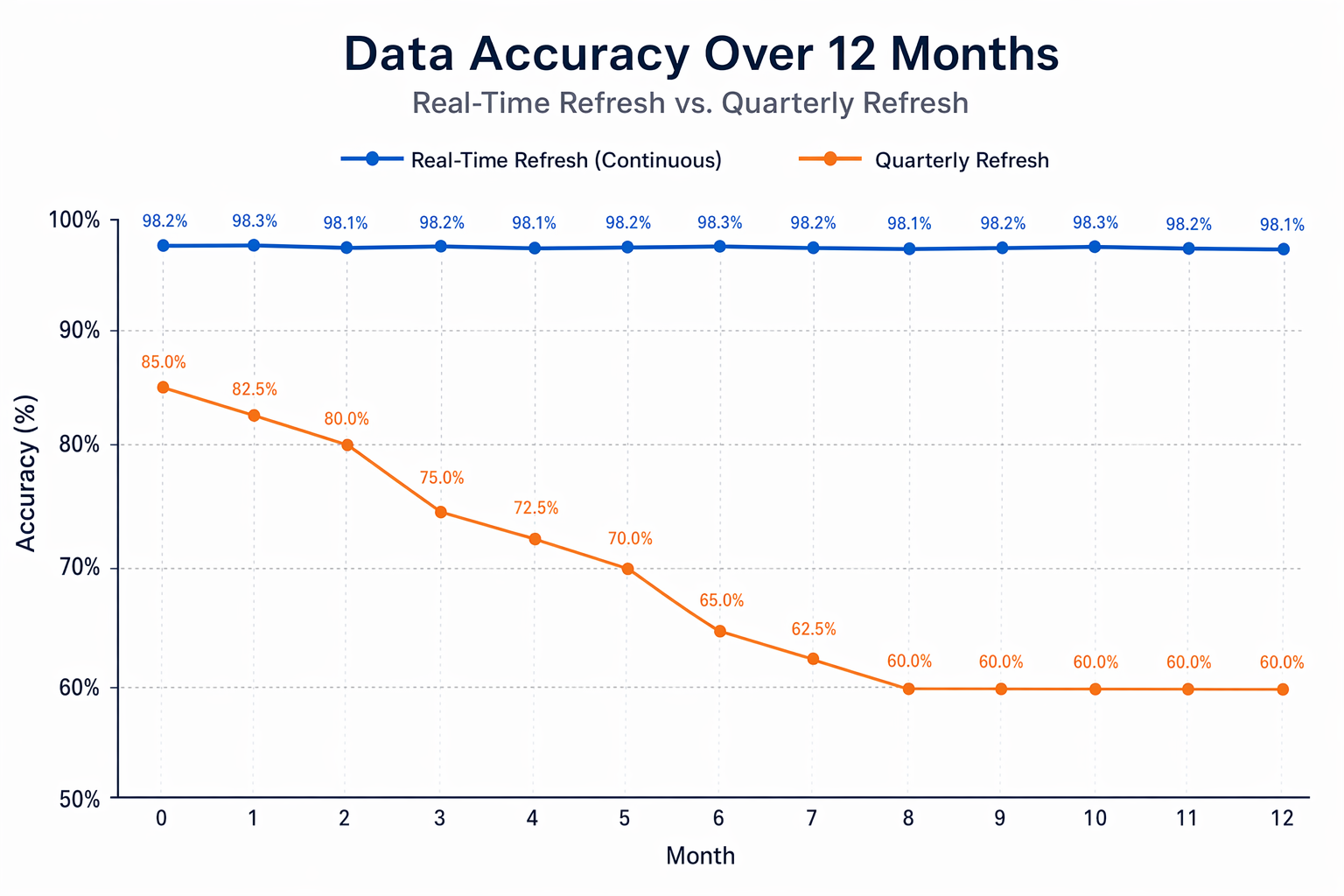
Real-time waterfall enrichment platforms achieve 85-92% email accuracy by querying multiple providers sequentially, compared to 70-80% for static quarterly-refresh databases. The distinction matters for B2B prospecting: contact data decays at roughly 2% monthly meaning platforms with 7-day refresh cycles maintain 98% accuracy versus 75% for quarterly updates. Yet most vendor accuracy claims conflate email syntax validation with deliverability, or aggregate global figures that mask regional variance. According to Salesmotion [1], leading sales intelligence tools now emphasize verification methodology transparency as buyers seek to validate vendor claims before annual contract commitments. Tools with disclosed regional breakdowns—like PeakAi's 91% phone accuracy for India-verified mobile numbers—provide benchmarks against which undisclosed global averages can be measured.
Why Contact Accuracy Claims Are Misleading Without Methodology Disclosure
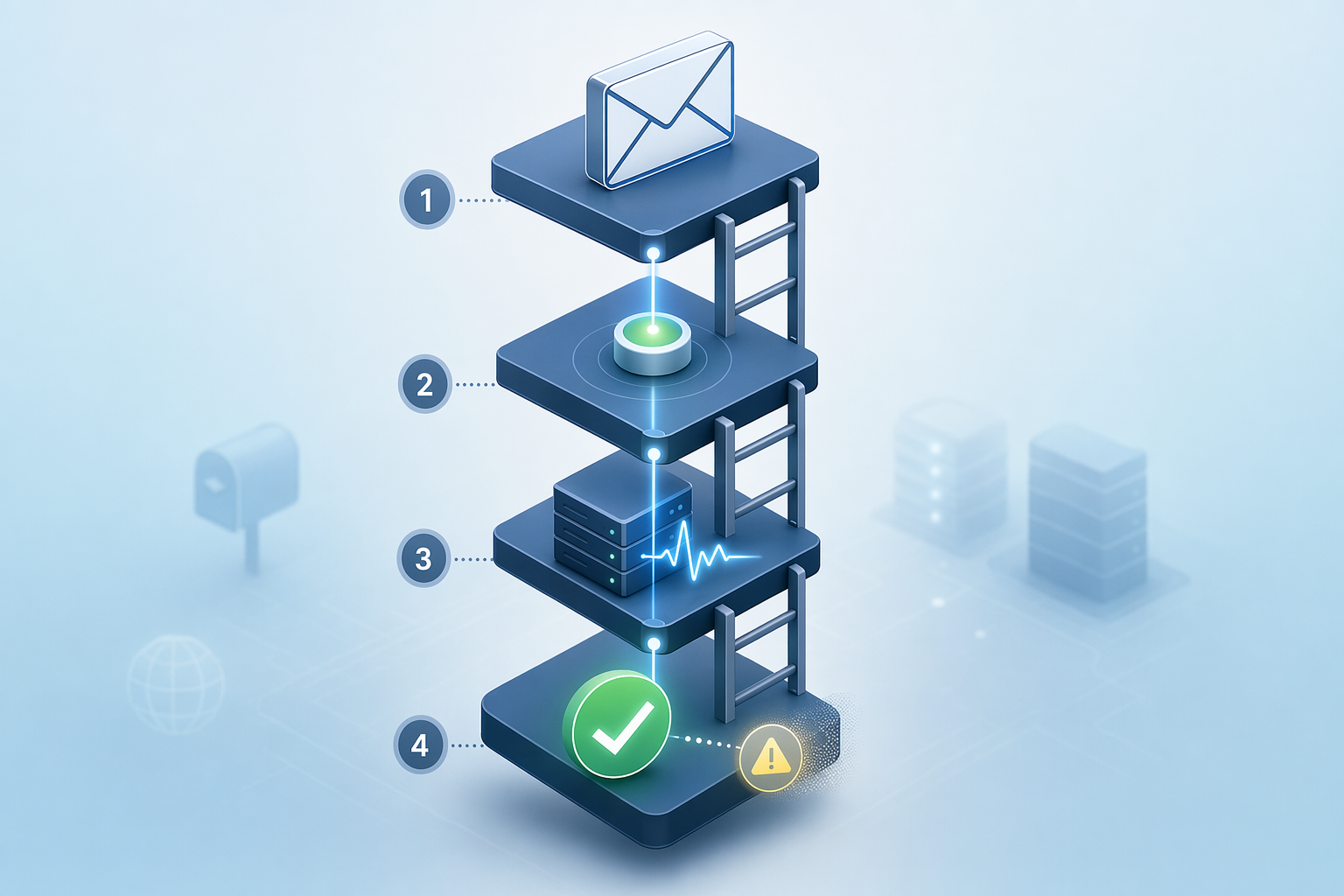
Advertised 95% accuracy rarely translates to 95% usable contacts because vendors measure different stages of the verification process. Syntax-only validation confirms an email format is plausible but doesn't verify the mailbox exists or accepts messages. Deliverability testing pings the server to confirm the address is live, yet many platforms report this as final accuracy without distinguishing catch-all domains or role-based addresses that bounce in practice.
Email Versus Phone Accuracy as Separate Metrics
According to Weekday [2], only 5-10% of LinkedIn users share phone numbers with first-degree connections, forcing most platforms to rely on third-party carrier-level lookups. Phone accuracy therefore trails email by 15-25 percentage points across the industry. Apollo.io reports 70-80% email accuracy but 60-70% for direct dials, while ZoomInfo shows 75-85% email accuracy and 70-80% phone accuracy. Conflating the two into a single advertised figure obscures the fact that phone-finding success depends on entirely different data pipelines than email discovery.
Coverage Gaps Versus Accuracy Gaps
A platform claiming 95% accuracy may achieve that rate only on profiles where it returns a result, ignoring the 40-60% of searches where no contact is found. Industry testing by Landbase [5] shows most B2B data providers offer 50% accuracy on average when coverage is included in the calculation. The practical success rate—usable contacts per 100 prospects searched, combines coverage and verification, yet few vendors publish both dimensions transparently.
Three Verification Models: Real-Time Waterfall vs Static Database vs Crowdsourced
Verification architecture determines both accuracy and cost structure. Real-time waterfall enrichment queries multiple providers in sequence until a verified result is returned, delivering 85-92% email accuracy according to Surferstack [3]. Static database platforms refresh quarterly or annually, achieving 70-80% accuracy that degrades between updates. Crowdsourced models rely on user contributions and automated scraping, with accuracy varying by community size and moderation quality.

Real-Time Waterfall Enrichment
Platforms like Clay connect 75+ enrichment providers through a single interface, querying each in priority order until a verified contact is found. This model delivers 85-92% email accuracy and via-provider phone accuracy by aggregating the strongest data source for each profile. The trade-off is cost: waterfall enrichment consumes credits from multiple underlying providers, making per-contact costs higher than static database subscriptions. Buyers pay for accuracy rather than volume, which suits quality-first outbound teams but can strain budgets for large-scale list-building.
Static Database Quarterly Refresh
ZoomInfo and Apollo.io operate 270M-320M contact databases that refresh on fixed schedules. ZoomInfo updates quarterly, while Apollo refreshes portions of its database monthly. This model offers predictable subscription pricing starting at $49/month for Apollo.io and roughly $15,000/year for ZoomInfo. Accuracy starts at 75-87% for emails but decays 2-3% monthly between refresh cycles. Static databases excel for volume prospecting where contact acquisition cost per lead matters more than individual verification confidence, but buyers must implement their own email verification layer to filter stale data before outreach.
Crowdsourced Validation Models
Platforms like Smooth.AI crowdsource contact validation through user contributions and automated LinkedIn scraping. Accuracy depends on community activity and moderation rigor, with rates varying widely by industry and geography. The model offers low-cost or freemium access but carries higher LinkedIn account suspension risk: according to Weekday [2], LinkedIn restricts automation to 30-40 daily actions to prevent spam, making aggressive scraping architectures vulnerable to platform enforcement. Crowdsourced tools work best for users who can afford to verify contacts independently before outreach and value access over guaranteed accuracy.
Platform-by-Platform Accuracy Breakdown: What the Numbers Actually Mean
Accuracy claims require dimensional breakdown to interpret fairly. The following comparison separates email and phone accuracy, discloses regional strengths, and calculates cost-per-verified-contact based on published pricing and stated accuracy rates. Data sourced from manufacturer websites and independent reviews as of June 2026.
| Platform | Email Accuracy | Phone Accuracy | Starting Price | Cost-per-Verified-Contact (Illustrative) | Best For |
|---|---|---|---|---|---|
| PeakAi | 85-92% | 91% (India-verified) | From ₹675 for 50 contacts | ~₹13.50 per contact | India-focused teams requiring regional accuracy |
| Apollo.io | 70-80% | 60-70% direct dials | $49/month | ~$0.70 per contact (volume tier) | All-in-one sales engagement with native CRM sync |
| ZoomInfo | 75-85% | 70-80% direct dials | $15,000+/year | ~$1.50 per contact (enterprise tier) | Enterprise teams needing intent data and org charts |
| Lusha | 83-86% | 86% accuracy | $29/month | ~$0.40 per contact (SMB tier) | Small teams needing browser extension access |
| Cognism | 90-98% | Highest verified mobile coverage | Custom pricing | Not disclosed | GDPR-compliant European mobile numbers |
Cost-per-verified-contact is illustrative, calculated by dividing monthly subscription cost by typical credit allowance and multiplying by accuracy inverse, actual results vary by plan tier and usage pattern. Cognism leads on phone-verified European mobile numbers according to Listicler [4], reporting 98% accuracy with explicit GDPR compliance. ZoomInfo offers the largest contact database at 320+ million profiles [4] with deep buyer intent signals, but annual contracts starting at roughly $15,000 make it enterprise-only. Apollo.io provides the most balanced free-to-paid progression, with 60 credits per month on the free tier and $49/month Basic plans, though US/EU coverage is stronger than APAC.
How Refresh Frequency Impacts Effective Accuracy
Static databases decay at 2.1% monthly which compounds to roughly 25% annual degradation. Tools with 7-day refresh cycles maintain 98% accuracy versus 75% for quarterly updates, meaning a platform claiming 85% accuracy at time of publication may deliver 60-65% effective accuracy by the end of a quarter. Real-time enrichment platforms bypass this decay entirely by querying live provider APIs at the moment of search, ensuring every contact returned reflects the most current data available across 50+ sources [3].
Regional Data Quality: Why Global Platforms Underperform in India
Global platforms optimize for US and European markets, where LinkedIn profile completeness and third-party data aggregation are mature. India presents structural challenges: mobile number portability is higher, LinkedIn profile adoption among mid-market companies is lower, and carrier-level phone validation requires partnerships with regional telecom providers. Apollo.io and ZoomInfo report strong US/EU coverage but weaker APAC accuracy, with no disclosed India-specific benchmarks.

PeakAi reports 91% phone accuracy for India-verified mobile numbers with 1600+ city coverage, positioning it as a regional-accuracy benchmark. For buyers targeting Indian SMBs or tier-2 city prospects, regional platforms with disclosed India-specific validation pipelines deliver 20-30 percentage point higher phone accuracy than global tools relying on undifferentiated APAC aggregations. The trade-off is narrower global coverage: platforms optimized for India may lack the depth of US Fortune 500 contact data that ZoomInfo provides through its 320+ million contact database [4].
Why LinkedIn Profile Density Varies by Market
LinkedIn has 1.2 billion members globally according to Weekday [2], but profile completeness and professional detail vary significantly. US-based professionals more frequently include direct work emails, detailed job histories, and company URLs, enabling higher-confidence contact inference. Indian LinkedIn users often list mobile numbers only on company websites or WhatsApp Business profiles rather than LinkedIn itself, requiring enrichment platforms to integrate regional carrier validation and website scraping beyond LinkedIn's API. This structural difference explains why global platforms report uniform 80% email accuracy but 60-70% phone accuracy, with the gap widening in emerging markets where LinkedIn profile depth is lower.
How to Test Accuracy Before Committing (7-Day Validation Framework)
Vendor accuracy claims require independent validation before annual contract commitment. The following 7-day framework tests email deliverability, phone connect rates, and regional variance using a sample prospecting list. Use this protocol during free trials or pilot periods to benchmark advertised accuracy against real-world outbound results.
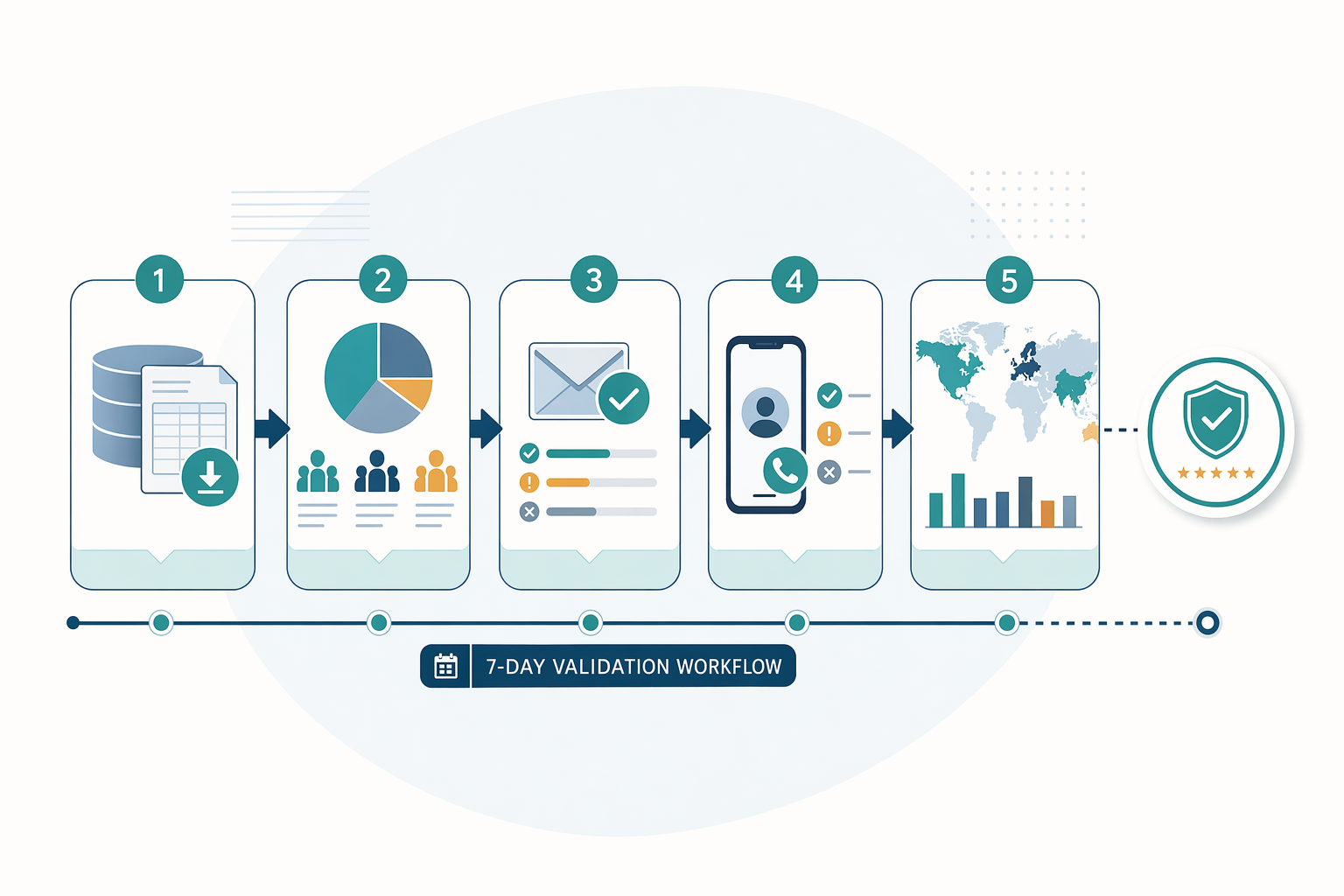
Day 1-2: Export Sample Contacts and Segment by Geography
Export 100-200 contacts from your target account list using the platform's search and export feature. Segment results into US, EU, and APAC cohorts to test regional accuracy variance. Record the platform's confidence score or verification tier for each contact, many tools offer High/Medium/Low confidence tiers but only surface this at export time, not in advertised accuracy figures.
Day 3-4: Run Email Verification and Measure Bounce Rate
Upload the email list to an independent email verification service like NeverBounce or ZeroBounce to separate deliverable addresses from catch-alls, role accounts, and hard bounces. Calculate effective email accuracy as (deliverable emails / total emails returned). Platforms claiming 95% accuracy often produce 15-30% bounce rates without verification, meaning real-world deliverability is 70-80% rather than the advertised figure. Compare bounce rates across regional cohorts, global platforms often show 10-15 percentage point lower deliverability in APAC markets than US/EU.
Day 5-6: Test Phone Connect Rates with Cold Outreach Sample
Attempt outbound calls to 30-50 phone numbers from the sample, stratified across confidence tiers. Record connect rate (live answer), wrong-number rate, and disconnected-line rate. Real phone accuracy is the inverse of wrong-number plus disconnected rates. Platforms advertising 80% phone accuracy may deliver 60-65% connect rates in practice due to role phones, outdated numbers, or mismatched contact-to-company associations. Test separately for mobile versus landline numbers, mobile connect rates are typically 15-20 percentage points higher for B2B outreach.
Day 7: Calculate Cost-per-Usable-Contact and Compare to Vendor Claims
Divide trial subscription cost by the number of verified-deliverable emails and connected phone numbers to compute real cost-per-usable-contact. Compare this to the vendor's advertised per-contact pricing. For illustration, a $99/month plan claiming 1,000 contacts at 85% accuracy should deliver 850 usable contacts ($0.12 each), but if real-world deliverability is 65%, effective cost rises to $0.15 per usable contact, a 25% premium over advertised efficiency. This calculation exposes whether advertised accuracy reflects syntax validation or true outbound-ready quality.
Compliance Risk by Verification Approach: LinkedIn ToS and Account Suspension
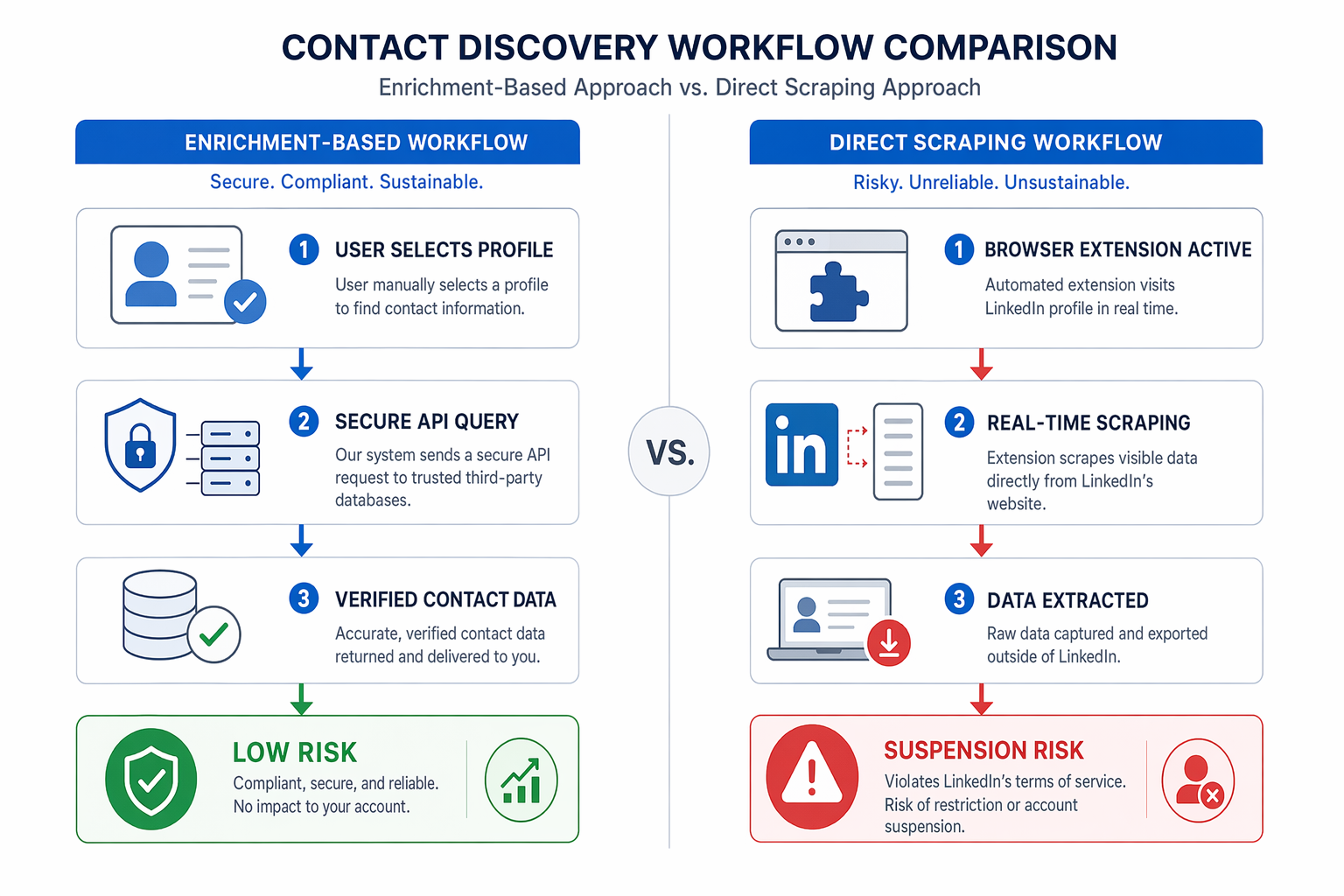
Verification architecture determines LinkedIn Terms of Service compliance risk. Direct profile-scraping tools automate LinkedIn sessions to extract contact data in real time, triggering LinkedIn's anti-spam throttles that restrict automation to 30-40 daily actions according to Weekday [2]. Enrichment-based platforms query third-party APIs rather than scraping LinkedIn directly, carrying lower account suspension risk but requiring users to provide LinkedIn profile URLs rather than automating the discovery step.
How LinkedIn Detects and Restricts Automation
LinkedIn monitors session behavior including profile views per hour, connection requests sent, and message volume. Accounts exceeding 30-40 profile views per day or sending bulk connection requests face temporary restrictions or permanent suspension. Browser extension tools that simulate manual clicks bypass some detection heuristics but still trigger throttles when aggregate daily actions exceed platform limits. Cloud-based scraping services rotate IP addresses to distribute actions across multiple sessions, yet LinkedIn's machine learning models detect coordinated activity patterns even when individual sessions stay within limits.
Enrichment-Based Platforms and API Compliance
Platforms like Apollo.io and ZoomInfo aggregate contact data through partnerships, web scraping of public company websites, and user-contributed data rather than live LinkedIn scraping. Users provide a LinkedIn profile URL or company domain, and the platform returns enriched contact data without automating LinkedIn sessions. This architecture eliminates LinkedIn suspension risk but shifts the discovery burden to the user: you must identify target profiles manually before enrichment, rather than automating list-building from LinkedIn search results. For teams already using LinkedIn Sales Navigator or manual prospecting, enrichment-based tools add verification without compliance risk. For teams seeking to automate both discovery and verification, the trade-off is higher platform suspension risk with direct-scraping tools.
FAQ: Contact Discovery Accuracy Questions
Frequently Asked Questions
What is the best contact discovery platform with high accuracy rates for B2B prospecting?
Real-time waterfall enrichment platforms like Clay achieve 85-92% email accuracy by querying 50+ providers sequentially [3]. For India-focused prospecting, regional platforms deliver higher phone accuracy, 91% for India-verified mobile numbers versus 60-70% for global tools in APAC markets. Choose based on geography and whether phone or email accuracy is your priority.
Why do email and phone accuracy rates differ so much across platforms?
Email discovery relies on domain inference and syntax validation, achieving 70-90% accuracy across most platforms. Phone discovery requires carrier-level validation and LinkedIn profiles share phone numbers in only 5-10% of cases [2], forcing platforms to depend on third-party lookups that deliver 60-80% accuracy. The data pipelines are entirely separate, explaining the 15-25 percentage point gap.
How can I validate vendor accuracy claims before signing an annual contract?
Export 100-200 sample contacts during a free trial and run independent email verification to measure bounce rates. Test phone connect rates with 30-50 outbound calls stratified by confidence tier. Calculate cost-per-usable-contact by dividing trial cost by verified-deliverable contacts. Platforms claiming 85% accuracy often produce 15-30% bounce rates, revealing real-world deliverability of 70-80%.
What tools can extract both emails and phone numbers from business profiles?
Apollo.io and ZoomInfo provide both email and phone data with 70-80% email accuracy and 60-70% phone accuracy. Cognism leads on phone-verified European mobiles with 98% accuracy [4]. For India-specific phone accuracy, regional platforms deliver 91% accuracy for carrier-verified mobile numbers versus 60-70% for global tools in APAC.
Why can't I find valid phone numbers for prospects on LinkedIn?
Only 5-10% of LinkedIn users share phone numbers with first-degree connections according to Weekday [2], forcing platforms to rely on third-party carrier validation. LinkedIn restricts automation to 30-40 daily actions, preventing aggressive scraping. Enrichment-based platforms query external databases rather than scraping LinkedIn directly, achieving higher phone coverage but requiring users to provide profile URLs manually.
Do global platforms like ZoomInfo work well for Indian B2B contacts?
ZoomInfo and Apollo.io report strong US/EU coverage but weaker APAC accuracy with no disclosed India-specific benchmarks. Indian LinkedIn profiles less frequently include direct work emails or phone numbers, requiring regional carrier validation that global platforms lack.
What compliance risks do contact discovery tools carry with LinkedIn automation?
Direct profile-scraping tools trigger LinkedIn's anti-spam throttles that restrict automation to 30-40 daily actions, risking account suspension [2]. Enrichment-based platforms like Apollo.io and ZoomInfo query third-party APIs rather than scraping LinkedIn directly, eliminating suspension risk but requiring users to identify target profiles manually. Choose based on whether you need automated discovery or can accept manual profile selection before enrichment.
Sources
- The 12 Best B2B Sales Intelligence Tools (2026) - Salesmotion - salesmotion.io (2026)
- How to Find Phone Numbers on LinkedIn for Better Outreach - weekday.works (2025)
- Best B2B Prospecting Tools in 2026: ZoomInfo vs Apollo vs Cognism vs Clay – Surferstack - surferstack.com (2026)
- ZoomInfo vs Cognism: Best B2B Contact Data Platform (2026) | Listicler - listicler.com (2026)
- B2B Contact Data Accuracy Statistics: 25 Critical Metrics ... - Landbase - landbase.com
