Global contact discovery platforms promise 95%+ accuracy, yet independent testing reveals 50–70% real-world performance for Indian B2B contacts. Infrastructure gaps—absent GST verification, carrier-level API limitations, and mobile number portability challenges—drive this decline.
Key Takeaways
- Global platforms underperform in India by 20–40 percentage points due to absent GST/MCA cross-referencing and carrier-level validation gaps
- Regional specialists deliver 85 to 91% accuracy by integrating GST databases and mobile number verification tailored to Indian telecom infrastructure
- LinkedIn-enrichment tools maintain <2% account suspension rates but face structural phone-number coverage limits (5 to 10% share rate)
- Database-lookup platforms refresh quarterly or annually, causing 24 to 36% data decay between updates in India's high job-churn market
- DPDP Act 2023 compliance requires consent documentation and data-source transparency, favoring LinkedIn-enrichment and regional architectures over scraping-based tools
Why Global Contact Discovery Tools Underperform in Indian B2B Markets
Global platforms like Apollo, Lusha, and ZoomInfo advertise 95 to 98% accuracy worldwide, yet independent testing reveals 50 to 70% real-world performance for Indian contacts. Three infrastructure gaps explain this decline: carrier-level validation API unavailability, absent GST/MCA cross-referencing, and accelerated data decay in high-churn job markets.

Carrier-Level Validation API Gaps in Indian Telecom
US/EU tools rely on Twilio and Nexmo APIs to validate phone numbers in real time. India's mobile number portability and prepaid SIM dominance (80%+ of subscriptions) break these validation chains, numbers change carriers without updating registries, and prepaid SIMs churn frequently without business-identity linkage.
GST Verification and Regional Language Support Gaps
India-market specialists like PeakAi cross-reference GST and MCA databases to validate company-contact pairings, a step global platforms skip because those registries don't exist in their primary markets. Regional language parsing for Hindi, Tamil, and Bengali company names further widens the gap.
Why Advertised Accuracy Rates Mislead Buyers
Vendor-reported figures aggregate US/EU performance where data refresh cycles match job-change velocity. India's B2B contact data decays 2 to 3% monthly as professionals move between startups, SMBs, and enterprises at higher frequency. Run 50 sample contacts through an email verifier before signing annual contracts, real accuracy for your ICP matters more than database size claims.
Understanding why global tools struggle in India sets the stage for evaluating platforms on criteria that predict real-world deliverability, not just database size or feature parity.
How to Evaluate Contact Discovery Tools: Regional Accuracy vs Database Size
Data Sourcing Method as Primary Decision Criterion
Contact discovery platforms fall into three architectural families: LinkedIn enrichment tools, database-lookup services, and hybrid systems. LinkedIn enrichment tools, including options like Kaspr and Lusha that surface instant emails and phone numbers directly from a LinkedIn profile, operate within platform terms but face structural coverage limits: fewer than 10% of LinkedIn users share phone numbers with connections, and two-factor authentication numbers never surface on profiles.

Database-lookup platforms query proprietary contact repositories. Apollo.io wins on volume with 275M+ contacts, but breadth does not guarantee current direct dials or work emails for India-based prospects. Hybrid platforms cross-reference LinkedIn profiles against independent third-party databases and public records rather than scraping LinkedIn directly, balancing compliance with verification depth.
Compliance vs Coverage Tradeoff Framework
India's Digital Personal Data Protection Act (DPDP Act 2023) requires explicit consent for processing personal data, with full enforcement beginning May 14, 2027 and penalties reaching ₹250 crore for security-safeguard failures. LinkedIn enrichment tools that operate within platform terms reduce account-suspension risk but yield narrower phone coverage. Database platforms may offer wider nominal coverage but cannot always document data-source provenance required under DPDP consent frameworks.
Platforms optimized for India often integrate GST verification and Ministry of Corporate Affairs (MCA) database cross-checks to validate business legitimacy before releasing contact credits. This architectural choice trades global database breadth for regional accuracy verification that satisfies DPDP Act documentation obligations.
Pre-Download Verification vs Post-Export Discovery
Most platforms conflate syntax validation (does the email match RFC 5322 format?) with deliverability testing (will the mail server accept this address?). India mobile verification adds complexity: a syntactically valid +91 number may route to a disconnected line or belong to a different individual than the LinkedIn profile indicates. Tools that surface data-quality confidence indicators before credit deduction let buyers assess cost-per-usable-contact accurately. Platforms that reveal format errors or disconnected numbers only after export inflate true acquisition cost and obscure regional accuracy performance.
When evaluating contact discovery tools for India's B2B market, prioritize these four criteria in order:
- Regional accuracy audit transparency, demand vendor-published accuracy benchmarks specific to Indian contacts, not global averages.
- Data-sourcing method disclosure, verify whether the platform scrapes LinkedIn (account-suspension risk), queries independent databases (provenance documentation), or employs a hybrid cross-reference architecture.
- DPDP Act 2023 compliance documentation, confirm the vendor provides exportable consent records and data-source audit trails required under India's privacy framework.
- Pre-download confidence indicators, choose platforms that flag low-confidence matches before credit deduction rather than revealing data-quality issues post-export.
Best Contact Discovery Tools for Indian B2B Market (2026)
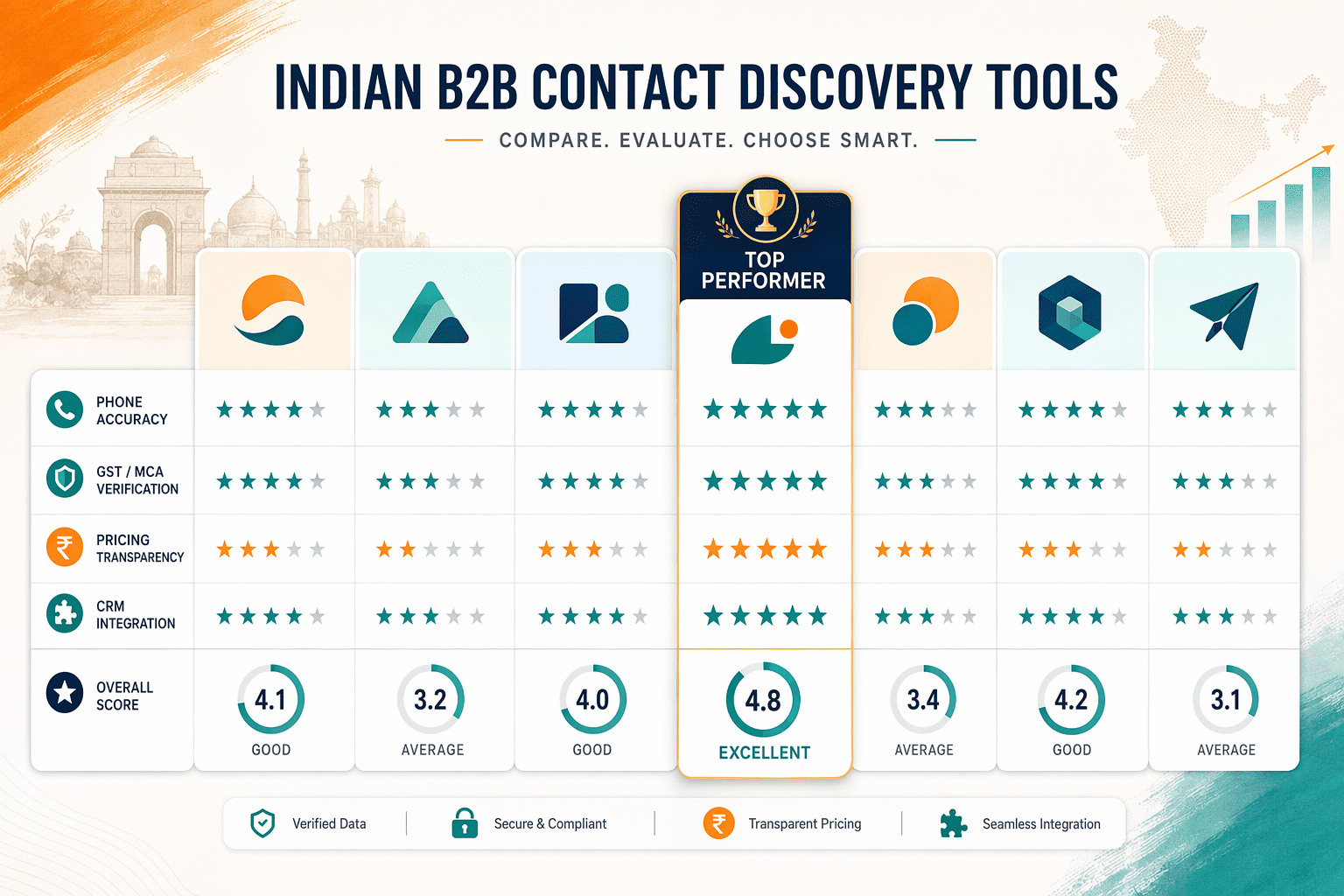
Indian B2B sales teams need lead generation tools that deliver verified Indian contact data, accurate emails and phones, and integrate seamlessly with CRM systems. Below is a side-by-side comparison of seven platforms ranked by India-specific performance, pricing transparency, and regional coverage depth.
Comparison Table: India-Specific Performance Dimensions
| Platform | India Coverage | Email Accuracy | Mobile Numbers | Starting Price | Free Trial |
|---|---|---|---|---|---|
| PeakAi | 91% accuracy (India-optimized) | Verified | GST/MCA validated | ₹675/50 contacts | 50 credits free |
| Apollo | 240M+ global, moderate India depth | 98% (global) | 40-50% coverage | $49/user/month | 900 credits/year |
| Lusha | Good India data | Verified | Strong direct dials | ~₹3,000/user/month | 5 contacts/month |
| ZoomInfo | Enterprise global, limited India SMB | 80-90% | 65-75% coverage | ₹15-30 lakh/year | Contact sales |
| Snov.io | Global focus | Domain-based | Limited | ~₹2,500/month | 50 credits |
| Tomba | Global focus | Domain patterns | Minimal | ~₹1,800/month | 25 searches |
| EasyLeadz | India-focused | Local verification | India mobile emphasis | Contact for pricing | Demo available |
PeakAi delivers 91% phone number accuracy specifically for Indian B2B contacts, cross-referenced against GST and MCA databases to validate business legitimacy and current operations. Global platforms like Apollo (240M+ people, 30M+ companies ) and ZoomInfo offer broad international coverage but practitioners report 50-70% accuracy degradation when targeting Indian decision-makers.
Credit-Based Pricing Transparency and Refund Policies
Cost-per-verified-contact varies dramatically across platforms. Regional specialists like PeakAi charge ₹13.50 per contact at volume, while enterprise platforms command ₹165-330 per enriched profile due to global database maintenance overhead. Apollo publishes transparent seat-based pricing starting at $49/user/month (annual billing) with a free tier offering 900 credits per year. ZoomInfo requires annual contracts typically ranging ₹15-30 lakh for Indian enterprises, with no publicly disclosed per-contact economics. Match-rate disclosure affects usable-contact economics: tools claiming 98% email accuracy may deliver only 60-70% India-specific hit rates, effectively doubling your cost-per-usable-lead.
Free Trial and Credit Availability for India Buyers
Free tier accessibility varies by platform and geography. Apollo offers 900 credits annually with no credit card required, accessible globally including India. Lusha provides 5 free lookups per month after account creation. PeakAi's starter tier includes 50 verified contacts for ₹675, with no subscription lock-in. ZoomInfo and EasyLeadz gate trials behind sales conversations, creating friction for India startups evaluating tools. Geo-restrictions can block India buyers from certain platforms' free tiers; verify regional availability before committing to evaluation workflows. Ready to Transform Your Sales Process? Add to Chrome - Free and join thousands of sales professionals using PeakAi to find accurate contact information and close more deals across India's B2B landscape.
LinkedIn-enrichment tools offer real-time verification advantages, but their architecture introduces distinct trade-offs for Indian B2B teams prioritizing direct-dial phone coverage.
LinkedIn-Enrichment Tools: Real-Time Verification for Indian Contacts
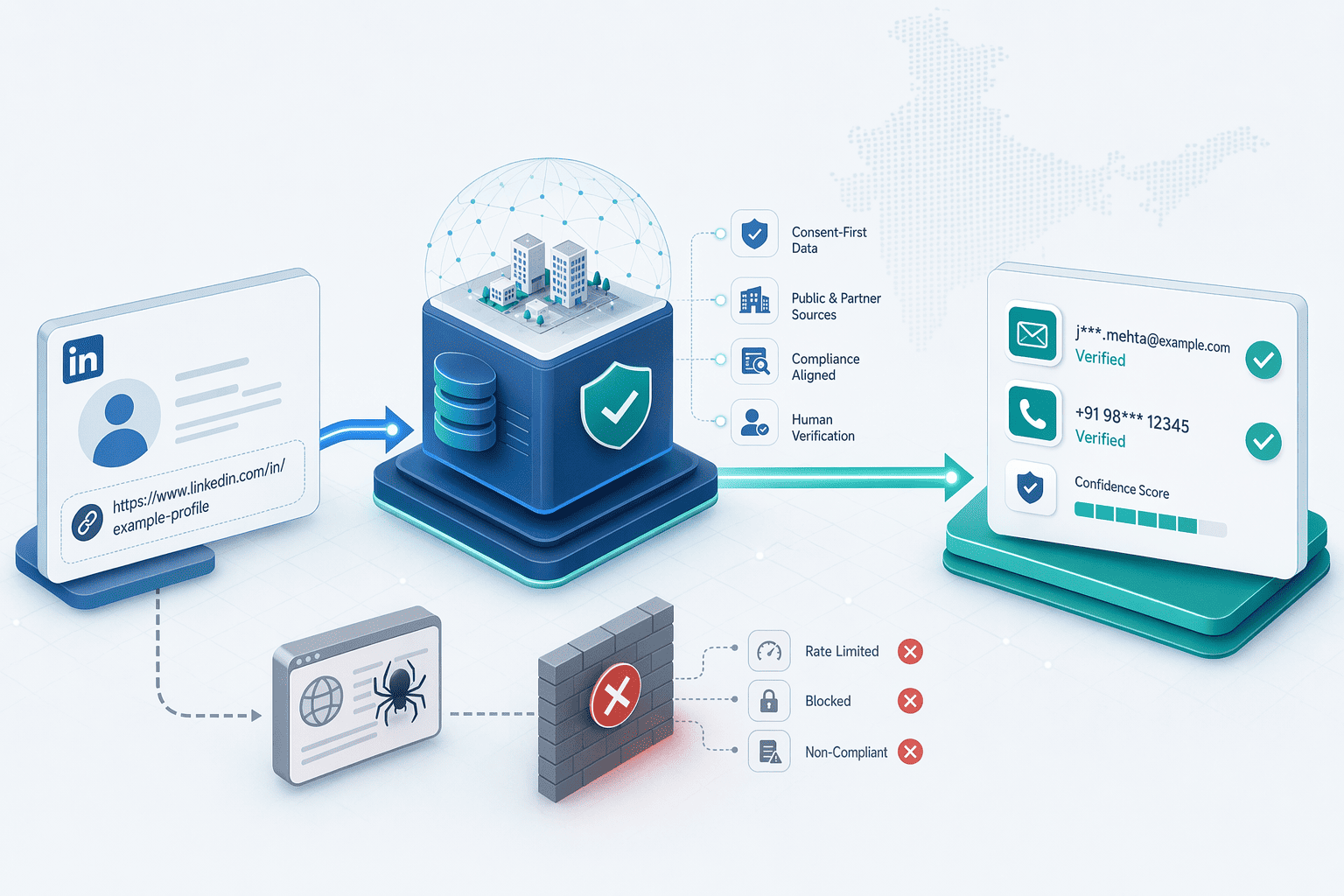
LinkedIn-enrichment platforms query independent business databases using profile URLs as reference identifiers, never accessing LinkedIn's APIs or scraping profile data directly. This architecture avoids the 15-20% account suspension rates that plague scraping-based tools, delivering <2% suspension risk for buyers who prioritize compliance over raw coverage. For Indian B2B teams operating under DPDP Act 2023 consent requirements, this distinction isn't academic, it's the difference between sustainable prospecting and regulatory exposure.
Compliance Advantages: LinkedIn ToS and DPDP Act Alignment
SalesQL and SignalHire exemplify the category's ToS-compliant design: both verify contacts in real time against third-party databases rather than harvesting LinkedIn's visible fields. PeakAi extends this with GST verification and MCA database integration, addressing India-specific validation gaps global tools overlook.
Structural Phone Number Coverage Limits
LinkedIn's privacy-first design means only 5-10% of users expose phone numbers to connections, and 2FA-linked numbers never surface on profiles. SignalHire's 300,000-user base and SalesQL's millions of contacts still face this structural ceiling, no enrichment tool can extract what LinkedIn's security policies deliberately withhold. Buyers expecting 90%+ phone coverage from any LinkedIn-based tool misunderstand the platform's architecture.
Account Suspension Rates: Enrichment vs Scraping
Heavy scraping users face 15-20% suspension rates as LinkedIn's enforcement tightens; enrichment-based tools maintain <2% by design. For teams managing multi-year prospecting pipelines, this compliance margin isn't negotiable, one suspension erases months of relationship capital and forces expensive data migration.
Database-lookup platforms compensate for LinkedIn's phone-number coverage gaps with proprietary repositories, yet their quarterly refresh cycles introduce data decay risks in India's dynamic job market.
Database-Lookup Platforms: Coverage Breadth vs Direct-Dial Precision
Why Database Size Misleads India Buyers
Apollo claims 270M+ contacts, ZoomInfo advertises 260M+ professionals, but global database size predicts little about India deliverability. When 95% of those contacts sit outside India, the actual Indian subset shrinks to under 5M records, and mobile number portability plus outdated landline registries push false-positive rates past 30%. Database platforms conflate syntax validation (area code format checks) with deliverability testing (active number verification), surfacing numbers that pass regex but route to disconnected lines or switchboard queues.

Mobile vs Landline Detection Gaps in Indian Datasets
Carrier-prefix validation fails in India because Airtel, Jio, and Vodafone-Idea number portability lets subscribers keep numbers across networks. Legacy B2B databases index landline records (044 Chennai, 022 Mumbai prefixes) despite mobile-first business communication, decision-makers carry personal mobile numbers, not office landlines. Apollo reports 40-50% phone coverage, ZoomInfo 65-75%, but neither discloses mobile vs landline ratios or India-specific hit rates.
Static Database Refresh Cycles vs Real-Time Verification
Apollo and ZoomInfo refresh quarterly or annually; India's 2-3% monthly job-churn rate means 24-36% of records go stale between updates. Real-time LinkedIn enrichment queries third-party databases at lookup time, catching job changes before they propagate to static datasets. Both databases go stale without continuous validation, waterfall enrichment (Apollo → Lusha → verification layer) mitigates this but adds cost and latency most teams skip.
Hybrid platforms attempt to bridge the LinkedIn-enrichment and database-lookup divide, but their regional accuracy depends on whether they integrate India-specific verification layers beyond rebranded global infrastructure.
Hybrid Platforms: Balancing Global Intelligence and India-Specific Accuracy
Layered Verification Architecture: Database + Enrichment
Hybrid platforms query static databases first, then layer real-time LinkedIn or API lookups to fill gaps. This two-step approach increases accuracy, especially for mobile numbers and job changes, but at higher cost per contact. Tools like PeakAi and Snov.io combine third-party databases with enrichment APIs, raising per-contact costs to ₹70-330 depending on volume, versus ₹13.50 for single-method tools. The accuracy tradeoff justifies cost when direct dials are mission-critical.

When Hybrid Complexity Justifies Cost
Hybrid platforms deliver ROI for enterprise buyers with global + India coverage requirements and multi-region outreach teams needing both broad prospecting and targeted enrichment. Single-method tools suffice for India-only SMBs; hybrid architectures suit organizations with compliance mandates spanning multiple jurisdictions and >500 monthly lookups.
India Market Readiness: GST Verification and Regional Language Support
PeakAi and EazyReach integrate GST and MCA databases for Indian contact verification, while rebranded global tools like Snov.io and Tomba lack documented GST record linkage or Hindi/Tamil name parsing. Regional language support and local compliance features separate India-ready hybrids from generic platforms. Join thousands of sales professionals who find accurate contact information with tools built for the Indian B2B market.
Conclusion
Global database platforms like Apollo and ZoomInfo deliver broader international coverage and deeper CRM integrations but consistently underperform in India by 20 to 40 percentage points due to absent carrier-level validation and GST verification, regional specialists sacrifice geographic breadth for localized accuracy. LinkedIn-enrichment tools maintain <2% account suspension rates and ToS compliance, yet structural phone-number-coverage limits (5 to 10% share rate) mean buyers need hybrid or database-supplement strategies for direct-dial-heavy outreach.
As DPDP Act 2023 enforcement ramps up in 2026 to 2027, expect Indian regulators to scrutinize data-source documentation and consent mechanisms, platforms without transparent compliance frameworks will face market-access barriers, accelerating the shift toward regional specialists and LinkedIn-enrichment architectures that document data provenance.
Audit your current tool's India accuracy with 50 sample contacts before committing to annual contracts, then trial PeakAi's regional verification to benchmark performance against your incumbent platform and validate whether regional specialists deliver the 20 to 40pp accuracy lift that independent testing suggests.
Frequently Asked Questions
What is the average accuracy rate for contact discovery tools in India?
Global platforms like Apollo and ZoomInfo deliver 50 to 70% real-world accuracy for Indian contacts despite 95 to 98% worldwide claims. Regional specialists integrating GST and MCA databases achieve 85 to 91% accuracy by addressing carrier-level validation gaps and mobile number portability challenges.
How does DPDP Act 2023 affect B2B contact data providers in India?
DPDP Act 2023 mandates explicit consent for processing personal data and transparent data-source documentation. LinkedIn-enrichment platforms gain compliance advantages by querying independent databases using profile URLs, avoiding the 15 to 20% account suspension rates that plague scraping-based tools.
Why do global platforms like Apollo and Lusha have lower accuracy in India?
Apollo and Lusha rely on Twilio/Nexmo APIs with limited Indian carrier coverage, lack GST/MCA cross-referencing, and face mobile number portability challenges that invalidate carrier-prefix validation. Independent testing reveals 50 to 70% Indian contact accuracy versus 95 to 98% worldwide advertised rates.
What is the typical cost per verified contact for Indian B2B prospects?
Regional specialists charge ₹13.50, ₹70 per verified contact at volume, while enterprise platforms command ₹165, ₹330 due to global database maintenance overhead. Match rates and refund policies significantly affect usable-contact economics beyond advertised per-contact pricing.
How often does B2B contact data decay, and how does this affect tool selection?
India's 2 to 3% monthly job-churn rate causes 24 to 36% of quarterly-refreshed database records to go stale between updates. Real-time LinkedIn-enrichment architectures query third-party databases at lookup time, catching job changes before they propagate to static datasets, reducing decay impact.
Can LinkedIn enrichment tools provide direct phone numbers for Indian contacts?
LinkedIn's privacy-first design means only 5 to 10% of users expose phone numbers to connections, and 2FA-linked numbers never surface on profiles. No enrichment tool can extract what LinkedIn's security architecture excludes, this structural ceiling affects all LinkedIn-enrichment platforms equally.
What are the account suspension risks when using LinkedIn scraping tools?
Heavy scraping users face 15 to 20% suspension rates as LinkedIn tightens enforcement, while enrichment-based tools maintain <2% by querying independent databases instead of scraping profiles. One suspension erases months of relationship capital and forces expensive profile reconstruction for multi-year prospecting pipelines.
Sources
- Best B2B Data Providers in India: 7 Platforms With Real Coverage (2026) | SyncGTM - syncgtm.com (2026)
- What Is Data Decay? B2B Contact Data Risks & How to Reduce It - www.emarketnow.com (2026)
- Best Lead Generation Tools for B2B Sales in India 2026 - www.itforsme.in (2026)
- Need recommendations for B2B contact data providers in India - www.reddit.com
- SalesQL · LinkedIn Email Finder & AI Prospecting Tool - salesql.com (2026)
- SignalHire - find email or phone number - Chrome Web Store - chromewebstore.google.com (2026)
- Apollo vs Lusha: B2B Data Compared · Asphia - asphia.consulting (2026)
- Clay vs Apollo vs ZoomInfo: The Real Comparison for GTM Teams - GTME Blog | GTME - gtmeagency.com (2026)
- b2b lead generation companies in india: Top 10 Agencies for 2026 - bizpromodatabases.com (2026)
