
Sales teams evaluating LinkedIn contact discovery tools face a critical challenge: advertised accuracy rates rarely translate to actual deliverable contact rates. Understanding verification methodology, refresh cycles, and pricing structures separates high-performing tools from expensive disappointments.
Key Takeaways
- Advertised accuracy rates measure verification success (syntax/domain/deliverability checks pass), not contact discovery rates (the tool actually returned a usable contact)
- Email deliverability and phone line-type detection require separate validation pipelines and must be evaluated independently
- Real-time verification tools deliver higher accuracy but slower query times, while static database tools offer faster bulk exports at the cost of 2-3% monthly accuracy decay
- Variable match rates inflate true cost per verified contact — a $0.50/credit tool with 60% phone match rate costs $0.83 per verified contact
- Contact data decays at 2-3% monthly; tools with 7-day refresh cycles maintain 98% accuracy while quarterly-update systems drop to 75% within five months
How to Evaluate Accuracy Claims in Contact Discovery Tools
When sales teams evaluate LinkedIn contact discovery tools with high accuracy rates, they should prioritize three validation dimensions: verification methodology transparency (syntax/domain/deliverability checks for email, line-type detection for phone), email versus phone metric separation, and refresh-cycle impact on decay rates — not ambiguous '97% triple-verified' marketing claims without explanation.

Why '95% Accuracy' Does Not Mean 95% Find Rate
Advertised accuracy rates measure verification success (the contact passed syntax, domain, and deliverability checks) rather than deliverable contact discovery (the tool actually returned a usable contact). A platform reporting 95% email accuracy may still return contacts for only 14% of a target ICP, because the accuracy denominator counts only records the system attempted to verify — not the accounts it failed to discover in the first place. The find rate reflects source architecture constraints; notes that platforms relying on LinkedIn profiles plus corporate web data face 10–20% decision-maker mobile coverage floors for ICPs with limited LinkedIn presence, regardless of verification rigor.
Email vs. Phone Number Accuracy: Two Separate Metrics
Email deliverability and phone line-type detection operate through distinct validation pipelines and must be evaluated independently. Top-tier platforms achieve 85 to 95% email deliverability by checking SMTP handshakes and inbox existence, while phone accuracy ranges from 65 to 91% due to number portability and line-type misclassification (mobile numbers routing to front-desk lines). Budget tools struggle below 70% on both metrics when they skip real-time verification steps.
Data Decay and Refresh-Cycle Impact
Contact records decay at 2 to 3% monthly due to job changes and number portability. Platforms with 7-day refresh cycles maintain 98% accuracy, while quarterly-update systems drop to 75% accuracy within five months. Sales teams should confirm update frequency in vendor contracts and prioritize real-time verification over static database size to close more deals with current contact information.
Once you understand how to evaluate accuracy claims, the next step is distinguishing between email and phone number verification, two fundamentally different validation processes that vendors often conflate.
What 'High Accuracy' Actually Means: Email vs. Phone Number Verification
Sales teams evaluating LinkedIn contact discovery tools encounter two separate accuracy metrics that vendors often conflate into a single 'contact accuracy' claim. Email verification and phone number verification rely on fundamentally different methodologies, produce different success rates, and serve different stages of the prospecting workflow.
Email Verification: Syntax, Domain, and Deliverability Checks
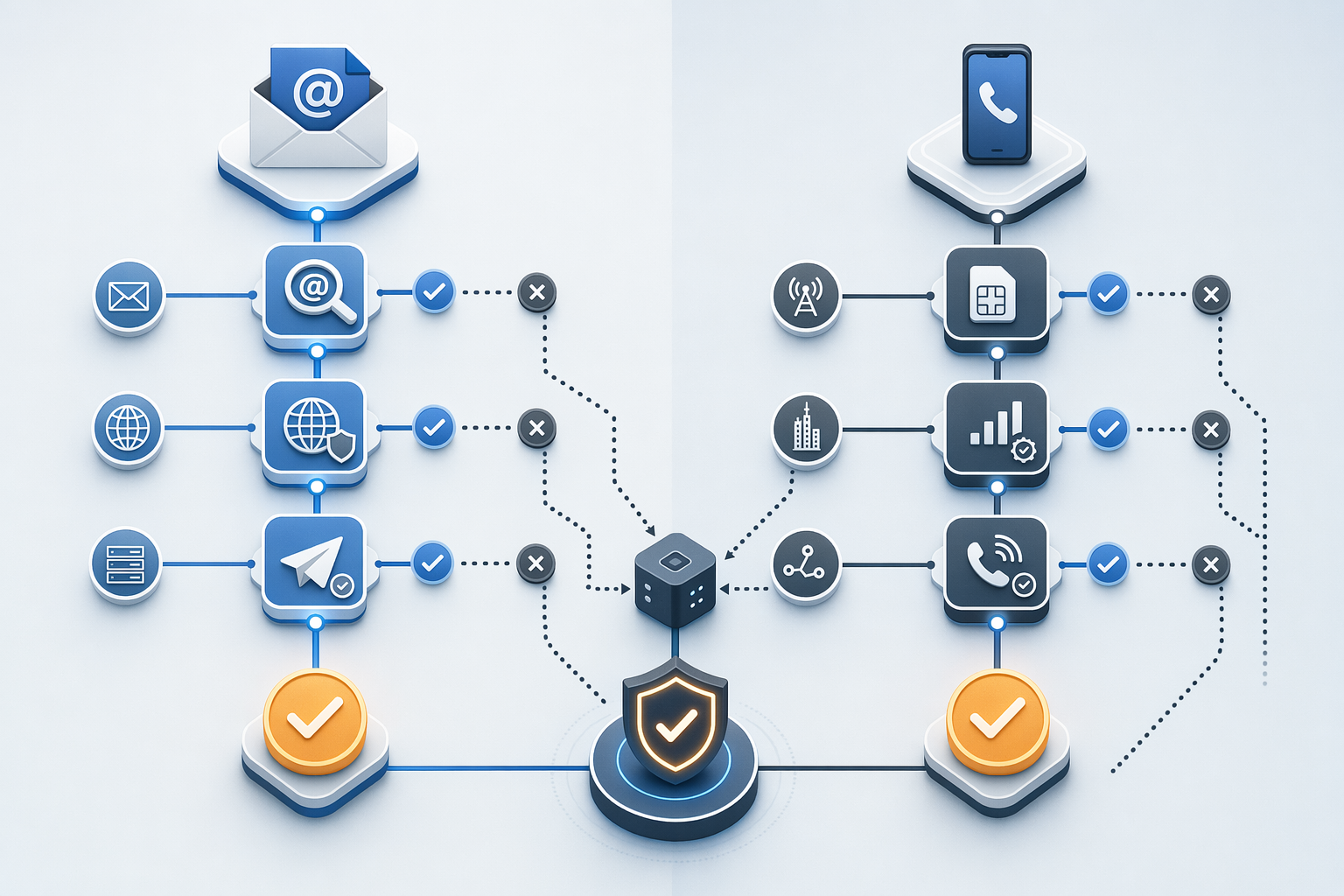
Most platforms run a three-stage verification process for email addresses:
- A syntax check confirms the address follows standard formatting
- Domain validation confirms active MX records on the recipient's mail server
- An SMTP handshake pings the server to verify the specific mailbox exists, all without sending an actual message
The third stage, deliverability, is the hardest to pass. Maintaining a bounce rate below 2% is critical for inbox placement, which makes SMTP handshake verification the decisive factor separating tools that find accurate contact information from those that simply predict email patterns.
Phone Number Accuracy: Line-Type Detection and Direct-Dial Filtering
Phone verification introduces a complexity absent from email: distinguishing direct-dial mobile or desk numbers from switchboard lines. A technically valid phone number that routes to a company's front desk reduces sales-team efficiency even when the number is syntactically correct and actively in service.
Line-type detection separates tools that help you close more deals from those that burn credits on unusable numbers. PeakAi delivers 91% phone accuracy with 10-second verification speed, positioning its enrichment-based workflow at the high end of the accuracy spectrum alongside tools that validate each candidate number through carrier lookup protocols.
Why LinkedIn Limits Phone Number Enrichment
Only 5 to 10% of LinkedIn users share phone numbers with first-degree connections, constraining enrichment tools' phone find rates even when verification accuracy is high. Apollo provides access to over 210M contacts, but phone coverage lags email coverage because LinkedIn profiles themselves rarely contain phone data.
This supply-side constraint explains why enrichment-based tools, which augment LinkedIn data with third-party databases rather than scraping profile fields, deliver better phone accuracy than direct-scraping tools. Automated scraping tools violate LinkedIn's Terms of Service and risk permanent account suspension, making enrichment-layer architectures the lower-risk path for sales teams that need verified direct-dial numbers.
With these verification mechanics clear, we can now compare how six leading platforms implement email deliverability and phone line-type detection.
6 LinkedIn Contact Discovery Tools Compared by Accuracy Methodology
Verification methodology separates LinkedIn contact discovery tools into two architectural camps: real-time verification platforms and static database providers. ZoomInfo, Apollo, Clay, Cognism, and Lusha share one foundational architecture: LinkedIn profiles plus corporate web data. For enterprise SaaS buyers with active LinkedIn profiles, it works. For teams targeting local businesses or SMBs with limited LinkedIn presence, coverage drops to 10 to 20% decision-maker mobile regardless of vendor.

Comparison Table: Accuracy Rates, Verification Method, and Pricing
| Tool | Phone Accuracy | Verification Method | Pricing Model | Best For |
|---|---|---|---|---|
| PeakAi | 91% | Real-time carrier lookup | Pay-per-verified-contact | Teams prioritizing phone accuracy |
| Apollo.io | Not disclosed | Static database, quarterly refresh | Credit-based, free tier available | Sales intelligence at scale |
| Lusha | Not disclosed | Static database | Credit-based | Quick LinkedIn profile enrichment |
| ZoomInfo | Not disclosed | Static database, monthly refresh | Annual contract, $30K+ mid-market | Enterprise breadth and integrations |
| Cognism | Not disclosed | Static database | Subscription-based | European market compliance |
| Kaspr | Not disclosed | Static database | Credit-based | LinkedIn Chrome extension workflow |
Tool-by-Tool Accuracy Methodology Breakdown
PeakAi delivers 91% phone accuracy with real-time verification. The platform validates each candidate number through carrier lookup protocols before download. Pros: high phone accuracy, pay-per-verified-contact pricing eliminates wasted credits. Cons: newer player with smaller database vs. ZoomInfo. Best for sales teams where phone outreach drives pipeline and accuracy matters more than database size.
Apollo.io offers access to over 210M contacts and 35M companies but burns credits on enrichment, and data accuracy drops significantly for local businesses and SMBs. Apollo's free tier attracts users, but teams quickly hit limitations when they need consistent data quality. Best for teams needing sales engagement features (email sequences, A/B testing) alongside contact data.
ZoomInfo costs climb into five figures once you factor in seats, credits, and add-ons. Mid-market teams report spending $30K+ annually. Static database refreshed monthly. Best for enterprise teams requiring broad coverage and native CRM integrations.
Cognism serves European markets with GDPR-compliant data. Static database architecture. Best for teams selling into EU where compliance requirements are strict.
Lusha and Kaspr both operate on credit-based models with Chrome extension workflows. Static databases. Best for reps enriching LinkedIn profiles one at a time rather than building bulk lists.
The architectural divide between real-time verification and static databases directly impacts accuracy freshness and query speed.
Real-Time Verification vs. Static Database Tools
Real-time verification trades query speed for accuracy freshness; static databases trade accuracy decay risk for bulk-export speed. Understanding this architectural difference helps sales teams close more deals without burning credits on outdated contacts.

How Real-Time Verification Works
Real-time verification queries third-party data sources at enrichment time. When a user requests a contact, the tool validates deliverability and line-type against live databases before returning the record. PeakAi uses real-time verification, querying sources at the moment of lookup to ensure contacts are active. This workflow prevents credit burn on unverified contacts, teams pay only for verified, deliverable numbers.
Static Database Architecture and Decay Risk
Static databases are pre-indexed snapshots refreshed on fixed cycles, 7-day, monthly, or quarterly. Accuracy depends on refresh frequency: tools with 7-day cycles maintain 98% accuracy, while quarterly-refresh databases drop to 75% within five months. Post-export verification models charge credits upfront, regardless of deliverability, increasing cost per verified contact when decay is high.
When to Choose Each Architecture
Real-time verification suits teams prioritizing accuracy over speed, ideal for high-value accounts where one bad number wastes hours. Static databases suit teams needing bulk export with faster query times, accepting higher bounce rates in exchange for scale. Join thousands of sales professionals who evaluate refresh cycles and verification timing before committing to a platform.
Understanding how pricing models interact with match rates reveals the true cost per verified contact, often significantly higher than advertised per-credit rates.
Pricing Models and Cost
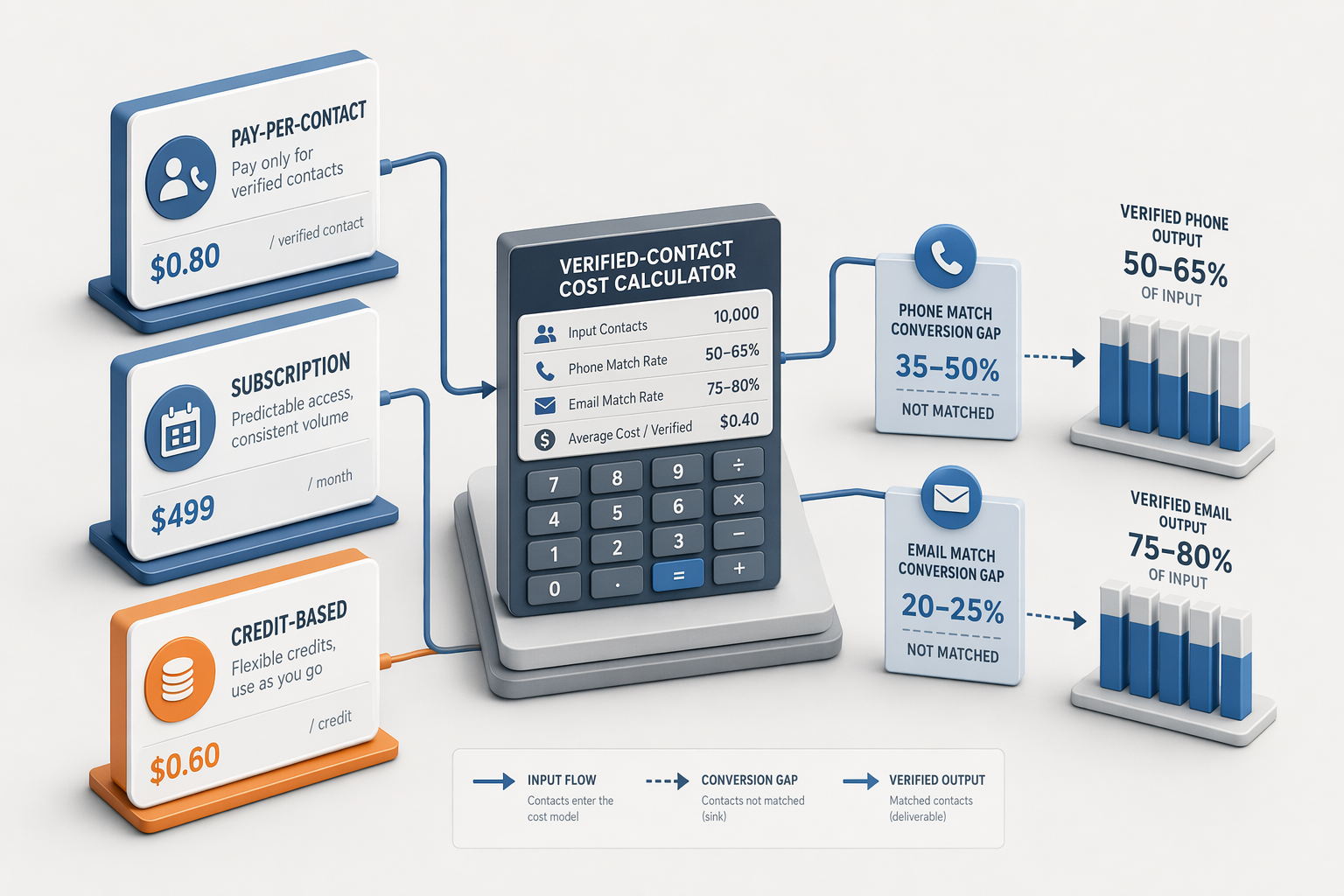
When tools advertise per-credit pricing but have variable match rates, the advertised cost-per-credit does not equal actual cost-per-verified-contact. Sales teams must calculate the true cost accounting for phone match rates (50-65%) and email match rates (75-80%).
Three Pricing Models Explained
LinkedIn contact discovery tools use three pricing models: pay-per-contact charges a fixed cost per enriched record; subscription models offer monthly fees for unlimited enrichments; and credit-based models require purchasing credit packs with variable match rates. Apollo's free tier attracts users but teams quickly hit limitations, while ZoomInfo costs climb into five figures. PeakAi offers credit-based pricing starting at ₹675 for 50 contacts, with no monthly subscription required.
How to Calculate True Cost
The real cost per verified contact depends on match rates:
- Buy N credits at advertised price
- Multiply by match rate (50-65% for phone, 75-80% for email)
- Divide total cost by verified contacts returned
For example, if a tool charges $1 per credit and you buy 100 credits but only 55 phone numbers verify, your actual cost is $1.82 per verified contact, not $1. Teams comparing tools should request match-rate data before purchase to find accurate contact information.
Free Tier Limitations
Free tiers limit phone number enrichment to 5-10 contacts monthly and typically exclude real-time verification features. These caps serve as trial windows rather than sustainable workflows for teams that need to close more deals. For consistent access, budget teams should evaluate specialized tools over massive databases.
Which Tool Fits Your Sales Team's Workflow
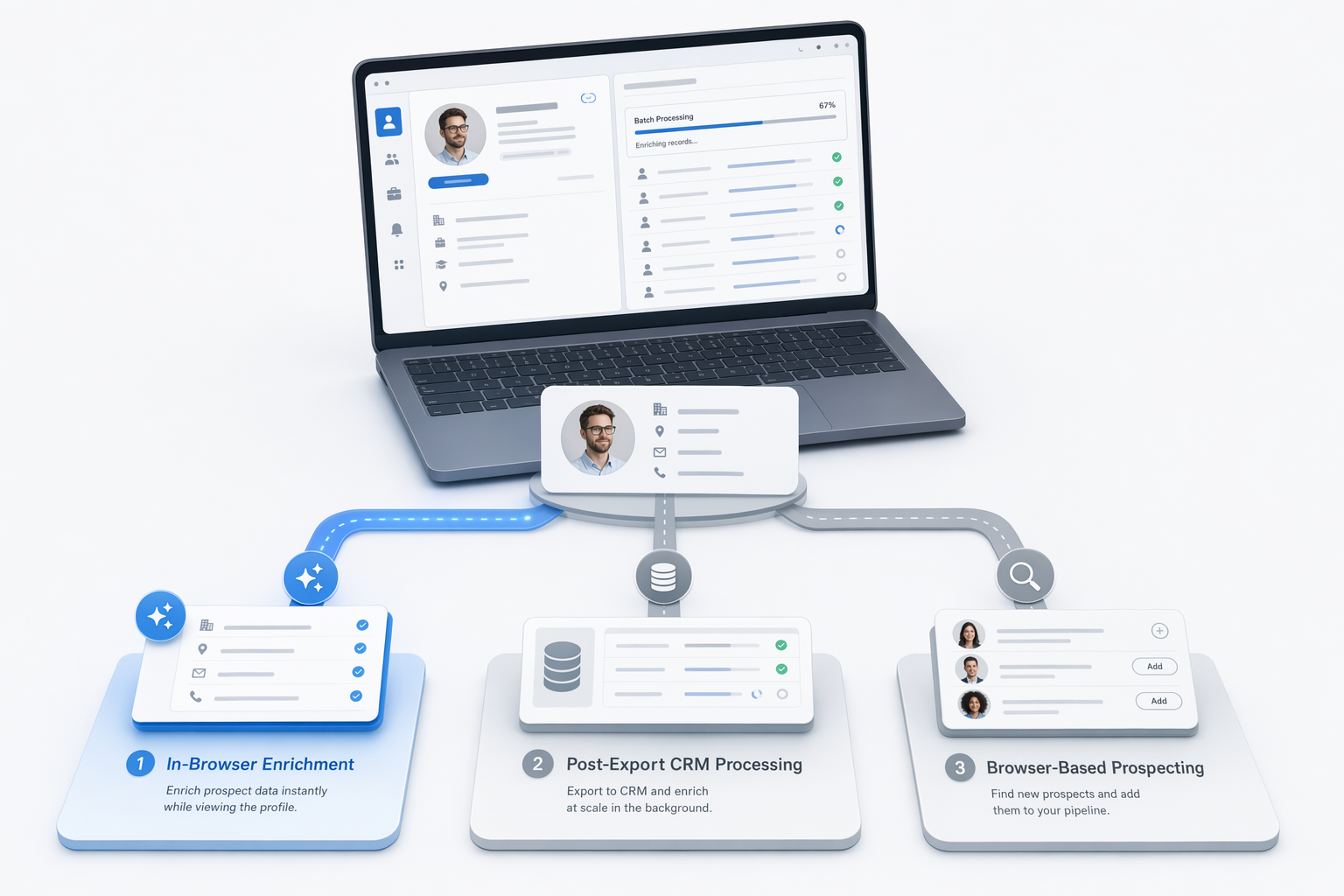
LinkedIn-native tools suit in-platform prospectors who enrich contacts without leaving their browser; post-export platforms serve teams who prospect outside LinkedIn or need batch processing across CRM records.
LinkedIn-Native Workflow Tools (Chrome Extensions)
Chrome extensions enrich contacts directly within LinkedIn's interface, best for teams who prospect in-platform and need instant enrichment. PeakAi's Chrome extension integrates directly into LinkedIn's interface, delivering verified contacts without leaving the profile view. LinkedIn's 30-40 daily action limit means Chrome extensions must throttle enrichment requests to comply with LinkedIn Terms of Service. Tools that scrape profiles programmatically risk account suspension; one-by-one enrichment within daily limits carries lower compliance risk.
Post-Export Enrichment Platforms
Post-export tools enrich CSV uploads or CRM records in bulk, best for teams who prospect outside LinkedIn or need batch processing. Apollo and ZoomInfo operate in this category, accepting contact lists from multiple sources and enriching them through proprietary databases. These platforms suit workflows where prospecting happens across channels (events, webinars, referrals) rather than LinkedIn alone. Bulk enrichment processes hundreds of contacts simultaneously but lacks the real-time verification signals available during in-platform prospecting.
CRM Integration and Sales Stack Fit
Native CRM integrations reduce manual data entry and close more deals. Apollo offers native Salesforce and HubSpot integrations; ZoomInfo supports Salesforce, HubSpot, and Microsoft Dynamics; PeakAi integrates with Salesforce and Pipedrive. Sales teams using Pipedrive find fewer tools offer native support, making workflow fit a decisive factor. Organizations using advanced account intelligence platforms report 208% more revenue compared to traditional approaches.
Conclusion
Real-time verification tools deliver higher accuracy but slower query times, while static database tools offer faster bulk exports at the cost of 2-3% monthly accuracy decay unless refresh cycles are frequent. LinkedIn-native Chrome extensions suit in-platform prospectors who need instant enrichment, while post-export enrichment platforms suit teams who prospect outside LinkedIn or need batch CRM updates, no single workflow fits all sales stacks.
As AI-powered lead scoring and intent signals become standard features in contact discovery platforms, sales teams will need to evaluate tools not just on accuracy and pricing but on how well they surface high-intent prospects from enriched contact lists, shifting the buyer's question from 'Can I find this contact?' to 'Should I prioritize this contact?'
Test PeakAi's 91% phone accuracy claim on your own prospect list with a free trial, compare real match rates against your current tool's performance before renewing annual contracts.
Frequently Asked Questions
What does '95% email accuracy' actually mean for contact discovery tools?
A '95% email accuracy' claim means 95% of returned emails passed syntax, domain, and deliverability checks, not that the tool found verified contacts for 95% of profiles queried. A platform reporting 95% email accuracy may still return contacts for only 14% of a target ICP list. Verification success differs fundamentally from contact discovery rates.
How do I calculate the real cost per verified contact when tools charge per credit?
Divide total credits purchased by actual verified contacts returned: (credits purchased) ÷ (verified contacts) = true cost. For example, 100 credits at $0.50/credit = $50. If the phone match rate is 60%, you receive 60 verified contacts, making the real cost $0.83 per verified contact, not $0.50.
Do contact discovery tools work well for India-focused sales teams?
Regional accuracy variance is significant, global platforms like Apollo and ZoomInfo have sparser phone coverage for India versus US/EU markets. Advertised accuracy rates reflect verification success, not geographic find rates. Test a tool's India phone accuracy on a pilot prospect list before committing to annual contracts to validate actual deliverable contact rates.
What's the difference between real-time verification and static database tools?
Real-time verification queries live data sources at enrichment time, returning only deliverable contacts with higher accuracy but slower queries. Static database tools serve pre-indexed contact records with faster queries, but accuracy decays 2-3% monthly. Platforms with 7-day refresh cycles maintain 98% accuracy; quarterly-update systems drop to 75% within five months.
Are LinkedIn contact discovery tools compliant with LinkedIn's Terms of Service?
LinkedIn prohibits automated scraping but allows enrichment-based tools that augment LinkedIn data with third-party sources. Chrome extensions that enrich contacts one-by-one within the 30-40 daily action limit carry lower compliance risk than bulk-scraping bots. Choose tools that disclose their data sourcing methodology and respect LinkedIn's usage limits.
Why is phone number accuracy lower than email accuracy?
Only 5-10% of LinkedIn users share phone numbers with first-degree connections, constraining enrichment tools' phone find rates even when verification accuracy is high. Email addresses appear in public directories, domain records, and email signatures, making them more discoverable. Phone accuracy ranges from 65-91%, while email accuracy ranges from 75-95%.
How often should contact databases be refreshed to maintain accuracy?
Contact data decays at 2-3% monthly due to job changes and number portability. Tools with 7-day refresh cycles maintain 98% accuracy, while quarterly-update systems drop to 75% accuracy within five months. Prioritize tools that disclose their refresh-cycle cadence and offer real-time verification for mission-critical prospects.
Sources
- Sales Intelligence Tools Comparison 2026: The Honest GTM Buyer's Guide | Datalane Blog - www.datalane.com (2026)
- Top 5 Email Finder Tools for Lead Generation (2026) - www.leadscrape.com (2026)
- Best Apollo Competitors & Alternatives for B2B Lead Generation - www.highperformr.ai
- Best Apollo & ZoomInfo Alternatives for Budget Teams 2026 - origami.chat (2026)
- LinkedIn launches Sales Insights to provide real-time data on business opportunities - venturebeat.com (2021)
- Top Account Intelligence Tools to Consider in 2026 - www.marketsandmarkets.com (2025)
