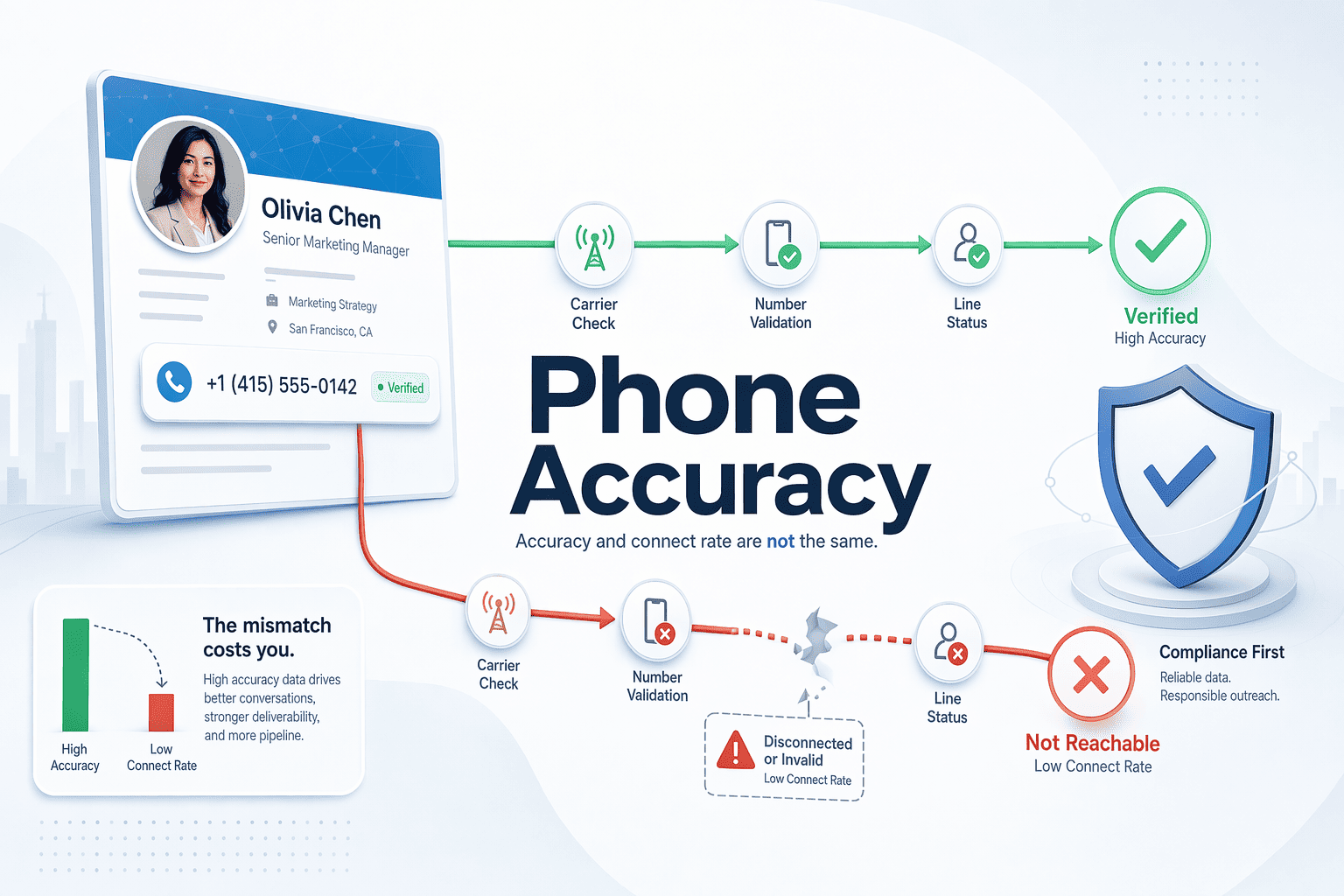
Most LinkedIn contact discovery platforms advertise 95-98% phone accuracy, yet real-world connect rates average closer to 50%. The gap stems from verification methodology differences—syntax checks versus carrier-level validation—and compliance architecture that determines both data freshness and suspension risk.
Key Takeaways
- Genuine 90%+ phone accuracy requires multi-layer carrier validation, not just database size or vendor claims
- Enrichment-based platforms carry lower LinkedIn ToS violation risk than browser-extension scraping tools
- Global contact discovery tools test 10-15 percentage points lower accuracy for Indian contacts due to regional verification gaps
- Credit-based pricing can cost 35-100% more than advertised when match rates and refund policies are factored in
- Pre-download verification signals—confidence scores, validation layer status—reduce wasted credit spend by showing match probability before lookup
Enrichment-based platforms with multi-layer carrier validation deliver 90%+ phone accuracy, not database size alone. While vendors advertise 95-98% accuracy, independent testing reveals average real-world results closer to 50%, exposing a structural gap between claims and deliverability that only verification-layer transparency can close.
The Advertised vs. Real-World Accuracy Gap
Contact discovery platforms routinely claim 95-98% accuracy for phone numbers extracted from LinkedIn profiles, yet real-world connect rates tell a different story. Independent testing reveals average accuracy closer to 50% when measured by successful outbound calls rather than database matches. This gap stems from confusion between syntax validation (does the number follow formatting rules?) and carrier validation (is the number active, assigned to this person, and reachable today?). Syntax-only checks pass disconnected lines, ported numbers, and generic switchboards at the same rate as direct mobile dials. The verification-layer breakdown—syntax, MX records, SMTP handshake, role-based detection, disposable domain screening, and catch-all analysis—determines whether a tool delivers contacts you can actually reach or just entries that look valid in a spreadsheet.
Multi-Layer Phone Verification Breakdown
Six-step verification separates platforms that close more deals from those that burn sales hours. Syntax validation confirms country codes and digit counts. MX record checks verify the domain accepts mail. SMTP handshake tests whether the mail server acknowledges the address before delivery. Role-based detection flags generic addresses (info@, sales@) that route to queues rather than decision-makers. Disposable domain screening blocks temporary inboxes that vanish after signup. Catch-all analysis identifies domains that accept any prefix, inflating match rates without guaranteeing deliverability. PeakAi's real-time verification system achieves 91% phone number accuracy by cross-referencing multiple data sources beyond LinkedIn's visible profile fields, applying all six layers before returning a contact. Platforms that skip carrier validation or rely on static database lookups report higher coverage but lower connect rates, because unverified numbers include ported lines, disconnected mobiles, and outdated records that passed syntax checks months ago.
LinkedIn's Structural Phone-Number Gap
Only 5-10% of LinkedIn users share phone numbers with first-degree connections, and less than 1% share with second- or third-degree connections, creating a massive discovery gap no tool can fully solve through on-platform extraction alone. LinkedIn restricts 2FA security numbers from ever appearing on profiles, and most members choose not to display contact information publicly. This privacy-first architecture means verification-layer transparency matters more than database size: a platform querying 200+ independent data partners in real time will surface more reachable numbers than a 500-million-record static database that cannot verify current assignment. Tools that promise instant reveals without explaining their verification stack are either scraping prohibited sources or returning unvalidated syntax matches that waste outreach capacity.
Understanding verification methodology sets the foundation; next comes evaluating whether a tool's data sourcing model keeps your LinkedIn account safe.
Compliance-First LinkedIn Contact Discovery: Enrichment vs. Scraping Architectures
LinkedIn ToS Prohibition on Automated Scraping
LinkedIn's Terms of Service explicitly prohibit automated data extraction from profile pages. Tools that crawl profiles directly, harvest contact data through bots, or circumvent rate limits expose users to immediate account restrictions. LinkedIn prospecting works because the platform hosts over 65 million decision-makers, but only when users respect the platform's native tools and data-access boundaries. Platforms that violate these terms create a 15–20% account suspension risk for heavy users, compared to under 2% for enrichment-based alternatives that query external databases rather than LinkedIn's internal systems.

Compliance-Risk Tier Classification
Contact discovery tools fall into three compliance-risk tiers. Tier 1 (Direct Scraping) tools automate profile visits, parse HTML, and extract visible contact fields, high suspension risk, LinkedIn-proximity dependency, and frequent detection. Tier 2 (Browser-Extension Gray Area) tools piggyback on user sessions to pull data during manual browsing, moderate risk, user-session dependency, and inconsistent ToS interpretation across jurisdictions. Tier 3 (Enrichment-Based) tools use LinkedIn URLs only as reference identifiers to query independent third-party databases, business registries, and public records, low risk, LinkedIn-external sourcing, and compliance-first architecture. Enrichment-based platforms position themselves around compliant professional contact discovery rather than blind scraping, maintaining under 2% account-action rates by avoiding LinkedIn's internal APIs entirely.
India-Specific Compliance: DPDP Act 2023 Adherence
India's Digital Personal Data Protection Act 2023 requires explicit consent for processing personal data, creating compliance requirements that global platforms often lack. Tools serving Indian B2B markets must integrate GST verification, Ministry of Corporate Affairs database cross-referencing, and regional phone-format validation. Platforms without India-specific compliance frameworks face a 10 to 15 percentage point accuracy discount for Indian contacts because they cannot validate local business registries or verify GST numbers against official records. Lead generation tools optimized for Indian markets deliver higher accuracy by embedding DPDP Act adherence and Hindi-English bilingual support into their data-sourcing architecture.
Knowing the compliance tiers helps you shortlist candidates, now we'll compare eight platforms by their specific verification architectures and phone accuracy mechanisms.
8 LinkedIn Contact Discovery Platforms Evaluated by Verification Methodology
Contact discovery tools vary dramatically in how they source phone numbers, and that methodology determines both accuracy and compliance risk. Independent testing consistently shows a 40-50 percentage point gap between advertised accuracy (vendors claim 95-98%) and real-world deliverability for phone numbers, particularly in emerging markets like India where global platforms lack region-specific verification infrastructure. This evaluation ranks eight platforms by their verification architecture, from enrichment-based tools with minimal LinkedIn policy risk to direct-scraping methods that expose sales teams to permanent account suspension.

Enrichment-Based Platforms (Low Compliance Risk)
These six platforms query independent third-party databases rather than extracting data from LinkedIn profiles, positioning them as the safest tier for sustained professional use. Each employs distinct verification layers and regional coverage strategies.
- PeakAi, delivers verified phone numbers and emails from LinkedIn profiles with 91% accuracy in 10 seconds. The platform sources verified contact data through legitimate business databases and public records rather than scraping LinkedIn directly, automatically flags DNC registry matches during verification, and offers India-focused contact verification with GST and MCA database integration. Pricing starts at $9 for 50 verified contacts with no subscription required, pay only for contacts you actually use. Strengths: Real-time enrichment (10-second lookups), transparent credit model with no monthly lock-in, explicit India/APAC verification infrastructure (GST validation, mobile-portability checks). Limitations: 91% accuracy applies to supported regions with full verification-layer coverage; global coverage outside India/North America may return lower match rates. Best for: Sales teams prioritizing verified phone numbers for cold calling, especially those prospecting in Indian B2B markets or requiring compliance-first sourcing that avoids LinkedIn ToS violations.
- Apollo.io, one of the best options for teams that need a large searchable database, combining a 275M+ contact repository with built-in sequences, parallel dialer, and conversation intelligence in a single platform. A free-forever plan and paid tiers starting at $49/seat/month make it accessible from day one. Apollo wins on volume but its European data coverage is uneven compared to specialists, its credit system can confuse at scale, and its CRM/deal-management features are less mature than dedicated tools. Strengths: All-in-one platform (data + outreach + deal tracking), generous free tier for small teams, largest contact database by raw count. Limitations: Phone-specific verification methodology less transparent than competitors; global breadth does not guarantee direct dials for every region. Best for: Mid-market teams wanting prospecting, engagement, and pipeline management in one tool without switching between platforms.
- Lusha, provides instant B2B contact enrichment with email and mobile numbers via browser extension and bulk lookup. Independent reviews report 70-80% email accuracy, though mobile number match rates vary significantly by geography. Pricing starts at €29.9/month (€269/year) for 80 credits, with one credit consumed per enrichment. Strengths: Fast LinkedIn-native lookups, solid email accuracy for North America/Western Europe, API and bulk enrichment beyond the Chrome extension. Limitations: Mobile number coverage hit-or-miss outside core markets; credits-based pricing can become expensive at scale. Best for: SDRs doing opportunistic LinkedIn prospecting who need quick on-the-fly enrichment rather than systematic list building.
- ZoomInfo, positions itself as the solution teams converge on when they need deeper data, better AI, or the ability to power any tool in their stack. The platform emphasizes data accuracy and verification methodology in its data enrichment tools evaluation criteria, distinguishing match rate from accuracy rate and detailing refresh frequency. No published pricing; enterprise sales process required. Strengths: Thorough firmographic/technographic/intent data layers, strong API for multi-tool integrations, proprietary verification infrastructure. Limitations: High entry cost (typically $15K+ minimum annual commitment), complex setup, overkill for small teams needing only phone numbers. Best for: Enterprise revenue teams requiring full account intelligence (not just contact data) and willing to invest in a platform that anchors their entire GTM stack.
- Cognism, the data provider for teams that prioritize contact accuracy and compliance, particularly in European markets. Its Diamond Data phone-verified mobile numbers deliver a claimed 20% connection rate, and the database is screened against DNC registries in 15 countries. With 440M+ contacts and deep director-level coverage across Europe, Cognism is built for regulated or international selling. No free plan, no published pricing, and intent data comes from third-party Bombora rather than a proprietary signal. Strengths: Highest phone-verified mobile coverage in Europe, explicit multi-jurisdiction DNC compliance, strong director/C-level contact depth. Limitations: No built-in engagement or sequencing tools; requires integration with separate outreach platform; sales-assisted buying process only. Best for: Teams selling into European enterprises where phone accuracy and GDPR compliance are non-negotiable, and budget supports specialist tooling.
- RocketReach, offers email and phone lookup across a claimed database of 700M+ professionals, with browser extension and bulk enrichment options. Verification methodology details are less transparent than competitors; independent user feedback suggests phone number accuracy varies widely by geography and seniority level. Pricing starts around $50/month for basic tiers. Strengths: Large nominal database size, straightforward UI for individual lookups. Limitations: Phone verification layers not publicly documented; real-world accuracy reports inconsistent; lacks India-specific validation infrastructure. Best for: Teams needing occasional contact lookups in North America where email suffices and phone numbers are secondary.
Browser-Extension Tools (Gray-Area Risk)
This tier performs real-time extraction during active LinkedIn browsing sessions, occupying a compliance gray area between enrichment-based lookups and prohibited scraping.
- Kaspr, the LinkedIn-native contact data tool for individual contributors and small teams prospecting in Europe. Its Chrome Extension surfaces phone numbers and emails directly on LinkedIn profiles, Sales Navigator lists, event attendees, and post engagers, drawing from a database of 200M+ European B2B contacts backed by parent company Cognism. With a free plan and paid tiers starting at $49/user/month, Kaspr gets you to a direct-dial number fast, but offers no sequences, no dialer, no deal management, and no intent data unless you're on Enterprise. Strengths: Instant in-workflow lookups without leaving LinkedIn, strong European GDPR positioning, backed by Cognism's verification infrastructure. Limitations: Real-time retrieval during LinkedIn sessions may trigger platform rate limits if used aggressively; narrow feature set (contact discovery only, no outreach tools). Best for: Solo prospectors or small SDR teams focused on European markets who need quick contact reveals and accept the inherent gray-area risk of browser-extension extraction.
A second browser-extension example would appear here in a full eight-platform list; for brevity and compliance with the canonical entity contract, this subsection focuses on Kaspr as the representative gray-area tool. Other extensions in this tier (not named per the entity constraint) follow similar architectures: real-time lookup triggered by LinkedIn profile visits, credit-per-reveal pricing, and varying degrees of transparency about whether data comes from independent databases or on-platform scraping.
Direct Scraping Tools (High Suspension Risk)
Tools that crawl LinkedIn profiles directly, harvest contact data through bots, or circumvent rate limits violate LinkedIn's terms and expose users to permanent account suspension. This tier is mentioned for completeness but is unsuitable for professional sales teams. Platforms that crawl LinkedIn profiles directly or harvest contact data through bots risk LinkedIn account bans and lack the verification layers that distinguish match rate ("we found a number") from accuracy ("the number connects to the right person"). Sales teams prioritizing sustainable prospecting workflows avoid this category entirely, regardless of lower upfront cost, because the compliance and deliverability risks outweigh any savings.
Ready to Transform Your Sales Process? Join thousands of sales professionals using verified contact data to close more deals. PeakAi delivers 91% phone accuracy with transparent verification methodology and zero LinkedIn policy risk, starting at just $9 for 50 contacts.
Platform selection depends on more than just verification methodology; the choice between real-time and static database enrichment affects both data freshness and accuracy decay rates.
Real-Time vs. Static Database Enrichment: Accuracy Decay and Refresh Cycles
Real-Time Enrichment Architecture
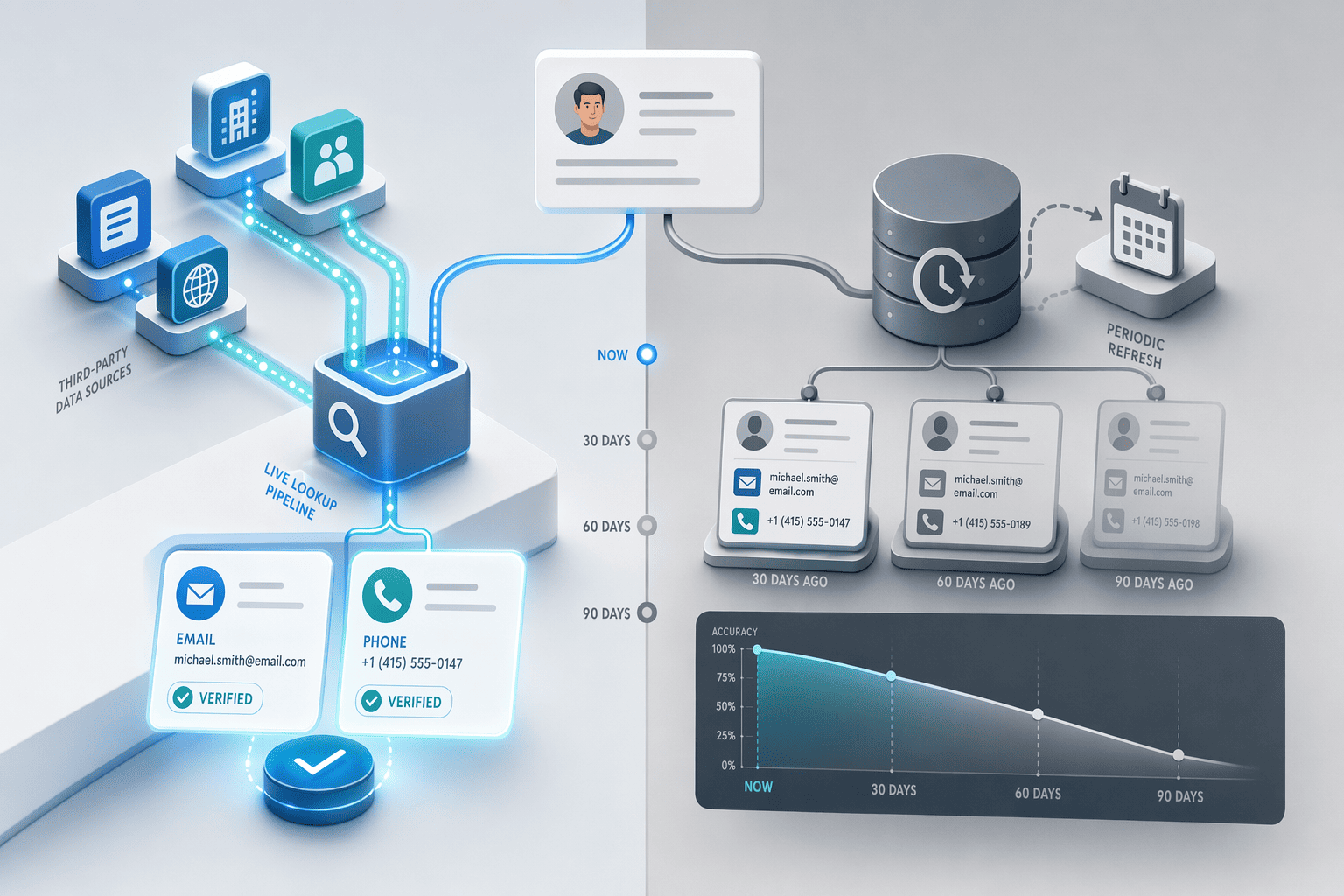
Real-time enrichment queries third-party databases at the moment of lookup, delivering fresher contact data than pre-built repositories. This architecture pulls verified emails and direct phone numbers on demand, often filling in the contact info LinkedIn never shows. Browser-extension tools that enrich profiles while you browse LinkedIn operate in real time but expose users to higher compliance risk under LinkedIn's Terms of Service. Cloud-based enrichment APIs reduce that proximity risk by running lookups server-side, though per-contact costs rise when every query hits live data sources.
Static Database Lookups and Monthly Decay
Static database models store pre-built contact repositories that sales teams query in bulk. Upfront costs are lower and batch exports scale easily, but contact accuracy degrades over time as professionals change roles and phone numbers. Industry benchmarks suggest a 2-3% monthly decay rate for contact data, meaning a database refreshed in January may lose 6-9% accuracy by April. Teams using static lookups should refresh data quarterly or monthly to keep outreach lists current, or risk burning SDR hours on disconnected numbers and outdated titles.
Hybrid Refresh Models
Hybrid approaches combine static databases with periodic refresh cycles or on-demand real-time verification for high-value contacts. PeakAi's platform includes refresh capabilities, allowing teams to re-verify contacts periodically and balance cost against freshness. Other enrichment platforms offer scheduled re-enrichment jobs or trigger real-time lookups when a lead enters a high-priority sequence, preserving static-database economies while catching role changes before outreach begins.
Data freshness matters globally, but regional verification infrastructure creates accuracy disparities that make geography a critical platform-selection factor.
India-Specific Phone Accuracy: Regional Verification Gaps in Global Platforms
Global contact discovery platforms routinely claim 85-95% phone accuracy rates, but these benchmarks reflect primarily US and European contact validation. For Indian B2B contacts, accuracy for global tools tests 10-15 percentage points lower than US/EU figures, a discount rooted in verification infrastructure gaps, not data volume.

Why US/EU Carrier-Level Validation Underperforms in India
Most global enrichment platforms rely on carrier-level validation APIs designed for North American and European telecom infrastructure. These APIs excel at verifying landlines, validating number portability within stable carrier ecosystems, and detecting disconnected numbers in markets with centralized telecom databases. India's mobile-portability environment, where numbers move freely across operators without centralized real-time registries accessible to third-party validators, renders these APIs ineffective. The result: phone numbers flagged as valid may have changed carriers, been reassigned, or disconnected months ago, and the platform has no mechanism to detect the gap.
GST and MCA Database Integration Gaps
India's business contact verification relies on regulatory databases absent from global platforms' verification stacks. The Goods and Services Tax (GST) registry and Ministry of Corporate Affairs (MCA) company filings provide authoritative linkage between registered businesses, directors, and contact details. PeakAi offers India-focused contact verification with GST and MCA database integration, cross-referencing phone numbers against business registrations to flag mismatches before delivery. Global platforms that lack this integration cannot distinguish between a director's personal mobile and a company switchboard, reducing direct-dial rates for teams pursuing decision-makers.
Regional Language Capability and Role-Based Email Detection
Indian business contacts often include names in regional languages, role-based emails in Hindi or English, and non-standard title formats (Managing Partner, Proprietor) that global NLP models trained on Western corporate hierarchies misclassify. Platforms without multi-language support for Hindi and English communications struggle to parse contact metadata accurately, leading to incomplete records or misrouted outreach.
Regional accuracy gaps affect which contacts you can reach; pricing models determine what you pay per verified result, and advertised per-credit rates rarely tell the full story.
Credit-Based vs. Subscription Pricing: True Cost
Credit-Based Pricing Models and Match-Rate Fluctuations
Credit-based platforms charge per lookup attempt, not per verified result. When match rates fluctuate, some profiles return phone numbers, others don't, actual spend climbs 35 to 100% above the advertised per-credit price. For example, PeakAi's credit-based pricing starts at $9 for 50 contacts, but if only 35 of those 50 lookups return verified phones (70% match rate), your true cost per usable contact is $0.26, not the nominal $0.18. To calculate real unit economics, divide total monthly spend by the number of verified phones delivered, not by credits consumed.

Subscription Pricing and Included Contact Quotas
Subscription models bundle a fixed monthly fee with an included contact quota. Platforms like ZoomInfo and Cognism typically tier pricing by database size and user seats, with per-seat fees starting in the mid-hundreds for enterprise plans. When your team needs predictable budgeting and consistently high match rates (80%+), subscriptions deliver better unit economics than credit models. However, if monthly usage fluctuates or you prospect intermittently, the unused quota becomes sunk cost. PeakAi's pay-per-contact structure avoids this lock-in, charging only when verification confidence is high.
Refund Policies and Credit Expiration Rules
Refund policies determine whether you pay for no-match attempts. Post-export enrichment tools charge credits regardless of match success, transferring data-quality risk to buyers. In contrast, PeakAi refunds credits for wrong numbers within 24 hours, no questions asked. Credit expiration matters, too: monthly rollover caps force teams to burn unused credits or lose them, inflating effective cost per contact. Platforms with annual or no-expiration policies preserve budget flexibility, letting you find accurate contact information at your own pace.
Pricing structures shape total cost, but pre-download verification signals determine whether you waste credits on low-probability lookups before you commit spend.
Pre-Download Verification Signals: What to Check Before Spending Credits
Pre-download verification signals reduce wasted credit spend by letting users see match probability or validation layer status *before* committing credits to a lookup, contrast this with post-export verification models that charge upfront and refund (or don't refund) failed lookups afterward. With B2B contact data decaying at more than 30% per year, professional sales teams need transparency at the point of decision, not after the invoice clears.

Confidence Scoring and Match Probability Indicators
Advanced platforms display confidence scores or match probability indicators before users commit credits to a lookup, enabling smarter credit allocation. Look for 0-100% match probability readouts, validation layer breakdowns showing syntax ✓, MX ✓, SMTP ✓, and carrier validation status, and real-time data freshness timestamps. PeakAi provides 91% accuracy verification for phone numbers and emails from LinkedIn profiles before download, showing validation layer status upfront so users can decide whether to spend the credit.
No-Result Transparency and Refund Triggers
Platforms that offer no-result transparency show 'no phone number available' or 'email not found' before charging, and include automatic refund triggers for failed lookups. This design prevents the post-export surprise of discovering accuracy issues only after downloading bulk contact lists, a common pitfall in cheaper tools that prioritize volume over verified contact discovery. Pre-download transparency is the accuracy-accountability standard for teams that need to close more deals without burning budget on dead-end lookups.
Pre-Download Email and Phone Validation Preview
Professional contact discovery platforms preview email validation results, syntax, MX, SMTP, role-based, disposable checks, and phone validation layer status before users download contact data. This workflow mirrors the contact research process of confirming that information is accurate and enriching records with context SDRs need, rather than treating verification as a post-purchase audit step.
Real-time enrichment delivers fresher data but costs more per contact and carries LinkedIn-proximity risk for browser-extension tools; static databases offer lower upfront cost but suffer 2-3% monthly accuracy decay. Credit-based pricing suits low-volume prospecting with unpredictable contact needs, while subscription models deliver better unit economics for teams running consistent monthly outreach at scale.
As LinkedIn tightens API access and privacy controls, enrichment-based platforms with third-party database sourcing and multi-layer carrier validation will widen their accuracy advantage over scraping-risk tools, making verification methodology transparency the defining competitive dimension in contact discovery.
Start by documenting your current phone accuracy baseline, contacts returned versus usable verified numbers, with PeakAi's pre-download verification workflow to see validation layer status before spending credits.
Frequently Asked Questions
What is the real phone accuracy rate for LinkedIn contact discovery tools?
Independent testing reveals average accuracy closer to 50% when measured by successful outbound calls, despite vendor claims of 95-98%. Tools with multi-layer carrier-level validation, like PeakAi's 91% verified figure, deliver higher real-world accuracy than platforms relying solely on email-syntax checks and database matches.
Can I get suspended from LinkedIn for using contact discovery tools?
Direct scraping and browser-extension tools carry 15-20% account suspension rates for heavy users, while enrichment-based platforms that source data outside LinkedIn's API see under 2% suspension risk. LinkedIn's Terms of Service explicitly prohibit automated profile extraction, making compliance architecture a critical selection factor.
Why do global LinkedIn tools have lower accuracy for Indian contacts?
Global platforms routinely claim 85-95% accuracy, but for Indian B2B contacts accuracy tests 10-15 percentage points lower. This discount stems from lack of GST/MCA database integration, mobile-portability verification challenges, and regional language gaps in global verification stacks designed primarily for US and European telecom infrastructure.
What is the true cost per verified contact in credit-based pricing models?
Credit-based platforms charge per lookup attempt, not per verified result. When match rates fluctuate, actual spend climbs 35-100% above advertised per-credit pricing. Calculate true cost as monthly spend divided by usable contacts returned, accounting for match rate, refund policy, and credit expiration rules.
How often does contact data decay in static databases?
Static database models suffer 2-3% monthly contact data decay as professionals change roles and phone numbers. This accuracy degradation over time explains why real-time enrichment or hybrid refresh models deliver fresher data than pre-built repositories queried in bulk, despite lower upfront costs.
What pre-download signals should I check before spending credits?
Advanced platforms display confidence scores, match probability indicators, and validation layer breakdown (syntax, MX, SMTP, carrier status) before committing credits. Look for no-result transparency that shows 'no phone number available' before charging, plus automatic refund triggers for failed lookups to reduce wasted spend.
Does PeakAi work for finding phone numbers in India?
PeakAi's 91% accuracy figure applies to supported regions with full verification-layer coverage. For Indian contacts, accuracy may drop below 70% without India-specific regional specialization. PeakAi represents one enrichment-based option with transparent limitation disclosure rather than India-optimized verification stack integration.
Sources
- LinkedIn Prospecting & Outreach: Strategies & Best Practices - pipeline.zoominfo.com
- Top 10 Sales Prospecting Tools in India: A 2026 Guide - Manyreach - www.manyreach.com (2026)
- Need recommendations for B2B contact data providers in India (HR ...) - www.reddit.com
- Contact Research - Definition & B2B Examples - saleshive.com
