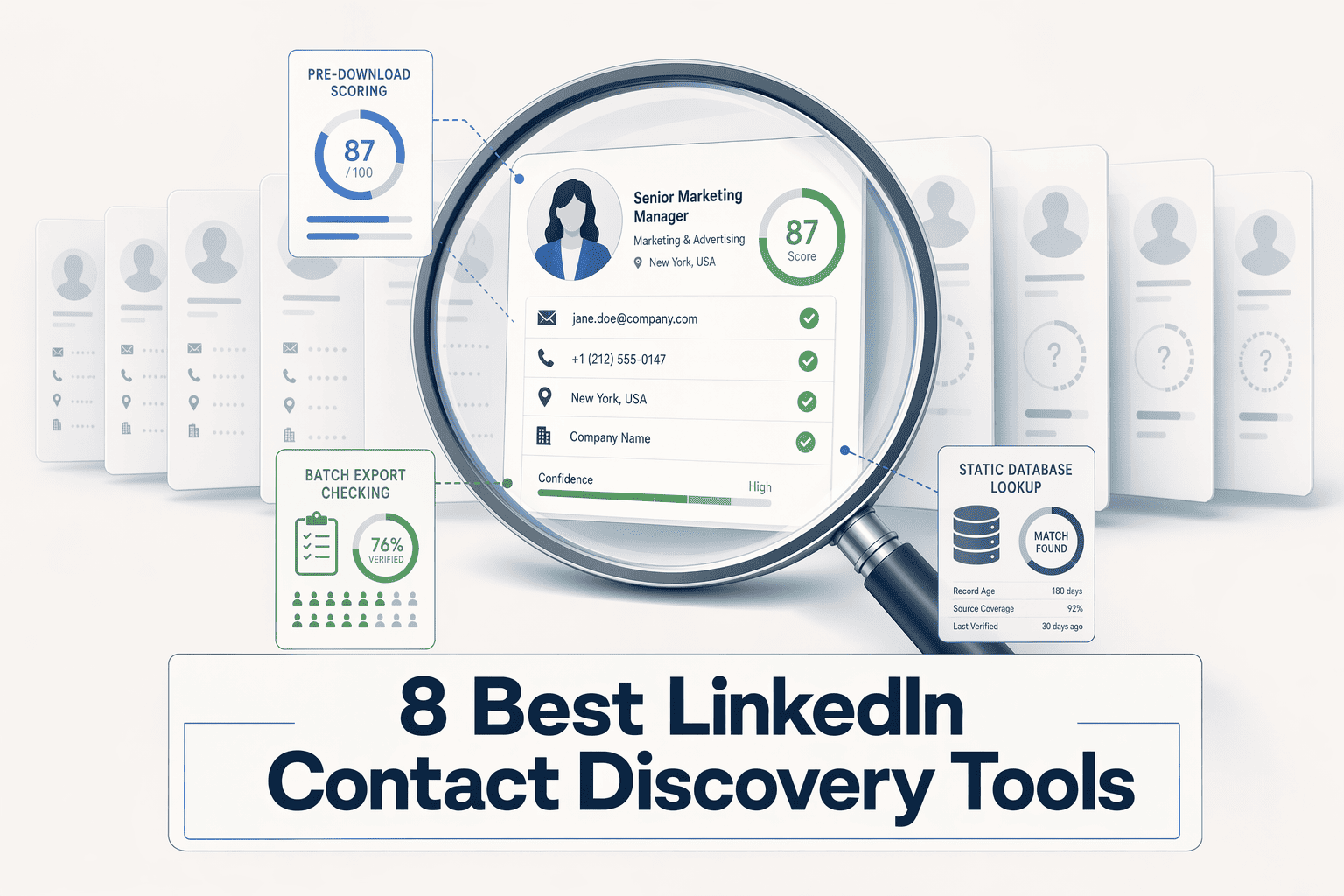
Sales teams evaluating LinkedIn contact discovery tools face a core challenge: accuracy metrics fragment across email deliverability, phone connectivity, data freshness, and geographic coverage—yet vendors collapse these into single percentages.
The primary differentiation axis isn't advertised accuracy rates but verification timing: pre-download confidence scoring versus post-export batch processing versus static database lookups. This comparison examines eight tools by verification method, regional performance, and compliance risk.
Key Takeaways
- Contact accuracy aggregates multiple dimensions—email deliverability (70-85% find rates), phone connectivity (5-10% visibility ceiling), and data decay (2-3% monthly)—that vendors often collapse into single percentages
- Pre-download verification surfaces accuracy confidence before credit spend, reducing wasted investment compared to post-export batch processing where credits charge upfront regardless of match success
- Global platforms underperform in India by 10-15 percentage points due to mobile number portability challenges and LinkedIn user-base skew toward multinational firms
- Scraping-based tools trigger 15-20% account suspension rates for heavy users, while enrichment-based architectures reduce risk to <2% by querying third-party databases
- True cost per verified contact diverges sharply from advertised per-credit pricing—a 70% match rate inflates a $0.50/credit price to $0.71/verified-contact (42% premium)
Why Contact Discovery Accuracy Is Not a Single Metric
When evaluating the best LinkedIn contact discovery tools with high accuracy rates for sales teams, understand that "accuracy" aggregates multiple verification dimensions — email deliverability, phone connectivity, data freshness, and regional coverage — each measured differently and producing divergent results. Vendor claims of 95 to 98% accuracy often obscure 20 to 40 percentage-point gaps between email format validation and phone carrier-level verification, plus monthly decay rates that render static databases stale within 90 days.

Email Syntax Validation vs. SMTP Handshake vs. Carrier-Level Phone Verification
Not all verification is created equal. Syntax validation confirms an email address matches formatting rules (e.g., [email protected]) but says nothing about whether the mailbox exists or accepts mail. SMTP handshake verification connects to the recipient's mail server to confirm the mailbox is active, a step that adds latency but reduces bounce rates dramatically. Phone verification introduces another layer: carrier-level checks confirm a number is active and not disconnected, while format-only validation simply checks digit count and area-code structure. Tools that report "90%+ accuracy" often mix these methodologies without disclosing which dimension each percentage references.
Phone vs. Email Accuracy Reporting: The 20 to 40pp Gap Vendors Don't Publish
Email find rates routinely hit 70 to 85% because work addresses follow predictable patterns and are indexed in business directories. Phone numbers, by contrast, face a structural visibility ceiling: only 5 to 10% of LinkedIn users share phone numbers with first-degree connections, and even fewer expose them to second- or third-degree contacts. The result: phone connectivity rates lag email deliverability by 20 to 40 percentage points in practice. Vendors that advertise "95% accuracy" without separating email from phone metrics obscure this gap, leaving sales teams to discover through trial that half their supposed "verified" numbers route to disconnected lines or switchboards.
Data Freshness vs. Database Breadth: The Staleness Tradeoff
Contact data decays at roughly 2 to 3% per month as professionals change jobs, phone numbers, and email addresses. Static databases that refresh quarterly accumulate 6 to 9% stale records between updates, compounding bounce rates over time. Real-time verification queries live data sources at the moment of lookup, adding 2 to 5 seconds of latency but eliminating staleness. Independent testing shows average accuracy closer to 50% when vendors rely on quarterly-refresh databases, versus 85 to 91% for enrichment platforms that verify before download. The tradeoff: breadth (millions of static records) versus currency (smaller pools refreshed continuously). Teams prioritizing cold-call connectivity should weight freshness over database size.
Understanding these accuracy dimensions reveals why verification timing, the moment validation occurs relative to credit charges, represents the most critical purchasing decision sales teams make.
Pre-Download vs. Post-Export Verification: What Sales Teams Pay For
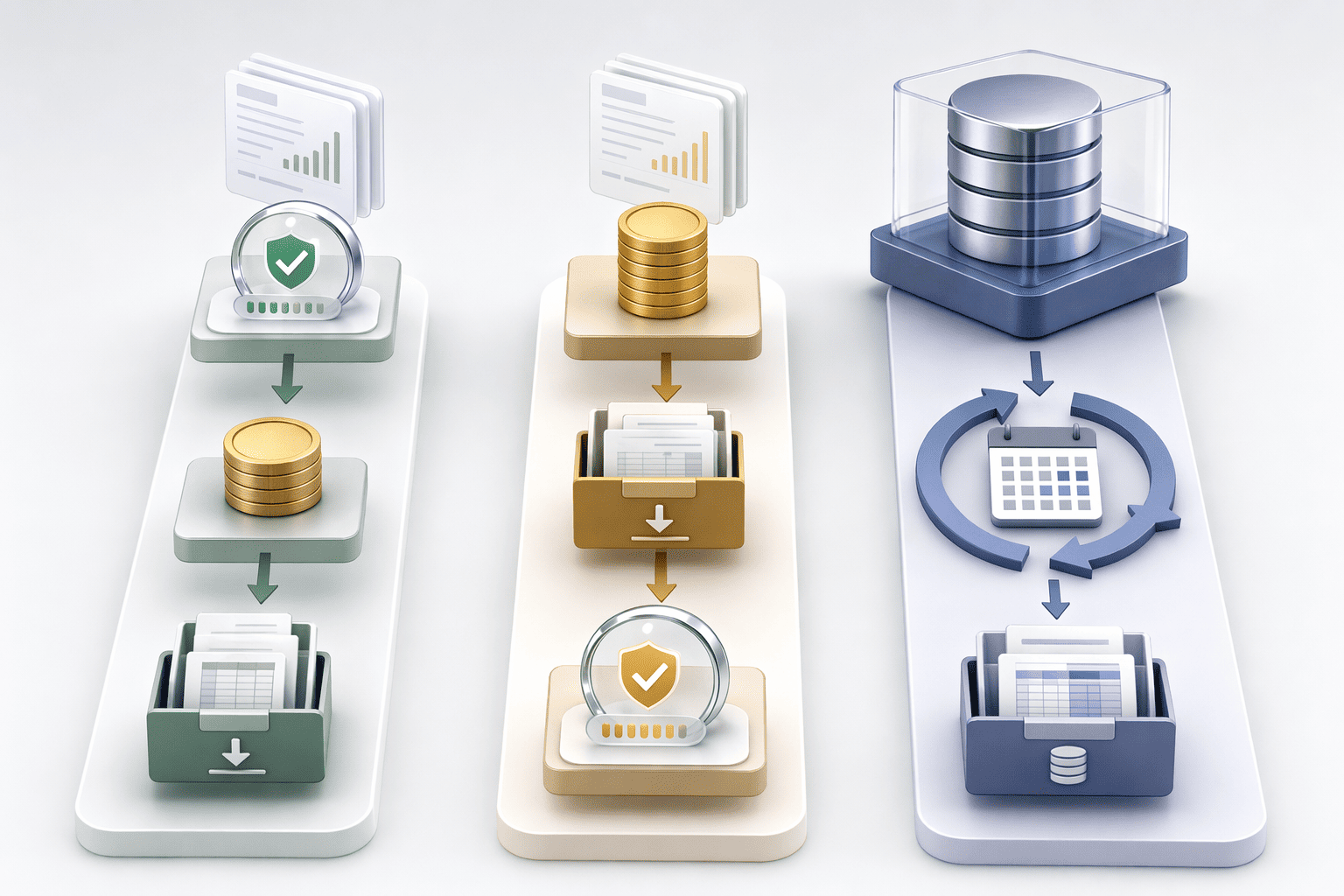
The verify-before-spend versus charge-first-verify-later distinction is the core purchase criterion most sales teams overlook when evaluating contact discovery tools. Pre-download verification surfaces accuracy confidence per contact before credit deduction; post-export models charge upfront and run validation afterward; static databases query pre-built datasets with monthly refresh cycles. Each model shifts cost, risk, and latency differently.
Pre-Download Confidence Scoring: Verify Before You Spend Credits
Pre-download verification tools surface accuracy confidence per contact before you commit a credit. PeakAi delivers 91% phone number accuracy with verification completed in 10 seconds, allowing reps to see whether a number is classified as mobile, landline, or VoIP before export. This model reduces wasted spend on unverifiable records because credits are deducted only when the platform confirms a match. The tradeoff: slightly higher per-credit cost to cover verification overhead, and the 10-second latency adds friction for bulk workflows. Best for teams that prioritize cost control and want to avoid paying for no-match attempts.
Post-Export Batch Enrichment: The Credit-Burn-on-Attempt Model
Post-export tools charge credits at export time, then run batch validation afterward. Reps spend time dialing disconnected lines and working through bad data because the verification step happens after the credit is gone. No-match scenarios still consume credits in most pricing models, and partial-match charges (email found, phone not found) increase actual cost per usable contact. Sales teams waste significant time on mechanics instead of conversations, and when match rates fluctuate, true cost per verified contact can climb well above the advertised per-credit price. Refund policies vary, but recovering credits for failed lookups often requires manual review. This model works when speed matters more than cost precision, but budgeting becomes harder.
Static Database Lookups: Monthly Refresh Cycles and Staleness Risk
Static database tools query pre-built datasets with quarterly or monthly refresh cycles. Lower latency and simpler infrastructure keep per-contact costs down, but staleness risk climbs as contacts change roles, phone numbers disconnect, and emails bounce. ZoomInfo and similar platforms refresh North American data frequently, but even best-in-class databases face decay between update cycles. The verify-at-query-time model eliminates this lag but costs more per lookup. For deeper context on how phone numbers go stale and why real-time verification matters, see our guide on why contact discovery tools return outdated phone numbers.
These verification models translate into concrete architectural differences across the leading platforms, each optimizing for distinct buyer priorities around cost efficiency, speed, and data depth.
Most LinkedIn contact discovery platforms claim high accuracy, but verification timing and methodology vary dramatically. Tools that verify *before* you spend credits reduce wasted spend on disconnected numbers, while post-export or database-only approaches leave you chasing outdated contacts. Below, we compare eight tools by verification architecture, regional accuracy, compliance risk, and credit transparency to help sales teams choose based on cost-per-connected-call rather than raw database size.
Comparison Table: Verification Method, Regional Accuracy, Compliance Risk
| Tool | Verification Timing | Email Verification | Phone Verification | India Coverage | Compliance Architecture | Credit Model |
|---|---|---|---|---|---|---|
| PeakAi | Pre-download | SMTP handshake | Carrier-level (91% accuracy) | High (1,600+ cities) | Enrichment-based (third-party databases) | Pay-per-verified-contact |
| LinkedIn Sales Navigator | None (native platform) | N/A | None | Global | Native platform (no external scraping) | Subscription (seat-based) |
| Apollo.io | Post-export | Syntax-only | None (database lookup) | Moderate | Database-dependent | Credit-per-attempt (expires) |
| Lusha | Post-export | SMTP validation | Database lookup | Moderate | Database + public records | Credit-per-lookup |
| Kaspr | Post-export | SMTP validation | Database lookup | High (EU-focused) | GDPR-aligned enrichment | Unlimited emails (paid plans) |
| LeadIQ | Post-export | SMTP validation | None | Moderate | Database + CRM sync | Subscription-based |
| ZoomInfo | Static database | SMTP validation | Database lookup | Low (US-focused) | Proprietary database | Enterprise contract |
| SignalHire | Real-time | SMTP validation | Database lookup | Moderate | Multi-source aggregation | Credit-per-contact |
Tool-by-Tool Reviews: Pros, Cons, Best-For by Verification Architecture
PeakAi: Pre-download verification with 91% phone accuracy. Cross-references 200+ data partners in real-time, delivering verified contacts in 10 seconds without leaving LinkedIn. Pros: Pay only for verified numbers (no credit burn on failed lookups), real-time accuracy confidence scoring, India-optimized with GST/MCA database integration. Cons: Higher per-credit cost than database-only tools, smaller global breadth than legacy platforms. Best for: Sales teams prioritizing cost-per-connected-call efficiency over raw database size, especially for Indian B2B prospecting. Transparent pre-download pricing, credits deducted only for verified contacts.
LinkedIn Sales Navigator: Native platform prospecting with advanced filters and Relationship Explorer. Surfaces up to eight relevant leads per account based on target persona, with job-change alerts and past-customer insights. Pros: First-party LinkedIn data updated in real-time, no scraping risk, integrates with 29 tools. Cons: No phone numbers (LinkedIn restricts visibility by design), seat-based subscription with 2-month implementation. Best for: Teams already invested in LinkedIn workflows who need compliant lead discovery and warm-intro intelligence. Subscription model, no per-contact verification.
Apollo.io: All-in-one platform combining 230M+ contacts with email sequencing. Entry pricing at $49/user/month with 900 free credits/year. Pros: Built-in engagement platform (outreach + data in one tool), transparent seat-based pricing, strong free tier. Cons: G2 reviews cite 15-25% bounce rates, phone credits cost 8× email credits and expire each cycle. Best for: SMB teams needing affordable bundled data and outreach who can tolerate moderate accuracy gaps. Credit-burn-on-attempt model, refund policy unclear for no-match scenarios.
Lusha: Chrome extension with job-change alerts and API webhooks for auto-enriching Salesforce/HubSpot. Pros: One-click lookup from LinkedIn, CRM data-freshness workflows, free tier available. Cons: Database-dependent (accuracy varies by region), credit-per-lookup pricing adds up for high-volume teams. Best for: Teams prioritizing CRM hygiene and job-change tracking over point-of-prospecting speed. Credit model charges per lookup regardless of result quality.
Kaspr: GDPR-aligned EU data across 200M+ profiles with unlimited B2B emails on paid plans. Phone credits are the variable cost. Pros: Chrome extension for LinkedIn/Sales Navigator, EU compliance built-in, free tier. Cons: Phone coverage skews toward Europe (global tools test 10-15 points lower in India), credit variability for phones. Best for: EU-focused teams needing GDPR-compliant enrichment with predictable email costs. Unlimited emails (paid), phone credits billed separately.
LeadIQ: Chrome extension captures LinkedIn contacts and syncs to CRM in one click, with AI Scribe for personalized messaging. Pros: Champion tracking for job-change alerts, CRM sync automation, affordable entry ($15/mo Pro). Cons: No phone verification (email-focused), limited data depth compared to database giants. Best for: Individual reps or small teams needing lightweight CRM sync and relationship tracking. Subscription-based, no per-contact verification transparency.
ZoomInfo: Enterprise-grade database with best-in-class North American contact accuracy. Custom pricing starting $15K-50K+/year. Pros: Largest B2B database, deepest market penetration, conversation intelligence on advanced tiers. Cons: Aggressive contracts hard to exit, pricing climbs annually, many mid-market teams pay for 10× the data they use. Best for: Enterprise teams with dedicated ops resources who need maximum US/Canada coverage and can absorb multi-year commitments. Enterprise contract, no public credit-model details.
SignalHire: Real-time enrichment across 300K+ users with bulk lookup (up to 1,000 profiles). 10 free monthly credits for business accounts. Pros: Multi-source aggregation, ATS/CRM export, hit rate on par with Lusha/RocketReach. Cons: Credit-per-contact model (one credit = email + phone for one person), no regional accuracy breakdowns published. Best for: Recruiters and sales teams needing fast bulk enrichment with pay-as-you-go flexibility. One-credit-per-contact, transparency on verification methodology not disclosed.
For deeper methodology breakdowns on pre-download vs. Post-export verification architectures, see our guide on best LinkedIn contact discovery tools with high accuracy rates. When comparing tools, prioritize credit model transparency and regional accuracy data, global averages mask 10-15 point accuracy gaps in emerging markets.
Platform selection demands technical validation before credit purchase. Four specific vendor questions and one test protocol separate marketing claims from operational reality.
How to Verify Accuracy Claims Before Buying Credits
Request Verification Methodology Documentation: What to Ask Vendors
Before committing to bulk credit purchases, ask vendors these specific technical questions:
- Do you verify email deliverability via SMTP handshake or syntax-only checks?
- Is phone verification carrier-level or format-only validation?
- Do you publish regional accuracy breakdowns for India and APAC markets?
- When does verification occur, pre-download or post-download?
- What is your reported match rate for direct dials versus switchboard numbers?
- Do you provide documentation of your data sources and refresh cycles?
- Can you share third-party audit results or customer-verified accuracy benchmarks?
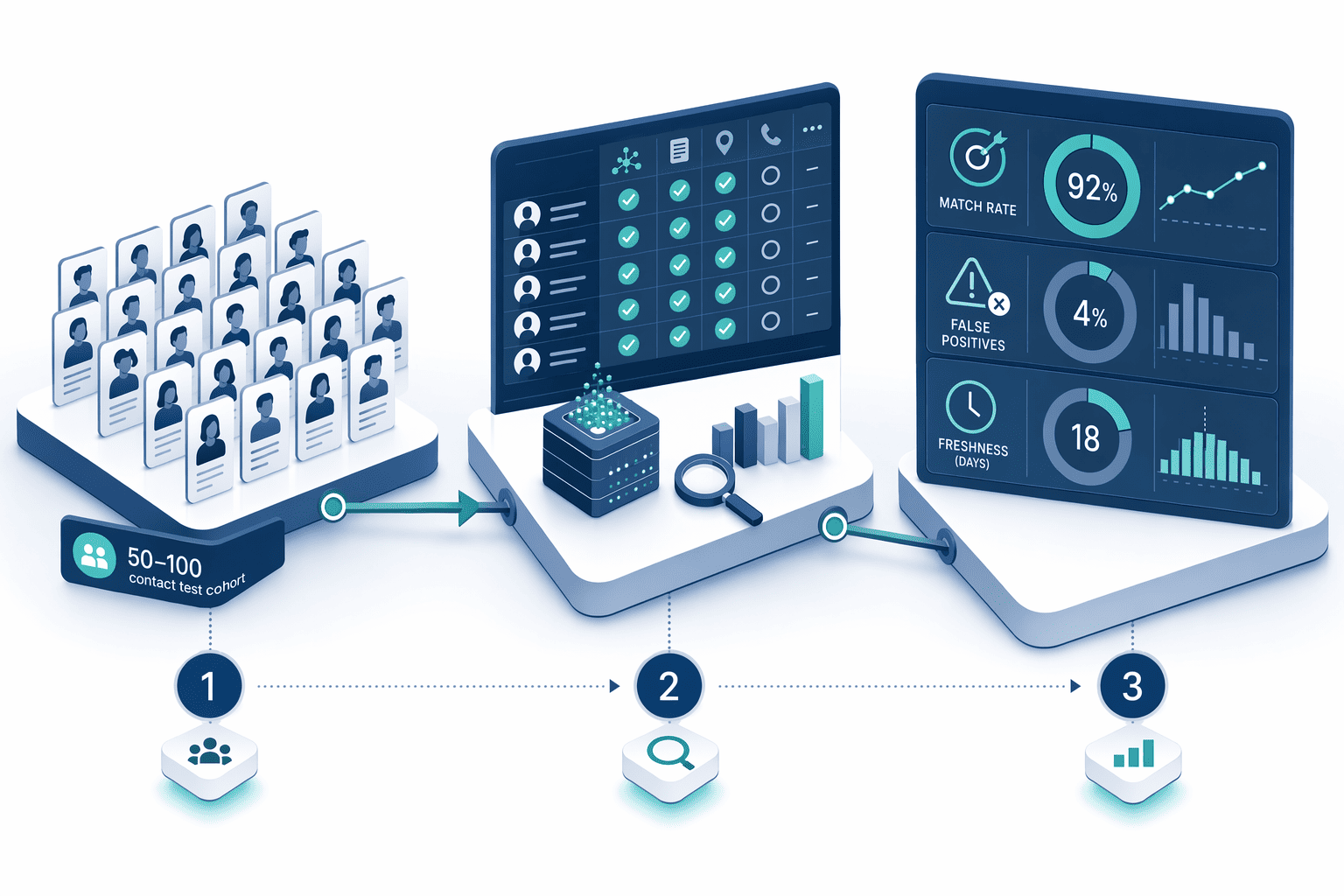
Run a Pilot Test With 50-100 Known-Good Contacts
Build a test cohort of 50-100 contacts you've already verified through recent deals or inbound leads. Run them through the tool to measure match rate, false positive rate, and data freshness. This reveals real-world accuracy before you scale. For deeper benchmarking guidance, see most accurate LinkedIn contact discovery platforms.
Calculate True Cost : The Match-Rate Formula
Advertised per-credit pricing hides the real cost. Use this formula: (total credits purchased × cost per credit) ÷ (number of successfully verified contacts). Example: $500 spend ÷ 700 verified contacts = $0.71 per verified contact, a 42% inflation over the advertised $0.50 rate. Match rates between 70-95% can inflate true costs by 35-100%.
The accuracy gaps documented in India exemplify a broader pattern: global platforms optimized for US/EU markets carry hidden architectural mismatches in other geographies.
Regional Accuracy Gaps: Why Global Tools Underperform in India
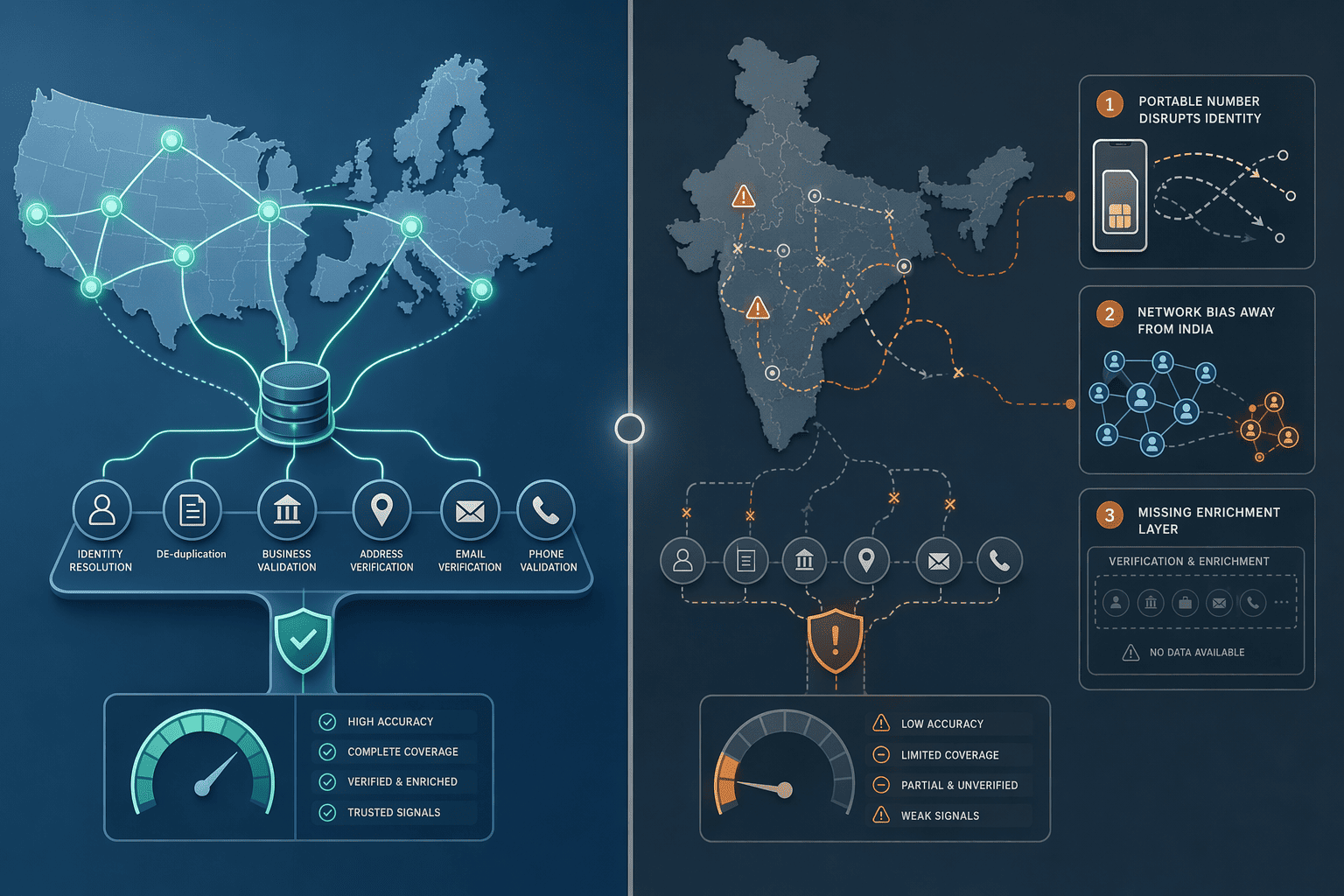
Global contact discovery platforms deliver 10-15 percentage points lower accuracy in India compared to their US/EU benchmarks. This gap isn't a data quality problem, it's an architecture mismatch. Tools optimized for Western markets rely on validation APIs and database infrastructure that don't translate to India's business landscape. Three structural gaps create this persistent underperformance: mobile number portability challenges, LinkedIn user-base skew, and absence of India-specific enrichment layers like GST verification.
Mobile Number Portability and Carrier-Level Verification Challenges
India's mobile number portability, users switching carriers while keeping numbers, breaks carrier-level verification APIs optimized for US/EU markets where portability is less common. These APIs query carrier databases that don't update in real time when users port numbers between carriers. The result: higher false-negative rates for Indian phone numbers, even when the contact data itself is current. Global tools running validation against stale carrier registries flag valid Indian mobile numbers as disconnected.
LinkedIn User-Base Skew: Multinational Firms vs. Domestic SMBs
LinkedIn penetration in India skews heavily toward employees of US/EU multinational firms and large domestic conglomerates. Mid-market and SMB prospects, the bulk of India's B2B economy, have lower LinkedIn adoption rates. Only 5-10% of LinkedIn users share phone numbers with first-degree connections, and that share drops further outside multinational firm employees. Database breadth claims built on LinkedIn-centric architectures miss the segments India-focused sales teams actually target.
GST Verification and India-Specific Data Enrichment Gaps
Global tools lack GST registration number verification and India-specific firmographic enrichment, company size bands, revenue classifications, industry structures aligned with Indian business registries. This creates compliance and segmentation gaps for India market sales teams. Tools optimized for India markets integrate GST and MCA database lookups; PeakAi offers India-focused contact verification with GST and MCA integration. Close more deals with verified contacts built for your market.
Beyond accuracy and regional performance, compliance architecture determines whether your sales team faces account suspension risk, a distinction rooted in how tools source contact data.
Compliance Architecture: Scraping vs. Enrichment-Based Contact Discovery
Direct LinkedIn Scraping: ToS Violation Risk and Suspension Rates
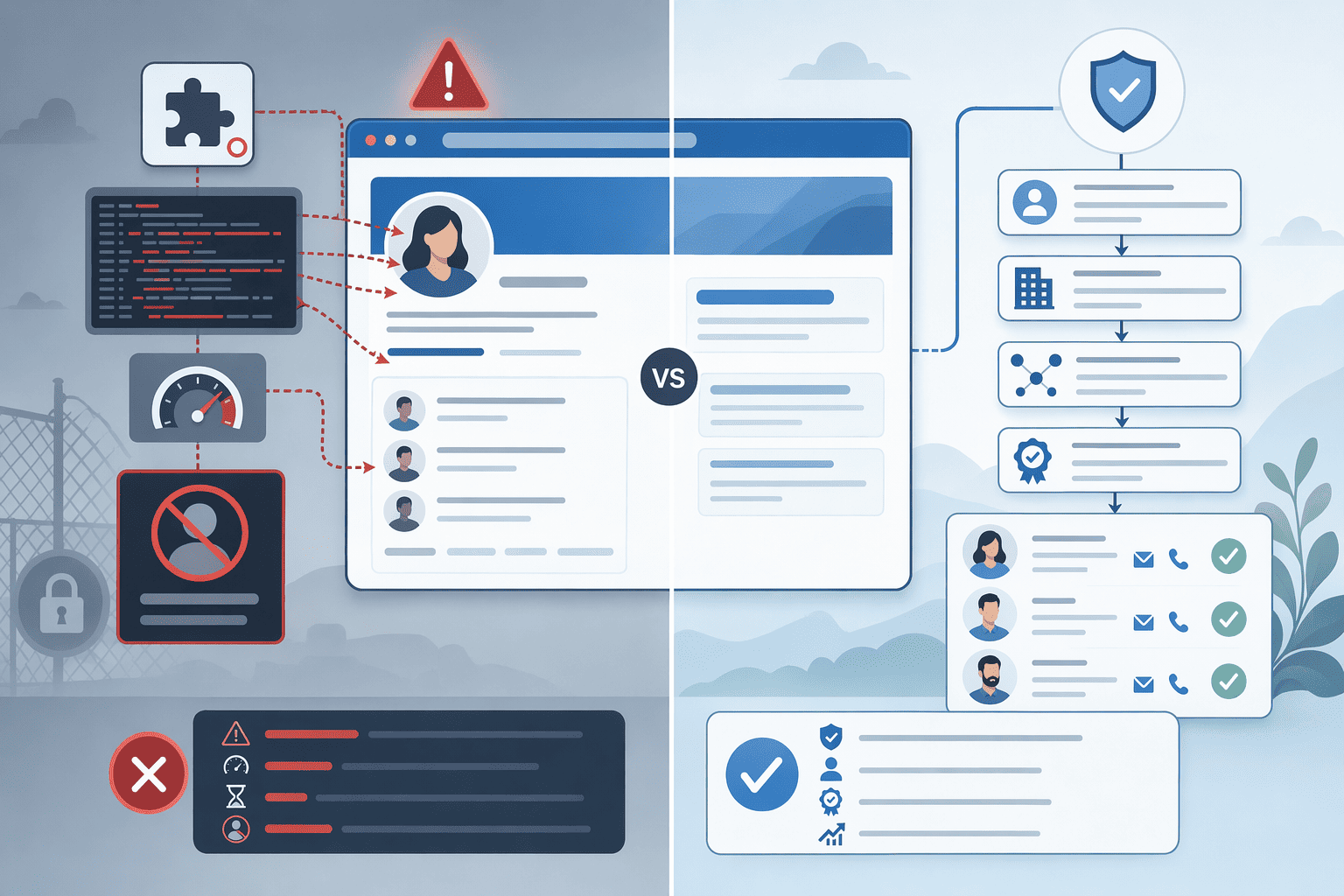
Tools that scrape LinkedIn profile data in real time, triggered by user search queries or browser navigation, violate LinkedIn's Terms of Service Section 8.2, which prohibits automated data collection. These platforms typically operate as Chrome extensions that crawl profile pages as you browse. SignalHire, for example, searches and verifies contact details in real time by compiling profiles from multiple sources as you navigate LinkedIn. While this approach offers immediate results, heavy users of scraping-based tools face 15 to 20% account suspension rates, a compliance risk most vendors downplay. LinkedIn's automated detection systems flag unusual profile-access patterns, rate-limit violations, and bot-like behaviors, making direct scraping a high-risk strategy for sales teams that depend on the platform for daily prospecting.
Enrichment-Based Third-Party Databases: Reduced but Not Eliminated Risk
Enrichment-based tools query pre-built databases sourced from legitimate business records, public directories, and aggregated third-party data, not scraped from LinkedIn in real time. These platforms use LinkedIn profile URLs as reference identifiers to match records in external databases, avoiding direct access to LinkedIn's internal systems. This architecture reduces suspension risk to below 2% for heavy users, a substantial improvement over scraping-based methods. However, the risk is not zero: LinkedIn's Terms of Service still prohibit unauthorized use of member data regardless of sourcing method. Tools using enrichment-based architectures like PeakAi reduce suspension risk by querying third-party databases rather than scraping profiles, offering a compliance-first approach for enterprise buyers requiring auditable data sourcing.
How to Audit Vendor Compliance Claims: Questions to Ask
Sales teams evaluating contact discovery tools should conduct compliance due diligence before committing to a vendor. Ask these questions to distinguish scraping-based tools from enrichment-based platforms:
- Do you scrape LinkedIn profile pages in real time, or do you query pre-built third-party databases? Real-time scraping triggers ToS violations; database queries do not.
- What percentage of your contact database comes from LinkedIn versus public records and business directories? Higher LinkedIn sourcing increases suspension risk.
- What is your documented account suspension rate for heavy users (500+ lookups/month)? Vendors should disclose this metric; rates above 5% indicate scraping-based architectures.
- Do you offer indemnification if my LinkedIn account is suspended due to your tool's data collection methods? Absence of indemnification suggests the vendor knows the risk is material.
- Can you provide documentation of your data sourcing methods for compliance audits? Enterprise buyers need auditable records for legal and procurement reviews.
- How do you handle GDPR, CCPA, and regional data privacy requirements? Compliant platforms maintain consent records and exportable documentation.
- Do you access LinkedIn's internal APIs, or do you use profile URLs as reference identifiers only? API access without partnership agreements violates LinkedIn's developer terms.
These questions force vendors to disclose their compliance architecture and help sales teams avoid tools that prioritize extraction volume over sustainable, policy-compliant prospecting. Ready to Transform Your Sales Process? With verified contact data that respects platform policies and regional privacy regulations.
Conclusion
Pre-download verification tools like PeakAi deliver higher cost-per-verified-contact efficiency by surfacing accuracy confidence before credit spend, but carry slightly higher per-credit costs to cover real-time validation overhead, ideal for sales teams prioritizing ROI on contact data budgets over raw database size. Enrichment-based architectures reduce LinkedIn account suspension risk to <2% by querying third-party databases rather than scraping LinkedIn directly, but still face compliance constraints under LinkedIn's ToS, sales teams must weigh the reduced (not eliminated) risk against the data freshness tradeoff inherent in pre-built databases versus real-time scraping.
As AI-powered validation layers, multi-step email verification, carrier-level phone confirmation, real-time job-change tracking, become table stakes for contact discovery platforms, accuracy differentiation will shift from advertised rates to methodology transparency. Vendors that publish verification-method breakdowns, regional performance data, and credit-model math will earn buyer trust over those relying on aggregate accuracy percentages. Sales teams should prioritize tools that verify contacts before charging credits and publish India-specific accuracy benchmarks, particularly as LinkedIn's enforcement of scraping-related ToS violations tightens.
Run a 50-100 contact pilot test using PeakAi's pre-download verification to measure real-world match rates against your known-good contact cohort, calculate true cost per verified contact before committing to bulk credit purchases.
Frequently Asked Questions
What is the average accuracy rate for LinkedIn contact discovery tools?
Vendors claim 95-98% accuracy, but independent testing reveals 50% in practice. Actual accuracy depends on verification methodology (SMTP handshake versus syntax-only), data freshness (2-3% monthly decay), and geography, India accuracy runs 10-15 percentage points below US/EU benchmarks due to mobile number portability and LinkedIn user-base skew.
What is pre-download verification and why does it matter?
Pre-download verification validates contact accuracy before deducting credits, reducing wasted spend on unverifiable records. PeakAi's 91% phone accuracy model completes verification in 10 seconds, surfacing confidence per contact before credit commitment. Post-export tools charge credits at export time regardless of match success, inflating costs 35-100% compared to advertised per-credit pricing.
Why do global LinkedIn contact tools underperform in India?
Global platforms deliver 10-15 percentage points lower accuracy in India. Three causes drive this gap: mobile number portability breaks carrier-level verification APIs optimized for US/EU markets, LinkedIn user-base skews toward multinational firms (mid-market coverage gaps), and absence of India-specific enrichment like GST verification leaves business structure classifications incomplete.
What is the difference between email syntax validation and SMTP handshake verification?
Syntax validation confirms email format correctness ([email protected]) but not mailbox existence, fast but surface-level. SMTP handshake verification contacts the recipient mail server to confirm the mailbox exists and accepts mail, slower but more accurate. Vendors often report syntax validation rates as 'email accuracy' without disclosing methodology gaps.
What is the compliance risk of using LinkedIn contact discovery tools?
Scraping-based tools violate LinkedIn ToS Section 8.2, triggering 15-20% account suspension rates for heavy users. Enrichment-based tools query pre-built third-party databases rather than scraping LinkedIn directly, reducing suspension risk to <2%. However, enrichment architectures still face LinkedIn ToS constraints prohibiting unauthorized use of member data regardless of sourcing method.
How do I calculate the true cost per verified contact?
(Total credits purchased × cost per credit) ÷ (number of successfully verified contacts). A 70% match rate turns a $0.50/credit advertised price into $0.71/verified-contact true cost, 42% inflation. Match-rate transparency matters when comparing vendors, as cost-per-verified-contact diverges sharply from advertised per-credit pricing depending on verification methodology and data freshness.
Why is phone number accuracy lower than email accuracy for LinkedIn contacts?
Only 5-10% of LinkedIn users share phone numbers with first-degree connections, creating a structural visibility ceiling. Phone connectivity rates run 20-40 percentage points lower than email format validation. Vendors often aggregate both metrics in a single 'accuracy' claim without disclosing dimension-specific breakdowns, masking the phone-email performance gap.
Sources
- Best LinkedIn Email Finder Tools for 2026: Best Tools Compared - prospectingmanual.com (2026)
- Why Reps Spend 72% of Their Time NOT Selling (And How to Fix It) - salesmotion.io (2026)
- Why Enterprise Sales Reps Waste Time Dialing - www.orum.com (2026)
- Best Data Enrichment Tools (2026) | The CRO Report - thecroreport.com
- LinkedIn Sales Navigator Reviews 2026: Details, Pricing, & Features | G2 - www.g2.com (2026)
- Best B2B Data Providers in India: 7 Platforms With Real Coverage (2026) | SyncGTM - syncgtm.com (2026)
- SignalHire - find email or phone number - Chrome Web Store - chromewebstore.google.com
