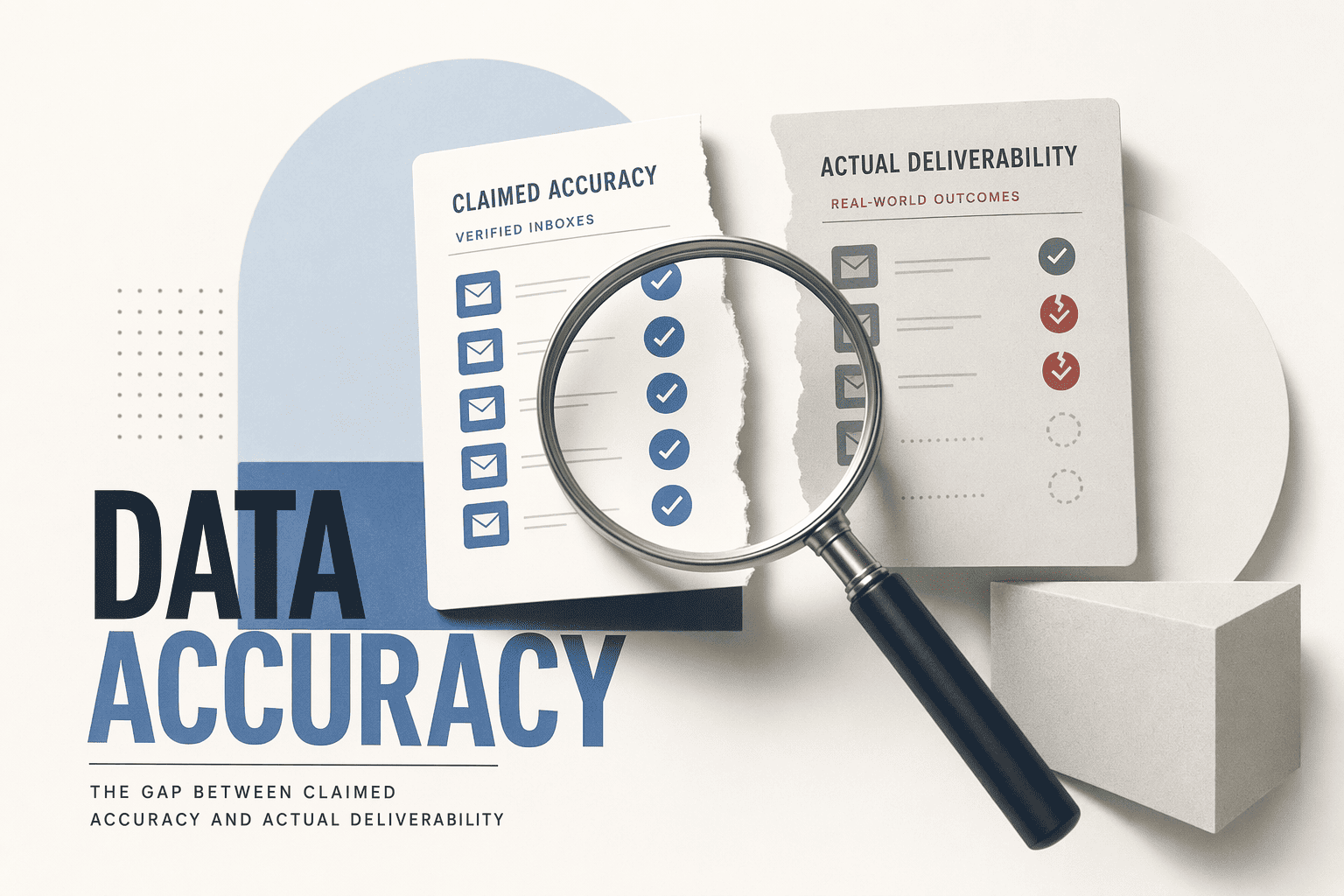
Prospecting platforms promise 95% accuracy, yet independent tests reveal industry averages closer to 50%. The gap stems from conflicting verification methods—syntax checks versus true inbox deliverability—and credit structures that charge for attempts rather than results.
Key Takeaways
- Accuracy claims vary by 30+ percentage points because platforms measure different validation layers—syntax, SMTP checks, or deliverability testing.
- Pre-download verification eliminates wasted credits by validating contacts before charging, reducing true cost-per-contact by 35-100%.
- Regional specialization matters: global tools optimized for US/EU markets often underperform by 10-15 percentage points in India and emerging markets.
- Contact data decays at 2-3% monthly, meaning platforms without continuous refresh lose accuracy over time.
- Six vendor questions expose verification methodology, match-rate guarantees, and regional performance data before you buy credits.
When prospecting platforms claim "95% accuracy," they're often aggregating fundamentally different metrics — email syntax validation, phone number existence checks, and actual inbox deliverability — into a single headline figure. Independent testing shows industry-average accuracy closer to 50%, while vendor marketing promises 95-98%. The gap exists because most vendors conflate three distinct verification layers, measure only the easiest one, then apply that percentage to all contact types.
Three Layers of Verification Most Vendors Conflate
The 30+ percentage-point variance stems from which layer a platform actually tests:
- Syntax validation, Regex checks confirm an email follows the pattern `[email protected]`. This catches obvious typos but tells you nothing about whether the mailbox exists or accepts mail. Accuracy claims north of 95% usually measure only this layer.
- SMTP validation, The platform pings the recipient mail server to verify the mailbox exists. This confirms deliverability to the server but not to the inbox; emails can still land in spam or be rejected by domain reputation filters.
- Deliverability testing, The platform tracks whether messages actually reach the inbox vs. The spam folder, accounting for sender reputation, domain health, and recipient engagement signals. This is the layer that matters for outreach ROI, and the layer fewest vendors measure.
Platforms that stop at layer 1 or 2 can truthfully claim high "validation rates" while delivering contact lists that bounce or go unread. PeakAi's 91% phone-number accuracy reflects real-time verification with dual checks for both emails and phone numbers, positioning it as a transparent methodology example against the 50% industry baseline.
Email vs Phone Accuracy: Why Aggregated Metrics Mislead
Many platforms report a single "contact accuracy" percentage that blends email and phone results. This obscures a structural reality: only about 5% of LinkedIn users share phone numbers with first-degree connections, and a mere 0.5% with second- or third-degree connections. Email discovery can hit 70-80% coverage because professional addresses follow predictable patterns (`[email protected]`). Phone numbers, by contrast, require database enrichment or manual research, they're rarely visible on profiles and don't follow a guessable format.
When a vendor claims 95% accuracy without splitting email vs. Phone metrics, they're usually reporting email-only performance and letting buyers assume phone coverage matches. Teams shopping for verified phones should ask: "What percentage of profiles return a validated mobile number?", not just "What's your overall accuracy?"
Independent Testing vs Vendor Claims: The 50% vs 95% Gap
Real-world testing consistently shows industry-average accuracy closer to 50% when measuring end-to-end deliverability (inbox arrival + valid phone connectivity), even as marketing pages promise 95-98%. The divergence has three causes: vendors measure syntax validation instead of inbox placement; they exclude bounces or unreachable numbers from their denominator; and they test against their own curated sample sets rather than live prospect lists. Buyers comparing platforms should demand methodology transparency, which verification layer is measured, how bounces are counted, and whether the test data mirrors real prospecting workflows.
Understanding why accuracy varies is only half the equation, the other half is knowing when platforms charge you for that data.
Pre-Download vs Post-Export Verification: The Cost Structure That Determines Accuracy
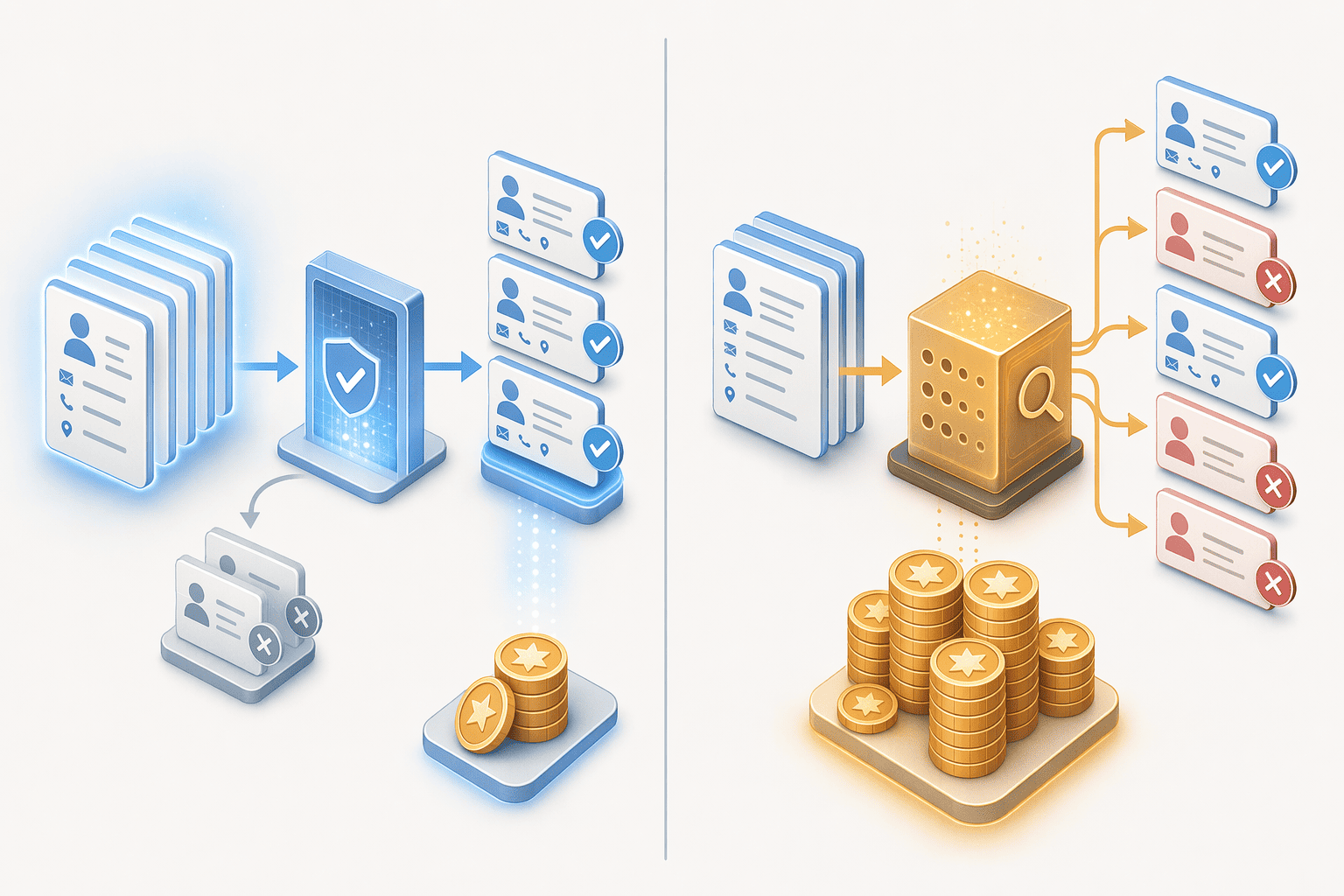
When validation happens relative to credit charges determines whether you pay for attempts or results, a structural difference that shapes your true cost-per-usable-contact by 35-100% above advertised per-credit pricing. Platforms split into two camps: pre-download verification (you pay only when data passes validation) and post-export enrichment (you pay for every lookup attempt, whether it returns a verified contact or not).
Pre-Download Validation: Paying Only for Verified Contacts
Pre-download verification runs email deliverability checks and phone number validation before charging your account. If a contact fails SMTP validation or number formatting rules, you don't consume a credit. PeakAi provides phone and email verification before download, ensuring customers only pay for verified phone numbers they successfully retrieve. This pay-per-verified-contact pricing model eliminates the credit-waste problem endemic to post-export systems. When your team exports 500 contacts and 200 fail validation, you've paid for 500 but received 300, a hidden 67% markup over the advertised per-contact rate.
Post-Export Models: The Hidden Credit-Waste Problem
Platforms that charge per enrichment attempt, regardless of match success, inflate actual cost per usable contact by 35-100% above advertised pricing. Post-export enrichment tools process entire Sales Navigator search pages and bill for every profile queried, whether the database returns a verified email or a null result. When match rates hover at 60-70% for phone numbers, your effective per-contact cost doubles: a $0.20 advertised rate becomes $0.35-$0.40 after accounting for failed lookups. Teams that don't audit credit consumption against usable contacts delivered often discover they're funding a 40-50% waste layer baked into the billing model.
Real-Time Verification vs Static Database Lookup Trade-Offs
Real-time SMTP validation and phone carrier lookups deliver higher accuracy at the cost of latency (2-10 seconds per contact). Static database queries return results instantly but suffer from decay: contact data decays at 5% monthly as professionals change roles, meaning a database refreshed quarterly carries 10-15% stale records at any given moment. Platforms that query live carrier APIs catch disconnected numbers and role-based emails before you waste outreach cycles; cached lookups trade speed for a higher bounce floor. For cold outreach campaigns where deliverability governs ROI, real-time verification's latency penalty is typically justified by the 8-12 percentage point accuracy gain over static databases.
Ready to Transform Your Sales Process? Join thousands of sales professionals who find accurate contact information and close more deals with verified data.
Armed with the cost-structure framework, you can now evaluate six platforms on their verification methodology, pricing transparency, and regional coverage.
6 LinkedIn Prospecting Platforms Compared by Verification Methodology
Comparison Table: Verification Workflow and Pricing Structure
The table below compares six platforms evaluated on starting price, free tier availability, contact coverage, LinkedIn integration, India market specialization, and community ratings.

| Platform | Starting Price | Free Tier | Email+Phone | LinkedIn Extension | India Focus | G2 Rating |
|---|---|---|---|---|---|---|
| PeakAi | $9 for 50 contacts | Yes | 91% phone accuracy | Yes | Yes | Not disclosed |
| Apollo.io | Free-forever tier | Yes | Email-focused | Yes | No | 4.7/5 |
| ZoomInfo | Contact for pricing | No | Thorough | No | No | 4.4/5 |
| Cognism | Contact for pricing | No | Strong EU mobile | Yes | No | 4.5/5 |
| Lusha | Contact for pricing | No | High accuracy | Yes | No | 4.3/5 |
| Kaspr | Free tier available | Yes | Profile-based | Yes | No | 4.2/5 |
PeakAi delivers verified emails and phone numbers in 10 seconds with 91% phone accuracy optimized for Indian B2B contacts. Best for teams prioritizing direct-dial accuracy in emerging markets. Limitation: smaller global database footprint than ZoomInfo or Apollo.
Apollo.io offers a generous free tier with real database access and no credit card required. Best for SDR teams testing tools before committing budget. Limitation: multiple reviewers report bounce rates that don't match vendor marketing claims.
ZoomInfo provides thorough B2B contact data across industries. Best for enterprise sales teams with existing sales-tech stacks. Limitation: pricing requires sales conversations; not cost-effective for startups.
Cognism excels at verified mobile numbers for European contacts. Best for teams prospecting in GDPR-regulated markets. Limitation: weaker coverage outside US/EU regions.
Lusha delivers high accuracy across industries with good global reach. Best for mid-market teams needing balanced coverage. Limitation: premium pricing without transparent tier details.
Kaspr offers a Chrome extension with a free tier that pulls data directly from profiles. Best for recruiters and solo prospectors. Limitation: phone-specific validation metrics not publicly disclosed.
Regional Accuracy Variations: US/EU vs India Performance
Regional accuracy gaps mean India-specific performance often tests 10-15 percentage points lower than US/EU figures for global tools. Most platforms optimize verification algorithms for North American and Western European business directories, leaving emerging markets underserved.
PeakAi specializes in the Indian B2B market, integrating GST verification and MCA database cross-referencing to close this gap. Apollo and ZoomInfo maintain stronger US/EU coverage but lack regional phone-format validation for India. Cognism's European mobile strength doesn't transfer to Asian markets. Teams prospecting in emerging economies should evaluate platform-specific regional benchmarks rather than global accuracy claims.
Compliance Models: Scraping vs Enrichment-Based Architectures
Account suspension rates for heavy scraping users range from 15-20% based on community reports. Platforms that crawl LinkedIn profiles directly, harvest contact data through bots, or circumvent rate limits violate LinkedIn's Terms of Service and expose users to permanent account suspension.
PeakAi uses an enrichment-based compliance method, querying third-party databases rather than scraping LinkedIn profiles. The platform does not access LinkedIn's internal APIs or scrape profile data. Apollo, Kaspr, and some Chrome-extension tools operate closer to the scraping boundary, increasing compliance risk. ZoomInfo and Cognism rely on proprietary databases but don't disclose enrichment methodology publicly. For detailed compliance positioning, see LinkedIn tools for B2B prospecting in India and emerging markets.
Join thousands of sales professionals who find accurate contact information and close more deals with verified data.
Platform comparison reveals structural differences, but only vendor documentation and trial testing confirm whether advertised accuracy translates to usable contacts in your workflow.
How to Audit a Platform's Accuracy Claims Before Buying Credits
Before buying credits from any LinkedIn prospecting platform, verify whether advertised accuracy figures translate into usable contacts. Vendors often conflate syntax validation with deliverability testing, a 95% syntax-validation rate (emails formatted correctly) says nothing about whether those addresses accept mail or reach active decision-makers. The checklist below surfaces transparency gaps before you commit budget.
Vendor Documentation Checklist: What to Request
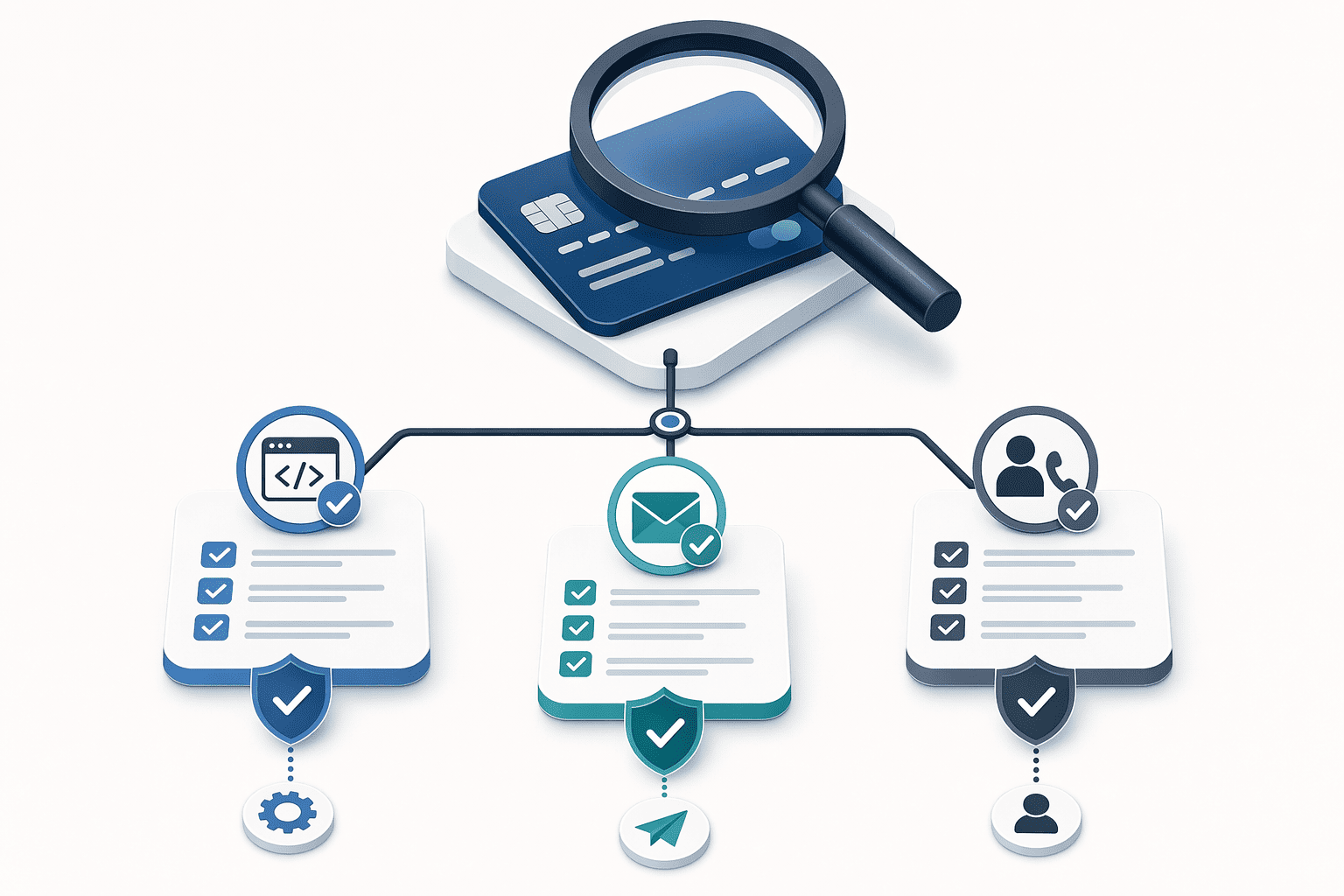
Ask every prospective vendor these six questions before purchasing credits:
- Verification methodology, Does the platform perform syntax-only validation, SMTP handshake, or full deliverability testing? Syntax checks catch typos but miss inactive mailboxes; SMTP handshakes verify the server exists but not whether the address is monitored; deliverability testing simulates actual send behavior.
- Match-rate guarantees, What percentage of lookups return a verified contact? If the vendor advertises "$0.18 per credit" but only 40% of lookups succeed, your true cost per usable contact is $0.45, not $0.18.
- Regional performance data, Does the platform publish accuracy breakdowns by geography? A tool with 91% accuracy in North America may achieve 60% in India if its data partners lack regional coverage.
- Credit refund policies, Do you pay for every lookup attempt, or only for verified contacts? Platforms that charge per attempt inflate costs when match rates drop below marketing claims.
- Data refresh cycles, How often are contacts re-verified? Stale databases accumulate job changes, domain migrations, and disconnected numbers; ask for the median age of records in the dataset.
- Role-based vs. Personal email distinction, Does the tool flag generic addresses (info@, sales@) separately from personal work emails? Role-based emails reduce personalization effectiveness and increase spam-filter risk.
PeakAi publishes a 91% verified contact accuracy rate and charges only when verification confidence is high, providing a reference point for transparent match-rate disclosure. Compare this level of specificity against competitors who market "95% accuracy" without clarifying whether that figure applies to syntax, SMTP, or end-to-end deliverability.
Cost-Per-Verified-Contact Calculation Framework
Advertised per-credit pricing masks the true cost when match rates fluctuate. Credit-based models can inflate actual cost per usable contact by 35 to 100% above advertised per-credit pricing, depending on lookup success rates. Use this formula to calculate true cost before committing:
True cost per verified contact = Advertised per-credit price ÷ Match rate
Example: A vendor advertises $0.20 per credit. If only 50% of your lookups return a verified contact, your true cost is $0.20 ÷ 0.50 = $0.40 per usable contact, double the marketed rate. At a 35% match rate (common for niche industries or emerging markets), that same $0.20 credit becomes $0.57 per usable contact, a 185% markup. Run this calculation using the vendor's documented match rate (if disclosed) or request a pilot batch to measure actual performance on your target audience before scaling spend.
Role-Based Email Detection and Personalization Effectiveness
Not all verified emails deliver equal outreach value. Role-based emails (info@, sales@, support@) reduce personalization effectiveness and increase spam-filter risk because they route to shared inboxes monitored by multiple staff members or automated ticket systems. Personal work emails ([email protected]) reach individual decision-makers and support tailored messaging. When auditing a platform's accuracy claims, ask whether the vendor distinguishes between these two categories, a 90% accuracy rate dominated by role-based addresses will underperform a 75% rate composed entirely of personal emails. Learn more about verified contact discovery and how to close more deals with accurate data.
Regional Specialization and Data Decay: Hidden Accuracy Variables
Why Global Platforms Underperform in India by 10-15pp
Regional database coverage gaps mean accuracy claims don't translate uniformly across geographies. Tools optimized for US and EU markets often see India-specific performance drop 10-15 percentage points lower due to sparse local data partnerships and limited regional verification infrastructure. India accuracy drops below 70% without regional specialization, a threshold that renders many global databases unsuitable for high-velocity prospecting in emerging markets. Platforms like PeakAi address this by integrating GST and MCA database verification, delivering 91% phone number accuracy specifically for Indian contacts across 1600+ cities. This India-first architecture contrasts with global platforms that rely on broad coverage but lack the regional depth needed to close more deals in markets where standard data providers fall short.

Data Decay Rates and Refresh-Cycle Implications
Contact data decays at 2-3% monthly as professionals change roles and numbers, meaning a database with 90% accuracy at launch degrades to 75% within six months without continuous refresh. Static databases refreshed annually or quarterly accumulate accuracy drift over time, causing bounce rates to climb and conversion metrics to slide. Real-time verification models query live data sources at lookup, sidestepping decay entirely by pulling current records rather than serving cached snapshots. Teams evaluating accuracy claims should ask when the vendor's database was last refreshed and whether verification happens at query time or relies on pre-built static datasets.
Conclusion
Post-export enrichment platforms offer faster initial downloads but inflate true cost-per-contact by 35-100% when match rates fall below vendor claims; pre-download verification tools like PeakAi eliminate this credit waste by validating before charging. Global platforms with US/EU-optimized databases deliver 95%+ accuracy in those regions but underperform in India by 10-15pp; regional specialists trade breadth for depth in emerging markets.
As AI-powered outbound prospecting scales in 2026, verification methodology transparency will become the primary differentiator, buyers will demand pre-download confidence indicators and regional accuracy breakdowns rather than accepting aggregated vendor claims.
Audit your current platform's verification workflow using the methodology checklist, then try PeakAi's pre-download verification to calculate your true cost-per-verified-contact against your existing tool.
Frequently Asked Questions
What is the average accuracy rate for LinkedIn prospecting platforms?
Independent testing shows industry-average accuracy near 50% when measuring end-to-end deliverability, inbox arrival plus valid phone connectivity, even as vendor marketing pages claim 95-98%. The gap exists because vendors measure syntax validation instead of inbox placement, exclude role-based emails from calculations, and aggregate phone number format checks with email deliverability.
Why do accuracy rates vary so much between platforms?
Platforms use different verification methods at different workflow points. Some stop at syntax validation (layer 1), others perform SMTP checks (layer 2), while few test actual inbox deliverability (layer 3). Measuring at pre-download versus post-export stages further fragments the metrics, causing 30+ percentage-point variances in reported accuracy.
What is pre-download verification and why does it matter?
Pre-download verification validates email deliverability and phone numbers before charging credits, eliminating spend on invalid records. Credit-based models that charge per enrichment attempt, regardless of match success, inflate actual cost per usable contact by 35-100% above advertised per-credit pricing when lookup success rates fluctuate.
Do LinkedIn prospecting tools work equally well in all regions?
Regional database coverage gaps mean accuracy claims don't translate uniformly. Tools optimized for US and EU markets often see India-specific performance drop 10-15 percentage points lower due to sparse local data partnerships and limited regional verification infrastructure. Check vendor documentation for region-specific accuracy claims before purchasing.
How often does contact data decay on LinkedIn?
Contact data decays at 2-3% monthly as professionals change roles and phone numbers. A database with 90% accuracy at launch degrades to 75% within six months without continuous refresh. Static databases refreshed annually or quarterly accumulate accuracy drift over time, causing bounce rates to climb steadily.
What questions should I ask a vendor before buying credits?
Ask for verification methodology (syntax vs SMTP vs deliverability testing), match-rate guarantees with regional breakdowns, credit refund policies for invalid contacts, data refresh cycles, and documentation of accuracy measurement methodology. Request trial access to test your target geography and industry segments before committing to bulk credit purchases.
Are role-based emails (info@, sales@) worth collecting?
Role-based emails reduce personalization effectiveness and increase spam-filter risk because they route to shared inboxes monitored by multiple staff or automated ticket systems. Personal emails deliver better engagement rates for outbound prospecting. Verify whether platforms exclude role-based addresses from accuracy calculations to avoid inflated claims.
Sources
- Best LinkedIn Email Finder Tools in 2026 (Real Data & Use Cases) - scravio.com (2026)
- LinkedIn Phone Number Search: Find Cell Numbers Fast - galadon.com
- LinkedIn Email Finder: 10 Best Tools Compared (2026) - www.octoparse.com (2026)
- Best B2B Prospecting Tools in 2026: ZoomInfo vs Apollo vs Cognism vs Clay - surferstack.com
