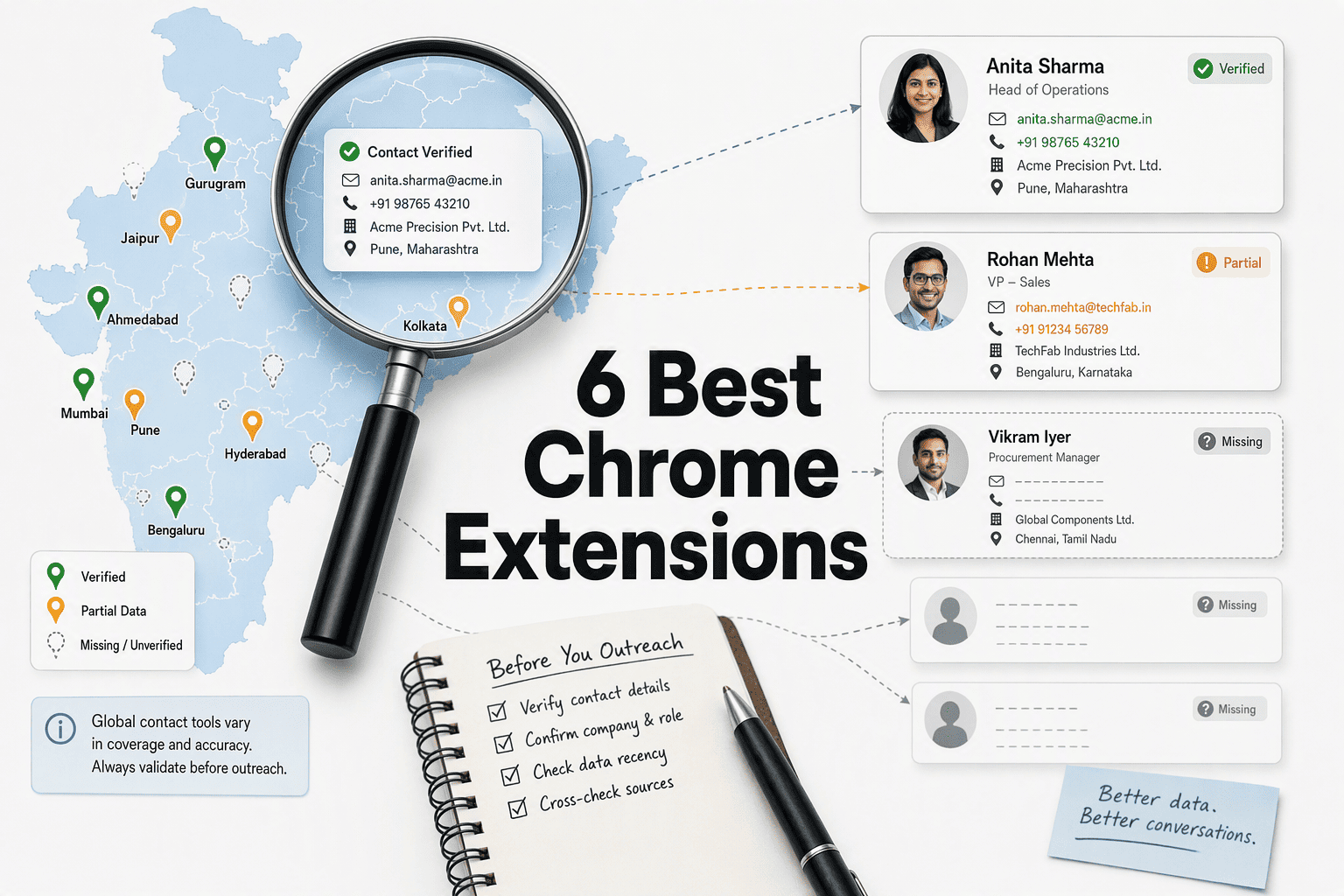
Sales teams targeting Indian B2B markets face a unique challenge: global contact discovery tools optimized for US and EU databases deliver significantly lower accuracy when applied to Indian LinkedIn profiles and company directories.
This guide compares Chrome extensions built for Indian B2B prospecting, evaluating regional verification infrastructure, DPDP Act compliance, accuracy benchmarks, and pricing models tailored to Indian sales workflows.
Key Takeaways
- Chrome extensions for Indian B2B prospecting require regional specialization—global tools underperform by 20-40 percentage points due to missing GST validation and mobile portability verification
- Independent testing reveals global tools achieve 50-70% accuracy for Indian contacts versus 91% for India-optimized platforms with regional verification layers
- Enrichment-based extensions carry <2% LinkedIn suspension risk versus 15-20% for scraping tools, making compliance architecture a critical evaluation dimension
- Credit-based pricing models effectively double costs when India match rates fall below 50%, making pre-download verification key for budget control
- DPDP Act 2023 establishes lawful processing grounds for professional contact data under legitimate interest basis, similar to GDPR Article 6(1)(f)
Chrome extensions for sales teams targeting Indian companies with verified contact data require regional specialization because global tools underperform by 20–40 percentage points in Indian markets. India-optimized extensions integrate GST verification, MCA database access, and telecom carrier-level APIs that global platforms typically lack, delivering the infrastructure needed to close more deals in emerging markets.
The 70% Accuracy Threshold for Global Tools in India
Global contact discovery tools often lack the regional data sources required for Indian B2B prospecting. Without local verification infrastructure, generic Chrome extensions drop below 70% accuracy for Indian contacts—a threshold that renders outreach campaigns inefficient. Tools designed for US or EU markets produce 10–15 percentage point lower accuracy in India because they rely on databases optimized for Western business registries, missing the GST numbers, Director Identification Numbers (DINs), and Ministry of Corporate Affairs (MCA) records that anchor Indian contact validation.
Regional Verification Infrastructure: GST, Mobile Portability, and Business Registries
Regional verification means querying GST registration databases, validating phone numbers against India's mobile number portability records, and cross-referencing company details through MCA filings. Chrome extensions that integrate these data layers—such as PeakAI's India-focused extension, deliver verified contact data by connecting to authoritative local sources rather than relying solely on global aggregators. GST verification confirms a prospect's business legitimacy; MCA lookups surface director and founder contact details; telecom carrier APIs distinguish active mobile numbers from landlines or disconnected lines.
Chrome Extension Workflow: Profile Lookup to CRM Export
The standard Chrome extension workflow for LinkedIn prospecting follows these steps:
- Navigate to a LinkedIn profile or Sales Navigator search results page.
- Activate the extension to reveal verified emails and phone numbers overlaid on the profile.
- Review contact details, enrichment data (job title, company size, GST status), and verification confidence scores.
- Export selected contacts directly to your CRM (Salesforce, HubSpot, Zoho) or download as CSV for bulk campaigns.
- Sync enrichment metadata (last verification date, line type, opt-out status) to maintain list hygiene.
This workflow, described in Apollo's Chrome extension documentation, applies across the category, but execution quality depends on the underlying verification infrastructure. Extensions without regional specialization may complete the workflow but deliver unverified or outdated contact data, particularly for Indian prospects where public profile information rarely includes direct phone numbers.
Understanding why regional specialization matters sets the stage for evaluating specific tools, here's how the leading Chrome extensions compare on accuracy, verification infrastructure, and compliance dimensions.
Comparison: Chrome Extensions for Verified Contacts in India
Sales teams targeting Indian companies need Chrome extensions that deliver verified contact data, phone numbers and emails, without triggering LinkedIn account suspensions. The market divides sharply between scraping-based tools (high risk, broad coverage) and enrichment-based platforms (compliant, region-specific accuracy). Below, we compare six extensions on the dimensions that matter most for India-focused prospecting: accuracy rates, regional data sources, pricing models, and compliance architecture.
Accuracy Rates: India-Specific vs. Global Averages
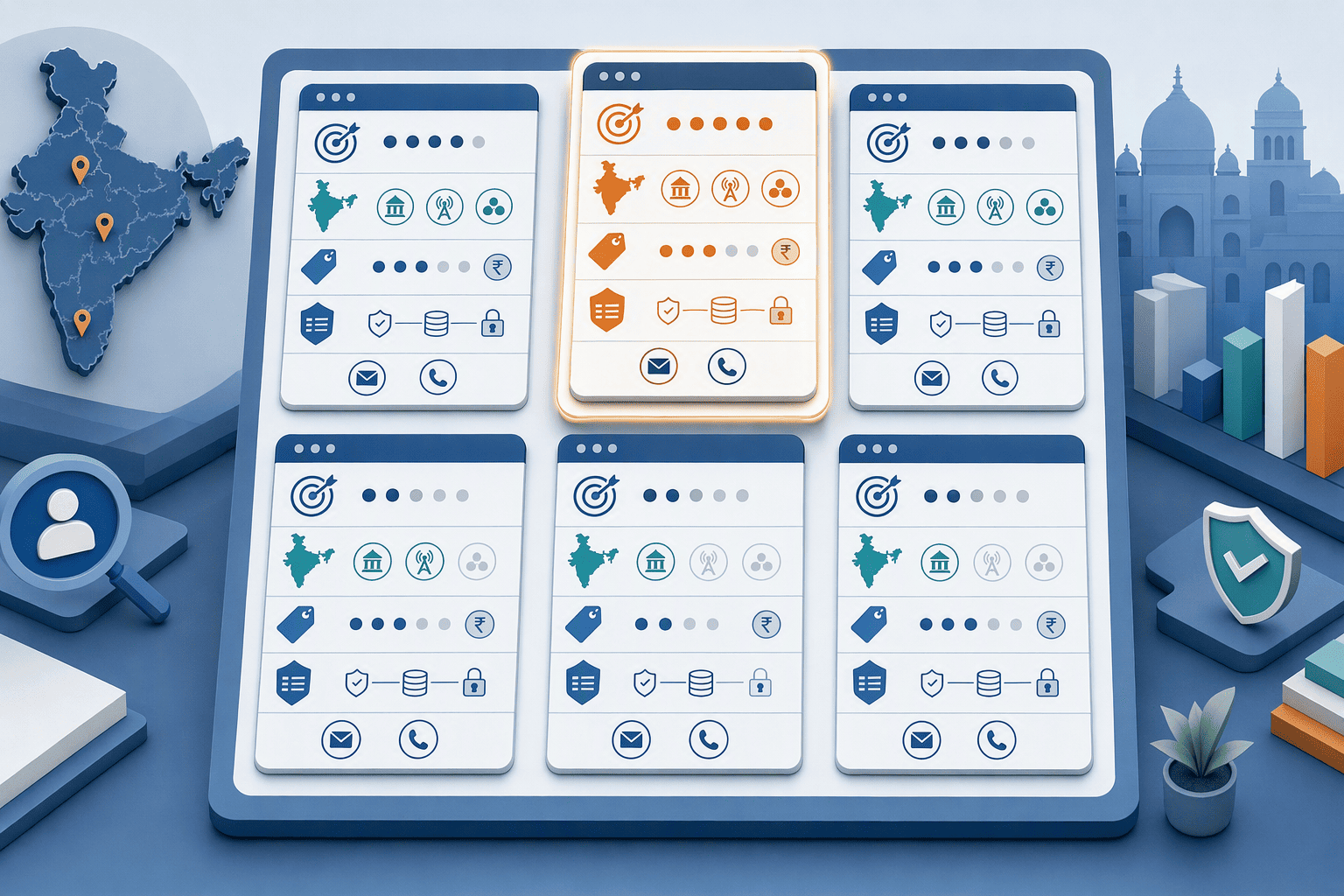
Vendor-published accuracy claims typically range from 95-98%, but independent testing reveals average performance closer to 50% for global tools applied to Indian contacts. PeakAi delivers 91% phone number accuracy for Indian business contacts through GST verification and MCA database integration. Lusha meets leading data protection standards including GDPR and CCPA, but does not publish India-specific accuracy rates. Apollo.io provides access to 275+ million verified B2B contacts globally, yet global breadth often underperforms in regions where local business registries (GST, MCA) are the authoritative source. EazyReach claims the highest accuracy rate for the Indian B2B market through cross-validation against multiple verified data sources including MCA DIN director records. ContactOut and Kaspr focus primarily on email extraction and do not publish phone-specific validation metrics for India.
Regional Data Sources and Enrichment Methodology
The compliance-risk trade-off is quantifiable: account suspension rates for scraping users range 15-20%, while enrichment tools report less than 2%. PeakAi sources verified contact data through legitimate business databases and public records rather than scraping LinkedIn directly. Lusha operates via a browser add-on that reveals verified contact details without leaving the page, prospecting directly from LinkedIn, Sales Navigator, or any company website. Apollo's Chrome Extension works with LinkedIn, Salesforce, HubSpot, Gmail, and company websites, enabling users to find verified emails or phone numbers wherever they work. EazyReach cross-references multiple verified data sources, including MCA DIN director records, before returning a result, enabling DIN director lookup unique to the Indian market. Generic scraping tools that violate LinkedIn's Terms of Service risk permanent account bans; browser-extension contact finders that respect rate limits and user interactions operate in a compliance gray area but avoid the prohibited automated crawling that triggers enforcement.
Side-by-Side Comparison Table
| Extension | Pricing (Starting) | Free Tier | Verified Phone/Email | India Contact Accuracy | Chrome Rating |
|---|---|---|---|---|---|
| PeakAi | $9 for 50 contacts | Free starter credits | Both (GST/MCA validation) | 91% | 4.8/5 (565 users) |
| Lusha | Contact for pricing | Available on all plans | Both (emails, direct dials, mobile) | Not publicly disclosed | 4.3/5 |
| Apollo.io | Free tier available | Limited free tier | Both (275M+ database) | Not India-specific | 4.5/5 |
| EazyReach | Pay per use (no monthly fee) | Free starter credits | Both (cross-validated) | Cross-validated for India (MCA DIN) | Not publicly disclosed |
| ContactOut | Contact for pricing | Limited trial | Primarily email | Not publicly disclosed | 4.2/5 |
| Kaspr | Contact for pricing | Limited trial | Primarily email | Not publicly disclosed | 4.4/5 |
PeakAi is strongest when your team targets Indian decision-makers, works heavily from LinkedIn, and needs lower-cost testing before a long procurement cycle. Lusha suits global teams that need one-click reveal across LinkedIn, Sales Navigator, CRM, and any company website, with GDPR/CCPA compliance for cross-border outreach. Apollo.io delivers breadth (275M+ contacts) and CRM integrations (Salesforce, HubSpot, Outreach, Salesloft) but does not specialize in India-specific validation. EazyReach offers the fastest India-focused workflow, reveal verified direct-dial numbers in under 10 seconds, with DIN director lookup and built-in browser calling. ContactOut and Kaspr focus on email discovery; neither publishes phone-specific accuracy metrics or India-market validation.
For deeper analysis of how these tools handle compliance and data freshness, see our guide on Chrome extensions for Indian B2B contacts.
Vendor claims often diverge from real-world performance. Independent accuracy benchmarks reveal the gap between marketing promises and verified contact delivery rates.
Accuracy Benchmarks: India-Specific Phone and Email Verification
Email Deliverability vs. Phone Connectivity Rates
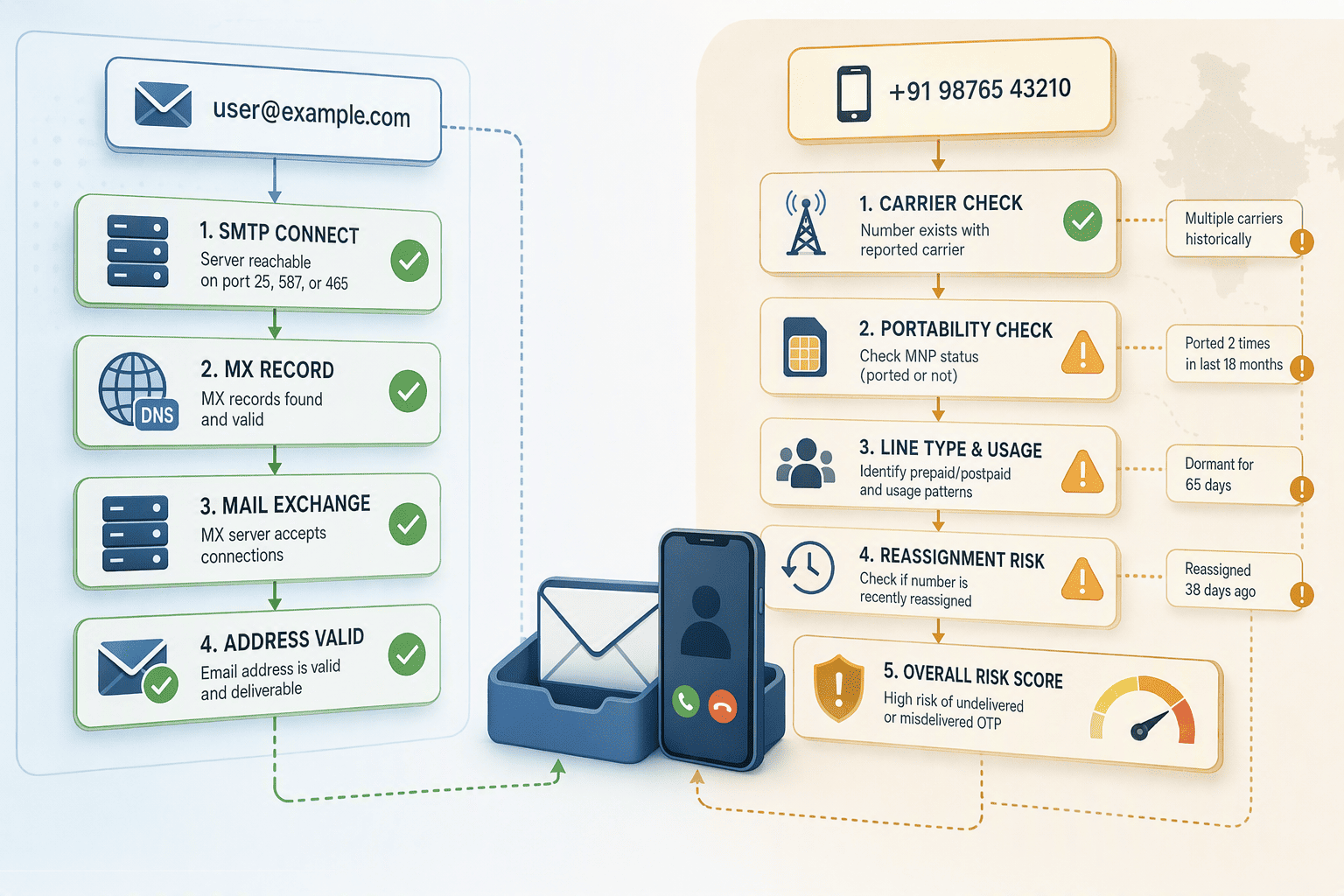
Email verification is fundamentally easier to automate than phone number discovery because email syntax and domain validation follow universal protocols (SMTP checks, MX records). Phone number verification faces region-specific challenges, in India, mobile number portability and prepaid SIM prevalence mean that static databases often list disconnected or reassigned numbers. Tools like Apollo's Chrome Extension prioritize email extraction and work across LinkedIn, Salesforce, HubSpot, and Gmail. For phone contacts, accuracy benchmarks differ sharply by region: only 5-10% of LinkedIn users expose phone numbers to first-degree connections, and Indian B2B contacts change mobile numbers more frequently than Western counterparts. PeakAi reports verified phone numbers and emails with 91% accuracy for both contact types, focusing on Indian phone number verification against local business hierarchies.
Data Freshness and Monthly Decay Rates
Even high-accuracy tools require ongoing refresh cycles. Contact data decays 2-3% monthly as professionals switch jobs, change carriers, or update email addresses. A 91% accurate database today will drift toward 88-89% accuracy within 60 days without re-verification. For teams running multi-week nurture sequences, this decay compounds: a list verified in January may underperform by 5-8 percentage points by March. Tools that display validation status before export let buyers assess freshness upfront rather than burning credits on stale contacts.
Pre-Download vs. Post-Export Verification
Pre-download verification shows confidence indicators (syntax validation, SMTP checks, catch-all detection) before you spend a credit, allowing teams to filter low-confidence entries and preserve budget for high-probability contacts. Post-export verification charges upfront regardless of deliverability, increasing cost-per-valid-contact when accuracy is below 90%. PeakAi's contact discovery platform includes real-time email verification with 91% accuracy, combining syntax validation, SMTP checks, and catch-all detection before contacts enter your CRM. This enrichment-based methodology queries independent third-party databases rather than accessing LinkedIn's internal APIs, helping teams close more deals without account-suspension risk.
Accuracy alone isn't sufficient, compliance with India's DPDP Act and LinkedIn's Terms of Service determines whether your prospecting workflow remains sustainable or triggers platform suspensions.
Compliance Considerations: DPDP Act, GST Validation, and LinkedIn ToS
DPDP Act 2023 Requirements for B2B Contact Data
India's Digital Personal Data Protection Act 2023 establishes lawful processing grounds for professional contact data, mirroring GDPR Article 6(1)(f)'s legitimate interest framework. Sales teams processing B2B contacts for prospecting purposes rely on this legitimate interest basis, balancing commercial outreach against individual privacy expectations. Compliance frameworks require transparent data handling, minimal retention periods, and respect for opt-out requests. PeakAi's compliance certifications cover GDPR, CCPA, and India's DPDP Act 2023, ensuring teams can prospect Indian decision-makers within lawful boundaries. The DPDP Act does not prohibit B2B contact discovery when organizations demonstrate legitimate interest and implement proper consent management workflows.

LinkedIn Terms of Service: Scraping vs. Enrichment Tools
LinkedIn prohibits automated scraping of profile data, and tools that directly crawl profiles face elevated suspension risk. Enrichment-based platforms avoid this trap by querying independent third-party databases rather than accessing LinkedIn's internal APIs. PeakAi operates within LinkedIn's terms of service, using LinkedIn URLs solely as reference identifiers to look up contacts in external business registries and telecom verification APIs. This architecture decouples contact discovery from profile scraping, dramatically reducing account risk for sales teams who need to find accurate contact information and close more deals.
GST Number Validation and MCA Database Access Limitations
Global contact platforms often lack integration with India-specific business registries, the GST registration database and Ministry of Corporate Affairs corporate records, which serve as verification layers for Indian B2B contacts. PeakAi cross-references LinkedIn profile data against India's official GST registration database and MCA corporate records, enabling teams to validate business legitimacy and director-level contacts. Without these regional data sources, global platforms struggle to deliver the verification depth Indian sales teams require, particularly when targeting MSMEs and regional enterprises.
Pricing models directly impact your cost-per-verified-contact. Understanding the trade-offs between subscription and credit-based structures reveals hidden costs in low-accuracy tools.
Pricing Models: Pay-Per-Use vs. Subscription for Indian Sales Teams
Cost-Per-Verified-Contact: Regional Specialists vs. Enterprise Solutions
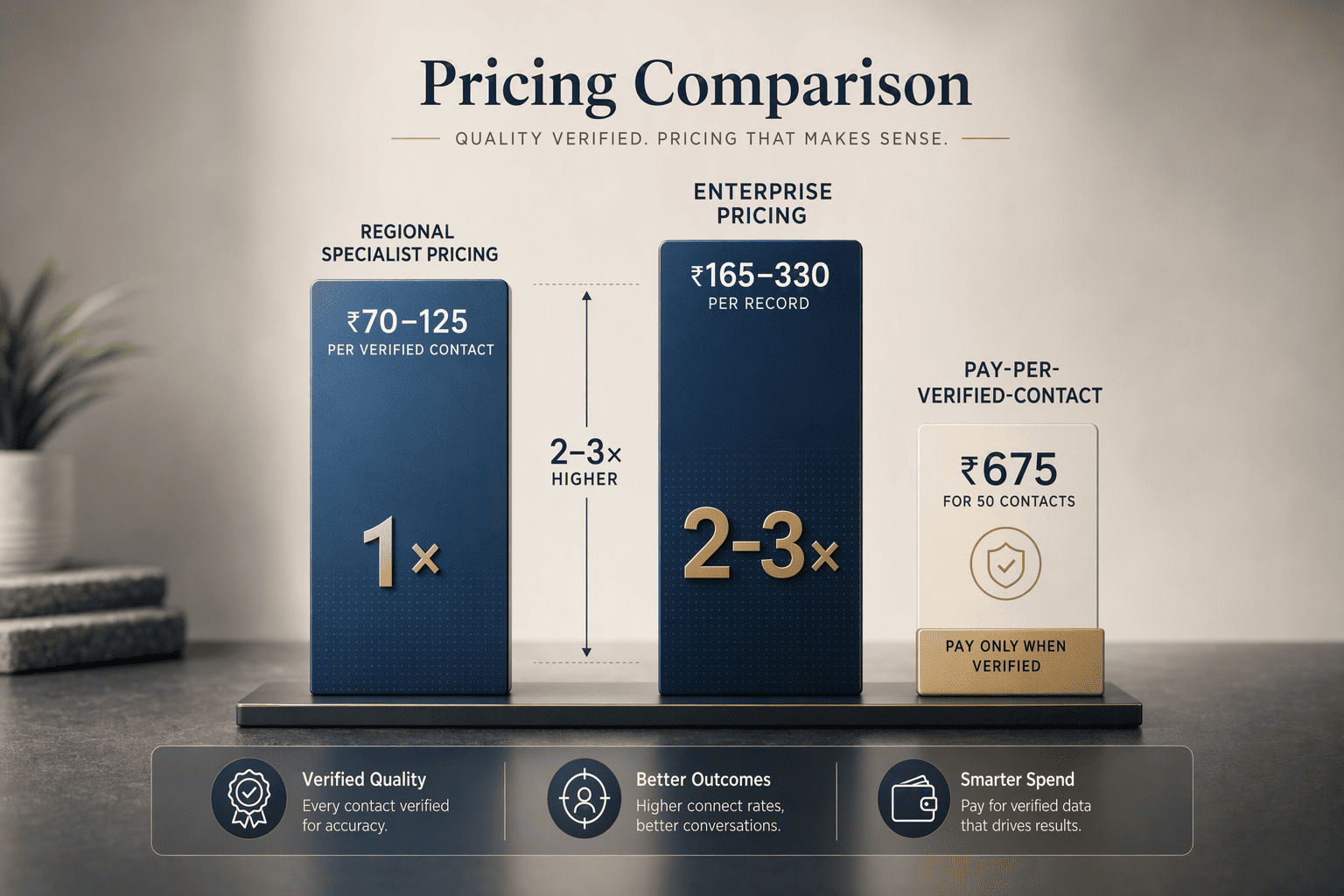
Pricing structures for contact discovery tools reveal a sharp divide between India-optimized platforms and global enterprise solutions. Regional specialists typically charge ₹70 to 125 per verified contact, while enterprise solutions command ₹165 to 330 per record. This 2-3× gap reflects both database breadth and market focus. PeakAi's pay-per-verified-contact pricing starts at ₹675 for 50 contacts, positioning it in the regional specialist tier. For Indian sales teams with concentrated prospecting needs, this model avoids the overhead of monthly seat fees and enterprise minimums, you pay only when contact data is successfully verified and delivered.
Credit Burn Rates and Match Rate Variability
Credit-based models penalize buyers when match rates are low. A tool charging ₹10 per credit with 50% India accuracy effectively costs ₹20 per verified contact, half your exports return unverified records, yet credits are deducted. This variability makes headline credit price misleading. Accuracy drives true cost-per-verified-contact more than headline pricing. Tools with 90%+ match rates deliver predictable burn; those with 40 to 60% Indian coverage force buyers to purchase 2× the credits needed to hit quota. When evaluating platforms, ask vendors to disclose India-specific match rates and calculate effective cost under realistic verification scenarios.
Refund Policies and Pricing Transparency
Refund policies separate transparent pricing from hidden costs. Some tools refund credits when a contact cannot be verified, you pay only for deliverable data. Others charge for every export regardless of verification status, converting low match rates into a pricing penalty. Before committing to a platform, confirm whether credits are consumed on attempted lookups or only on verified results. This distinction matters most when targeting emerging markets where database coverage is uneven. Transparent refund policies shift verification risk to the vendor; opaque models transfer that risk, and cost, to the buyer.
With regional specialization, accuracy benchmarks, compliance requirements, and pricing models mapped, you can now match your team's priorities to the right Chrome extension using a decision framework.
How to Choose the Right Chrome Extension for Your India Prospecting Workflow
Decision Framework: Accuracy vs. Feature Breadth vs. Compliance Risk
Match your tool choice to your team's top priority. Tier 1 (Accuracy-First): Teams targeting Indian decision-makers should prioritize regional specialists. PeakAi and EazyReach focus on India-specific verification with GST and MCA database integration, delivering stronger contact accuracy for local markets. Tier 2 (Feature-Breadth): If you need global coverage alongside India prospecting, accept a 10-15 percentage-point accuracy drop in Indian contacts and choose Apollo.io or Lusha for their broader database reach and CRM integrations. Tier 3 (Compliance-Risk-Averse): Prioritize enrichment-based architectures over scraping. Tools that query independent third-party databases rather than crawling LinkedIn profiles reduce platform policy risk and account suspension exposure.

Pre-Download Verification Checklist
Before committing, verify:
- Run a free trial on 20-30 Indian LinkedIn profiles to test real accuracy.
- Check the Chrome Web Store rating, aim for ≥4.0 stars.
- Confirm the credit refund policy for unverified contacts.
- Verify whether the tool uses enrichment databases or direct scraping.
- Test GST validation if your workflow requires Indian company verification.
Cross-reference your tier from the framework above against the comparison table in Section 2 to identify your best-fit tool. Remember: even 91% accuracy means 9% unverified contacts, so budget for ongoing data refresh cycles.
Conclusion
Global platforms like Apollo.io and Lusha offer broader feature sets, CRM integrations, intent data, technographic filters, but accept 10-15 percentage point lower accuracy in India. Choose them when global coverage outweighs India contact quality. Regional specialists like PeakAi and EazyReach prioritize India-specific verification (91% accuracy via GST validation and telecom APIs) over feature breadth, choose them when contact accuracy determines campaign ROI and compliance risk matters.
As India's DPDP Act enforcement matures in 2026-2027, expect compliance architectures, enrichment versus scraping, to become a mandatory evaluation dimension alongside accuracy and pricing. Tools that cannot demonstrate lawful third-party data sourcing will face regulatory and platform suspension risk.
Test PeakAi's free Chrome extension trial on 20-30 Indian LinkedIn profiles this week to benchmark accuracy against your current tool, compare verified phone and email match rates before committing to a subscription.
Frequently Asked Questions
Which Chrome extension has the highest accuracy for Indian phone numbers?
PeakAi achieves 91% accuracy for Indian professional networks through regional verification infrastructure, GST validation, mobile portability handling, and telecom APIs. Global tools lacking these layers produce 50-70% accuracy, creating a 20-40 percentage point gap that renders outreach campaigns inefficient.
Do Chrome extensions for LinkedIn prospecting violate LinkedIn's Terms of Service?
Scraping-based extensions carry 15-20% account suspension risk, while enrichment tools report <2%. Enrichment platforms aggregate data from third-party business registries rather than crawling LinkedIn profiles directly, reducing Terms of Service violation risk. PeakAi sources verified contacts through legitimate databases and public records.
What is the average cost per verified contact for Indian B2B prospecting?
Regional specialists charge ₹70-125 per verified contact, while enterprise solutions cost ₹165-330. Tools with low India match rates effectively double costs, a ₹10-per-credit platform with 50% accuracy delivers ₹20 per verified contact because half your exports return unverified records.
How does DPDP Act 2023 affect B2B contact data sourcing in India?
DPDP Act 2023 allows lawful processing of professional contact data under legitimate interest basis, mirroring GDPR Article 6(1)(f). Sales teams processing B2B contacts for prospecting rely on this framework, balancing commercial interest against data subject rights. Verify that Chrome extensions source data from lawful third-party registries.
Why do global Chrome extensions like Apollo.io and Lusha have lower accuracy in India?
Tools optimized for US/EU markets lack regional verification layers, GST validation, Indian business registries (MCA filings), and telecom carrier APIs for mobile portability. This infrastructure gap causes accuracy to drop 10-15 percentage points below global averages, rendering outreach campaigns inefficient.
How often should I refresh contact data for Indian prospects?
Indian contact databases decay at 2-3% monthly due to job changes and carrier switches. Quarterly refresh cycles maintain >85% verification rates for active prospect lists. Even high-accuracy tools require ongoing refresh to compensate for workforce mobility and prepaid SIM churn.
What is pre-download verification and why does it matter for Chrome extensions?
Pre-download verification displays confidence indicators, email/phone availability, SMTP validation, catch-all detection, before you spend a credit. This allows teams to filter low-confidence entries and preserve budget for high-probability contacts. Post-export verification charges upfront regardless of deliverability, burning credits on unverified profiles.
Sources
- Top 10 Business Contact Finder Tools in India to Generate High-Quality Leads - businessinsight27.wordpress.com (2026)
- Lusha Chrome Extension: Accurate prospecting made easy - www.lusha.com
- PeakAI : Free instant B2B Email ids Finder - Chrome Web Store - chromewebstore.google.com
- Lusha Extension - Prospect from Anywhere - docs.lusha.com
- Apollo.io Chrome Extension - Apollo.io Integration Directory - www.apollo.io
