Sales teams targeting Indian B2B markets face a critical challenge: most Chrome extensions promise global contact accuracy but deliver inconsistent results when queried for verified Indian phone numbers and regional email formats.
This guide compares six Chrome extensions on India-specific accuracy benchmarks, compliance methods that avoid LinkedIn account suspension, and transparent pricing models that eliminate wasted spend on invalid records.
Key Takeaways
- Vendor-advertised accuracy rates of 95–98% measure email format validation, not real deliverability — global tools drop 10–15 percentage points when queried for Indian contacts
- Direct scraping extensions violate LinkedIn ToS and carry 15–20% suspension risk, while enrichment-based tools query third-party databases with under 2% suspension rates
- India-optimized tools cross-reference GST registration and MCA filings to achieve 91% accuracy versus global tools at below 70% without regional data partners
- Pay-per-use pricing charges only for successful matches, while subscription models can drive true costs 35–100% higher due to match-rate fluctuations
- Contact data decays at 2 to 3% monthly, compounding to 25 to 30% annual staleness without India-specific refresh pipelines
Chrome extensions advertising 95 to 98% contact accuracy rarely disclose that these figures measure email format validation, not real deliverability. For sales teams targeting Indian companies, this distinction becomes critical: global tools that perform well in Western markets often test 10 to 15 percentage points lower in India due to regional data-partner gaps and local compliance requirements.
Syntax Validation vs. Multi-Layer Deliverability Testing
Vendor-advertised accuracy conflates two distinct processes. Syntax validation confirms that an email address follows the correct format ([email protected]), while multi-layer deliverability testing verifies that the mailbox exists, accepts messages, and hasn't been deactivated. Independent testing reveals average contact finder accuracy closer to 50% when measured by actual deliverability, not format checks alone. Extensions that rely on syntax-only validation deliver high match rates but low connect rates, forcing sales teams to burn hours on bounced emails and disconnected numbers. Tools that integrate SMTP-layer checks, carrier API validation, and real-time database queries close this gap, but few vendors publish separate email-accuracy and phone-accuracy benchmarks, making pre-purchase comparison difficult.
India-Specific Accuracy Drops Without Regional Data Partners
Global contact databases built primarily on LinkedIn and Western business registries show a consistent 10 to 15 percentage point accuracy drop when queried for Indian contacts. The root cause is structural: India's 63 million businesses span manufacturing, trade, services, and technology, yet many mid-market companies outside major metros do not maintain active LinkedIn profiles. Extensions optimized for Indian B2B markets integrate regional data sources, GST registries, Ministry of Corporate Affairs (MCA) databases, and MSME directories, to fill these gaps. PeakAi, for example, delivers 91% phone number accuracy specifically for Indian contacts by cross-referencing these regional partners. Without this integration, even high-tier global tools return outdated switchboard numbers or generic company emails instead of direct dials and verified decision-maker contacts.
Why Email Accuracy and Phone Accuracy Are Separate Metrics
Email verification relies on SMTP-layer handshake protocols that confirm mailbox existence without sending a message. Phone verification, by contrast, requires carrier-level API integration to distinguish mobile numbers from landlines, identify VoIP lines, and flag prepaid SIMs that churn frequently in Indian markets. Vendors that report a single "contact accuracy" figure are obscuring this difference. Extensions built for cold calling need phone-specific validation that checks number portability, DND registry status, and carrier routing, capabilities that email-focused tools typically lack. Sales teams prospecting Indian decision-makers should evaluate email and phone accuracy independently, prioritize tools that publish separate benchmarks, and verify that the extension integrates regional carrier APIs rather than relying on static database snapshots. Ready to Transform Your Sales Process? Extensions with multi-layer verification help you find accurate contact information and close more deals without burning budget on dead leads.
Understanding how accuracy is measured reveals why the methodology behind contact discovery directly impacts both data quality and account safety.
How Chrome Extensions Discover Contact Data: Scraping vs. Enrichment
Direct Scraping Methods and LinkedIn ToS Violations
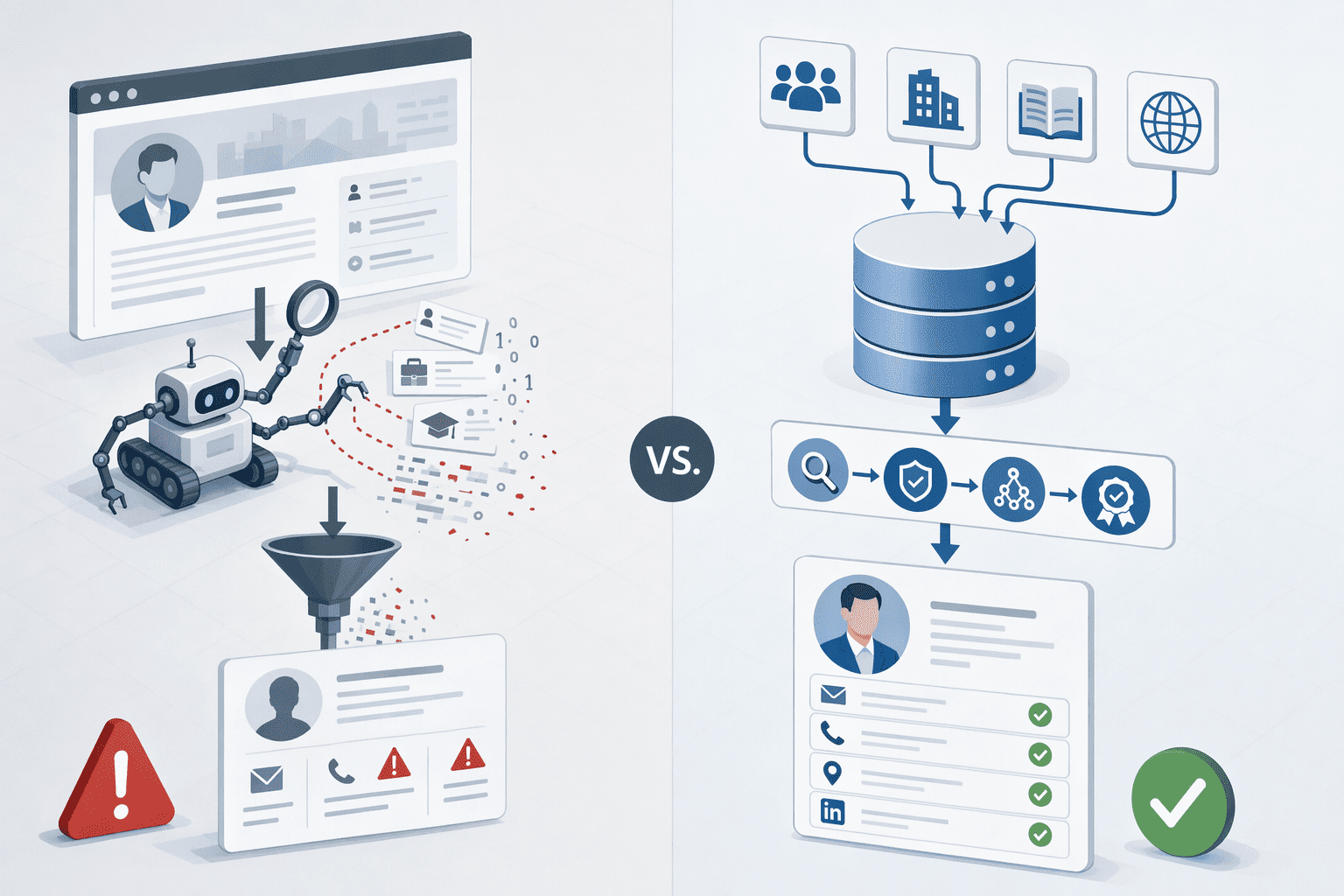
Direct scrapers extract profile data in real-time by crawling LinkedIn pages, harvesting contact fields visible to your account, and parsing HTML to populate databases. This approach violates LinkedIn's Terms of Service, which explicitly prohibit automated data collection. Platforms that scrape LinkedIn profiles directly expose users to permanent account suspension, as LinkedIn's security systems flag bot-like activity patterns, rapid profile visits, unusual API call volumes, and systematic data harvesting.
Enrichment-Based Tools Query Independent Databases
Compliant extensions use the LinkedIn URL as a reference identifier to query third-party contact databases, legitimate business directories, public records, and professional network aggregators maintained outside LinkedIn's infrastructure. Lusha's Chrome Extension accesses verified contact details from independent sources rather than scraping LinkedIn itself. Apollo.io's extension works across LinkedIn, Salesforce, and HubSpot by matching profile identifiers to its 275+ million verified B2B contact database. This enrichment model avoids ToS violations because the extension never accesses LinkedIn's internal APIs or crawls profile data, it simply uses the public profile URL to look up the person in external systems.
Structural Data Gaps: Why 90-95% of LinkedIn Profiles Lack Phone Numbers
Only 5-10% of LinkedIn users share phone numbers with first-degree connections, and even fewer expose them to second- or third-degree connections. LinkedIn restricts phone numbers used for two-factor authentication from appearing on profiles, and users rarely add work phone numbers to public-facing fields. This creates an unavoidable data gap for any extension, scraper or enrichment tool, because the contact detail simply doesn't exist on LinkedIn. Enrichment tools close more deals by querying external databases that aggregate phone numbers from business registrations, public filings, and professional directories, but even these sources cannot overcome the structural gap when a prospect has never published their number in any accessible channel.
The technical approach a Chrome extension uses to discover contacts determines not just data quality, but also the legal and platform risks your sales team assumes.
Compliance Risks: LinkedIn Terms of Service and Account Suspension
Account Suspension Rates for Heavy Scraping Users
Extensions that directly scrape LinkedIn profiles, harvesting contact data through bots or circumventing rate limits, carry measurable account-suspension risk. Community reports on platforms like Reddit document suspension rates of 15-20% among heavy scraping users, contrasted with under 2% for teams using enrichment-based tools that query independent third-party databases rather than LinkedIn's internal systems. The gap reflects LinkedIn's evolving detection methods: scraping tools leave telltale fingerprints (irregular request patterns, rapid profile visits, cookie anomalies) that LinkedIn's security layer flags and suspends, often permanently.

Why LinkedIn Enforces Scraping Bans More Aggressively in 2026
LinkedIn has tightened enforcement in 2026 through advanced rate limiting, bot fingerprinting, and behavioral-anomaly detection. Chrome extensions that scrape are now easier to detect because they must operate within the browser's JavaScript sandbox, leaving consistent patterns, tab-switching velocity, DOM-query frequency, session duration, that LinkedIn's client-side instrumentation monitors in real time. Platforms that violate terms expose users to permanent account suspension, not just temporary restriction.
How to Identify Compliant Extensions Before Installation
Before installing a LinkedIn contact-finder extension, verify three signals of compliance: (1) Does the vendor disclose an enrichment-based methodology rather than scraping? Look for phrases like "third-party database" or "independent business records." (2) Does the Chrome Web Store listing reference LinkedIn APIs or official partnerships? If yes, verify the claim on LinkedIn's integration directory, unauthorized API claims are a red flag. (3) Does the vendor's privacy policy name specific data partners (e.g., public registries, commercial databases)? Vague sourcing language often masks direct scraping. Tools that meet all three criteria typically fall into the <2% suspension-risk category, while those that fail signal the 15-20% heavy-scraping cohort.
With the methodology and compliance landscape mapped, the next question is which extensions deliver verified contact data for Indian companies without triggering LinkedIn enforcement.
Sales teams targeting Indian companies face a critical choice: Chrome extensions that promise global coverage often fall short on verified local contact data, while India-focused tools may lack the CRM integrations enterprise teams expect. Below is a structured comparison of six Chrome extensions evaluated on pricing transparency, India-specific accuracy, compliance method, and LinkedIn integration, the four dimensions that determine whether an extension closes deals or burns credits on unverified leads.
| Extension | Pricing model | Free tier | India accuracy claim | LinkedIn support | Chrome Web Store rating |
|---|---|---|---|---|---|
| PeakAi | Pay-per-use (₹675/50 contacts) | Free starter credits | 91% for Indian contacts | Native overlay | 5.0 (6 ratings) |
| Lusha | Subscription-based | Available on all plans | Not disclosed | Works on LinkedIn, CRM, company sites | Not available |
| Apollo.io | Subscription + free tier | Free with limits | Not disclosed | Works on LinkedIn, Salesforce, HubSpot, Gmail | Not available |
| ContactOut | Subscription-based | Not disclosed | Not disclosed | LinkedIn integration | Not available |
| Easyleadz | Subscription-based | Not disclosed | Regional focus | LinkedIn support | Not available |
| EazyReach | Pay-per-reveal | Free Chrome extension | India-optimized | Works on LinkedIn, Sales Navigator, Recruiter | Not available |
Accuracy Benchmarks: India-Specific vs Global Rates
Generic global databases often report match rates above 90%, but those figures collapse when tested against Indian mobile numbers and regional email formats. PeakAi delivers 91% phone number accuracy specifically for Indian contacts across 1,600+ cities, validated against GST and MCA databases. Apollo.io and Lusha publish global accuracy claims but do not disclose India-specific performance metrics. Tools like Easyleadz and EazyReach position themselves as India-optimized but lack transparent third-party benchmarks. Teams prospecting Indian decision-makers should verify real-world deliverability, advertised accuracy rates rarely match genuine testing, because platforms conflate syntax validation with active number verification.
Compliance Method and Account Risk
Extensions fall into two categories: enrichment-based tools that query independent business databases (lower account risk), and scraping-based tools that extract data directly from LinkedIn profiles (higher suspension risk). PeakAi sources verified contact data through legitimate business databases and public records rather than scraping LinkedIn directly. Apollo.io positions its Chrome Extension as a database-query layer that provides contact insights without violating platform terms. Lusha states it meets GDPR, CCPA, ISO 27001, and ISO 27701 standards. Tools that instantly reveal contact details without a separate lookup step are likely using prohibited sources, teams should verify that extensions obtain data through authorized channels, not aggressive scraping techniques that jeopardize account standing.
Pricing Models and Cost Transparency
Pay-per-use models (PeakAi at ₹675 for 50 verified contacts, EazyReach with no monthly seat fees ) let teams test contact quality before scaling spend. Subscription lock-in models (Lusha, Apollo.io) require upfront monthly commitments that may exceed actual usage, and credit-based tiers often hide effective per-contact costs behind tiered rate cards. Apollo.io offers a free tier with export and enrichment limits; teams exceeding those caps face upgrade pressure. PeakAi's transparent per-contact pricing makes cost predictable for Indian B2B prospecting. When evaluating extensions, compare real burn rates (credits consumed per verified contact) against advertised per-credit pricing, compliance-focused enrichment costs more per contact than scraping-based volume, but delivers higher connect rates and protects account standing. Ready to close more deals with verified Indian contact data? Add to Chrome - Free.
Beyond comparing extensions, understanding why Indian contact data requires specialized verification methods clarifies the structural accuracy gaps that plague global tools.
India-Specific Accuracy: Regional Data Gaps and GST Verification
GST and MCA Database Integration for Contact Verification
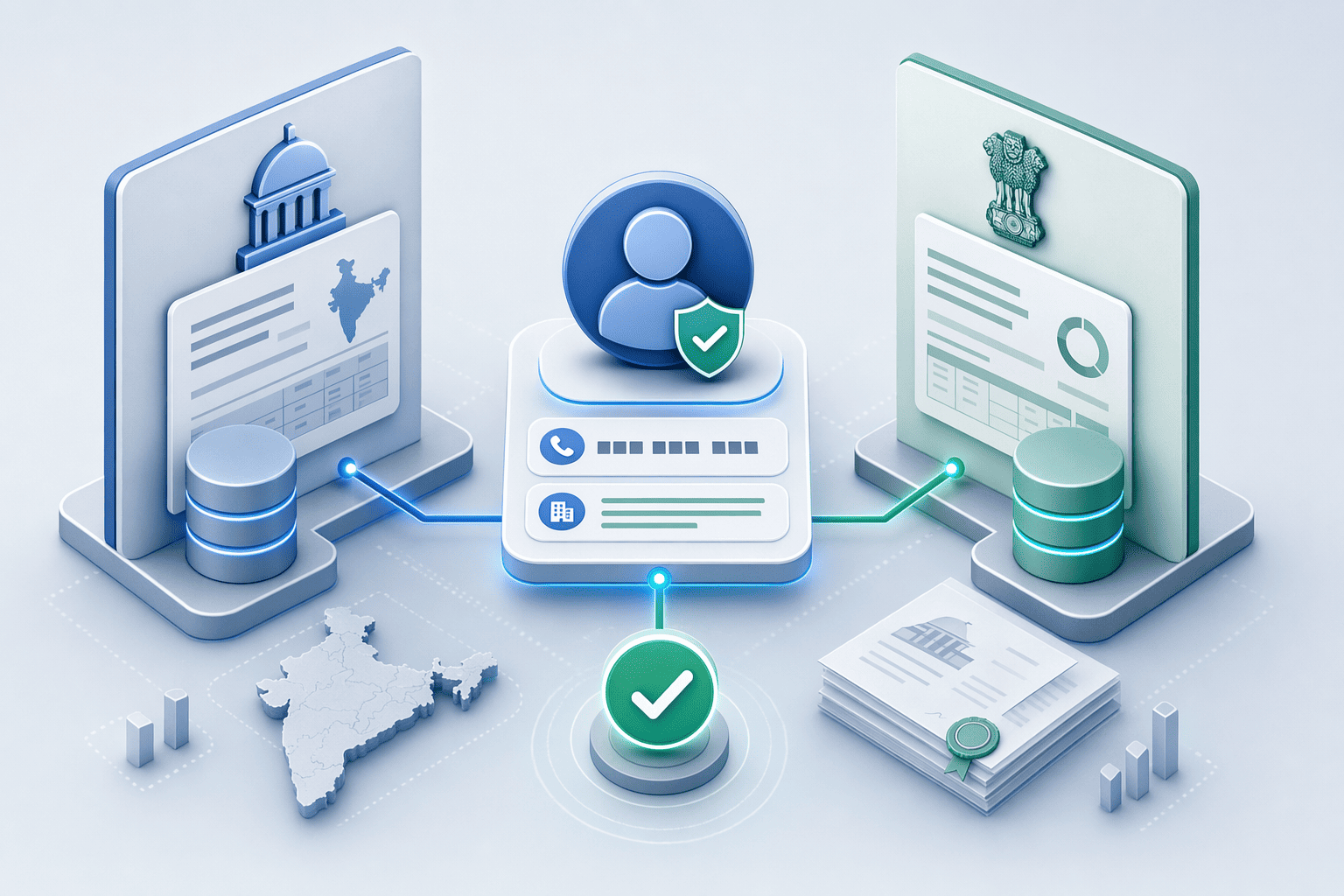
India-optimized tools cross-reference GST registration and Ministry of Corporate Affairs (MCA) company filings to validate contact authenticity and reduce wrong-number rates. EazyReach, for example, cross-validates phone numbers against MCA DIN director records. PeakAi uses GST verification and MCA database integration to confirm that returned contacts map to legally registered entities, a critical step when global tools often lack partnerships with Indian government databases. This infrastructure helps teams close more deals by ensuring the first call reaches a valid business contact.
Mobile Number Verification Challenges in India
Indian mobile verification faces carrier-level API gaps, prepaid SIM prevalence exceeding 90%, and number portability that breaks traditional validation rules. Unlike email verification, which relies on standardized SMTP protocols, phone validation in India must account for telco-specific formatting, frequent SIM swaps, and the absence of a unified carrier data-sharing framework. Tools that verify Indian contacts need partnerships with multiple telecom data providers to confirm active lines, whereas US- or EU-focused platforms typically rely on single-source HLR lookups that don't map to India's fragmented carrier landscape.
Why Contact Data Decays Faster Without Regional Monitoring
Contact data decays at 2 to 3% monthly as professionals change jobs, numbers, and companies, a rate that compounds to 25 to 30% annual staleness without active refresh. Tools without India-specific refresh pipelines fall behind on accuracy within six months because they lack real-time feeds from local registries, job-change monitoring in Indian metros, and partnerships with regional data brokers who track number reassignments. Global platforms typically refresh contact pools quarterly at best, leaving Indian prospects unreachable by the time a sales team initiates outreach.
Regional data challenges and verification complexity translate directly into cost, the final variable that determines whether a Chrome extension fits your sales team's prospecting budget.
Pricing Models: Pay-Per-Use vs. Subscription Lock-In
Pay-Per-Use: No Wasted Spend on Invalid Records
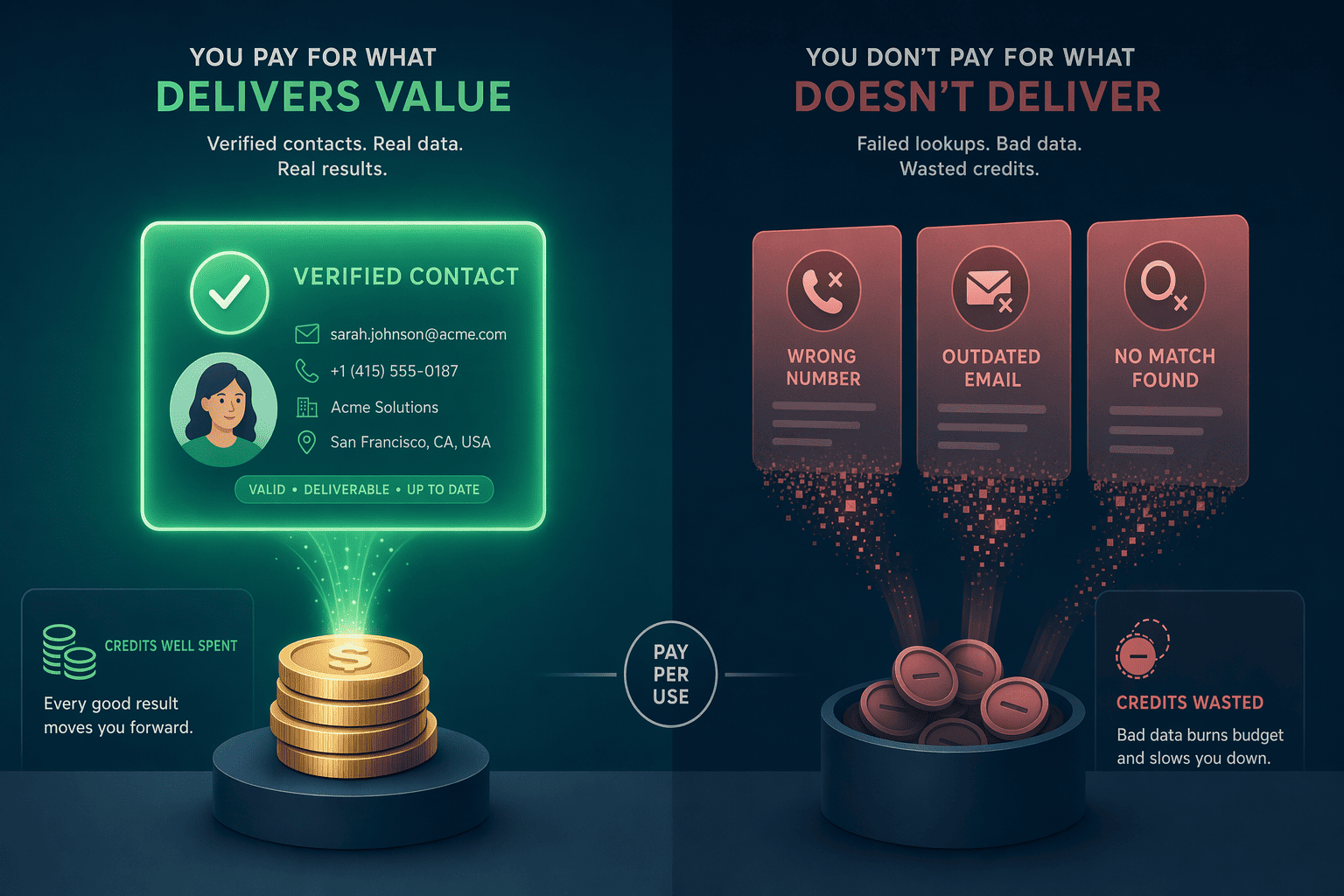
Pay-per-use models charge only when a contact is successfully matched and verified. If a lookup fails, wrong number, outdated email, or no match in the database, you pay nothing. This eliminates the common scenario where teams burn credits on profiles that yield unusable contact details. PeakAi's pay-per-contact model starts at ₹675 for 50 verified contacts, ensuring every rupee delivers a callable or emailable record. For teams targeting Indian B2B decision-makers, this transparency helps find accurate contact information [recurring_phrase] without locking capital into subscription tiers.
Credit-Based Subscription Models and Hidden Burn Rates
Credit-based subscriptions often advertise a low per-credit cost, say ₹10 per contact, but match-rate fluctuations can drive the true cost 35 to 100% higher. When 40% of lookups fail or return incomplete data, a team effectively pays ₹13.50, ₹20 per usable contact. Many Lusha alternatives operate this way: you purchase bulk credits, then discover regional gaps or outdated records after the fact. Unlike Cognism's transparent model and generous data allowance, smaller vendors rarely disclose match rates upfront, making budget forecasting a guessing game.
Pre-Download Verification vs. Post-Export Charges
Tools that preview quality before payment, showing confidence scores or partial data, let teams assess whether a record is worth revealing. Post-export models charge the moment you click 'Export,' regardless of whether the phone number connects or the email bounces. Look for platforms that surface match indicators (mobile vs. Landline classification, last-verified timestamp) during the lookup phase, so you can close more deals [recurring_phrase] with contacts you trust before spending the credit.
Conclusion
Global extensions like Lusha and Apollo.io offer broader international coverage but drop 10 to 15 percentage points in India accuracy without regional data partners, PeakAi specializes in India-specific verification through GST and MCA integration but maintains a smaller global database. Subscription models suit teams with predictable high-volume prospecting, while pay-per-use pricing eliminates wasted spend for teams testing new markets or prospecting intermittently where match rates are uncertain.
As LinkedIn tightens scraping enforcement in 2026, the compliance divide between enrichment-based and direct-scraping extensions will widen, expect suspension rates for scraping tools to exceed 25% by year-end, making enrichment-based Chrome extensions the category standard for prospecting teams managing multiple accounts.
Audit your current extension's compliance method and India accuracy using the section 3 checklist, then explore PeakAi's pay-per-use Chrome extension for verified Indian contact data with GST-linked validation.
Frequently Asked Questions
Which Chrome extension has the highest accuracy for Indian B2B contacts?
PeakAi reports 91% India-specific accuracy through GST and MCA database integration, while global tools drop below 70% without regional data partners. The 10 to 15 percentage point accuracy gap stems from structural limitations: India's fragmented business registries and mobile verification challenges demand local refresh pipelines that global extensions lack.
Can using a Chrome extension get my LinkedIn account suspended?
Direct scraping tools that extract LinkedIn profile data through bots carry 15 to 20% suspension risk, while enrichment-based extensions that query third-party databases show under 2% suspension rates. LinkedIn tightened enforcement in 2026 through advanced bot fingerprinting and behavioral-anomaly detection, making compliance method verification critical before installation.
What's the difference between email accuracy and phone number accuracy?
Email verification uses SMTP-layer deliverability checks that confirm mailbox existence without sending messages, while phone verification in India faces carrier-level API gaps and prepaid SIM prevalence exceeding 90%. Structural data limits compound the challenge: only 5 to 10% of LinkedIn users share phone numbers with connections, making phone accuracy consistently lower than email metrics.
Why do global Chrome extensions perform worse in India?
Global tools built on LinkedIn and Western business registries show a consistent 10 to 15 percentage point accuracy drop for Indian contacts because they lack GST/MCA database integration and India-specific refresh pipelines. Contact data decays at 2 to 3% monthly, compounding to 25 to 30% annual staleness without regional verification feeds that validate authenticity and reduce wrong-number rates.
Is pay-per-use pricing better than subscription for contact data?
Pay-per-use models charge only for successful matches, while credit-based subscriptions can drive true costs 35 to 100% higher due to match-rate fluctuations. Teams prospecting new markets where match rates are uncertain benefit from pay-per-use pricing that eliminates wasted spend on invalid records and allows quality assessment before scaling investment.
How do Chrome extensions verify contact data without scraping LinkedIn?
Compliant extensions use the LinkedIn URL as a reference identifier to query third-party contact databases, business directories, public records, and professional network aggregators maintained outside LinkedIn's infrastructure. This enrichment-based methodology avoids ToS violations and account suspension risk by never accessing LinkedIn's internal APIs or directly extracting profile data.
What is GST verification and why does it matter for Indian contacts?
India-optimized tools cross-reference GST registration and Ministry of Corporate Affairs (MCA) company filings to validate contact authenticity and reduce wrong-number rates. This regional specialization enables tools like PeakAi to achieve 91% accuracy versus global tools at below 70% in India, because GST-linked validation confirms active business status and recent contact updates.
Sources
- 15 Lead Generation Chrome Extension Tools to Automate Outreach - oppora.ai
- Best B2B Data Providers in India: 7 Platforms With Real Coverage (2026) - syncgtm.com (2026)
- Lusha Chrome Extension: Accurate prospecting made easy - www.lusha.com
- Apollo.io Chrome Extension - Apollo.io Integration Directory - www.apollo.io
- Need recommendations for B2B contact data providers in India (HR ...) (www.reddit.com) - www.reddit.com
- Is Apollo Extension the Best for Sales Prospecting? (And What to Use Instead) (phantombuster.com) - phantombuster.com
- PeakAI : Free instant B2B Email ids Finder - Chrome Web Store - chromewebstore.google.com
- LinkedIn Phone Number Finder — Free Chrome Extension | EazyReach - eazyreach.app
- Apollo.io Chrome Extension | Free B2B Email & Phone Finder Tool - www.apollo.io
- Top 10 Business Contact Finder Tools in India to Generate High-Quality Leads - businessinsight27.wordpress.com (2026)
- Best Lead Generation Tools for B2B Sales in India 2026 - www.itforsme.in (2026)
