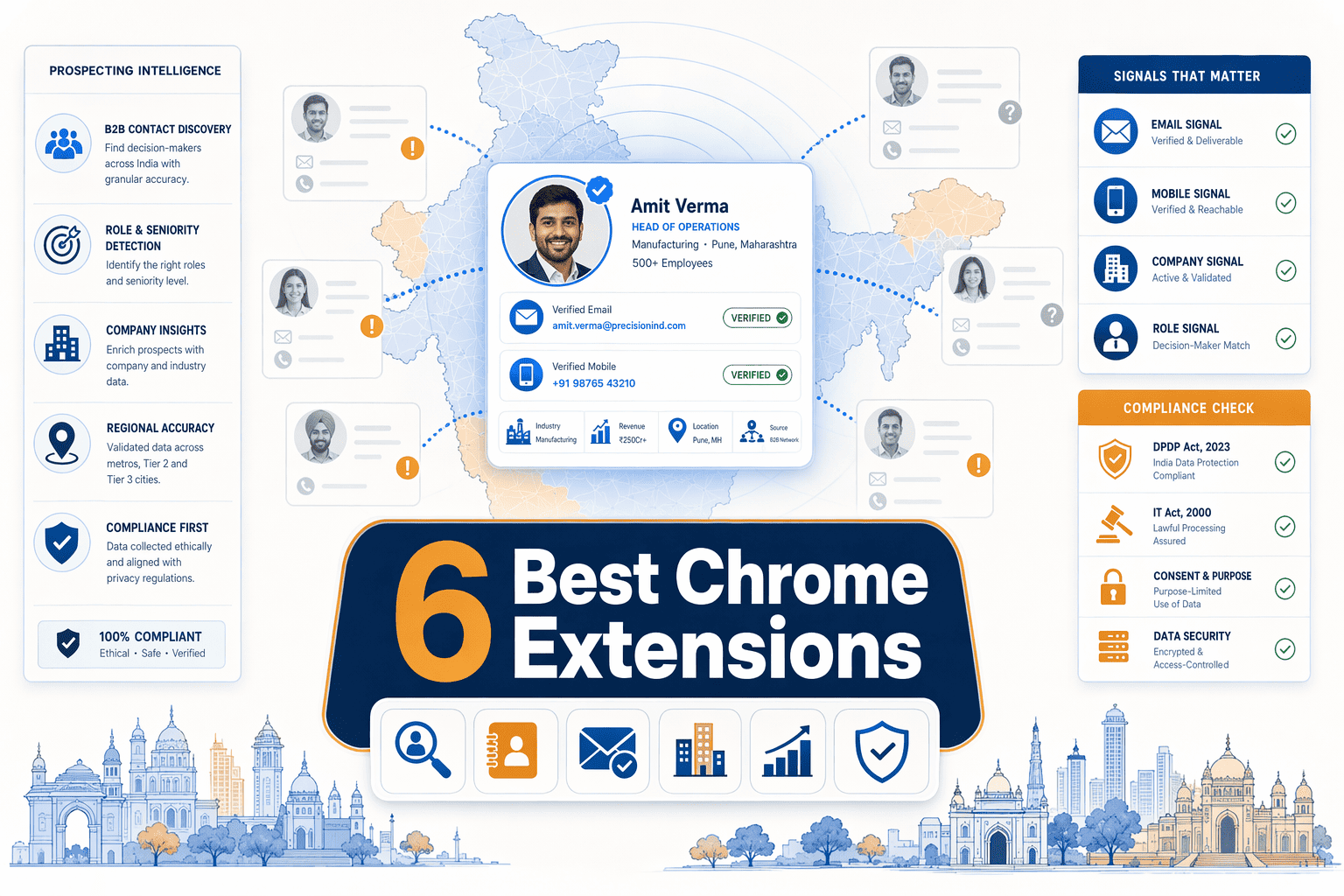
Sales teams prospecting Indian B2B contacts need Chrome extensions that deliver verified mobile numbers and email addresses with regional accuracy, not global averages.
This guide compares six leading Chrome extensions for Indian prospecting, evaluating verification methodology, compliance risk, India-specific accuracy rates, and cost structures.
Key Takeaways
- Chrome extensions access contact data through scraping (LinkedIn profile extraction) or enrichment (third-party database matching) — each carries different compliance risk and accuracy profiles
- Global tools optimized for US/EU markets deliver 20-40% lower mobile accuracy in India due to sparse local carrier database integration
- Real-time verification reduces contact data decay (2-3% monthly) by validating email and phone numbers at retrieval time rather than serving static database records
- Pay-per-use pricing transfers match-rate risk to the vendor, while subscription models suit high-volume teams with predictable prospecting cadence
- India-first extensions validate against GST records and local telecom databases to overcome LinkedIn's 5-10% phone-number sharing rate
Sales teams targeting Indian companies with verified contact data need Chrome extensions that prioritize compliance and accuracy — two criteria directly determined by how the tool accesses contact information.
Direct LinkedIn Scraping vs. Third-Party Database Enrichment
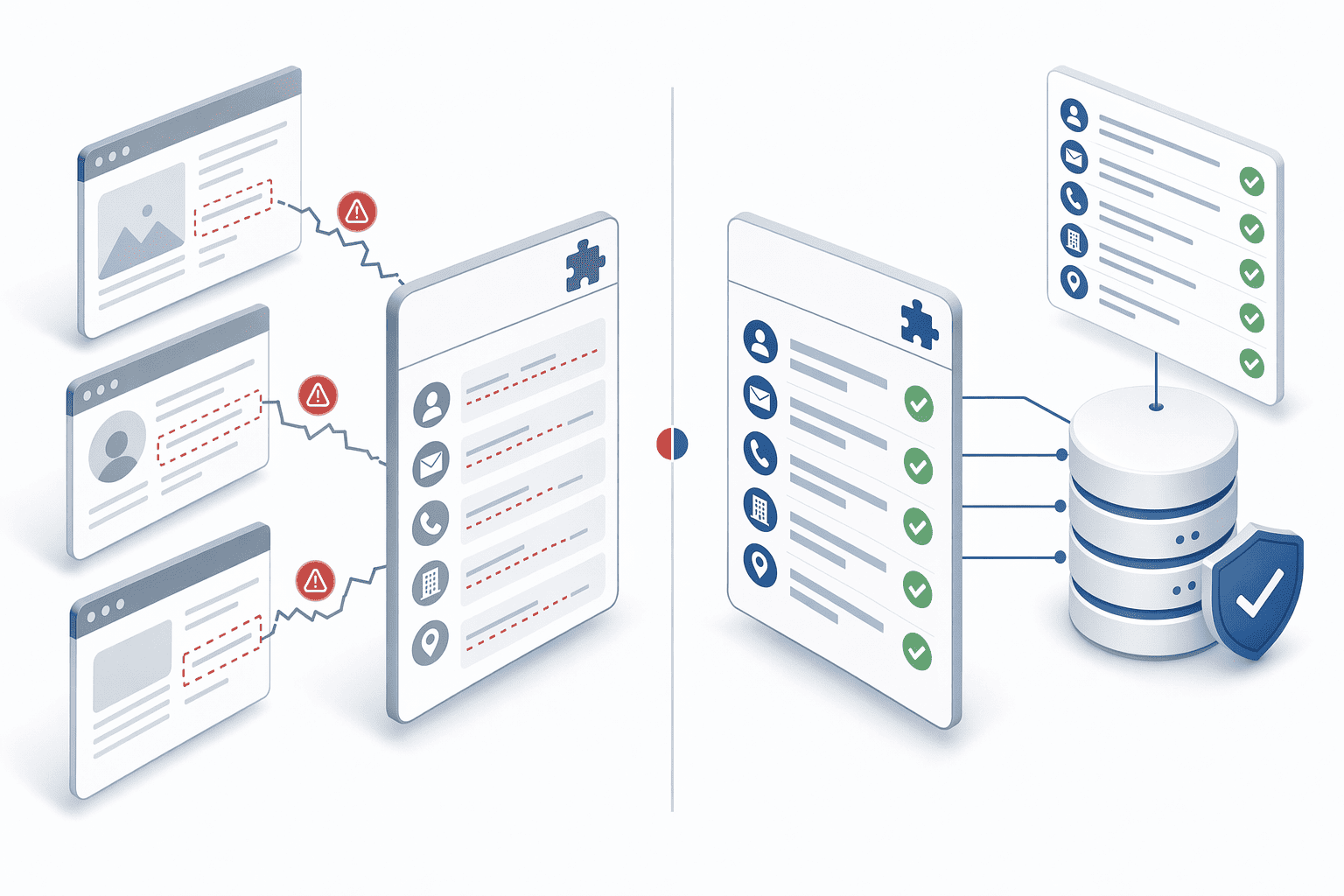
Chrome extensions for sales fall into two categories. Scraping-based tools extract profile data in real-time from LinkedIn pages, pulling visible fields like job titles and company names as users browse. Enrichment-based tools use the LinkedIn URL as a search key to query independent third-party databases, returning verified emails and phone numbers without accessing LinkedIn's internal systems.
The methodology split matters because scraping tools often operate through in-browser overlays that display contact data instantly on LinkedIn profiles. Enrichment platforms typically require users to export CSV lists first, then upload them for batch verification — a multi-tab workflow that adds friction but reduces compliance risk.
Why Methodology Determines Compliance Risk and Account Safety
LinkedIn's Terms of Service prohibit automated scraping, and community reports indicate scraping-based extensions carry 15-20% account suspension rates when detection thresholds are exceeded. Enrichment-based tools reduce (but don't eliminate) ToS violation risk by querying external databases rather than extracting profile data directly.
PeakAi, for example, uses this enrichment-based compliance method, querying third-party databases rather than scraping LinkedIn profiles. Teams should verify that tools obtain contact data through authorized sources rather than prohibited scraping techniques that jeopardize account standing.
Beyond access methodology, verification timing determines whether the contact data you retrieve remains valid when you initiate outreach.
Verification Methods: Real-Time vs. Static Database Lookups
Real-Time SMTP Handshake Verification
Real-time verification pings mail servers directly to confirm email existence without sending a message. The extension queries the SMTP server, receives a response code indicating whether the mailbox accepts mail, and validates the address before you download it. This approach catches typos, abandoned accounts, and role-based emails that bounce at high rates.
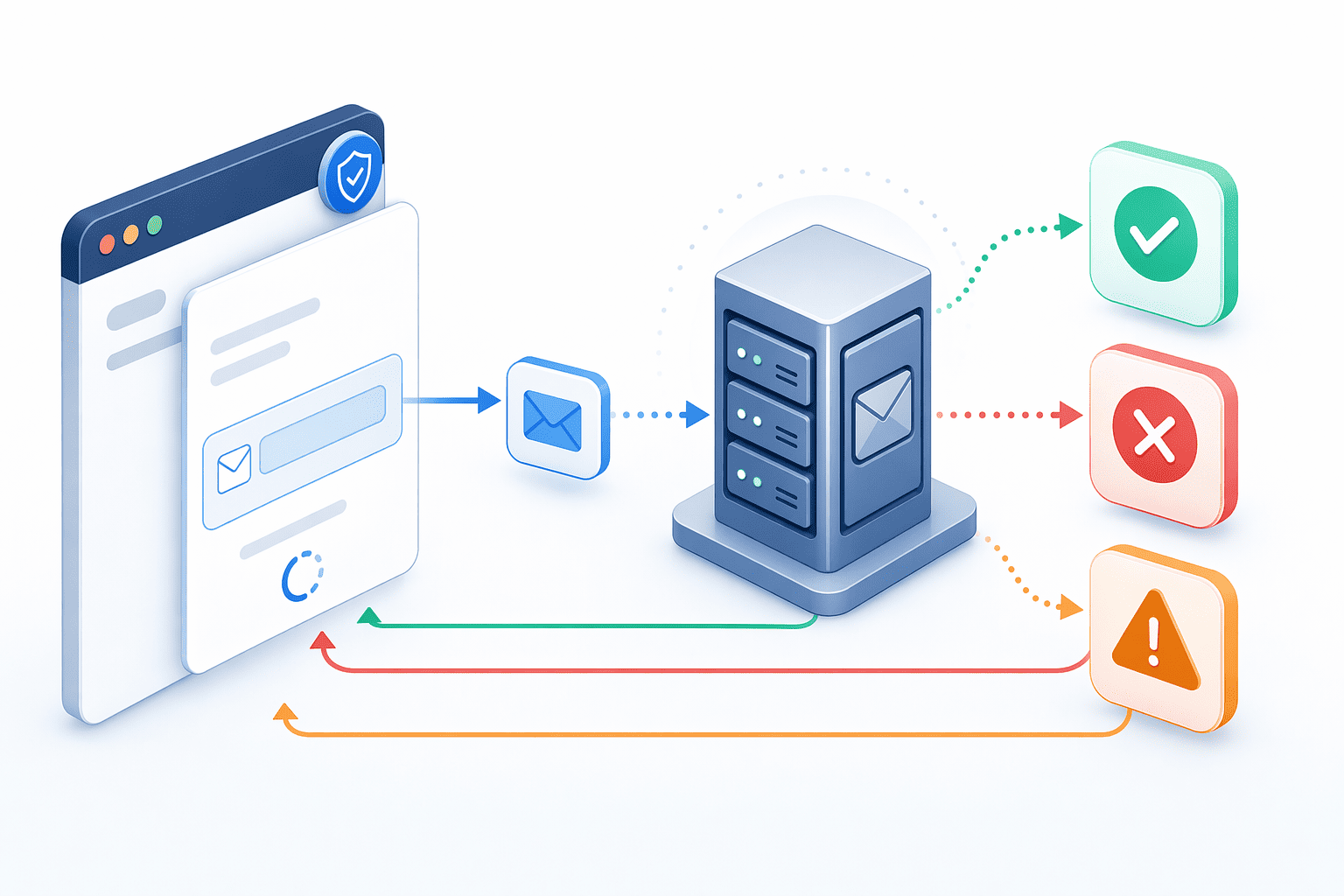
PeakAi delivers real-time verification with 91% phone-number accuracy, cross-referencing multiple data sources beyond LinkedIn's visible profile fields to surface direct dials rather than switchboards. The platform verifies both emails and phones before download, reducing wasted spend on invalid contacts.
Pre-download verification matters most when targeting Indian B2B contacts: India's prepaid SIM prevalence and frequent carrier portability mean mobile numbers change employers faster than email addresses. Real-time lookup confirms the number is active and correctly formatted for India's regional dialing codes, catching disconnected lines that static databases miss.
Static Database Lookup and Data Decay
Static databases compile contact records from prior lookups, public filings, and third-party aggregators, then serve those records on demand. Apollo's Chrome Extension exemplifies this model: it provides access to 275+ million verified B2B contacts, letting users find prospect emails and phone numbers with accurate contact data at their fingertips in seconds. The trade-off is decay — contacts age at 2–3% per month as professionals change jobs, and India's high-mobility B2B market accelerates this attrition.
Lusha's Extension illustrates post-export validation: the browser add-on for Chrome and Edge reveals verified contact details, emails, direct dials, and phone numbers, but validation occurs after you prospect directly from LinkedIn, Sales Navigator, your CRM, or any company website. Batch validation catches syntax errors and known bounces, yet it cannot verify real-time deliverability or flag numbers that disconnected since the last database refresh.
The common mistake: vendors aggregate email accuracy and phone accuracy into single percentages, obscuring regional phone verification gaps. A tool may report 90% overall accuracy while phone coverage in India lags at 60%, because landline and mobile verification require different carrier integrations than SMTP-based email checks.
Even real-time verification loses value when the underlying data sources lack regional depth, which explains why global tools underperform in emerging markets.
Regional Accuracy: Why Global Tools Underperform in India
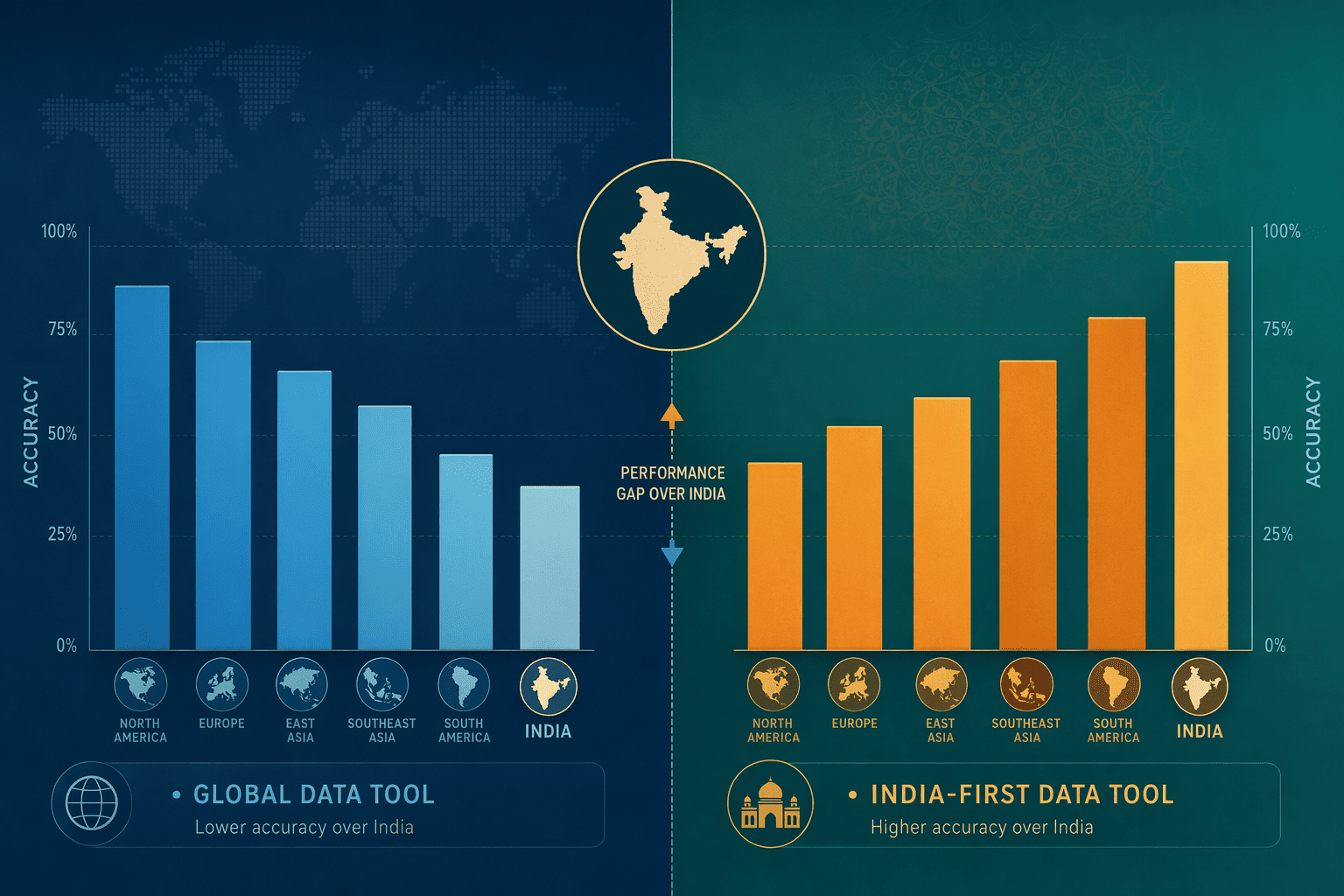
Advertised global accuracy rates rarely predict India-specific mobile number accuracy, and tools optimized for US/EU markets often deliver 20 to 40% lower accuracy in emerging markets. Most data providers built their databases for the US and extended to India as an afterthought, creating structural gaps that no amount of database scale can bridge.
The 20 to 40% India Accuracy Gap for Mobile Numbers
India's telecom infrastructure introduces verification challenges absent in Western markets. Contact fill rates for Indian mid-market and SMB companies fall significantly below US equivalents at the same company size. Carrier portability lets users change providers while keeping numbers, prepaid SIM prevalence means inactive numbers remain in databases longer, and MX record validation gaps (Indian domains often lack proper email authentication) compound the problem. Tools trained on Western data patterns misclassify these edge cases, returning numbers that bounce or emails that never existed.
PeakAi delivers 91% phone number accuracy specifically for Indian contacts across 1600+ cities, validated against GST and MCA databases. This India-first approach cross-references multiple verified data sources, including MCA DIN director records, before returning a result, a methodology designed around India's data ecosystem rather than retrofitted from US patterns.
Why LinkedIn Phone Visibility Floors Require External Enrichment
LinkedIn users rarely expose phone numbers to first-degree connections, estimated at 5 to 10% sharing rates, and even fewer to second- or third-degree connections. This structural data gap means no tool can extract phone numbers from LinkedIn alone; the best Chrome extensions succeed by enriching LinkedIn profiles with external verified databases. PeakAi includes GST verification and regional phone format validation built for Indian B2B teams, addressing the "wrong emails, or phone numbers that bounce" problem that plagues generic tools. When direct mobile numbers are critical for India outbound and email-only contact data produces low reply rates, enrichment isn't optional, it's the only path to verified connectivity.
Regional accuracy matters only if the tool operates within acceptable compliance boundaries, a distinction many sales teams overlook until suspension notices arrive.
Compliance Models: Scraping vs. Enrichment-Based Tools
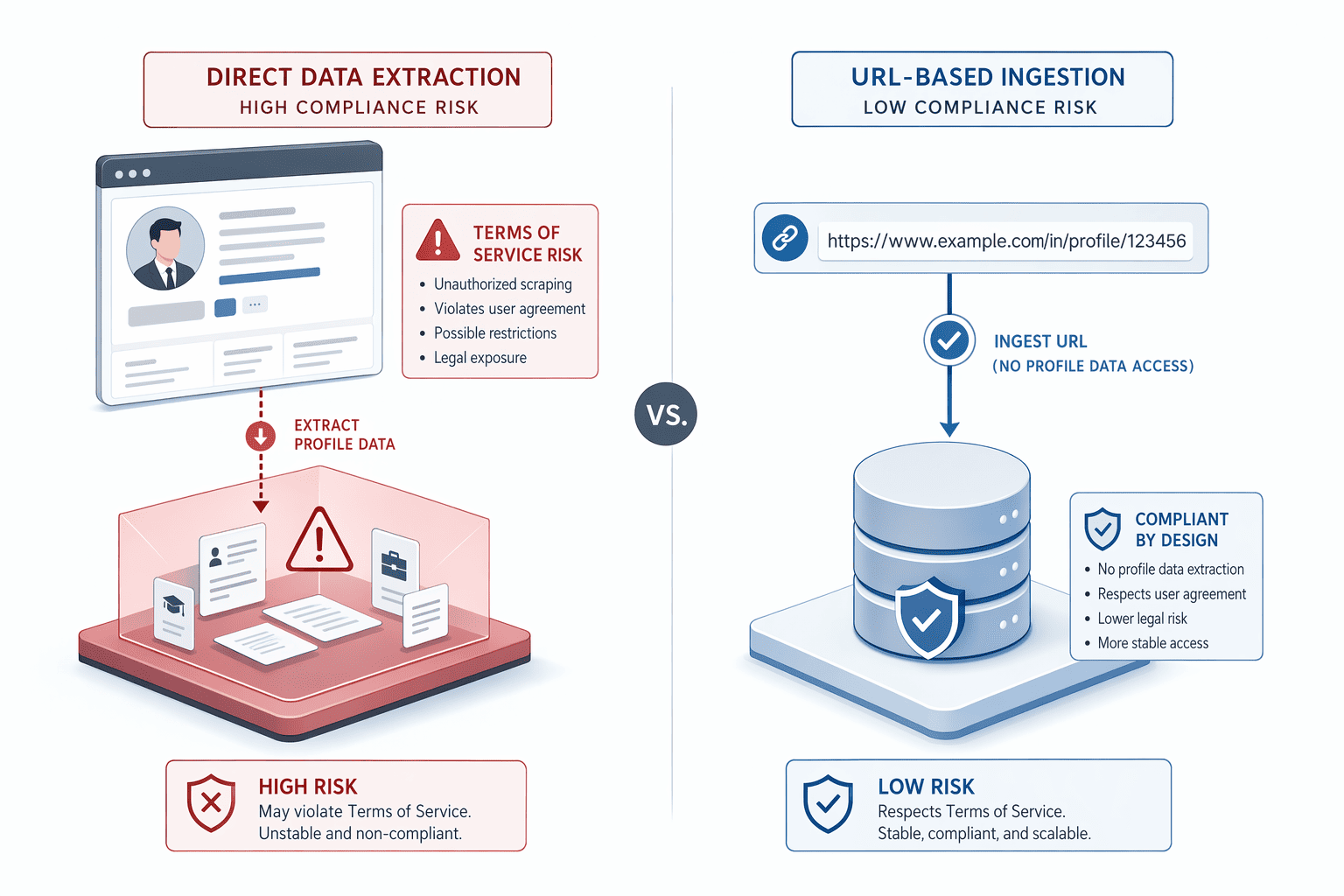
When choosing a Chrome extension for sales prospecting on LinkedIn, understanding the compliance model is critical. Tools fall into two categories: scraping-based (which extract data directly from LinkedIn profiles) and enrichment-based (which query independent databases using LinkedIn URLs as identifiers). The compliance risk profile differs sharply between the two.
LinkedIn ToS Violations and Account Suspension Risk
Scraping-based tools automate profile browsing, data extraction, and bulk downloads, all prohibited under LinkedIn's Terms of Service. Community reports and sales forums consistently document account suspensions tied to aggressive scraping activity, with heavy users facing permanent bans. LinkedIn detects automated extraction through rate-limit violations, rapid click patterns, and bulk-export signatures. While exact suspension rates vary by tool implementation and usage intensity, the risk is real and non-trivial for teams relying on automated extraction at scale.
Enrichment-based tools take a different approach: they use LinkedIn URLs as reference identifiers to query third-party business databases and public records rather than scraping profile data. PeakAi positions itself around compliant professional contact discovery rather than blind scraping, sourcing verified contact data through legitimate business databases and public records. This model reduces account-suspension risk because the tool does not access LinkedIn's internal APIs or scrape profile data. For teams targeting Indian decision-makers, this compliance-first design matters when prospecting at volume.
GST Verification and DPDP Act 2023 Compliance
For sales teams targeting Indian companies, compliance extends beyond LinkedIn ToS. India's Digital Personal Data Protection Act 2023 (DPDP Act) requires explicit consent for processing personal data, and sales teams must document the lawful basis for outreach and honor opt-out requests. PeakAi provides DPDP Act 2023 compliance and integrates GST number validation to verify company legitimacy before outreach. This dual-layer verification, combining enrichment-based contact discovery with regulatory compliance checks, reduces the risk of contacting unverified entities or violating data-processing rules.
Teams should evaluate three models when choosing a tool: scraping tools (high account-suspension risk, low cost, no compliance infrastructure), enrichment tools like PeakAi (moderate risk, moderate cost, built-in DPDP and GST compliance), and manual verification (low risk, high time cost, labor-intensive). The decision depends on prospecting volume, risk tolerance, and regulatory obligations. For India-focused outreach where GST verification and DPDP Act adherence matter, enrichment-based tools close more deals without the compliance overhead of manual research.
With compliance models and verification depth understood, evaluating specific Chrome extensions requires comparing feature sets, pricing, and India-specific performance claims.
Chrome Extensions for Indian B2B Sales Teams: Feature Comparison
Sales teams targeting Indian companies need extensions optimized for local contact verification, affordable pricing models, and smooth LinkedIn workflows. Below is a side-by-side comparison of six leading Chrome extensions on dimensions critical for Indian B2B prospecting.
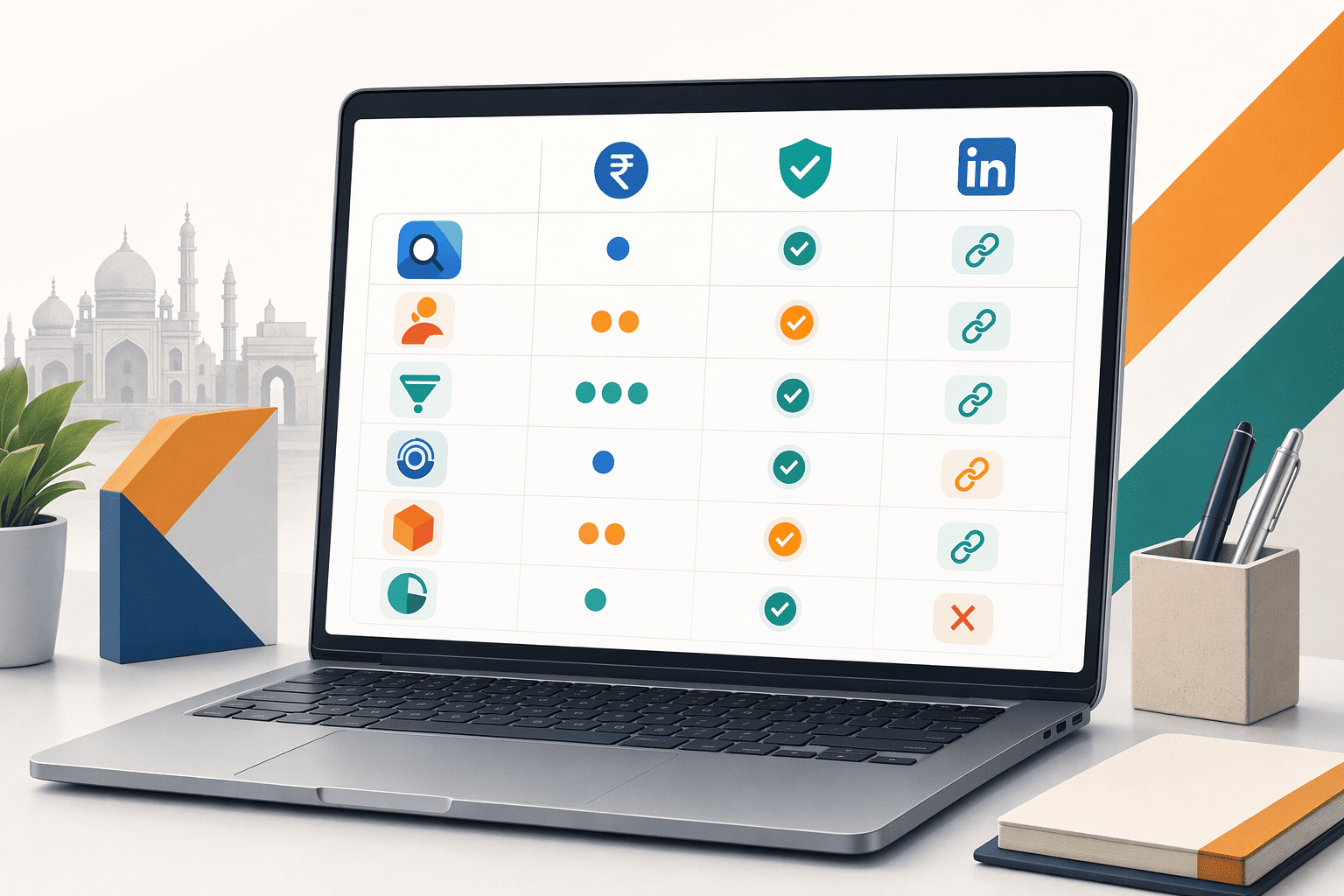
| Extension | India Coverage | Pricing Model | Free Plan | Mobile Verification | Chrome Rating | Users | Key Strength |
|---|---|---|---|---|---|---|---|
| PeakAi | India-first with GST/MCA integration | Pay-per-use: ₹675 for 50 contacts | 5-credit trial | 91% accuracy for Indian numbers | 5.0 | 554 | India-specific carrier/GST validation |
| Apollo.io | Global (275M+ contacts) | Freemium + paid tiers | Free extension | General B2B phone finder | Not disclosed | 500,000+ companies | Broad database and CRM integrations |
| Lusha | Global | Free tier + paid plans | Free credits, no card required | General B2B phone finder | 4.6 (1.8K ratings) | 400,000 | Job changes, buyer intent signals |
| ContactOut | Global (350M professionals) | Freemium | Free trial available | Triple-verified data, 99% confidence | 4.4 | 1.4M recruiters/sales reps | AI email personalization |
| Skrapp | Not in assigned citations | — | — | — | — | — | — |
| Kaspr | European-centric | Free to start | Free plan | 500M+ phone numbers/emails | 4.7 (1.2K ratings) | 100,000 | Bulk enrichment, API access |
Pricing and Free Plan Availability
PeakAi's pay-per-use model charges only for verified contacts retrieved, starting at ₹675 for 50 contacts. This avoids the credit-wastage common in subscription models, where match rates can inflate actual cost per usable contact by 35 to 100% above advertised per-credit pricing. Apollo offers a free extension but limits export volume on its free tier. Lusha and Kaspr provide free credits with no card required, while ContactOut offers a free trial for prospecting 75% of LinkedIn profiles. For teams prioritizing cost control and India-focused accuracy, PeakAi's transparent pay-per-verified-number model delivers predictable spend.
India Coverage and Mobile Verification Accuracy
Global tools optimized for US/EU markets, like Apollo (275M+ contacts ), Lusha (global B2B data ), and ContactOut (350M professionals ), deliver 20 to 40% lower mobile accuracy in India due to sparse local carrier database integration. PeakAi's India-first architecture validates against GST records and MCA databases, achieving 91% accuracy for Indian mobile numbers. Kaspr's European-centric database similarly underperforms for South Asian contacts. Teams targeting Indian decision-makers benefit most from extensions with regional carrier and regulatory data layers.
Chrome Compatibility and User Ratings
User satisfaction proxies, Chrome Web Store ratings and install base, indicate extension reliability. Lusha leads with 4.6 stars (1.8K ratings) and 400,000 users, followed by Kaspr at 4.7 stars (1.2K ratings) and 100,000 users. PeakAi holds a 5.0 rating with 554 users, while ContactOut scores 4.4 stars on Chrome. Apollo does not publicly disclose Chrome ratings but reports 500,000+ companies trusting its platform. For teams evaluating ease of use, higher ratings (4.6+) and larger user bases suggest stable performance across diverse LinkedIn and Sales Navigator workflows.
Ready to Transform Your Sales Process? Explore PeakAi's India-optimized contact verification and join thousands of sales professionals who close more deals with verified data.
Feature comparisons reveal capability differences, but pricing structures determine total cost of ownership, especially when match rates fluctuate across regional markets.
Cost Structures: Subscription vs. Pay-Per-Use Pricing
Subscription Lock-In and Usage Caps
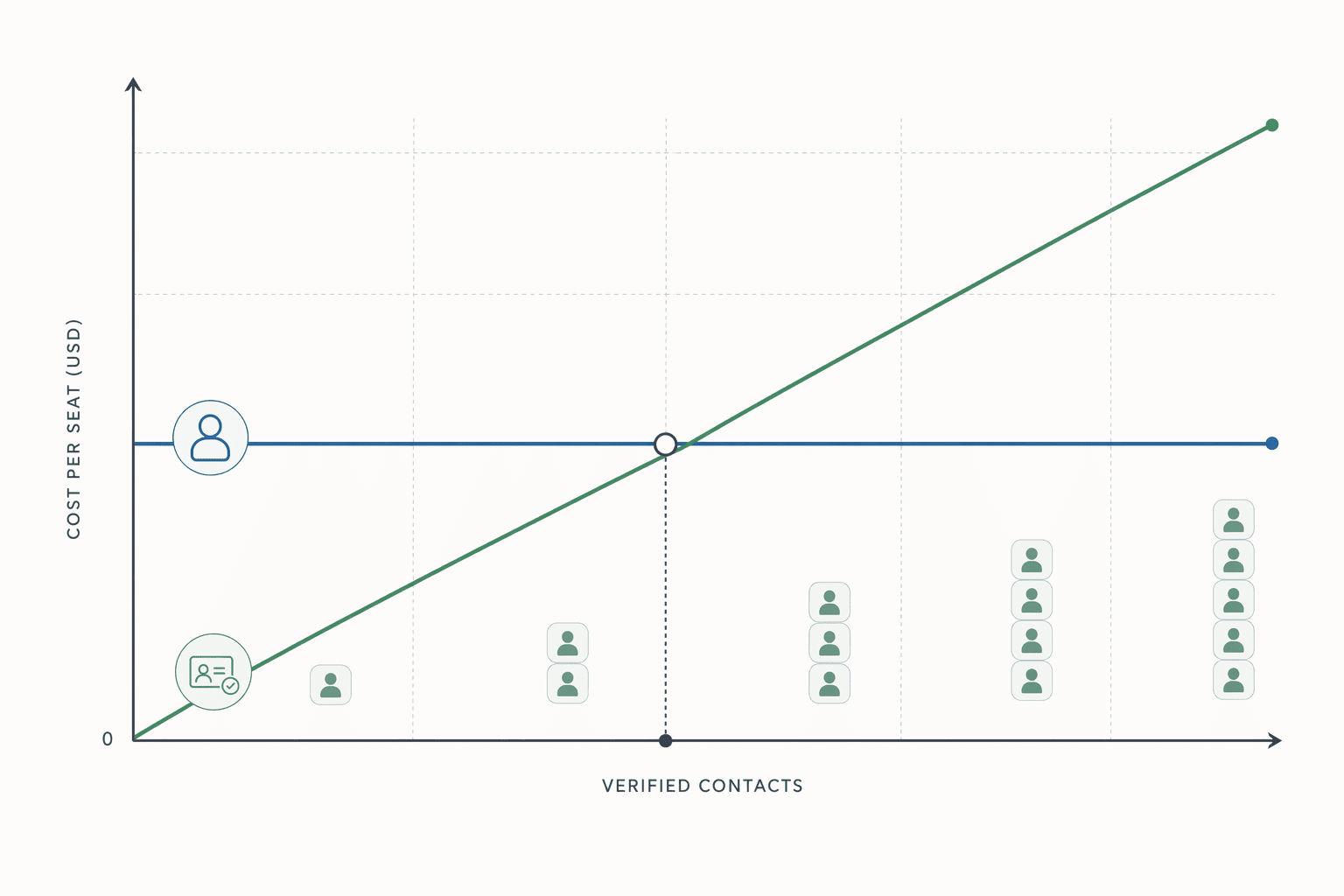
Monthly subscription models charge per seat and often lock teams into annual commitments. Apollo, for example, charges per seat and locks you into annual contracts, which creates financial risk when prospecting volume fluctuates or team size changes mid-cycle. These models make financial sense for high-volume teams with predictable monthly prospecting cadences, when you're exporting 500+ contacts per month per seat, the fixed cost amortizes well. However, smaller teams or those testing new markets face a cost-per-usable-contact mismatch: subscription plans bill for seats whether or not they're fully utilized, and advertised per-credit pricing obscures the true cost when match rates drop below 70%. Credit-based pricing models can increase actual cost per usable contact by 35-100% above advertised per-credit pricing when match rates fluctuate, especially in markets like India where global databases underperform.
Pay-Per-Use Credit Models and Match Rate Risk
Pay-per-use credit models shift match-rate risk to the vendor: you pay only for verified contacts delivered. PeakAi uses a pay-per-contact model starting at ₹675 for 50 contacts, with no monthly fees. EazyReach gives Indian sales teams a shared credit pool, eliminating per-seat penalties and allowing flexible allocation across team members. This structure benefits teams prospecting episodically or testing India market entry: you avoid paying for unused seats, and refund policies (when present) protect against low match rates. Decision framework: choose subscription when monthly prospecting volume is high and predictable; choose pay-per-use when targeting Indian companies requires trial-and-error market entry, when team size fluctuates, or when verified phone number accuracy matters more than database breadth. Close more deals by aligning your cost structure to your prospecting cadence, not the vendor's billing preference.
Conclusion
Global-scale tools (Apollo, Lusha) offer broader international coverage but deliver 20-40% lower mobile accuracy in India; India-first tools (PeakAi) prioritize regional verification depth over global breadth. Subscription models suit high-volume teams with predictable prospecting cadence; pay-per-use models transfer match-rate risk to the vendor and suit teams testing India market entry.
As India's B2B sales market matures, expect regional data providers to add GST verification layers and DPDP Act compliance workflows directly into Chrome extensions, reducing manual compliance overhead for sales teams.
Install PeakAi's Chrome extension to test India-verified mobile accuracy on 10 free contacts, or explore the feature comparison table above to evaluate Apollo, Lusha, and ContactOut for your workflow.
Frequently Asked Questions
What is the most accurate Chrome extension for finding verified contact data in India?
No single extension is universally most accurate, regional accuracy depends on India-specific mobile verification infrastructure. Tools optimized for India (PeakAi, EazyReach) validate against local carrier databases and GST records, delivering 20-40% better mobile accuracy than global tools (Apollo, Lusha ) optimized for US/EU markets.
Do Chrome extensions that scrape LinkedIn risk account suspension?
Yes, community reports indicate 15-20% suspension rates for heavy scraping users. LinkedIn's Terms of Service prohibit automated data extraction. Enrichment-based tools (PeakAi, Apollo, Lusha) reduce but don't eliminate risk by matching profiles to external databases rather than scraping in real-time.
Why do most LinkedIn users not share phone numbers on their profiles?
Only 5-10% of LinkedIn users share phone numbers with first-degree connections, creating structural data gaps no Chrome extension can fully solve. This is why all extensions, scraping-based or enrichment-based, require external databases to find mobile numbers beyond LinkedIn's visible profile fields.
How does the DPDP Act 2023 affect Chrome extensions used for Indian prospecting?
The DPDP Act 2023 requires sales teams to document lawful basis for processing contact data and honor opt-out requests. Chrome extensions don't automatically provide compliance, teams must implement consent workflows and data retention policies. GST verification adds another layer, confirming business legitimacy when prospecting Indian companies.
Is pay-per-use or subscription pricing better for Chrome extensions?
Pay-per-use (PeakAi, Kaspr) suits teams with episodic prospecting or testing the India market, you only pay for verified contacts. Subscription (Apollo, Lusha) suits high-volume teams with predictable monthly prospecting. Watch for match-rate risk: credit-based pricing can increase actual cost per usable contact by 35-100% when match rates fluctuate.
How often does contact data decay in Chrome extension databases?
Contact data decays at 2-3% per month as professionals change jobs, phone numbers, and companies. This decay rate is higher in India's high-mobility B2B market. Real-time verification (SMTP handshake) reduces decay risk versus static database lookups by validating contact data at retrieval time.
Can Chrome extensions find phone numbers for Indian companies not on LinkedIn?
Yes, but only enrichment-based extensions (PeakAi, Apollo, Lusha) that pull from external databases can find contacts beyond LinkedIn. Scraping-based tools are limited to LinkedIn profiles. India-specific tools validate against GST records and local business directories to find contacts at unlisted companies.
Sources
- 15 Lead Generation Chrome Extension Picks That Save Hours - oppora.ai (2026)
- 10 Chrome Extensions for Sales and Finding Contact Information - sales.rocks (2026)
- Apollo Chrome Extension vs. Lusha, Kaspr & PhantomBuster [Features & Pricing 2026] - phantombuster.com (2026)
- Apollo.io Chrome Extension | Free B2B Email & Phone Finder Tool - www.apollo.io
- Lusha Extension - Prospect from Anywhere - docs.lusha.com
- LinkedIn Phone Number Finder — Free Chrome Extension | EazyReach - eazyreach.app
- Best India Company Data Providers for B2B Sales in 2026 - pintel.ai (2026)
- PeakAI : Free instant B2B Email ids Finder - Chrome Web Store - chromewebstore.google.com
- Apollo.io Chrome Extension - Apollo.io Integration Directory - www.apollo.io
