
Contact discovery platforms for the Indian B2B market advertise accuracy rates above 90%, yet most buyers discover actual performance trails published claims by 15-25 percentage points after deployment.
This guide decodes accuracy metrics, verification methodologies, and cost-per-verified-contact economics to help you select platforms that deliver measurable results for Indian B2B prospecting.
Key Takeaways
- Accuracy claims conflate email deliverability, phone connectivity, and existence verification—request separate metrics before signing contracts
- Indian B2B contacts require regional verification through GST/MCA registry integration and mobile number validation, not just LinkedIn scraping
- Contact data decays 2-3% monthly; platforms with seven-day refresh cycles maintain 98% accuracy versus 75% for quarterly updates
- Credit-based pricing burns credits at different rates for phone versus email lookups, making advertised per-credit costs misleading
- Pay-per-verified-contact models eliminate waste from expired records but cost $0.85-$1.50 per contact versus $0.12-$0.50 for subscription plans
Contact discovery platforms claiming '95% accuracy' for the Indian market rarely specify whether that figure applies to email deliverability, phone connectivity, or mere existence verification — three distinct metrics vendors conflate into single percentages. For Indian B2B teams evaluating platforms, understanding what 91% (or any percentage) actually measures is the difference between qualified conversations and wasted credit spend.
Accuracy vs Deliverability vs Verification
Email deliverability accuracy measures whether an address accepts messages without bouncing. Phone number connectivity accuracy tests whether a number rings and connects. Existence verification confirms a data point exists in a database but makes no claim about reachability. A platform stating '91% accuracy' without specifying which metric — or how email and phone figures are weighted — provides no actionable signal. Apollo.io's published breakdown illustrates the gap: their 82% email accuracy and 65-80% phone accuracy would average to '~75%' if weighted equally, yet marketing materials emphasize the higher email figure.
Why Aggregated Accuracy Rates Mislead Buyers
Vendors combine email match rates (typically 75-80%) and phone match rates (50-65%) into single accuracy claims without disclosing the weighting formula. A platform claiming '91% accuracy' might deliver 95% email matches but only 55% phone connectivity, the aggregate hides the phone gap. PeakAi discloses its 91% figure applies specifically to phone number accuracy with real-time verification, positioning it as one example on the transparency spectrum. Buyers should demand data-type-specific breakdowns before comparing platforms.
The Indian Market Accuracy Gap
US-focused databases queried for Indian contacts show accuracy drops of 15-30 percentage points versus their North American baseline. For seed-stage startups needing 200-500 verified contacts monthly, this gap means burning 30-50% of credit budgets on unusable data. The cost implication: a $29/month tool with 70% Indian accuracy delivers more reachable contacts than a $79/month platform with 90% US accuracy and 60% Indian coverage. Regional validation evidence, not global database size, determines ROI for Indian B2B prospecting, and close more deals requires verifying platform accuracy claims against your target geography before committing budget.
Understanding what accuracy percentages actually measure reveals why platforms optimized for Western markets struggle with Indian B2B contacts.
Why Regional Verification Matters for Indian B2B Contact Discovery
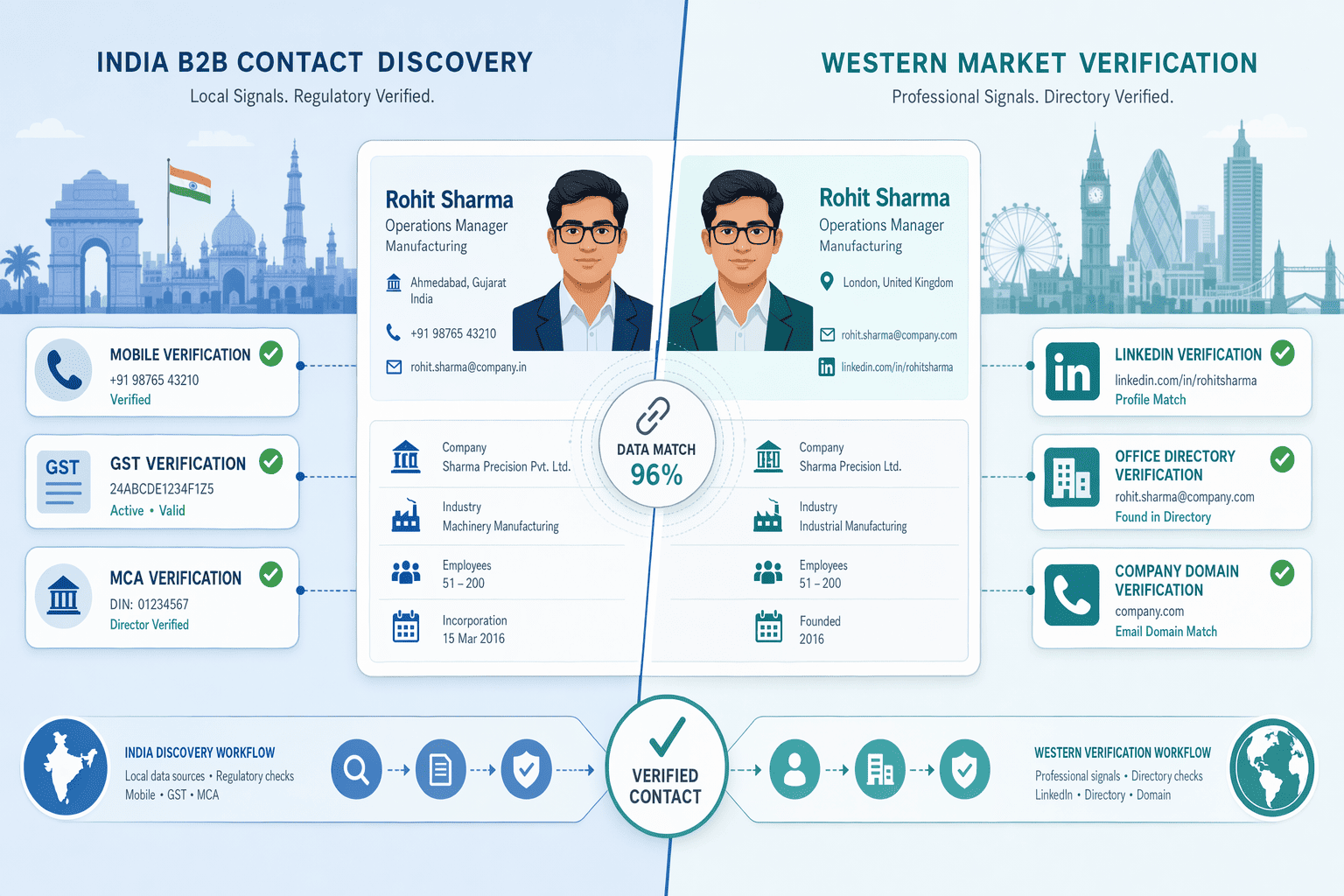
Global contact discovery platforms often fail in India because their optimization is for Western markets. Manual research can take hours and often yields outdated or incorrect data, while regional verification requirements differ fundamentally from US and European B2B environments.
Mobile vs Landline Identification in India
Indian B2B contacts disproportionately use mobile numbers, decision-makers rarely list landlines on LinkedIn profiles. Databases optimized for US markets, where corporate landlines dominate directory records, underperform in India's mobile-first business culture. Only 5-10% of LinkedIn users share phone numbers with first-degree connections, making scraping-based tools ineffective. PeakAi validates carrier codes, STD prefixes, and mobile-vs-landline classifications to filter out non-reachable landline entries.
GST and MCA Data Integration
India-verified platforms integrate GST and MCA registries for company validation, a verification layer absent in US-focused tools. PeakAi uses GST validation and MCA record cross-referencing to confirm that listed companies and tax registrations match LinkedIn profile claims before releasing contacts, reducing the risk of outdated or fabricated company affiliations.
Local Telecom Carrier Integration
Regional platforms validate phone numbers against Indian telecom carrier databases, not just generic format checks. PeakAi's real-time GST and MCA lookups extend to carrier-level verification, flagging disconnected numbers and confirming active mobile lines. Generic international validators check E.164 format but miss India-specific carrier codes, leading to high bounce rates on cold calls.
Decision framework: If your target market is India-exclusive, prioritize platforms with GST/MCA data integration and local telecom carrier validation. If multi-region, assess regional accuracy separately for each geography, global breadth does not guarantee Indian mobile precision. Ready to close more deals with verified Indian contacts? Evaluate regional validation capabilities before committing.
Once you understand regional verification requirements, evaluating platforms requires comparing five specific metrics that vendors often obscure.
Key Accuracy Metrics to Compare Across Platforms
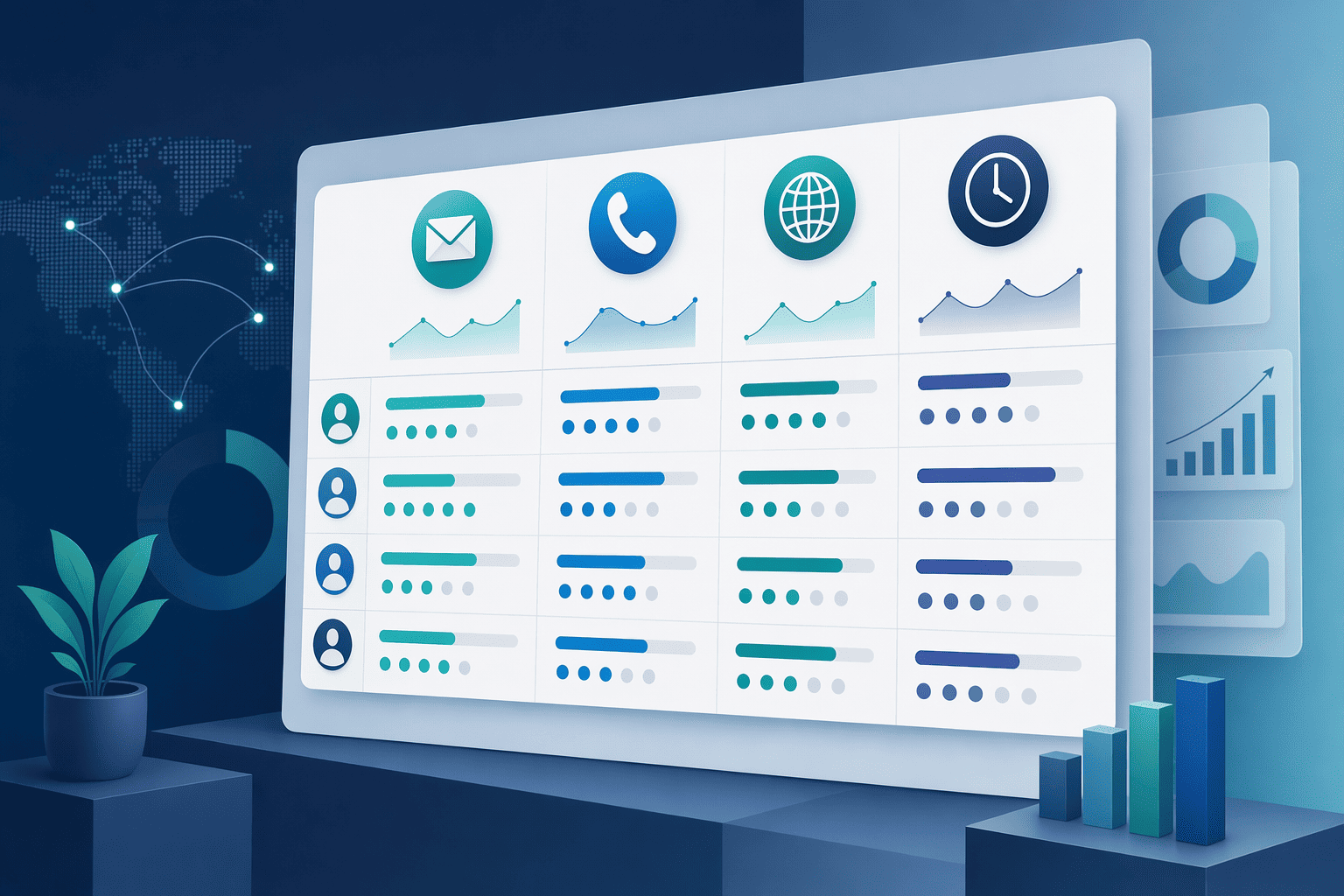
Before committing to annual contracts, request five specific metrics from every vendor to find accurate contact information:
- Email deliverability rate (India-specific), percentage of emails that reach inboxes without bouncing, measured for Indian business domains
- Phone connectivity rate (India-specific), percentage of phone numbers that connect to active lines when dialed, validated for +91 prefixes
- Credit burn rate by contact type, how many credits the platform consumes per successful phone vs email lookup
- Regional match rate, percentage of contacts successfully found and verified in your target Indian geography vs total database size claims
- Data freshness policy, documented update frequency and verification cadence for Indian business contacts
Email Deliverability Rate vs Phone Connectivity Rate
Vendors often cite aggregate "accuracy" percentages that obscure critical differences. Email deliverability (whether an address accepts mail) differs fundamentally from phone connectivity (whether a number reaches the prospect). Request separate figures: no single database clears 50 to 60% coverage, so platforms that bundle metrics hide where their gaps concentrate. Ask for geography-specific rates, a platform with 80% email accuracy in North America may deliver 45% in India.
Credit Burn Rate by Contact Type
Credit-based platforms burn credits differently for phone vs email lookups. Industry data shows phone match rates of 50-65% and email match rates of 75-80%. A platform charging one credit per lookup but returning verified emails 75% of the time costs less per usable contact than a competitor charging half a credit but matching phones only 50% of the time. Calculate cost-per-verified-contact, not cost-per-lookup, to close more deals within budget.
Regional Match Rate
Database size claims ("200M+ contacts") mean little without regional breakdowns. Ask vendors to run a sample export of 50 contacts in your target Indian geography and verify the results manually before signing. This real-world test exposes accuracy gaps that marketing claims obscure.
Even platforms with strong initial accuracy face a universal challenge: contact data expires at predictable rates that most accuracy claims ignore.
How Data Decay Affects Published Accuracy Rates
Monthly Contact Data Decay Benchmarks
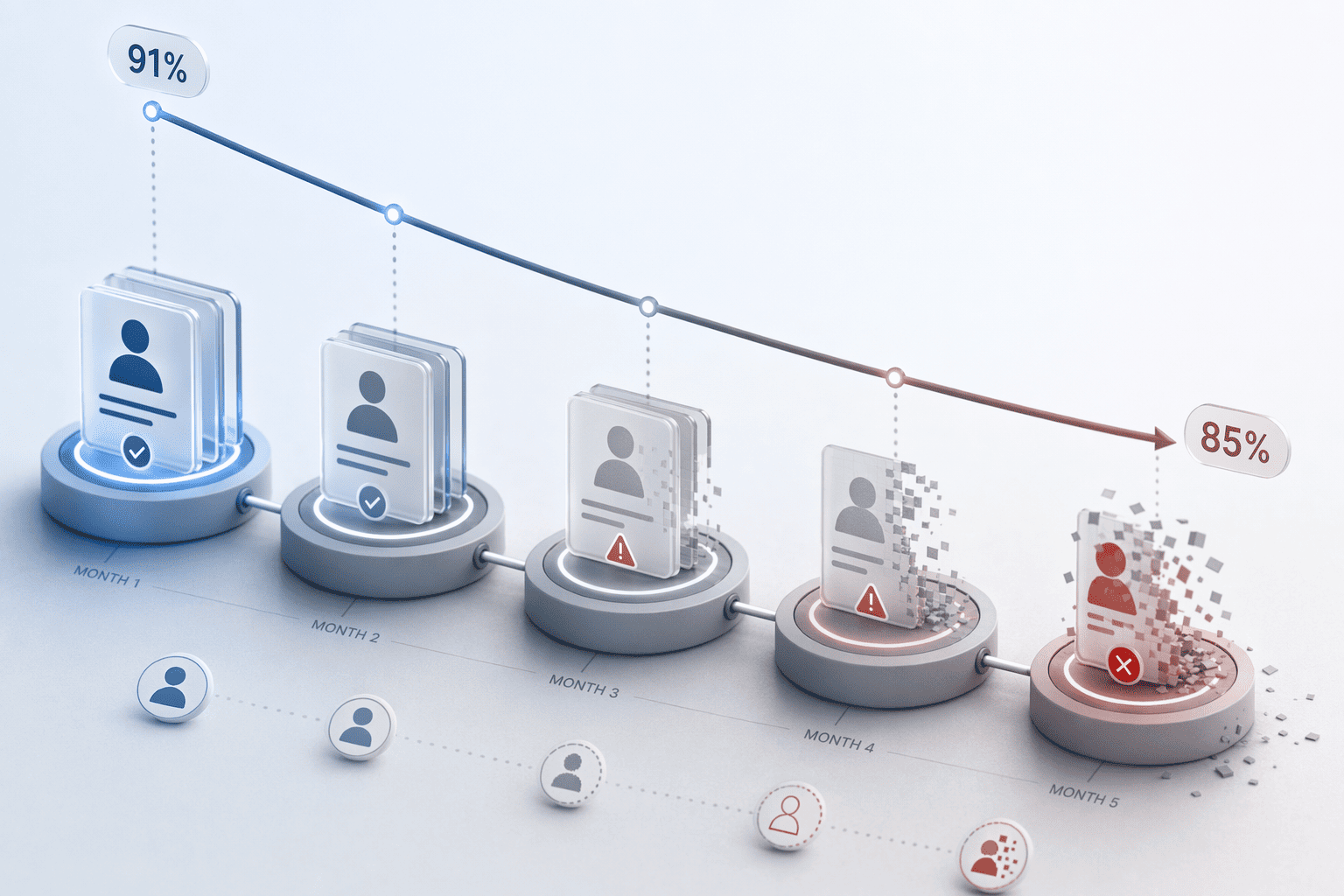
Contact databases lose 2-3% of their records to obsolescence every month as professionals change roles, companies restructure, and phone numbers reassign. A platform claiming 91% accuracy at contract signing will deliver approximately 85% accuracy after five months if the underlying database is refreshed only quarterly. Job-title changes, corporate acquisitions, and mobile-number porting drive the majority of decay. For sales teams relying on cold calling, this erosion translates directly into wasted rep hours and lower connect rates over the contract lifecycle.
Refresh Cycle Impact on Accuracy ROI
Platforms that refresh contact data every seven days maintain 98% of their initial accuracy after five months, while those updating quarterly see accuracy drop to 75% over the same period. This gap explains why annual database subscriptions often deliver diminishing returns: buyers pay the same monthly rate but receive progressively staler data. For teams making 500+ monthly dials, the effective cost-per-valid-contact rises sharply in months 6-12 even when the per-lookup price stays flat, because 20-25% of retrieved numbers no longer connect to the intended decision-maker.
Real-Time Verification vs Static Database Trade-Offs
Pay-per-verified-contact models like PeakAi's real-time verification architecture eliminate waste from expired records by validating each lookup at query time, though the unit cost ($0.85-$1.50 per contact ) runs higher than bulk database access. Credit-based platforms (Apollo, Lusha) offer lower per-lookup pricing but buyers pay for invalid contacts when databases decay between refresh cycles. The math favors real-time verification for teams prospecting fewer than 500 contacts monthly; above 2,000 contacts, bulk access with seven-day refresh cycles balances cost and accuracy if your CRM deduplicates aggressively. Join thousands of sales professionals who audit their contact-data refresh policies quarterly to prevent accuracy erosion from undermining annual contract ROI.
Knowing how data decays helps you evaluate whether a platform's verification methodology can maintain accuracy over your contract term.
Platform Comparison: Verification Methodology Transparency
What Verification Methodology Transparency Looks Like
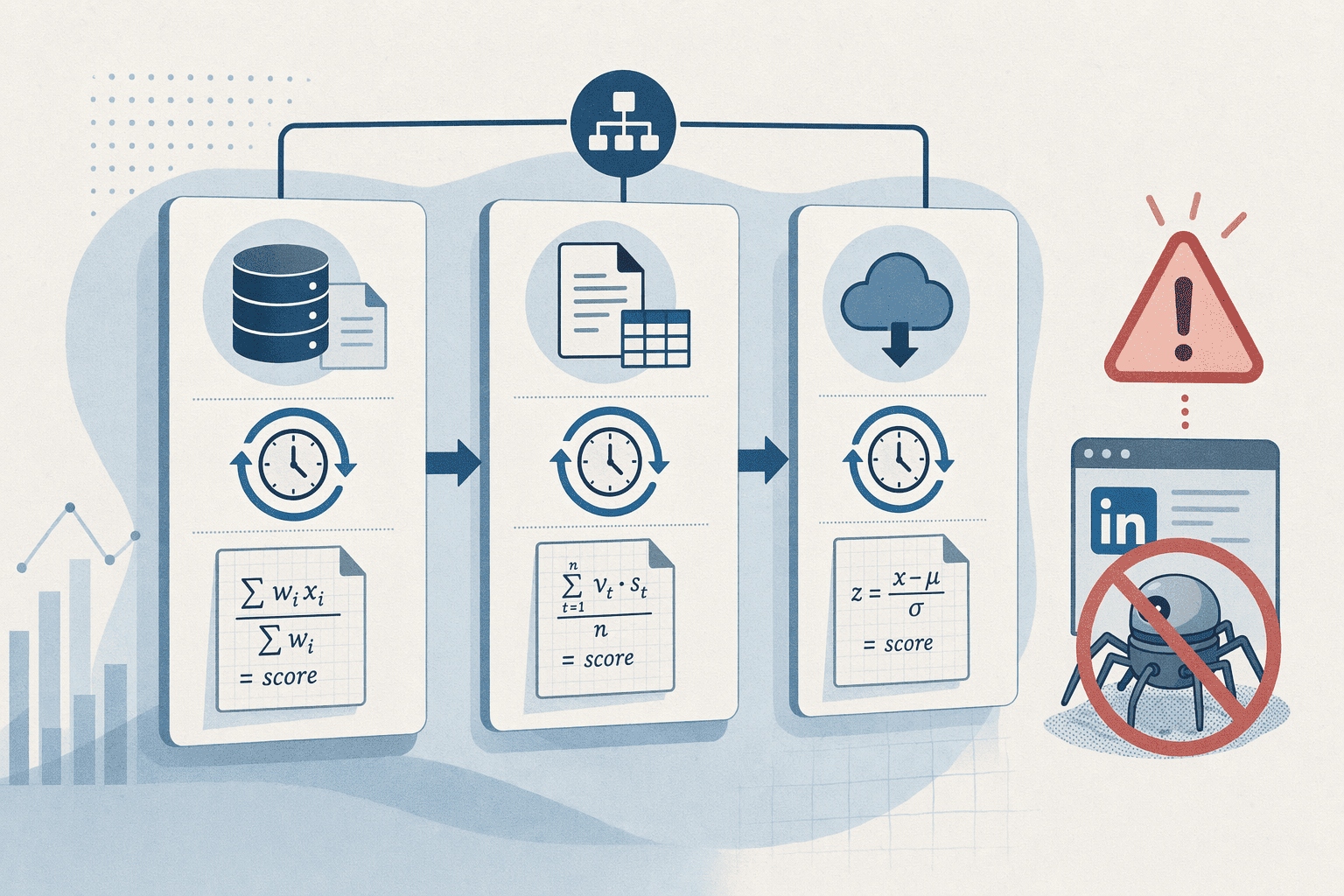
Buyers should demand three disclosures before accepting any accuracy claim: named data sources, stated refresh frequency, and explained calculation methods. A platform claiming 95% accuracy without methodology disclosure is less trustworthy than one claiming 85% with full sourcing and refresh-cycle transparency, you optimize for verifiable accuracy, not marketing hyperbole. Platforms that scrape LinkedIn for contact discovery violate Terms of Service and expose buyers to compliance risk. The table below shows which platforms meet this standard.
Platform-by-Platform Transparency Assessment
| Platform | Email Accuracy | Phone Accuracy | India Coverage | Verification Method Disclosed | Compliance |
|---|---|---|---|---|---|
| PeakAi | 91% | 91% | GST/MCA integration | Third-party databases, consent-verified sources | GDPR, CCPA, DPDP Act 2023 |
| Apollo.io | 82% | 65-80% | Moderate | Not publicly disclosed | Standard |
| Lusha | Not disclosed | Not disclosed | Moderate | Not publicly disclosed | Standard |
| ZoomInfo | Not disclosed | Not disclosed | Strongest in North America and Western Europe | LinkedIn plus corporate web | Enterprise-grade compliance tooling |
| Cognism | Not disclosed | Not disclosed | Moderate | Not publicly disclosed | Standard |
| Tomba | Not disclosed | Not disclosed | Low | Not publicly disclosed | Standard |
LinkedIn Compliance Risks in Verification Workflows
Platforms that crawl LinkedIn profiles directly or harvest contact data through bots circumvent rate limits and violate LinkedIn's terms. This exposes users to permanent account suspension. When evaluating platforms, ask: does the tool expose me to account restriction risk? ZoomInfo sources its contact graph from LinkedIn plus the corporate web, and buyers must assess whether that methodology aligns with their compliance posture. PeakAi queries independent third-party databases rather than accessing LinkedIn's internal APIs, positioning itself as a lower-risk alternative for teams that want verified contact discovery without platform policy violations.
Transparency around verification sources and methods determines whether advertised accuracy translates into actual cost efficiency for your Indian market prospecting.
Cost-Per-Verified-Contact Analysis for Indian Market
Credit-Based vs Subscription Pricing Models
Credit systems charge per lookup but burn credits at varying rates, 50-65% for phone numbers, 75-80% for emails, meaning advertised per-credit costs rarely match final spend per verified contact. Subscription models offer unlimited access but absorb waste from invalid records; teams without CRM deduplication infrastructure pay for the same contact multiple times. Neither model's list price reflects the true cost until you factor in verification rates and credit-burn waste.

Calculating Effective Cost
The formula: (Total monthly spend) ÷ (Successful verifications), adjusted for platform-specific credit burn rates. For example, PeakAi's credit-based pricing starts at ₹675 for 50 contacts, delivering roughly ₹13.50 per verified contact with credit-back guarantees for wrong numbers. Platforms that charge for failed lookups can cost more per verified contact than higher-priced alternatives with better match rates.
India Market Pricing Comparison
Below is an illustrative cost range for Indian B2B contact discovery, cost table is illustrative, not guaranteed:
| Platform | Pricing Model | Effective Cost/Contact |
|---|---|---|
| PeakAi | Pay-per-verified (₹675/50) | ₹13.50 |
| Apollo.io | Subscription ($49/mo) | Varies by volume |
| Lusha | Credit-based | Not publicly disclosed |
| ZoomInfo | Enterprise subscription | Contact for pricing |
| Cognism | Enterprise subscription | Contact for pricing |
Subscription models suit high-volume teams (>2,000 contacts/month) with CRM deduplication infrastructure; pay-per-verified models suit lower-volume teams (<500/month) who cannot absorb waste from invalid records. Join thousands of sales professionals who calculate total cost before choosing a platform, accurate contacts help close more deals when your spend reflects successful verifications, not failed lookups.
Choosing the Right Platform for Your Indian B2B Prospecting
Global platforms like Apollo and ZoomInfo offer broader multi-region coverage but deliver lower India-specific accuracy than regionally optimized platforms with GST/MCA integration, choose based on whether your target market is India-exclusive or multi-geography. Credit-based models suit high-volume teams with CRM deduplication infrastructure to absorb waste; pay-per-verified models suit teams with fewer than 500 contacts monthly who cannot tolerate invalid-record spend.

As Indian B2B contact data matures, expect regional platforms to integrate real-time telecom carrier validation and seven-day GST registry refresh cycles, raising the accuracy floor from today's 65-80% range to 90%+ within 24 months. Buyers committing to multi-year contracts today should negotiate accuracy SLAs tied to these emerging standards.
Validate contact discovery accuracy for your Indian B2B targets by requesting a 50-contact sample export from shortlisted platforms, compare results against the evaluation framework above, then explore PeakAi's India-verified contact discovery with GST/MCA integration and pay-per-verified pricing.
Frequently Asked Questions
How do I validate a contact discovery platform's accuracy claim before signing an annual contract?
Request a sample export of 50-100 contacts in your target Indian geography, then manually verify results by calling phone numbers and testing email deliverability. Calculate the actual accuracy rate before committing to annual contracts, database size claims mean little without regional validation.
What is the difference between email accuracy and phone number accuracy in contact discovery?
Email accuracy measures deliverability (whether the address accepts messages without bouncing), while phone accuracy measures connectivity (whether the number reaches the intended contact). Credit burn rates quantify this difficulty gap: 75-80% for emails versus 50-65% for phone numbers.
Why does contact data accuracy decay over time?
Professionals change jobs, phone numbers, and email addresses at 2-3% monthly. Platforms with seven-day refresh cycles maintain 98% initial accuracy after five months, while quarterly updates drop to 75%, explaining why annual database subscriptions deliver diminishing returns over time.
Do global contact discovery platforms like ZoomInfo and Apollo work well for Indian B2B contacts?
Global platforms cover India but with lower accuracy than US/Europe performance because Indian contact data requires different registries (GST/MCA) and telecom infrastructures. Indian B2B contacts disproportionately use mobile numbers, requiring regional validation layers absent in US-focused tools.
What are the LinkedIn compliance risks when using contact discovery tools?
Platforms that crawl LinkedIn profiles directly through bots violate LinkedIn's Terms of Service and expose users to permanent account suspension. Compliant platforms use API partnerships or verified third-party data sources rather than automated scraping to extract contact information.
Is pay-per-verified-contact pricing better than subscription pricing for contact discovery?
Pay-per-verified models eliminate waste from invalid records but cost $0.85-$1.50 per contact; subscription models offer $0.12-$0.50 per lookup but buyers pay for failed verifications. The better choice depends on monthly volume and tolerance for invalid-record waste.
How often should contact databases be refreshed to maintain accuracy?
Prioritize platforms with seven-day or real-time refresh cycles, they maintain 98% accuracy after five months versus 75% for quarterly updates. For the Indian market where job mobility is high, weekly refresh cycles counteract the 2-3% monthly decay rate effectively.
Sources
- Lusha vs Apollo vs ZoomInfo: B2B Contact Data Compared - theautomationsguide.com (2026)
- Apollo.io vs ZoomInfo: Which B2B Data Platform Wins on Price and Accuracy? - listicler.com
- Affordable LinkedIn Contact Discovery Tools for Startups 2026 - origami.chat (2026)
- Top 10 Business Contact Finder Tools in India to Generate High-Quality Leads - businessinsight27.wordpress.com (2026)
- Prospecting Data Intel Report 2026 - 42 Agency - intel.42agency.com (2026)
- How to Automate LinkedIn Outreach Without Getting Your Account Restricted - quicklead.io (2025)
- Is ZoomInfo Legit? Legal & Safe (2026) | Datalane Blog - www.datalane.com (2026)
- Best LinkedIn Contact Discovery Tools 2026 | High Accuracy - origami.chat (2026)
