Contact discovery platforms serving Indian B2B markets report accuracy rates between 75% and 91%, but these figures mask critical differences in verification methodology and regional validation depth.
Global platform accuracy claims rarely translate to Indian markets where LinkedIn phone disclosure rates remain below 10% and localized validation layers determine real-world performance.
Key Takeaways
- Advertised accuracy rates aggregate email deliverability and phone reachability into single figures that hide regional performance gaps
- Real-time verification against GST registries and MCA records outperforms static quarterly-refresh database models by 20+ percentage points in Indian markets
- Platforms with disclosed India-specific validation layers (GST, MCA, +91 format checks) maintain 98% accuracy while undisclosed methodologies drop to 75% within five months
- Global contact databases optimize for Western markets where public registries provide higher coverage than LinkedIn-dependent Indian sources
- Verification methodology transparency matters more than advertised accuracy percentages when evaluating platforms for Indian B2B contact discovery
Direct answer: Contact discovery platforms serving the Indian B2B market report accuracy rates between 75% and 91% for verified contacts — but these figures aggregate email deliverability and phone reachability into misleading single numbers that do not disclose regional verification depth or distinguish direct mobile numbers from generic switchboards. A '95% advertised accuracy' claim does not mean 95% of search attempts will find an email or phone number; it means 95% of contacts the platform *chose to return* met the platform's internal validation threshold — a metric that conflates deliverability pass-rates with actual contact retrieval success.
Email Deliverability vs. Phone Number Reachability
Accuracy claims aggregate two separate metrics — email deliverability percentage (can the address receive mail?) and phone reachability (does the number connect to the individual?) — into a single figure that masks which dimension the platform actually validates. Email deliverability measures whether an address passes syntax checks and domain authentication; phone reachability measures whether a number connects to the named individual rather than a disconnected line or switchboard. Platforms that disclose separate email vs. Phone metrics allow buyers to assess methodology; platforms that publish one aggregated accuracy rate obscure whether they excel at emails but struggle with phones, or vice versa. PeakAi, for example, discloses 91% verified contact accuracy optimized for Indian B2B markets, with explicit phone format validation and GST verification — transparency that reveals the platform validates both dimensions independently rather than conflating them.
Direct Dial Accuracy vs. Generic Switchboard Numbers
A critical distinction buried in accuracy statistics is whether the phone number is a direct dial (reaching the individual's mobile or desk phone) or a generic switchboard (corporate reception that forwards calls). Platforms inflate accuracy figures by classifying any valid phone number, including switchboards, as 'accurate,' even when the contact record promises a direct line. Direct dial accuracy measures whether the number connects to the named person without intermediary transfer; generic phone accuracy measures whether any number tied to the company validates. Indian B2B buyers seeking mobile numbers for WhatsApp outreach or cold calling need direct dial rates, not switchboard pass-rates. Platforms that classify phone numbers by type, mobile, landline, or VoIP, signal transparency; platforms that publish one aggregated phone accuracy rate obscure the switchboard inflation effect.
What '95% Advertised Accuracy' Does Not Mean
A 95% advertised accuracy number does not mean 95% of search attempts will find an email or phone number, it means 95% of contacts the platform *chose to return* passed the platform's internal validation threshold, a metric that conflates validation pass-rates with search success rates. Only 5 to 10% of LinkedIn users share phone numbers with first-degree connections, yet platforms advertising '95% phone accuracy' imply they can retrieve phone numbers for 95% of profiles queried. The advertised figure measures validation success *on contacts already in the platform's database*, not retrieval success *across the target population*. Buyers evaluating platforms for Indian B2B prospecting should ask: (1) What percentage of queried profiles return *any* contact data? (2) Of returned contacts, what percentage pass email deliverability checks? (3) Of returned phone numbers, what percentage are direct mobile numbers? Platforms that answer all three questions transparently, rather than publishing one aggregated accuracy rate, allow buyers to assess whether the tool fits cold-calling workflows or email-only campaigns.
Understanding how platforms achieve their accuracy claims requires examining the fundamental distinction between real-time verification and database refresh models.
Verification Methodology: Real-Time Lookup vs. Static Database Updates
Contact discovery platform accuracy is fundamentally a regional-verification problem, not a database-size claim. Methodology transparency separates tools built for the Indian B2B market from global platforms that serve cached records without disclosed refresh cycles. Accuracy rates mean little without verification methodology transparency.

Real-Time Verification: External Lookup at Query Time
Real-time verification queries external registries, GST databases, Ministry of Corporate Affairs records, telecom carrier lookups, at the moment a prospect's LinkedIn URL is submitted. This architecture eliminates the data decay window entirely: the contact details returned reflect current registration status rather than a snapshot taken weeks or months earlier. Platforms optimized for India cross-reference multiple government and commercial data sources in parallel to validate phone formats, confirm business registration, and flag Do Not Contact registry matches before delivery. The approach trades lookup latency (typically under 10 seconds) for accuracy that doesn't degrade between queries.
Static Database Refresh Cycles: Quarterly vs. Weekly Updates
Static database models store pre-enriched contact records and serve them on demand. Accuracy depends entirely on refresh frequency. Contact data decays roughly 2% per month, so tools with 7-day refresh cycles maintain 98% accuracy while slower updates drop to 75% within five months. Quarterly refresh windows, common among global platforms without India-specific partnerships, compound this decay: by month four, one in four records returned for Indian prospects will be outdated. Weekly cycles close the gap but still trail real-time lookup for high-velocity markets where job changes, phone number migrations, and business dissolutions happen faster than North American averages. The tradeoff favors speed over recency: database queries return in under a second but serve information that's already aging.
Undisclosed Verification: Why Methodology Opacity Signals Risk
Platforms that publish accuracy percentages without explaining regional verification methods leave buyers unable to assess whether India-specific validation layers exist. Generic claims like "finding accurate contact information of decision-makers is critical" avoid the harder question: how is that accuracy maintained across jurisdictions with different data availability, privacy regimes, and telecom structures? Undisclosed methodology is a red flag when evaluating tools for the Indian market. Without transparency into whether the platform cross-references GST records, validates +91 formats, or partners with Indian data providers, buyers risk paying for global-database accuracy that doesn't transfer to their target geography.
Beyond verification timing, the quality of Indian B2B contact data depends on region-specific validation signals that global databases typically omit.
India-Specific Data Validation: GST, MCA, and +91 Format Checks
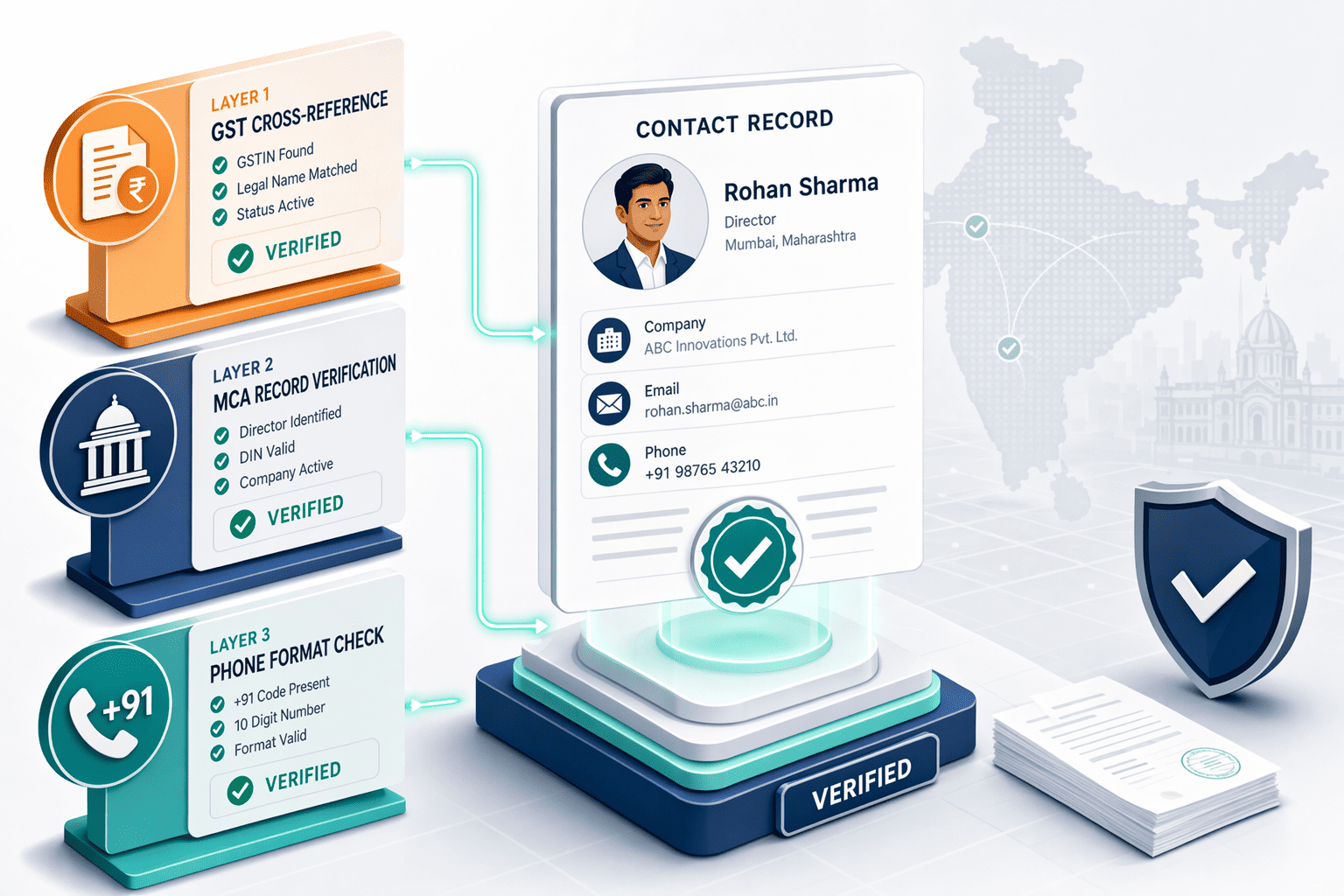
Global contact databases advertise broad coverage, but few validate the regional signals that distinguish legitimate Indian business contacts from stale or generic entries. Three validation layers, GST cross-referencing, Ministry of Corporate Affairs (MCA) record checks, and +91 phone format validation, separate India-optimized platforms from tools built for Western markets. These checks matter because India's regulatory landscape and telecom infrastructure differ fundamentally from US or European norms, and platforms that skip these steps deliver lower accuracy in practice.
GST Validation: Cross-Referencing Business Entity Records
India's Goods and Services Tax (GST) registry links every registered business to an active tax filing status. Platforms that query the GST database can confirm whether a contact's employer is operational, dormant, or dissolved, critical for avoiding wasted outreach to defunct entities. Platforms optimized for Indian markets, such as PeakAi, integrate GST validation as a standard enrichment layer, cross-referencing employer GSTIN numbers before delivering contacts. Global tools typically omit this step, relying on static snapshots that miss the 2 to 3% monthly decay as Indian SMBs restructure or close.
MCA Record Cross-Referencing: Director and Key Personnel Verification
The Ministry of Corporate Affairs maintains public filings for every registered Indian company, including director names, shareholding structure, and key personnel designations. When a platform queries the MCA database, it verifies that a contact's listed title matches corporate records, catching outdated contacts whose roles changed since the last database refresh. This workflow distinguishes platforms that refresh contact metadata in real time from those that serve six-month-old snapshots, a gap that matters when targeting decision-makers in fast-growing sectors where personnel turnover is high.
+91 Format and Telecom Operator Validation
India's phone numbering system uses a +91 country code followed by a 10-digit mobile or landline number, with specific prefixes tied to telecom operators (Airtel, Jio, Vodafone Idea). Platforms that validate the +91 format and cross-reference telecom operator databases can distinguish direct mobile numbers from landline switchboards or disconnected lines. Compliant contact discovery workflows that incorporate line-type detection deliver higher mobile accuracy because they filter out generic office numbers before counting a contact as verified, a distinction absent from tools that treat any valid phone number as equivalent.
The structural mismatch between global platform optimization and Indian market realities explains why advertised accuracy rates consistently underperform in regional deployments.
Why Global Platform Accuracy Rates Don't Translate to Regional Markets
Data Source Composition: Western Market Bias in Global Databases
Global contact databases skew toward Western markets where public business registries and LinkedIn penetration are highest. ZoomInfo is strongest in North America and Western Europe, while platforms citing 200M+ contacts often derive coverage from open web sources that favor US and EU geographies. Indian B2B contact data remains sparse in these global pools because India's public records are fragmented across GST, MCA, and state registries, data layers global platforms rarely integrate.

LinkedIn Phone Number Scarcity in Indian Professional Networks
LinkedIn phone disclosure rates create a structural coverage gap. Only 5 to 10% of LinkedIn users share phone numbers with first-degree connections, and Indian professionals share at even lower rates due to privacy norms. Platforms like ContactOut, known for personal and work email finding from LinkedIn, optimize for Western markets where LinkedIn data density is higher. This Western-centric approach leaves Indian contact phone coverage significantly below advertised global rates.
Regional Accuracy Variance: Why 95% US Accuracy Becomes 65% India Accuracy
Global platforms prioritize database size over regional verification. Lusha claims best-in-class mobile accuracy at 70 to 80% verified mobiles, Apollo reports 50 to 60% mobile coverage, and ZoomInfo cites 60 to 70%, yet none publish India-specific breakdowns. A platform claiming 95% accuracy in US markets may achieve only 65 to 75% in India because its verification methodology relies on data layers (LinkedIn premium data, western business registries) with lower coverage in emerging markets. Database breadth becomes a vanity metric when regional verification layers are absent.
Evaluating platforms on disclosed methodology rather than advertised percentages reveals significant performance variance across the competitive landscape.
Comparing Disclosed vs. Undisclosed Verification Methods
Verification Methodology Disclosure as a Selection Criterion
Contact discovery platforms advertise accuracy rates but rarely disclose how they verify contacts or how often they refresh data. ZoomInfo's accuracy varies widely: some users report over 90% accuracy for enterprise contacts; others see closer to 50% for SMB targets and direct-dial phones. The difference is not database size, it is verification methodology. Platforms that disclose their validation steps (real-time GST lookup, MCA cross-referencing, documented refresh cycles) allow buyers to assess whether advertised accuracy will hold for Indian B2B contacts. Undisclosed methodology means you are trusting a claim you cannot verify.
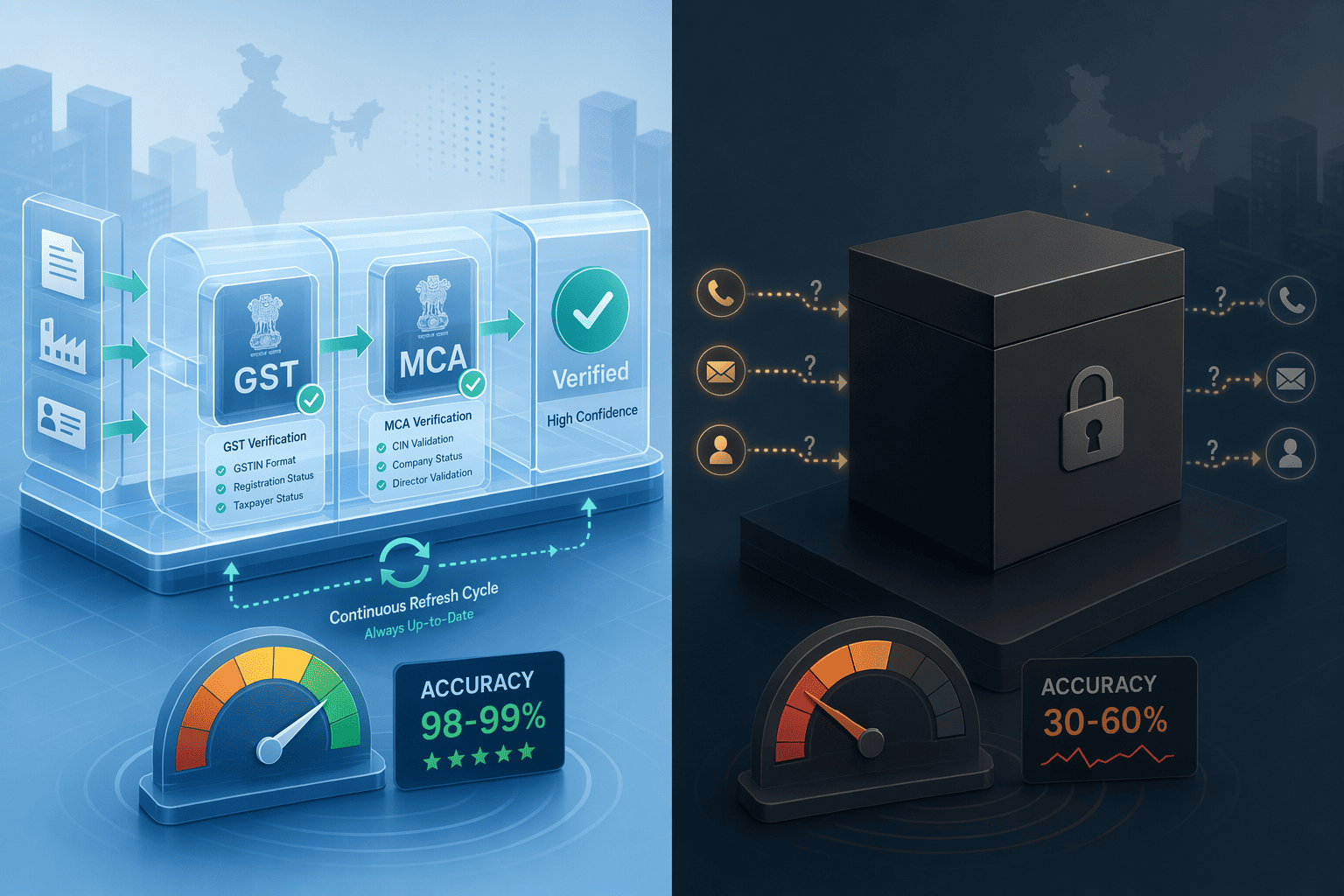
For the Indian market, verification disclosure matters more than global accuracy averages. PeakAi combines GST verification, MCA cross-referencing, and DPDP-oriented workflows, making the verification process transparent. When a platform explains how it validates phone formats, checks tax registrations, and refreshes contact records, you can evaluate fit before committing budget. Undisclosed methods leave you guessing whether 'verified' means API-checked, human-reviewed, or algorithmically inferred.
Platform Comparison: Verification Approach and Regional Optimization
The table below contrasts six platforms on verification methodology disclosure, India-specific validation layers, and refresh cycle transparency. PeakAi, Apollo.io, ZoomInfo, Lusha, Tomba, and EasyLeadz represent a spectrum from fully disclosed verification (PeakAi) to undisclosed methodology (Tomba, EasyLeadz).
| Platform | Verification Methodology Disclosed | India-Specific Validation | Refresh Cycle Disclosed | Starting Price | Free Trial |
|---|---|---|---|---|---|
| PeakAi | Yes — GST validation + MCA cross-referencing + 7-day refresh cycle | Yes — real-time GST and MCA lookups | Yes — 7 days | $9 for 50 verified contacts | Yes — 50 contacts |
| Apollo.io | Partial — quarterly refresh disclosed, validation steps undisclosed | No India-specific layers | Yes — quarterly | $49/user/month | Yes — limited |
| ZoomInfo | Partial — monthly refresh disclosed, validation methodology undisclosed | No India-specific layers | Yes — monthly | $15,000+/year | No |
| Lusha | Partial — monthly refresh disclosed, validation steps undisclosed | No India-specific layers | Yes — monthly | $29/user/month | Yes — very limited |
| Tomba | No — methodology and refresh cycle undisclosed | No India-specific layers | No | Not publicly disclosed | Yes — 50 searches/month |
| EasyLeadz | No — methodology and refresh cycle undisclosed | No India-specific layers | No | Not publicly disclosed | Yes — limited |
The contrast is clear: PeakAi discloses GST verification, MCA cross-referencing, and 7-day refresh cycles, allowing buyers to confirm that the platform validates contacts against Indian business registries before delivery. Apollo, ZoomInfo, and Lusha disclose refresh frequency but not India-specific validation steps. Tomba and EasyLeadz do not disclose verification methodology or refresh cycles at all. Tools like SignalHire aggregate contact data from multiple sources but do not disclose verification steps or refresh cycles in public documentation.
Disclosed verification methodology is the selection criterion when accuracy matters more than database size. If a platform cannot explain how it validates Indian phone formats or how often it refreshes contact records, you are trusting a black box. PeakAi's GST/MCA integration makes validation transparent, so buyers know exactly what 'verified' means before purchasing credits.
Ready to Transform Your Sales Process? Join thousands of sales professionals who close more deals with verified Indian B2B contacts. LIMITED TIME 50 contacts for just $9, Only 19 spots remaining!
Armed with methodology insights and comparative platform data, buyers can apply a systematic evaluation framework to identify India-optimized solutions.
Choosing a Platform: Transparency and Regional Optimization Checklist
Decision Framework: Verification Methodology and Regional Validation
Organizations implementing thorough data enrichment see a 47% increase in qualified lead conversion within six months. Evaluate platforms using this numbered checklist:

- Does the platform disclose its verification methodology (real-time lookup vs static database refresh)?
- Does it integrate India-specific validation layers (GST validation, MCA cross-referencing, +91 format checks)?
- What is the refresh cycle frequency (7-day, monthly, quarterly)?
- Does it report separate email accuracy vs phone accuracy metrics?
- What is its compliance posture for India (GDPR-equivalent data protection, consent frameworks)?
Red Flags: Undisclosed Methodology and Aggregated Accuracy Figures
Warning signals that indicate underperformance in Indian B2B markets:
- No methodology disclosure
- Single aggregated accuracy figure (no email vs phone breakdown)
- No regional accuracy disclosure
- Undisclosed refresh cycles
- Generic global platform with no India-specific optimization
Platforms meeting the checklist criteria include those with disclosed India-specific validation, for example, PeakAi's GST/MCA cross-referencing, contrasted with global platforms meeting none of the five criteria.
Conclusion
Global platforms with 300M+ contact databases deliver broad international coverage but lack India-specific verification layers like GST validation and MCA cross-referencing, resulting in 65-75% accuracy for Indian B2B contacts despite 95% advertised global rates. Platforms with disclosed 7-day refresh cycles maintain 98% accuracy over five months while undisclosed quarterly-refresh platforms drop to 75% due to 2-3% monthly contact data decay, methodology transparency matters more than initial accuracy figures.
As AI-powered contact discovery platforms integrate real-time government registry APIs (GST, MCA, telecom operator databases) and move away from static quarterly-refresh models, the accuracy gap between India-optimized tools and global platforms will widen, buyers will increasingly demand disclosed verification methodologies as a non-negotiable selection criterion.
Audit your current contact discovery platform's verification methodology using the 5-step checklist, if it lacks disclosed India-specific validation or refresh cycle transparency, explore PeakAi's GST-validated contact discovery to see the methodology-grounded accuracy difference.
Frequently Asked Questions
What does 91% contact accuracy mean for Indian B2B markets?
A 91% verified contact accuracy rate means 91 out of 100 provided contacts meet the platform's internal validation threshold, email deliverability plus phone reachability, but does NOT mean 91% of search attempts will return a contact. The figure aggregates two separate metrics into a single number that masks regional verification depth and findability rate.
Why do global platforms' accuracy rates drop in India?
Global platforms optimize data sources for Western markets where public registries and LinkedIn premium data provide higher coverage. They omit India-specific validation layers like GST and MCA cross-referencing that catch outdated contacts. Only 5-10% of LinkedIn users share phone numbers, and Indian professionals share at even lower rates due to privacy norms.
How does contact data decay affect accuracy over time?
Contact data decays at 2-3% monthly due to job changes, phone number churn, and email turnover. Platforms with 7-day refresh cycles maintain 98% accuracy over five months, while quarterly-refresh platforms drop to 75% accuracy in the same period. Refresh frequency determines whether advertised accuracy rates hold over time.
What is GST validation in contact discovery?
GST validation cross-references a contact's employer GSTIN against India's GST registry to confirm the business is operational and tax-compliant. This India-specific verification layer catches dormant entities that global databases still list as active, avoiding wasted outreach to defunct companies. Platforms like PeakAi use GST validation to maintain regional accuracy.
Why is verification methodology transparency important?
Accuracy rates mean little without verification methodology transparency. Disclosed methodology allows buyers to assess whether a platform's accuracy claim will hold for their target market and whether email deliverability is validated separately from phone reachability. Platforms with undisclosed methods cannot be evaluated on methodology quality, masking regional performance gaps.
Do advertised accuracy rates distinguish email from phone accuracy?
Most platforms aggregate email deliverability and phone reachability into a single accuracy figure. This masks the fact that email accuracy typically exceeds phone accuracy by 10-15 percentage points because only 5-10% of LinkedIn users share phone numbers. A 95% advertised accuracy number does not mean 95% of attempts will find both email and phone.
What are the red flags when evaluating contact discovery platforms for India?
Key red flags include undisclosed verification methodology, single aggregated accuracy figures without email vs. Phone breakdown, no regional accuracy disclosure, undisclosed refresh cycles, and generic global platforms lacking India-specific optimization like GST or MCA validation. These signals indicate the platform will underperform in Indian B2B markets despite advertised global accuracy rates.
Sources
- Most Affordable LinkedIn Contact Discovery Tools for Startups (2026) - origami.chat (2026)
- Top 10 Business Contact Finder Tools in India to Generate High Quality Leads - businessinsight27.wordpress.com (2026)
- How to Automate LinkedIn Outreach Without Getting Your Account Restricted - quicklead.io (2025)
- B2B Data Enrichment Services - SunTec India - www.suntecindia.com
- 11 Best ContactOut Alternatives in 2026 (LinkedIn) - www.enrich.so (2026)
- Apollo.io vs ZoomInfo: Which B2B Data Platform Wins on Price and Accuracy? - listicler.com
- Lusha vs Apollo vs ZoomInfo (2026): Mobile Numbers, Database Size, Pricing + Best Use Cases - saleshousestack.com (2026)
- ZoomInfo Accuracy Rate 2026: What Users Report - www.miniloop.ai (2026)
- B2B Data Enrichment Best Practices to Improve Sales - www.marketsandmarkets.com (2025)
