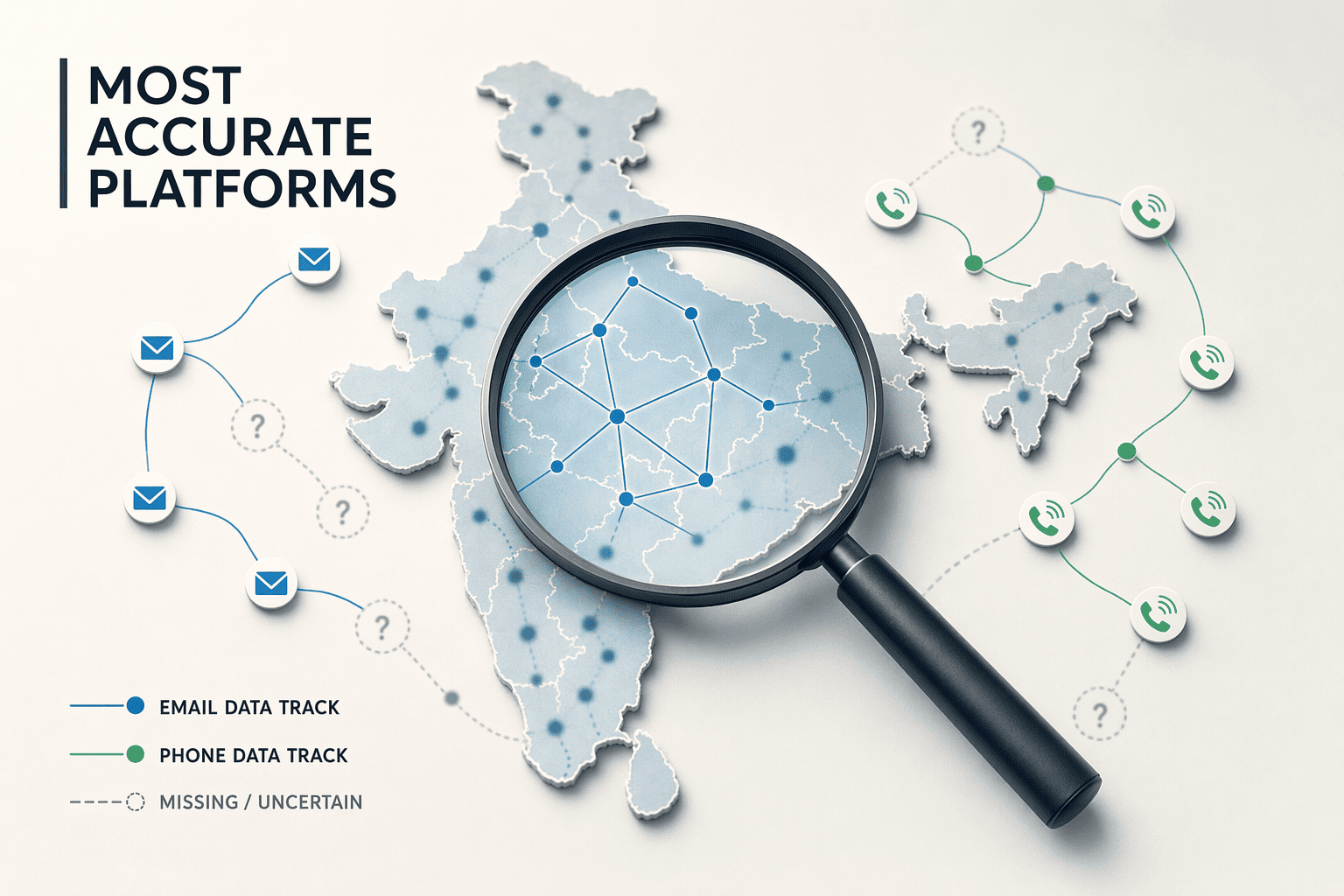
Vendor-claimed accuracy rates of 95-98% rarely reflect real-world performance for Indian B2B contacts. Independent testing reveals average accuracy closer to 50% because platforms measure syntax validation rather than deliverability.
Evaluating contact discovery tools for India requires separating email from phone metrics, understanding verification methodology depth, and identifying regional infrastructure gaps that cause global platforms to underperform.
Key Takeaways
- Advertised 95% accuracy rates mask verification methodology differences: syntax-only validation produces high pass rates but doesn't confirm contact reachability.
- Email and phone accuracy are separate metrics with different verification methods — email uses SMTP handshake testing while phone requires carrier-level connectivity validation.
- Real-time verification costs $0.85-$4 per contact but provides current accuracy, while static databases offer lower per-contact pricing but decay at 2-3% monthly.
- LinkedIn prohibits automated scraping, causing 15-20% account suspension rates for heavy users; enrichment-based tools query third-party databases instead, reducing suspension risk to under 2%.
- Global platforms lack GST/MCA database integrations and carrier-level validation APIs for India, causing 10-15 percentage point accuracy drops below US/EU benchmarks.
Why Advertised Accuracy Rates Don't Predict India Performance
Vendor accuracy claims of 95-98% rarely translate to real-world performance in the Indian B2B market. Independent testing reveals average contact discovery accuracy closer to 50% — not the advertised rates — because vendors measure syntax validation rather than connectivity or deliverability. For Indian contacts specifically, accuracy typically drops another 10-15 percentage points below global benchmarks due to regional verification infrastructure gaps that global platforms lack access to.
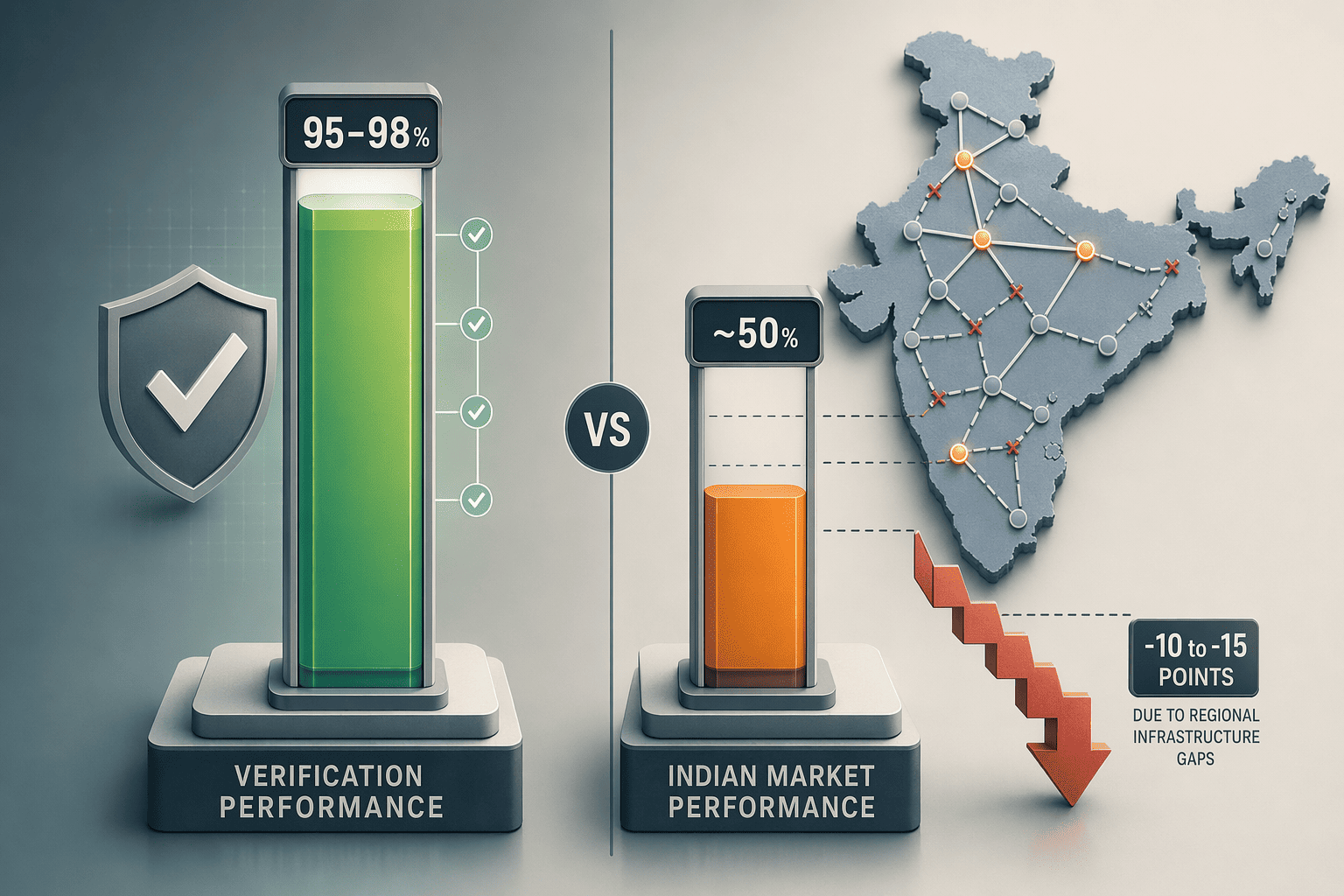
The 95% Advertised vs 50% Real-World Gap
Most vendors report accuracy after syntax-only validation: confirming that an email follows [email protected] format or a phone number contains the correct digit count. This testing method produces 95%+ pass rates but tells you nothing about whether the contact is reachable. Full deliverability testing — which includes SMTP handshake verification for emails and carrier-level connectivity checks for phone numbers — reveals the structural gap. Real-world testing shows average contact discovery accuracy closer to 50% when measured against successful connection rates rather than format validation.
Why India-Specific Accuracy Drops 10-15 Percentage Points
Regional verification infrastructure determines whether a platform can validate Indian contacts at the same depth as US or EU records. Global tools face several India-specific barriers: carrier-level API availability is limited compared to Western telecom providers, mobile number portability means numbers frequently change carriers without updating business records, prepaid SIM prevalence (over 95% of Indian mobile connections) creates churn that databases struggle to track, and GST and MCA database access requires India-specific partnerships that most global platforms lack. These gaps explain why accuracy for Indian contacts drops below 70% for tools without regional verification infrastructure, even when the same platform reports 85%+ accuracy for US enterprise contacts.
What 'Accuracy' Actually Measures in Vendor Claims
Vendor accuracy percentages conflate three distinct verification levels that produce vastly different results. Syntax validation checks format only ([email protected] structure, 10-digit phone format) — this is what most 95%+ claims measure. SMTP handshake testing confirms the email server accepts messages to that address but doesn't verify the recipient reads them. Full deliverability testing adds inbox placement verification and spam-filter outcomes. For phone numbers, format validation confirms digit count; connectivity verification tests whether the number accepts calls via carrier APIs. Understanding which layer a vendor measures explains why find accurate contact information requires evaluating verification depth, not just advertised percentages.
Understanding why advertised accuracy doesn't predict India performance requires examining how platforms measure contact quality, starting with the fundamental difference between email and phone verification methods.
Email Accuracy vs Phone Accuracy: Why They're Separate Metrics
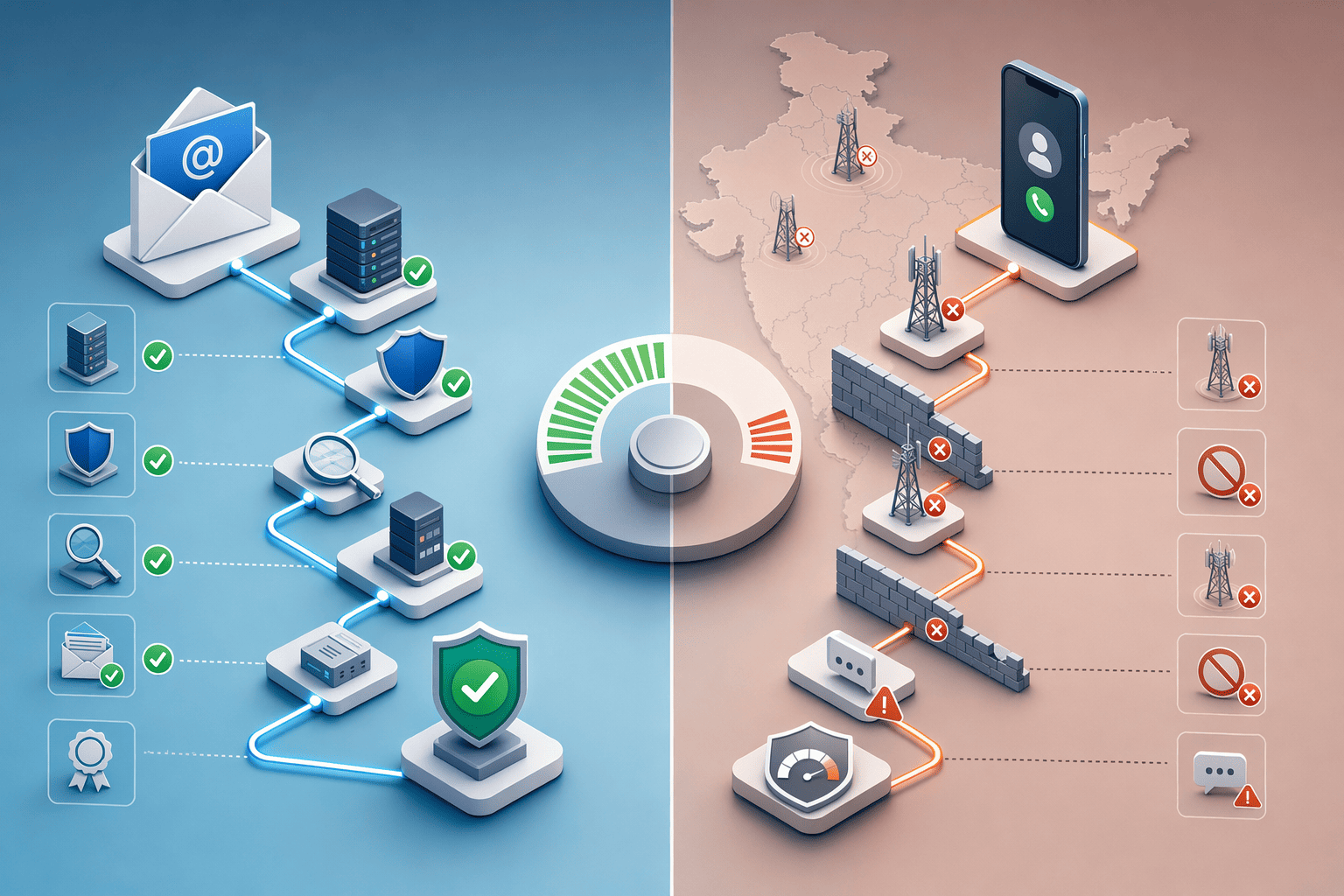
Most contact discovery platforms advertise a single 'accuracy rate', but that figure often masks a critical gap. Email verification and phone verification rely on fundamentally different technical methods, and conflating them into one metric hides the reality that phone accuracy consistently lags email accuracy by 15-30 percentage points, especially in markets like India where carrier-level data access is restricted.
Different Verification Methods for Email vs Phone
Email verification operates through a well-established technical pipeline: syntax validation confirms the address follows RFC 5322 standards, SMTP handshake testing pings the recipient mail server to verify the mailbox exists without sending a message, and catch-all detection flags domains that accept mail to any address. These steps happen in seconds and return binary confirmation, the email either passes all checks or it doesn't. Platforms like PeakAi deliver 91% accuracy with real-time email verification by layering syntax checks, SMTP validation, and catch-all detection before contacts enter your CRM.
Phone verification is structurally harder. Carrier-level connectivity testing requires API agreements with telecom providers, number portability checks must account for subscribers switching carriers while keeping the same mobile number, and format validation alone cannot confirm a number is currently active. The result: advertised phone accuracy rates across the industry vary widely, with best-in-class platforms like Lusha achieving 70-80% verified mobiles while mid-tier tools like Apollo report 50-60% mobile coverage. The gap reflects methodology differences, not just database size.
Structural Data Gaps: LinkedIn Phone Sharing Rate
Platform-level privacy architecture creates unavoidable coverage floors. Only 5-10% of LinkedIn users share phone numbers with first-degree connections, and even fewer expose them to second- or third-degree connections. This structural constraint means no contact discovery tool, regardless of verification sophistication, can retrieve phone numbers that users have explicitly hidden. Email addresses, by contrast, appear more frequently in public profiles, company directories, and professional bios, giving enrichment platforms a broader surface area to verify against. Tools that aggregate multiple data sources and use verification algorithms to provide accurate emails, phone numbers, and professional profiles still hit this LinkedIn visibility ceiling on phone data.
India-Specific Phone Verification Challenges
Carrier-level API availability in India remains inconsistent compared to US and EU markets. Major Indian telecom operators restrict third-party access to number verification endpoints, forcing contact discovery platforms to rely on indirect signals, public business directories, regulatory filings, and user-contributed data, rather than direct carrier confirmation. Mobile number portability adds complexity: a subscriber who switched from Airtel to Jio retains the same number, but legacy databases may still route verification requests to the wrong carrier. Prepaid SIM prevalence compounds the issue, as prepaid numbers churn faster than postpaid plans and lack the institutional validation that comes with corporate billing accounts. These infrastructure gaps explain why phone accuracy for Indian contacts drops below 70% without regional specialization, even when email accuracy remains above 85%.
Platforms like PeakAi that use enrichment-based methods rather than direct scraping can maintain email verification accuracy while reducing account suspension risk, but the phone accuracy ceiling for Indian contacts reflects carrier-infrastructure constraints that no vendor can fully bypass through methodology alone.
Beyond email versus phone accuracy, the timing of verification determines both cost and data freshness, a trade-off that affects every contact discovery budget.
Real-Time Verification vs Static Database Lookup: Cost and Freshness Trade-offs
How Real-Time Verification Works
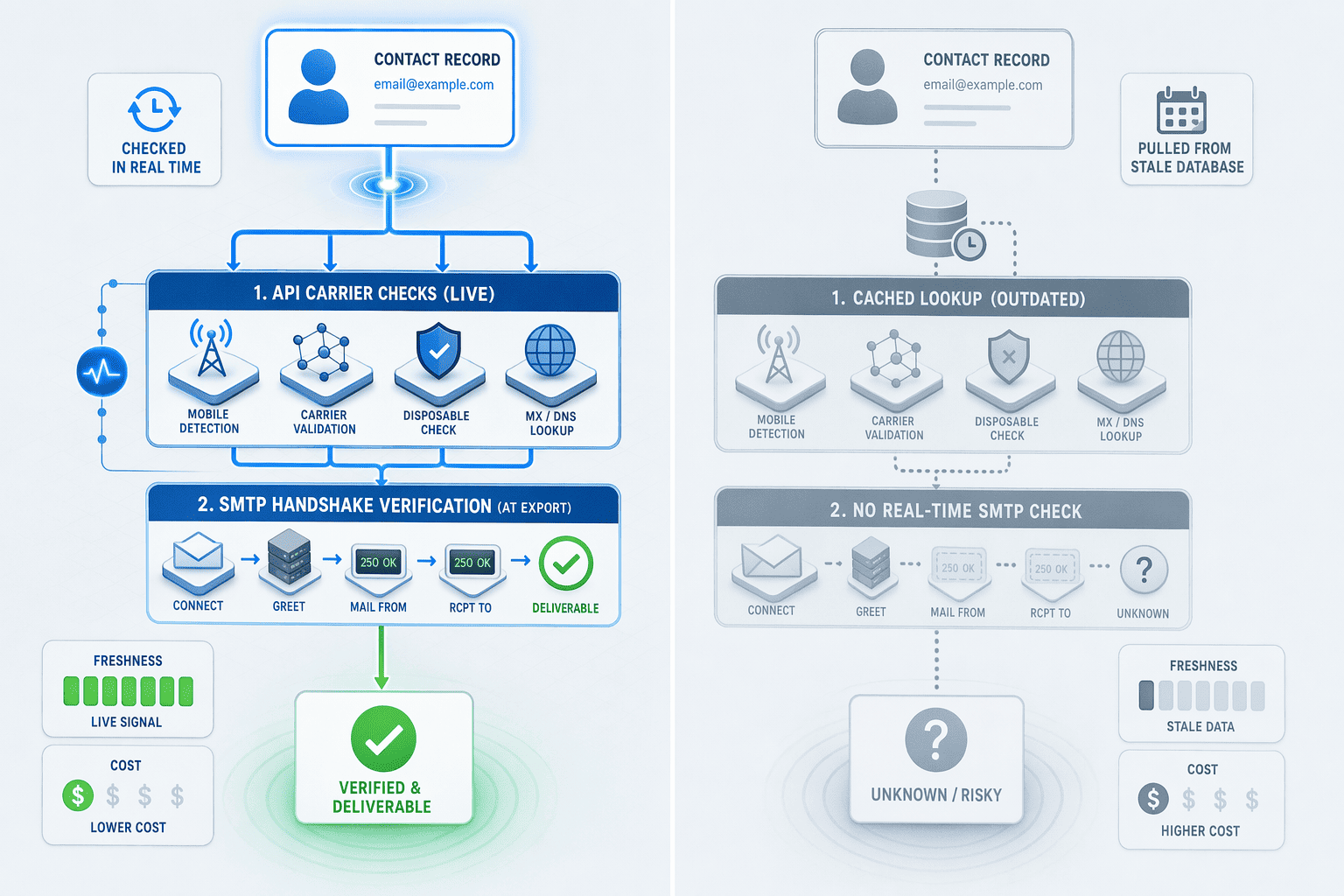
Real-time verification validates contact details at query time through API-based carrier checks and SMTP handshake testing. When you export a contact, the platform queries 200+ network data partners, verifies phone number format and active status, and confirms email deliverability before charging your account. This guarantees current accuracy but drives cost-per-verified-contact to $0.85, $4, depending on data depth and verification layers. PeakAi includes verification in base pricing and charges only when verification confidence is high, eliminating wasted credits on undeliverable contacts.
Static Database Decay Rates
Pre-verified bulk databases offer lower upfront cost, typically $49, $149 per user monthly, but contact data decays at 2 to 3% per month as professionals change jobs, emails, and phone numbers. A 500-contact export validated in January reaches 18% stale by mid-year. Credit-based models obscure true cost when match rates fluctuate: a $49 plan promising 10,000 contacts delivers far fewer usable records after bounce rates hit 22 to 38%, forcing teams to over-purchase credits.
Pre-Download Confidence Indicators
Modern platforms now surface verification status before export, showing last-verified date, data source freshness, and confidence scores, so buyers can assess credit-burn risk upfront. This pre-download transparency avoids false-positive cost absorption: you see which contacts passed recent SMTP checks versus stale database matches. PeakAi's pay-per-verified model eliminates guesswork by deducting credits only after successful verification, ensuring every contact charged meets current accuracy thresholds.
| Dimension | Real-Time Verification | Static Database Lookup |
|---|---|---|
| Verification Timing | At query time (point of export) | Pre-verified in batch (monthly/quarterly refresh) |
| Freshness | Current (validated within seconds) | Decays 2-3% monthly |
| Cost Model | $0.85–$4 per verified contact | $49–$149/user/month with credit bundles |
| Credit Burn Risk | Low (pay only for verified) | High (22-38% bounce rates absorb credits ) |
| Accuracy Range | 85-95% (depends on verification depth) | 75-85% at purchase, declines over time |
Ready to Transform Your Sales Process? Join thousands of sales professionals who find accurate contact information and close more deals with verified data.
Verification timing matters, but so does data sourcing method. LinkedIn's compliance enforcement creates a structural risk that separates compliant enrichment-based tools from prohibited scraping approaches.
LinkedIn Compliance Models: Scraping vs Enrichment-Based Tools
Why Scraping-Based Tools Trigger Account Restrictions
LinkedIn is actively hostile to automation because automated extraction at scale degrades user experience. The platform's algorithms detect automation patterns, flag suspicious activity, and restrict accounts aggressively. Tools that route actions through proxy IPs, headless browsers, or API scraping from cloud servers trigger multiple detection signals simultaneously, session origins that don't match your account history, inconsistent session data, and behavioral patterns divergent from genuine human use.
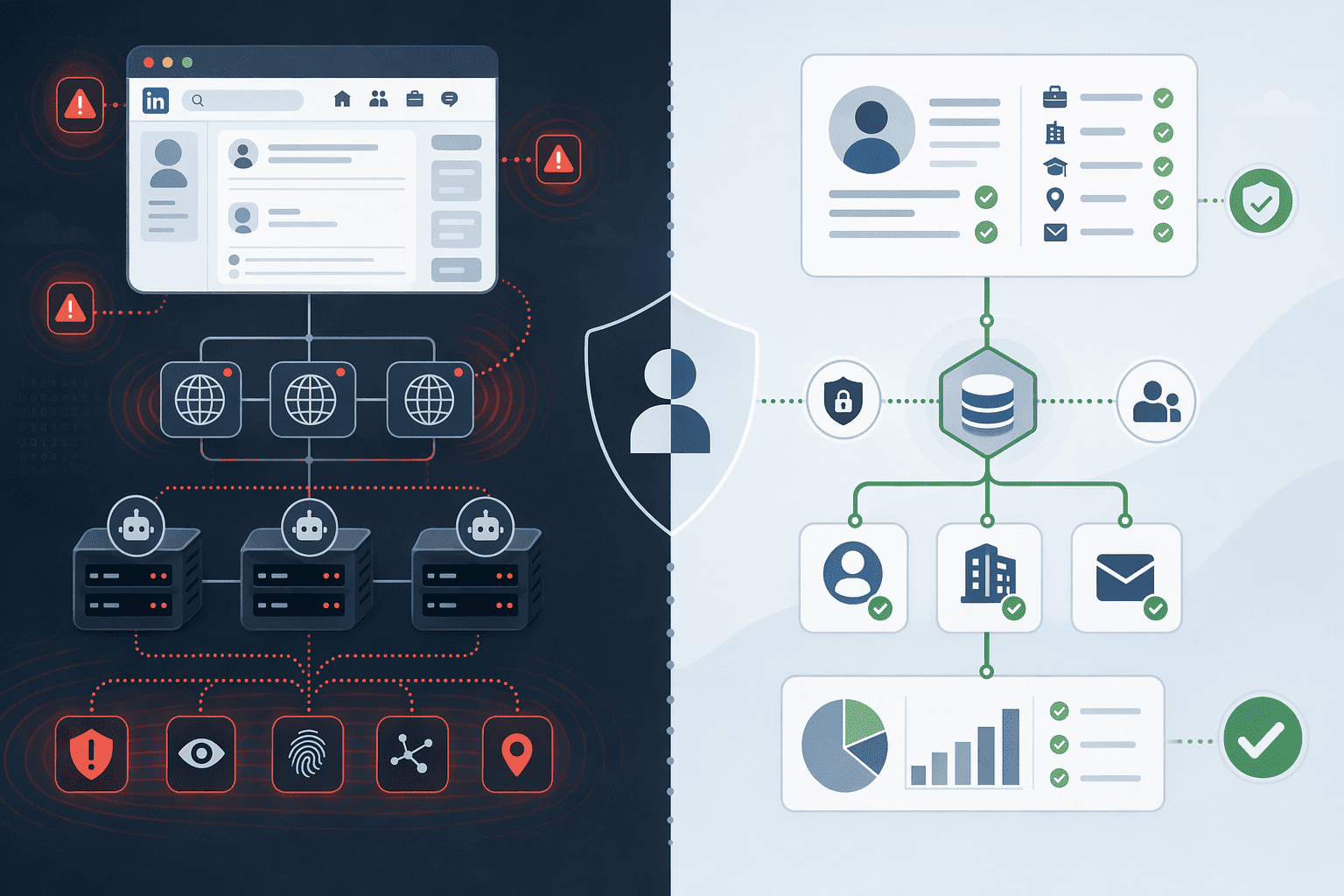
The compliance cost is measurable: roughly 40% of accounts using non-compliant automation tools received some form of restriction between January and March 2026. When tools crawl LinkedIn profiles directly, harvest contact data through bots, or circumvent rate limits, they violate LinkedIn's terms and expose users to permanent account suspension.
How Enrichment-Based Tools Avoid ToS Violations
Enrichment-based platforms sidestep these risks by changing the data source entirely. Instead of extracting contact details directly from LinkedIn profiles, they use LinkedIn profile URLs as reference identifiers to query independent third-party databases, legitimate business databases and public records that aggregate contact information outside LinkedIn's ecosystem. PeakAi, for example, uses this enrichment-based compliance method, querying third-party databases rather than scraping LinkedIn profiles. Because the tool never accesses LinkedIn's internal APIs or crawls profile data, it operates within LinkedIn's terms of service and reduces account suspension risk to under 2%.
Compliance Red Flags to Audit Before Committing
Before selecting a contact discovery platform, audit these questions to evaluate the vendor's compliance model:
- Does the tool require your LinkedIn username and password? (Credential handoff is a red flag for proxy-based scraping.)
- Does it reveal contact data instantly without third-party database lookup latency? (Instant reveals indicate prohibited on-platform extraction.)
- Does it display phone numbers that aren't publicly visible on the LinkedIn profile? (If yes, it's pulling from external sources, confirm those sources are legitimate business databases, not scraped LinkedIn data.)
- Does the vendor publish compliance documentation, exportable consent records, and GDPR/CCPA policies? (Absence signals weak compliance posture.)
Ready to Transform Your Sales Process? Join thousands of sales professionals who find accurate contact information and close more deals with compliant enrichment tools.
Compliance models address one risk layer, but regional infrastructure gaps create a second accuracy barrier specific to Indian contacts, one that even compliant global platforms struggle to overcome.
India-Specific Verification Infrastructure Gaps That Cause Global Platforms to Underperform
Global contact discovery tools often underperform in India because they lack access to regional verification infrastructure that determines whether a mobile number is active, belongs to the stated contact, and routes to the right carrier network.

Carrier-Level API Availability for Phone Verification
Most global platforms validate Indian mobile numbers using format-only checks, confirming a number follows the +91-XXXXX-XXXXX pattern without testing whether it connects. Carrier-level validation APIs that query Airtel, Jio, or Vodafone networks directly are region-gated and require local partnerships. Without these integrations, accuracy for Indian contacts drops below 70%.
GST and MCA Database Access Gaps
India-specialized platforms like PeakAi integrate with GST registration and Ministry of Corporate Affairs databases to enrich company and contact data, providing verification capabilities that global platforms lack. Apollo.io has strong metro-city coverage in Bengaluru, Hyderabad, Pune, NCR, and Mumbai, but its database was built for the US and extended to India as an afterthought.
Mobile Number Portability and Prepaid SIM Complexity
India's mobile number portability between carriers and high prepaid SIM prevalence create additional verification friction. A number issued by Airtel may now route through Jio, and prepaid numbers churn frequently. Global platforms don't account for portability lookups or prepaid validation, while India-focused tools like PeakAi cross-reference multiple data sources to close more deals.
Recognizing these infrastructure gaps clarifies what to audit before committing to a platform, turning vendor claims into testable, trial-period benchmarks.
How to Audit Vendor Accuracy Claims Before Committing
Accuracy claims vary dramatically across contact discovery platforms, yet most vendors publish single combined metrics that obscure email-versus-phone performance and regional variations. Before committing credits or signing annual contracts, buyers should conduct structured audits during trial periods to validate advertised rates against real-world prospecting targets.

Methodology Transparency Questions to Ask
When evaluating platforms, request detailed answers to these audit questions:
- What verification layers does the platform apply, syntax-only, SMTP handshake, or full deliverability testing?
- Does the vendor source data through legitimate business databases and public records, or through scraping that violates LinkedIn's Terms of Service?
- Are email accuracy and phone accuracy reported separately, or combined into a single metric that obscures channel-specific performance?
- Does the platform provide region-specific accuracy breakdowns (India versus US/EU), or only global averages that may not reflect your target market?
- What infrastructure supports Indian contact validation, GST verification, MCA database integration, local phone format validation?
- When was the accuracy rate last measured, and does the vendor publish ongoing test results or rely on a single historical audit?
- Does the platform require LinkedIn credentials or operate within LinkedIn's terms through third-party enrichment?
- Are refunds or credit-backs provided for incorrect data, and what constitutes a verified versus unverified contact in the vendor's model?
Platforms that provide pre-download confidence scores and separate email versus phone accuracy metrics, like PeakAi for Indian B2B contacts, allow buyers to audit match rates before committing credits.
Trial-Period Audit Steps
Conduct a controlled accuracy test during the trial window:
- Export a sample of 50-100 contacts matching your ideal customer profile (geography, seniority, industry) from the platform.
- Manually verify a random subset of 25-30 contacts by calling phone numbers and sending test emails to gauge deliverability.
- Calculate the true positive rate separately for emails and phone numbers, divide verified contacts by total contacts tested.
- Compare the platform's advertised accuracy against your measured rate; a gap larger than 10 percentage points signals inflated claims.
- Document any regional performance discrepancies (tier-1 cities versus tier-2, metro versus non-metro contacts).
- Test bounce rates on a small cold email campaign using the trial data; sustained bounce rates above 5% indicate poor verification depth.
Trial access lets teams validate claims before scaling, platforms offering refunds for incorrect data reduce financial risk during the audit phase.
Red Flags That Indicate Inflated Claims
Watch for these warning signs when reviewing vendor accuracy statements:
- Single combined accuracy metric without email-phone separation obscures channel-specific performance.
- No India-specific accuracy data or regional performance breakdown when targeting Indian B2B contacts.
- Instant contact reveal without visible database lookup latency suggests pre-cached data that may be outdated.
- Platform requires LinkedIn credentials or login, a compliance risk that violates LinkedIn's Terms of Service.
- Advertised accuracy rates exceed 95% globally without methodology disclosure or independent verification.
- No refund policy or credit-back guarantee for incorrect data shifts verification risk entirely to the buyer.
Join thousands of sales professionals who close more deals by validating vendor claims before committing annual budgets to unverified platforms.
Conclusion
Global platforms like Apollo and ZoomInfo offer larger total database sizes but lack GST/MCA integrations and carrier-level validation APIs for India, causing 10-15 percentage point accuracy drops. India-specialized platforms like PeakAi prioritize regional verification infrastructure over global coverage breadth. Real-time verification delivers current accuracy at $0.85-$4 per contact, while static database credits cost less per contact but decay 2-3% monthly, high-value outreach justifies real-time cost, large-scale prospecting favors static bulk pricing.
As India's B2B SaaS market grows and GST/MCA database access becomes standard for contact verification platforms, expect the accuracy gap between global and India-specialized tools to narrow, but compliance risk from LinkedIn scraping will remain a differentiator for enrichment-based approaches.
Audit your contact discovery accuracy using the methodology transparency questions and trial-period testing steps from this guide, then explore PeakAi's enrichment-based approach with India-specific verification infrastructure and separate email/phone accuracy metrics.
Frequently Asked Questions
Why can't contact discovery tools guarantee 95% accuracy?
Vendor-claimed 95% accuracy reflects syntax validation, confirming email format or phone digit count, rather than deliverability testing. Independent testing shows real-world accuracy closer to 50% because syntax checks don't verify whether contacts are reachable. Data also decays at 2-3% monthly as professionals change jobs and contact details.
Is scraping LinkedIn allowed for contact discovery?
LinkedIn's Terms of Service prohibit automated scraping, and heavy scraping users face 15-20% account suspension rates. Enrichment-based tools avoid violations by using LinkedIn URLs as reference identifiers to query independent third-party databases, reducing suspension risk to under 2% while maintaining compliance.
Why does email accuracy differ from phone accuracy for Indian contacts?
Email verification uses SMTP handshake testing to confirm deliverability, while phone verification requires carrier-level connectivity testing. LinkedIn's 5-10% phone sharing rate creates structural data gaps. Indian telecom operators restrict third-party API access, forcing platforms to rely on indirect signals like public directories rather than real-time validation.
What causes contact discovery accuracy to drop for Indian contacts?
Global platforms lack carrier-level validation APIs for Indian mobile numbers and don't integrate with GST/MCA databases for company validation. Telecom operators restrict third-party verification endpoint access, forcing reliance on format-only checks. Mobile number portability and prepaid SIM prevalence add complexity, causing 10-15 percentage point accuracy drops below US/EU benchmarks.
Should I choose real-time verification or static database lookup?
Real-time verification validates contacts at query time through carrier checks and SMTP handshakes, costing $0.85-$4 per verified contact. Static databases offer lower per-contact cost but decay at 2-3% monthly. Choose real-time for high-value outreach where freshness justifies cost; use static for large-scale prospecting prioritizing volume over perfect accuracy.
How can I audit a contact discovery platform's accuracy claims before buying?
Export 50-100 Indian contacts during free trial, manually verify a sample via LinkedIn messaging or phone calls, then calculate true positive rate separately for email and phone. Compare against vendor's claimed accuracy. Request methodology transparency: whether they use syntax-only, SMTP, or deliverability testing, plus regional performance breakdown for India versus US/EU markets.
What are the red flags that a contact discovery tool is using prohibited scraping?
Warning signs include requiring LinkedIn login credentials, revealing contacts instantly without third-party database lookup latency, showing non-public phone numbers immediately, lacking pre-download confidence indicators, and not explaining enrichment methodology. These indicate direct scraping rather than compliant enrichment-based querying, exposing users to 15-20% account suspension risk.
Sources
- Best Tools For Contact Discovery - www.landbase.com (2026)
- Lusha vs Apollo vs ZoomInfo (2026): Mobile Numbers, Database Size, Pricing + Best Use Cases | Sales House - saleshousestack.com (2026)
- Top 10 Business Contact Finder Tools in India to Generate High-Quality Leads - businessinsight27.wordpress.com (2026)
- Apollo vs ZoomInfo vs RocketReach 2026 | B2BSalesTools - b2bsalestools.com (2026)
- Best B2B Contact Databases in 2026, Ranked by Accuracy - oneaway.io (2026)
- LinkedIn Outreach Automation: How We Do It Without Getting Banned | by Talha Fakhar - talhafakhar.medium.com (2026)
- How to Automate LinkedIn Outreach Without Getting Banned - northlight.ai (2026)
- Best India Company Data Providers for B2B Sales in 2026 - pintel.ai (2026)
- Need recommendations for B2B contact data providers in India - www.reddit.com
