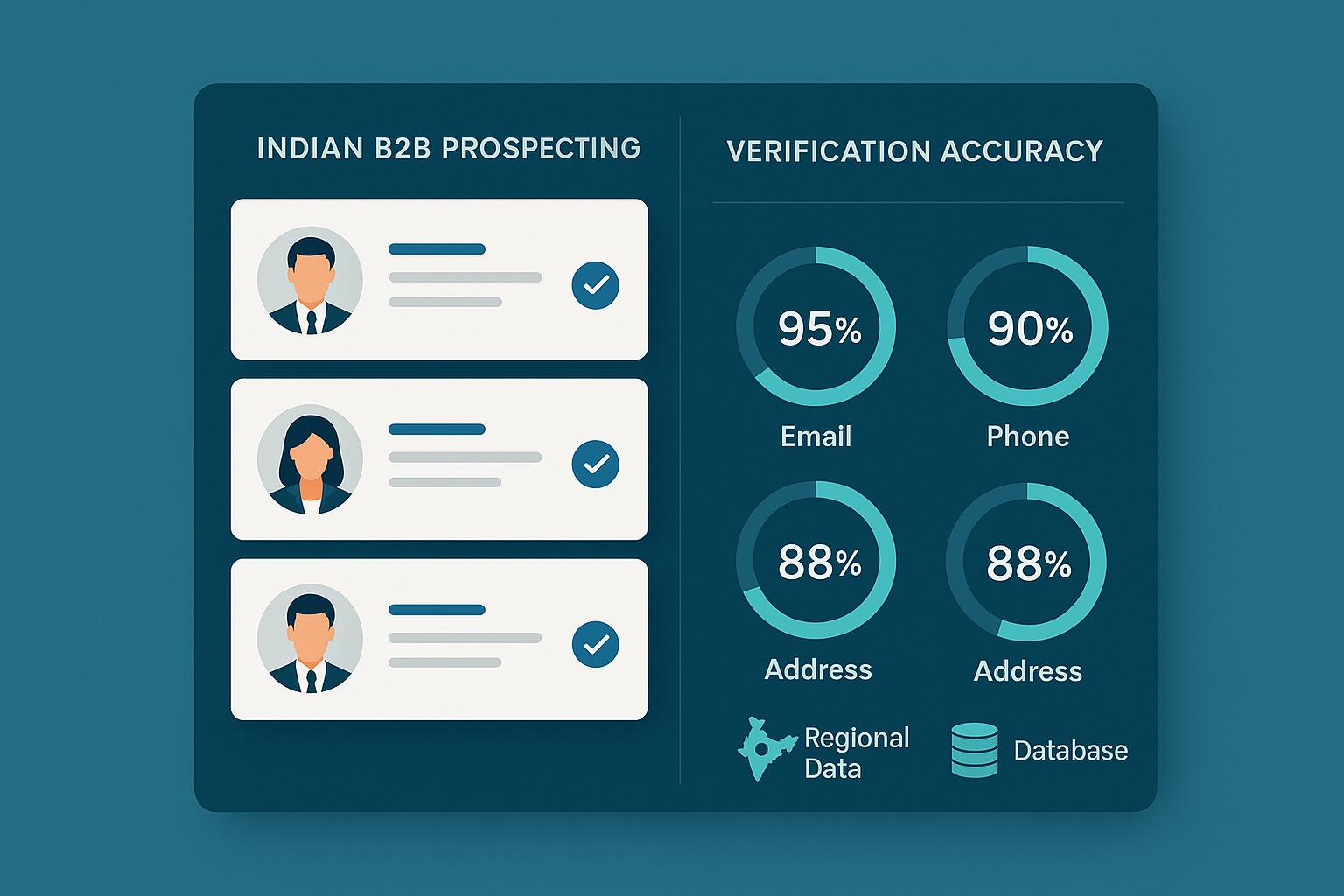
LinkedIn contact discovery tools extract professional email addresses and phone numbers from LinkedIn profiles, enabling B2B prospecting across Indian markets where direct-dial accuracy and database coverage vary significantly by regional data quality.
Key Takeaways
- Tools claiming 90%+ accuracy for Indian B2B contacts typically measure email deliverability and phone connectivity separately, with verification methodologies ranging from multi-source cross-referencing to static database lookups that decay at roughly 3% per month [4].
- Indian contact data requires integration with GST and MCA registries for current verification, as MSME contact churn outpaces global averages and LinkedIn profiles rarely display phone numbers—only 5-10% share with first-degree connections.
- DPDP Act 2023 requires explicit consent for personal data processing in India [6], making tools that source from legitimate business databases more compliant than LinkedIn scrapers that risk account suspension under platform Terms of Service.
- Cost-per-verified-contact varies from approximately $0.85-1.50 for specialized regional platforms to $2-4 for enterprise global solutions, with real-time verification commanding premium pricing over 90-day refresh cycles.
- Phone number accuracy matters more than email for Indian B2B outreach in industries where WhatsApp and voice calls drive engagement, while email verification suits sectors with formal procurement workflows.
Introduction
Tools claiming 90%+ accuracy for Indian B2B contacts typically measure email deliverability and phone connectivity separately, with verification methodologies ranging from multi-source cross-referencing to static database lookups that decay at roughly 3% per month. According to Salesmotion [4], independent testing shows most providers deliver only about 50% accuracy on average, making the 90%+ claim a critical benchmark to evaluate against actual verification source and refresh frequency. LinkedIn email finder tools and Chrome Extensions extract professional emails directly from LinkedIn profiles or search results [3], but only a small fraction of Indian LinkedIn users share phone numbers—5-10% with first-degree connections and less than 1% with second- or third-degree connections. This structural limitation means achieving 90%+ phone accuracy for Indian B2B prospects requires verification sources beyond LinkedIn's public profile data, such as government registries, business databases, and multi-source enrichment workflows.

What 90%+ Accuracy Really Means for LinkedIn Contact Discovery in India
Defining Accuracy: Email vs. Phone vs. Combined Metrics
Accuracy claims split into three measurement categories: email deliverability, phone connectivity, and combined contact-reveal success rate. Verified records are often cited around 90–95%, but this figure typically applies to email verification accuracy rather than phone number discovery. Skrapp claims 97% verification accuracy for LinkedIn email extraction [7], measuring whether the email address passes server validation rather than whether the contact opens messages or responds. Phone accuracy measures whether a revealed number connects to the intended contact, which requires real-time carrier validation and cross-referencing against business registries. For Indian B2B prospects, email accuracy alone is insufficient—sales teams need verified direct-dial mobile numbers for WhatsApp outreach and voice calls, where engagement rates exceed email by 20-40% in mid-market and MSME segments.
Regional Data Quality Variation Across Indian Markets
Global databases deliver lower accuracy for Indian contacts because coverage depth varies by city tier and industry vertical. Apollo.io has partial India coverage [2], while Kaspr focuses primarily on European contacts with some US data [5]. Tools optimized for Tier 1 cities like Mumbai and Bengaluru show higher accuracy than those targeting Tier 2-3 markets where business contact churn accelerates due to MSME turnover. A mid-sized telesales company in Chennai serving SaaS clients saw a 40% increase in qualified leads over 3 months by integrating real-time lead tracking, demonstrating that regional data freshness directly impacts conversion outcomes. India-specific databases integrate GST registration records and MCA director identification numbers to verify current employment and contact details, reducing the impact of monthly decay rates that undermine static global databases.
Testing Methodology and Verification Source Transparency
Few providers publish their accuracy testing methodology, sample size, or segment breakdown. When evaluating a 90%+ claim, ask whether the vendor tests against Indian B2B segments specifically or reports global averages that may not apply to regional markets. Verification sources matter as much as the accuracy figure itself—tools pulling from over 150 sources with real-time validation [5] deliver fresher data than platforms relying on single-database snapshots refreshed quarterly. Independent testing reveals accuracy gaps: Salesmotion reports that teams pairing contact data with account intelligence and buying signals see 20-40% higher conversion rates [4], suggesting that raw accuracy alone is less predictive of sales outcomes than contextual enrichment depth.
Why Indian B2B Contact Data Decays Faster Than Global Averages
MSME Contact Churn and Monthly Decay Rates
According to Salesmotion [4], B2B data decays at roughly 3% per month as contacts change roles, companies restructure, and phone numbers port to new users. Indian MSME segments experience higher churn due to startup failure rates, rapid hiring cycles in tech hubs, and mobile number portability that disconnects old contact records from current users. Static databases refreshed quarterly can drop to about 50% accuracy within six months [4], making real-time verification and 90-day refresh cycles critical for maintaining usable contact quality. Tools that verify contacts at the moment of reveal, rather than relying on pre-built lists, minimize the impact of decay by pulling current data from live sources each time a user requests a contact.
LinkedIn Profile Completeness Gaps in India
LinkedIn users in India rarely populate phone numbers or personal email addresses in their public profiles. Only 5-10% of users share phone numbers with first-degree connections, and less than 1% share with second- or third-degree connections, limiting the effectiveness of scraping strategies that rely solely on profile data. This structural gap means tools claiming 90%+ phone accuracy for Indian contacts must source numbers from external databases, such as business registries, telecom providers, or corporate directories, rather than extracting them directly from LinkedIn. Email addresses listed on LinkedIn profiles tend to be corporate domains that change when contacts switch employers, requiring continuous re-verification against current company email patterns.
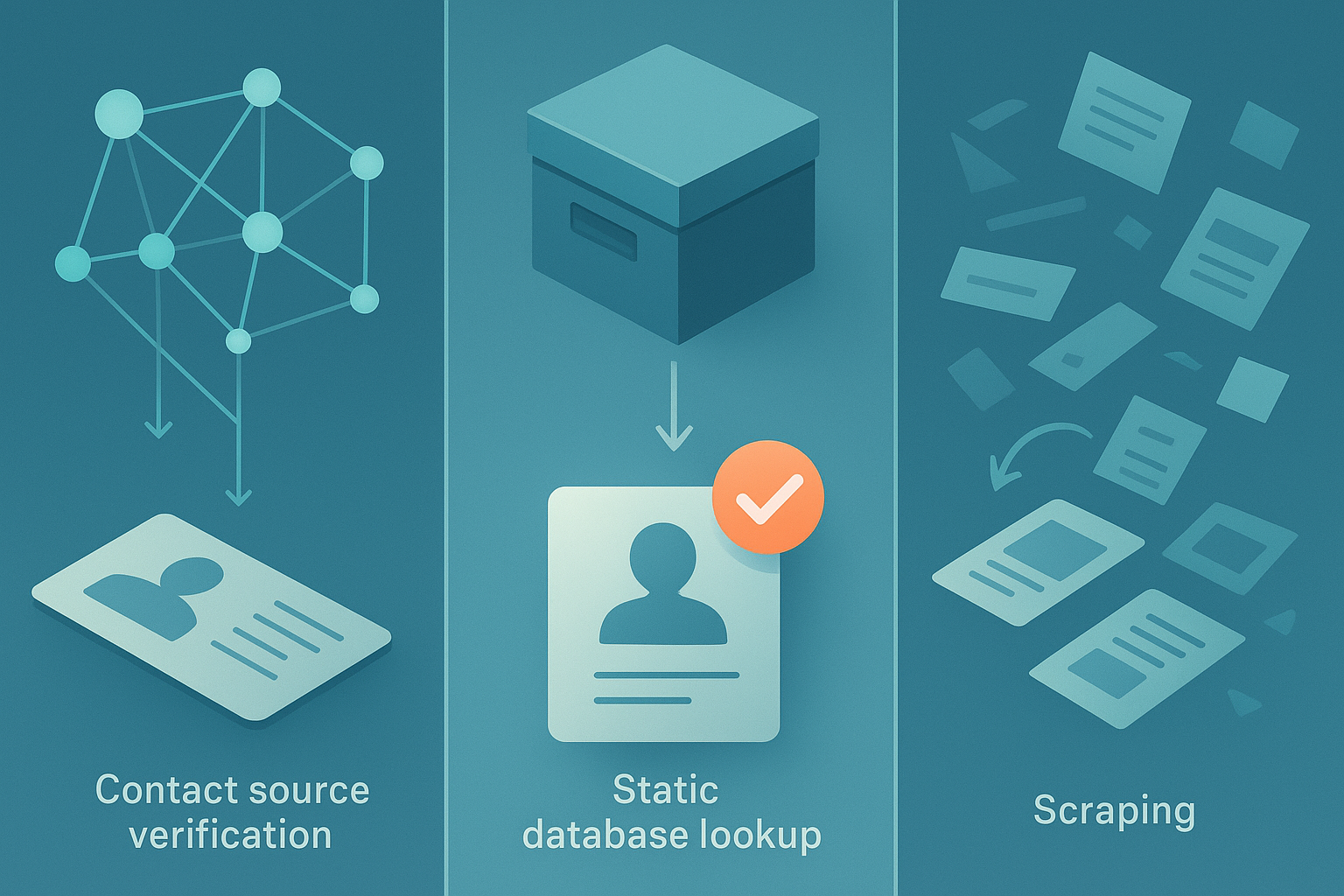
Verification Methodology Comparison: Multi-Source vs. Static Database vs. Scraping
Multi-Source Cross-Referencing and Real-Time Validation
Multi-source verification pulls contact data from business registries, public records, telecom databases, and CRM integrations, then cross-references matches to confirm current validity. According to Kaspr [5], real-time verified data from over 150 sources provides GDPR-aligned accuracy for European contacts, and similar multi-source approaches adapted for India integrate GST records and MCA director databases. Real-time validation queries live databases at the moment of contact reveal rather than relying on pre-cached snapshots, reducing decay impact and ensuring the user receives the most current available data. This methodology trades lower database breadth for higher per-contact accuracy, making it cost-effective when sales teams prioritize quality over volume.
Static Database Lookups and 90-Day Refresh Cycles
Static databases compile millions of contacts upfront and refresh them on fixed schedules, typically 30, 60, or 90 days. Apollo.io maintains a database of 275M+ contacts [2], enabling bulk searches and prospecting workflows but accepting decay-driven accuracy loss between refresh windows. For Indian B2B contacts, 90-day refresh cycles risk 9% cumulative decay before the next update, reducing effective accuracy from claimed 90%+ to low-80s by the end of the cycle. Static databases excel when sales teams need broad market coverage and can tolerate moderate inaccuracy in exchange for high contact volume, making them suitable for top-of-funnel prospecting rather than direct outreach to named decision-makers.
LinkedIn Scraping Risks and Compliance Trade-Offs
LinkedIn prohibits automated scraping under its Terms of Service, with account suspension as the primary enforcement mechanism for violations. Tools that extract contact data directly from LinkedIn profiles without API authorization risk triggering platform detection algorithms that flag unusual activity patterns and lock user accounts. Scraping-based tools offer the widest initial coverage because they pull directly from LinkedIn's member base, but they deliver the lowest long-term reliability due to enforcement risk and limited access to phone numbers not publicly displayed. Sales teams relying on scrapers face the operational cost of replacing suspended accounts and re-building prospecting workflows, making compliance-aligned alternatives that source from legitimate business databases a more sustainable choice for Indian B2B prospecting.
Compliance Considerations: DPDP Act and LinkedIn Terms of Service
DPDP Act 2023 Consent Requirements for Indian Contact Data
India's Digital Personal Data Protection Act 2023 requires explicit consent for processing personal data, including business emails and phone numbers. According to Sanguine [6], the DPDP Act covers business emails and IP addresses, extending privacy protections to professional contact information that many global data providers treat as exempt. Contact discovery tools must document the legal basis for data collection and processing, either explicit consent from the data subject or legitimate business interest that balances commercial use against individual privacy rights. Tools sourcing contact data from public business registries, such as GST records and MCA director filings, operate under legitimate interest grounds because the data is already publicly disclosed for regulatory transparency, whereas tools scraping LinkedIn profiles without user consent face higher compliance risk.

LinkedIn Terms of Service Prohibitions on Automated Scraping
LinkedIn's Terms of Service explicitly prohibit automated scraping, web crawling, and bulk data extraction without written permission from the platform. Enforcement mechanisms include account suspension, IP blocking, and legal action against commercial scraping operations that violate the terms. Kaspr is a Chrome extension owned by Cognism that pulls phone numbers and email addresses from LinkedIn profiles, working across standard LinkedIn profiles, Sales Navigator searches, and Recruiter Lite candidate profiles. Tools marketed as LinkedIn extensions must either operate under official API partnerships or risk enforcement action when scraping activity exceeds platform detection thresholds. Sales teams should verify whether a tool uses authorized API access or relies on scraping workarounds that transfer compliance risk to the user's LinkedIn account.
LinkedIn Contact Discovery Tools: Accuracy and India Coverage Compared
The comparison table below evaluates six LinkedIn contact discovery tools on accuracy claims, India-specific coverage, data type support, bulk workflow capabilities, and Chrome extension availability. Tools are assessed on regional fit for Indian B2B prospecting rather than global database size alone.
| Tool | Accuracy Claim | India Coverage | Data Type | Bulk Lookup Workflow | Chrome Extension | Best For |
|---|---|---|---|---|---|---|
| PeakAi | 91% phone accuracy | 1600+ city coverage, GST/MCA integration | Email and phone | Sales Navigator exports 2,500+ contacts | LinkedIn-native | India-focused teams needing GST-verified direct-dial accuracy |
| EazyReach | Cross-validated multi-source | MCA DIN director records | Verified direct dials | Pay-per-reveal pricing | Free Chrome extension | Indian director-level contacts with MCA cross-referencing |
| Apollo.io | 90%+ | Partial India coverage | 275M+ contacts, built-in CRM | Profile, people search, Sales Navigator lists | Yes | Global prospecting with limited Indian market depth |
| Lusha | 88%+, 95%+ India coverage | 95%+ India coverage | Professional emails and direct phone numbers | Chrome extension and standalone platform | Yes | Teams needing generous free-tier credits (40/month) for Indian contacts |
| Skrapp | 92% email success rate | 200M business profiles | Emails | Bulk email extraction | LinkedIn Extension | Email-only prospecting in mid-market and enterprise segments |
| Kaspr | Not disclosed | European strength, limited India data | Professional email and mobile phone | Chrome extension, CRM sync | Yes | European contacts or US markets, not optimized for India |
Data sourced from vendor websites, third-party reviews, and independent testing as of May 2026.
India-Optimized Platforms vs. Global Databases
India-optimized platforms integrate local data sources, GST registrations, MCA director records, and regional telecom databases, that global tools lack, delivering higher accuracy for Indian B2B contacts at the cost of narrower geographic coverage. According to Folk [1], tools specializing in regional markets prioritize verification quality over database breadth, making them suitable for teams prospecting exclusively in India rather than multi-market campaigns. Global databases offer broader international reach and built-in CRM functionality but accept lower regional accuracy as a trade-off for scale. Sales teams targeting Indian SMEs, MSMEs, and mid-market decision-makers benefit more from regional specialists, while enterprise teams running global outreach campaigns favor platforms with worldwide coverage and multi-currency pricing.
Cost-Per-Verified-Contact Analysis
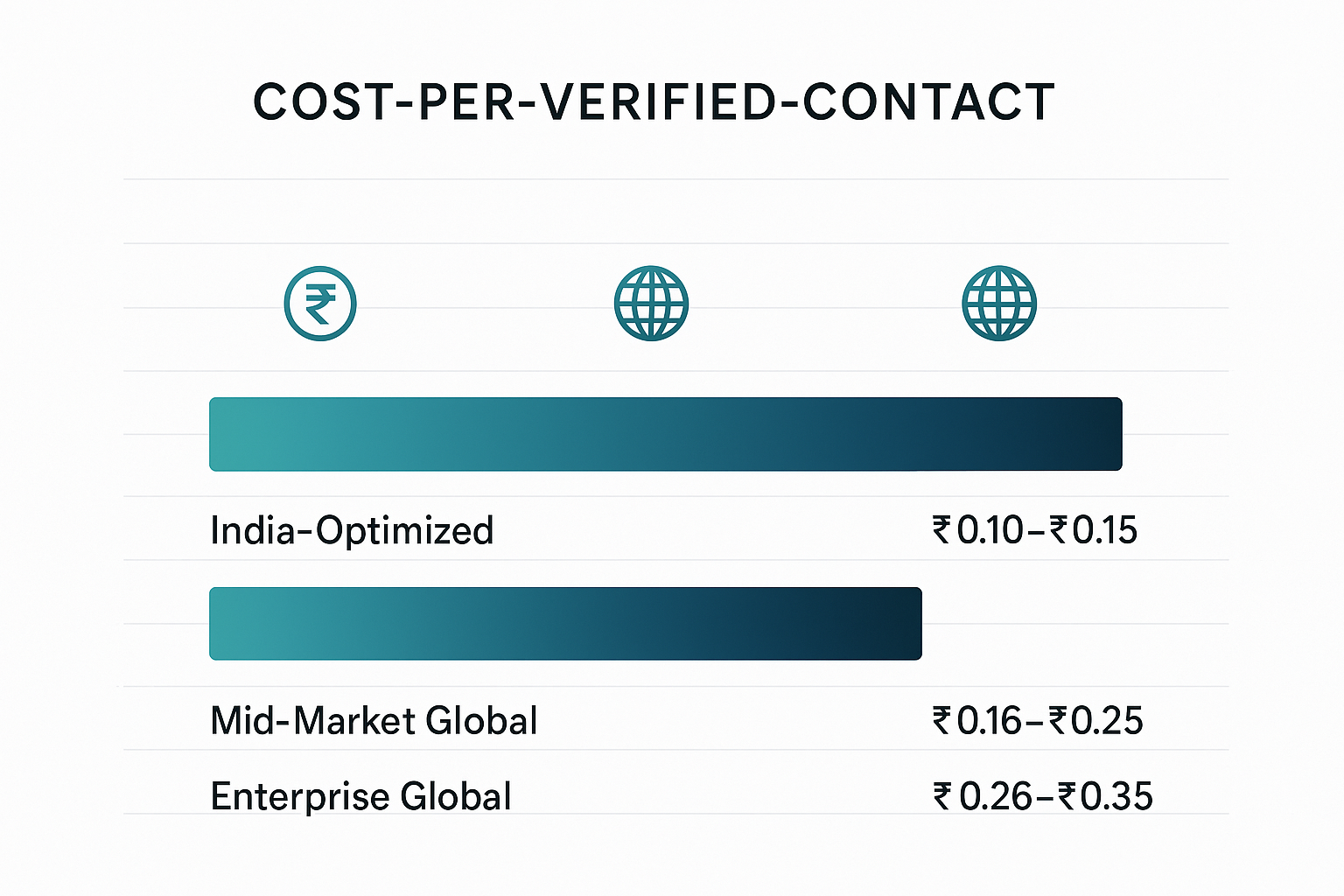
Pricing models split into subscription tiers with monthly credit limits and pay-per-reveal models that charge only for successfully verified contacts. Specialized regional platforms charge approximately $0.85-1.50 per verified contact, while enterprise global solutions range from $2-4 per contact when accounting for subscription cost divided by monthly reveal limits. According to La Growth Machine [2], teams pairing contact data with account intelligence see 20-40% higher conversion rates, suggesting that cost-per-verified-contact should be evaluated against downstream pipeline value rather than upfront price alone. Pay-per-reveal models reduce waste by charging only for contacts that meet verification thresholds, making them cost-effective for targeted account-based prospecting where each contact carries high potential deal value.
When to Prioritize Phone Verification Over Email (and Vice Versa)
Industry Verticals Where Phone Accuracy Drives Engagement
Phone numbers outperform email in Indian B2B verticals where WhatsApp messaging and voice calls dominate communication workflows, such as manufacturing, logistics, real estate, and MSME services. Decision-makers in these sectors often ignore cold emails but respond to direct calls and WhatsApp outreach, making verified mobile numbers the primary engagement channel. 43% of B2B marketers have sourced their customers from LinkedIn, but success rates vary by contact channel and industry responsiveness. Sales teams targeting CXOs and founders in fast-moving sectors benefit from phone-first strategies that enable real-time qualification conversations, while teams selling to procurement departments in regulated industries prioritize email trails for compliance documentation.

Email-First Strategies for Formal Procurement and Enterprise Buyers
Enterprise buyers in IT services, SaaS, financial services, and consulting operate through formal procurement workflows that require documented communication trails, making email the preferred initial contact channel. Email verification ensures messages reach current corporate addresses rather than bouncing to outdated domains after job changes, reducing sender reputation damage and improving deliverability for follow-up sequences. Tools with 97% email verification accuracy [7] validate addresses against company mail servers in real time, confirming that the contact exists and can receive messages before charging the user a credit. Email-first strategies work best when combined with LinkedIn engagement, such as profile views and connection requests, that warm up the prospect before the first outbound message arrives.
FAQ: LinkedIn Contact Discovery Accuracy for Indian Prospects
Conclusion
Achieving 90%+ accuracy for Indian B2B contacts requires evaluating verification methodology, regional data sources, and compliance alignment alongside advertised accuracy claims. Tools optimized for India integrate GST and MCA databases to counter monthly decay rates that undermine global static databases, while multi-source verification delivers fresher data than scraping-based alternatives that risk LinkedIn account suspension. Sales teams must decide whether phone-first or email-first strategies align with their target vertical's communication preferences, balancing cost-per-verified-contact against downstream conversion rates. As DPDP Act enforcement tightens and Indian B2B buyers demand personalized outreach, contact discovery tools that prioritize real-time verification over database breadth will command premium pricing but deliver the pipeline quality required to justify the investment. Evaluate your team's India market focus, compliance risk tolerance, and preferred contact channel before selecting a platform, then test accuracy claims against actual conversion outcomes in your specific segment.
Ready to Transform Your Sales Process?
Join thousands of sales professionals using verified contact data to close more deals. Add to Chrome - Free
Frequently Asked Questions
Is there a LinkedIn contact discovery tool with 90%+ accuracy that works well for Indian B2B prospects?
Tools claiming 90%+ accuracy for Indian contacts must integrate regional data sources like GST and MCA registries, as global databases deliver partial India coverage. Multi-source verification platforms achieve higher accuracy than static databases that decay at roughly 3% per month [4], making real-time validation critical for Indian B2B prospecting.
How do verification methods affect contact accuracy for Indian markets?
Multi-source cross-referencing pulls from over 150 live databases [5] and validates contacts at reveal time, reducing decay impact. Static databases refresh every 30-90 days and accept cumulative accuracy loss, while LinkedIn scraping risks account suspension under platform Terms of Service without improving phone number discovery rates.
Why do Indian B2B contact databases decay faster than global averages?
Indian MSME segments experience higher contact churn due to startup turnover, rapid hiring cycles in tech hubs, and mobile number portability. According to Salesmotion [4], B2B data decays at roughly 3% per month, but Indian markets see accelerated rates in Tier 2-3 cities where business volatility exceeds Tier 1 metro stability.
Does the DPDP Act 2023 restrict LinkedIn contact discovery in India?
India's DPDP Act requires explicit consent for personal data processing, including business emails and IP addresses [6]. Tools sourcing from public business registries like GST records operate under legitimate interest grounds, while scraping-based tools face higher compliance risk when processing data without documented consent frameworks.
What is the cost difference between regional and global contact discovery platforms?
Specialized regional platforms charge approximately $0.85-1.50 per verified Indian contact, while enterprise global solutions range from $2-4 per contact. Pay-per-reveal models reduce waste by charging only for successfully verified contacts, making them cost-effective for targeted account-based prospecting in Indian markets.
When should I prioritize phone verification over email for Indian B2B outreach?
Phone-first strategies work best in Indian manufacturing, logistics, real estate, and MSME services where WhatsApp and voice calls drive engagement. Email verification suits enterprise IT, SaaS, and financial services sectors requiring documented procurement trails. 43% of B2B marketers source customers from LinkedIn, but channel effectiveness varies by vertical.
Can LinkedIn scraping tools maintain 90%+ accuracy without violating platform terms?
LinkedIn prohibits automated scraping under its Terms of Service, making compliance-aligned tools that source from legitimate business databases more sustainable for Indian B2B prospecting. Scraping offers wide initial coverage but delivers low long-term reliability due to enforcement risk and limited access to phone numbers not publicly displayed on profiles.
Sources
- 10 Best Linkedin Phone Number Finders in 2026 - folk CRM - www.folk.app (2026)
- Best Contact Finding Tools for B2B Sales Teams in 2026 - lagrowthmachine.com (2026)
- What makes a great LinkedIn Email Finder - Phantombuster - phantombuster.com (2025)
- Best B2B Contact Data Providers in 2026 (Compared) - Salesmotion - salesmotion.io (2026)
- LinkedIn Email Finder | Find Verified Emails Effortlessly - Skrapp.io - skrapp.io
- Email finder • Free email search - find 50 valid emails for free - getprospect.com
- RocketReach Alternatives 2026: 5 Tools Without Paywalls - modernleads.io (2026)
