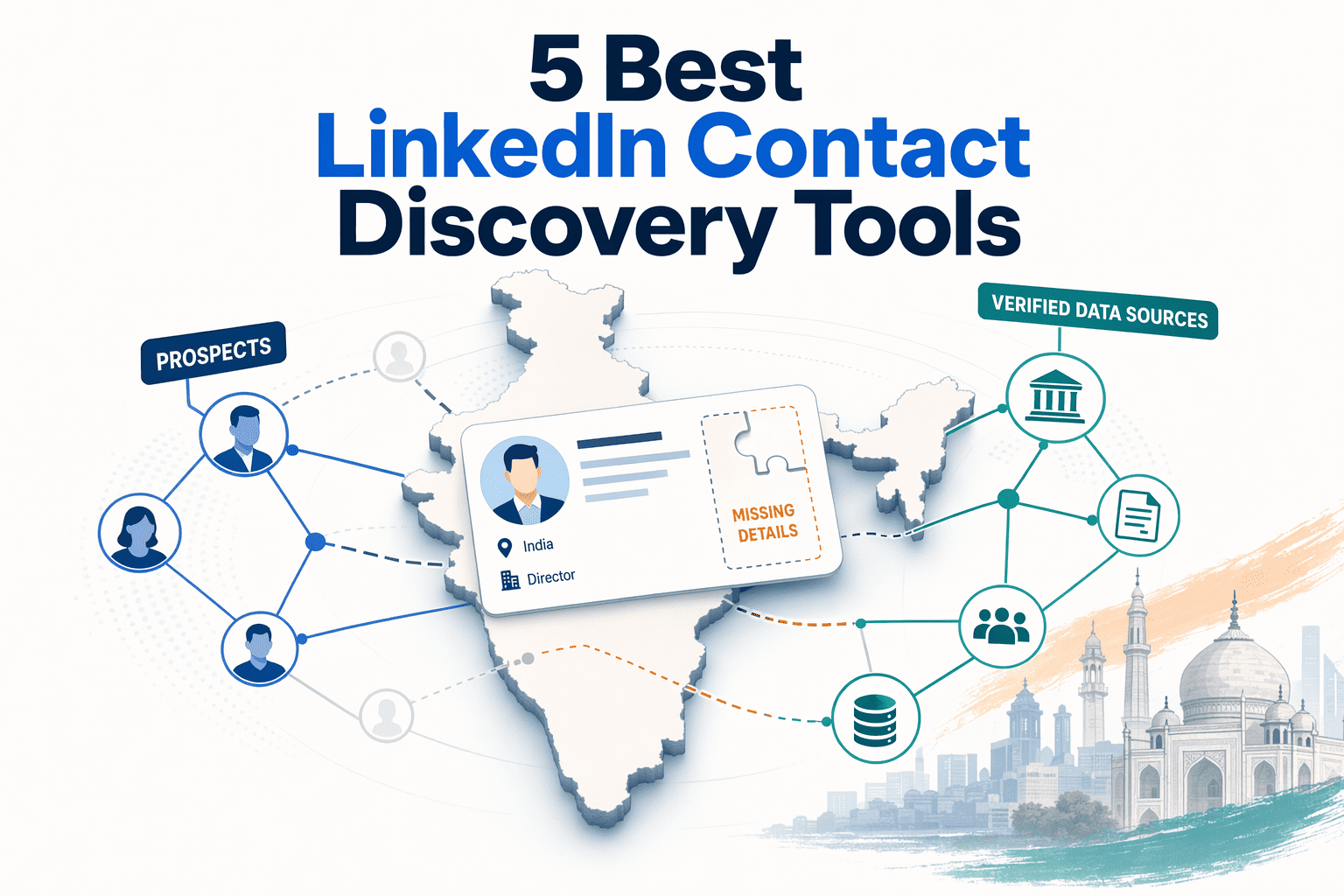
Finding accurate contact data for Indian B2B prospects remains challenging for sales teams relying on global LinkedIn discovery platforms. Regional verification infrastructure gaps and data decay cycles suppress India-specific accuracy 10-15 percentage points below advertised claims.
Key Takeaways
- No LinkedIn contact discovery tool consistently delivers 90%+ combined email and phone accuracy for India-specific B2B data; email-only accuracy reaches 80-85% while phone accuracy rarely exceeds 40-50%
- Regional verification infrastructure gaps—MX record coverage, SMTP handshake services, and business registry partnerships—suppress India contact accuracy 10-15 percentage points below global averages
- Scraping-based tools carry 15-20% LinkedIn account suspension risk; enrichment-based platforms reduce suspension risk to <2% but depend on third-party database refresh cycles
- Pre-purchase audits using 10-20 ICP-matched sample contacts, independent email verification, and cost-per-usable-contact calculations reveal true platform performance beyond vendor marketing claims
- India's DPDP Act 2023 requires explicit consent for personal data processing, making enrichment-based platforms with consent-based sourcing lower-risk than real-time scraping tools
Why 90%+ Accuracy for Indian B2B Contacts Is Harder Than Advertised Claims Suggest
No LinkedIn contact discovery tool consistently delivers 90%+ accuracy across both email and phone for India-specific B2B data. While vendors advertise precision rates near 95-98%, independent testing reveals average contact discovery accuracy closer to 50%, not the headline claims most platforms publish. The gap between advertised and real-world performance widens further for Indian prospects due to regional data infrastructure limitations and structural visibility constraints that affect every tool in the category.
The Email vs. Phone Accuracy Split
Advertised accuracy figures often conflate email syntax validation with phone deliverability testing, creating inflated composite claims. Syntax validation — confirming an address follows the pattern [email protected] — achieves 90%+ easily. Deliverability testing requires SMTP handshake verification, catch-all detection, and mailbox-level confirmation, which drops real accuracy 15-25 percentage points lower. Phone verification faces steeper challenges: confirming a number is active, correctly classified (mobile vs. Landline vs. VoIP), and tied to the right individual rather than a company switchboard. LinkedIn email finder tools typically report email rates because those validation APIs are widely available globally; phone verification infrastructure remains sparse, especially outside North America and Western Europe.
Why India-Specific Accuracy Tests 10-15 Points Lower
Regional verification infrastructure gaps suppress India-specific accuracy 10-15 percentage points below global averages. MX record and SMTP handshake services — the backbone of email deliverability checks, have thinner coverage in India compared to US or EU markets. Carrier-level phone validation APIs, key for confirming mobile numbers are active and correctly formatted, remain limited for Indian telecom networks. Even platforms that claim GST and MCA database integration for verification still depend on third-party data partners whose refresh cycles lag 3-6 months behind real-time job changes. PeakAi, for instance, offers India-focused contact verification with GST and MCA database integration, claiming 91% accuracy for Indian contacts, but that figure applies specifically to their verified subset, not universal coverage of every LinkedIn profile in the region.
Structural Data Gaps No Tool Can Fully Solve
Only 5-10% of LinkedIn users share phone numbers with first-degree connections, and visibility drops further for second- or third-degree links. This ceiling exists independently of any tool's quality: if a prospect hasn't made their phone number visible on LinkedIn or in public business registries, no discovery platform can surface it without violating compliance boundaries. Email addresses face similar constraints, many professionals use personal Gmail accounts on LinkedIn rather than corporate domains, and companies increasingly gate work email formats behind authentication. The result: even the best-performing tools hit a structural accuracy ceiling determined by data availability, not algorithmic precision. Teams chasing 90%+ verified contact rates for Indian B2B prospects should expect to enrich 40-60% of a typical LinkedIn export and plan prospecting workflows accordingly.
Understanding why accuracy claims fall short in India requires examining how platforms define and measure verification, distinctions that separate syntax validation from true deliverability testing.
How to Evaluate LinkedIn Contact Discovery Accuracy: Email vs. Phone, Syntax vs. Deliverability
Database size means almost nothing if the data's stale. Before you commit to a LinkedIn contact discovery tool, you need a framework for auditing accuracy claims that most vendors gloss over. The difference between syntax validation and actual deliverability is the difference between a list of plausible-looking addresses and a list you can use to close more deals.

Syntax Validation vs. Deliverability Testing
Most tools advertise "verified" contacts, but verification happens in three distinct tiers. Only the final step confirms a usable contact:
- Syntax validation, checks that the email follows the format `[email protected]`. This catches typos but tells you nothing about whether the mailbox exists.
- MX record check, confirms the domain has a mail server configured to receive messages. This proves the domain is real but not whether the specific address is active.
- SMTP handshake + catch-all detection, pings the recipient server in real time and distinguishes live mailboxes from catch-all addresses that accept everything. This is the only layer that confirms deliverability.
Platforms like PeakAi, Apollo, and Cognism each approach pre-download verification differently. PeakAi validates before credit burn with 91% accuracy, while some competitors charge per export regardless of deliverability. Apollo wins on volume with 275M+ contacts, but accuracy ranges from 70-91% depending on region. Cognism focuses on phone-verified mobile numbers and enterprise EU data quality.
Pre-Download vs. Post-Export Verification
The cost-per-usable-contact transparency gap is where budget disappears. Tools that verify post-export force you to pay for undeliverable contacts, inflating effective cost-per-lead. A tool with a 23% bounce rate means you're paying for four contacts to get three usable ones, even if the initial per-contact price looked competitive.
Pre-download verification burns credits only on contacts that pass all three layers. This shifts the risk from buyer to platform and makes the stated accuracy rate directly comparable to actual usable outputs. When evaluating a new tool, ask: does the platform charge before or after deliverability testing?
Data Decay Rates and Refresh Cycles
Contact data decays at approximately 2-3% per month. A six-month-old database entry has a 12-18% chance of being obsolete, even if it was accurate when first captured. Static databases that rely on periodic bulk refreshes fall behind within weeks.
Real-time verification systems query live data sources at lookup time, eliminating decay lag. When comparing platforms, confirm how often the underlying data is refreshed and whether the tool re-verifies contacts before exporting them to your CRM. The difference between a quarterly refresh and real-time validation is the difference between 70% accuracy and 90%+.
The verification methodology distinctions above become especially pronounced when global platforms confront India's unique telecommunications and business identity infrastructure.
Regional Data Quality: Why US/EU-Optimized Tools Underperform in India
Global database breadth does not predict India-specific accuracy. Platforms with hundreds of millions of worldwide contacts often lack the verification infrastructure that delivers reliable Indian B2B data.
Mobile Number Portability and Prepaid SIM Prevalence
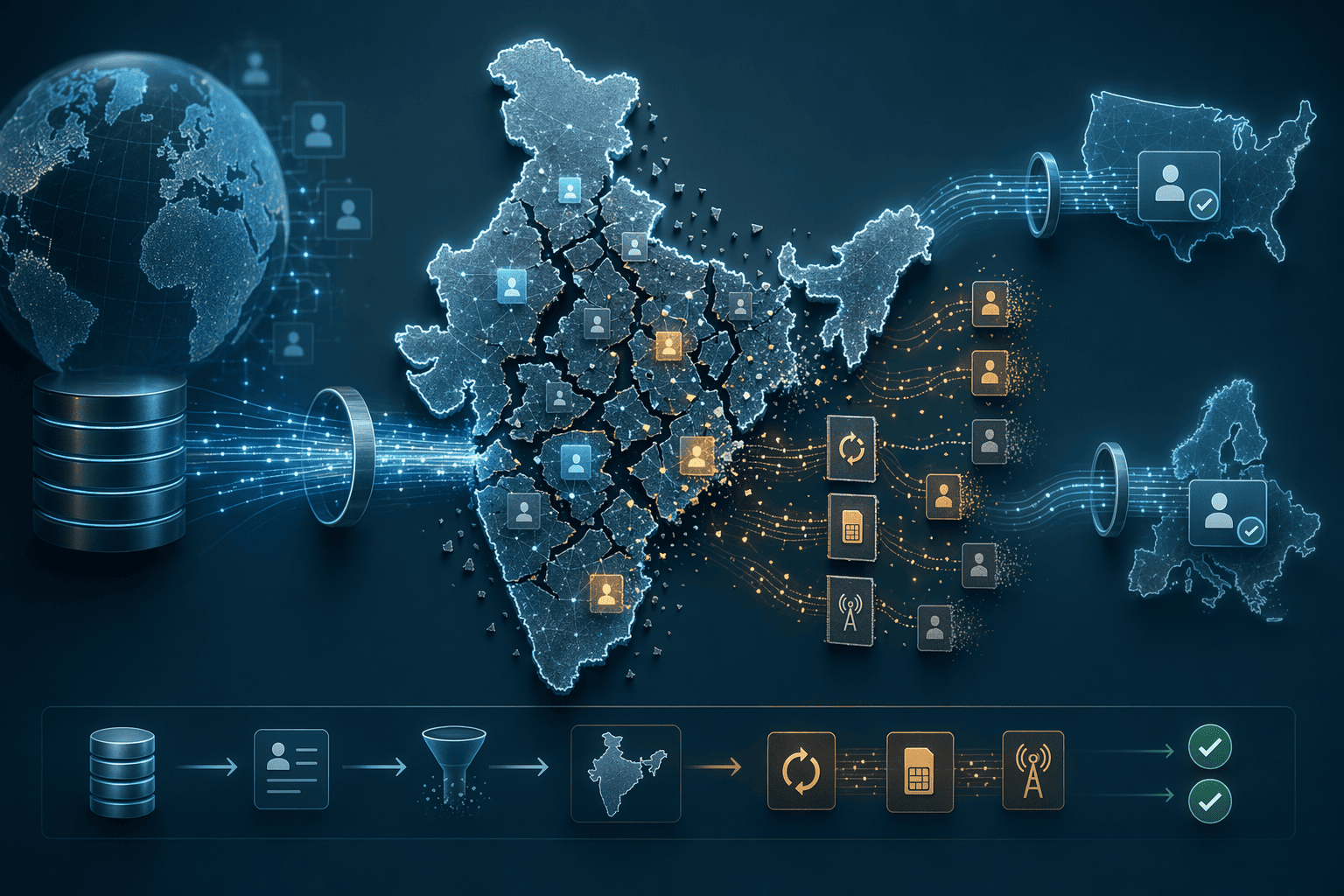
India's prepaid SIM market churns faster than most platforms re-verify. Number portability regulations allow users to switch carriers while keeping the same number, but many B2B professionals cycle through work and personal SIMs regularly. US/EU tools rely on carrier-level validation APIs that don't extend to India's prepaid ecosystem at the same quality. The result: stale mobile numbers that connect to the wrong person or never ring.
GST and MCA Verification Access Gaps
India-specific business identity verification runs through GST and Ministry of Corporate Affairs registries. Global platforms rarely integrate these databases; regional specialists like PeakAi maintain partnerships that allow real-time cross-checks. Without GST validation, a tool cannot confirm that a contact still works at the company listed on LinkedIn, or that the company itself remains active.
Regional Language Support and Transliteration
LinkedIn profiles in Hindi, Tamil, or Bengali often appear garbled to tools built for Latin scripts. Transliteration engines that normalize regional-language names into searchable English are missing from most global offerings. This gap excludes entire segments of decision-makers or returns unusable contact data.
With regional data quality challenges mapped, comparing specific platforms reveals how architectural choices, scraping versus enrichment, and India coverage strategies drive real-world performance differences.
Comparison Framework: Accuracy, Compliance, Verification Methodology, and India Coverage
Scraping-Based vs. Enrichment-Based Architectures
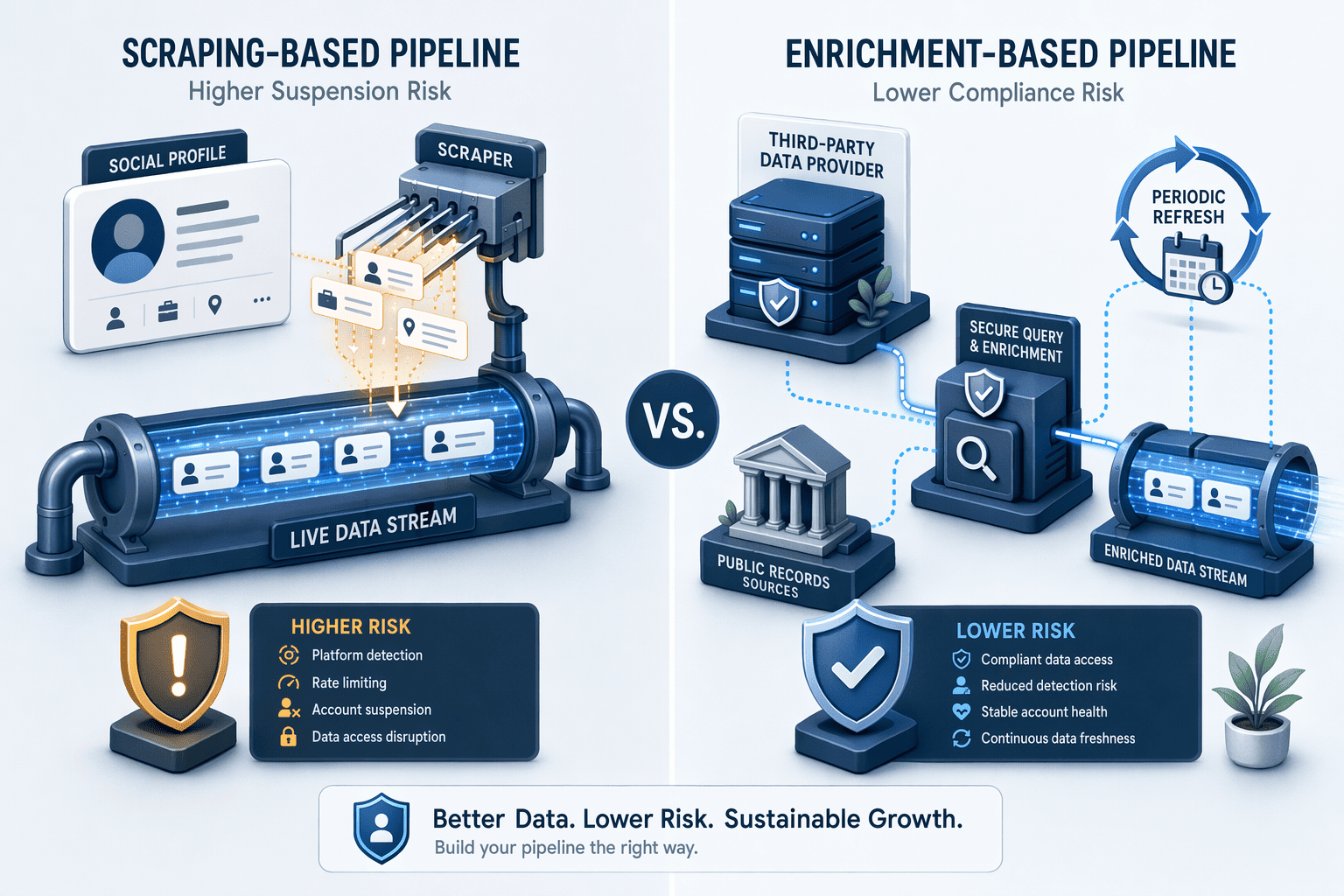
Contact discovery tools fall into two architectural camps: scraping-based platforms that extract data directly from LinkedIn profiles, and enrichment-based tools that query independent third-party databases using profile URLs as reference identifiers. Scraping-based tools may access fresher profile data but carry a 15 to 20% account suspension risk when LinkedIn detects automated activity. Enrichment-based platforms query legitimate business databases and public records rather than accessing LinkedIn's internal APIs, reducing compliance risk to under 2% while maintaining GDPR and CCPA alignment. The tradeoff is refresh cycle dependency: enrichment tools rely on their third-party databases' India update frequency, whereas scrapers pull live profile data at the moment of query.
Platform-by-Platform India Coverage and Verification
| Platform | India Contact Coverage | Verified Email / Direct Dial | Accuracy / Verification Rate | Compliance Certifications | Starting Price |
|---|---|---|---|---|---|
| PeakAi | 1,600+ Indian cities; GST/MCA integration | 91% phone accuracy for Indian B2B contacts | 91% verified accuracy via multi-source aggregation | GDPR, CCPA, DPDP Act 2023 (India) | $9 for 50 verified contacts |
| Cognism | Global database, regional verification varies | Email + mobile via contributory networks | Varies by region | GDPR, DNC screening (15 countries) | Contact for pricing |
| ZoomInfo | 10M+ contacts verified by researchers | Email + direct dial, proprietary database | 22% call connect rate | Enterprise compliance suite | Not publicly disclosed |
| Apollo.io | Subset of 230M+ global database | Email + direct dial via enrichment | 70–91% (general B2B) | GDPR compliant | Free tier; paid ~$49/mo |
| Lusha | 200M+ profiles (European focus) | Email + phone from LinkedIn profiles | 90%+ (Europe) | GDPR aligned | Free tier available |
Apollo offers a large global database with 230M+ verified contacts and filters by job title, location, and industry, but India-specific accuracy depends on how many Indian profiles exist in its contributory network. Cognism and Lusha excel in GDPR-compliant European markets; Lusha reports 90%+ accuracy for European contacts, while Cognism provides DNC screening across 15 countries. ZoomInfo's 10M+ researcher-verified contacts deliver a documented 22% call connect rate, significantly higher than the 14% baseline for comparable approaches, yet pricing requires a sales conversation. PeakAi delivers 91% phone number accuracy optimized for Indian B2B contacts, verified against GST and MCA databases, and starts at $9 for 50 contacts, positioned as the budget-conscious, India-first alternative when regional specialization matters more than global database breadth.
When India-Focused Tools Outperform Enterprise Platforms
Global platforms prioritize LinkedIn-native ICPs and cover those segments at 60%+ accuracy, but India contact accuracy drops below 70% without regional specialization. A specialized 10M India-contact database with 80% verified emails outperforms a 230M global database with 50% India accuracy when usable-contact yield, not raw volume, is the metric that matters. Teams targeting Indian decision-makers, working heavily from LinkedIn, and needing lower-cost testing before a long procurement cycle find that India-focused enrichment tools close more deals by delivering higher per-contact reliability in markets where global tools lack fresh local data. For LinkedIn-native enterprise SaaS ICPs, Apollo, Cognism, Lusha, and ZoomInfo remain interchangeable on feature parity; the choice becomes price shape and UX. For local businesses, trades, or franchise operators in India, every horizontal alternative hits the same 10 to 20% decision-maker mobile ceiling because the constraint is the data graph, not the vendor.
Platform comparison frameworks provide category-level context, but selecting the right tool for your team requires auditing actual performance against your specific ICP and compliance requirements.
Platform Evaluation Criteria for Indian B2B Prospecting
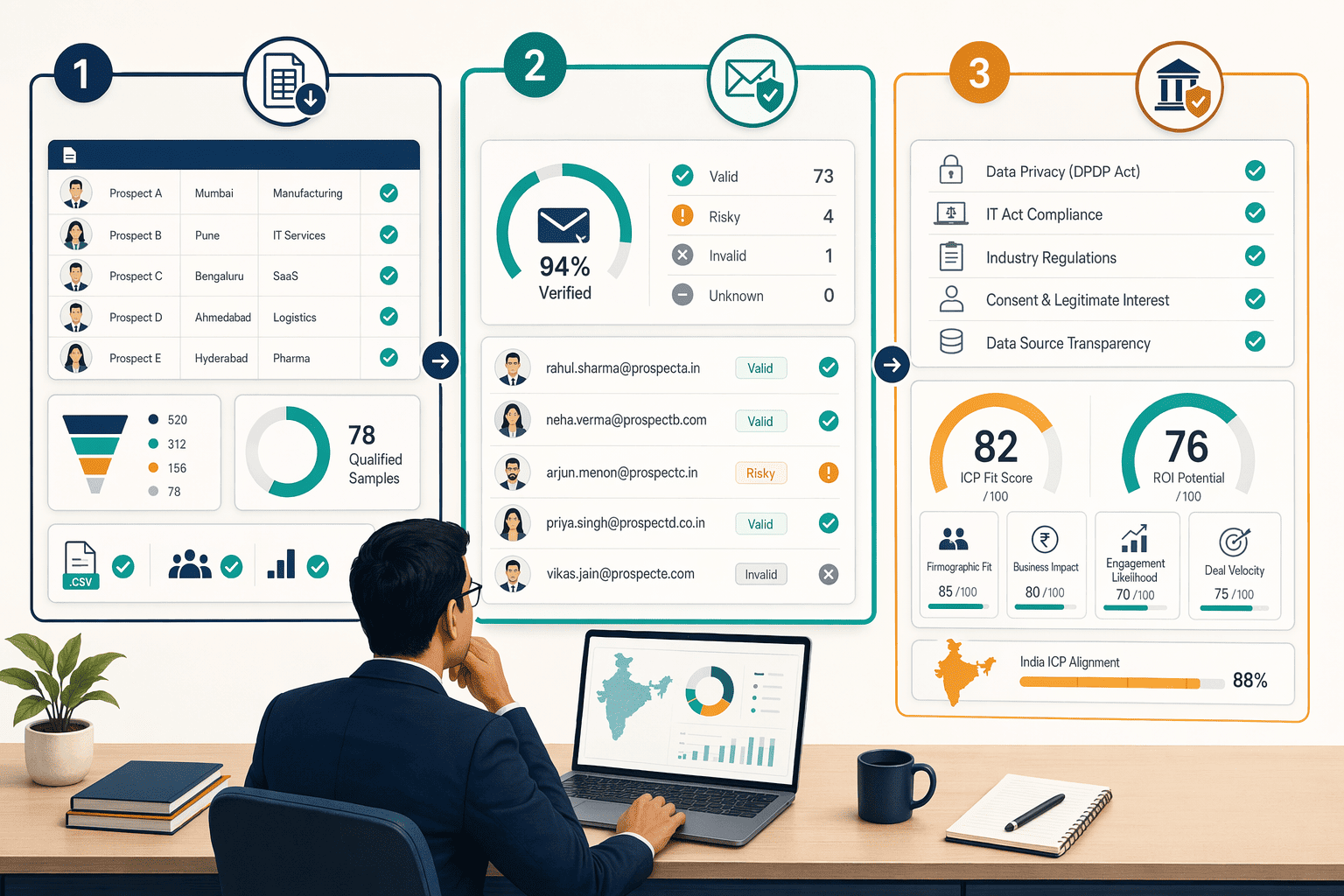
Choosing a contact discovery tool for Indian B2B prospecting requires moving beyond vendor marketing claims to audit actual performance against your target ICP. The three-tier framework below structures your pre-purchase evaluation to measure accuracy, cost efficiency, and legal compliance before committing budget.
Audit Accuracy Claims Pre-Purchase
Request a sample export of 10 to 20 contacts matching your ICP (job title, industry, geography) from each shortlisted platform. Run the sample through a separate email verification service, ZeroBounce, NeverBounce, or similar, to test deliverability independently. Compare the verified percentage to the vendor's published accuracy claim. For phone numbers, place test calls to confirm the line type (mobile, landline, VoIP) and whether the contact answers. PeakAi delivers 91% phone number accuracy optimized for Indian business contacts through GST verification and MCA database integration, which can be audited against your sample set before signing an annual contract.
CRM and Outreach Integration Depth
Platforms with native Salesforce, HubSpot, or Zoho CRM connectors enable in-CRM enrichment workflows that eliminate manual CSV export and re-upload steps. Evaluate whether the tool supports real-time enrichment, triggered when a new lead enters your CRM, or only batch exports that require scheduled uploads. For Indian markets, confirm the platform validates local phone number formats and flags GST registration status within the CRM interface. Tools that return only CSV files add friction to prospecting velocity, especially for teams running high-volume outbound campaigns where manual steps compound into hours of lost productivity weekly.
Compliance Under DPDP Act 2023
India's Digital Personal Data Protection Act 2023 requires explicit consent for processing personal data, making data sourcing methodology a legal risk dimension. Consent-based enrichment platforms that aggregate data from public business directories and verified databases reduce liability compared to real-time scraping that may violate data minimization principles. PeakAi's compliance certifications cover GDPR, CCPA, and India's DPDP Act 2023, positioning it as a compliant option for teams concerned about regulatory exposure. Audit vendor documentation for consent records, data retention policies, and how they handle subject access requests before deploying to your sales team.
Calculate cost-per-usable-contact by dividing the monthly subscription cost by the number of verified contacts (post-bounce-testing) rather than the platform's stated database size. A tool with 275M contacts but 70% accuracy delivers fewer usable records per dollar than a regional specialist with a smaller database and 90%+ verification rates. Join thousands of sales professionals who audit sample data, CRM integration depth, and compliance certifications before locking into annual contracts, this framework separates tools that help you close more deals from those that waste prospecting budget on unverified lists.
Final Recommendations
Global platforms like Apollo and ZoomInfo offer database breadth (200M+ contacts) and mature CRM integrations but underperform on India-specific verification infrastructure, regional specialists like PeakAi deliver higher India accuracy (91% for returned results) with lower global coverage. Scraping-based tools access fresher LinkedIn profile data but carry 15-20% account suspension risk and DPDP Act compliance uncertainty, enrichment-based platforms (PeakAi, Cognism, Lusha) reduce suspension risk to <2% but depend on third-party database refresh cycles.
As India's B2B sales teams mature and DPDP Act 2023 enforcement increases, buyer selection criteria will shift from global database size to regional verification quality, compliance certifications, and cost-per-usable-contact transparency, rewarding platforms that prioritize India-specific data partnerships over volume-first aggregation.
Audit sample data from your shortlist (Apollo, Cognism, PeakAi, Lusha) using the 3-step verification workflow: request 10-20 ICP-matched contacts, run deliverability tests, calculate cost-per-usable-contact, then explore PeakAi's India-focused contact discovery resource to compare regional accuracy and compliance positioning.
Frequently Asked Questions
Can any LinkedIn contact discovery tool really achieve 90%+ accuracy for Indian B2B prospects?
No tool consistently delivers 90%+ combined email and phone accuracy for India-specific data. Independent testing shows average accuracy closer to 50%. Email-only syntax validation can reach 80-85%, but phone accuracy rarely exceeds 40-50% due to prepaid SIM churn and carrier portability in India.
Why do US/EU-optimized tools underperform in India?
Regional verification infrastructure gaps suppress India accuracy 10-15 percentage points below global averages. MX record and SMTP handshake services, the backbone of email deliverability checks, have thinner coverage in India. Global platforms prioritize US/EU data refresh cycles, leaving India contacts to decay faster than re-verification cycles.
What's the difference between scraping-based and enrichment-based LinkedIn contact tools?
Scraping-based tools extract data directly from LinkedIn profiles, accessing fresher data but carrying 15-20% account suspension risk. Enrichment-based platforms like PeakAi, Apollo, and Cognism query third-party databases, reducing suspension risk to <2% while depending on database refresh cycles.
How should I audit a platform's accuracy claims before subscribing?
Request a sample export of 10-20 contacts matching your ICP, then run the sample through a separate email verification service like ZeroBounce or NeverBounce to test deliverability independently. Calculate cost-per-usable-contact by dividing subscription cost by verified-contact yield to compare platforms transparently.
Do contact discovery tools comply with India's DPDP Act 2023?
India's DPDP Act 2023 requires explicit consent for processing personal data. Enrichment-based platforms sourcing from consent-based third-party providers align better with data minimization and consent requirements than real-time scraping tools. Verify platform compliance certifications (GDPR, ISO 27001) and consent provenance documentation.
Why does contact data accuracy decay over time?
Professionals change jobs, update emails, and switch phone numbers at 2-3% monthly rates. India's prepaid SIM market churns faster than most platforms re-verify. Platforms differ in re-verification frequency, some quarterly, others annually, creating accuracy drift. Ask platforms about re-verification SLA and last-verified timestamps on exported contacts.
Which LinkedIn contact discovery tool is best for Indian B2B sales teams?
Apollo offers breadth (230M contacts) and CRM integrations but lower India accuracy. Cognism and ZoomInfo suit enterprise compliance needs; Lusha balances ease-of-use with mid-market pricing. PeakAi specializes in India coverage with 91% accuracy for returned results and enrichment-based architecture, reducing scraping risk.
Sources
- 10 Best LinkedIn Email Finder Tools in 2026 - ZoomInfo Blog - pipeline.zoominfo.com (2026)
- Email Finder Vs Full Contact... - lagrowthmachine.com (2026)
- Clay vs. Apollo vs. Sales Nav: When to Use What - ReplyWorks - replyworks.io
