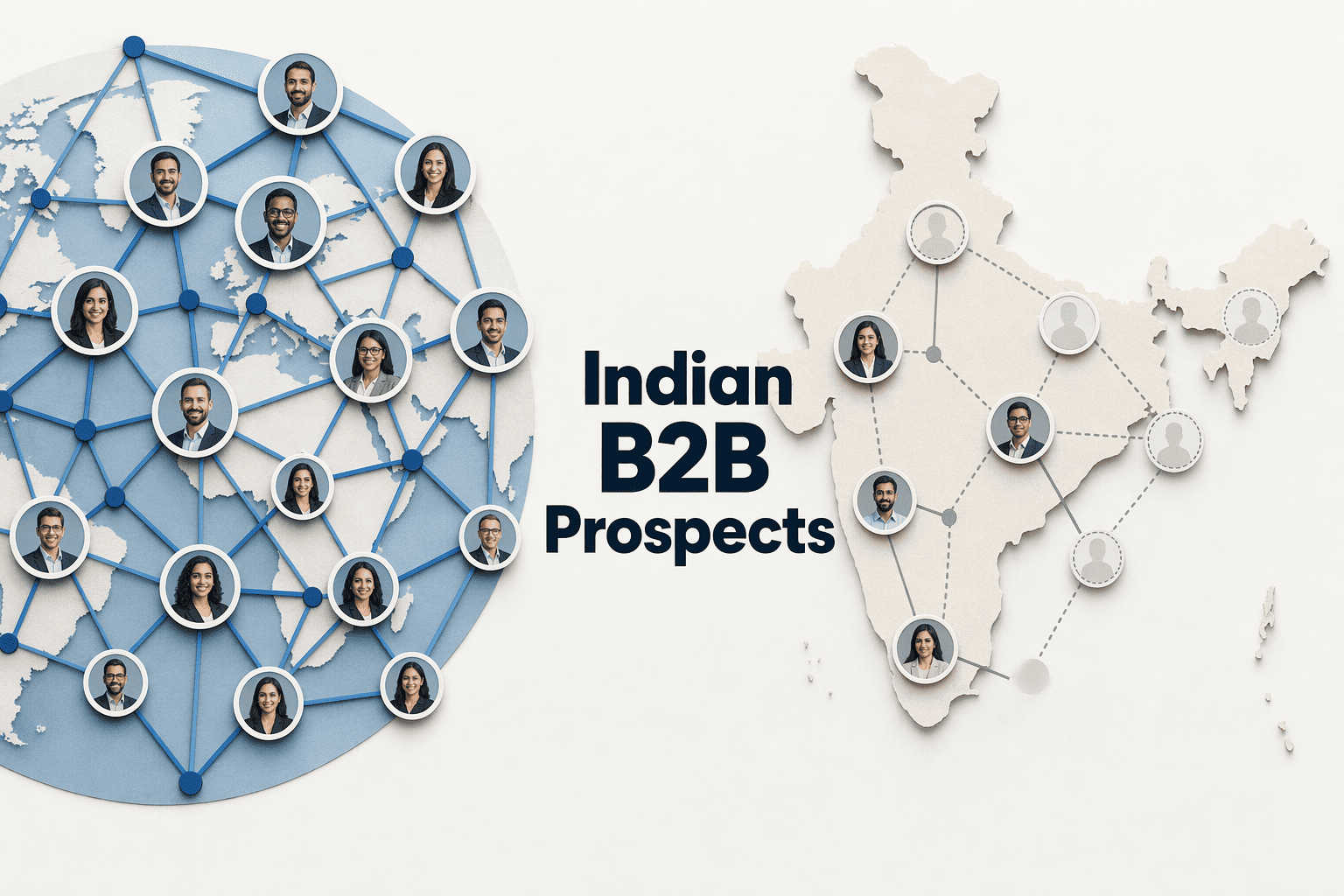
Most LinkedIn contact discovery tools advertise 85–95% accuracy rates, yet their performance for Indian B2B prospects drops sharply—often by 10–15 percentage points—due to database coverage gaps and verification infrastructure differences.
Key Takeaways
- Global contact discovery platforms typically deliver 10–15 percentage points lower accuracy in India than in US/EU markets due to database infrastructure gaps.
- Real-time verification (SMTP handshake, carrier-level validation) outperforms static database enrichment, which loses 2 to 3% of records monthly to job changes and domain migrations.
- Enrichment-based tools query third-party databases to avoid LinkedIn Terms of Service violations, while direct scraping tools risk 15 to 20% account suspension rates.
- GST and MCA database integration provides verified Indian business data that global platforms lack, enabling 90%+ accuracy for regional specialists.
- Pay-per-verified-contact pricing offers cost transparency compared to credit-based models where match rates fluctuate between $0.85, $4 per lookup.
Yes, PeakAi delivers 91% verified phone number accuracy specifically for Indian B2B contacts. But this figure is exceptional because most global LinkedIn contact discovery tools achieve only 60 to 75% accuracy in India, dropping 10 to 15 percentage points below their advertised US/EU rates. Without regional specialization, Indian contact accuracy falls below 70%, turning prospecting campaigns into expensive guesswork and close more deals into an unreachable goal.
The Regional Accuracy Gap: Global Tools Underperform in India
Contact databases optimized for North American and European markets typically advertise 85 to 95% accuracy rates, but India-specific accuracy for these global tools often tests 10 to 15 percentage points lower than US or EU figures. The gap stems from data infrastructure differences: US corporate directories aggregate reliably into Dun & Bradstreet and ZoomInfo feeds, while Indian SME contact records scatter across state-level registries, informal networks, and regional telecom operators with inconsistent API access. A tool claiming 90% accuracy in California may deliver only 65% reachable numbers in Bangalore, burning sales budgets on dead leads and forcing reps to manually verify contacts before every call.
Structural Barriers: Carrier-Level Validation and Mobile Portability
Indian telecom operators provide limited carrier-level validation APIs compared to Western counterparts, making real-time phone verification harder. Mobile number portability, widespread since 2010, creates false positives when contact databases rely on prefix-based carrier identification: a number originally issued by Airtel may now route through Jio, invalidating static lookup tables. Prepaid SIM prevalence (over 90% of Indian mobile subscriptions) adds another layer of complexity, as prepaid numbers churn faster and lack the employer-linked billing records that anchor B2B verification in postpaid-dominant markets. Tools without India-specific carrier partnerships and MNP (Mobile Number Portability) reconciliation engines misclassify active numbers as inactive, or landlines as mobiles.
LinkedIn Phone Number Discovery Limits
Only 5 to 10% of LinkedIn users share phone numbers with first-degree connections, and even fewer expose them to second- or third-degree connections. Direct LinkedIn scraping, the method many budget tools rely on, yields poor phone coverage because prospects treat LinkedIn as a networking platform, not a public directory. For Indian B2B contacts, this coverage gap is wider: professionals often reserve personal mobile numbers for WhatsApp-only communication and withhold them from LinkedIn profiles entirely. Tools that depend solely on LinkedIn's visible fields return email addresses reliably but fail on phone discovery, forcing sales teams back to manual research or third-party enrichment layers that query carrier databases, GST registries, and MCA records outside LinkedIn's ecosystem.
To understand why accuracy matters, you first need to know how different tools verify contact data, and why methodology determines whether you pay for working contacts or database noise.
Verification Methodology: Real-Time vs Static Database Enrichment
Real-Time Deliverability Checks vs Syntax Validation
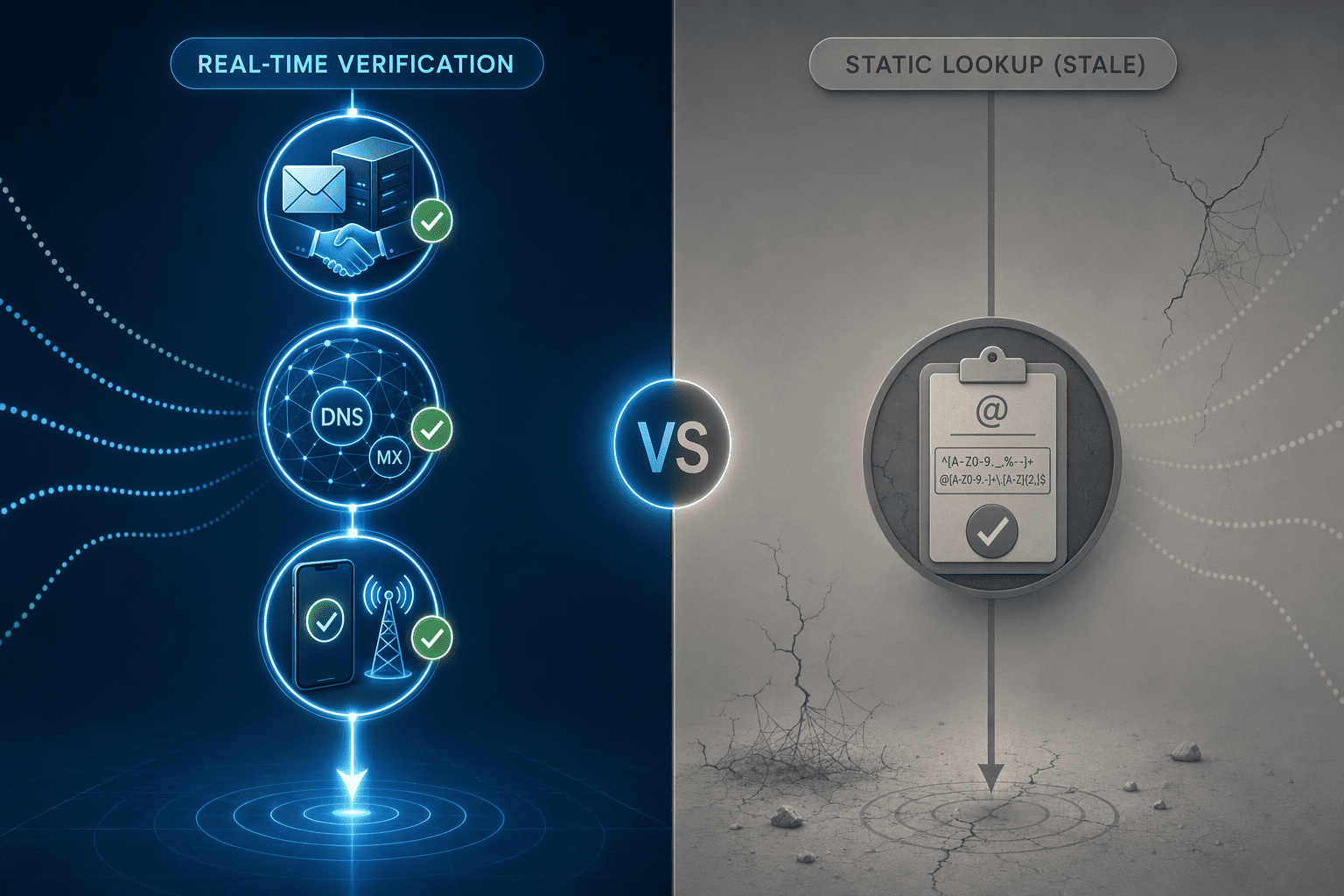
Real-time verification runs three sequential checks at the moment of lookup: SMTP handshake (does the recipient mail server accept this address?), MX record validation (is the domain's mail exchange configured correctly?), and carrier-level validation (for mobile numbers, is the line active and correctly formatted?). These layers confirm deliverability before a contact is returned. Static databases, by contrast, perform syntax-only validation, checking that an email follows the pattern [email protected] without confirming the address actually receives mail. Tools like PeakAi use real-time carrier validation, querying live data sources rather than relying on pre-compiled lists that may be months out of date.
Contact Data Decay: The 2-3% Monthly Churn Problem
B2B contact databases lose 2-3% of their records to churn every month, job changes, domain migrations, phone number reassignments. Over a year, that compounds to 25-30% of a static database becoming stale. When a contact-finding tool pulls from a static database, you inherit that decay: emails that were valid six months ago now bounce, mobile numbers route to new owners. Real-time verification solves this by pulling fresh data at request time, querying authoritative sources (telecom carriers, mail-server registries) instead of relying on snapshots. The 90%+ accuracy benchmarks cited for Indian B2B contacts require this architecture, static databases cannot maintain that threshold over time.
Pre-Download Verification vs Post-Export Enrichment Cost Models
Pre-download verification charges only for verified contacts: the tool runs SMTP and carrier checks *before* debiting your credit balance, so you never pay for a bounced email or disconnected number. Post-export enrichment charges for all exports regardless of deliverability, you pull a Sales Navigator list, upload it to an enrichment service, and pay per row enriched, then discover 15-30% bounce rates when you send. The false-positive cost falls on you. Pre-download models shift that cost to the vendor: if a contact fails verification, it doesn't consume a credit. This distinction matters most for Indian B2B prospecting, where phone-number accuracy varies widely and paying for unverified contacts erodes ROI quickly.
Even the best verification methodology is useless if the tool itself violates LinkedIn's Terms of Service, a compliance risk many prospecting teams overlook until account suspensions disrupt their pipeline.
Compliance-First Discovery: LinkedIn ToS and Scraping Risk
Before evaluating contact discovery tools, understand the compliance divide: enrichment-based platforms query third-party databases using LinkedIn URLs as reference identifiers, while direct scraping tools harvest profile data from LinkedIn itself, violating the platform's Terms of Service and exposing users to permanent account suspension. Tools that promise instant phone reveals on LinkedIn profiles are likely using prohibited scraping methods, because legitimate enrichment requires cross-referencing external databases in real time.

Direct LinkedIn Scraping: Account Suspension Rates and ToS Violations
LinkedIn automation tools that scrape profile data directly, harvesting contact details through bots or circumventing rate limits, carry measurable compliance risk. Heavy scraping users face account restrictions, and the platform actively monitors for automated data extraction. No tool can extract 90%+ phone coverage directly from LinkedIn profiles alone, because LinkedIn restricts phone number visibility by default and limits what first-degree connections can see.
Enrichment-Based Architecture: Querying Third-Party Databases Without Scraping
Enrichment tools like SalesQL, Apollo, Lusha, and PeakAi query independent business registries, public records, and professional social profiles, never accessing LinkedIn's internal APIs or scraping profile data. PeakAi uses ethical data sourcing methods that cross-reference multiple verification layers, delivering verified phone numbers and emails in 10 seconds. This architecture eliminates account suspension risk while maintaining 91% phone accuracy for Indian B2B contacts, explore how Chrome-extension-based contact discovery tools integrate enrichment workflows without violating platform policies.
Why Instant Reveals Signal Prohibited Sources
When a tool displays verified phone numbers or direct-dial emails instantly on a LinkedIn profile page, it's either scraping the platform or relying on a pre-scraped database, both prohibited. Compliant enrichment platforms introduce a query delay (typically 5 to 15 seconds) because they're cross-referencing external databases in real time, not pulling cached data from LinkedIn. If you see instant reveals, close more deals by switching to a compliance-first enrichment tool that queries legitimate business databases.
Compliance aside, the structural reason global tools underperform in India lies in data infrastructure, what works for US and EU markets often fails when applied to Indian business registries and telecom systems.
Regional Coverage Gaps: Why Global Tools Underperform in India
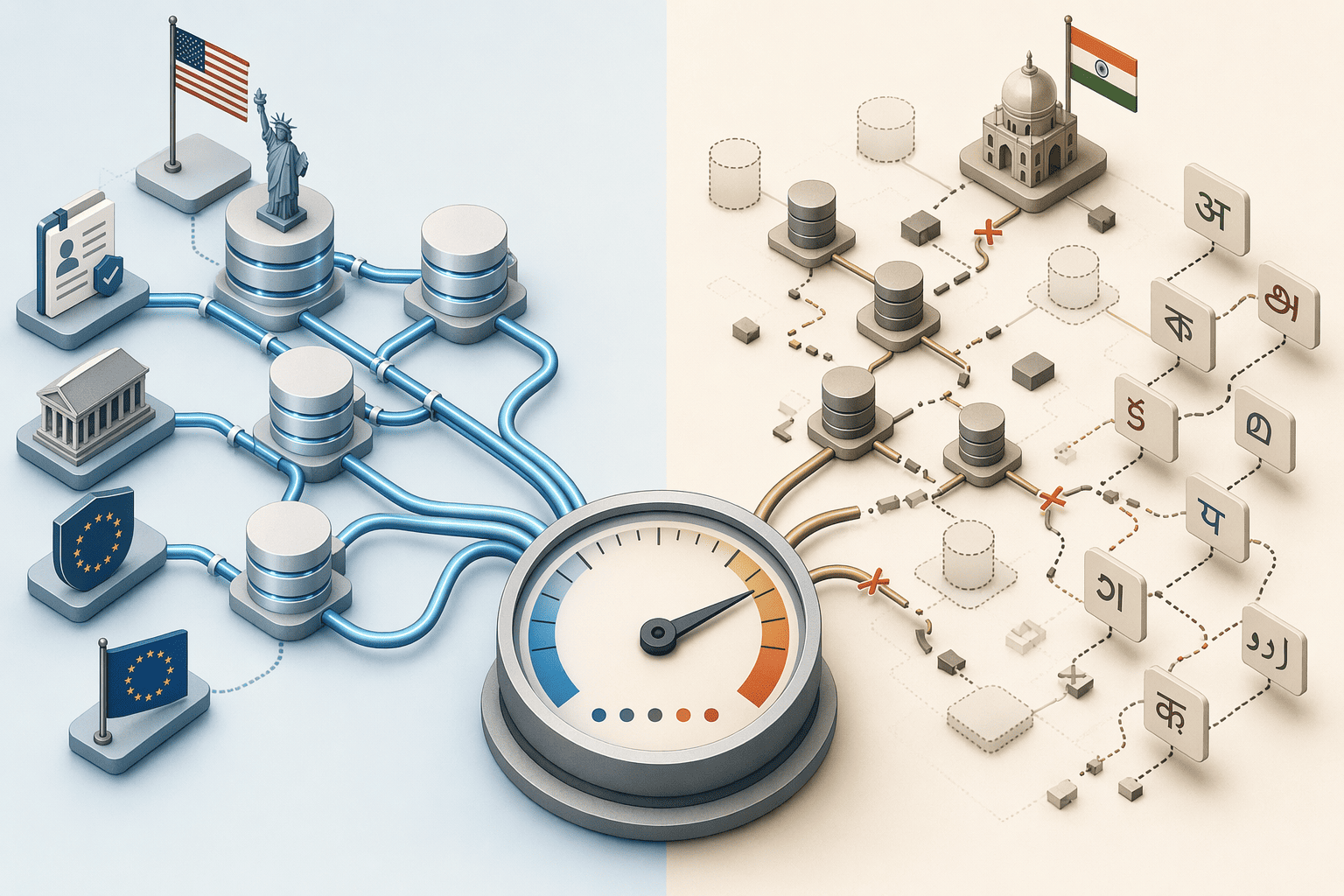
Global LinkedIn contact discovery platforms typically deliver 10 to 15 percentage points lower accuracy in India than in their home US/EU markets. Three structural factors drive the gap: database architecture, infrastructure availability, and linguistic design assumptions.
Database Coverage: US/EU Business Registries vs Indian GST/MCA Data
US and EU markets benefit from decades of structured business data, SEC filings, D&B registries, Crunchbase records, that global email finder platforms have integrated as core sources. India's equivalent public registries, GST records and Ministry of Corporate Affairs (MCA) databases, are newer, fragmented, and rarely surfaced in global platforms optimized for Western markets. Tools that specialize in Indian B2B prospecting integrate GST verification and MCA cross-referencing to close this gap, achieving meaningfully higher accuracy for Indian contacts.
Mobile Operator APIs: Carrier-Level Validation Gaps in India
Carrier-level phone validation APIs are widely standardized in North America and Europe, enabling platforms to verify number portability, line type (mobile vs. Landline), and active status in real time. India's telecom ecosystem lacks the same API maturity. Global platforms that rely on carrier validation struggle to classify numbers accurately or confirm deliverability, creating verification blind spots that regional specialists mitigate through alternative data partnerships.
Language and Localization: Transliteration Errors in Indian Business Names
Indian business names frequently appear in Hindi, Tamil, Bengali, or other regional scripts, then transliterate inconsistently into Latin characters. Global databases optimized for English-language matching treat "Patel & Sons" and "Patil and Sons" as distinct entities, fragmenting contact records. Platforms that normalize transliteration variants and account for regional naming conventions, honorifics, patronymics, family-name-first vs. Given-name-first ordering, reduce false negatives and improve match rates.
Regional specialists address these infrastructure gaps by integrating India-specific data sources that global platforms rarely access, resulting in measurably higher accuracy for Indian B2B contacts.
PeakAi's India-Specific Verification: GST, MCA, and 91% Accuracy
Most global contact discovery tools achieve 85-95% advertised accuracy rates, yet accuracy for Indian contacts drops below 70% without regional specialization. PeakAi addresses this gap through India-specific verification layers that cross-reference official government databases rather than relying solely on LinkedIn profile data.
GST and MCA Database Integration for Indian B2B Contacts
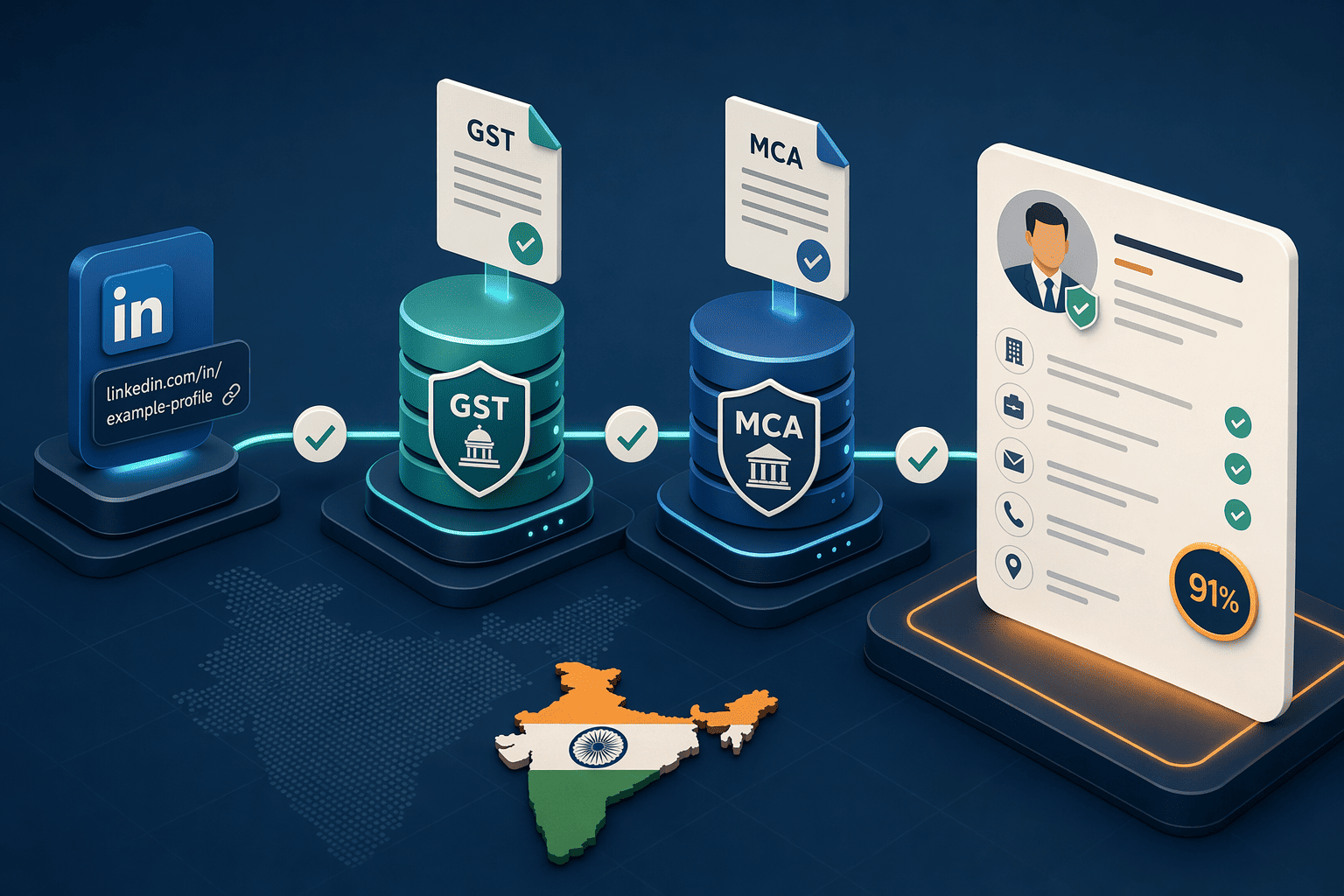
PeakAi uses GST verification and MCA database integration to validate business identity and contact accuracy. The platform queries the Goods and Services Tax Network and Ministry of Corporate Affairs registries in real time, confirming that a company exists as a registered entity and that the returned contact details correspond to verified business records. This approach addresses a core challenge in the Indian B2B market: mid-market firms and Tier-2 city companies often don't appear in standard global databases like Apollo or ZoomInfo, yet maintain official GST and MCA registrations that serve as authoritative proof of business legitimacy.
Real-Time Carrier-Level Validation for Indian Mobile Numbers
PeakAi validates phone numbers through real-time carrier lookups that handle mobile number portability and prepaid SIM verification, two factors that affect accuracy in India more than in Western markets. The platform classifies each number as mobile, landline, or VoIP, then runs carrier-level checks to confirm the number is active and assigned to the expected geographic region. This multi-layer validation delivers 91% verified contact accuracy for the Indian B2B market, measured as the accuracy of contacts returned, not the percentage of LinkedIn profiles for which a phone number is found.
Accuracy Benchmarking: 91% Returned-Result Accuracy vs Vendor Claims
The 91% accuracy claim represents returned-result accuracy: when PeakAi surfaces a phone number or email for an Indian B2B contact, that contact detail is correct 91% of the time. This metric differs from overall search hit rate, the platform does not claim to find contact details for 91% of LinkedIn profiles searched. Apollo's India mobile accuracy runs 60-73% s, while ZoomInfo's India data requires a $9,995/year add-on on top of a minimum $14,995/year contract. Teams targeting Indian decision-makers can compare these options and find accurate contact information through platforms optimized for regional verification layers.
Ready to Transform Your Sales Process? PeakAi delivers verified contacts through GST, MCA, and carrier-level validation, close more deals with India-optimized accuracy.
When to Choose Regional Specialists vs Global Platforms
The decision between regional specialists and global platforms hinges on three factors: geographic focus, cost transparency, and team size. Each shapes which tool delivers the best ROI for your prospecting workflow.

Geographic Focus: India-Only vs Multi-Region Prospecting
If your entire pipeline targets India, regional specialists maximize accuracy. PeakAi achieves 91% phone number accuracy for Indian B2B contacts, while global platforms without regional specialization drop below 70% for India coverage. Global tools like Apollo and ZoomInfo excel when you prospect across multiple continents, their breadth compensates for lower India-specific precision. For multi-region campaigns, choose data and enrichment tools that prioritize volume. For India-only teams, regional specialists deliver verified contacts at higher match rates. Learn more about B2B contact discovery in India.
Budget and Cost-Per-Verified-Contact Economics
Credit-based pricing on global platforms can obscure true cost when match rates fluctuate. RocketReach uses always-on AI to verify and enrich data but charges per lookup attempt, not per verified result. Pay-per-verified-contact models, like PeakAi's ₹675 for 50 verified contacts, eliminate waste by billing only for returned contacts. Teams on tight budgets benefit from transparent pricing that scales with success, not search volume.
Team Size and CRM Integration Requirements
Large teams needing deep Salesforce or HubSpot integrations should prioritize global platforms with native connectors. Smaller teams prioritizing accuracy over ecosystem lock-in can close more deals with regional specialists that focus on contact quality rather than workflow automation. If your CRM sync is mission-critical, choose a platform from the data and enrichment group. If your bottleneck is finding verified Indian contacts, regional specialists deliver higher ROI per contact discovered.
Regional specialists like PeakAi deliver 10 to 15 percentage points higher accuracy for Indian contacts through GST/MCA integration but offer narrower geographic coverage than global platforms (Apollo, ZoomInfo) optimized for multi-region prospecting. Global platforms provide deeper Salesforce/HubSpot integrations and broader contact databases, yet their India-specific accuracy drops below 70% without regional verification layers. As Indian B2B markets mature and regulatory data (GST, MCA, EPFO) becomes more accessible via APIs, expect the accuracy gap to narrow, but regional verification layers will remain the differentiator for 90%+ accuracy benchmarks through 2026. Benchmark your current contact discovery accuracy for Indian prospects using PeakAi's free trial, compare the 91% returned-result accuracy and cost-per-verified-contact transparency against your existing tools.
Frequently Asked Questions
What accuracy should I expect from LinkedIn contact discovery tools for Indian B2B prospects?
Most global LinkedIn contact discovery tools achieve only 60 to 75% accuracy for Indian B2B contacts, dropping 10 to 15 percentage points below their advertised US/EU rates. Regional specialists like PeakAi deliver 91% verified phone number accuracy through GST/MCA database integration and real-time carrier validation tailored to India's telecom infrastructure.
Why do global contact discovery tools underperform in India?
Global tools rely on US/EU business registries (SEC filings, D&B databases) that lack equivalents in India, where GST and MCA registries remain underutilized by international platforms. Carrier-level phone validation APIs are less standardized in India, and transliteration errors in business names compound accuracy gaps, resulting in 10 to 15 point accuracy drops for Indian contacts.
How does real-time verification differ from static database enrichment?
Real-time verification runs SMTP handshakes, MX record validation, and carrier-level checks at lookup time, ensuring current contact status. Static databases rely on syntax checks and pre-collected data that decay at 2 to 3% monthly due to job changes and domain migrations, charging for unverified lookups rather than confirmed working contacts.
Can I get phone numbers from LinkedIn Sales Navigator?
No, LinkedIn Sales Navigator does not provide phone numbers natively. Only 5 to 10% of LinkedIn users share phone numbers with first-degree connections, and even fewer expose them publicly. Third-party enrichment tools querying independent business registries are required to obtain verified phone numbers from LinkedIn profile URLs.
What is the compliance risk of using LinkedIn scraping tools?
Direct LinkedIn scraping tools violate the platform's Terms of Service and carry 15 to 20% account suspension rates for heavy users. Enrichment-based platforms like Apollo, Lusha, and PeakAi avoid this risk by querying third-party databases (business registries, public records) using LinkedIn URLs as reference identifiers rather than harvesting profile data directly.
How much does verified contact discovery cost per contact in India?
Credit-based pricing ranges from $0.85, $4 per lookup attempt, but true cost varies with match rate fluctuations. Pay-per-verified-contact models provide transparency by charging only when SMTP and carrier checks confirm working emails and phone numbers, eliminating charges for bounced or disconnected contacts that credit-based platforms count as billable lookups.
What are GST and MCA databases, and why do they matter for Indian contact discovery?
GST (Goods and Services Tax) and MCA (Ministry of Corporate Affairs) are India's primary business registries, providing verified company data that global platforms rarely integrate. Tools connecting to these databases validate business identity and contact accuracy using India-specific sources, achieving 90%+ accuracy compared to the 60 to 75% rates of global platforms relying on US/EU data infrastructure.
Sources
- 10 Best Linkedin Phone Number Finders in 2026 - folk CRM - www.folk.app (2026)
- Does LinkedIn Sales Navigator Provide Email Addresses? (Here's the Workflow) — BounceGuard Blog - bounceguard.app (2026)
- LinkedIn Automation: Messaging, Connections 2026 - meet-lea.com (2026)
- 10 Best LinkedIn Email Finder Tools in 2026 - pipeline.zoominfo.com (2026)
- How to Get Contact Details from a LinkedIn URL — India B2B Guide 2026 - cookleads.com (2026)
- Best B2B Data Providers in India 2026 - cookleads.com (2026)
- Head of Marketing Chennai Leads: Best Tools for 2026 - origami.chat (2026)
- RocketReach Software Pricing, Alternatives & More 2026 - www.capterra.com (2026)
- 10 Best Sales Prospecting Tools for 2026 (Compared) - kayako.com (2026)
