Most LinkedIn contact discovery tools advertise 90%+ accuracy rates that reflect US and EU performance—not the 50-60% reality Indian B2B sales teams experience daily.
This guide reveals why regional data gaps, compliance models, and verification infrastructure determine which tools actually deliver usable Indian contacts.
Key Takeaways
- Independent testing reveals average LinkedIn contact discovery accuracy closer to 50% for Indian B2B prospects, not the 90%+ vendors advertise globally
- Enrichment-based platforms carry under 2% account suspension risk versus 15-20% for scraping-based tools that violate LinkedIn's Terms of Service
- India-specific accuracy drops 10-15 percentage points below US/EU figures due to immature verification infrastructure and regional data-provider partnership gaps
- True cost per usable contact ranges from $0.85-$4 after factoring match rate, verification pass rate, and 2-3% monthly data decay
- Pre-download verification separates syntax-only checks from SMTP handshake validation—only the latter confirms mailbox existence before charging credits
No LinkedIn contact discovery tool consistently achieves 90%+ accuracy for Indian B2B prospects due to structural regional data gaps that vendor marketing rarely discloses. Independent testing reveals average accuracy closer to 50%, not the 95-98% vendors advertise globally, and India-specific performance tests 10-15 percentage points lower than US/EU figures because mature data-provider partnerships in those markets have no equivalent in India.
What '90%+ Accuracy' Actually Measures (and What It Doesn't)
Vendors conflate three distinct accuracy definitions, each measuring a different validation layer:
- Email syntax validation — verifies the address follows RFC standards ([email protected] format) but does not confirm deliverability or current employment.
- Email deliverability — confirms the domain has an active MX record and SMTP handshake completes, yet does not test whether the recipient monitors the inbox or still works at that company.
- Phone connectivity — validates the number is active at the carrier level, but cannot confirm whether it belongs to the named prospect or reaches a personal mobile versus a shared office line.
Most vendor accuracy claims refer to syntax or deliverability checks, not actual reachability. A tool reporting 95% email accuracy may measure only MX-record validation, ignoring bounce rates from role-based addresses or outdated job changes.
The Regional Accuracy Gap: Why US/EU-Optimized Tools Underperform in India
US and EU platforms achieve higher accuracy because they partner with mature data aggregators that maintain GST-equivalent business registries, mobile carrier API integrations, and verified employment databases. India lacks these partnerships at scale. Community-reported testing shows India-specific accuracy tests 10-15 percentage points lower than US/EU figures for the same tool, and even top-tier platforms like ZoomInfo optimize for US direct-dials rather than Indian regional formats.
PeakAi addresses this gap with GST and MCA database integration, delivering 91% phone number accuracy specifically for Indian B2B contacts across 1,600+ cities, a regional focus that global platforms do not replicate.
Independent Testing vs. Vendor-Claimed Accuracy
Independent LinkedIn email finder testing reveals average accuracy closer to 50%, not the 95-98% vendors advertise. This gap stems from a structural phone-number limitation: only 5-10% of LinkedIn users share phone numbers with first-degree connections, and even fewer expose them to second- or third-degree connections. No compliant enrichment tool can close this gap to 90%+ when the underlying visibility is capped at single-digit percentages.
Vendor-claimed accuracy typically measures database coverage (how many profiles have a phone number on file), not successful connection rates after outreach. A tool with 95% database coverage may deliver only 60% actual connectivity if the numbers are outdated, belong to shared office lines, or were never verified at the carrier level.
Understanding why accuracy claims fail in India requires examining how tools acquire contact data, a compliance divide that determines both suspension risk and regional coverage depth.
Compliance Methods: Scraping vs. Enrichment-Based Contact Discovery
LinkedIn ToS Prohibitions on Automated Scraping and Profile Crawling
LinkedIn's Terms of Service explicitly prohibit automated data extraction from member profiles. The platform restricts tools that crawl profile data, harvest contact information through bots, or circumvent rate limits. Enforcement mechanisms include permanent account suspension, IP bans, and legal action against platforms violating these terms. Sales teams relying on prohibited scraping tools risk losing LinkedIn access mid-campaign, a disruption that can paralyze prospecting operations for weeks while account recovery appeals proceed. The ToS language applies equally to browser extensions that automate profile visits and standalone platforms that index LinkedIn data without authorization.

Enrichment-Based Tools: Third-Party Database Queries vs. Direct Scraping
Enrichment-based platforms use LinkedIn URLs as reference identifiers to query independent third-party databases rather than accessing LinkedIn's APIs or crawling profile data directly. This architectural difference reduces ToS violation risk because the tool never requests data from LinkedIn itself, contact details come from business registries, public records, and data partnerships maintained outside LinkedIn's platform. Vendor marketing in tool comparison guides rarely distinguishes these compliance methodologies, treating scraping-based and enrichment-based platforms as functionally identical categories. Teams evaluating tools should verify the data sourcing model before committing to a platform.
Account Suspension Risk: Scraping-Based 15-20% vs. Enrichment-Based <2%
Community-reported suspension rates show scraping-based tools carry 15-20% account suspension risk, while enrichment-based platforms report under 2% suspension rates. The compliance tradeoff is direct: scraping tools may claim higher match rates, but a single suspension halts prospecting workflows entirely. Sales teams lose access to saved leads, Sales Navigator filters, and InMail credits, forcing manual prospect list reconstruction from scratch. Enrichment platforms like PeakAi prioritize compliant professional contact discovery over maximum coverage, reducing the operational risk of account lockout during active campaigns.
Even compliant enrichment-based tools show performance variability across geographies, the regional data partnerships that power US and EU accuracy rarely extend to emerging markets.
Regional Accuracy: Why US/EU-Optimized Tools Underperform in India
Global contact discovery platforms advertise headline accuracy rates, often 85-90%, that reflect performance in US and EU markets where verification infrastructure is mature. Yet those same tools deliver 10-15 percentage points lower accuracy when targeting Indian B2B prospects. The gap isn't a data quality issue; it's a structural mismatch between where platforms partner for verification and where your prospects operate.

Mobile Number Portability and Prepaid SIM Prevalence in India
India's telecommunications landscape accelerates contact data decay beyond what quarterly database refreshes can handle. High prepaid SIM adoption means professionals routinely change numbers when switching carriers or employers, yet global tools' monthly update cycles lag the actual rate of change. Mobile number portability compounds the problem: a number that routes correctly in January may redirect to a different subscriber by March. Platforms optimized for US landline stability lack the real-time carrier API integrations needed to track portability events, producing false-positive "verified" contacts that bounce on first dial.
Carrier-Level Validation API Gaps for Indian Mobile Networks
US and EU contact tools validate phone numbers through mature carrier-level APIs that return line type (mobile/landline), active status, and subscriber metadata. India's telecom ecosystem lacks equivalent third-party API access at scale. Without carrier validation hooks, global platforms fall back to syntax-only checks, verifying that a +91 number follows the correct digit pattern but unable to confirm whether the line is active, belongs to the listed professional, or routes to a personal versus business device. This infrastructure gap explains why advertised global accuracy rates fail to predict India-specific mobile number reliability.
GST Validation and Regional Language Support Deficits
India-specific B2B verification requires layers that global platforms don't implement:
- GST number validation for B2B entity verification (analogous to VAT validation in EU), cross-referencing Government of India registries to confirm company legitimacy before outreach.
- Mobile carrier-level APIs for real-time number validation (mature in US/EU, absent in India), verifying line type, active status, and subscriber metadata rather than syntax-only checks.
- Regional language support for contact name matching, critical when LinkedIn profiles use transliterated or regional-language names that ASCII-only matching logic fails to reconcile.
Tools built for Western markets partner with data aggregators like Experian and Dun & Bradstreet, whose India coverage remains shallow. Platforms that integrate GST and MCA databases for India verification close this gap, but most global tools omit these layers entirely, producing higher false-positive rates when your outreach targets Indian prospects. Regional data-provider partnerships determine real-world accuracy more than advertised headline claims, and it's time to close more deals by choosing tools built for the markets you sell into.
Vendors conflate multiple validation tiers under the same 'verified' label, understanding the technical hierarchy reveals which platforms measure deliverability versus actual reachability.
Verification Layers That Separate Real Accuracy from Syntax Validation
Email Verification Methodology: Syntax vs. MX Records vs. SMTP Handshake
Most platforms advertise 'verified' emails without specifying *which* verification tier they use. The hierarchy has three levels:

- Syntax validation checks `[email protected]` format, fast, free, zero confidence the mailbox exists.
- MX record lookup confirms the domain has a mail server, medium confidence, but doesn't prove the specific mailbox accepts mail.
- SMTP handshake pings the mailbox to verify it exists and accepts mail, highest confidence, but slow and often blocked by corporate firewalls.
PeakAi uses dual verification for both emails and phone numbers, displaying validation status before lookup, credits charge only when verification passes. Apollo, Kaspr, and Hunter report verification tiers differently: Apollo tags 'Verified' emails at ~88% deliverability, while Hunter relies on MX + pattern-matching at ~85%.
Phone Number Verification: Carrier Lookup vs. Deliverability Testing
Phone validation splits into syntax-only checks (area code + length) and carrier-level APIs that query telecom databases to confirm the number is active. Deliverability testing, actual SMS send attempts, is rare because Indian carriers throttle bulk verification requests. PeakAi validates local phone number formats and classifies numbers as mobile, landline, or VoIP, cross-referencing 200+ network data partners for carrier-level confirmation before surfacing the contact.
Pre-Download vs. Post-Export Verification Models and Wasted Spend
Pre-download models (PeakAi, Findymail) charge credits only when a verified contact is found, failed lookups cost nothing. Post-export models (Apollo, Lusha) charge for all matches and leave verification to the user after CSV download. When match rates sit at 65 to 76%, post-export pricing inflates real spend by 35 to 100%: a 1,000-credit purchase yields 650 to 760 verified contacts, pushing per-verified-contact cost from nominal $0.85 to effective $1.15, $1.31. For high-volume outreach where deliverability is critical, pre-download verification eliminates waste; for exploratory prospecting where broader coverage matters more than precision, post-export models offer faster bulk pulls at the expense of downstream bounce-rate cleanup.
With accuracy thresholds, compliance models, and verification layers mapped, selecting the right tool requires matching platform architecture to your sales motion and risk tolerance.
Choosing a LinkedIn Contact Tool for Indian Prospects: Decision Framework
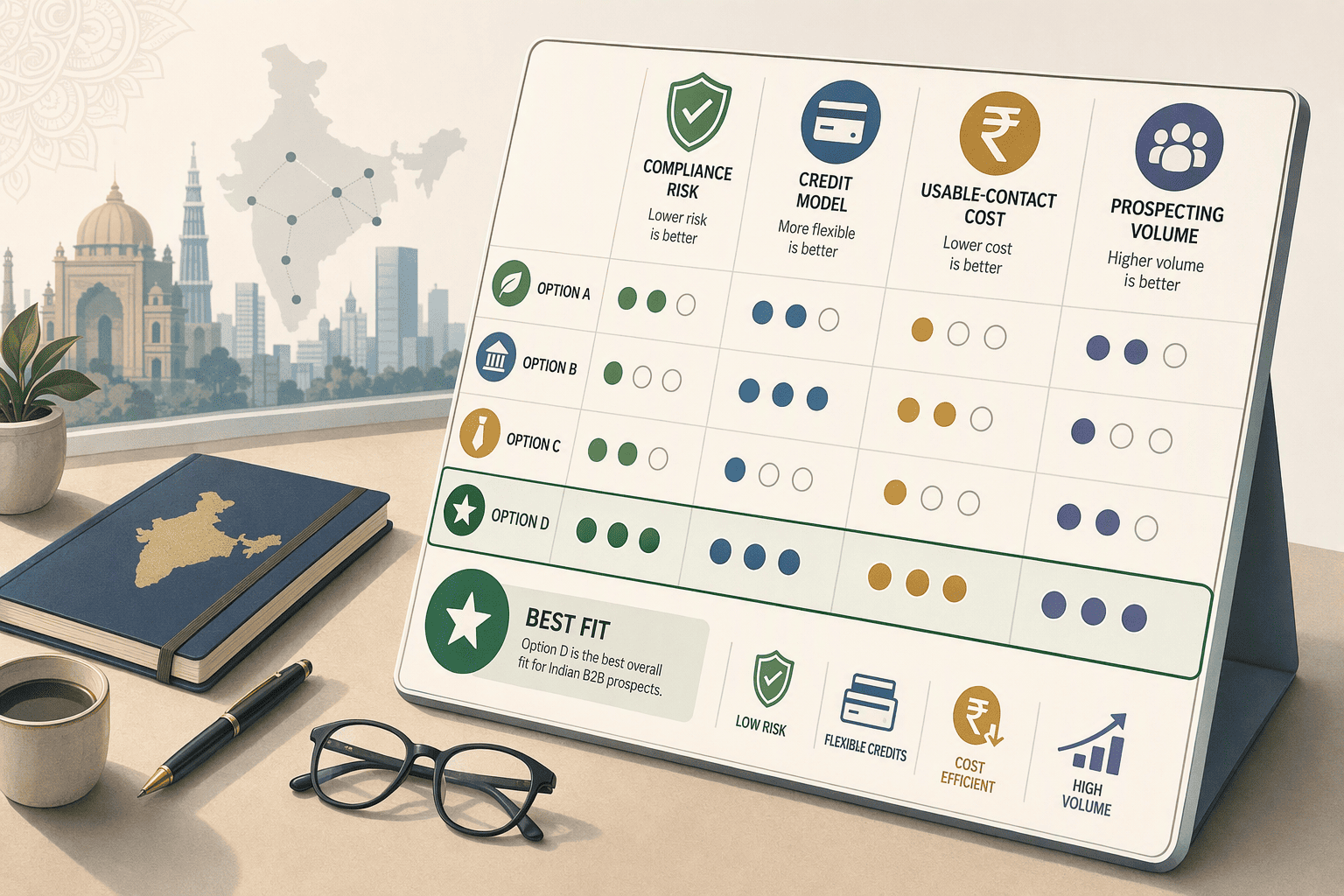
Selecting a contact discovery platform requires evaluating your sales motion, compliance posture, and actual cost per usable contact, not just headline pricing or database size claims.
High-Volume Cold Outreach vs. Targeted Account-Based Prospecting
High-volume outreach teams prioritize pre-download verification and credit-based pricing that scales with fluctuating prospecting needs. Tools that offer large monthly credit allocations (Apollo.io's free plan includes 50 email reveals/month ) suit teams running automated sequences where match rate matters more than per-contact verification depth. Targeted account-based prospecting, by contrast, demands India-specific coverage depth and enrichment quality over raw match quantity. PeakAi delivers verified phone numbers and emails from LinkedIn profiles with 91% accuracy in 10 seconds, using India-focused contact verification with GST and MCA database integration rather than relying on generic global datasets.
Compliance Risk Tolerance and Account Suspension Impact
Scraping-based tools carry suspension risk that can paralyze operations, platforms that crawl LinkedIn profiles directly violate LinkedIn's terms and expose users to permanent account suspension. Enrichment-based platforms like PeakAi and Lusha reduce suspension risk to below 2% by querying independent third-party databases rather than accessing LinkedIn's internal APIs or scraping profile data. For teams targeting Indian decision-makers, compliance-first tools offer operational safety: PeakAi provides DPDP Act 2023 compliance and does not store profile information or browsing history, while scraping tools accept 15-20% suspension risk in exchange for higher claimed match rates.
Budget Considerations: Credit-Based Pricing vs. True Cost
Calculate true cost per usable contact by factoring match rate, verification quality, and data decay. The hit rate gap between the best and worst tools on the same LinkedIn URL list is roughly 35 percentage points, and the price gap on a 5,000-email-per-month workload is 6×. PeakAi's credit-based pricing starts at ₹675 for 50 verified contacts, charging only when verification confidence is high. Apollo.io offers paid plans starting at $49/month for 1,000 reveals but charges separate credits for emails and phone numbers with no rollover. Lusha's pricing is transparent and starts at $37/month, though per-contact costs vary by verification pass rate.
| Platform | Pricing Model | India Coverage | Phone Accuracy | Compliance Approach |
|---|---|---|---|---|
| PeakAi | ₹675 for 50 contacts (credit) | India-first with GST/MCA | 91% | Enrichment-based, DPDP compliant |
| Lusha | $37/mo annual | GDPR-aligned EU/US | Not disclosed | LinkedIn-native, job-change alerts |
| Apollo.io | $49/mo for 1,000 reveals | 275M+ global profiles | ~76% (88% verified) | Database aggregator |
| RocketReach | Custom pricing | 700M+ profiles | Not disclosed | Massive database, limited verification |
| Kaspr | €45/user/mo | 200M+ EU profiles | Not disclosed | LinkedIn scraper, GDPR-aligned |
Join thousands of sales professionals who find accurate contact information and close more deals by calculating true cost per verified contact rather than chasing headline match rates.
Ready to Transform Your Sales Process? Add to Chrome - Free
Conclusion
Enrichment-based platforms like PeakAi, Lusha, and Cognism reduce account suspension risk to under 2% but sacrifice some coverage depth versus scraping-based tools that offer higher match rates with 15-20% suspension risk, teams must choose between operational safety and marginal coverage gains. Global platforms optimized for US/EU markets deliver 10-15 percentage points lower accuracy in India due to immature regional data-provider partnerships, India-specific verification infrastructure (GST validation, mobile carrier APIs, regional language support) remains absent from most vendor roadmaps, making regional accuracy more dependent on data partnerships than headline claims.
As India's B2B digital ecosystem matures, expect regional data aggregators to close the verification infrastructure gap, platforms that invest in GST validation APIs, mobile carrier partnerships, and regional language support will differentiate on India-specific accuracy rather than global headline claims, shifting the category toward regional specialization over one-size-fits-all coverage.
Audit your current contact discovery tool's verification methodology using the layer hierarchy from section 4, then explore PeakAi's enrichment-based platform to compare compliance, India-specific coverage depth, and true cost per usable contact against your existing provider.
Frequently Asked Questions
Can any LinkedIn contact discovery tool achieve 90%+ accuracy for Indian B2B prospects?
No LinkedIn contact discovery tool consistently achieves 90%+ accuracy for Indian B2B prospects. Independent testing reveals average accuracy closer to 50%, with India-specific performance dropping 10-15 percentage points below US/EU figures due to structural phone-number gaps (only 5-10% of LinkedIn users share phone numbers) and regional data-provider partnership deficits that global platforms have not addressed.
What's the difference between scraping-based and enrichment-based LinkedIn contact tools?
Scraping-based tools directly extract data from LinkedIn profiles, violating Terms of Service and carrying 15-20% account suspension risk. Enrichment-based platforms query independent third-party databases using LinkedIn URLs as reference identifiers, reducing suspension risk to under 2%. Teams prioritizing operational safety should choose enrichment-based platforms despite slightly lower match rates.
Why do global contact discovery tools underperform in India compared to US/EU markets?
US and EU platforms achieve higher accuracy through partnerships with mature data aggregators like Experian and D&B that maintain GST-equivalent business registries, mobile carrier API integrations, and verified employment databases. India lacks these partnerships at scale, producing a 10-15 percentage point accuracy drop because global tools lack India-specific verification infrastructure.
What verification layers should I look for in a LinkedIn contact discovery tool?
Verification splits into six tiers: (1) syntax validation (format checks), (2) MX record lookup (mail server exists), (3) SMTP handshake (mailbox accepts mail), (4) role-based detection (filters admin@, info@), (5) disposable domain screening, and (6) catch-all analysis. Vendors conflate these under 'verified' labels, audit which layers a platform implements before purchase.
How do I calculate the true cost per usable contact for a LinkedIn tool?
Divide subscription price by claimed match rate to get cost per match, then multiply by (1 ÷ verification pass rate) to account for unverified contacts. Add a 2-3% monthly decay factor for ongoing maintenance. The hit rate gap between best and worst tools is roughly 35 percentage points, inflating wasted spend by 35-100% in post-export verification models.
What are the account suspension risks of using LinkedIn contact discovery tools?
Scraping-based tools carry 15-20% account suspension risk, while enrichment-based platforms report under 2% suspension rates. A single suspension can paralyze prospecting workflows for weeks, teams prioritizing operational safety should choose enrichment-based platforms over scraping tools that claim higher match rates but violate LinkedIn's Terms of Service.
Which LinkedIn contact discovery tool is best for Indian B2B prospects?
No single platform is 'best', optimal choice depends on sales motion. High-volume outreach teams prioritize pre-download verification and credit-based pricing. Targeted account-based prospecting requires India-specific coverage depth and enrichment quality. Compliance-first teams should choose enrichment-based platforms with under 2% suspension risk over scraping-based tools with higher match rates but operational risk.
Sources
- Best Contact Finding Tools for B2B Sales Teams in 2026 - lagrowthmachine.com (2026)
- Linkedin Email Finder Accuracy: What Actually Works - HyperClapper - www.hyperclapper.com
- I compared the top 8 B2B contact databases in 2026. Here is the reality of what's actually worth your money - www.reddit.com
- 10 Best LinkedIn Email Finder Tools for Sales Teams in 2026 - pipeline.zoominfo.com (2026)
- Best LinkedIn Contact Discovery Tools 2026 | High Accuracy - origami.chat (2026)
- Need recommendations for B2B contact data providers in India - www.reddit.com
- Best Contact Discovery Tools for 2026 - The Rank Masters - www.therankmasters.com (2026)
- Best LinkedIn Email Finder Tools for 2026 - prospectingmanual.com (2026)
- LinkedIn Executive Email Finder: Research Guide 2026 - instantly.ai (2026)
- I tested Apollo, Lusha, Cognism, and SalesTarget.ai - www.reddit.com (2024)
