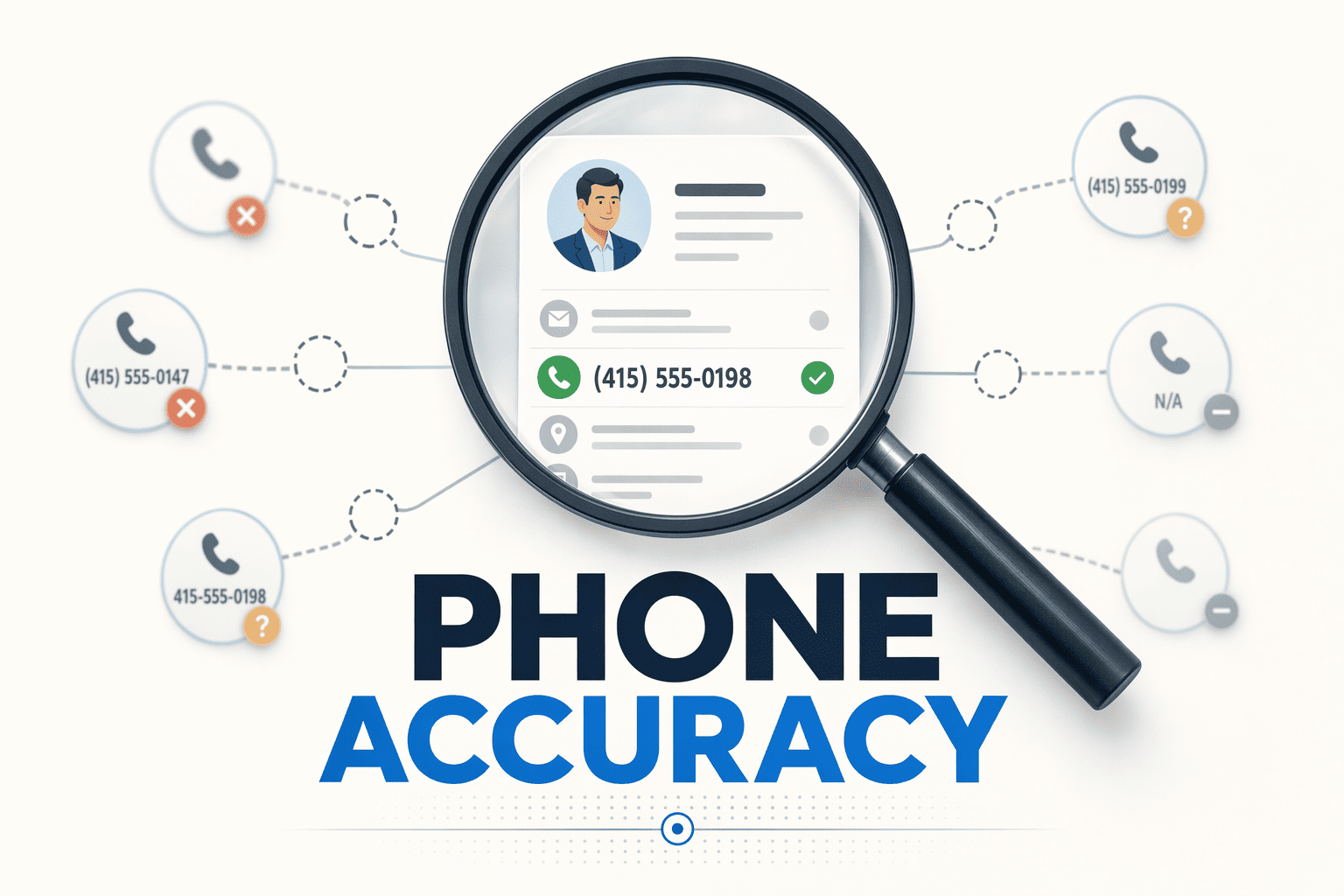
Vendor claims of 95%+ phone accuracy often combine email and phone metrics into a single figure, masking real-world connectivity rates that independent testing shows closer to 50% for most platforms.
This guide compares verification methodologies, compliance models, and regional accuracy variance across six LinkedIn contact discovery tools to help you identify platforms delivering genuine 90%+ phone-specific accuracy.
Key Takeaways
- Enrichment-based platforms query third-party databases compliantly, achieving higher accuracy than scraping-based tools that risk 15-20% account suspension rates
- Syntax validation checks format only; deliverability testing verifies real connectivity—most vendors disclose which methodology produces their accuracy claims
- India-specific accuracy typically tests 10-15 percentage points lower than US/EU figures for global tools optimized for Western markets
- Contact data decays 22-25% annually, requiring quarterly re-verification workflows to maintain advertised accuracy levels
- Independent testing reveals phone-specific accuracy closer to 50-70% for most vendors despite aggregate claims of 95-98%
How LinkedIn Contact Discovery Tools Measure Phone Number Accuracy
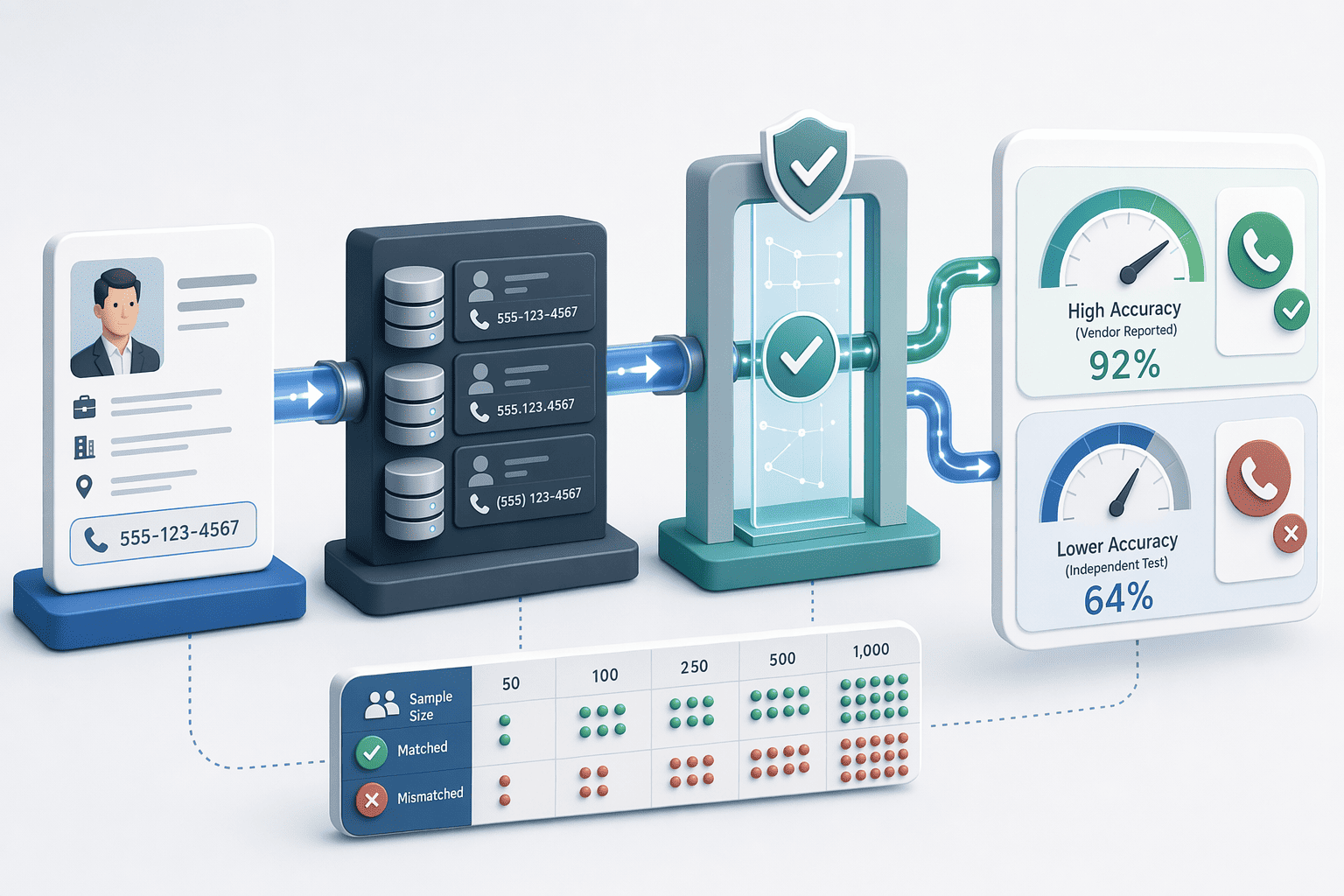
Enrichment-based platforms like PeakAi, Cognism, and Apollo achieve higher phone accuracy compliantly by querying third-party business databases rather than scraping LinkedIn directly. Aggregate vendor claims mask lower phone-specific connectivity — independent testing shows average accuracy closer to 50% versus vendor claims of 95-98% — because most vendors combine email and phone metrics into a single figure.
Syntax Validation vs. Deliverability Testing
Syntax validation checks whether a phone number follows the correct format for its country code — this confirms structure, not connectivity. Deliverability testing verifies the number is still in service and belongs to the intended recipient. A tool advertising 95% syntax accuracy may deliver only 70% connectivity if it skips real-world verification. PeakAi's real-time verification system achieves 91% phone number accuracy by cross-referencing multiple data sources beyond LinkedIn's visible profile fields.
Email Accuracy vs. Phone Accuracy: Why Aggregate Claims Mislead
Vendors advertise 95% contact accuracy by combining email (85-90% accuracy) and phone (50-70% accuracy) into a single metric. This masks the phone-specific gap because email addresses are easier to verify through syntax checks and domain validation. When evaluating tools for cold calling, demand phone-specific accuracy figures separated from email — aggregate claims obscure the metric that determines whether your SDRs reach live prospects.
Regional Variance: Why US/EU-Optimized Tools Underperform in India
India-specific accuracy for global tools often tests 10-15 percentage points lower than US or EU figures because telecom infrastructure, number portability practices, and business directory coverage vary by region. A platform claiming 90% accuracy for North America may deliver 75% for Indian mobile numbers if it lacks local carrier partnerships. PeakAi validates local phone number formats and queries 200+ network data partners in real time to close this regional gap.
Ready to Transform Your Sales Process? PeakAi delivers verified phone numbers and emails from LinkedIn profiles with 91% accuracy in 10 seconds. Add to Chrome - Free
Understanding verification methodology establishes the foundation for evaluating accuracy claims, but compliance models determine whether those methods expose your team to platform risk.
Compliance-First vs. Scraping-Based: The Accuracy-Risk Tradeoff
Enrichment-Based Tools: How Third-Party Databases Avoid LinkedIn ToS Violations
Enrichment-based platforms operate outside LinkedIn's Terms of Service restrictions by querying independent third-party databases rather than accessing LinkedIn's APIs or scraping profile data directly.

PeakAi uses publicly shared LinkedIn URLs as search keys for independent third-party databases, never accessing LinkedIn's internal systems. Apollo and Cognism follow similar database-lookup architectures, aggregating contact records from business registries, public records, and partner networks indexed by LinkedIn profile URLs rather than platform scraping.
This compliance-first model enables teams to scale contact discovery without breaking budget while maintaining zero LinkedIn account risk. The enrichment layer separates data sourcing from LinkedIn's platform entirely, delivering verified phone numbers and emails without triggering platform detection systems.
Database lookup platforms maintain independent contact repositories indexed by LinkedIn profile URLs, company domains, and individual names. When a user requests contact details, the enrichment tool queries its own database, not LinkedIn's servers, returning phone numbers and emails aggregated from business databases, telecom records, and consent-based data partnerships.
Scraping-Based Tools: Account Suspension Rates and Deliverability Impact
Scraping-based tools extract contact data by automating LinkedIn profile visits, triggering platform rate limits and detection algorithms. Account suspension rates for heavy scraping users range from 15-20% versus under 2% for enrichment-based tools.
LinkedIn's anti-bot systems flag profiles that view hundreds of contacts daily or extract data through browser automation. Suspended accounts lose access to Sales Navigator, InMail credits, and prospect interaction history, disrupting entire sales workflows.
Beyond suspension risk, scraping-based tools often return unverified contact data. When extracted phone numbers include outdated landlines, generic switchboards, or incorrect regional formats, connect rates drop below 60%. Enrichment-based platforms cross-reference multiple data sources before delivery, filtering disconnected numbers and validating mobile-versus-landline classifications.
For teams prioritizing accuracy and compliance, verified phone numbers from LinkedIn profiles require enrichment layers that operate outside platform boundaries, delivering 90%+ accuracy without exposing user accounts to policy violations.
Compliance models shape the accuracy-risk tradeoff, but real-world performance varies significantly across vendors and regions.
Platform Comparison: Verification Methodology and Regional Coverage
The table below compares six LinkedIn contact discovery platforms on verification methodology transparency, phone accuracy claims versus independent testing results, regional coverage quality, compliance model, and pricing. These factors determine whether a tool delivers verified contact data your sales team can trust, or whether advertised accuracy rates evaporate in real-world prospecting workflows.

Verification Methodology: Transparency and Third-Party Audits
Most platforms advertise high phone accuracy but disclose little about how they verify numbers, syntax-only validation versus deliverability testing versus manual outbound calls. Cognism's Diamond Data methodology is the exception: the research team manually verifies mobile numbers by calling them, delivering around 87% mobile number accuracy for Diamond-verified contacts. PeakAi cross-references 200+ network data partners in real time and classifies phone numbers as mobile, landline, or VoIP, offering transparency into verification coverage. ZoomInfo, Apollo, RocketReach, and Kaspr publish aggregate accuracy claims without disclosing independent audit results or methodology details, making it difficult for buyers to distinguish syntax-only checks from deliverability-tested contacts.
Phone Accuracy Claims vs. Independent Testing Results
Vendor-advertised phone accuracy rates typically range from 90 to 98%, yet independent testing reveals a significant gap. Cognism's Diamond Data achieves around 87% mobile number accuracy, while non-verified numbers from other providers fall to 40 to 60%. PeakAi delivers 91% phone number accuracy by querying legitimate business databases and public records rather than scraping LinkedIn directly. Apollo and ZoomInfo offer large contact databases, Apollo has 275 million B2B contacts, ZoomInfo has over 174 million email addresses and 94 million direct dials, but independent reviews show accuracy varies widely depending on geography and job level. Kaspr and Lusha are the strongest LinkedIn-native pickers for instant emails and phone numbers, yet neither publishes third-party audit results. RocketReach positions itself within the same contact discovery landscape but does not disclose independent verification metrics.
Regional Coverage Quality: India-Specific Performance Gaps
Global contact discovery tools often deliver 10 to 15 percentage points lower accuracy in India versus US or EU markets, a structural gap that undermines cold-calling campaigns targeting Indian B2B contacts. PeakAi delivers 91% phone number accuracy specifically for Indian contacts across 1600+ cities, validated against GST and MCA databases. Cognism's EMEA database depth exceeds every US-based competitor, while North American hit rates trail ZoomInfo by 15 to 25% for direct dials, suggesting regional performance varies significantly. Apollo, ZoomInfo, RocketReach, and Kaspr do not publish India-specific accuracy benchmarks, making it difficult for teams prospecting in emerging markets to predict real-world coverage. PeakAi's GST verification and regional phone format validation close this gap for teams focused on Indian B2B prospecting.
Ready to Transform Your Sales Process? PeakAi delivers verified phone numbers and emails in 10 seconds, no scraping, no compliance risk, no lengthy onboarding. LIMITED TIME 50 contacts for just $9. Only 19 spots remaining! Add to Chrome - Free.
Platform comparison tables reveal methodology gaps, but testing vendor claims in your target market requires a systematic evaluation framework.
How to Evaluate 90%+ Accuracy Claims Before Buying
Contact discovery platforms advertise accuracy rates ranging from 70% to 95%, but vendor claims rarely explain the verification methodology behind those numbers. Before committing to a tool that promises 90%+ phone number accuracy, implement a systematic evaluation framework that tests real-world performance against your target market, not just the vendor's marketing deck.
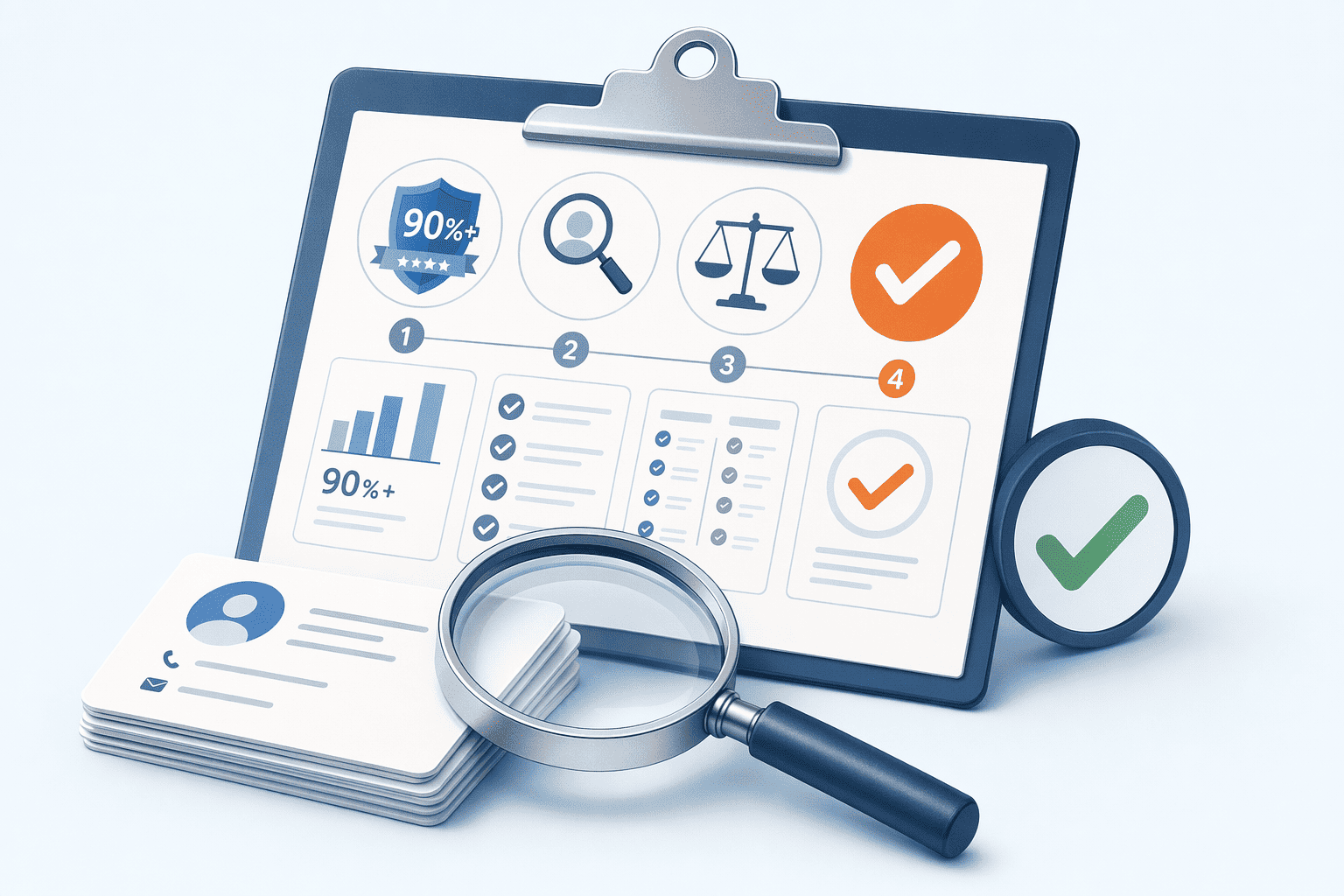
Different contact finder tools vary widely in accuracy, with leading solutions achieving verification rates above 90% while legacy platforms struggle below 70%. The gap between advertised and delivered accuracy widens further when vendors optimize for global markets but underperform in regional contexts like India. Use this four-step decision framework to audit vendor accuracy claims before purchasing:
- Request third-party audit results and verification methodology documentation, Ask vendors for independent accuracy audits and detailed explanations of their verification process.
- Run trial-period deliverability tests on your target market, Download sample contact batches during trial access and measure real-world connectivity rates.
- Test regional accuracy variance with India-specific batches, Request test datasets focused on Indian B2B contacts to quantify geographic performance gaps.
- Verify data freshness disclosure and update frequency, Confirm how often the vendor refreshes contact data and whether pricing includes ongoing verification.
Request Third-Party Audit Results and Verification Methodology Documentation
Most contact discovery vendors publish accuracy percentages without disclosing the verification methodology that produces those numbers. Before evaluating any tool, request two critical documents: third-party audit reports that validate advertised accuracy claims, and technical documentation explaining the verification process.
Third-party audits eliminate vendor bias by having independent organizations test contact accuracy against real-world calling and email campaigns. Ask whether the vendor commissions annual audits and whether those reports segment accuracy by region, global averages often mask poor performance in emerging markets. For verification methodology, look for platforms that use external database verification rather than relying solely on LinkedIn's visible profile fields.
PeakAi uses external database verification and offers a verification API that integrates with your existing workflows. When vendors cannot provide audit documentation or methodology transparency, treat advertised accuracy claims as unverified marketing assertions rather than operational guarantees.
Run Trial-Period Deliverability Tests on Your Target Market
Advertised accuracy means nothing if the tool fails to deliver verified contacts for your specific prospect profile. During trial periods, download sample batches of 50-100 contacts matching your ideal customer profile and run systematic deliverability tests to measure real-world connectivity rates.
Mobile phone verification focuses on validating phone numbers at multiple stages, account creation, transaction authentication, and ongoing engagement activities. Apply this same validation discipline to vendor trial data: attempt to reach a statistically meaningful sample of provided contacts through both phone and email channels, then calculate your actual connection rate against the vendor's advertised percentage.
Track three metrics during trial testing: initial deliverability (what percentage of phone numbers connect), contact accuracy (whether you reach the intended decision-maker), and data freshness (how many contacts have changed roles since the vendor's last update). PeakAi recommends verification at list build, pre-send campaign review, and after CRM aging periods to maintain accuracy over time. If trial-period testing reveals a gap of more than 10 percentage points between advertised and delivered accuracy, escalate to vendor support before purchasing, and document their response for contract negotiations.
Test Regional Accuracy Variance with India-Specific Batches
Global contact discovery tools often underperform in India because they optimize databases for North American and European markets. To quantify regional variance, request India-specific test batches from vendors during trial periods and compare deliverability rates against their global accuracy claims.
India-specific testing should cover three dimensions: phone number format validation (ensuring local mobile and landline prefixes are correct), regional business database coverage (particularly for MSMEs that may not appear in global datasets), and verification recency (contact turnover rates are higher in fast-growing markets). When PeakAi states 91% verified contact accuracy for the Indian B2B market, that claim is regional-specific rather than a global average applied uniformly.
Ask vendors whether they maintain separate accuracy metrics for India and whether their pricing includes regional verification as a standard feature. Platforms that charge premium fees for regional data enrichment or cannot demonstrate India-specific testing likely source contacts from generic global databases that prioritize coverage over regional accuracy. For teams focused on Indian B2B prospecting, a tool delivering 85% accuracy in India outperforms a platform advertising 95% global accuracy but delivering 65% in your target market.
Ready to Transform Your Sales Process? Test PeakAi's India-focused verification with a trial batch, our pay-per-contact model means you only pay for verified numbers that meet your accuracy threshold.
Pre-purchase evaluation identifies high-accuracy vendors, yet maintaining that accuracy over time requires understanding contact data decay dynamics.
Data Freshness and Accuracy Decay: Why 90% Accuracy Doesn't Stay 90%
Monthly Decay Rates: How Fast Contact Data Goes Stale
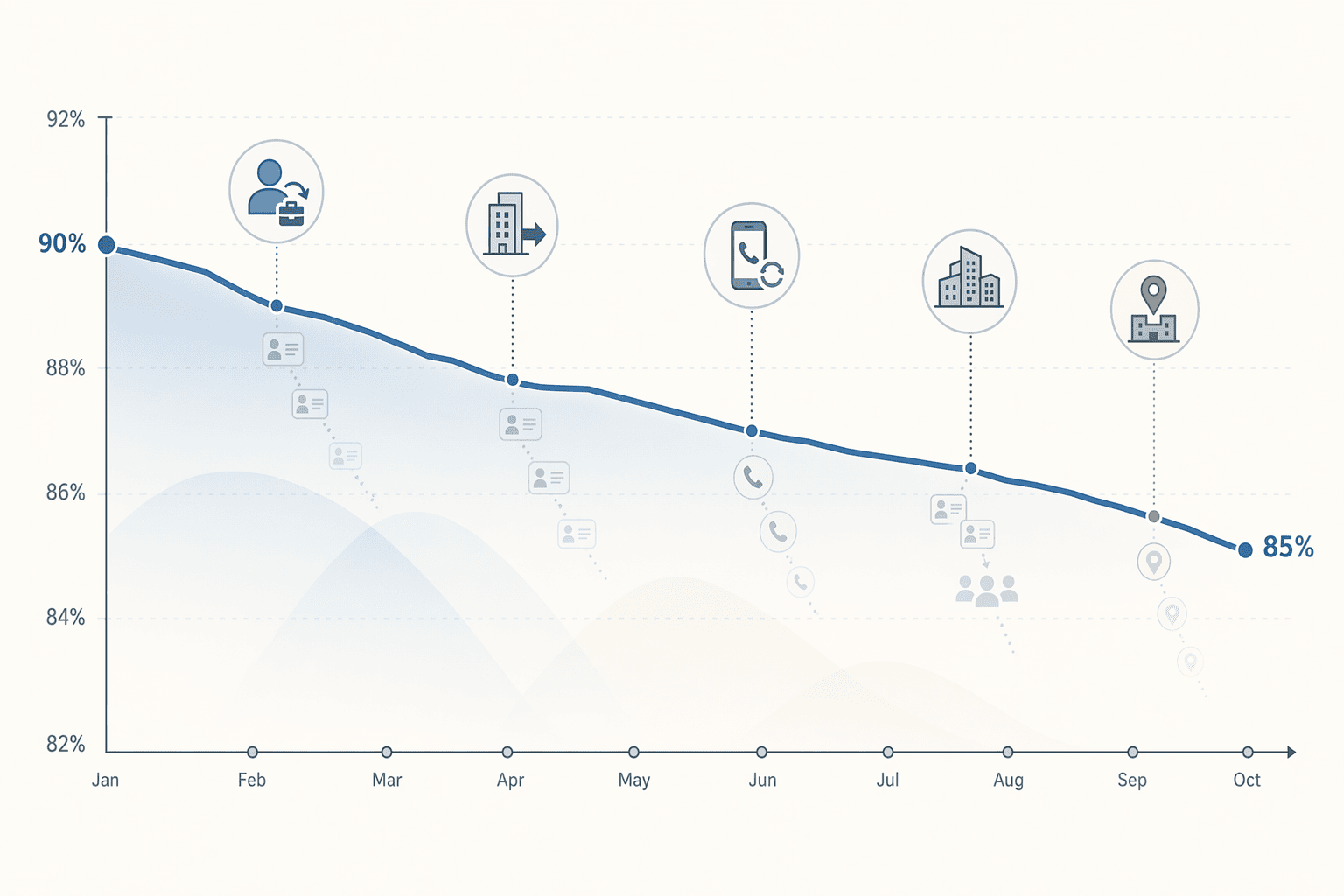
Contact databases lose 22 to 25% of their accuracy within 12 months as professionals change roles, companies, and phone numbers. That translates to roughly 2% monthly decay, meaning a list verified at 90% accuracy in January drops to ~88% by February and ~86% by March without intervention. Job transitions, mergers, acquisitions, and office relocations all accelerate the rate at which direct dials and email addresses go stale. The decay is non-linear: senior roles turn over more slowly than mid-level positions, and landlines decay faster than mobile numbers when employees move departments or switch employers.
Ongoing Verification Workflows to Maintain Accuracy
To offset decay, re-verify contacts at three critical stages: initial list build when prospects enter your CRM, pre-send campaign review before launching new sequences, and periodic re-verification after aging periods or significant time gaps. Automated workflows trigger re-enrichment when a contact's last-verified timestamp exceeds 90 days, a bounce occurs, or a role-change signal appears in your CRM. Tools that offer API-driven verification let you schedule quarterly batch validations and flag high-risk segments, executives who joined recently, contacts at companies undergoing M&A, or prospects whose emails returned soft bounces. This continuous-validation approach keeps accuracy above 85% over a 12-month cycle, ensuring your team can close more deals without burning hours on disconnected numbers.
Conclusion
Scraping-based tools may offer lower upfront pricing but carry 15-20% account suspension risk and lower long-term deliverability; enrichment-based platforms like PeakAi trade higher per-contact costs for compliance and sustained 90%+ accuracy. US/EU-optimized tools deliver higher accuracy in those regions but test 10-15 percentage points lower in India; platforms with India-specific enrichment layers close the regional gap.
As professionals change roles 2-3% monthly, the accuracy-decay challenge will intensify, platforms investing in real-time re-verification workflows and third-party audit transparency will outcompete vendors relying on static databases and self-reported accuracy claims.
Audit your current vendor's phone accuracy using PeakAi's verification-methodology framework, request third-party audit results, run trial deliverability tests on India-specific batches, and verify data freshness disclosure before renewing annual contracts.
Frequently Asked Questions
What is the average phone number accuracy for LinkedIn contact discovery tools?
Vendor claims typically range from 90-98%, but independent testing shows average phone-specific accuracy closer to 50%. Most platforms aggregate email (85-90% accuracy) and phone (50-70% accuracy) into a single metric. Enrichment-based platforms like Cognism and Apollo achieve higher phone accuracy by querying third-party business databases rather than scraping LinkedIn directly.
Why do LinkedIn contact discovery tools have lower phone accuracy in India?
India-specific accuracy for global tools often tests 10-15 percentage points lower than US or EU figures because telecom infrastructure, number portability practices, and business directory coverage vary by region. A platform claiming 90% accuracy for North America may deliver 75% for Indian contacts unless it uses India-specific enrichment layers.
Do LinkedIn contact discovery tools risk account suspension?
Scraping-based tools extract contact data by automating LinkedIn profile visits, triggering platform rate limits and detection algorithms. Account suspension rates for heavy scraping users range from 15-20% versus under 2% for enrichment-based tools. Enrichment platforms query independent databases without accessing LinkedIn's systems, operating outside Terms of Service restrictions.
How can I verify a vendor's 90%+ phone accuracy claim before buying?
Before committing to a tool promising 90%+ phone accuracy, request third-party audit results, run trial-period deliverability tests on your target market, test regional variance with India-specific batches, and verify data freshness disclosure. Contact discovery platforms advertise accuracy rates ranging from 70-95%, but vendor claims rarely explain the verification methodology behind those numbers.
What is the difference between syntax validation and deliverability testing for phone numbers?
Syntax validation checks whether a phone number follows the correct format for its country code, this confirms structure, not connectivity. Deliverability testing verifies the number is still in service and belongs to the intended recipient. Most vendors rely on syntax-only validation, while platforms like Cognism's Diamond Data conduct outbound calls to verify connectivity.
How fast does contact data decay and how often should I re-verify?
Contact databases lose 22-25% of their accuracy within 12 months as professionals change roles, companies, and phone numbers. To offset decay, re-verify contacts at three critical stages: initial list build, pre-send campaign review before launching new sequences, and periodic re-verification after 90 days. Quarterly workflows maintain advertised accuracy levels.
What is Cognism Diamond Data and how does it compare to other verification methods?
Cognism's Diamond Data methodology manually verifies mobile numbers through outbound calls, achieving around 87% mobile number accuracy. Non-verified numbers from other providers fall to 40-60%. Most platforms advertise high phone accuracy but disclose little about verification methods, syntax-only validation versus deliverability testing versus manual outbound calls distinguishes methodologies.
Sources
- How to Verify Phone Numbers for Cold Calling? - Hatch - hatchhq.ai
- The 2026 State of B2B Contact Data Accuracy: What the Numbers ... - www.elpdata.com (2026)
- How to Scale Contact Discovery for B2B Sales Without Breaking Budget - oppora.ai (2026)
- Cognism Review (2026) - Score: 7.5/10 | SultanOfSaaS - sultanofsaas.com (2026)
- What Is Mobile Phone Verification and Why Do You Need It? | Vonage - www.vonage.com
- Best Contact Finding Tools for B2B Sales Teams in 2026 - lagrowthmachine.com
