LinkedIn contact discovery tools promise 95%+ accuracy globally, but Indian B2B prospects present unique verification challenges. Global platforms typically drop 10-15 percentage points below their advertised rates when targeting India.
Key Takeaways
- Contact accuracy for Indian B2B prospects requires understanding email syntax validation, MX record lookup, SMTP handshake verification, and carrier-level phone number confirmation
- Global tools like Apollo and Lusha face structural accuracy challenges in India due to high prepaid SIM adoption, aggressive mobile number portability, and lack of regional carrier validation APIs
- Enrichment-based tools that integrate GST and MCA databases achieve higher accuracy than scraping-based tools relying solely on LinkedIn's limited public fields
- Scraping-based platforms violate LinkedIn's Terms of Service and carry 15-20% account suspension risk, while enrichment-based tools use LinkedIn URLs as reference identifiers to query third-party databases
- Pre-download verification tools eliminate false-positive credit waste by showing accuracy before you spend, reducing cost-per-verified-contact compared to post-export cleanup labor
What 90%+ Accuracy Actually Means for LinkedIn Contact Discovery
Yes — PeakAi delivers 91% phone number accuracy for Indian B2B prospects through real-time verification, positioning it as one compliant option among several tools that cross the 90% threshold. However, advertised accuracy percentages obscure a critical distinction: email deliverability and phone connectivity are measured through entirely different validation pipelines, and vendors frequently aggregate both into a single headline figure that hides phone-specific performance gaps.
Email Deliverability vs. Phone Connectivity: Two Accuracy Metrics
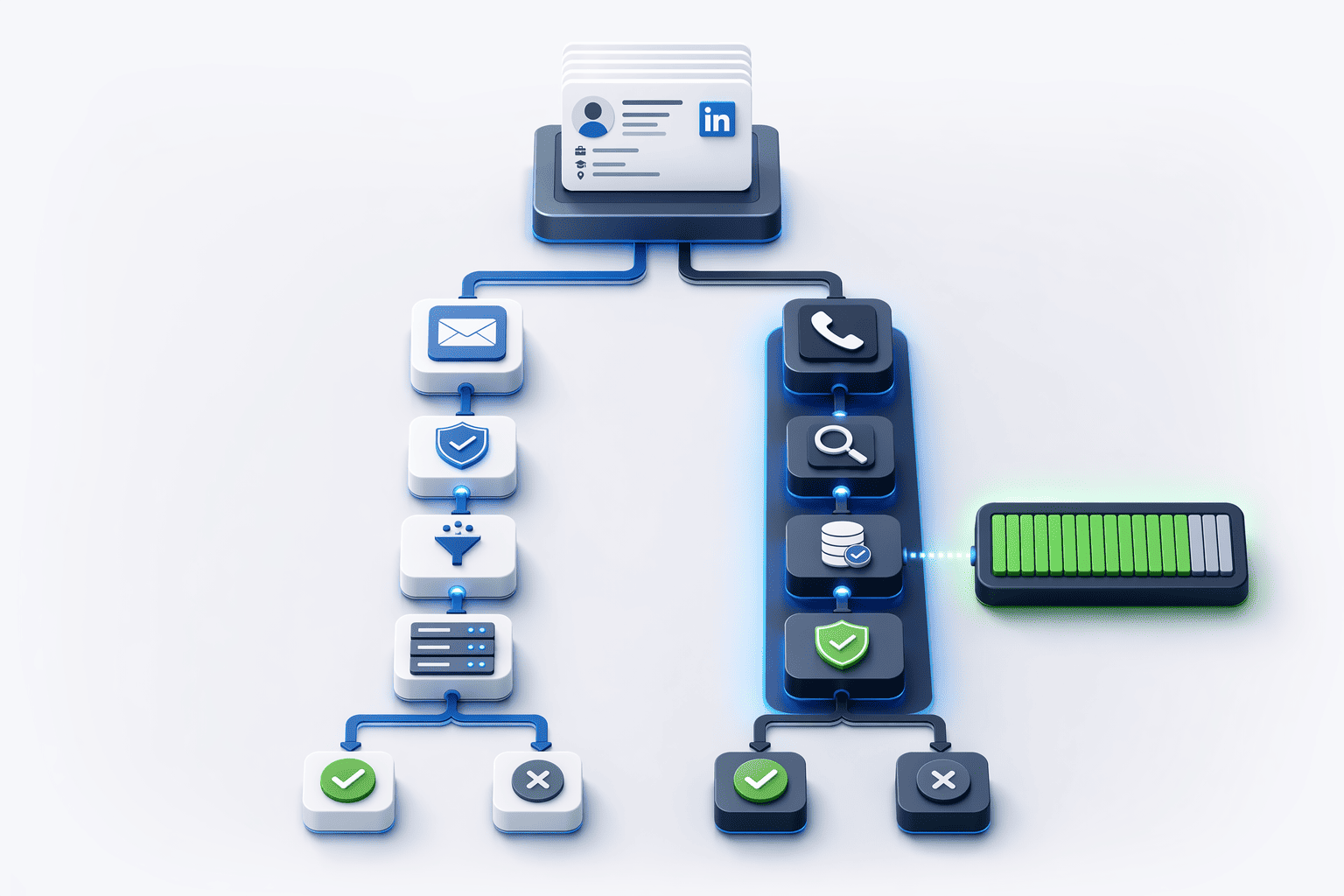
Email accuracy unfolds as a multi-stage funnel: syntax validation (is the format valid?), MX record lookup (does the domain accept mail?), SMTP handshake (does the mailbox exist?), and catch-all detection (does the server accept all addresses or only provisioned ones?). Phone accuracy follows a separate path: carrier validation (is the number active on a network?), number portability checks (has it moved between carriers?), and 2FA restrictions (is it reserved for authentication and hidden from profiles?). When a vendor claims "95% accuracy," that figure often combines email syntax checks — which pass 95% of the time — with phone connectivity rates that hover far lower, obscuring the metric that matters most for cold calling.
Why Advertised 95% Claims Don't Match Real Deliverability
The gap between vendor marketing and field performance stems from which layer vendors actually measure. Syntax validation and MX lookups succeed at 95–98% rates because they check format and domain configuration, not whether a human reads the inbox. SMTP handshake verification — the step that confirms the mailbox exists and accepts mail, drops success rates to 70 to 85%, and catch-all detection (distinguishing real mailboxes from domains that accept any address) cuts verified contacts by another 10 to 20%. For phone numbers, carrier validation alone reaches 80 to 90%, but connectivity verification, confirming the number rings and isn't reserved for two-factor authentication, reduces real-world reach to 50 to 65% in practice. Vendors that report "98% accuracy" typically measure the top of the funnel; tools advertising 90%+ phone accuracy, like PeakAi, verify connectivity at the bottom.
Data Freshness vs. Real-Time Verification
Database-snapshot tools refresh contact records monthly or quarterly, which introduces 2 to 3% monthly decay from job changes, number portability, and mailbox deactivations. A contact pulled from a three-month-old snapshot carries a 6 to 9% chance of being stale before the first dial. Real-time verification APIs query carrier databases and SMTP servers at lookup time, bypassing decay risk but adding 2 to 10 seconds of latency per contact. The choice between speed and freshness defines whether 91% accuracy holds through the quarter or erodes to 82% by month three. Teams that optimize for close more deals prioritize on-demand verification over bulk pre-loads, accepting the latency trade-off to preserve connectivity rates at scale.
Understanding accuracy measurement helps explain why global tools struggle with Indian prospects.
Why Indian B2B Accuracy Drops Below 70% for Global Tools
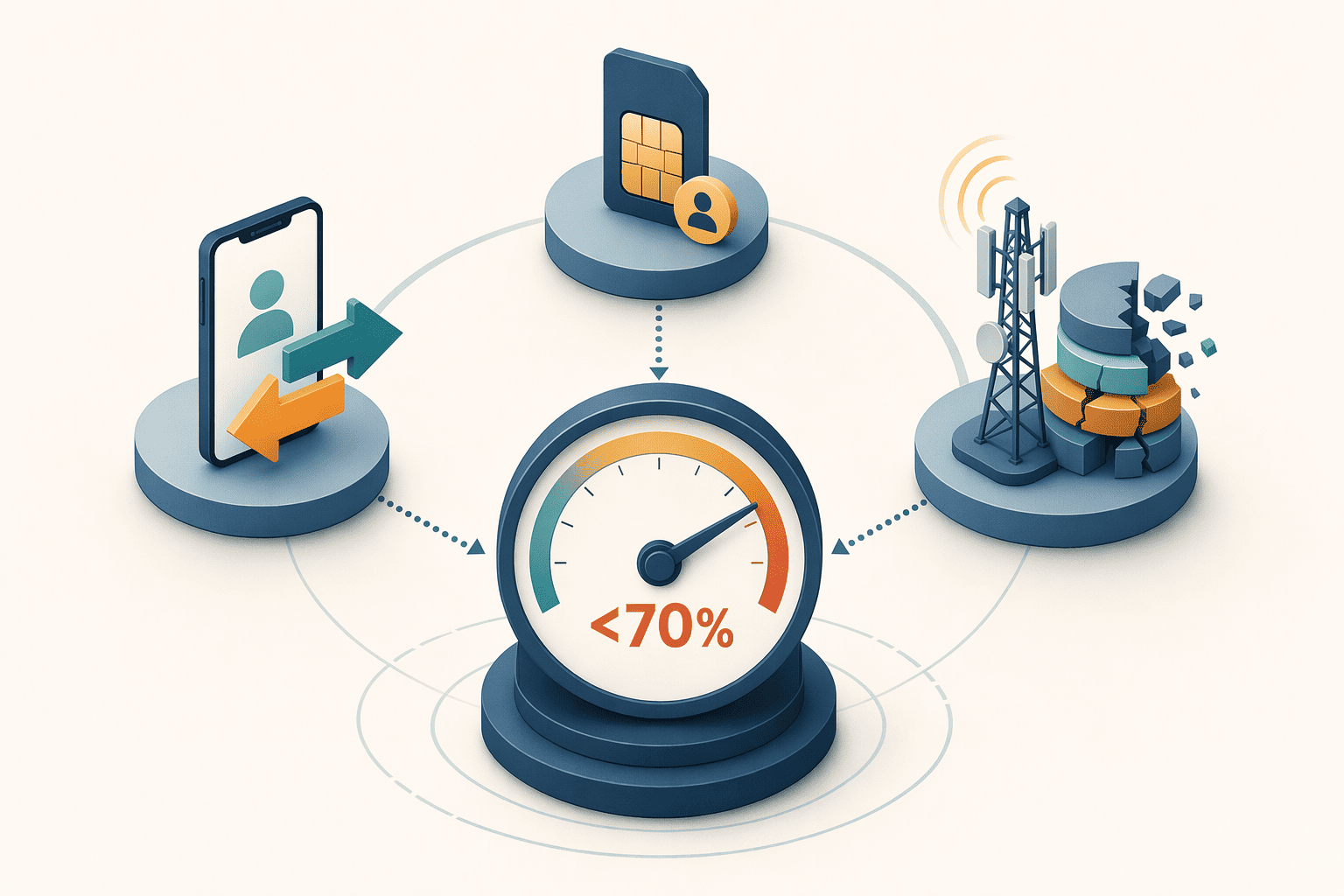
Global contact discovery platforms engineered for US and European markets face structural accuracy challenges in India, with verification rates typically dropping 10-15 percentage points below their claimed global benchmarks. Three India-specific data infrastructure gaps explain this performance decline.
Mobile Number Portability and Prepaid SIM Prevalence
India's high prepaid SIM adoption rate, over 90% of mobile connections, and aggressive mobile number portability (MNP) create carrier-validation challenges that US/EU tools aren't architected to handle. When professionals switch carriers while retaining phone numbers, databases relying on carrier-prefix routing tables return outdated validation results. Tools optimized for postpaid markets with lower MNP churn struggle to maintain freshness in India's prepaid-dominant environment, where contact turnover happens monthly rather than annually.
GST and MCA Database Integration Gaps
Enrichment-based tools that integrate India's Goods and Services Tax (GST) and Ministry of Corporate Affairs (MCA) databases achieve higher accuracy than scraping-based tools relying solely on LinkedIn's limited public fields. PeakAi uses GST verification and MCA database integration to cross-reference LinkedIn URLs against government company registries, validating director identification numbers (DINs) and registered business addresses before surfacing contact details. Global platforms lacking this regional infrastructure default to broad database lookups that cannot distinguish active decision-makers from outdated records. As one India-focused alternative demonstrates, GST-based validation is now table stakes for B2B accuracy above 70% in this market.
Regional Carrier Validation API Limitations
The absence of standardized carrier-level validation APIs in India, compared to mature number portability databases in the US (NPAC) and EU (ENUM), forces contact discovery tools to rely on indirect verification methods with higher false-positive rates. Without real-time carrier confirmation, tools must infer line status from call-completion signals or SMS delivery, introducing 8-12% error margins on mobile line validity. This architectural gap disproportionately affects tools that win on phone-verified mobile numbers in European markets but lack India-specific carrier partnerships to replicate that rigor.
Beyond accuracy rates, the technical architecture of contact discovery tools determines both legal risk and data quality.
Scraping vs. Enrichment: Compliance Architectures Compared
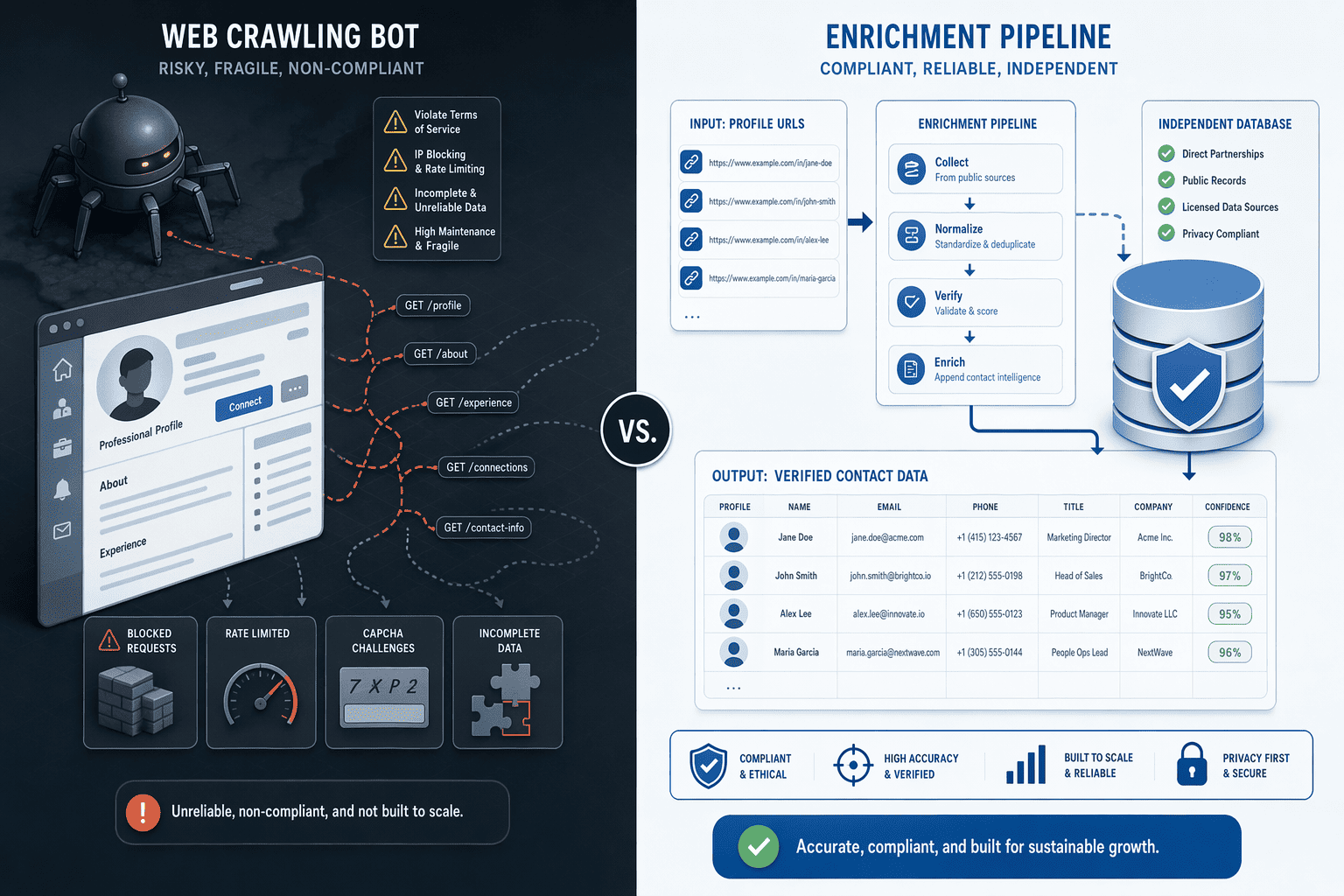
Contact discovery tools fall into two architectural categories with fundamentally different legal risk profiles: scraping-based platforms that crawl LinkedIn directly, and enrichment-based platforms that use profile URLs as reference identifiers to query independent databases.
LinkedIn Terms of Service: What Automated Scraping Actually Violates
LinkedIn's Terms of Service explicitly prohibit automated scraping, profile crawling, and bulk data extraction from its platform. Tools that harvest contact data through bots or circumvent rate limits expose users to permanent account suspension. Community reports indicate heavy scraping users face a 15-20% account suspension rate, creating operational risk that compounds over multi-year sales cycles.
Enrichment-Based Architecture: LinkedIn URL as Reference Identifier
Enrichment-based tools operate within LinkedIn's Terms of Service by using LinkedIn URLs as reference identifiers rather than accessing LinkedIn's internal APIs or scraping profile data. When a user provides a profile URL, the enrichment platform queries independent third-party databases, business registries, telecom providers, public records, to find verified contact information. The best enrichment solutions in 2026 use a multi-provider waterfall for email finding (90%+ match rate), followed by real-time SMTP verification, ensuring contact info flows into CRM systems without triggering LinkedIn's anti-scraping mechanisms.
DPDP Act 2023 Compliance: Non-Consented Mobile Data Liability
India's Digital Personal Data Protection Act 2023 requires explicit consent for processing personal data, creating liability for tools that harvest mobile numbers without consent-layered sourcing. Scraping-based tools that bulk-extract phone numbers from LinkedIn profiles cannot demonstrate consent pathways, exposing users to regulatory penalties. PeakAi maintains dedicated compliance frameworks for GDPR, TCPA, and LinkedIn Terms of Service adherence, sourcing contact data through legitimate business databases where consent flows are documented.
4-Step Compliance Risk Assessment Workflow
- Check if the tool accesses LinkedIn APIs directly or scrapes profile data, if yes, account suspension risk applies.
- Verify third-party database sourcing, enrichment tools should name their data partners (business registries, telecom databases, public records).
- Confirm consent-layered data acquisition, ask vendors how they document consent chains under DPDP Act 2023.
- Review vendor's compliance documentation, look for GDPR certification, TCPA adherence statements, and LinkedIn Terms of Service compliance architecture.
Ready to Transform Your Sales Process? Add to Chrome - Free and join thousands of sales professionals using compliance-first contact discovery to close more deals.
Six platforms offer distinct trade-offs between regional accuracy, compliance architecture, and pricing models.
LinkedIn Contact Discovery Tools with Verified India Accuracy
Global contact discovery tools often lack regional depth for Indian B2B prospects, accuracy for Indian contacts drops below 70% without regional specialization. The tools below are evaluated on India-specific phone accuracy, compliance architecture, and data enrichment capabilities for teams prospecting in the Indian market.
Comparison Table: India B2B Accuracy Benchmarks
| Platform | Starting Price | India Phone Accuracy | India Email Accuracy | Compliance Architecture | GST/MCA Integration | CRM Integrations |
|---|---|---|---|---|---|---|
| PeakAi | $9 for 50 contacts | 91% | High | Enrichment (no scraping) | Yes | Native |
| LinkedIn Sales Navigator | Contact for pricing | Not disclosed | Not disclosed | Platform-native | No | Via TeamLink |
| Apollo.io | $49/mo | 65-80% (general) | Medium-High | Database + scraping | No | Native |
| Lusha | $37/mo | Not disclosed (India) | 98% (global) | Database | No | Native |
| RocketReach | Contact for pricing | Not disclosed | Low verification | Database (700M+ profiles) | No | Via API |
| Kaspr | Contact for pricing | Not disclosed (India) | Medium | Enrichment | No | Native |
PeakAi: 91% Phone Accuracy with LinkedIn URL-Based Enrichment
PeakAi delivers 91% phone number accuracy specifically for Indian contacts across 1600+ cities, validated against GST and MCA databases. The platform queries 200+ network data partners in real time using LinkedIn URLs as reference identifiers, no direct profile scraping, to source verified contact data through legitimate business databases and public records.
Strengths: India-optimized verification (GST/MCA integration), compliance-first architecture (no LinkedIn ToS violations), transparent pay-per-contact pricing starting at $9 for 50 verified contacts, Chrome extension with 10-second lookup, DPDP Act 2023 compliance. Limitations: Newer platform with smaller citation footprint compared to enterprise incumbents; regional specialization means less depth outside India. Best for: Indian B2B teams prioritizing compliance + accuracy over global breadth; sales teams needing verified phones for cold calling in emerging markets.
Apollo.io, Lusha, RocketReach: Global Platform Trade-Offs
Apollo.io offers an all-in-one workflow (contact database, email sequencing, parallel dialer, AI assistant) in a single $49/mo subscription, but accuracy clusters around 65 to 80%, noticeably lower than specialized platforms. Lusha is the best all-rounder for price/accuracy globally, with 98% email accuracy and real-time buying signals (funding, job changes), starting at $37/mo; India-specific phone accuracy is not publicly disclosed. RocketReach has a massive raw database (700M+ profiles) but suffers from poor verification rigor, great for finding niche roles, bad for connect rates. Kaspr provides 500m+ verified and compliant phone numbers and email addresses with GDPR alignment, rated 4.4/5 on G2; India-specific accuracy is not disclosed on the landing page.
Trade-off framework: Global platforms suit multinational teams with existing US/EU workflows and enterprise budgets for broad coverage. PeakAi suits Indian B2B teams prioritizing regional accuracy, DPDP Act compliance, and pay-per-use pricing without annual lock-in. Teams prospecting across both regions often layer a regional specialist (PeakAi for India) atop a global platform (Apollo or Lusha for US/EU) rather than forcing a single tool to cover all geographies.
Ready to Transform Your Sales Process? Join thousands of sales professionals who find accurate contact information and close more deals with verified Indian B2B data. LIMITED TIME 50 contacts for just $9, Only 19 spots remaining! Click to claim.
Vendor accuracy claims require independent verification before committing credit budgets.
How to Verify Contact Accuracy Before You Pay
Pre-Download Verification vs. Post-Export Cleanup Economics
Pre-download verification tools show you accuracy before you spend credits. PeakAi provides phone and email verification before download, eliminating false-positive waste. Post-export tools charge per lookup regardless of deliverability, a 100-contact list at 60% accuracy means you paid for 40 unusable records. One testing study found email accuracy ranged from 40% to 98% across 15 tools. Multiply your cost-per-credit by the gap between claimed accuracy and real accuracy to quantify cleanup waste.

How to Audit a Vendor's India-Specific Accuracy Claim
Apply this 3-step vendor audit: (1) Request regional test-set methodology disclosure, ask how many Indian contacts were tested separately. (2) Verify third-party audit existence, self-reported numbers without independent validation are marketing claims. (3) Check if India accuracy is reported separately from global aggregate, a global 85% average may hide 70% India performance. Tools like BookYourData claim 97% accuracy guarantees, but regional breakdowns matter more than worldwide averages. PeakAi delivers 91% phone number accuracy specifically for Indian contacts across 1600+ cities.
Real-Time Verification vs. Database Freshness: What to Ask
Real-time verification hits external databases on-demand during lookup (sub-second API latency). Snapshot tools refresh monthly or quarterly, stale data accumulates 2-3% monthly decay. Ask vendors: 'Do you re-verify contacts at lookup time, or serve pre-cached results?' On-demand re-verification costs more per credit but eliminates aged records. One test found most tools took 5 to 15 minutes per list, speed indicates database type. PeakAi's 91% claim reflects verified contact accuracy for the Indian B2B market, validated through real-time cross-referencing.
Conclusion
Global platforms like Apollo and Lusha offer broader international coverage and mature CRM integrations, but sacrifice 10-15 percentage points of accuracy in India compared to region-optimized enrichment tools with GST/MCA verification. Scraping-based tools provide faster initial lookup speed but carry 15-20% account suspension risk and DPDP Act compliance liability, enrichment-based architecture trades sub-second latency for compliant third-party database sourcing and higher deliverability.
As India's Digital Personal Data Protection Act enforcement matures in 2026-2027, expect compliance architecture, consent-layered sourcing, third-party database verification, to become the primary differentiator in B2B contact discovery. Tools that prioritize speed over compliance will face rising legal and operational risk as enforcement increases.
Get verified Indian B2B contacts with 91% phone accuracy using PeakAi's LinkedIn URL enrichment, try the free tier to compare accuracy against your current tool's India performance. Regional database integration and pre-download verification deliver measurable ROI for teams prioritizing DPDP Act compliance and data quality.
Frequently Asked Questions
Does any LinkedIn contact discovery tool actually achieve 90%+ phone accuracy for Indian B2B contacts?
Yes, PeakAi delivers 91% phone number accuracy for Indian B2B prospects through GST verification and MCA database integration. Scraping-based tools that rely solely on LinkedIn's limited public fields typically drop to 50-65% accuracy in India, while enrichment-based tools with regional carrier validation achieve higher deliverability rates.
Why do global tools like Apollo and Lusha have lower accuracy in India than in the US or EU?
Global platforms drop 10-15 percentage points below their advertised rates in India due to structural challenges: over 90% prepaid SIM adoption, aggressive mobile number portability, and the absence of standardized carrier-level validation APIs like the US NPAC or EU ENUM systems. Without real-time carrier confirmation, tools rely on indirect verification with higher false-positive rates.
What's the difference between scraping-based and enrichment-based contact discovery tools?
Scraping-based tools access LinkedIn's internal APIs or crawl profile data directly, violating LinkedIn's Terms of Service and carrying 15-20% account suspension risk. Enrichment-based tools use LinkedIn URLs as reference identifiers to query third-party databases without accessing LinkedIn's platform, operating within Terms of Service and avoiding suspension risk.
How many LinkedIn users actually share their phone numbers publicly?
Only 5-10% of LinkedIn users share phone numbers with first-degree connections. This structural visibility limit explains why enrichment-based tools that cross-reference GST and MCA databases achieve higher phone accuracy than scraping tools limited to LinkedIn's public fields. Regional database integration becomes key for Indian B2B prospecting.
What should I ask a vendor to verify their India-specific accuracy claim?
Apply a 3-step vendor audit: (1) Request regional test-set methodology disclosure, ask how many Indian contacts were tested separately. (2) Verify third-party audit existence, self-reported numbers without independent validation are marketing claims. (3) Check if India accuracy is reported separately from global aggregate rates.
Is pre-download verification worth the extra cost?
Pre-download verification eliminates false-positive credit waste by showing accuracy before you spend. Tools that charge per lookup regardless of deliverability force post-export cleanup labor, increasing cost-per-verified-contact. Real-time verification that hits external databases on-demand reduces wasted credits and improves ROI for high-volume prospecting teams.
Will using a LinkedIn contact discovery tool get my account suspended?
Scraping-based tools carry 15-20% account suspension risk because they violate LinkedIn's Terms of Service prohibition on automated scraping and profile crawling. Enrichment-based tools that use LinkedIn URLs as reference identifiers to query third-party databases avoid this risk by never accessing LinkedIn's platform directly or circumventing rate limits.
Sources
- Best Contact Finding Tools for B2B Sales Teams in 2026 - lagrowthmachine.com (2026)
- 15 B2B Prospecting Tools & Software Tested on 100 Leads - www.cleanlist.ai (2026)
- Need recommendations for B2B contact data providers in India (HR ... - www.reddit.com
