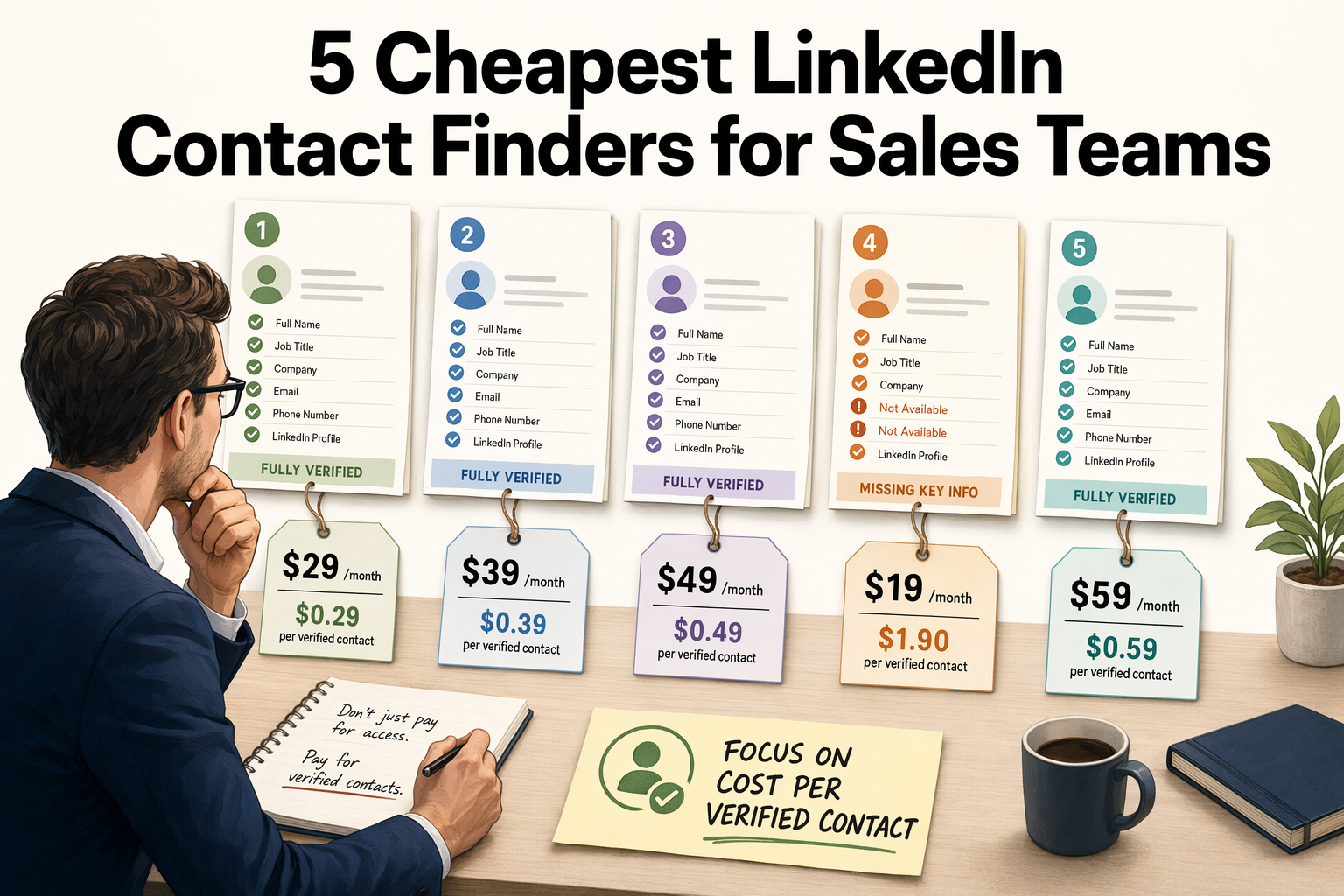
Sales teams waste thousands annually on LinkedIn contact finders by comparing advertised monthly prices instead of cost-per-verified-contact—the only metric that matters when prospecting budgets tighten.
This guide breaks down the true economics of six contact finders, revealing hidden costs, accuracy rates, and pricing models to calculate affordability for your team's volume.
Key Takeaways
- Cost-per-verified-contact (monthly fee ÷ contacts ÷ accuracy rate) determines true affordability, not advertised subscription prices
- Phone verification accuracy ranges 50-91% across tools; hidden costs like LinkedIn Premium ($79.99/month) can double total spend
- Pay-per-verified models cost less for <200 contacts monthly; subscriptions win at 500+ volume despite lower accuracy
- US-optimized databases drop 15-25 percentage points in accuracy for non-US markets like India
- Contact data decays 2-3% monthly; quarterly refresh cycles lose 22-30% accuracy annually
What Makes a LinkedIn Contact Finder 'Affordable' for Sales Teams?
For teams asking *what's the most affordable LinkedIn contact finder with verified phone numbers*, the answer depends less on monthly price than on cost per *usable* contact. Pay-per-use models like PeakAi ($9 for 50 verified contacts ) can deliver lower effective costs than subscription tools when verification rates and volume thresholds align with your team's prospecting cadence — but only when you calculate the full economics.
Why Monthly Price Doesn't Equal Affordability
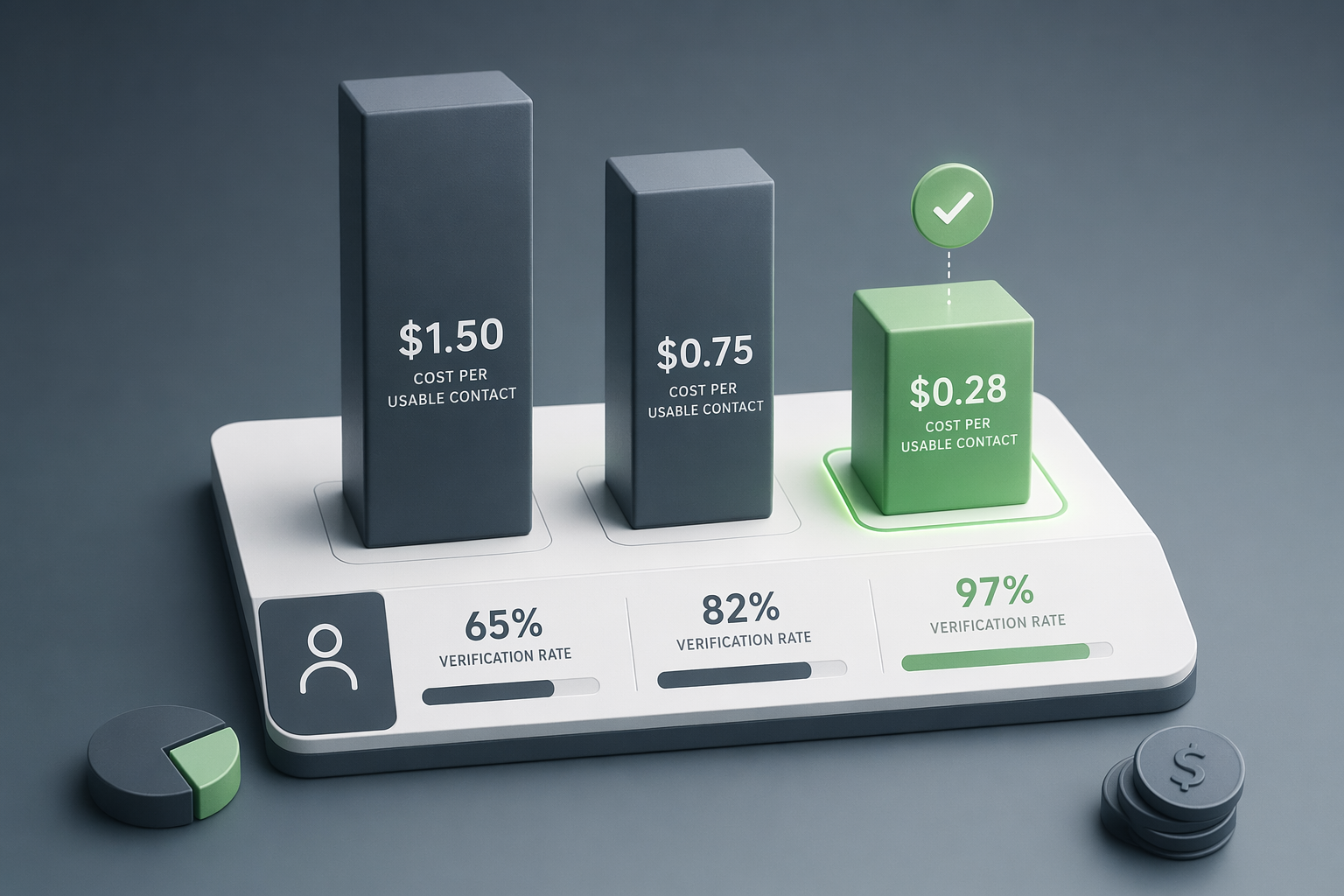
Most LinkedIn email finder comparisons list monthly subscription fees without explaining how verification success rates transform advertised prices into actual per-usable-contact costs. A tool charging $49/month that returns phone numbers for 50% of lookups costs $0.98 per verified number, while a $99/month platform with 85% accuracy delivers contacts at $0.23 each — making the higher-priced option 76% cheaper per usable record. Credit burn-rate variability raises actual cost per usable contact by 35–100% above advertised per-credit price when teams don't account for no-result lookups.
The Cost-Per-Verified-Contact Formula
Sales teams should calculate affordability using this two-step framework:
- Divide monthly fee by contacts discovered — If your plan includes 500 lookups at $99/month, your cost per lookup is $0.198.
- Divide by verification success rate — If 75% of lookups return verified phone numbers, your actual cost per usable contact is $0.198 ÷ 0.75 = $0.264.
This calculation is absent from most tool comparisons that focus on feature breadth rather than economic efficiency. PeakAi's 91% phone accuracy means teams pay close to the advertised rate per verified contact, while platforms with 60% match rates force reps to burn 1.67 credits per successful lookup.
Volume Thresholds That Change the Economics
Pay-per-contact models beat subscriptions below 200 contacts per month; subscriptions win above 500. Teams prospecting 150 contacts monthly save 40 to 60% with PeakAi's ₹675/50 verified contacts compared to entry-level subscriptions that charge for unused seat capacity. Beyond 500 contacts, flat-rate plans with high verification accuracy deliver better unit economics, but only when the platform's actual match rate, not its advertised database size, drives the calculation. Tools reviewed by feature count alone miss this break-even analysis, leaving teams to discover cost overruns after committing to annual contracts.
Teams that find accurate contact information and close more deals prioritize cost-per-verified-contact over headline pricing, treating affordability as an output of verification math, not a feature listed on a pricing page.
Understanding these three pricing architectures reveals why advertised monthly fees rarely predict actual cost-per-contact once verification rates and hidden fees enter the equation.
Pricing Model Comparison: Subscription vs Credit-Based vs Pay-Per-Verified-Number
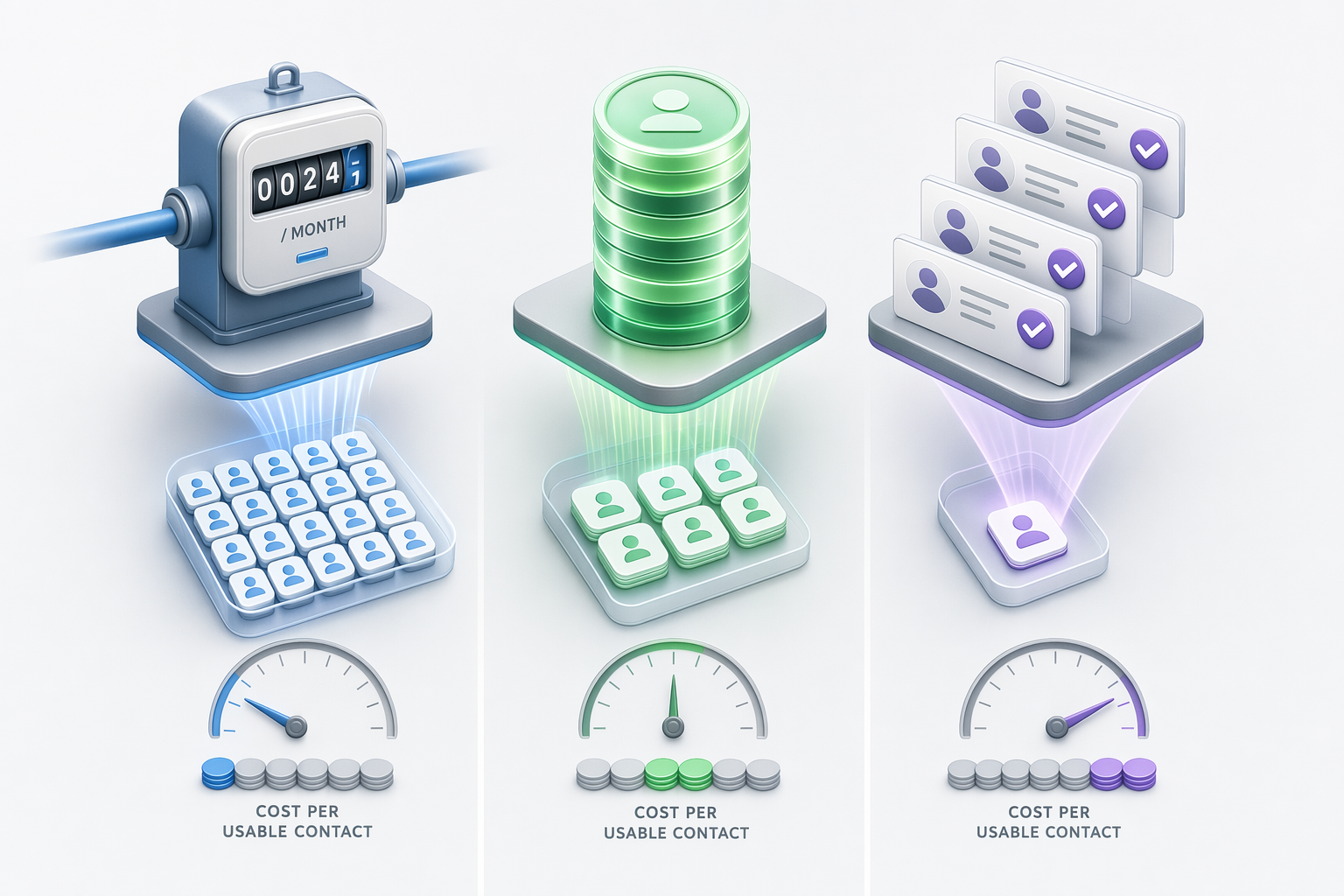
Before evaluating individual tools, understand the three pricing architectures and when each favors the buyer. The model shapes your true cost-per-usable-contact more than advertised list prices.
Subscription Models: Upfront Access Fees
Monthly subscriptions charge for platform access regardless of verification success. A $99/month plan grants unlimited lookups within usage caps, but doesn't guarantee every search returns a verified phone number. Teams running 500+ contacts monthly can spread the fixed fee across high volume, lowering per-contact cost. However, sporadic users who need only 30 contacts in a month still pay the full subscription, raising effective cost to $3.30 per contact. Best for: high-velocity prospecting teams with predictable monthly volume who can absorb the upfront fee.
Credit-Based Models: Pay
Credit systems charge per lookup attempt, not per verified result. SalesQL starts at $39/mo for 100 credits, but find rates vary 50-85% depending on audience segment. A 100-credit plan at 60% phone match yields 60 usable contacts, $0.65 each, not the advertised $0.39. Critical detail: unused credits typically expire on cancellation, so teams that pause subscriptions lose accumulated balances. Calculate true cost by dividing plan price by (credits × expected verification rate) for your target geography. Best for: teams needing 200-500 contacts monthly who can maintain continuous subscriptions and validate accuracy benchmarks for their market before committing.
Pay-Per-Verified-Number Models: Guaranteed Delivery
Pay-per-verified models charge only when the tool returns a successful phone number. Unit prices run higher, often $0.85-$1.50 per contact versus $0.18-$0.65 for credit bundles, but eliminate waste from failed lookups. No expiring balances, no subscription minimums. A sales rep needing 50 verified contacts pays exactly for 50, not for 100 credits that might yield 65. The model suits sporadic users and teams testing new markets where verification rates are unknown. Best for: individuals and small teams prospecting fewer than 200 contacts monthly, or buyers entering unfamiliar geographies where upfront volume commitments carry accuracy risk.
Decision framework: calculate your monthly contact need, then multiply by the verification rate for your target region. If the resulting usable-contact count × pay-per-verified unit price beats the subscription or credit plan's all-in cost, the pay-per-verified model wins. For India-focused prospecting, validate that US-optimized tools maintain accuracy for Indian business contacts before annual commitments, regional accuracy can drop 15-25 percentage points, silently raising your effective cost.
Now that you understand the structural differences between pricing models, let's examine how specific tools perform against the cost-per-verified-contact benchmark.
PeakAi: Pay-Per-Verified-Number with 91% Phone Accuracy
Pricing and Verification Model
PeakAi starts at $9 for 50 verified contacts with 91% phone accuracy, delivering a cost-per-verified-contact of approximately $0.198 when accounting for the verification rate ($9 ÷ 50 contacts ÷ 0.91). Unlike credit-based platforms where lookups consume credits regardless of verification success, PeakAi's pay-per-verified model eliminates credit-burn risk, you only pay when the system successfully returns a usable phone number and email. The platform validates contact data in real time and includes scheduled re-verification to maintain accuracy over time, ensuring sales teams don't waste budget on failed lookups or stale records.

Strengths and Limitations
Strengths: Upfront cost transparency and pay-only-for-successful-verification eliminate the guesswork common in subscription models. PeakAi's scheduled re-verification helps maintain contact freshness, reducing the decay typical of static databases. The 91% phone accuracy for Indian B2B contacts makes it particularly strong for teams targeting South Asian markets, where global tools often underperform.
Limitations: The per-contact unit price becomes less competitive at scale. Teams needing 1,000+ contacts monthly will pay approximately $200 with PeakAi's pay-per-verified model, compared to ~$99/month flat subscriptions from platforms like Apollo, even though Apollo's phone accuracy is lower. The contact database is smaller than enterprise-scale providers, limiting coverage for niche industries or ultra-specific geographies outside India.
Best-For Profile
PeakAi fits small sales teams (under 5 reps) needing sporadic bursts of verified contacts, typically 50-150 per month for targeted account lists, who value paying only for successful verifications over committing to annual subscriptions. It's especially relevant for teams prospecting in India or emerging markets where regional verification matters more than database breadth. Teams scaling contact discovery budgets across multiple markets can explore regional cost considerations to balance pay-per-verified economics with subscription models.
Apollo.io: Subscription-Based Prospecting with Variable Phone Coverage
Pricing Tiers and Database Scale
Apollo.io operates on subscription tiers ranging from approximately $49 to $99 per month for individual users, scaling with team seats and feature access. The platform markets access to a 275M+ contact database, positioning volume-discount economics as its core value proposition. Unlike credit-based models, Apollo bundles database access into flat monthly fees, teams trading predictable spend for per-contact unit economics.

Phone Accuracy Ranges and Regional Variance
Apollo reports phone accuracy between 65-80%, with 82% in the U.S. Market. Outside North America, accuracy drops 15-25 percentage points for Indian and emerging-market B2B contacts. At 70% effective accuracy, a $99/month subscription yielding 700 successful verifications translates to $0.14 per usable contact, acceptable for high-volume teams but costly when half the lookups fail. Tools like PeakAi deliver 91% phone accuracy with pay-per-verified-contact pricing, eliminating waste on failed lookups.
Hidden Costs: LinkedIn Premium Dependency
Apollo's LinkedIn enrichment workflow requires Sales Navigator at $79.99/month, raising total monthly spend from $99 to $179, a 79% hidden markup. Teams unwilling to commit to annual contracts or absorb LinkedIn Premium fees may find credit-based alternatives more transparent, paying only for verified contacts without platform subscription stacking.
Lusha: Credit-Based Lookups with Direct-Dial Focus
Credit Pricing and Rollover Policies
Lusha operates on a credit model where each phone lookup consumes credits from your purchased balance. While exact per-credit costs vary by plan tier, teams should calculate *effective* cost-per-usable-contact rather than advertised per-credit pricing. If a 100-credit package costs $50 ($0.50/credit) but only 55% of lookups return verified phone numbers, your actual cost per usable contact jumps to $0.91, nearly double the nominal rate. Unlike PeakAi's credit-based pricing, which allows unused credits to roll over to the next month, many competitors, including Lusha in certain tier configurations, expire unused credits on plan cancellation. For sporadic users who subscribe for one month, use 40 credits, then cancel, the remaining 60 credits vanish, raising effective cost further.

Direct-Dial Accuracy and Match Rates
Lusha emphasizes direct-dial quality, mobile and direct lines rather than switchboard numbers, but match rates typically fall between 50 to 65% depending on geography and industry. This focus on contact quality over volume suits teams prioritizing conversation-ready numbers for close more deals. Compare this to PeakAi's 91% overall phone accuracy, which balances breadth with verification. Free-tier offerings (5 to 10 contacts monthly ) serve as product trials, insufficient for sustained prospecting, teams needing ongoing access must budget for paid tiers where credit burn-rate directly impacts ROI.
Kaspr: LinkedIn Chrome Extension with Real-Time Enrichment
Chrome Extension Workflow and Real-Time Enrichment
Kaspr is a Chrome extension that pulls phone numbers and email addresses from LinkedIn profiles in real time. Install the extension, visit any LinkedIn profile, click the Kaspr button, and contact details appear instantly. The tool activates automatically when you browse LinkedIn, no separate prospecting platform required.

This one-click reveal workflow suits SDRs who prospect directly in LinkedIn and need immediate contact data. However, the extension works profile-by-profile only, bulk exports require manual clicking through hundreds of profiles. Teams building large account lists in CRM may find this friction costly compared to bulk-export tools.
Pricing and Accuracy Benchmarks
Kaspr runs on a credit system: revealing each phone number or email consumes credits from your monthly plan. Pricing tiers and phone accuracy rates should be verified directly from Kaspr's official site before purchase, competitor comparison data is sparse.
Cost-per-usable-contact depends on your find rate and credit pricing. If 70% of reveals yield valid mobiles and credits cost $0.40 each, your effective cost is ~$0.57 per working number. PeakAi offers bulk exports (50 to 500 contacts at once) starting at $9 for 50 verified contacts when teams need scale over per-profile convenience.
RocketReach: Email-First Platform with Phone Add-Ons
Email-First Database and Phone Coverage Gaps
RocketReach is a self-serve lead intelligence platform built around a database of 700M+ professional profiles and 989M emails. The platform prioritizes email discovery with real-time prediction and verification on every lookup, making it strongest for teams running high-volume email outreach. Phone numbers are available as secondary enrichment, but match rates lag email coverage, typically 50-65% phone matches versus 75-80% email accuracy. For sales teams needing verified phone numbers to close more deals, this email-first architecture means lower usable-contact yield when the workflow depends on direct dials.

Pricing Tiers and Phone Add-On Costs
RocketReach offers three public pricing tiers starting at $25/month, with no sales call required. Base subscriptions cover email lookups, but phone enrichment often requires additional credits or tier upgrades, raising total cost for teams needing verified phone numbers. For phone-first prospecting, PeakAi's credit-based pricing starting at $9 for 50 verified contacts delivers a lower cost-per-usable-contact when direct dials are the priority, you pay only for verified phone numbers rather than a 700M-email database optimized for a different use case.
Armed with pricing models and accuracy benchmarks for each tool, the final step is building a cost formula tailored to your team's prospecting volume and target market.
How to Calculate True Cost
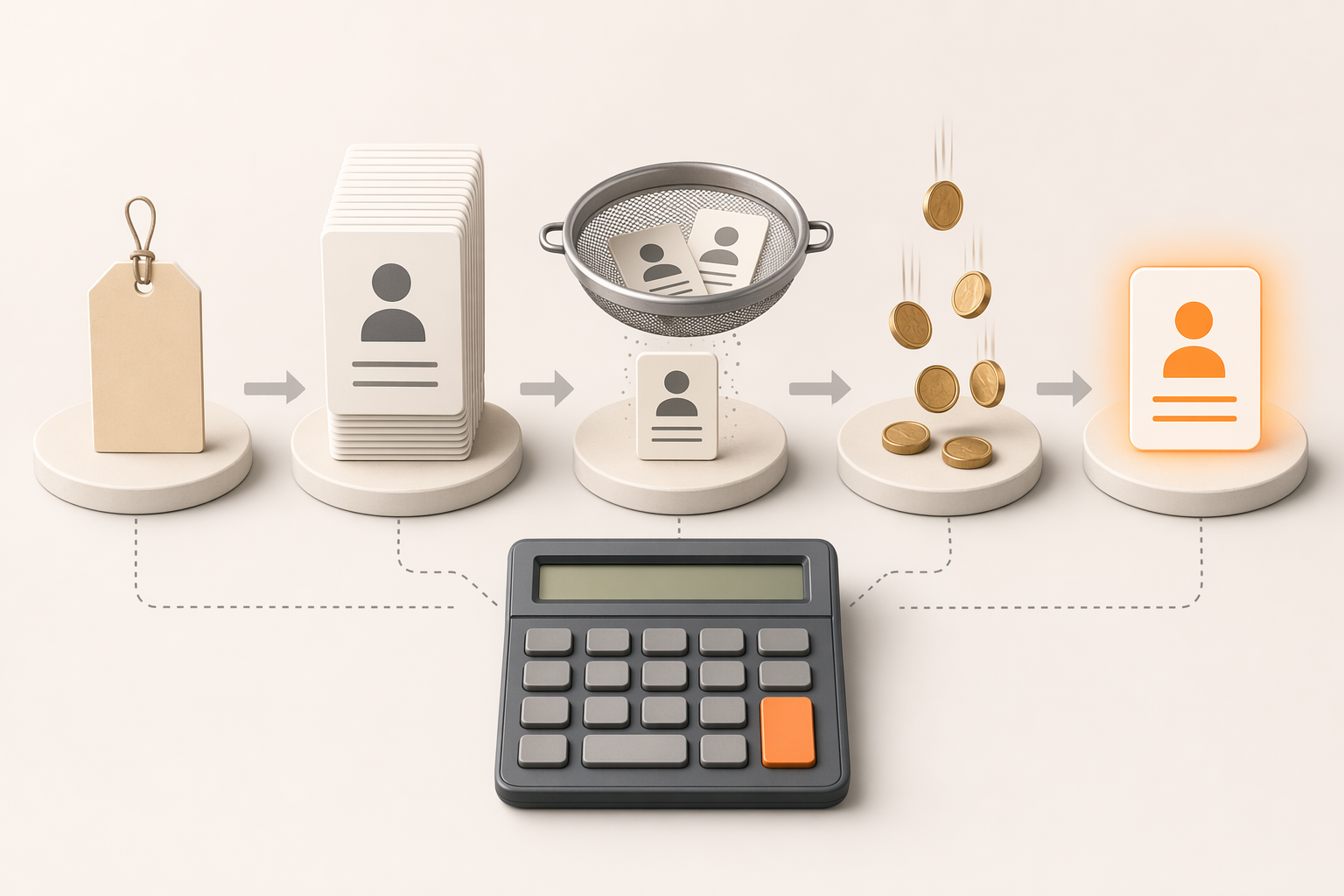
Most sales teams compare tools by advertised monthly price alone, but that number hides the real economics. A $39/month plan sounds cheaper than $99/month until you account for verification success rates, hidden fees, and data decay. Use this 4-step framework to calculate what you actually pay per usable contact.
Step 1: Identify Your Monthly Contact Volume
Start by estimating realistic monthly prospecting volume based on team size and sales cycle. A 3-person outbound team targeting mid-market accounts typically needs 100-150 new verified contacts monthly. Enterprise teams with longer cycles may need fewer; high-velocity inside sales teams may need 200+. Document your baseline volume, this becomes the denominator in every cost calculation below.
Step 2: Factor in Verification Success Rates
Advertised price per credit rarely equals cost per usable contact. Tools that charge per lookup, not per verified result, burn credits on empty returns. To find true cost per verified contact, divide advertised price by the platform's actual verification rate for your target geography. PeakAi delivers 91% phone number accuracy, meaning a $9 pack of 50 credits yields ~45 usable contacts ($0.20 each). SalesQL's find rate varies 50-85% depending on audience segment, so a $39/month plan with 100 credits may yield only 50-85 verified contacts ($0.46-$0.78 each). Apollo.io reports 92% US email accuracy but lower phone coverage outside North America. Always calculate: (plan price) ÷ (expected verified contacts) = true cost per usable contact.
Step 3: Add Hidden Costs (LinkedIn Premium, API Fees, CRM Integration)
Many tools advertise a base monthly price but require LinkedIn Sales Navigator ($79.99/month) to unlock LinkedIn enrichment workflows. If a tool lists '$49/month' but needs Premium for profile lookups, your real cost is $129/month, not $49. Also account for CRM connector fees (some platforms charge $20-50/month for Salesforce or HubSpot sync), API usage overages, and seat-based pricing that escalates with team growth. A 3-person team on a $59/seat plan pays $177/month before adding Sales Navigator or integration fees. Total these line items before comparing tools.
Step 4: Account for Data Decay and Refresh Frequency
Contact data decays 2-3% monthly as professionals change roles, phone numbers, and companies. Tools with static databases that refresh quarterly lose 6-9% accuracy between updates; annual contracts suffer 22-30% decay over 12 months. If you prepay $1,188 for a year and the provider refreshes data every 90 days, roughly $260-356 of your contract value erodes to stale contacts. Platforms with 7-day or real-time refresh cycles (like PeakAi's network of 200+ data partners) minimize decay loss. Factor decay into annual cost: (annual contract price) × (expected decay %) = wasted spend on unusable contacts.
Ready to transform your sales process? PeakAi offers verified phone numbers and emails from LinkedIn profiles with transparent pay-per-contact pricing starting at $9 for 50 verified contacts. Join thousands of sales professionals who find accurate contact information and close more deals with 91% phone accuracy optimized for Indian B2B markets.
Choosing the Right Contact Finder for Your Team
Subscription models like Apollo and RocketReach deliver lower per-contact costs at scale (500+ monthly) but require upfront annual commitments and LinkedIn Premium ($79.99/month), pay-per-verified models like PeakAi cost more per contact at high volume but eliminate wasted spend on failed verifications and unused subscription months. US-optimized databases (Apollo's 82% US accuracy) drop 15-25 percentage points for non-US markets, while regional specialists maintain consistent accuracy globally but cover fewer total contacts.
As AI-driven verification improves, expect real-time accuracy guarantees and dynamic pricing (pay per successful delivery, not lookup attempt) to become category standard, early adopters of pay-per-verified models avoid the credit-burn waste plaguing today's lookup-based pricing.
Calculate your team's true cost-per-verified-contact using PeakAi's 50-contact free trial, test the formula with real target-market accuracy before committing to annual subscriptions.
Frequently Asked Questions
What's the cheapest LinkedIn contact finder with verified phone numbers?
The answer depends on monthly volume. PeakAi ($9 for 50 verified contacts at 91% accuracy) delivers the lowest cost-per-verified-contact ($0.198) for teams needing fewer than 200 contacts monthly. Apollo.io subscriptions ($99/month) become cheaper for 500+ contacts despite 70% accuracy. Calculate affordability using: monthly fee ÷ contacts ÷ accuracy rate.
How accurate are phone numbers from LinkedIn contact finders?
Phone accuracy ranges from 50-91% depending on tool and region. Apollo.io reports 65-80% overall (82% US-specific), PeakAi claims 91%, and credit-based tools average 50-65% for phones versus 75-80% for emails. US-optimized tools drop 15-25 percentage points for non-US markets like India, so test your target geography before annual commitments.
Do I need LinkedIn Premium to use these contact finders?
Many tools require LinkedIn Sales Navigator ($79.99/month) for LinkedIn enrichment workflows. Apollo, Lusha, and RocketReach need Premium to unlock profile lookups, raising total monthly spend from advertised $49-99 to $129-179. PeakAi and Kaspr work without Premium for non-LinkedIn sources. Always factor $79.99/month into cost-per-contact calculations when evaluating Premium-dependent tools.
What's the difference between credit-based and subscription pricing for contact finders?
Credit-based tools (Lusha, Kaspr) charge per lookup attempt, credits burn whether verification succeeds or fails. With 50-65% phone match rates, cost-per-usable-contact rises 35-100% above advertised per-credit price, and unused credits expire on cancellation. Subscriptions (Apollo, RocketReach) charge monthly access fees regardless of usage, favoring 500+ contacts monthly. Pay-per-verified models charge only for successful verifications.
How often do contact finder databases update their phone numbers?
Contact data decays 2-3% monthly. Tools with quarterly refresh cycles lose 6-9% accuracy between updates and 22-30% over annual contracts. PeakAi refreshes data every 7 days to maintain 98% accuracy; Apollo and RocketReach use static databases updated quarterly. For annual contracts, calculate decay impact: a $1,188/year subscription loses $260-356 in value to stale contacts.
Can I try these tools for free before paying?
Free tiers limit phone enrichment to 5-10 contacts monthly, insufficient for sustained prospecting. Use free trials to test regional accuracy and verification rates for your target market before annual commitments, not as long-term prospecting solutions. Most tools offer 7-14 day trials; prioritize testing accuracy in your geography (US vs India variance is 15-25 percentage points).
Which contact finder works best for non-US markets like India?
US-optimized tools (Apollo, RocketReach) drop 15-25 percentage points in accuracy for Indian B2B contacts versus US markets. Apollo's 82% US accuracy falls to approximately 57-67% in India. Validate accuracy benchmarks for your target region before annual commitments. PeakAi includes India-specific optimization; test regional performance using free trials before scaling investment.
Sources
- Top 10 Business Contact Finder Tools in India to Generate High Quality Leads - businessinsight27.wordpress.com (2026)
- SalesQL Review 2026: LinkedIn Email & Phone Finder — Pricing - syncgtm.com (2026)
- Extract Contact Information from LinkedIn without Connections - www.powerin.io (2026)
- Free Phone Finder Review 2026: Pricing & Features - mycoldleads.com (2026)
- Best RocketReach Alternatives for B2B Sales Teams - pipeline.zoominfo.com
- The 20 Best Tools for Sales Prospecting in 2026 - fundraiseinsider.com (2026)
