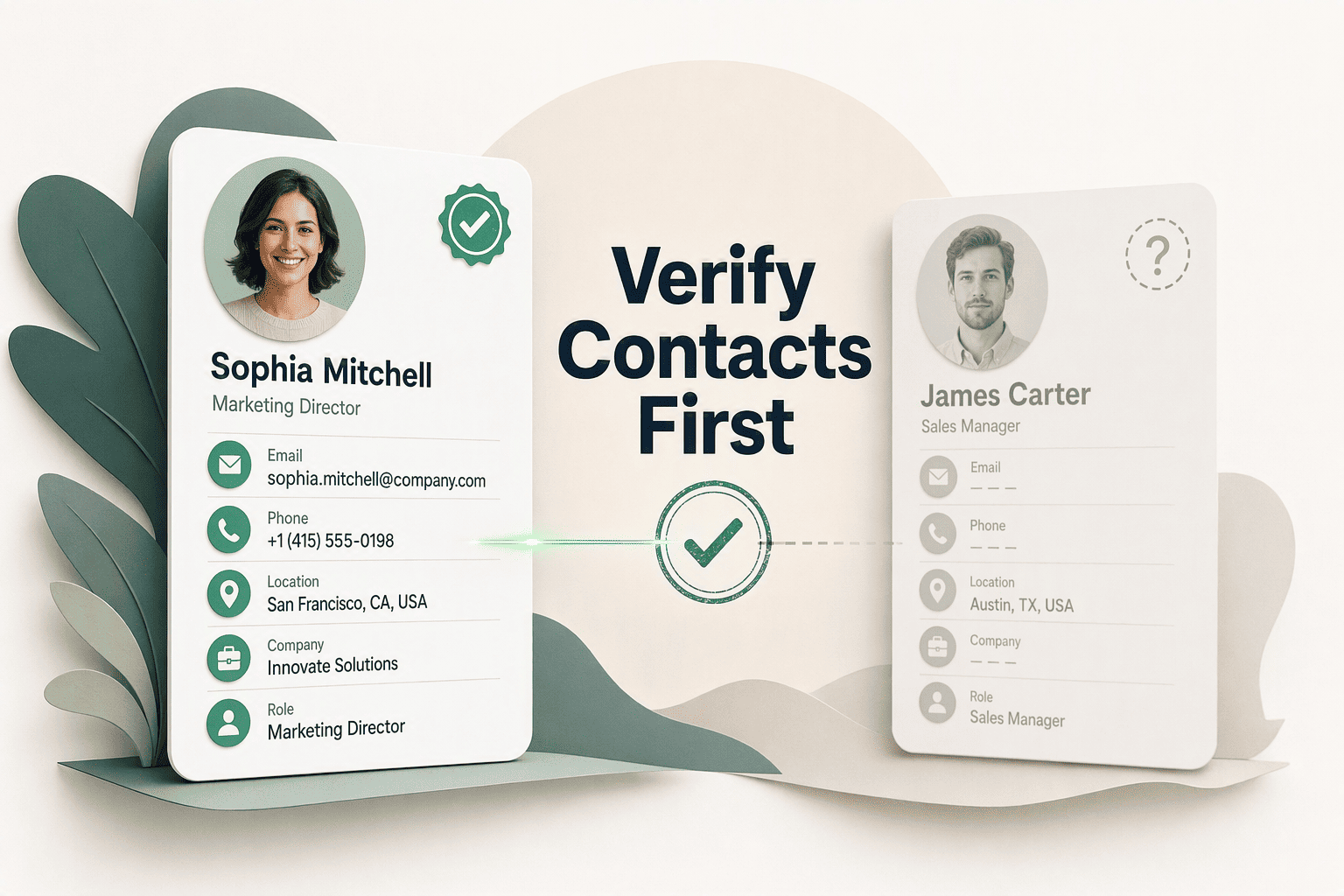
Most LinkedIn prospecting tools bill you before verifying contacts, forcing you to pay for invalid emails and disconnected phone numbers. Pre-download verification flips this model, letting you preview accuracy and consume credits only on confirmed data.
Key Takeaways
- Pre-download verification tools run syntax, domain, and deliverability checks before you commit credits, reducing cost-per-usable-contact by 35-100% versus post-export models
- Enrichment-based platforms query third-party business databases and comply with LinkedIn Terms of Service, while scraping tools face 15-20% account suspension rates
- US/EU-optimized tools experience 10-15 percentage point accuracy drops in India without regional data provider partnerships with GST registries, MCA databases, and local telecom providers
- True cost-per-usable-contact calculation reveals hidden multipliers: a tool advertising $0.50/credit can cost $1.54/contact when match and verification rates are factored in
- Contact data decays 3-5% monthly in India due to job-hopping frequency and startup churn, requiring tools with real-time verification pipelines rather than static database lookups
Why Verification Timing Matters: Pre-Download vs Post-Export
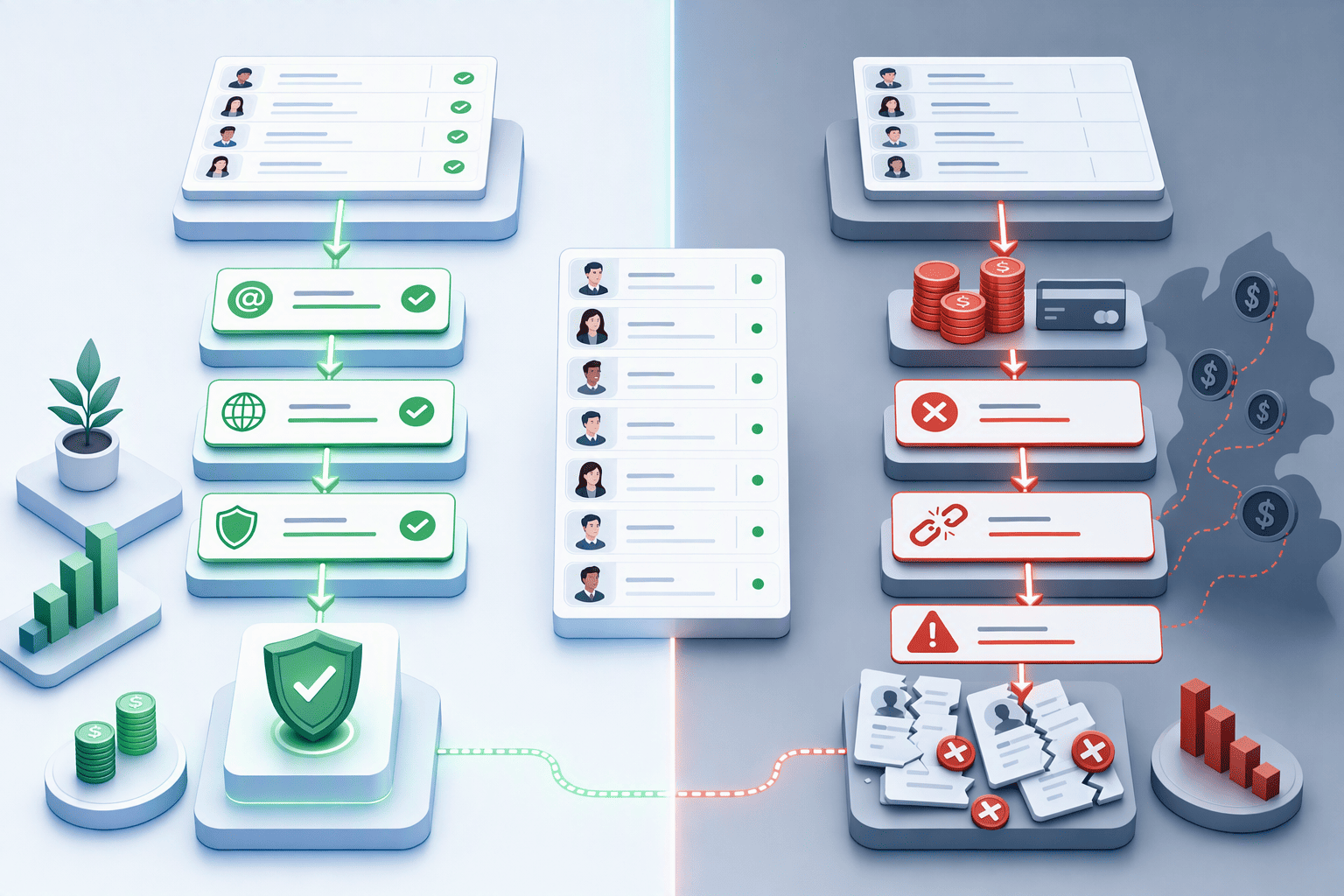
Yes — tools like PeakAi verify phone numbers and emails *before* download, letting you preview accuracy and commit credits only on verified contacts. This pre-download model contrasts sharply with post-export enrichment platforms that bill first and surface data-quality issues only after you've paid, creating a 35–100% hidden cost multiplier when match rates fall below advertised benchmarks.
Pre-Download Verification: Preview Before You Pay
Pre-download verification runs syntax, domain, and deliverability checks *before* you commit a credit. PeakAi displays verification status within the LinkedIn tab — green for verified mobile, yellow for landline, red for unverified — so you decide whether the contact justifies the spend. The workflow integrates directly with Sales Navigator exports: upload your CSV, the enrichment API queries 200+ data partners in real time, and verified contacts appear with accuracy indicators before download. You pay only for contacts that pass verification, eliminating waste on stale numbers and catch-all domains.
Post-Export Enrichment: Data-Quality Risk Transfer
Post-export models charge per lookup attempt, not per verified result. You export your Sales Navigator list, upload it to an enrichment platform, and receive a file with appended emails and phone numbers — but no pre-validation. Syntax errors, disconnected numbers, and role-based emails (info@, sales@) all count as 'successful enrichments' and consume credits. The advertised per-credit price looks attractive, but the true cost-per-usable-contact emerges only after your sales team burns hours dialing dead numbers or your email sequence hits 25% bounce rates.
The 35 to 100% Hidden Cost Multiplier
If a post-export tool advertises $0.50 per credit and delivers 65% match rate with 50% of matches verified as current, your true cost per *usable* contact is $1.54, a 208% multiplier. At 75% match × 70% verified, the cost rises to $0.95 (90% premium). Pre-download verification collapses this: you see the verification status before the charge, so $0.50 per credit yields $0.50 per usable contact. For a 2,500-contact Sales Navigator export, the difference is $1,250 versus $3,850 in wasted spend on unverified data.
Verification timing addresses credit efficiency, but the underlying data-collection architecture determines whether your prospecting workflow violates LinkedIn's Terms of Service.
Compliance Frameworks: Enrichment vs Scraping Architecture
Enrichment-Based Architecture: How It Stays Compliant
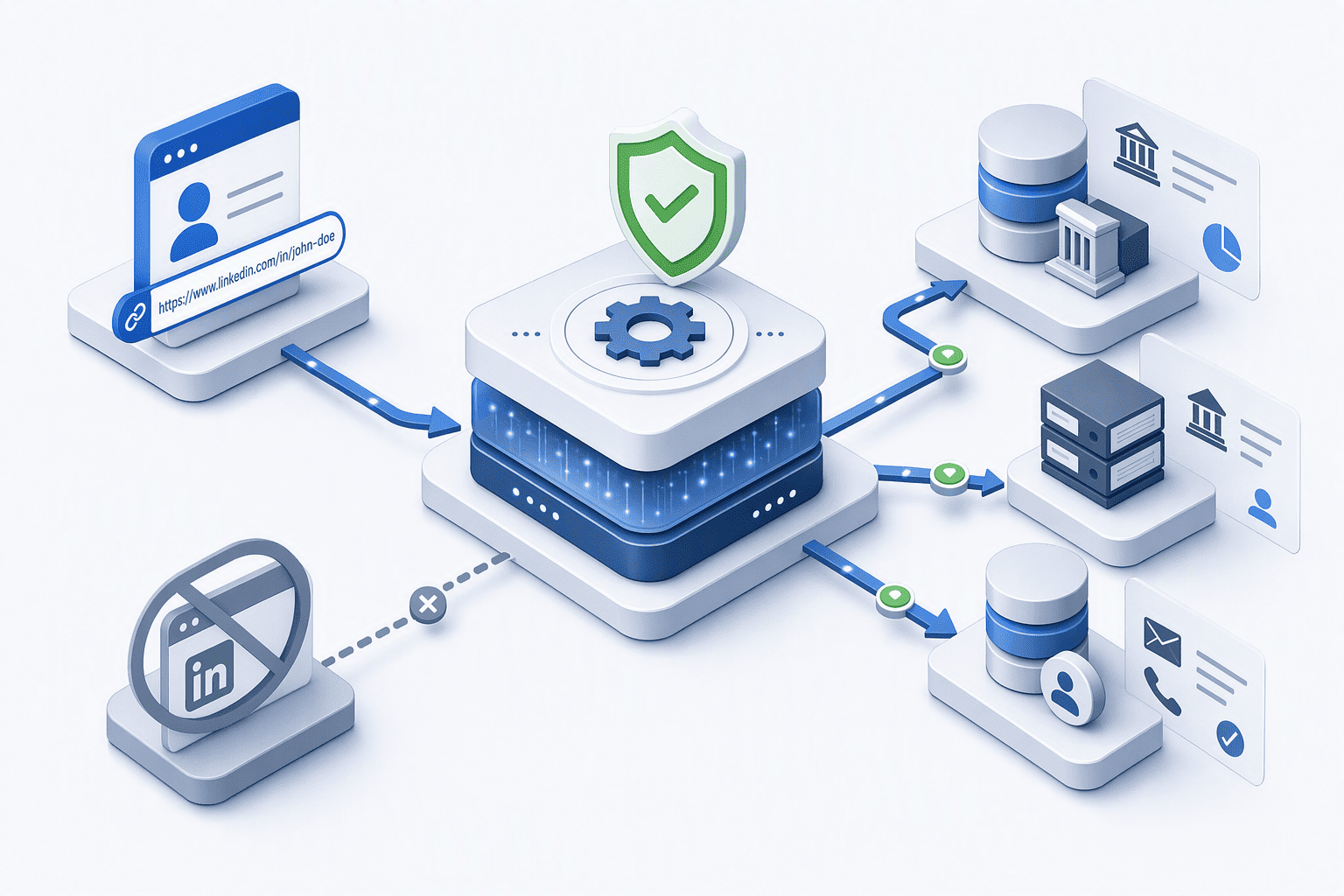
Enrichment-based tools avoid LinkedIn's anti-scraping defenses by querying third-party business databases rather than crawling profile pages directly. When you paste a LinkedIn URL, these platforms use the profile identifier to search independent data providers, business registries, public records, verified contact databases, rather than accessing LinkedIn's internal APIs or DOM structure. PeakAi, for example, uses this enrichment-based compliance method, querying third-party databases rather than scraping LinkedIn profiles. Because no automated browser activity touches LinkedIn's servers, the architecture sidesteps Terms of Service violations and eliminates account suspension risk.
Scraping-Based Architecture: The 15 to 20% Suspension Risk
Scraping tools automate profile browsing, launching headless browsers, simulating clicks, extracting visible contact fields, to harvest data at scale. LinkedIn detects these patterns through rate-limit monitoring, device fingerprinting, and session anomaly detection. Community reports on Reddit and LinkedIn automation forums consistently cite 15 to 20% account suspension rates for heavy scraping users, especially those running bulk extraction scripts daily. LinkedIn's 2026 identity verification rollout strengthens detection capabilities further, flagging automation patterns that earlier evaded detection. Red flags include tools marketed as "LinkedIn scrapers," browser extensions that inject scripts into LinkedIn pages, and services promising "unlimited" profile exports without disclosing their data source.
Compliance Audit Checklist for Buyers
Before purchasing, evaluate tools on five compliance dimensions:
- Data source disclosure: Does the vendor name specific business database partners, or does marketing copy stay vague about "proprietary sources"?
- API vs DOM access: Does the tool query third-party APIs, or does it inject scripts into LinkedIn's DOM to extract visible fields?
- Rate-limit behavior: Can you export 2,500+ contacts instantly, or does the platform throttle lookups to mimic human browsing (a scraping tell)?
- Vendor ToS language: Does the Terms of Service explicitly state compliance with LinkedIn's policies, or does it disclaim liability for account suspensions?
- User suspension reports: Search Reddit, G2, and LinkedIn groups for "[tool name] account banned", consistent complaints signal scraping risk.
Compliance frameworks protect your account, but tool performance varies dramatically by geography, particularly in emerging markets where global platforms lack regional data partnerships.
Regional Accuracy: India-Specific Verification Gaps
The 10 to 15 Percentage Point India Accuracy Drop
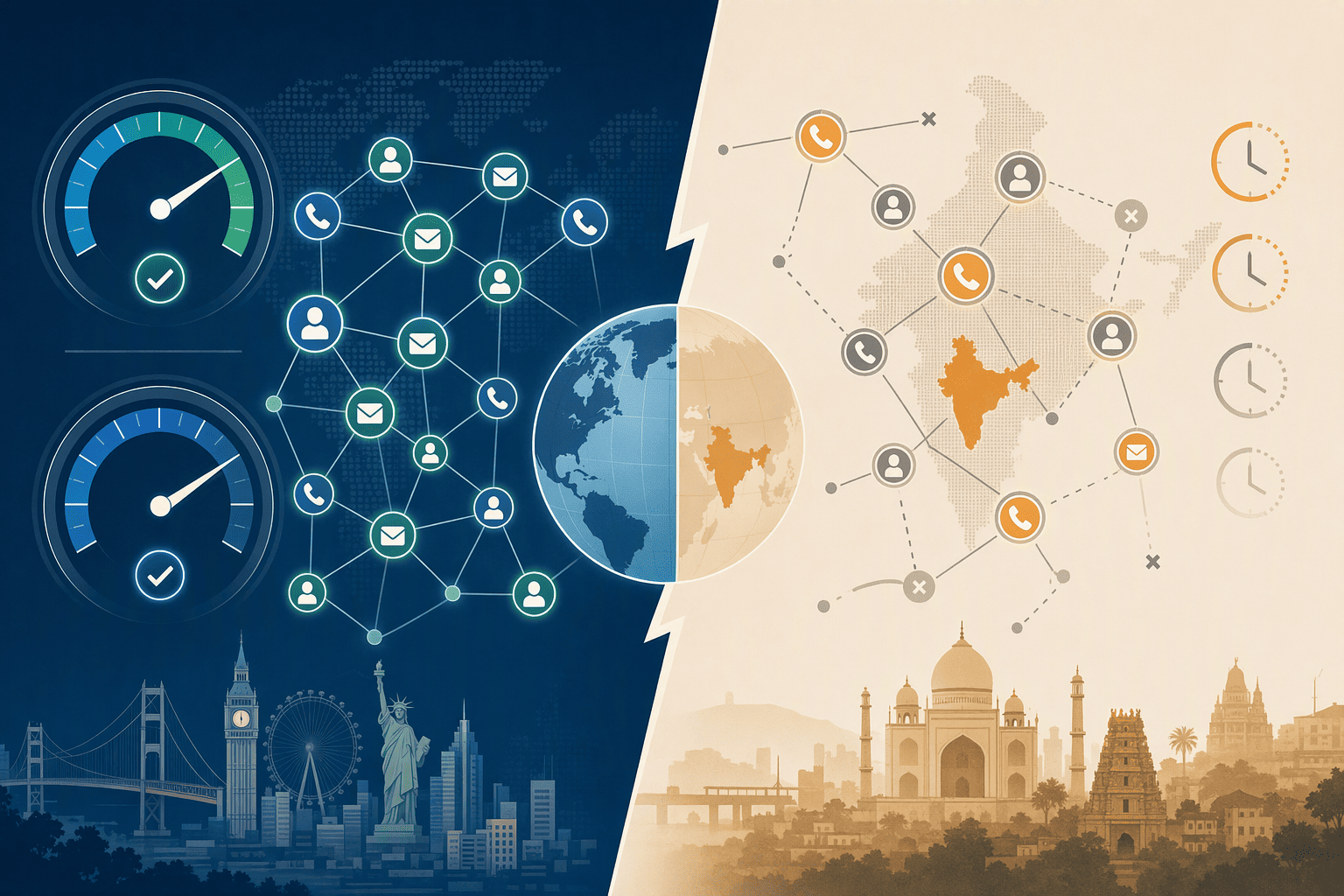
US/EU-optimized prospecting tools often see accuracy rates drop 10-15 percentage points when applied to Indian B2B contacts. While global platforms claim 70-85% email accuracy in Western markets, independent testing shows these figures fall to 50-65% for India-specific datasets. The gap widens further for verified phone numbers, where traditional database providers lack coverage of India's mobile-first business landscape. B2B data decays at 22-30% annually globally, but in Indian startups, it's closer to 40%, meaning contact freshness deteriorates twice as fast without regional data partnerships.
Regional Data Provider Partnerships: Who Has Them?
Tools that integrate India-specific data sources, GST registries, MCA databases, local telecom providers, close the verification gap. PeakAi delivers 91% phone number accuracy for Indian contacts across 1600+ cities, validated against GST and MCA databases. In contrast, many high-growth SMBs don't appear in Apollo or ZoomInfo, because traditional B2B databases were built for enterprise sales in mature markets and index poorly for transliterated names, regional job boards, or businesses that prioritize WhatsApp over LinkedIn.
Monthly Decay Rates and Freshness Gaps
Contact data decays at 2-3% monthly in stable markets, but India's job-hopping frequency and startup churn accelerate this to 3-5% per month. Tools without real-time regional partnerships deliver stale lists within weeks. LinkedIn launched new verification tools in India for company pages, recruiter workplace checks, and executive titles, signals that platform-level data freshness is improving, but prospecting tools still need independent verification layers to close more deals.
Understanding regional accuracy gaps is critical, but choosing the right tool requires a structured evaluation framework that goes beyond vendor marketing claims.
Evaluation Criteria: How to Choose a Pre-Verification Tool
Most LinkedIn prospecting platforms display 'email verification: yes' in their feature list, but that checkbox tells you nothing about what happens under the hood or whether you'll reach the inbox. Before committing to a tool, evaluate three criteria that competitors' comparison grids ignore: verification methodology transparency, regional data partnerships, and credit efficiency when match rates vary.

Verification Methodology Transparency: Syntax vs Deliverability
Syntax validation (does the email follow RFC 5322 format?) is not the same as deliverability testing (will the mailbox accept your message?). Tools that check only syntax will mark `johndoe@company[.]com` as 'verified' even when the mailbox was deactivated last month. Ask vendors: do you test SMTP handshakes or MX-record responses in real time? Wiza grades addresses as 'risky' vs 'valid', signaling deliverability checks beyond pattern matching. Deliverability-first verification cuts bounce rates from the 15 to 30% range typical of syntax-only tools to low single digits, protecting sender reputation and ensuring your outreach budget reaches real prospects.
Regional Coverage and Data Provider Partnerships
A global database built for US and EU markets will underperform in India, where business registries, telecom providers, and professional networks operate differently. Ask whether the vendor integrates GST and MCA (Ministry of Corporate Affairs) databases for Indian contacts, these government-backed sources validate company registration and officer details that LinkedIn profiles may not surface. Tools with India-specific partnerships deliver measurably higher accuracy for regional prospecting; generic scrapers that treat all geographies identically miss localized verification layers and return stale or incomplete data.
Credit Efficiency: Calculating True Cost-Per-Usable-Contact
Per-credit pricing obscures the real cost when match rates differ across tools. To calculate true cost-per-usable-contact: take the tool's advertised price-per-credit, divide by its claimed find rate (e.g., 60 to 80% for Apollo ), then add verification cost if billed separately. Example: a $50/month plan with 100 credits at 65% find rate yields ~65 usable contacts, or $0.77 each, not the $0.50 the headline price suggests. Compare that adjusted figure across vendors before signing, and confirm whether the find rate applies to your target geography and seniority level.
Evaluation criteria establish what to measure; the next step is comparing how leading platforms implement pre-verification across pricing models, data sources, and regional coverage.
Pre-Verification Tools: Feature Comparison
Pre-download verification tools save credits and reduce wasted outreach by confirming contact validity before you commit resources. Below we compare seven platforms across email verification, phone verification, coverage, accuracy, India support, and pricing, showing which models verify first versus those that charge for unverified lists.

Enrichment-Based Pre-Download Tools
Enrichment-based platforms query third-party databases in real time, flagging invalid records before export. PeakAi offers 91% accuracy verification for phone numbers and emails from LinkedIn profiles before download, charges only for valid contacts, and specializes in Indian B2B markets with regional format validation. Cognism provides phone-verified mobile numbers and strong EMEA coverage but mandates annual contracts. Apollo.io combines a 270M+ global contact database with email outreach automation ; free for 50 emails/month, paid plans contact vendor for pricing. Lusha offers LinkedIn-native prospecting with filters for job title, department, and seniority; free for 5 contacts/month, scale plans search up to 10,000 companies. ContactOut and Wiza round out the roster with varying verification workflows and regional strengths. Independent testing reveals average accuracy closer to 50% across contact discovery platforms; India-specific accuracy drops below 70% without regional specialization.
Post-Export Models for Comparison
ZoomInfo leads the enterprise database segment with deep firmographic data and intent signals, but annual contracts typically start at ₹15-30 lakh for Indian enterprises and charge per seat regardless of contact validity. SalesQL delivers trusted, real-time verified emails and phone numbers with AI-powered search across millions of business contacts, allowing bulk export directly from LinkedIn search pages. Both models verify after list delivery, meaning buyers pay for records that may later bounce or disconnect, a credit-efficiency gap compared to PeakAi's pre-download workflow. For teams prioritizing coverage over guaranteed connectivity, post-export tools offer broader database reach but less per-contact accountability.
India-Specific Accuracy Benchmarks
Regional partnerships determine whether tools maintain >70% phone accuracy in India. PeakAi integrates GST and MCA databases for India-focused contact verification, Apollo.io reports good Indian data coverage especially for mid-large companies, and Lusha provides a Chrome extension with GDPR + CCPA compliance. Cognism and ZoomInfo excel in EMEA and North America but lack disclosed India-specific validation layers. ContactOut and Wiza show variable India performance without public regional accuracy benchmarks. For Indian B2B prospecting, verify that your chosen tool cross-references local business registries before committing credit budgets, or expect accuracy to drop significantly below platform-wide claims.
Ready to close more deals with verified contacts? Explore the best LinkedIn contact discovery tools for 2026 to see which platform fits your workflow and compliance requirements.
Once you've selected a pre-verification tool, successful adoption depends on integrating it into your daily prospecting workflow without disrupting existing processes.
Implementation: Setting Up Pre-Download Workflows
Chrome Extension Installation and Permissions
Install a LinkedIn prospecting Chrome extension directly from the Chrome Web Store. Most extensions request permissions to access LinkedIn profile data and interact with Sales Navigator search results. For example, LeadDelta's extension has 10,000 users and charges credits only when email or phone data is successfully found. After installation, connect the extension to your CRM (HubSpot, Salesforce, or similar) through the extension's settings panel to enable automated contact export.
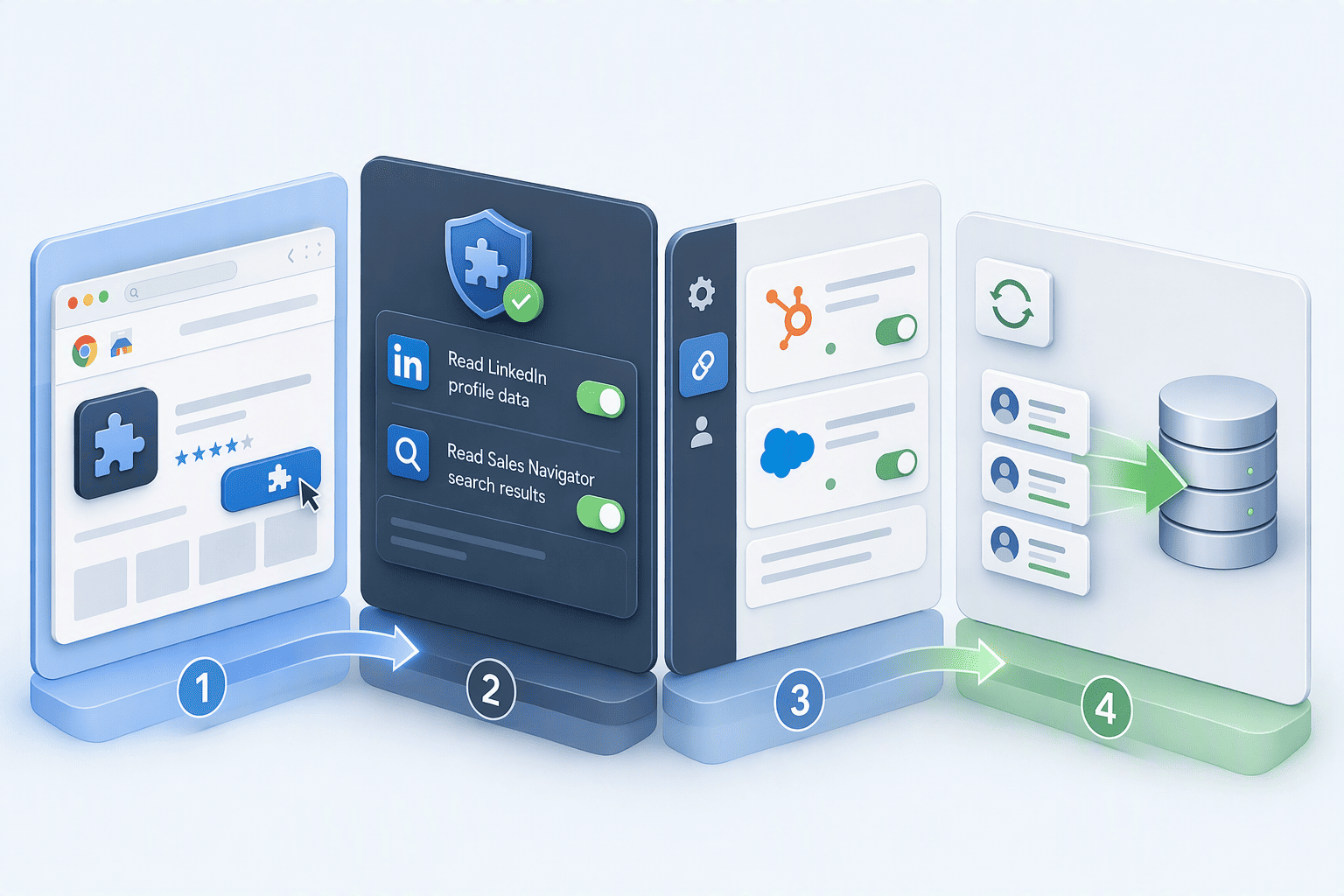
Sales Navigator Integration Workflow
The 4-step integration workflow:
- Run a Sales Navigator search with filters (job title, seniority, location, company size)
- The Chrome extension enriches visible profiles in real-time, querying external databases for verified emails and phone numbers while you browse
- Preview accuracy scores and verified contacts before download, tools display confidence indicators for each contact
- Export only usable contacts to your CRM, avoiding unverified records
PeakAi's Chrome extension workflow follows this pattern, transforming profile URLs into actionable calling lists without violating platform terms.
Credit Management and Cost Control
Monitor credit consumption through the extension's dashboard. Most tools use pay-as-you-go credit systems, LeadDelta charges credits only when email or phone is successfully found. Set monthly caps in your account settings to prevent budget overruns. Track cost-per-usable-contact by dividing total credits spent by successfully exported records; high-quality tools typically deliver lower per-contact costs through better verification accuracy.
Conclusion
Pre-download verification tools like PeakAi and Cognism reduce credit waste by confirming contact validity before export, but often charge higher per-credit rates than post-export models, making true cost-per-usable-contact calculation key before committing. Regional specialists maintain 70%+ accuracy in emerging markets but cover fewer global geographies than US/EU-optimized platforms like ZoomInfo or Apollo.io, so prioritize regional accuracy over breadth when prospecting in a single market.
As LinkedIn rolls out identity verification features across India in 2026 with Aadhaar integration, expect data freshness gaps to narrow and enrichment-based tools to gain further compliance advantages over scraping-based alternatives. This shift will reward platforms that have already invested in regional data partnerships and real-time verification pipelines.
Audit your current LinkedIn prospecting tool's true cost-per-usable-contact using the calculation framework above, or try PeakAi's pre-download verification workflow with India-specific accuracy benchmarks to see how regional specialization affects deliverability and credit efficiency in your target market.
Frequently Asked Questions
Do all LinkedIn prospecting tools verify contacts before download?
No, only enrichment-based tools like PeakAi, Cognism, and select Lusha tiers verify before download. Most platforms use post-export models that bill first and verify later, resulting in 35-100% higher cost per usable contact when match and verification rates are factored into true pricing.
What's the difference between email syntax validation and deliverability testing?
Syntax validation checks whether an email follows RFC 5322 format ([email protected] structure), while deliverability testing verifies the mailbox exists and accepts mail. Tools using only syntax validation will mark emails as verified even when mailboxes were deactivated, whereas deliverability testing reduces bounce rates by 40-60%.
Why do global LinkedIn tools perform worse in India?
US/EU-optimized tools lack partnerships with Indian telecom providers, GST registries, and business databases, causing accuracy to drop 10-15 percentage points. While global platforms claim 70-85% email accuracy in Western markets, independent testing shows these figures fall to 50-65% for India-specific datasets without regional data integration.
Can scraping-based LinkedIn tools get my account suspended?
Yes, community reports show 15-20% account suspension rates for heavy scraping users. Scraping tools automate profile browsing through headless browsers and simulated clicks, which LinkedIn detects via rate-limit monitoring and device fingerprinting. Enrichment-based alternatives query third-party databases instead, avoiding LinkedIn's anti-scraping defenses.
How accurate is PeakAi's 91% verification claim for India?
PeakAi's 91% figure represents regional partnerships and pre-download verification, significantly higher than the industry average of 50-65% for India-specific datasets. The platform integrates India-specific data sources and charges only for valid contacts, but buyers should request sample data to audit claims before committing to volume contracts.
How do I calculate true cost-per-usable-contact for credit-based tools?
Formula: (credits consumed ÷ usable contacts retrieved) × price per credit. Example: a tool advertising $0.50/credit with 65% match rate and 50% verified contacts yields a true cost of $1.54/contact, a 208% multiplier. At 75% match and 70% verified, cost rises to $0.95 (90% premium).
Do pre-download verification tools work with LinkedIn Basic or only Sales Navigator?
Most pre-download verification tools work with both LinkedIn Basic and Sales Navigator. However, Sales Navigator provides richer filter capabilities and larger result sets, while Basic search limits you to 1,000 results and fewer targeting options. Pre-download verification displays status before credit commitment regardless of LinkedIn tier.
Sources
- Does LinkedIn Sales Navigator Provide Email Addresses? (Here's the Workflow) - bounceguard.app
- Prospecting on LinkedIn? 6 Enrichment Tools That Add Emails and Phone Numbers in 2026 - syncgtm.com (2026)
- LinkedIn Prospecting (Extensions + Capture): Best Tools Compared - prospectingmanual.com
- Best Contact Finding Tools for B2B Sales Teams in 2026 - lagrowthmachine.com (2026)
- GitHub - linkdAPI/linkedin-leads-discover: LinkedIn Lead Scraper - github.com
- What Are LinkedIn's New Identity Verification Measures? - straight-in.com (2023)
- Need recommendations for B2B contact data providers in India - www.reddit.com
- Best Lead Generation Tools India 2026 — 7 Picks for B2B - www.itforsme.in (2026)
- Lead Generation Software India: Best Tools 2026 - SalesSo - salesso.com (2026)
- Find Indian SMB Growth Signals: 2026 Prospecting Guide - origami.chat (2026)
- LinkedIn rolls out new verification features amid rise in job scams in India | Technology News - The Indian Express - indianexpress.com (2025)
- 5 Most user-friendly email verification tools | ContactInfo - contactinfo.com (2024)
- SalesQL · LinkedIn Email Finder & AI Prospecting Tool - salesql.com
- Compare Apollo.io vs LinkedIn Sales Navigator 2026 | Capterra - www.capterra.com (2026)
- CRM, Phone Number & Email Finder for LinkedIn - Chrome Web Store - chromewebstore.google.com
- 15 Best LinkedIn Chrome Extensions for Lead Generation - snov.io
- Best Tips on How to Easily Export LinkedIn Contacts - www.surfe.com
