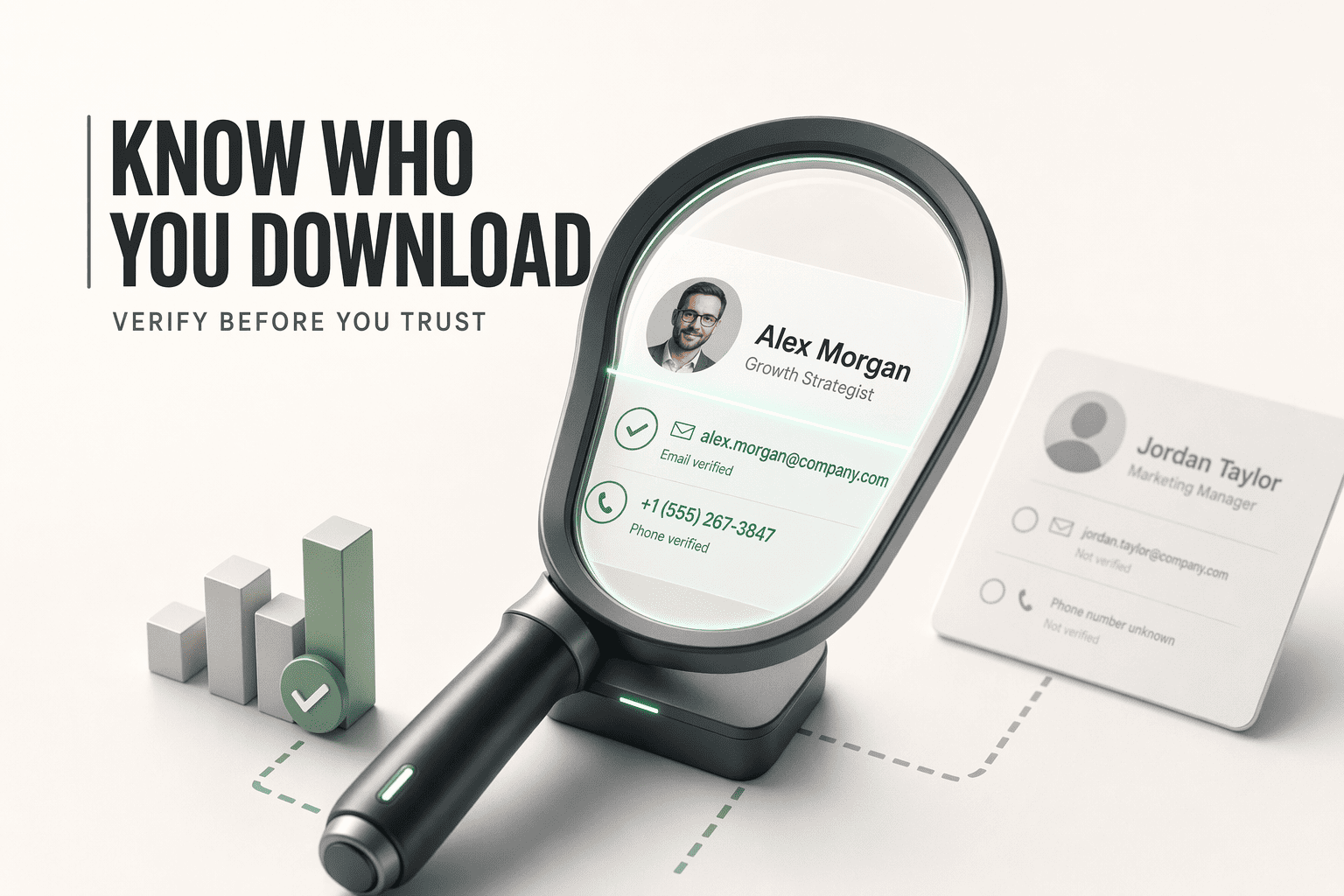
Most LinkedIn prospecting tools charge for every contact extracted, regardless of whether the email bounces or the phone disconnects. Pre-download verification shifts data-quality risk from buyer to vendor by validating deliverability before you spend credits.
Key Takeaways
- Pre-download verification runs syntax, MX, and SMTP handshake checks before credits are charged, reducing wasted outreach and improving ROI.
- Scraping-based extensions carry 15-20% account suspension risk; enrichment-based platforms query external databases and reduce risk to under 2%.
- Global accuracy claims of 95-98% drop to 50% average for India-focused contact lists due to lower data density and vendor presence.
- Credit-on-success pricing charges only for verified contacts, while credit-on-attempt models inflate true cost per usable contact by 35-100% at low match rates.
- SMTP handshake verification at query time proves real-time validation; sub-second API response alone indicates cached records, not fresh mailbox checks.
What Pre-Download Verification Actually Means (And Why Most Tools Skip It)
Yes—PeakAi verifies phone numbers and emails before download, delivering 91% accuracy on contacts from LinkedIn profiles. Most tools skip this step because post-export verification guarantees credit revenue regardless of match success, transferring data-quality risk to buyers.
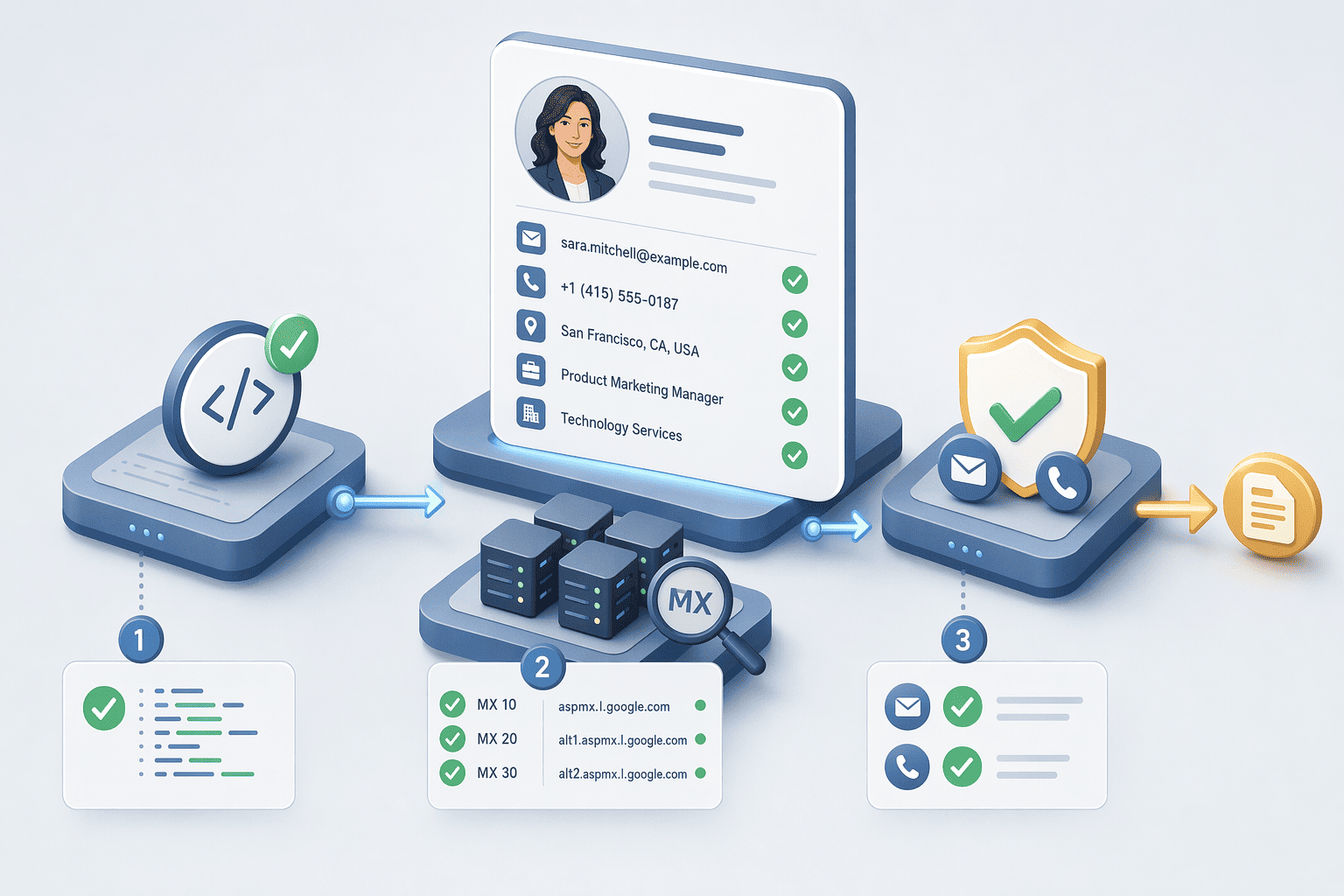
Verification Layers: Syntax, MX Records, and SMTP Handshakes
Pre-download verification runs three checks before a contact reaches your export. Syntax validation confirms the email matches standard format patterns ([email protected]). MX record lookup verifies the domain operates a mail server. SMTP handshake tests whether the mailbox accepts messages—the layer that catches role aliases, catch-all addresses, and abandoned inboxes. Tools like Derrick's data quality framework combine regular audits, automated enrichment, email verification, and deduplication into continuous workflows rather than one-time cleanup. PeakAi runs all three checks before download, filtering undeliverable records at validation rather than after payment.
Why Post-Export Verification Transfers Risk to Buyers
Post-export tools charge per record scraped, not per deliverable contact. A prospector exports 1,000 leads, runs a separate verification pass, and discovers 30% bounce—but the credit cost already hit. Pre-download systems like LeadFoxy's real-time SMTP and DNS checks validate during search, not after, so buyers pay only for verified records. The credit economics are clear: vendors that verify post-export collect revenue on invalid contacts; vendors that verify pre-download absorb the data-quality cost themselves.
Data Decay and the 2-3% Monthly Churn Problem
B2B contact data decays at roughly 22% per year —approximately 2% monthly—as professionals change roles, companies rebrand domains, and phone numbers reassign. Enrichment platforms cross-check verified contact databases against live LinkedIn signals to catch stale records before export. Without real-time refresh, even syntax-valid emails route to dead mailboxes within weeks. Pre-download verification mitigates decay by validating deliverability at query time rather than relying on static snapshots.
Ready to close more deals with verified contacts? Add to Chrome - Free and get 50 contacts for just $9, only 19 spots remaining.
Understanding verification mechanics matters little if the underlying data collection method violates platform terms and puts your account at risk.
Compliance Methods: Enrichment vs. Scraping and Account-Safety Risk
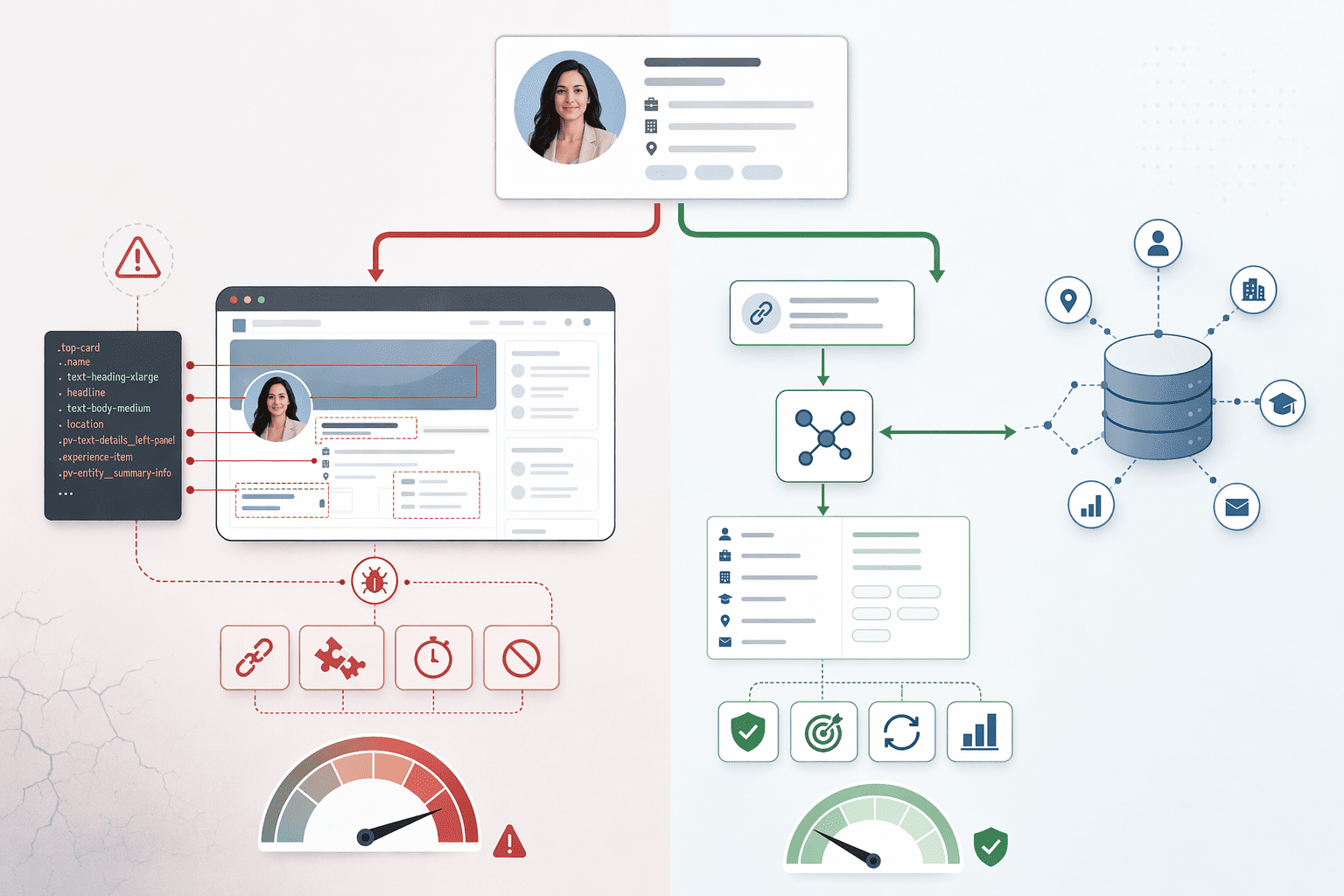
LinkedIn prospecting tools split into two architectural camps: scraping-based extensions that parse profile DOM in real time, and enrichment-based platforms that query external databases using LinkedIn URLs as reference keys. The compliance spectrum runs from gray-area (high risk) to ToS-compliant (lower risk), with measurable differences in account suspension rates.
What LinkedIn's Terms of Service Actually Prohibit
LinkedIn's Terms of Service explicitly ban automated scraping, profile crawling, and bulk data extraction. Tools that harvest contact data through bots, circumvent rate limits, or crawl profile fields directly violate these terms and expose users to permanent account suspension. The prohibition targets automated systems that access LinkedIn's internal structure, not third-party databases that compile contact information independently.
Scraping-Based Tools: Browser Extensions and Account Suspension Rates
Chrome extensions like Kaspr interact with LinkedIn's DOM to extract visible profile fields in real time. Heavy usage patterns, hundreds of profile views per day, rapid bulk enrichment, or automated sequencing, trigger LinkedIn's anti-scraping defenses. Community reports suggest 15-20% suspension rates for heavy scraping users, with penalties ranging from temporary restrictions to permanent bans. Risk scales with volume: individual prospectors face lower detection rates than teams automating bulk extraction.
Enrichment-Based Tools: Third-Party Databases and Lower Risk
Enrichment platforms query independent third-party databases using email, name, or company as input keys rather than accessing LinkedIn's APIs or crawling profile data. PeakAi uses this enrichment-based compliance method, querying third-party databases rather than scraping LinkedIn profiles. The architectural distinction matters: enrichment tools never touch LinkedIn's DOM, so they sidestep ToS prohibitions on automated scraping. Suspension risk drops to <2% because the tool operates outside LinkedIn's walled garden, contact discovery happens in external databases, not on LinkedIn's servers.
Teams with risk-averse IT policies should prioritize enrichment-based tools regardless of feature parity. The compliance tradeoff is a decision criterion: scraping-based extensions offer real-time profile field extraction but carry measurable account-safety risk, while enrichment platforms trade slightly slower lookup speeds for ToS-compliant architecture and sub-2% suspension rates.
Even compliant tools that verify before download face a second challenge: accuracy claims based on North American or European data rarely hold true for India-based prospects.
Regional Accuracy Transparency: Why Global Claims Don't Predict India Performance
The US/EU Data Density Advantage
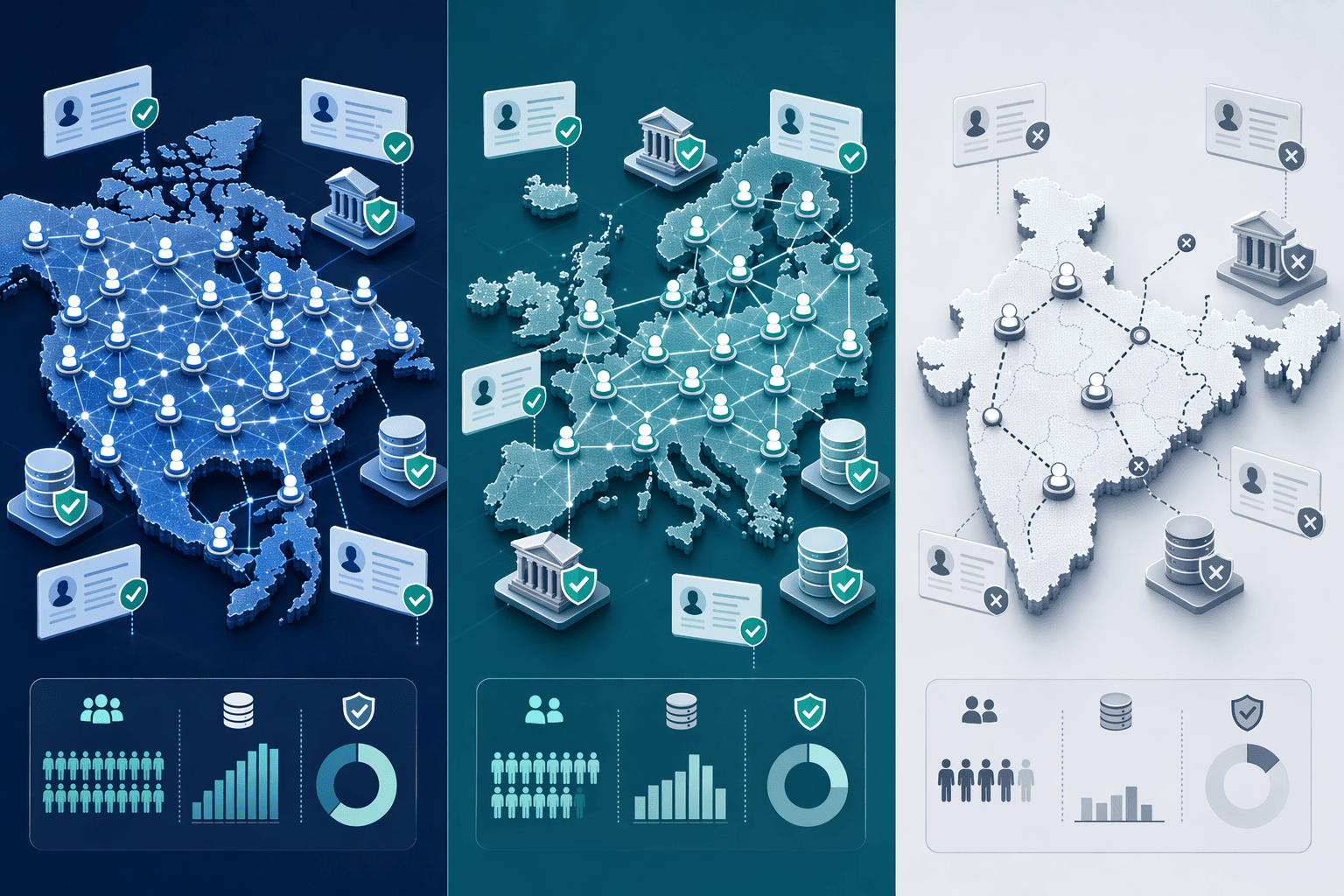
North American and European contact databases consistently outperform global averages by 10-15 percentage points due to structural advantages: longer vendor presence in these markets, GDPR-compliant data-sharing frameworks that standardize opt-in records, and higher LinkedIn profile completion rates. In the US and EU, business registries, public filings, and regulatory reporting requirements create dense, accessible contact datasets that vendors can cross-reference. India's business landscape, characterized by informal SMEs, fragmented registries, and lower profile completion, lacks these scaffolding layers, making third-party enrichment more difficult and expensive.
India-Specific Accuracy Testing: What Independent Audits Reveal
Vendors routinely cite 95-98% global accuracy, yet independent audits of India-focused contact lists reveal averages closer to 50%. This measurement gap stems from testing methodology: global claims often reflect US/EU test sets, not emerging-market samples. Tools built for Western markets apply pattern-matching algorithms trained on standardized formats, formats that break when applied to Indian phone numbering, regional name conventions, or mobile-first business communication. PeakAi offers India-focused contact verification with GST and MCA database integration, addressing these regional variables directly rather than extrapolating from global datasets.
How to Demand Regional Accuracy Breakdowns from Vendors
Apply this three-step framework when evaluating tools: (1) request India-specific accuracy metrics in writing, not global averages; (2) ask for sample test results with 50-100 India-based profiles, verifying phone formats and GST-linked company data; (3) prioritize vendors with local verification infrastructure, including India-based SMTP servers for email validation and regional phone validation APIs that recognize mobile prefixes and DND registries. This framework separates vendors with genuine India coverage from those repurposing US/EU engines.
Regional accuracy gaps expose a pricing structure problem: when match rates drop, credit economics shift dramatically depending on whether vendors charge per attempt or per success.
Verification Timing Models: Credit-on-Attempt vs. Credit-on-Success
Credit-on-Attempt: Pay Regardless of Match Success
Credit-on-attempt models charge every time you request a contact lookup, whether the tool finds a verified phone number or email or not. If the database returns nothing, you still lose a credit. This design transfers data-quality risk entirely to buyers: vendors guarantee revenue per query, not per usable contact. Teams prospecting into emerging markets or niche industries often see match rates below 50%, effectively doubling the advertised per-contact cost.
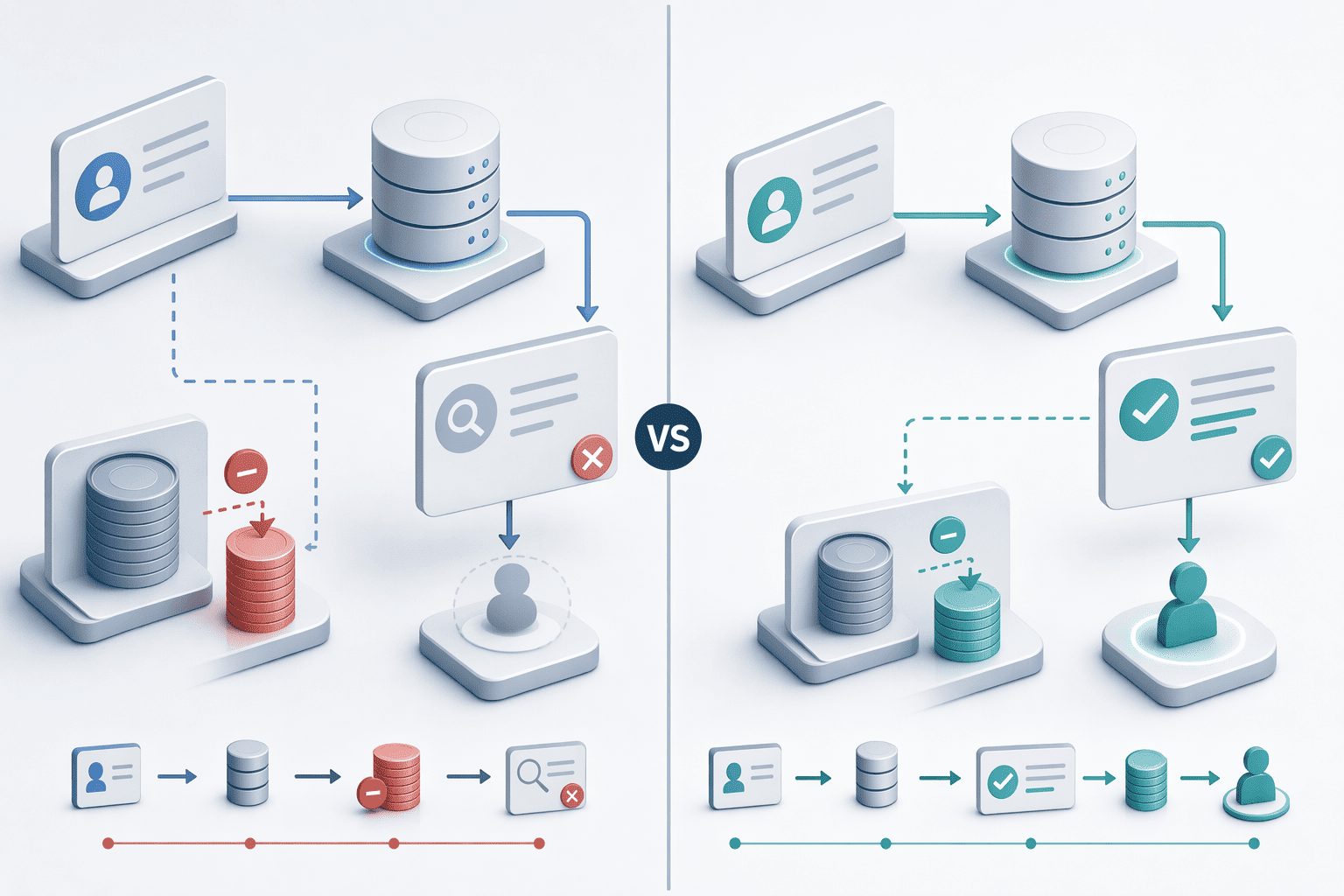
Credit-on-Success: Pay Only for Verified Contacts
Credit-on-success models charge only when the tool delivers a verified contact. SalesQL's API documentation states "1 credit per match, misses free," exemplifying this approach. PeakAi follows the same pattern: you only pay for the verified phone numbers you successfully retrieve. Failed lookups cost nothing. This shifts risk back to the vendor, which must maintain high verification accuracy or absorb the cost of unmatched queries.
True Cost : A Worked Example
Consider a credit-on-attempt tool advertising $0.50 per credit. If your target geography yields a 50% match rate, you burn two credits for every usable contact: one successful match, one miss. True cost per usable contact = $1.00, a 100% markup over the advertised price. Industry data shows credit-on-attempt models inflate effective per-contact costs by 35-100% depending on match rates. Credit-on-success tools eliminate this markup: advertised price equals true cost because you pay only for verified results. For budget-conscious teams or strict ROI requirements, credit-on-success pricing de-risks prospecting spend.
With verification timing and pricing models defined, the table below compares six tools on the features that determine true cost per usable contact.
Tools That Verify Before Download: Feature Comparison
Most LinkedIn prospecting tools charge for every contact extracted, regardless of whether the email bounces or the phone disconnects. Pre-download verification changes that equation by validating contact data before you spend credits, reducing wasted outreach and improving ROI. Below is a side-by-side comparison of six tools that offer verification-first workflows, enrichment-based compliance methods, and varying levels of India-specific infrastructure.

Comparison Table: Verification Timing and Compliance Method
| Tool | Email Verified Before Download | Phone Verified Before Download | Compliance Method | India Coverage | Starting Price | G2 Rating |
|---|---|---|---|---|---|---|
| PeakAi | Yes | Yes | Enrichment-based (third-party databases) | India-optimized with GST/MCA integration | $9 for 50 verified contacts | Not publicly disclosed |
| Apollo.io | Post-export (seven-step process) | Automatic verification | Database lookup with built-in verification | Global database (275M+ contacts) | Contact for pricing | Not publicly disclosed |
| Cognism | Yes (GDPR-native) | Yes (Diamond Data phone-verified) | Enrichment-based (third-party) | Europe-focused, limited India coverage | Contact for pricing | Not publicly disclosed |
| Lusha | Yes (reveal costs 1 credit) | Yes (reveal costs 1 credit) | Database lookup (reveal-then-save model) | Global database (100M+ contacts) | Free tier available; paid plans vary | Not publicly disclosed |
| ZoomInfo | Yes (600M+ profiles) | Yes (600M+ profiles) | Enrichment-based (enterprise intelligence) | Global database with intent data | Contact for pricing | Not publicly disclosed |
| RocketReach | Yes (verification features) | Yes (700M+ profiles) | Database lookup with verification | Global database | Contact for pricing | Not publicly disclosed |
The table shows verification timing as the primary differentiator. PeakAi and Lusha charge only when verification confidence is high, while Apollo runs its seven-step email verification process after export. Cognism and ZoomInfo both verify before download but require enterprise sales conversations for pricing. RocketReach offers pre-download verification across its 700M+ profile database but does not publicly disclose specific pricing tiers.
How Each Tool Handles Pre-Download Verification
PeakAi validates emails and phones in 10 seconds using real-time queries against 200+ network data partners. Verification includes syntax, MX record checks, SMTP handshakes for emails, and mobile/landline/VoIP classification for phones. Credits are charged only when verification confidence exceeds internal thresholds. India-specific infrastructure includes GST and MCA database integration for regional accuracy.
Apollo.io processes 275M+ contacts through a built-in seven-step verification process for email addresses. Cell phone numbers are verified automatically. Verification happens post-export rather than before download, meaning users pay for the contact first and receive validation results afterward. Built-in CRM integrations simplify the workflow once contacts are enriched.
Cognism specializes in Europe-focused verification with Diamond Data phone-verified mobile numbers and GDPR compliance. Verification happens before download through enrichment-based lookups. India coverage is limited compared to European markets, making it less suitable for teams prioritizing Indian B2B prospecting.
Lusha uses a reveal-then-save model where each reveal costs one credit, and saving does not cost credits. Users can search up to 100 companies at a time on free/self-service plans or 10,000 on Scale plans. Once revealed, the data is yours without repeat charges. Verification happens at reveal time, ensuring you pay only for validated contacts.
ZoomInfo delivers enterprise sales intelligence across 600M+ professional profiles with intent data signals. Verification is built into the enrichment process before download. Pricing requires direct vendor contact, and the platform is enterprise-first rather than startup-friendly. Global breadth is a strength, but India-specific validation infrastructure is not publicly documented.
RocketReach offers email verification features across its 700M+ profile database. Verification happens before download, and the platform supports global coverage. Pricing is not publicly disclosed, requiring prospective users to request quotes. Like ZoomInfo, India-specific verification capabilities are not emphasized in public documentation.
Ready to Transform Your Sales Process? Join thousands of sales professionals who find accurate contact information and close more deals with verified data.
Feature tables surface capabilities, but separating real verification from marketing labels requires an audit framework that tests vendor claims against evidence.
How to Evaluate Verification Claims (Red Flags and Proof Points)
What Constitutes Proof: SMTP Handshake Logs vs Syntax-Only Claims
Evidence hierarchy separates real verification from marketing labels. Tier-one proof includes sample SMTP handshake logs showing mailbox server responses, API response examples with verification status codes, and third-party audit reports confirming feature claims. Tier-two proof consists of vague 'verified' labels with no technical detail. When a vendor claims independent SMTP verification, request sample logs that demonstrate actual mailbox-level checks rather than domain-pattern inference.

Red Flags: 'Real-Time' Marketing vs Actual Data Freshness
Sub-second API response latency does not prove data freshness. Static databases serve cached records instantly, creating the illusion of real-time lookup without current mailbox validation. Tools advertising real-time SMTP verification should demonstrate server handshake at query time, not pre-verified database retrieval. Ask whether the system performs live checks or returns stored results; vendors conflating speed with recency rely on customer confusion about the technical difference.
The Pre-Download Test: How to Verify Before Committing
Run a four-step audit before bulk export:
- Request sample verification report for 10 contacts showing verification method and timestamp.
- Test with 5 known-good and 5 known-bad emails to measure false-positive and false-negative rates.
- Compare match rates across 2-3 vendors using identical input lists.
- Ask for India-specific accuracy metrics if targeting that region; global averages obscure regional performance.
Pre-download verification reduces DPDP Act 2023 compliance burden by preventing storage of unverifiable records. PeakAi provides verification API access and India-specific accuracy metrics as one example of transparent proof documentation.
Conclusion
Scraping-based browser extensions offer real-time data extraction but carry 15-20% account suspension risk; enrichment-based tools like PeakAi reduce risk to under 2% by querying third-party databases instead of LinkedIn's systems. Credit-on-attempt models advertise lower per-credit pricing but inflate true cost per usable contact by 35-100% when match rates drop; credit-on-success models cost more per credit but guarantee you pay only for verified contacts.
As DPDP Act 2023 enforcement tightens in India and LinkedIn refines its scraping-detection algorithms, enrichment-based tools with pre-download verification and regional accuracy transparency will become the compliance baseline for B2B sales teams.
Test PeakAi's pre-download verification with 50 India-based prospects and compare email/phone match rates against vendor claims before committing to annual contracts. Pre-download verification shifts data-quality risk from buyer to vendor, but only if the tool verifies deliverability through SMTP handshake and MX records before charging credits.
Frequently Asked Questions
What is pre-download verification in LinkedIn prospecting tools?
Pre-download verification validates contact data before you spend credits, running syntax, MX, and SMTP handshake checks visible before export. This contrasts with post-export validation that charges regardless of match success, transferring data-quality risk to the buyer rather than the vendor.
Which LinkedIn prospecting tools verify emails and phone numbers before download?
Enrichment-based platforms like PeakAi, Cognism, Lusha, and ZoomInfo offer pre-download confidence indicators by querying external databases using LinkedIn URLs as reference keys. Scraping-based extensions like Kaspr verify after export by parsing profile DOM in real time.
What is the difference between credit-on-attempt and credit-on-success pricing?
Credit-on-attempt charges every time you request a lookup, regardless of match success, inflating true cost per usable contact by 35-100% at low match rates. Credit-on-success models charge only when the tool delivers a verified contact, guaranteeing you pay exclusively for deliverable records.
Why do LinkedIn prospecting tools have lower accuracy for India vs US/EU?
North American and European contact databases outperform global averages by 10-15 percentage points due to longer vendor presence, GDPR-compliant data-sharing frameworks, and higher LinkedIn profile completion rates. Independent audits of India-focused lists reveal averages closer to 50% versus 95-98% global claims.
What is the risk of using scraping-based LinkedIn prospecting tools?
Scraping-based extensions parse profile DOM in real time, which LinkedIn's Terms of Service explicitly ban. Heavy scraping users face 15-20% account suspension rates, while enrichment-based tools that query external databases reduce risk to under 2% by avoiding LinkedIn's systems entirely.
How can I verify a vendor's email verification claims?
Apply a three-step framework: request India-specific accuracy metrics in writing, ask for sample test results with 50-100 India-based profiles verifying phone formats and GST-linked company data, and prioritize vendors with local verification infrastructure. Request sample SMTP handshake logs to confirm real-time mailbox validation.
What does 'real-time verification' mean in LinkedIn prospecting tool marketing?
Sub-second API response latency does not prove data freshness. Static databases serve cached records instantly, creating the illusion of real-time lookup without current mailbox validation. Real-time should mean fresh SMTP handshake at query time, not just fast retrieval of old data.
Sources
- Need recommendations for B2B contact data providers - www.reddit.com
- Top 10 Business Contact Finder Tools in India to Generate High-Quality Leads - businessinsight27.wordpress.com (2026)
- SalesQL · LinkedIn Email Finder & AI Prospecting Tool - salesql.com
- LinkedIn Sales Navigator Email Verification - billionverify.com
- 10 Best LinkedIn Email Finders + RocketReach Alternatives - cleverly.co (2026)
