Most LinkedIn prospecting tools charge credits for unverified contacts, hiding true cost-per-usable-lead. Enrichment-based platforms now surface verification confidence before export, reducing wasted spend by 35-100%.
Key Takeaways
- Pre-download verification platforms display confidence scores before you commit credits, while post-export enrichment validates after billing
- Enrichment-based tools query third-party databases rather than scraping LinkedIn profiles, avoiding ToS Section 8.2 violations
- Multi-layer validation (syntax, MX, SMTP, catch-all detection) separates high-accuracy platforms from syntax-only checkers
- Independent testing shows 50% average accuracy versus vendor claims of 95-98%—test match rates during free trials before annual commitments
- Regional accuracy for Indian B2B prospects drops below 70% without specialized data partnerships
How Contact Verification Timing Affects LinkedIn Prospecting ROI
Yes — enrichment-based platforms like PeakAi, Apollo.io, and Hunter.io verify phone numbers and emails before you commit credits, letting you assess quality upfront rather than discovering invalid records post-purchase. This pre-download confidence signaling shifts verification from a post-export cleanup task to a buying decision input, directly influencing cost-per-usable-contact and sender reputation.
The Cost of False Positives in Credit-Based Pricing Models
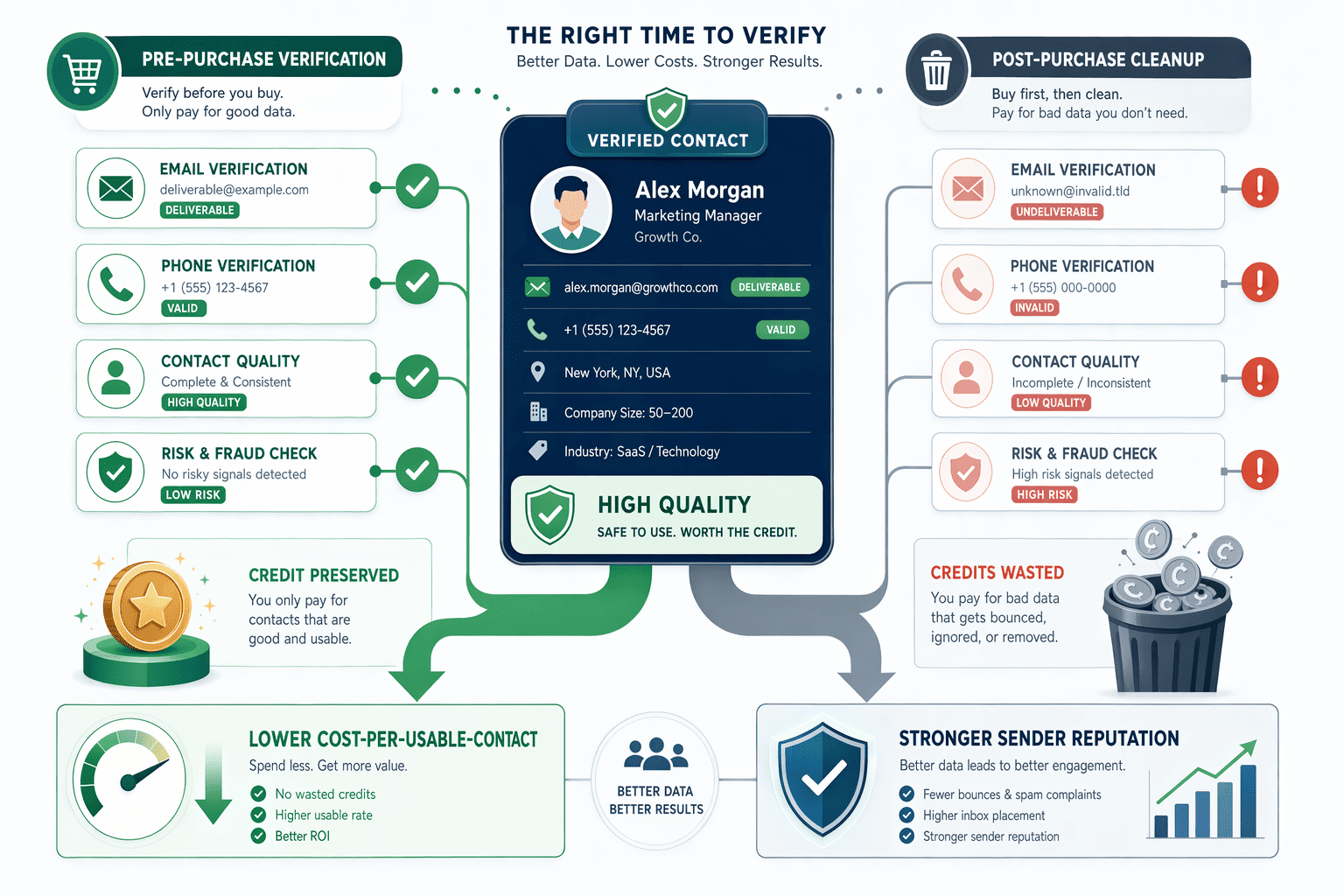
Credit-based pricing models can obscure true cost-per-usable-contact by 35-100% when match rates fluctuate. For example: purchase 100 credits at $0.18 each ($18 total), but only 40 records verify successfully. Your effective cost jumps to $0.45 per usable contact — 2.5× the advertised rate. Post-export validation compounds this: tools that charge for delivery rather than verification bill you for invalid emails and disconnected numbers, inflating acquisition costs without improving list quality. B2B contact data decays at roughly 22% per year, meaning stale records purchased in bulk today lose connectivity value within months, forcing re-purchase cycles that further erode ROI.
Pre-Download Verification as a Credit-Efficiency Signal
Platforms that surface verification confidence before export let buyers assess quality before committing credits. PeakAi displays verification status within the LinkedIn tab before committing a credit, running syntax, domain, and deliverability checks so you see which contacts passed validation and which failed. This contrasts sharply with blind-purchase models: export 500 contacts, pay upfront, discover 60% bounce rate only after your first campaign. Pre-download signals reduce waste by letting you skip low-confidence records and allocate credits to verified contacts, lowering effective cost-per-contact and improving campaign ROI predictability.
List Quality and Sender Reputation: Downstream Effects
Verification timing affects deliverability and personalization effectiveness downstream. High bounce rates (>5%) trigger spam filter penalties, reducing inbox placement for all messages from your domain — not just the current campaign. Role-based emails (info@, sales@) inflate list size without adding decision-maker contacts, diluting response rates and wasting personalization effort. Pre-download verification filters out these low-value records before they enter your CRM, protecting sender reputation and ensuring outreach budget targets genuine prospects. The 2-3% monthly decay rate means even verified contacts lose connectivity value over time; late-stage verification discovers quality issues only after stale records have already polluted your database, requiring retroactive cleanup that pre-download filtering prevents.
Understanding timing differences between verification architectures reveals why some platforms deliver better credit efficiency than others.
Pre-Download Verification vs. Post-Export Enrichment: Architecture Comparison
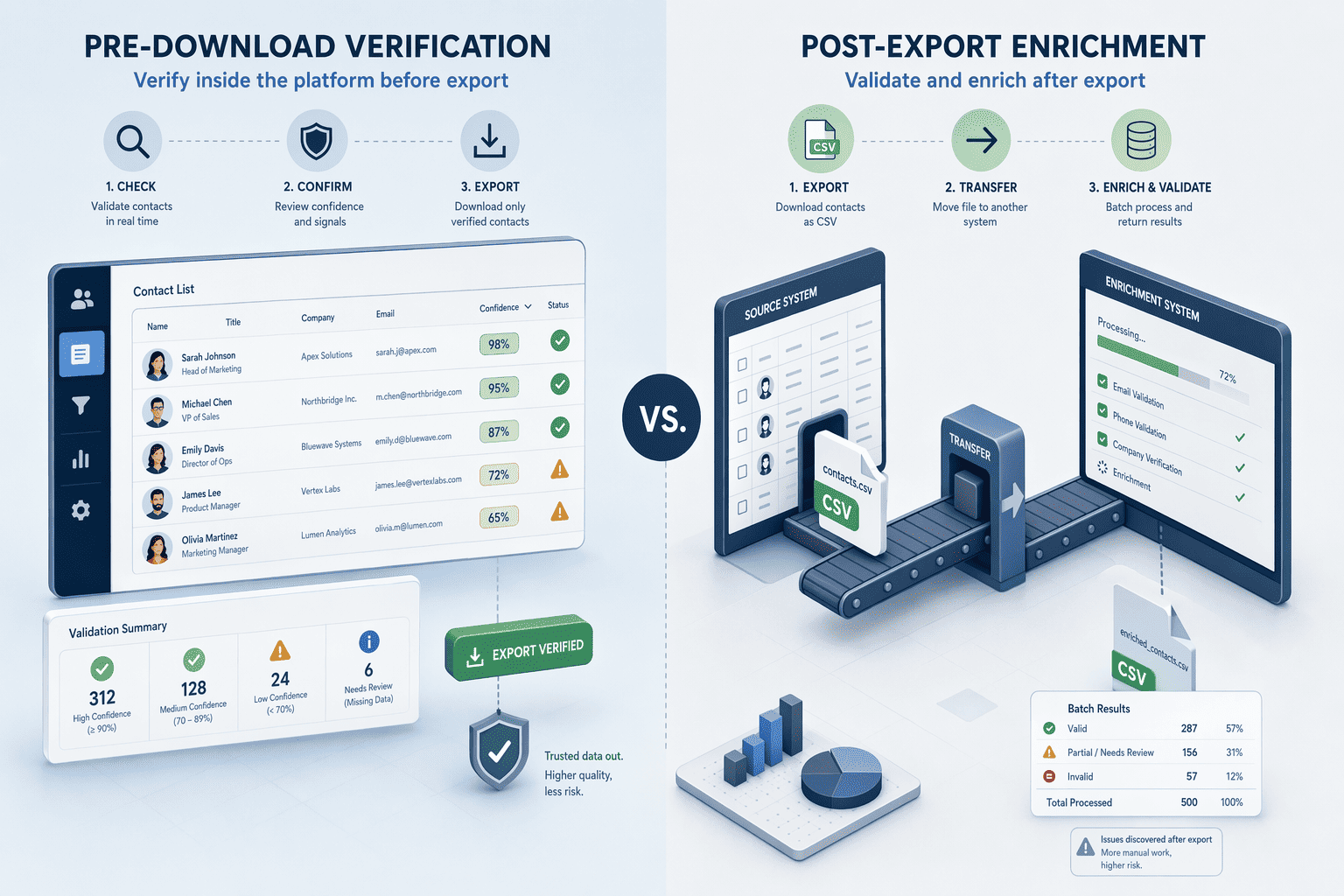
LinkedIn prospecting tools differ fundamentally in when and how they validate contact data. Pre-download verification platforms surface accuracy signals—confidence scores, verification badges, or real-time SMTP checks, within the platform UI before you export, while post-export enrichment tools require you to download a CSV first, then upload it to a separate service for batch validation. These architectural choices determine compliance risk, workflow efficiency, and the likelihood of burning credits on invalid contacts.
Enrichment-Based Tools: Third-Party Database Queries
Enrichment-based platforms query proprietary contact databases rather than scraping LinkedIn profiles directly. When you click a LinkedIn profile or paste a Sales Navigator URL, the tool sends identifiers (name, company, title) to third-party data providers, often hundreds of network partners, and returns verified emails and phone numbers sourced from business registries, public records, and opt-in directories. This architecture sidesteps LinkedIn's Terms of Service Section 8.2 prohibition on automated scraping because no automated profile extraction occurs within LinkedIn itself. Apollo, Lusha, Cognism, and similar tools operate this way, trading real-time freshness for compliance and reduced account-suspension risk.
However, enrichment-based architecture does not constitute a full compliance guarantee. Buyers should review LinkedIn's official guidance on data use independently, as compliance also depends on how the tool authenticates, rate-limits queries, and handles consent records under GDPR or CCPA.
Scraping-Based Tools: Direct Profile Extraction Risks
Scraping-based tools automate LinkedIn profile extraction by simulating browser actions, scrolling search results, clicking into profiles, and parsing the visible HTML, to harvest contact fields displayed on the page. This pattern violates LinkedIn Terms of Service Section 8.2, which prohibits scraping, crawling, or using bots to collect member data. LinkedIn actively monitors for automation signals (rapid page loads, repeated profile views from the same IP, headless browser fingerprints) and permanently suspends accounts that trigger detection thresholds.
The compliance gap is structural: even if a scraping tool claims to rate-limit requests or randomize intervals, the underlying action, automated profile access within LinkedIn, remains a ToS breach. Sales teams using scraping-based tools risk losing both the LinkedIn account and access to Sales Navigator seats, which can halt prospecting pipelines for weeks while accounts are restored or replaced.
Real-Time SMTP Checks vs. Batch Validation
Pre-download verification platforms run SMTP handshake checks and MX record lookups before you export, displaying confidence scores or deliverability badges in-UI. The SMTP handshake connects to the recipient mail server and simulates the first stage of email delivery without sending a message, confirming that the mailbox exists and accepts mail. This reduces false positives compared to syntax-only validation, which merely checks that an address matches the pattern [email protected] without verifying the mailbox is active.
Post-export enrichment tools invert the workflow: you download a CSV from Sales Navigator (which contains names, titles, and LinkedIn URLs but no emails or phones), then upload the file to a separate enrichment service or wait for API calls to return results. Validation happens after you've already committed credits or query limits. If 30% of the batch returns invalid emails, you've spent enrichment credits on contacts you cannot reach, and most platforms do not refund failed lookups.
The trade-off is workflow friction versus credit efficiency. Real-time verification lets you filter out low-confidence contacts before export, reducing wasted spend. Batch validation supports larger list sizes and deeper enrichment (firmographics, technographics, intent signals) but requires manual CSV handling and exposes you to higher bounce rates if the enrichment provider's data is stale.
Seven platforms stand out for surfacing verification signals before export, each with distinct strengths for different prospecting scenarios.
LinkedIn Prospecting Tools with Pre-Download Verification (Comparison Table)
When exporting thousands of LinkedIn profiles, verifying contact data *before* you pay prevents wasted credits on invalid numbers and undeliverable emails. The table below compares seven tools, PeakAi, Apollo.io, Cognism, Lusha, RocketReach, Kaspr, and Wiza, across verification timing, pricing, free-trial availability, CRM export format, and regional coverage for India. This LinkedIn contact discovery guide explains why pre-download verification matters for credit efficiency.
Comparison Dimensions: What to Evaluate Beyond Pricing
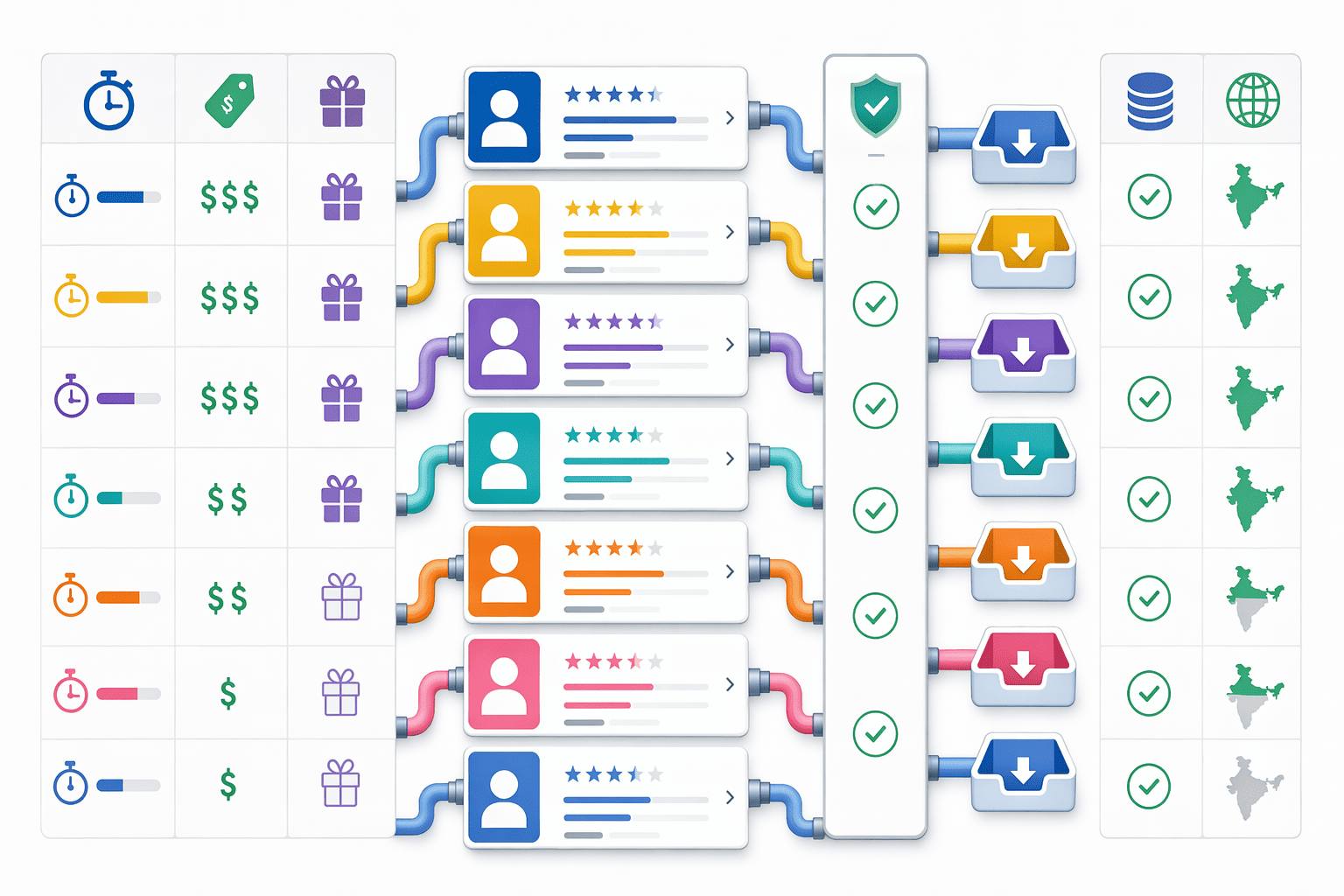
Four dimensions drive credit efficiency when comparing prospecting tools: verification timing (pre-download confidence vs. Post-export only), free plan or trial (can you test match rates before committing?), LinkedIn/Sales Navigator support (does the extension run natively inside LinkedIn?), and India coverage (does the vendor disclose regional data partnerships?). Manual research across websites and LinkedIn can take hours and often yields outdated or incorrect data, which is why these tools help businesses generate high-quality leads. Pre-download verification flags invalid records *before* you export, so you only pay for contacts that passed syntax, MX, and deliverability checks. Post-export tools bill for the full list and verify afterward, charging for records that later bounce.
Tool-by-Tool Highlights: Pre-Download Verification Leaders
| Tool | Verification Timing | Starting Price | Free Trial | LinkedIn Extension | India Coverage |
|---|---|---|---|---|---|
| PeakAi | Pre-download (real-time) | $9 for 50 contacts | Yes | Yes | 1600+ cities |
| Apollo.io | Pre-download (database lookup) | Contact for pricing | Free tier available | Yes | Not publicly disclosed |
| Cognism | Pre-download (phone-verified mobiles) | Contact for pricing | No | Yes | EU focus |
| Lusha | Pre-download (credit-per-reveal) | Contact for pricing | Free tier available | Yes | Not publicly disclosed |
| RocketReach | Post-export | Contact for pricing | Free tier available | Yes | Not publicly disclosed |
| Kaspr | Pre-download (instant reveal) | Contact for pricing | Free tier available | Yes | EU-centric database |
| Wiza | Post-export | Contact for pricing | No | Yes | Not publicly disclosed |
PeakAi delivers dual verification for both emails and phone numbers, surfacing confidence scores before you export. Pros: multi-layer validation (syntax, MX, SMTP, role-based detection, disposable screening, catch-all analysis), pay-per-contact pricing starting at $9 for 50 contacts, and India-focused coverage across 1600+ cities. Cons: pricing scales with volume, and coverage outside India depends on third-party database partnerships. Best for teams prioritizing credit efficiency and pre-download confidence when targeting Indian B2B prospects. Apollo.io offers a cost-effective database with similar data to LinkedIn and wins on volume (275M+ contacts), making it strong for teams needing large searchable databases. Cognism wins on phone-verified mobile numbers and enterprise EU data quality, ideal for European markets. SalesQL uses AI-powered search to access millions of business contacts with verified emails and phone numbers in real time, positioning it as another pre-download option with REST API and MCP server integrations.
Independent testing shows average contact-finder accuracy closer to 50% vs. Vendor claims of 95-98%. One practitioner reports getting around 85% verification using an Apollo → Clay (waterfall) → NeverBounce workflow, illustrating that multi-stage enrichment pipelines often outperform single-tool claims. Treat vendor-disclosed accuracy metrics (including those in G2 rating columns) as directional indicators, not guaranteed outcomes, verify with a free trial before committing to annual contracts.
Regional Performance Variance: India Coverage as a Proxy for Global Accuracy
Accuracy for Indian contacts drops below 70% without regional specialization. The 'India coverage' column in the table above indicates which platforms have disclosed India-specific data partnerships; absence of this disclosure does not mean zero coverage, but buyers targeting Indian B2B prospects should test match rates during trial periods. Tools with strong Indian coverage help businesses quickly uncover decision-makers and key stakeholders across industries without manual research. PeakAi emphasizes Indian business-profile coverage, while Kaspr and Cognism focus on European-centric databases. For teams prospecting globally, combine a regional specialist (PeakAi for India, Cognism for EU) with a broad database (Apollo.io) to maximize hit rates and close more deals.
When Post-Export Enrichment Makes Sense (and When It Doesn't)
Post-Export Enrichment: Best-Fit Scenarios
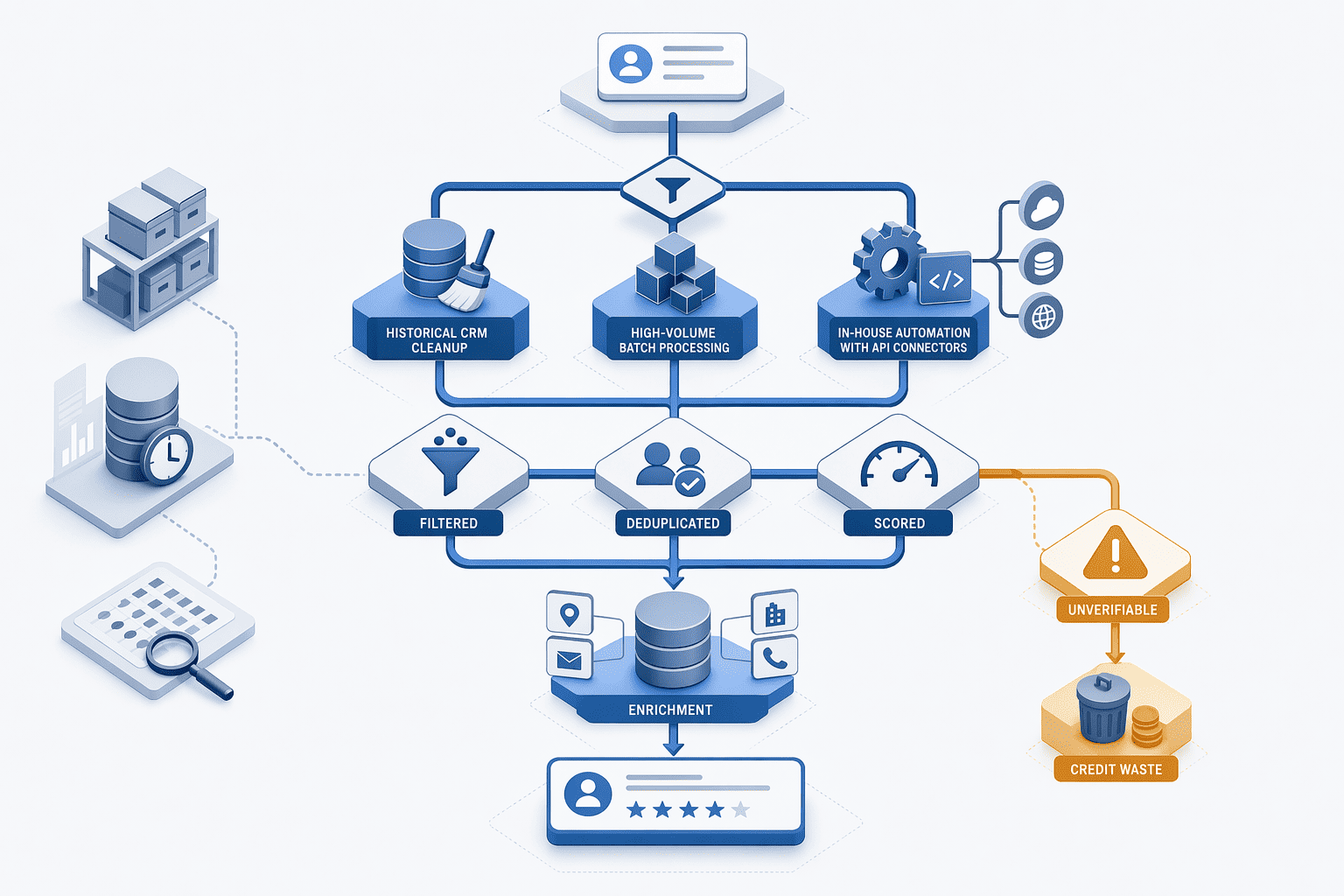
Post-export enrichment works best when teams already have strong CRM workflows and engineering resources to build API pipelines. If you're enriching historical CRM data rather than net-new LinkedIn prospecting, batch validation lets you transform data before enrichment, filtering by firmographics, deduplicating records, or applying custom scoring models. Teams running >500 contacts per month often pair post-export enrichment with in-house automation to handle volume. The trade-off: you pay credits for unverifiable records and discover quality issues only after download.
Pre-Download Verification: Best-Fit Scenarios
Pre-download platforms deliver better ROI when teams lack dedicated sales ops resources and need immediate list quality visibility. PeakAi, for instance, runs syntax, domain, and deliverability checks before download, letting you see verification status within the LinkedIn tab and decide whether to commit the credit. For teams running 50 to 500 contacts monthly, this approach reduces wasted outreach cycles and preserves credit budgets. If you're building net-new prospect lists from LinkedIn and prioritize credit efficiency, pre-download verification avoids charging for invalid records upfront.
Hybrid Workflows: Combining Both Approaches
Some teams use pre-download tools for net-new prospecting and post-export enrichment for CRM backfill, a staged approach rather than an either/or choice. Pre-download verification handles LinkedIn-native list-building where you want to see match rates before paying; post-export enrichment handles batch jobs where custom transformations justify the delayed quality check. For teams under 50 contacts monthly, free manual methods may suffice before investing in paid tools.
Ready to find accurate contact information and close more deals? See how pre-download verification fits your workflow.
Verification confidence scores only matter when the underlying validation layers actually test deliverability rather than formatting alone.
Verification Layers That Matter: Syntax, SMTP, Catch-All Detection
Multi-layer validation separates high-accuracy platforms from syntax-only checkers. The six key steps determine whether a contact reaches an inbox or bounces:
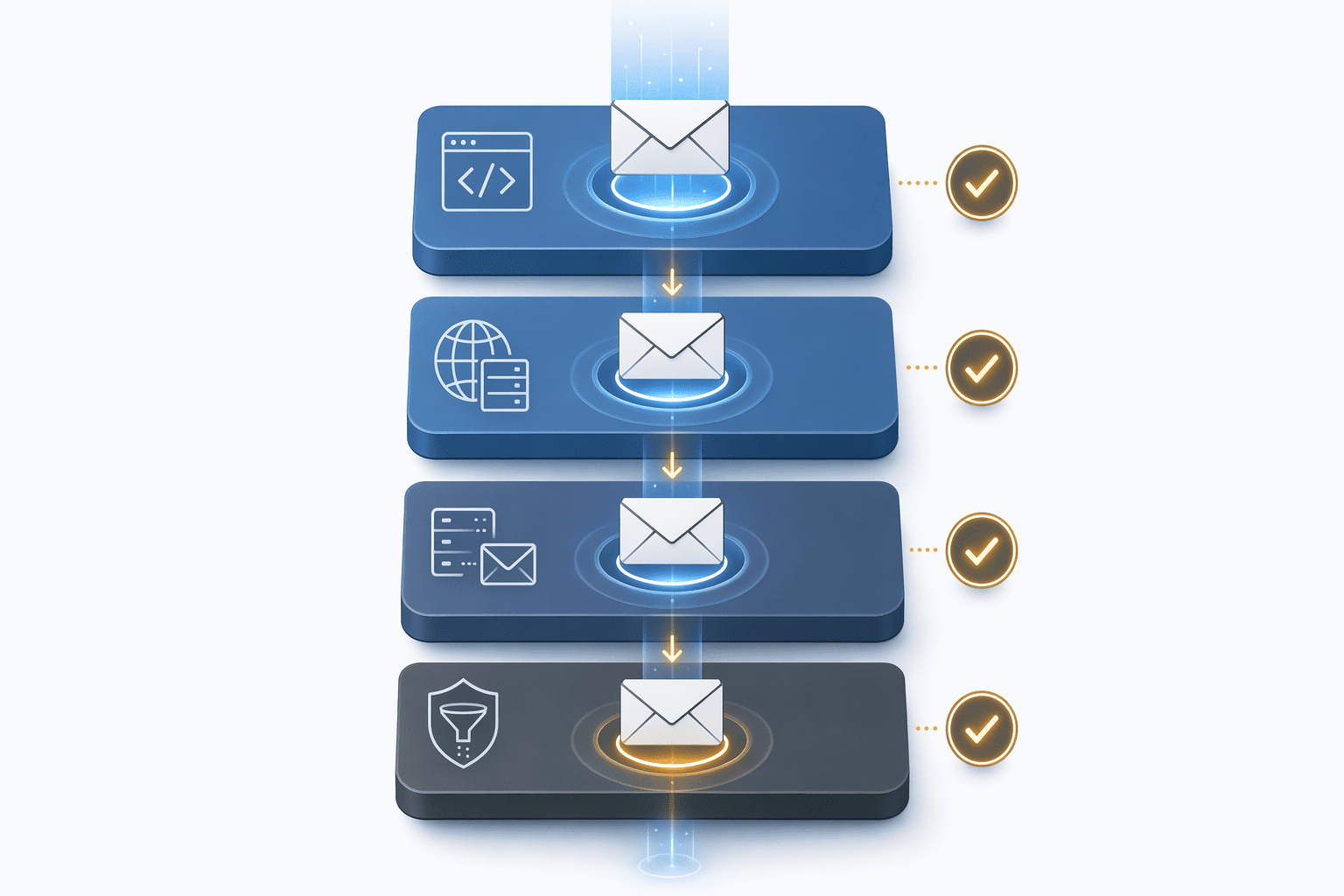
- Syntax validation, confirms the email address follows RFC 5322 format ([email protected] structure)
- MX record lookup, verifies the domain has a mail exchange server configured to accept messages
- SMTP handshake, tests whether the specific mailbox exists by sending an RCPT TO command without delivering mail
- Role-based detection, flags generic addresses (info@, sales@, hr@) that reduce personalization effectiveness
- Disposable domain screening, blocks temporary addresses from services like Mailinator or 10minutemail
- Catch-all analysis, identifies domains that accept mail to any address, even non-existent mailboxes
Syntax and MX Record Validation: The Baseline
Syntax checks confirm an email follows standard formatting rules, while MX record lookup verifies the domain accepts mail. Most tools stop here, they report 'verified' when the domain has a mail server, but they don't confirm the specific mailbox exists. This baseline catches malformed addresses but misses inactive accounts, typos in usernames, and addresses that were never created.
SMTP Handshake and Mailbox-Level Verification
SMTP handshake testing connects to the recipient's mail server and issues an RCPT TO command to check if the mailbox exists, without sending an actual message. Platforms like Apollo.io and PeakAi use this step to surface confidence scores before export. According to verification service documentation, SMTP handshake reduces bounce rates by 30-50% compared to syntax-only validation.
Role-Based, Disposable, and Catch-All Detection
Filtering role-based emails (info@, sales@) improves personalization effectiveness because these addresses route to shared inboxes, not individual decision-makers. Disposable domain screening prevents temporary addresses that expire after hours or days. Catch-all detection flags domains configured to accept mail to any address, for example, [email protected] will pass SMTP handshake, but the mailbox may not exist. Platforms that flag catch-all domains let buyers decide whether to suppress or manually review those contacts, reducing false positives in verified lists.
Ready to Transform Your Sales Process? PeakAi combines all six validation layers in its pre-download UI, so you see confidence scores before contacts enter your CRM.
Verification method choices carry legal and operational consequences that extend beyond match-rate percentages.
Compliance Implications: LinkedIn ToS and Verification Methods
LinkedIn ToS Section 8.2: Automated Data Collection Prohibition
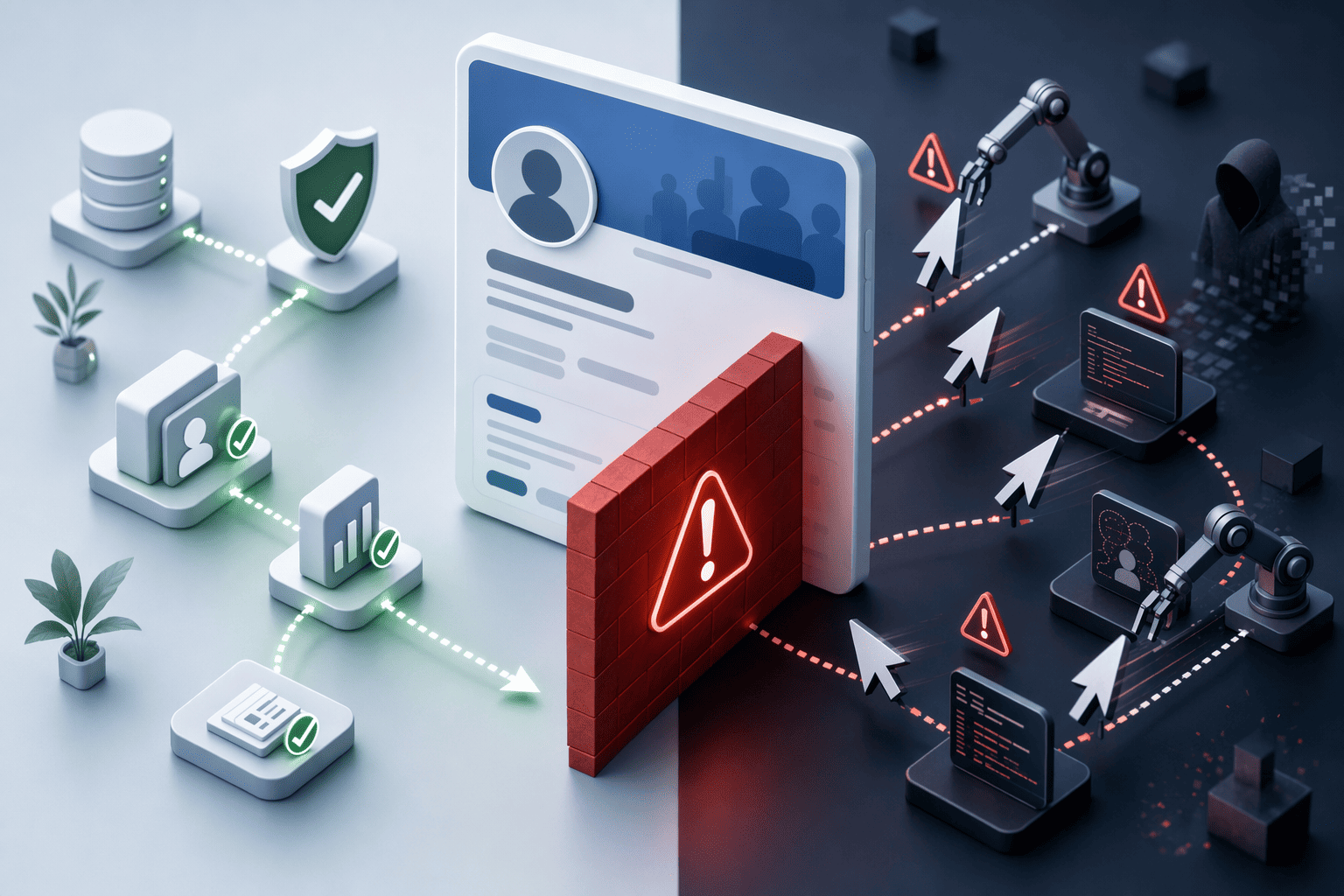
LinkedIn's Terms of Service explicitly prohibit automated scraping and data collection from the platform. Tools that automate browser actions within LinkedIn, such as automated profile visits, connection requests, or data extraction, violate this policy and expose users to account suspension. Scraping-based tools operate within the LinkedIn interface itself, triggering platform detection mechanisms and enforcement actions.
Enrichment-Based Tools and Third-Party Data Sources
Enrichment platforms including Apollo, Lusha, PeakAi, and Hunter query proprietary contact databases rather than scraping LinkedIn profiles directly. PeakAi, for example, uses this enrichment-based compliance method, querying third-party databases built from public web sources, data partnerships, and business registries instead of automated profile scraping. This architecture avoids LinkedIn ToS violations because no automated profile scraping occurs within LinkedIn itself, enrichment happens outside the platform using separate contact databases. However, this does not constitute a full compliance guarantee.
User Responsibility and Compliance Due Diligence
No tool guarantees full LinkedIn ToS compliance. Buyers remain responsible for reviewing LinkedIn's Terms of Service (Section 8.2) and each platform's data sourcing documentation independently. Enterprise deployments should consult legal counsel to verify that the tool's architecture and data sources align with organizational compliance policies. As LinkedIn's enforcement of ToS Section 8.2 evolves, with account restrictions for scraping-tool users increasing in 2025-2026, enrichment-based architectures are becoming the standard approach for enterprise compliance, but users should monitor LinkedIn's policy updates and close more deals within compliant frameworks.
Choosing Between Verification Architectures
Pre-download verification platforms like PeakAi and Apollo.io surface confidence scores before billing, reducing credit waste but requiring platform lock-in; post-export enrichment workflows offer flexibility for custom CRM pipelines but delay quality discovery and may charge for unverifiable records. Enrichment-based tools avoid LinkedIn ToS scraping violations but rely on third-party data sources with variable regional accuracy (India coverage often <70%); scraping-based tools access LinkedIn profiles directly but violate Terms of Service and risk account restrictions.

As LinkedIn's enforcement of ToS Section 8.2 intensifies (2025-2026 account restrictions for scraping-tool users), enrichment-based architectures with pre-download verification are becoming the compliance-safe standard for enterprise B2B prospecting, expect regional data partnerships (especially India, Southeast Asia) to mature and narrow the accuracy gap by late 2026.
Test pre-download verification confidence scores on a sample LinkedIn prospect list using PeakAi's free trial, compare match rates across Apollo.io and Hunter.io trials before committing to annual contracts.
Frequently Asked Questions
Is there a LinkedIn prospecting tool that verifies phone numbers and emails before download?
Yes, PeakAi, Apollo.io, and Hunter.io surface verification confidence scores before export, showing accuracy signals within the platform UI before you commit credits. Pre-download verification reduces credit burn by 35-100% compared to post-export tools that validate after billing.
What is the difference between pre-download verification and post-export enrichment?
Pre-download verification runs syntax, MX, and SMTP checks within the platform UI and displays confidence scores before export. Post-export enrichment validates after you download a CSV and upload it to a separate service, often charging for unverifiable records and obscuring true cost-per-usable-contact.
Do enrichment-based LinkedIn prospecting tools violate LinkedIn's Terms of Service?
Enrichment-based tools (Apollo, Lusha, PeakAi, Hunter) query third-party contact databases rather than scraping LinkedIn profiles directly, avoiding LinkedIn ToS Section 8.2 violations. However, users remain responsible for reviewing LinkedIn's policies independently, no tool guarantees full compliance.
Why does contact accuracy drop for Indian B2B prospects?
Accuracy for Indian contacts drops below 70% without regional specialization because fewer Indian professionals share contact info publicly and regional data partnerships are less mature. Test match rates during trial periods when targeting Indian markets, using the India coverage dimension in comparison tables.
How accurate are vendor claims of 95-98% email verification accuracy?
Independent testing shows average contact-finder accuracy closer to 50% versus vendor claims of 95-98%. Treat vendor-disclosed accuracy metrics as directional indicators, not guaranteed outcomes. Accuracy varies by region, industry, and seniority level, verify with a free trial before committing to annual contracts.
What are catch-all emails and why do they matter for verification?
Catch-all domains accept mail to any address, so SMTP handshake passes but the mailbox may not exist, lowering verification confidence. Platforms like PeakAi flag catch-all domains, letting buyers decide whether to suppress, manually review, or monitor those contacts for deliverability.
When should I use post-export enrichment instead of pre-download verification?
Post-export enrichment makes sense when you have existing CRM workflows, engineering resources to build API pipelines, or need custom data transformations before enrichment. For net-new LinkedIn prospecting without technical resources, pre-download verification reduces credit waste and delivers immediate list quality visibility.
Sources
- Best Contact Finding Tools for B2B Sales Teams in 2026 - lagrowthmachine.com (2026)
- How to Export Leads From LinkedIn Sales Navigator in 2026 (Step-by-Step) - www.cleverly.co (2026)
- Top 10 Business Contact Finder Tools in India to Generate High-Quality Leads - businessinsight27.wordpress.com (2026)
- What is the best tool to enrich LinkedIn with verified emails and phone numbers? - www.reddit.com
- SalesQL · LinkedIn Email Finder & AI Prospecting Tool - salesql.com
- Top 10 Sales Prospecting Tools in India: A 2026 Guide - www.manyreach.com (2026)
