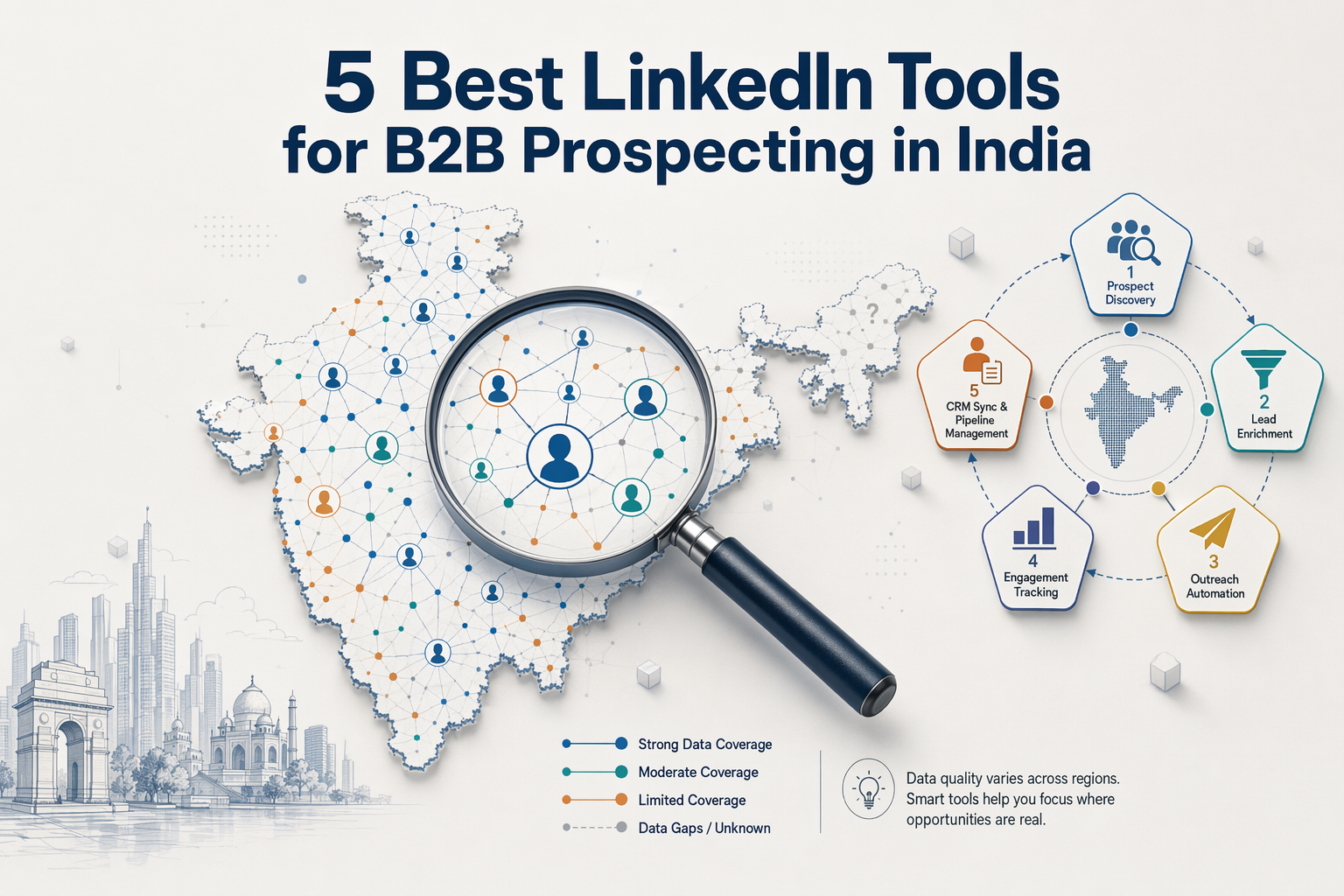
LinkedIn prospecting tools optimized for US and European markets often deliver 85-90% accuracy, but their performance drops to 65-75% in India due to privacy architecture and regional data gaps.
This guide compares eight tools by verification architecture, India mobile accuracy, refresh cycles, and compliance—helping you choose platforms that actually work in emerging markets.
Key Takeaways
- LinkedIn hides 90-95% of phone numbers from prospecting tools, creating accuracy gaps that global databases cannot bridge without regional data layers like GST and MCA validation
- Real-time verification tools with 7-day refresh cycles maintain 98% accuracy versus 75% for quarterly-updated static databases in Indian markets
- Phone accuracy for Indian mobiles (50-65% for Western-optimized tools) differs significantly from email accuracy (75-80%), making aggregated metrics misleading
- Enrichment-only platforms avoid LinkedIn Terms of Service violations by querying external databases, while direct-scraping tools face 30-40 daily action limits and suspension risk
- Pay-per-verified models protect budgets in low-match markets, while subscriptions suit high-volume teams willing to absorb 35-50% phone match failure rates
Why LinkedIn Prospecting Accuracy Drops Below 70% in India
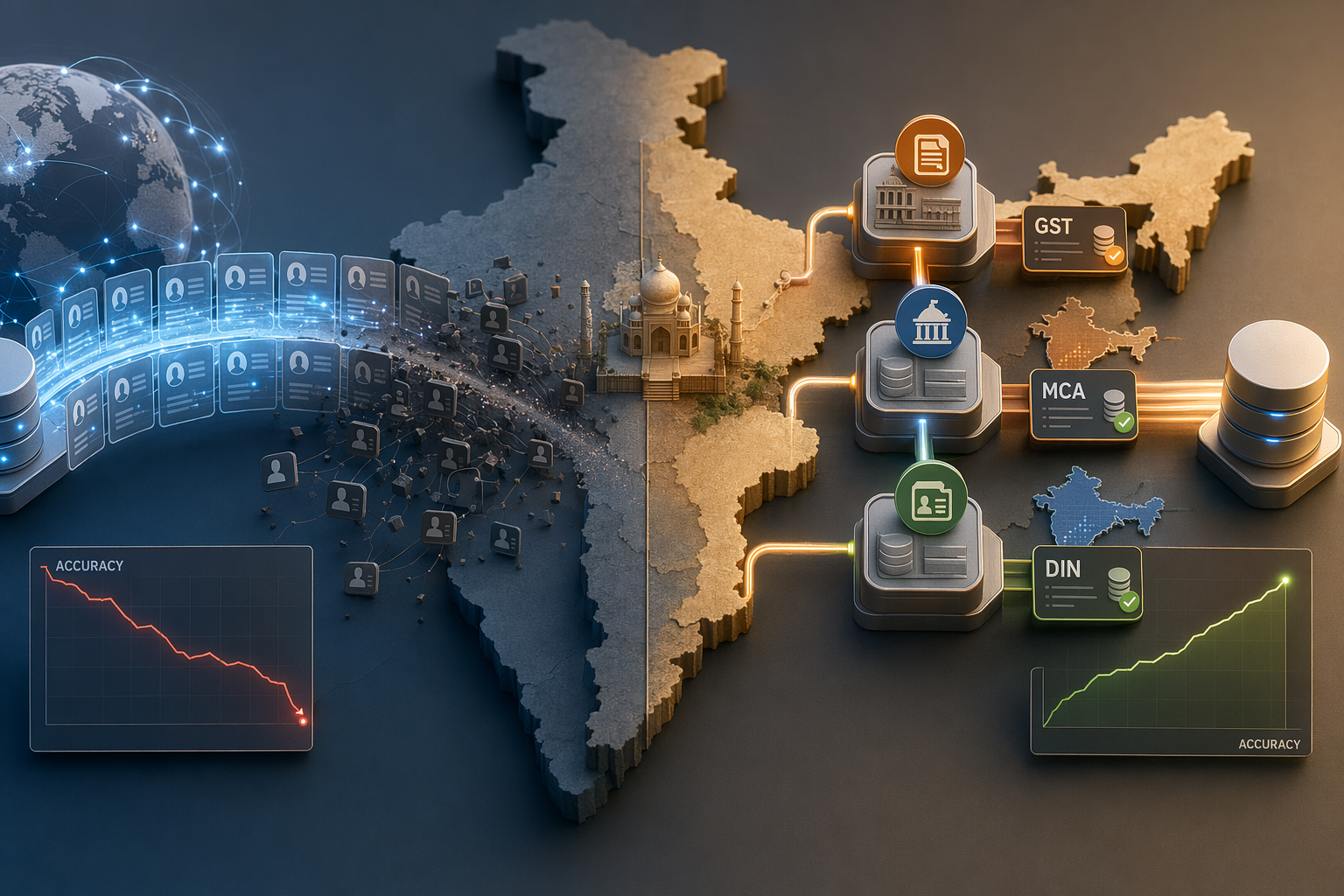
Global LinkedIn prospecting tools deliver 85-90% accuracy in the US but drop to 65-75% in India because of two structural barriers: LinkedIn's privacy architecture hides 90-95% of phone numbers from prospecting tools, and Western-optimized contact databases lack the regional verification layers (GST, MCA, DIN directory intelligence) that Indian B2B prospecting requires. Tools built for real-time verification against India-specific data sources maintain higher accuracy than static global databases.
LinkedIn Privacy Architecture and Phone Number Visibility
Only 5-10% of LinkedIn users share phone numbers with first-degree connections, creating a 90-95% visibility gap that global databases cannot bridge through profile scraping alone. LinkedIn's privacy-first architecture and user control settings deliberately limit phone number visibility, and security policies prohibit displaying numbers used for two-factor authentication. Prospecting tools that rely exclusively on LinkedIn's visible profile fields retrieve phone numbers for fewer than one in ten prospects, forcing effective tools to cross-reference external business databases and public records instead.
Contact Data Decay Rates in Emerging Markets
Contact data degrades 2-3% monthly in Indian markets; tools with 7-day refresh cycles maintain 98% accuracy versus 75% for slower cycles. Job mobility in India's startup and SMB sectors drives faster phone number turnover than in Western markets, where professionals often retain corporate numbers across role changes. PeakAi and similar real-time verification platforms query 200+ network data partners during each lookup to surface the current number rather than a months-old cached entry. Static databases that update quarterly or annually compound the visibility gap with staleness, delivering accurate contacts for fewer than seven in ten Indian prospects.
Western Database Optimization Failures
US- and EU-optimized contact databases lack the regional data layers that Indian B2B verification requires — GST validation, Ministry of Corporate Affairs record cross-referencing, and DIN-based director lookup. PeakAi addresses this gap through India-specific contact verification that validates GST numbers and cross-references MCA records before delivery, delivering 91% phone number accuracy for Indian contacts. Global tools built for Western markets treat India as a secondary geography, applying the same verification logic optimized for Delaware LLC filings and UK Companies House registries to Indian business structures — resulting in unverified phone numbers and mismatched company records that sales teams cannot act on.
Understanding why accuracy drops is only the first step—the next question is how different verification architectures attempt to solve the data gap problem.
Verification Architecture: Real-Time Lookup vs Static Databases
Real-Time Verification vs Post-Export Enrichment Workflows
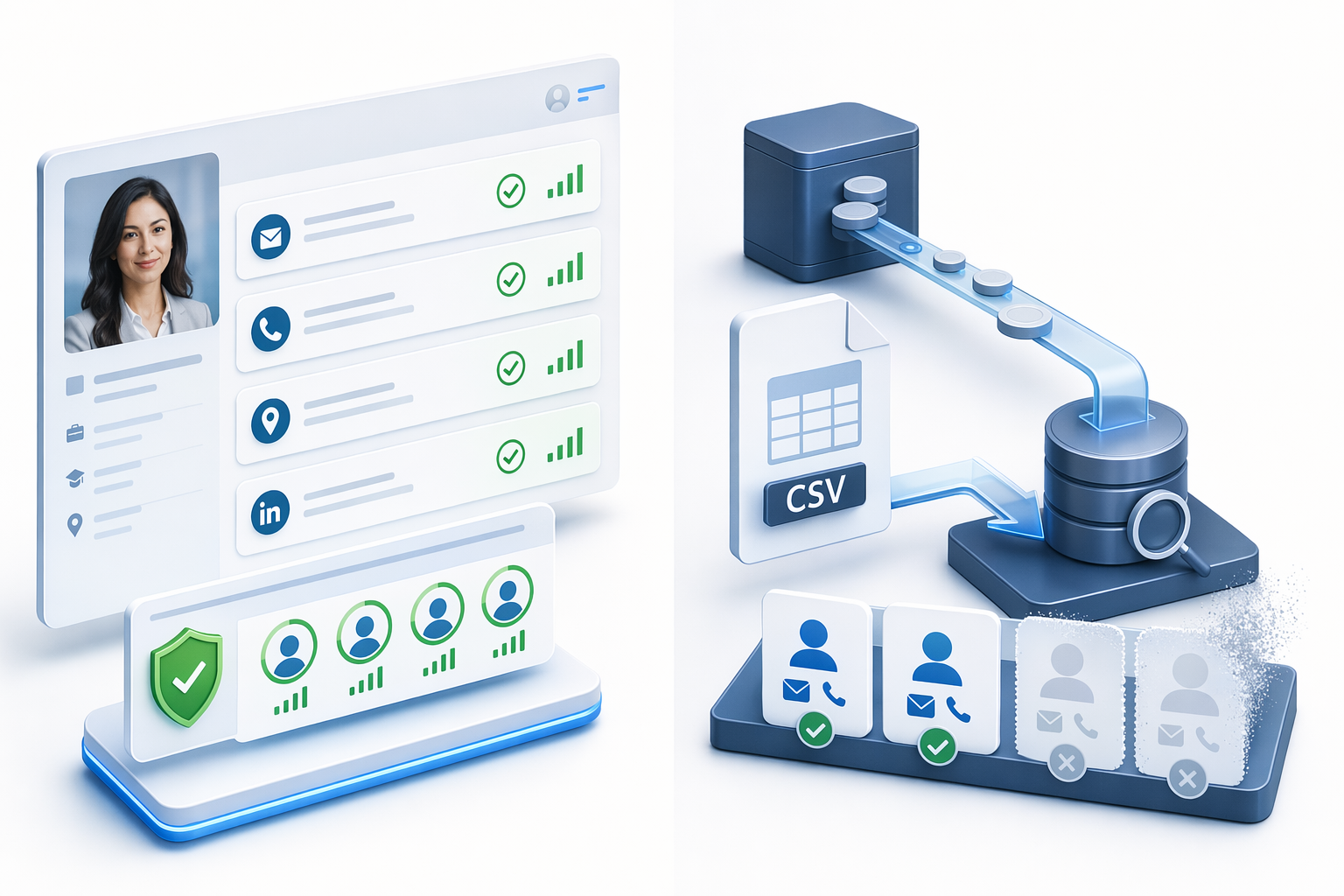
Pre-download verification shows contact accuracy *before* you spend credits. Real-time tools verify emails and phone numbers during profile review, displaying validation status directly in LinkedIn — users see match confidence before committing to a download. Post-export workflows validate contacts *after* CSV export, meaning you pay first and discover mismatches later. Credit burn rates differ sharply: 50-65% phone match and 75-80% email match means 35-50% of phone credits and 20-25% of email credits are wasted when validation happens post-payment.
Compliance Architecture: Enrichment vs Direct Scraping
Enrichment-based platforms query third-party databases using LinkedIn profile URLs as reference identifiers, they never scrape LinkedIn content or access internal APIs. Direct-scraping tools violate LinkedIn's Terms of Service by automating profile visits, connection requests, and message sends. LinkedIn restricts automation to 30-40 daily actions ; tools that exceed those limits trigger account flags and permanent suspension risk. Enrichment architecture avoids this exposure entirely because the verification layer operates outside LinkedIn's platform boundaries.
Accuracy Metrics: Email vs Phone Validation Separation
Aggregated '95% accuracy' claims hide the email vs phone split that determines real credit efficiency. Phone accuracy in India runs 50-65% for many tools while email accuracy reaches 75-80%, conflating both into a single metric masks the phone verification gap. Separate metrics let you calculate true cost-per-verified-contact: if you pay $0.50 per contact and phone accuracy is 55%, each verified phone costs $0.91. Tools that break out email and phone validation rates expose this math before you commit to bulk purchases.
With verification architecture principles clear, we can now evaluate specific tools by their India mobile accuracy, regional data layer integration, and refresh cycle performance.
LinkedIn Prospecting Tools Compared: India & Emerging Markets
Side-by-Side Accuracy and Coverage Comparison
When comparing LinkedIn prospecting tools for India and emerging markets, four dimensions matter most: phone accuracy for Indian mobiles, email accuracy in markets where professionals often use personal addresses for business, India-specific coverage depth, and pricing models that fit local budgets. The table below presents five tools evaluated on these criteria.
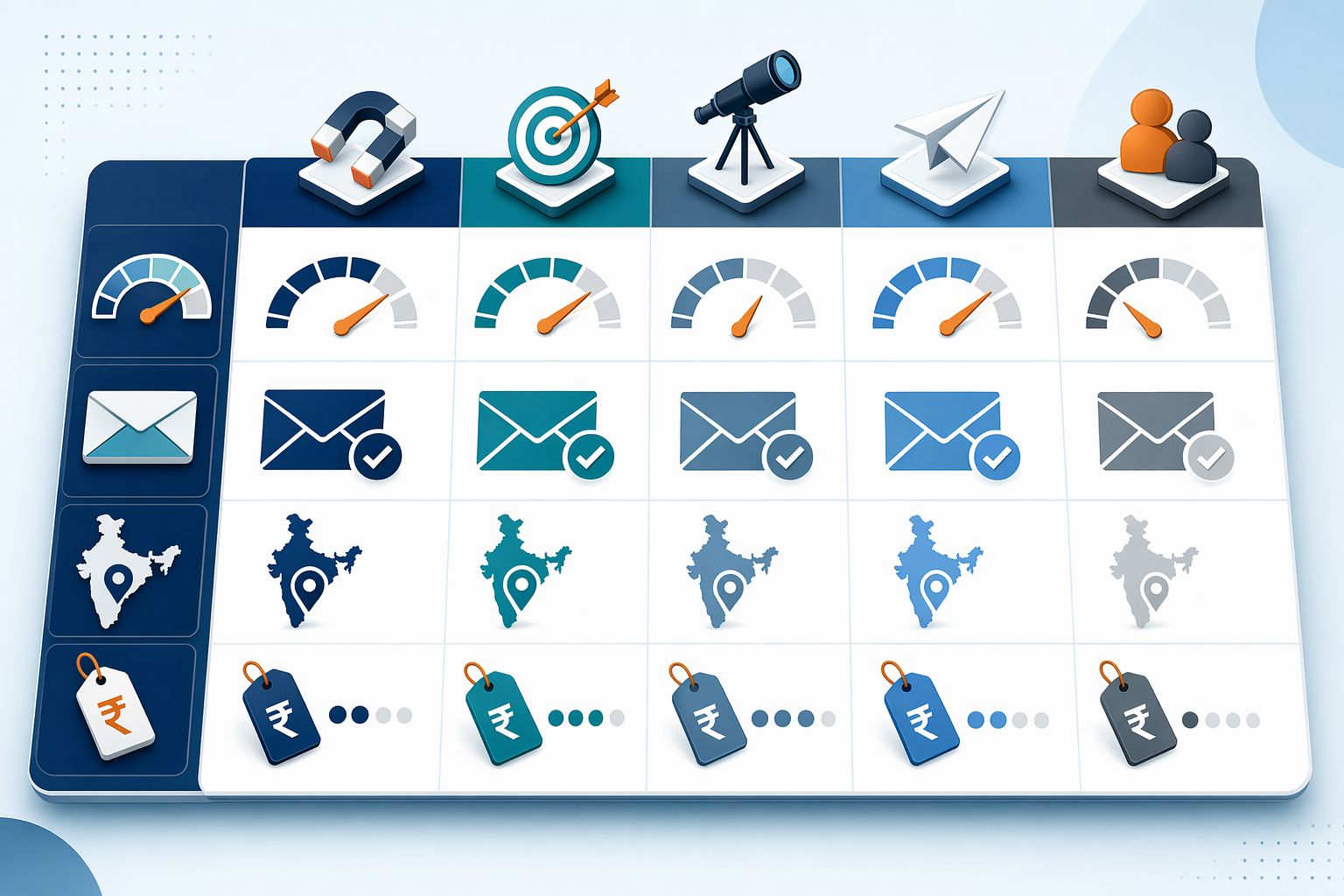
| Tool | Phone Accuracy (India) | Email Accuracy (India) | India Mobile Coverage | Refresh Cycle | Pricing Model |
|---|---|---|---|---|---|
| PeakAi | 91% | Not disclosed | 1600+ cities | 7-day refresh | Pay-per-contact from ₹675 for 50 |
| Lusha | Not disclosed | Not disclosed | Not disclosed | Real-time lookups | Free tier available |
| Cognism | Not disclosed | Not disclosed | Strong for EU; limited India data | Not disclosed | Contact for pricing |
| Apollo.io | Not disclosed | 70-80% | 15-20M contacts | Quarterly updates | Free tier (10,000 credits/year) |
| SalesQL | Not disclosed | Real-time verified | Millions of contacts globally | Real-time verification | Not publicly disclosed |
Reading the Table: What Each Column Reveals
Phone accuracy for Indian mobiles is a separate dimension from global phone accuracy because Indian professionals often register LinkedIn with personal numbers, and local number portability makes static databases stale faster. PeakAi reports 91% accuracy by cross-referencing GST and MCA databases in real time; Apollo does not disclose India-specific phone accuracy, though email accuracy drops to 70-80% in India versus 85-90% in the US.
Refresh cycle impacts accuracy directly: 7-day refresh cycles (PeakAi) catch job changes and number updates faster than quarterly updates (Apollo). Real-time verification (SalesQL) eliminates stale-data risk but depends on the underlying data-source breadth. Pricing models vary widely, pay-per-contact (PeakAi at ₹675 for 50 verified numbers) suits teams with variable prospecting volumes, while free tiers (Apollo's 10,000 credits/year) work for early-stage teams willing to accept lower India-market accuracy in exchange for zero cost.
India mobile coverage, the number of verified Indian business contacts a platform can deliver, differs from database size. Apollo lists 15-20M Indian contacts versus 100M+ in the US, reflecting thinner data sourcing in emerging markets. Tools that integrate India-specific business registries (GST, MCA) can close more deals by surfacing contacts global databases miss.
Tool capabilities matter only if they comply with LinkedIn's Terms of Service, enrichment-only platforms and direct-scraping tools face fundamentally different risk profiles.
Compliance-First Tools vs Direct-Scraping Platforms
Enrichment-Only Platforms and LinkedIn ToS Compliance
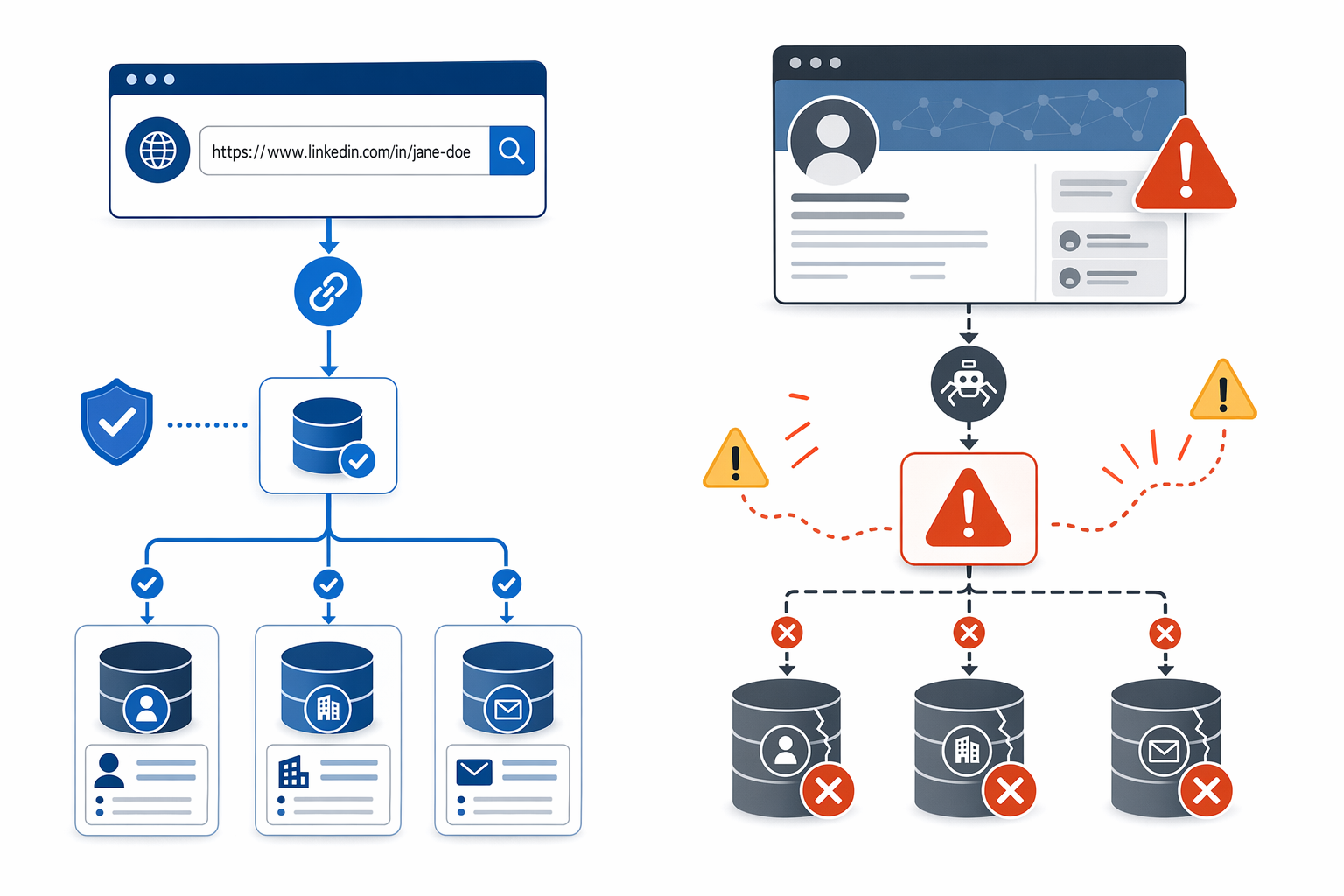
Enrichment-only platforms avoid LinkedIn Terms of Service violations by querying external databases rather than scraping LinkedIn profiles directly. PeakAi uses publicly shared LinkedIn URLs as search keys for independent third-party databases, never accessing LinkedIn's internal APIs or scraping profile data. This approach trades lower immediate match rates for long-term account safety. Tools like Apollo similarly rely on their own 275M-contact databases rather than crawling LinkedIn, while Lusha uses a Chrome extension with direct-dial reveal backed by external data sources.
Direct-Scraping Tools and Account Risk
Platforms that automate LinkedIn profile extraction face strict platform limits: LinkedIn restricts automation to approximately 30-40 daily actions, and exceeding this threshold triggers detection algorithms that can result in permanent account suspension. LinkedIn's 2024 enforcement actions against third-party scrapers shut down many workaround extensions. While scraping tools may offer higher short-term coverage, they expose users to compliance risk and potential loss of LinkedIn access, a critical channel for B2B prospecting where maintaining account standing is key to close more deals long-term.
Sales Navigator Integration and Third-Party Enrichment
LinkedIn Sales Navigator costs $100 per seat per month but provides advanced search filters without contact data exports. There is no native CSV export, forcing outbound teams toward hybrid workflows: Sales Navigator for profile discovery, enrichment tools for verified emails and phones. LeadIQ enables one-click LinkedIn-to-Salesforce/HubSpot push at $45/user/mo, while PeakAi delivers verified contacts in 10 seconds within the LinkedIn interface. This layered stack respects platform boundaries while enabling the contact export Sales Navigator deliberately restricts.
Compliance aside, pricing models determine whether verification accuracy translates into cost efficiency, pay-per-contact and subscription structures reward different usage patterns.
Pricing Models: Pay-Per-Contact vs Subscription Trade-Offs
Credit-Based Pricing and Match Rate Economics
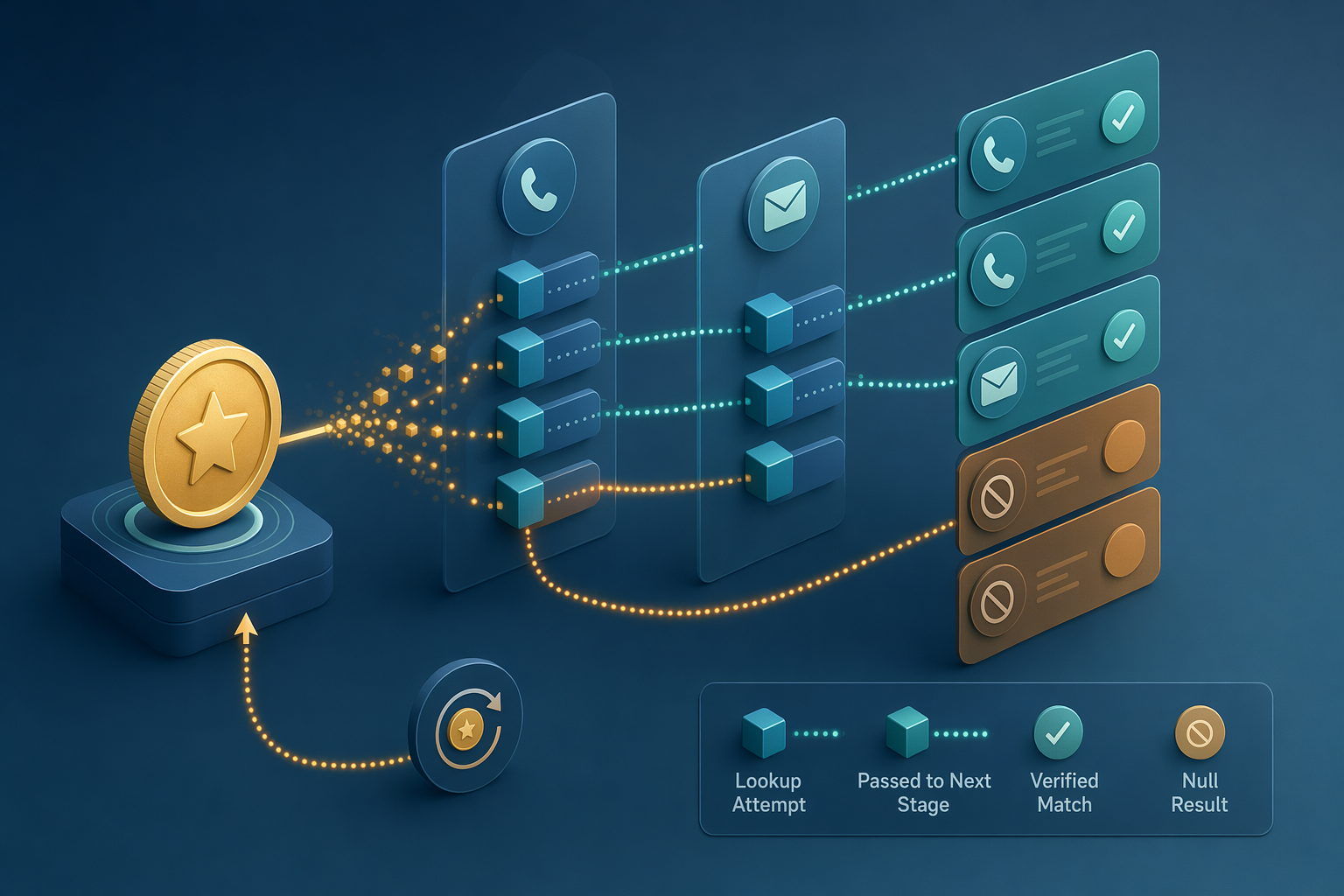
Pay-per-contact models charge for each lookup, but actual usable contact costs depend on verification success rates. Phone match rates typically fall between 50-65%, while email discovery succeeds 75-80% of the time. This means a ₹13.50 nominal cost per contact can balloon to ₹20-27 per verified phone when half your credits return null results. Refund guarantees matter here, PeakAi credits back wrong numbers flagged within 24 hours, reducing effective burn for teams that validate immediately.
Subscription vs Pay-Per-Verified Models
Fixed-subscription tools like Apollo.io (275M+ contacts) charge monthly regardless of match success, pushing low-volume users to overpay for unused credits. India-first alternatives offer shared credit pools billed in INR, letting teams scale spend with actual usage. PeakAi's pay-per-verified-number model starts at ₹675 for 50 contacts, no per-seat fees, no rollover waste, but higher per-unit costs can outweigh subscriptions once monthly volume crosses ~200 verified contacts.
Free-Tier Lookup Restrictions and Landline vs Mobile Guarantees
Free tiers cap monthly lookups (Kaspr: ~5/month; Lusha: 5 credits) and rarely guarantee mobile-only results, many return landlines mixed into trial data, limiting cold-calling usefulness. PeakAi validates phone types (mobile, landline, VoIP) before download, so trial users know whether a number supports SMS or WhatsApp outreach. For India-focused prospecting, this distinction matters: decision-makers rarely publish office landlines on LinkedIn, making mobile-guaranteed trials significantly more actionable than database tools that pad free-tier results with outdated switchboard numbers.
Rather than choosing a single tool, many teams combine LinkedIn Sales Navigator for profile discovery with enrichment platforms for verified contact data, creating a hybrid prospecting stack.
The Hybrid Stack Approach for Indian B2B Prospecting
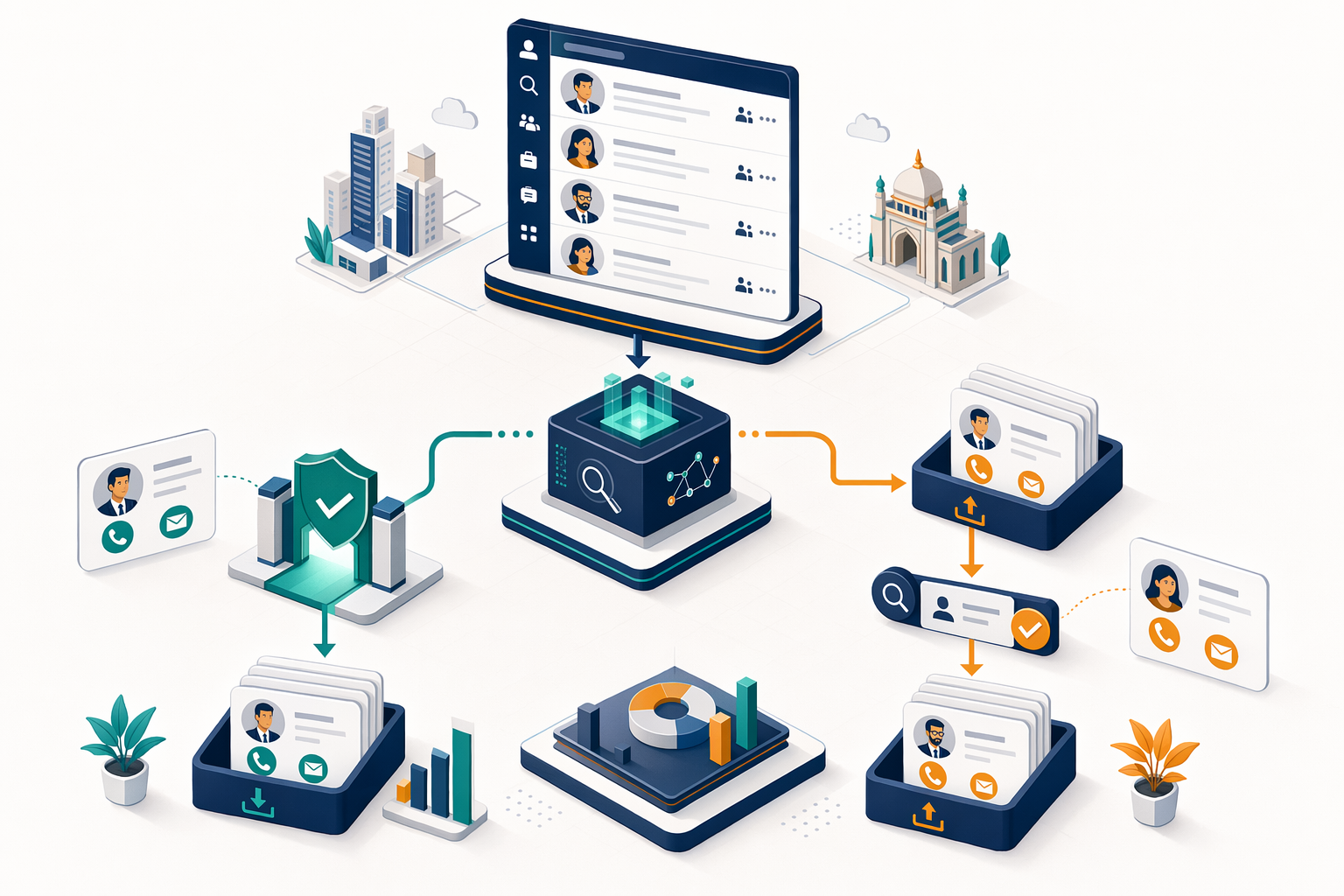
Sales Navigator finds profiles, but it doesn't deliver phone numbers or verified emails. That's why most teams pair it with a third-party enrichment tool, what we call a hybrid stack. The key question users rarely ask: *when* does the enrichment tool verify contact data? Some verify before you commit to a download (pre-purchase verification), while others verify after export (post-purchase verification). The timing determines whether you pay for unverified contacts or only for confirmed data.
Sales Navigator Profile Discovery + Third-Party Enrichment Workflow
Here's the four-step workflow that clarifies *when* verification happens:
- Use Sales Navigator filters to build your target list. Apply seniority, geography, company size, and industry filters to surface the right profiles.
- Export profile URLs. Most enrichment tools accept LinkedIn profile URLs or Sales Navigator CSV exports as input.
- Enrich with a third-party tool, and note the verification timing. Tools like PeakAi verify contact data *before download*, showing confidence indicators so you commit credits only to validated numbers. In contrast, subscription-based databases (Apollo, Lusha) verify *after export*, meaning you pay for the seat regardless of match rate.
- Validate and segment results. Tag contacts by confidence level, phone type (mobile vs. Landline), and DNC status before pushing to your CRM.
Pre-download verification protects your budget in markets where data accuracy is inconsistent, India being a prime example.
Recommended Stack Combinations by Team Size and Budget
Small team (1 to 3 SDRs, ₹10K, ₹15K/month budget): Sales Navigator Core (₹8,250/mo) + PeakAi pay-per-contact (₹675/50 contacts). Best for low-volume, high-accuracy needs. PeakAi's pros: refund guarantee on unverified contacts, 91% phone accuracy for Indian B2B. Cons: higher per-contact cost (₹13.50) than bulk subscriptions, no built-in outreach layer.
Mid-market (5 to 15 SDRs, $1,500, $3,000/month budget): Sales Navigator Advanced ($149/seat/mo) + Apollo ($49/seat/mo). Apollo combines database breadth (275M+ contacts) with built-in sequencing, though phone accuracy in India runs 70 to 80% vs. 85 to 90% in the US.
Enterprise (20+ SDRs, $5K+/month budget): Cognism (custom, ~$15K platform + $1.5K/seat) for EU/EMEA coverage, or pair Sales Navigator Advanced with a managed-service data provider when compliance and scale matter more than per-contact cost.
Join thousands of sales professionals who find accurate contact information using hybrid stacks tailored to their market and budget, whether you're prospecting in Mumbai or Manila.
Conclusion
Pay-per-verified models like PeakAi's credit refund system cost more per contact but eliminate waste from failed matches, subscription tools like Apollo and Lusha suit high-volume teams willing to absorb 35-50% phone match failure rates in India markets. Real-time verification tools with 7-day refresh cycles maintain 98% accuracy but cover fewer total profiles than static databases with 275M+ contacts, choose based on whether you prioritize contact freshness or breadth of initial discovery.
As LinkedIn accelerates profile verification in India, expect phone number visibility to improve for verified users, but Western-optimized databases will still lag regional data layers like GST and MCA that India-focused tools integrate natively. The verification architecture gap will widen between enrichment-only platforms and direct-scraping tools as LinkedIn tightens automation detection.
Audit your current tool's India phone accuracy by running a 50-contact test with PeakAi's pay-per-verified model, compare match rates and refund claims against your subscription tool's performance to quantify the real cost-per-usable-contact gap.
Frequently Asked Questions
What is the most accurate LinkedIn prospecting tool for finding mobile numbers in India?
PeakAi reports 91% accuracy for Indian mobile numbers by integrating GST and MCA databases with 7-day refresh cycles. Apollo and Lusha deliver 65-80% email accuracy and 82% US phone accuracy, but perform worse in India where local number portability and job mobility cause faster contact decay.
Can I use LinkedIn automation tools without risking account suspension?
Enrichment-only tools like PeakAi and Lusha query external databases using LinkedIn profile URLs and never scrape LinkedIn content. Direct-scraping tools violate LinkedIn Terms of Service by automating profile visits and connection requests, LinkedIn restricts automation to 30-40 daily actions, and exceeding this triggers detection algorithms.
Why do global tools like Apollo and Lusha have lower accuracy in India?
Global tools deliver 85-90% accuracy in the US but drop to 65-75% in India because Western-optimized databases lack regional verification layers like GST and MCA intelligence. LinkedIn's privacy architecture hides 90-95% of phone numbers, creating visibility gaps that regional data layers help close through third-party validation.
Is pay-per-contact pricing cheaper than subscription for LinkedIn prospecting tools?
Pay-per-contact models charge for each lookup, but actual cost depends on verification success rates, phone match rates fall between 50-65% while email discovery succeeds 75-80%. Pay-per-verified models can be cheaper for low-volume users, while subscriptions suit high-volume teams absorbing match failures.
Do I need LinkedIn Sales Navigator plus a separate enrichment tool?
Yes, Sales Navigator costs $100 per seat monthly and provides advanced search filters without contact data exports. There is no native CSV export, forcing hybrid workflows: Sales Navigator for profile discovery, enrichment tools like PeakAi or Apollo for verified emails and phone numbers.
How often should contact data be refreshed for Indian B2B prospects?
Contact data degrades 2-3% monthly in Indian markets; tools with 7-day refresh cycles maintain 98% accuracy versus 75% for slower cycles. Job mobility in India's startup and SMB sectors drives faster phone number turnover than Western markets where professionals retain corporate numbers across jobs.
What is the difference between email accuracy and phone accuracy for LinkedIn tools?
Aggregated '95% accuracy' claims hide the email versus phone split, phone accuracy in India runs 50-65% for many tools while email accuracy reaches 75-80%. Conflating both into a single metric masks the phone verification gap that determines real credit efficiency for cold-calling workflows.
Sources
- Best LinkedIn Prospecting Tools for India & Emerging Markets 2026 - www.linkedbreaker.com (2026)
- SalesQL - salesql.com
- Top 10 Sales Prospecting Tools in India: A 2026 Guide - Manyreach - www.manyreach.com (2025)
- 10 LinkedIn Sales Navigator Alternatives for Prospecting (2026) - www.hansdekker.ai (2026)
- Best LinkedIn Sales Navigator Alternatives 2026 | Typpout - www.typpout.com (2026)
- Sales Navigator Alternatives 2026: 6 Tools That Export Leads - modernleads.io (2026)
- B2B Contact Database India — EazyReach | Verified Emails & Phones - eazyreach.app
- Best Contact Finding Tools for B2B Sales Teams in 2026 - lagrowthmachine.com (2026)
- Top 10 Kaspr Alternatives for LinkedIn Prospecting - derrick-app.com (2026)
