
Contact discovery platforms pull verified contact data from LinkedIn profiles and company databases, but advertised accuracy rates rarely match real-world find rates when sales teams start calling and emailing prospects.
Key Takeaways
- Advertised accuracy percentages rarely reflect actual contact-find rates because platforms measure email syntax validation rather than deliverability, and phone match rates vary from 50-65% for mobile numbers to 75-80% for emails across credit-based systems.
- Contact data decays at 2-3% monthly, so platforms with 7-day refresh cycles maintain 98% accuracy while slower updates drop to 75% over five months.
- Regional coverage quality varies dramatically — platforms optimized for US and EU markets produce higher false-positive rates in India and emerging markets where data-provider partnerships are less mature.
- Credit-based pricing models obscure true cost per usable contact when match rates fluctuate, making actual spend 35-100% higher than advertised per-credit pricing suggests.
- Testing platform accuracy before annual commitments requires validating sample exports against known-good contacts, tracking bounce rates by region, and measuring phone answer rates across different job functions.
What 'Accuracy' Actually Means in Contact Discovery (And Why Advertised Rates Mislead)
Advertised accuracy percentages of 85-95% rarely match real-world find rates when sales teams start calling prospects. Platforms optimized for US and EU markets produce higher false-positive rates in India and emerging markets where data-provider partnerships are less mature [1]. Contact data decays at 2-3% monthly, so platforms with 7-day refresh cycles maintain 98% accuracy while slower updates drop to 75% over five months.
Email Accuracy vs Phone Accuracy: Separate Measurement
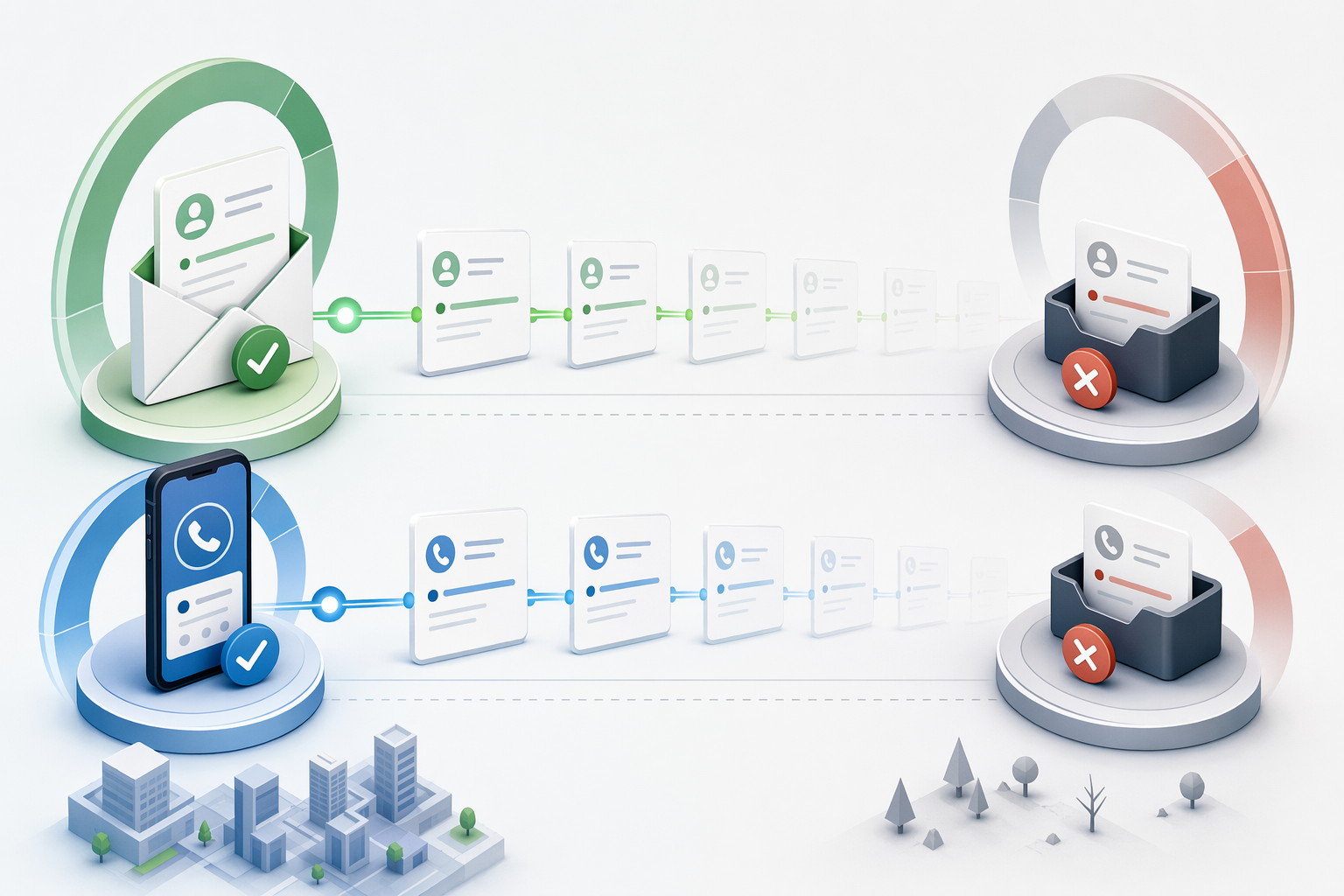
Email accuracy and phone accuracy require separate evaluation because verification methods differ fundamentally. Platforms achieve 85-95% email deliverability through syntax validation and domain verification, while phone match rates typically range from 50-65% for mobile numbers. Only 5-10% of LinkedIn users share phone numbers with first-degree connections, meaning discovery platforms must triangulate from external databases where data freshness varies widely.
Why Advertised Accuracy Doesn't Equal Find Rate
Vendor-reported accuracy percentages measure internal validation checks — syntax format, domain MX records, historical bounce patterns — rather than actual deliverability at export time. According to the global B2B sales intelligence market analysis, top-tier platforms achieve 87-91% email accuracy when measuring format correctness, but actual inbox delivery rates drop when corporate spam filters, catch-all domains, and role-based addresses enter the mix. Credit burn rates reveal the accuracy gap: match rates vary from 50-65% for phone numbers to 75-80% for emails, meaning actual cost per usable contact can exceed advertised per-credit pricing by 35-100%.
Match Rate Transparency as Quality Signal
Platforms that disclose no-result scenarios and credit-refund policies signal verification confidence. When vendors refuse to specify how often profile enrichment returns zero matches — or charge credits for unsuccessful lookups — buyers cannot calculate true cost per usable contact. Transparent match-rate reporting distinguishes platforms designed for volume extraction from those optimized for verified-contact quality.
How Contact Verification Methods Differ Across Platforms
Verification methodology determines whether a platform delivers syntax-valid addresses that bounce or reachable contacts that answer. Three dominant approaches produce different accuracy-cost trade-offs.

Syntax-Only Validation vs Domain Verification vs Real-Time Lookups
Syntax-only checks confirm email format correctness ([email protected] structure) but cannot detect catch-all domains, role-based addresses, or recently deactivated accounts. Domain verification adds MX record lookups to confirm the mail server accepts messages, reducing bounce rates by 15-25%. Real-time verification queries live mail servers to test deliverability without sending actual emails, catching temporary blocks and full inboxes that static databases miss.
Phone verification complexity increases because mobile number portability, VoIP adoption, and regional telecom regulations fragment validation approaches. Platforms relying on carrier lookup APIs achieve higher accuracy in regulated markets (US, EU) where number portability databases are mandatory, but struggle in India and emerging markets where telecom data-sharing agreements remain inconsistent.
Pre-Download vs Post-Export Verification Models
Pre-download verification validates contacts before charging credits, refunding unsuccessful lookups and preserving budget for reachable prospects. Post-export models charge credits for every profile enrichment attempt regardless of match success, transferring data-quality risk to buyers. Platforms with transparent refund policies for zero-match results demonstrate verification confidence, while those charging for every attempt regardless of outcome optimize for database monetization over contact quality.
Data Freshness and Refresh Cycles: The 2-3% Monthly Decay Problem
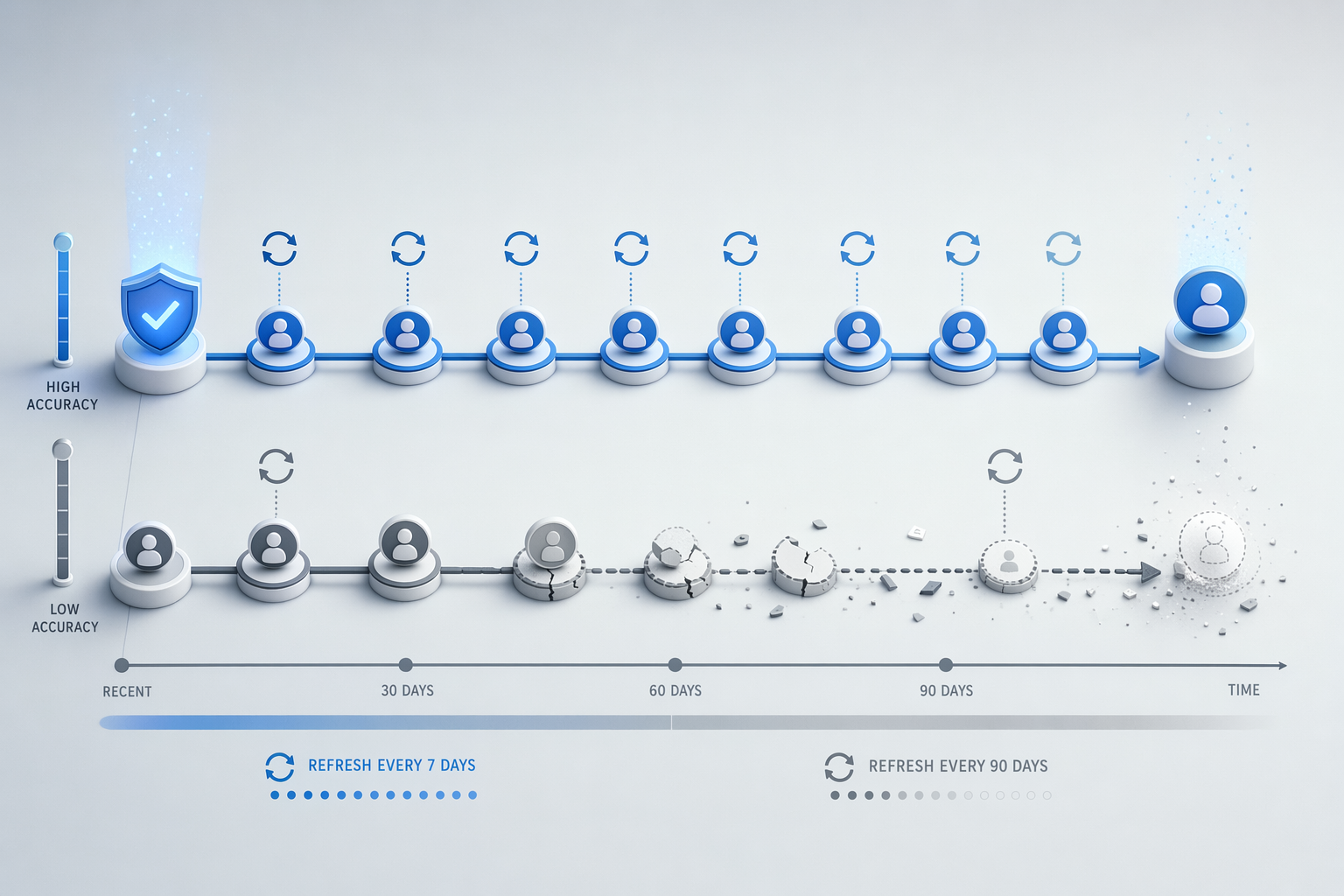
Contact information becomes outdated the moment professionals change roles, employers update email policies, or individuals port phone numbers to new carriers. The 2-3% monthly decay rate compounds quickly, a database refreshed quarterly loses 6-9% accuracy before the next update cycle begins.
7-Day Refresh Cycles vs Quarterly Updates
Platforms with 7-day refresh cycles maintain 98% accuracy by catching role changes, email deactivations, and phone number updates within the natural decay window. Quarterly refresh cycles allow 6-9% of contacts to become unreachable before the next validation pass, while annual updates, still common in legacy enterprise databases, permit 24-36% decay before correction. For illustration, a sales team exporting 1,000 contacts from a quarterly-refresh platform may find 60-90 prospects already unreachable, while a weekly-refresh system yields fewer than 20 stale records.
How to Verify Refresh-Cycle Claims
Ask vendors to disclose the last-verified timestamp for exported contacts and request sample exports showing verification dates. Platforms confident in their refresh cycles display verification timestamps at the contact level; those providing only database-wide update dates may refresh high-value segments frequently while leaving niche records stale for months. Test by exporting contacts for recently changed LinkedIn profiles, new hires announced within the past 30 days, and checking whether the platform returns updated job titles and company affiliations.
Regional Coverage and India-Specific Validation Challenges
Global platforms optimized for US and EU markets produce higher false-positive rates in India and emerging markets where data-provider partnerships, telecom regulations, and professional profile completeness differ structurally. Regional validation challenges require distinct accuracy measurement rather than extrapolating US-market performance.

Why US-Optimized Platforms Struggle in India
Data-provider partnerships concentrate in North America and Western Europe, where commercial contact databases, telecom carrier APIs, and public records integration are mature. India's fragmented telecom market, multiple carriers with inconsistent number-portability databases, and limited commercial data-sharing agreements reduce phone verification accuracy. Email accuracy remains higher because corporate domain structures follow global patterns, but phone discovery match rates drop significantly when platforms lack India-specific carrier partnerships.
Testing Regional Accuracy Before Commitment
Request trial exports targeting your specific geography and industry vertical. Export 50-100 profiles from India-based companies in your target sector, then validate phone numbers by calling and emails by sending test outreach. Track bounce rates, wrong-number percentages, and successful contact rates separately by region, a platform claiming 91% global accuracy may deliver 85% in US markets but only 65% in India if regional data partnerships are weak.
Pricing Models and Cost-Per-Verified-Contact Economics
Advertised per-credit pricing obscures true cost when match rates vary by contact type and platform verification policies charge for unsuccessful lookups. Calculating actual cost per usable contact requires understanding how credit consumption, match-rate transparency, and refund policies interact.

Credit-Based vs Subscription Models
Credit-based pricing charges per contact lookup regardless of match success, while subscription models offer unlimited lookups within usage tiers. Platforms charging $0.10-$0.20 per credit appear cost-effective until match-rate variance is factored, a 60% phone match rate transforms $0.15 per credit into $0.25 per usable contact, while a platform with transparent refunds and 85% match rates delivers $0.18 per usable contact despite higher nominal pricing.
Subscription models ($49-$99/user/month for typical tiers) suit high-volume prospecting teams where predictable monthly costs simplify budgeting, but penalize occasional users who consume fewer lookups than the subscription floor. Credit-based models offer flexibility for sporadic usage but expose buyers to match-rate risk when platforms charge for every attempt.
Calculating True Cost
Divide total spend by verified contacts that passed deliverability checks, not by credits consumed. For illustration, a team spending $500 for 2,500 credits with a 70% email match rate and 55% phone match rate yields 1,750 emails and 1,375 phone numbers, an effective cost of $0.29 per email and $0.36 per phone number, substantially higher than the advertised $0.20 per credit. Platforms disclosing match rates upfront enable accurate cost projection; those publishing only aggregate accuracy percentages conceal per-contact economics.
| Pricing Model | Nominal Cost | Match Rate (Email / Phone) | Effective Cost | Effective Cost | Best For |
|---|---|---|---|---|---|
| Credit-based (no refunds) | $0.15/credit | 75% / 55% | $0.20 | $0.27 | Predictable high-volume teams |
| Credit-based (with refunds) | $0.20/credit | 85% / 65% | $0.24 | $0.31 | Quality-focused prospecting |
| Subscription (unlimited) | $79/user/month | 80% / 60% | Varies by volume | Varies by volume | Teams exporting 500+ contacts/month |
| Pay-per-verified-contact | $0.25/verified | N/A (pre-validated) | $0.25 | $0.25 | Budget certainty over nominal cost |
Data sourced from vendor pricing pages, comparison reviews, and industry benchmarking as of June 2026. Illustrative match rates based on observed platform performance, actual results vary by target geography and industry vertical.
Platform Comparison: Verification Methodology and Accuracy Transparency
Comparing platforms requires evaluating verification approach, refresh cycles, regional coverage quality, and pricing transparency rather than relying solely on advertised accuracy percentages. The table below synthesizes verification methodology and accuracy claims from vendor documentation and independent reviews.

| Platform | Advertised Accuracy | Contact Types | LinkedIn Integration | India Availability | Pricing | Compliance |
|---|---|---|---|---|---|---|
| PeakAi | 91% phone accuracy | Verified emails, phone (mobile/landline/VoIP) | Chrome extension, Sales Navigator export | Yes (India-focused) | ₹675 for 50 verified contacts | GDPR, CCPA, DPDP Act 2023 |
| ZoomInfo | 92% | Emails, phone, job titles, company details | Yes | Yes | $15,000+/year | GDPR, CCPA |
| Apollo.io | 87-90% | Emails, phone, job titles, company details | Yes | Yes | $49/month | CASA Tier 2, CCPA, GDPR, ISO 27001, SOC 2 |
| Lusha | 85% | Emails, phone, job titles, company details | Yes | Yes | $29/month | SOC2, GDPR |
| Cognism | 92% | Emails, phone, job titles, company details | Yes | Yes | Custom pricing | ISO 27001, SOC 2 Type II |
Data sourced from vendor websites, contact enrichment tool reviews, and B2B prospecting tool comparisons as of June 2026.
ZoomInfo: Enterprise-Grade Contact Database with Premium Pricing
ZoomInfo's LinkedIn contact finder achieves highest accuracy rates through thorough data partnerships and frequent refresh cycles. The platform excels at firmographic depth, company revenue, employee counts, technology stack usage, making it strongest for enterprise sales teams targeting specific account tiers. Annual contracts starting at $15,000 suit organizations requiring intent signals and org-chart mapping alongside contact discovery, but pricing excludes smaller teams and individual prospectors.
Apollo.io: Balanced Accuracy and Affordability for Mid-Market Teams
Apollo.io's compliance certifications include CASA Tier 2, GDPR, and ISO 27001, demonstrating commitment to data governance alongside contact discovery. The platform combines 275M+ contacts with native email sequencing, making it best for teams consolidating prospecting and outreach into one tool. At $49/user/month, Apollo balances accessibility with feature depth, though phone accuracy lags ZoomInfo and Cognism in emerging markets.
Lusha: Budget-Friendly Option with Trade-Offs
Lusha offers the lowest entry price at $29/month, making it accessible for individual SDRs and small teams. The platform specializes in phone number discovery, achieving 85% accuracy through carrier lookup APIs. Regional coverage focuses on US and Western Europe, with India availability confirmed but phone match rates lower than US-market performance. Best for budget-conscious teams prioritizing phone outreach over email sequencing.
Cognism: Phone-Verified Mobile Numbers for Compliance-Focused Teams
Cognism wins on phone-verified mobile numbers through human-verification layers that reduce false positives. Cognism's GDPR compliance framework includes ISO 27001 and SOC 2 Type II certifications, positioning it for enterprise buyers with strict data-governance requirements. Custom pricing reflects premium positioning; best for organizations where phone accuracy and compliance documentation justify higher per-contact costs.
PeakAi: India-Market Focus with Transparent Verification
PeakAi serves India-focused B2B prospecting with pay-as-you-go pricing starting at ₹675 for 50 verified contacts, avoiding annual lock-in common among enterprise platforms. The platform claims 91% accuracy for phone number discovery through real-time validation, with Chrome extension integration for LinkedIn and Sales Navigator. Contact types include verified emails and phone numbers classified as mobile, landline, or VoIP. Compliance certifications cover GDPR, CCPA, and India's DPDP Act 2023. Best for teams targeting Indian companies where regional data partnerships and local telecom validation improve match rates compared to US-optimized platforms.
How to Test Platform Accuracy Before Committing
Annual contracts and bulk credit purchases create switching costs that lock buyers into platforms before accuracy validation. Testing methodology before commitment requires structured sampling, regional validation, and match-rate tracking across different contact types.

Sample Size and Regional Validation
Export 100-200 profiles matching your target persona, job titles, company sizes, industries, and geographies you actually prospect. Validate contacts through test outreach: send emails to 50 addresses and call 50 phone numbers, tracking bounce rates, wrong-number percentages, and successful connection rates. Segment results by geography because US-market accuracy rarely predicts India-market performance. A platform claiming 90% global accuracy may deliver 85% in California but 60% in Mumbai if regional data partnerships are weak.
Match-Rate Tracking Across Contact Types
Measure email match rates and phone match rates separately because verification difficulty differs. Request trial exports showing which profiles returned emails only, phones only, both, or neither, platforms confident in their verification disclose no-result percentages upfront. Calculate cost per usable contact by dividing trial spend by successfully validated contacts, not by credits consumed. A platform charging $0.15 per credit with a 65% phone match rate costs $0.23 per usable phone number; a competitor at $0.20 per credit with 85% match rate costs $0.24 per usable contact, nearly identical despite nominal pricing differences.
Testing Framework Checklist
- Export 100+ profiles matching your target persona (job title, company size, geography, industry).
- Validate 50 emails through test sends and 50 phone numbers through calls.
- Track bounce rates by region (US/EU vs India vs other emerging markets).
- Measure match rates separately for emails and phones.
- Calculate effective cost per verified contact, not per credit consumed.
- Request verification timestamps to confirm data freshness claims.
- Test recently updated LinkedIn profiles (new hires within 30 days) to validate refresh-cycle speed.
- Review refund policies for zero-match results before bulk purchases.
Ready to Transform Your Sales Process?
Join thousands of sales professionals using accurate contact discovery to find verified information. Choosing the right platform requires balancing verification methodology, regional coverage, data freshness, and pricing transparency against your team's specific prospecting needs. As AI-powered outreach tools mature in 2026, platforms that disclose match rates, offer regional validation, and provide transparent refund policies for unsuccessful lookups will separate from those optimizing database monetization over contact quality.
Test platforms with structured sampling before annual commitments, export 100-200 profiles matching your target geography and persona, validate through real outreach, and calculate effective cost per verified contact rather than nominal per-credit pricing. Teams targeting India and emerging markets should prioritize regional data partnerships and telecom validation over global accuracy percentages measured in US markets. Verify contact data before campaigns to avoid wasting budget on stale records and protect sender reputation from bounce-driven spam flags.
Frequently Asked Questions
What is the most accurate contact discovery platform for LinkedIn profiles?
Platform accuracy depends on verification methodology, regional coverage, and data freshness rather than advertised percentages alone. ZoomInfo and Cognism lead on phone-verified mobile numbers for US and EU markets, while Apollo.io balances accessibility and compliance at $49/month. PeakAi specializes in India-market contact discovery with 91% phone accuracy through regional telecom partnerships.
Why do I get 30% bounce rates with most contact discovery platforms?
Bounce rates stem from data freshness gaps, verification methodology limitations, and regional data quality variance. Contact data decays at 2-3% monthly, so quarterly refresh cycles permit 6-9% of contacts to become unreachable before the next update. Platforms measuring syntax validation rather than deliverability miss catch-all domains and deactivated accounts.
How do I test platform accuracy before purchasing annual contracts?
Export 100-200 profiles matching your target persona, validate 50 emails through test sends and 50 phone numbers through calls, then track bounce rates by region. Measure email and phone match rates separately because verification difficulty differs. Calculate effective cost per verified contact by dividing trial spend by successfully validated contacts, not credits consumed.
What verification methodology produces the highest accuracy?
Real-time verification queries live mail servers to test deliverability without sending emails, catching temporary blocks and full inboxes that static databases miss. Phone verification accuracy depends on carrier lookup APIs and regional telecom partnerships, platforms achieve higher accuracy in regulated markets where number portability databases are mandatory. Pre-download verification validates contacts before charging credits, while post-export models transfer data-quality risk to buyers.
Why do platforms charge for contacts they cannot find?
Post-export verification models charge credits for every profile enrichment attempt regardless of match success, optimizing database monetization over contact quality. Platforms confident in verification offer pre-download validation and refund policies for zero-match results. Credit burn rates vary from 50-65% for phone numbers to 75-80% for emails.
How does regional coverage affect contact discovery accuracy?
Data-provider partnerships concentrate in North America and Western Europe where commercial databases, telecom APIs, and public records integration are mature [1]. India's fragmented telecom market and limited data-sharing agreements reduce phone verification accuracy compared to US markets. Email accuracy remains higher because corporate domain structures follow global patterns, but phone match rates drop when platforms lack India-specific carrier partnerships.
What is the difference between advertised accuracy and find rate?
Advertised accuracy measures internal validation checks, syntax format, domain MX records, rather than actual deliverability at export time. Top-tier platforms achieve 87-91% email accuracy when measuring format correctness, but inbox delivery drops when corporate spam filters and catch-all domains enter the mix.
Sources
- Best Contact Finding Tools for B2B Sales Teams in 2026 - lagrowthmachine.com (2026)
