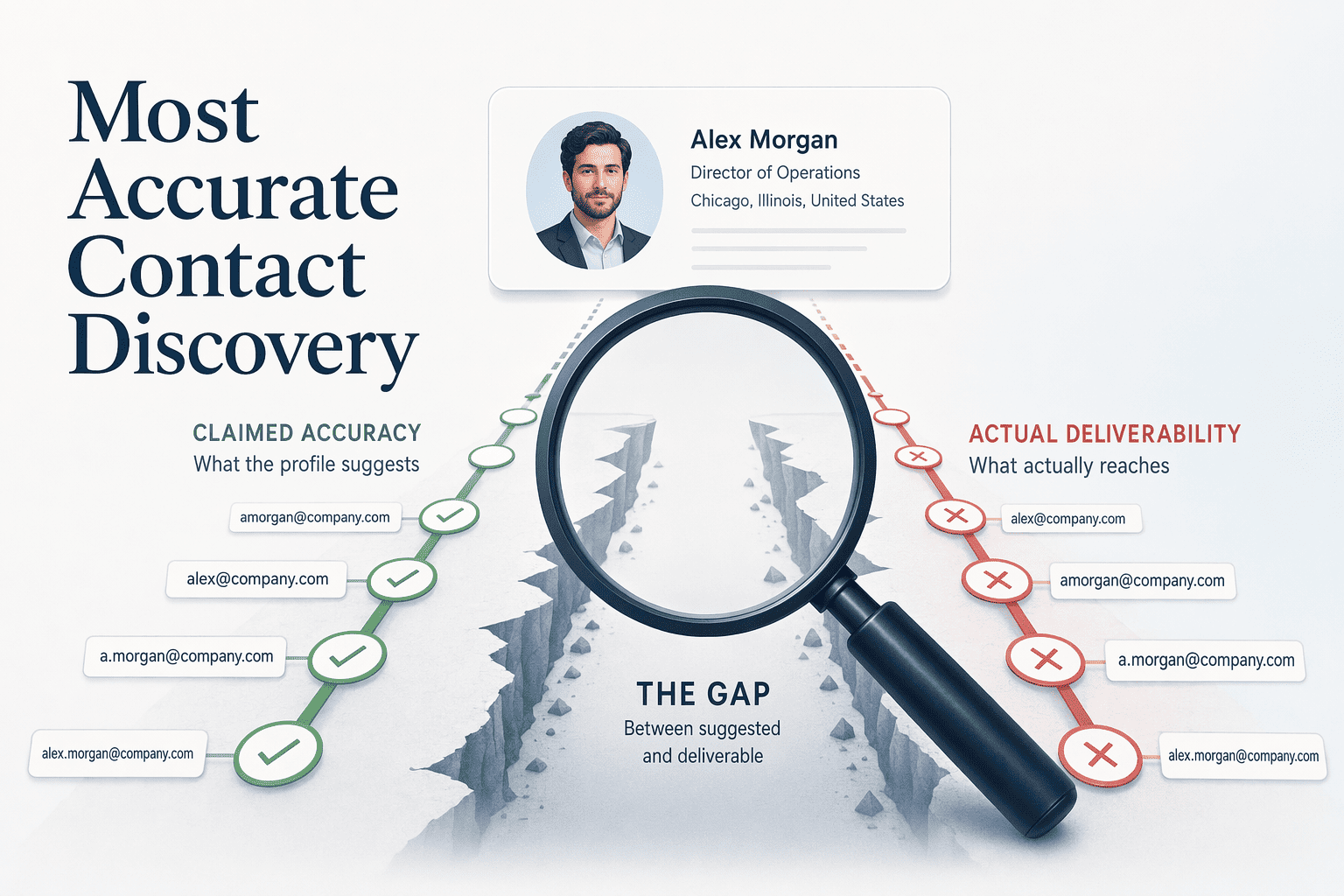
Contact discovery platforms promise 95% email accuracy, yet real-world deliverability often hovers near 50%. The gap stems from verification timing—whether platforms validate data quality before or after charging credits.
Key Takeaways
- Pre-download verification platforms deliver 85–91% deliverability by showing confidence indicators before credit commitment, outperforming post-export enrichment models that average 50% real-world match rates
- Vendors often measure email format correctness (syntax validation) rather than actual deliverability, creating a 45-point gap between advertised accuracy and inbox acceptance
- Contact data decays at 2–3% monthly as professionals change jobs and abandon mailboxes, making real-time verification critical over static database lookups
- Enrichment-based tools query third-party databases (compliant but lower coverage), while scraping-based tools crawl LinkedIn directly (broader coverage but 15–20% account suspension risk)
- Global platforms optimized for US/EU markets test 10–15 percentage points lower in India due to mobile verification infrastructure and carrier API availability gaps
Why Contact Discovery Accuracy Claims Don't Match Reality
Pre-download verification platforms delivering 85–91% deliverability consistently outperform post-export enrichment models that show 50% real-world match rates in independent testing because verification timing determines who absorbs data quality risk. Tools that verify contact data *before* you download it eliminate unusable records at the vendor's expense; platforms that enrich exported lists shift that risk to you, counting syntax-valid emails that bounce or phones that never connect as "accurate" in their advertised rates. This gap between vendor claims (often 95 to 98%) and actual connectivity creates a 40 to 50 percentage-point deliverability shortfall that most sales teams discover only after campaigns launch.

The Syntax Validation vs Deliverability Conflation
When vendors advertise 95% email accuracy, they typically measure format correctness, whether `[email protected]` follows RFC 5322 standards, not whether that mailbox accepts messages. A syntactically perfect email can fail deliverability checks (abandoned mailbox, full inbox, catch-all domain flagged as risky) yet still count as "accurate" in the vendor's published rate. Phone numbers face identical distortion: a ten-digit string matching North American numbering plans registers as valid even when the line disconnects three months ago or routes to a shared reception desk instead of the named contact. Buyers need actual connectivity, can I reach this person? but advertised accuracy percentages measure data structure, creating a definitional mismatch that hides the 50% real-world gap until your bounce rate spikes.
Most contact discovery tool comparisons organize reviews by brand features, database size, Chrome extension speed, CRM integrations, rather than verification workflow timing, which explains why teams reading those listicles still encounter the accuracy-deliverability gap after purchase.
Data Decay and the 2 to 3% Monthly Freshness Problem
Contact databases lose accuracy at a measurable rate as professionals change employers, update contact preferences, or abandon mailboxes. Data decay, the gradual loss of completeness in B2B records, erodes static contact files by approximately 2 to 3% monthly through normal business change: job transitions, domain migrations, and phone line reassignments that vendors using pre-compiled databases cannot detect until the next refresh cycle. A contact downloaded six months ago has weathered twelve to eighteen percentage points of decay before your outreach sequence even starts, compounding the baseline gap between advertised and delivered accuracy.
Real-time verification platforms mitigate decay by querying live data sources at the moment you request a contact, checking current employment, active mailbox status, and phone connectivity before the record enters your CRM. Post-export enrichment models enrich your exported LinkedIn list against databases that may be weeks or months stale, inheriting accumulated decay and pushing verification risk onto your team to discover through bounce tracking and manual cleanup.
The 5 to 10% LinkedIn Phone Number Availability Gap
LinkedIn's platform design creates structural data scarcity independent of vendor accuracy: only a small minority of users, typically 5 to 10% of first-degree connections, choose to display phone numbers on their profiles, and even fewer expose them to second- or third-degree connections. Security policies further restrict numbers used for two-factor authentication from appearing publicly. Tools that source contact data exclusively from LinkedIn's visible profile fields cannot overcome this availability ceiling; they return phone numbers for the narrow slice of users who opted to share them, leaving 90 to 95% of prospects unreachable by phone regardless of the vendor's verification accuracy. Platforms addressing this gap query independent business databases, public records, and third-party data partners rather than relying on LinkedIn's user-controlled visibility settings, which explains why verification timing and data sourcing architecture, not advertised accuracy percentages, determine whether you close more deals or burn through contact credits on unusable records.
Understanding why accuracy claims diverge from real-world results requires examining when platforms verify contact quality, before or after you commit credits.
Verification Timing: Pre-Download vs Post-Export Models
Contact discovery platforms differ fundamentally in when they verify contact data and when they charge credits.
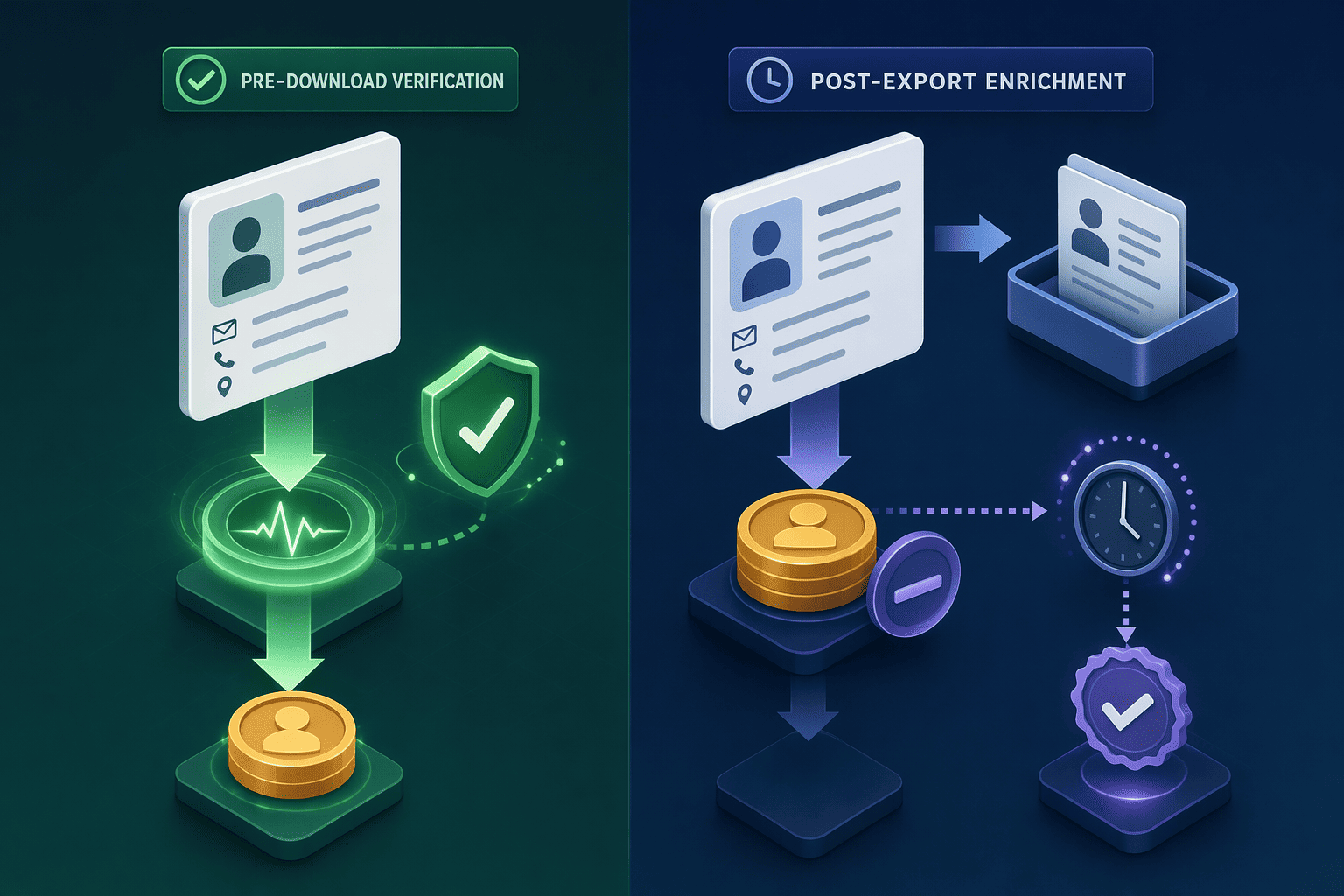
Pre-download verification models (PeakAi, Kaspr) display match confidence and deliverability status before the user commits a credit. Post-export enrichment models (Apollo, ZoomInfo) charge credits upfront and enrich after export, regardless of whether the returned contact is valid.
Pre-Download Verification Workflow (Confidence Indicators Before Payment)
Platforms that verify before download show syntax, domain, and deliverability checks within the LinkedIn profile tab before the user decides whether to commit the credit.
PeakAi displays verification status within the LinkedIn tab and charges only when verification confidence is high.
This workflow lets sales teams reject low-confidence matches before spending credits, keeping cost-per-usable-contact aligned with advertised per-credit pricing.
Kaspr and Lusha follow similar patterns, providing instant emails and phone numbers directly from a LinkedIn profile with GDPR coverage for European markets.
Post-Export Enrichment Models (Credit Deduction Regardless of Match Quality)
Apollo, ZoomInfo, and similar platforms charge credits when the user exports a lead list, then enrich contacts after export.
Credits are deducted whether the returned email bounces, the phone number is a generic switchboard, or the contact is unreachable.
Apollo offers volume, 275M+ contacts, but no pre-download confidence indicators. ZoomInfo is best for enterprise teams with $15K+/year budgets that need verified phone data and intent signals.
The quality risk shifts to the buyer: you pay for every credit consumed, not every usable contact delivered.
Cost-Per-Usable-Contact: The Hidden 35-100% Premium
Advertised per-credit pricing obscures true cost when match rates fluctuate.
A platform charging $0.50 per credit with a 60% valid-match rate delivers an actual cost-per-usable-contact of $0.83, a 66% premium over the advertised rate.
Teams sourcing 2,500+ contacts per quarter can see actual spend increase 35-100% above vendor projections when match rates drop below advertised benchmarks.
Pre-download verification platforms sidestep this problem by charging only for high-confidence matches, keeping cost-per-usable-contact stable regardless of database coverage fluctuations.
Read more about verification methodology before purchase.
Verification timing determines who absorbs data quality risk, but the underlying data sourcing method, enrichment versus scraping, shapes both accuracy ceilings and compliance exposure.
Data Sourcing Methods: Enrichment vs Direct Scraping
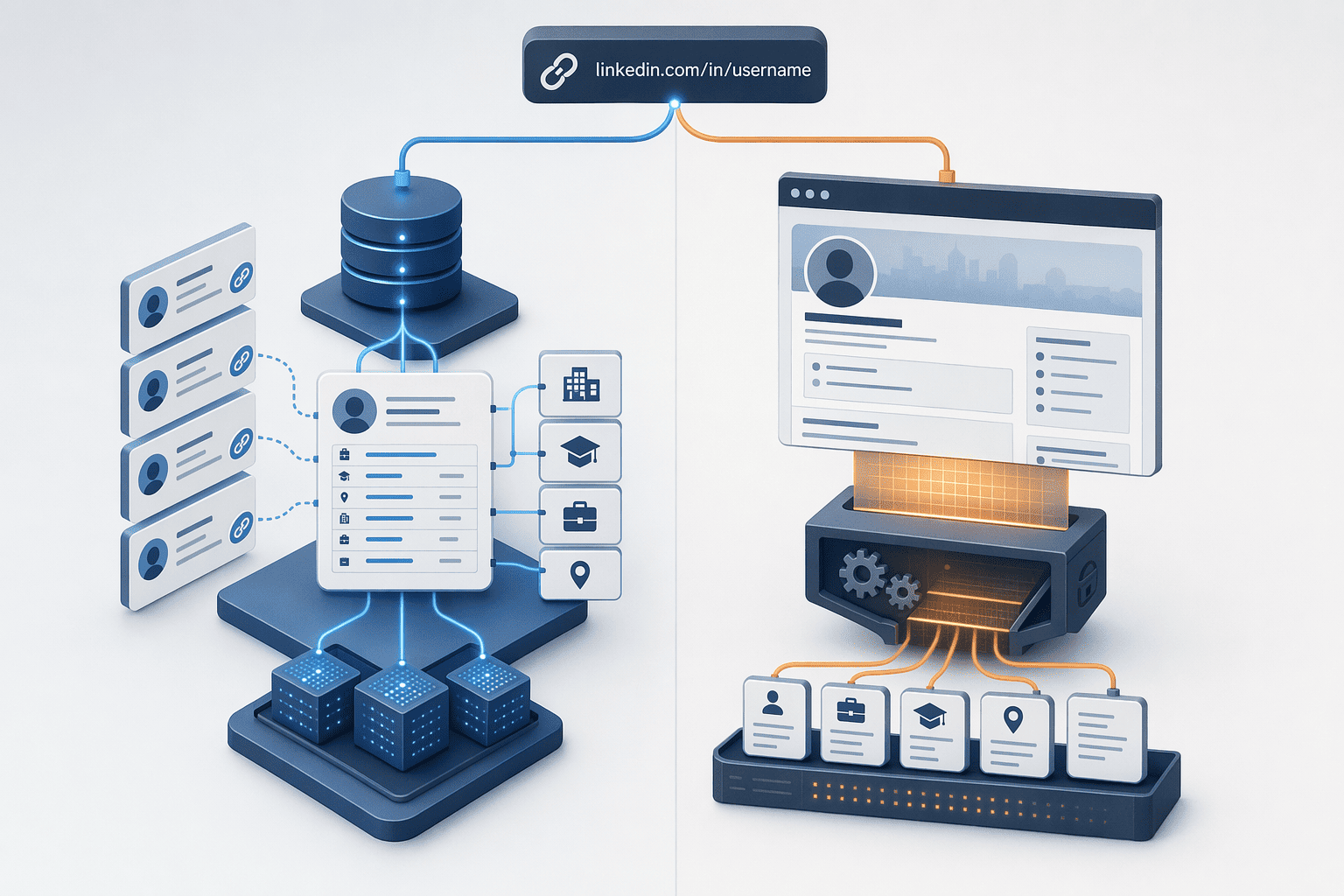
Contact discovery platforms fall into two architectural camps: enrichment-based tools that query third-party databases using LinkedIn profile URLs as reference identifiers, and scraping-based tools that extract data directly from LinkedIn's visible profile fields. The choice determines compliance risk, account safety, and data coverage, tradeoffs that sales teams rarely see explained beyond generic 'terms of service' warnings.
Enrichment-Based Compliance (Third-Party Database Lookups)
Enrichment tools operate by treating LinkedIn URLs as search keys for independent third-party databases, business registries, public records, and commercial contact repositories. The platform never accesses LinkedIn's internal APIs or crawls profile data; it uses the publicly shared URL to match records in external systems. This architecture keeps the tool outside LinkedIn's terms-of-service perimeter, eliminating account suspension risk for users. The compliance benefit comes with a coverage cost: enrichment platforms can only return contacts present in their partner databases, which may miss prospects whose information hasn't been aggregated into commercial repositories.
Direct Scraping Risk and Account Suspension Rates
Scraping-based tools extract contact data by automating profile visits, reading visible fields, and assembling records from what LinkedIn displays to logged-in users. This method offers broader coverage, if a prospect's email or phone appears on their profile (even to second-degree connections), the scraper can capture it. The regulatory exposure is severe: LinkedIn's Terms of Service prohibit automated scraping, and heavy scraping users report account suspension rates between 15-20% based on community feedback patterns. Platforms that crawl LinkedIn profiles directly, harvest contact data through bots, or circumvent rate limits expose users to permanent account bans, a compliance cost that outweighs the marginal coverage gain for most sales teams.
Role-Based Email Detection and Disposable Domain Screening
High-quality enrichment platforms layer verification steps that distinguish actionable contacts from noise: role-based email detection flags generic addresses (info@, sales@) that route to shared inboxes rather than decision-makers, and disposable domain screening removes temporary email services that prospects use to gate content downloads. These filters separate tools that return verified, callable contacts from basic scrapers that dump every visible field into a CSV. The verification architecture, cross-referencing multiple data sources, validating phone formats, classifying numbers as mobile versus landline, determines whether a platform delivers contacts ready for outreach or requires manual cleanup before dialing.
8 LinkedIn Contact Discovery Platforms Compared by Verification Workflow
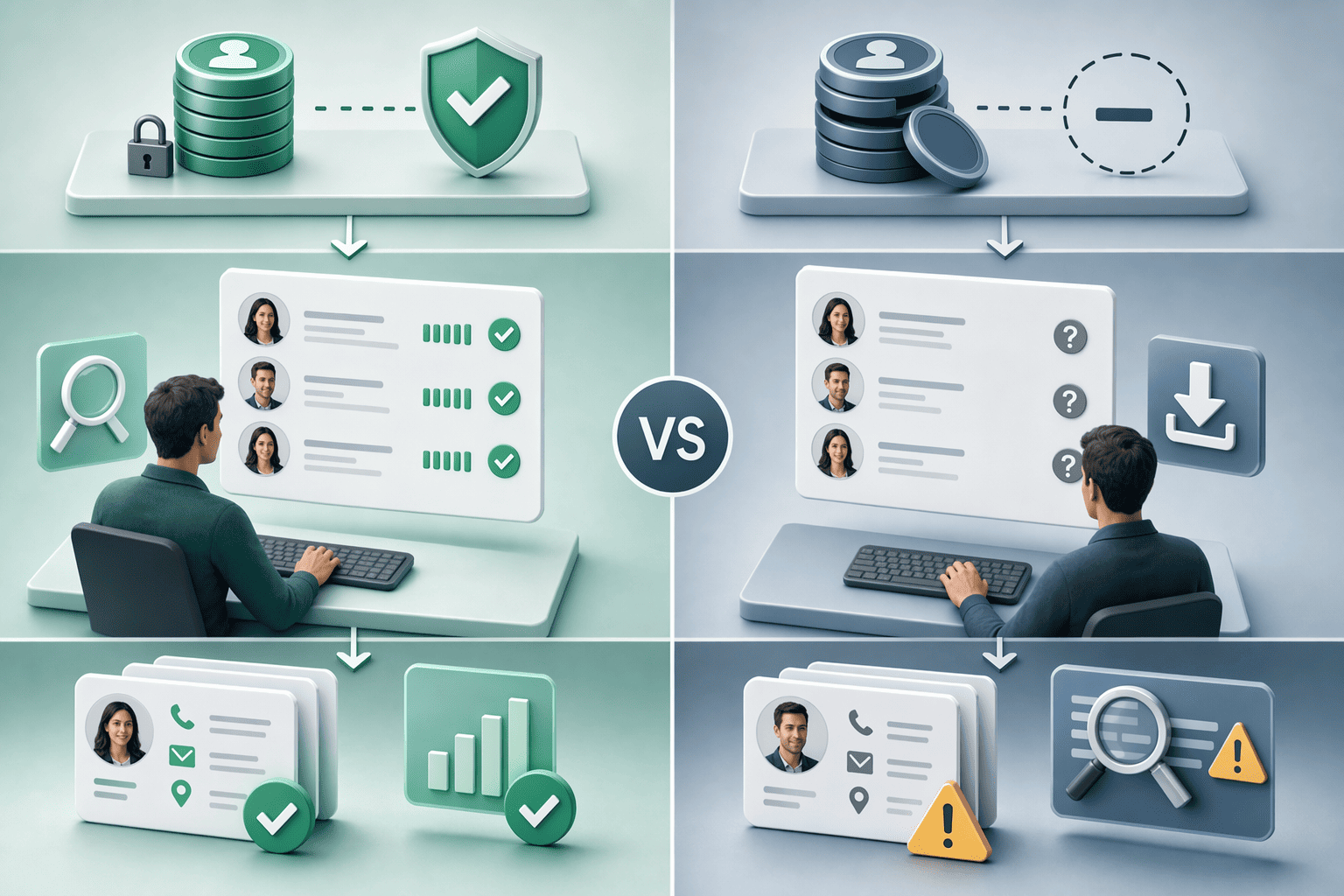
Most LinkedIn contact discovery platforms charge credits regardless of match success. Pre-download verification platforms show confidence indicators before consuming credits; post-export enrichment tools deduct credits first and validate later. The distinction directly affects cost-per-usable-contact and compliance risk.
Pre-Download Verification Platforms
PeakAi delivers verified phone numbers and emails from LinkedIn profiles with 91% accuracy in 10 seconds, displaying validation status before credit commitment. The platform queries 200+ network data partners in real time and classifies phone numbers as mobile, landline, or VoIP. Pricing starts at $9 for 50 verified contacts. Pros: verification before credit deduction, regional accuracy for Indian B2B contacts, GST verification capabilities. Cons: smaller database vs Apollo or ZoomInfo. Best for: teams prioritizing accuracy over breadth and needing phone-specific validation for cold calling.
Kaspr supports real-time email and phone discovery directly from LinkedIn with solid GDPR coverage for European markets. The Chrome extension surfaces contact information instantly, making it strong for individual SDRs doing LinkedIn-driven prospecting. Pros: instant lookups, GDPR-compliant. Cons: database-dependent match rates, limited bulk export features. Best for: individual prospectors working EU markets.
LeadIQ offers LinkedIn-native contact capture with pre-download confidence scoring. The platform integrates with major CRMs and supports bulk enrichment workflows. Pros: confidence indicators before credit use. Cons: pricing not publicly disclosed for higher tiers. Best for: teams needing CRM-sync workflows with verification transparency.
Post-Export Enrichment Platforms
Apollo.io provides a 275M+ contact database, built-in sequences, and conversation intelligence in a single tool. The platform charges credits regardless of match success, and European data coverage is uneven compared to specialists. Paid plans start at $49/seat/month. Pros: all-in-one prospecting with verified email discovery and outreach. Cons: credit system can confuse at scale, CRM features less mature than dedicated tools. Best for: teams that want data, multichannel outreach, and deal management in a single platform.
Hunter delivers accurate domain-based email finding and verification with a 68% verified match rate. The platform focuses on email-only enrichment and does not offer phone discovery. Pros: simple domain lookup, budget-friendly for email-only workflows. Cons: no phone numbers, limited LinkedIn integration. Best for: teams needing email-only at scale with domain-based lookup.
Lusha offers a free plan with 40 credits per month and paid plans from $36/month. The Chrome extension surfaces email and phone numbers instantly from LinkedIn profiles. Lusha has a 4.3 out of 5 rating based on 1,660 reviews. Pros: instant lookups, free tier available. Cons: data inaccuracy and outdated data listed among pros & cons, credits burn fast with bulk research. Best for: individual SDRs who need fast, in-the-moment contact lookups directly from LinkedIn.
Workflow and Pricing Transparency Comparison
| Platform | Verification Timing | Data Sourcing | Compliance Risk | G2 Rating | Starting Price | Phone Discovery |
|---|---|---|---|---|---|---|
| PeakAi | Pre-download | Enrichment-based | Low | Not listed | $9 for 50 contacts | Yes (91% accuracy) |
| Lusha | Post-export | Database-driven | Medium | 4.3 (1,660 reviews) | $36/month | Yes |
| Kaspr | Pre-download | Enrichment-based | Low | Not listed | Not disclosed | Yes |
| LeadIQ | Pre-download | Enrichment-based | Low | Not listed | Not disclosed | Yes |
| Apollo.io | Post-export | Database-driven | Medium | 4.8 (7,142 reviews) | $49/seat/month | Yes |
| Hunter | Post-export | Domain-based | Low | Not listed | Not disclosed | No |
Pre-download verification platforms (PeakAi, Kaspr, LeadIQ) display confidence indicators before credit consumption, reducing waste on invalid contacts. Post-export enrichment platforms (Apollo.io, Hunter, Lusha) charge credits first and validate later, increasing cost-per-usable-contact when match rates fall below 70%. For teams prioritizing accuracy and needing verified phone numbers for cold calling, PeakAi's 91% phone accuracy and pay-per-verified-contact model deliver the lowest cost-per-usable-contact. Ready to Transform Your Sales Process? Add to Chrome - Free and find accurate contact information to close more deals.
Platform architecture and verification workflows matter, but accuracy varies significantly by geography, especially when moving beyond US and EU markets.
Regional Accuracy Gaps: Why Global Tools Struggle in India
India-Specific Mobile Verification Challenges
Global contact discovery platforms optimized for US and EU markets often experience a 10-15 percentage-point accuracy drop when used in India. This gap stems from architectural differences in mobile verification infrastructure. Western tools rely on carrier-level APIs that query telecom databases directly, infrastructure widely available in North America and Europe but less accessible across India's fragmented telecom landscape. India-focused platforms compensate by cross-referencing GST (Goods and Services Tax) records, MCA (Ministry of Corporate Affairs) company registries, and regional business directories. For example, PeakAi integrates GST and MCA databases to deliver 91% phone number accuracy specifically for Indian contacts across 1600+ cities, validated against official government records rather than LinkedIn profile fields alone.

Email vs Phone Accuracy as Separate Metrics
Email accuracy and phone accuracy must be evaluated independently because they depend on different verification methods and data structures. Email discovery relies on SMTP validation, pinging mail servers to confirm address syntax and domain existence, a process that works uniformly across geographies. Phone number discovery, by contrast, requires carrier lookup or government database cross-reference, methods that vary significantly by region. LinkedIn profile sharing rates differ too: professionals in India are more likely to expose work emails than direct mobile numbers. Tools that bundle email and phone metrics into a single 'contact accuracy' figure obscure these structural differences and mislead buyers about what they'll actually receive.
Platforms Optimized for India vs Global Coverage
Platforms with India-specific optimization, GST verification, regional phone format validation, and MCA database integration, consistently test 10-15 percentage points higher for Indian contacts than global suites. PeakAi is one example, achieving 91% phone number accuracy for Indian B2B contacts through this multi-layer validation approach. Apollo and ZoomInfo, optimized for US/EU carrier APIs, show stronger performance in Western markets but weaker coverage in India. Buyers prospecting in India should prioritize tools that disclose regional accuracy testing and publish India-specific validation methods rather than relying on global 'average accuracy' claims.
Free trials reveal feature sets but rarely expose true accuracy. Independent testing with a control sample provides the only reliable benchmark before committing to annual contracts.
How to Test Accuracy Before Committing Credits
Free trials and small credit bundles rarely reveal true platform accuracy because match rates vary significantly by industry, region, and seniority level. The only reliable method is to test each platform against a control sample that mirrors your actual target persona mix.

Build a Test Sample of 50-100 Known Contacts
Compile a control set of LinkedIn profiles with verified contact information from your internal CRM or known professional connections. Include a representative mix of seniority levels (IC, manager, director, VP) and industries matching your prospecting targets. Export this sample as a CSV with LinkedIn URLs and the verified emails or phone numbers you already possess.
Run Parallel Exports Across 2-3 Platforms
Upload the same test sample to multiple contact discovery platforms simultaneously. Track match rate (percentage of profiles where the platform returned contact data), verification status (how many results were flagged as verified), and credit deduction timing (whether platforms charge for unverified matches). One independent test found a platform claiming 98% accuracy delivered only a 4.5% hit rate on a 1,000-contact Sales Navigator list, illustrating why advertised metrics rarely match field performance.
Measure Deliverability, Not Just Match Rate
Compare the platform-returned emails and phone numbers against your known-good control data. Test actual deliverability through SMTP validation, bounce rate monitoring, and carrier lookup for phone numbers. If your test reveals under 70% deliverability, switch to a platform with external database verification rather than pattern-matching. PeakAi uses external database verification to deliver 91% phone accuracy without relying on LinkedIn's visible profile fields alone.
Decision framework: If deliverability falls below 70%, consider pre-download verification platforms; if 70-85%, negotiate volume discounts to offset the accuracy gap; if above 85%, the platform matches your use case and justifies scaled credit purchases.
Conclusion
Pre-download verification platforms like PeakAi and Kaspr deliver higher deliverability (85 to 91%) but may have smaller databases than post-export enrichment giants such as Apollo and ZoomInfo, which offer broader coverage but lower match quality. Enrichment-based tools avoid LinkedIn terms-of-service violations and account suspension risk but may sacrifice 10 to 15 percentage points of coverage compared to scraping-based tools that risk 15 to 20% suspension rates for heavy users.
As AI-powered contact verification layers, role-based email detection, disposable domain screening, carrier-level phone lookup, mature, the gap between advertised accuracy and real-world deliverability will narrow, but only for platforms that adopt real-time verification architectures over static database lookups.
Test PeakAi's pre-download verification workflow with a free trial to see 91% accuracy verification before committing credits, compare side-by-side with your current platform using the 50 to 100 contact testing methodology from section 6.
Frequently Asked Questions
What is the most accurate LinkedIn contact discovery platform in 2026?
Pre-download verification platforms like PeakAi, Kaspr, and LeadIQ achieve 85 to 91% deliverability by displaying confidence indicators before credit commitment. Post-export enrichment models such as Apollo and ZoomInfo average 50% real-world match rates because they charge credits upfront and validate afterward, shifting data quality risk to the buyer.
Why do advertised accuracy rates (95%) differ from real-world deliverability (50%)?
Vendors typically measure email format validation, whether addresses follow RFC 5322 syntax standards, not actual deliverability. A syntactically perfect email can fail deliverability checks due to abandoned mailboxes, full inboxes, or catch-all domains that accept all addresses at the SMTP layer but never deliver messages to recipients.
How much does contact data decay each month?
Contact data decays at 2 to 3% monthly as professionals change employers, update preferences, or abandon mailboxes. This erosion makes real-time verification architectures critical, static databases lose accuracy continuously, while platforms that verify at query time reflect current mailbox and carrier status rather than outdated snapshots.
What is the difference between enrichment-based and scraping-based contact discovery?
Enrichment-based tools use LinkedIn URLs as search keys for third-party databases, offering compliance and lower coverage. Scraping-based tools automate profile visits to extract visible contact fields directly, providing broader coverage but carrying 15 to 20% account suspension risk from LinkedIn's terms-of-service enforcement for heavy automation users.
Do global contact discovery platforms work as well in India as in the US/EU?
No, global tools optimized for US and EU markets test 10 to 15 percentage points lower in India due to mobile verification infrastructure differences, carrier-level API availability gaps, and regional phone format variations. Platforms with India-specific optimization (GST verification, MCA database integration) consistently outperform global alternatives for Indian contacts.
How can I test contact discovery accuracy before committing to a paid plan?
Build a control set of 50 to 100 LinkedIn profiles with verified contact information from your CRM. Run parallel exports across multiple platforms, then measure actual deliverability through SMTP validation and bounce rate monitoring rather than relying on vendor-reported match success metrics, which often exclude failed matches from accuracy calculations.
Why do some platforms charge credits even when they don't find a contact?
Post-export enrichment models charge credits upfront and enrich after export, shifting data quality risk to the buyer. This makes actual cost-per-usable-contact 35 to 100% higher than advertised per-credit pricing when match rates fall below 60%, because you pay for both successful matches and empty records that consume credits without delivering actionable data.
Sources
- What Is Data Decay? B2B Contact Data Risks & How to Reduce It - www.emarketnow.com (2026)
- SalesQL - salesql.com
- ZoomInfo vs Apollo vs Clay: The Definitive 2026 Comparison - caelian.ai (2026)
- Best Contact Finding Tools for B2B Sales Teams in 2026 - lagrowthmachine.com (2026)
- Need recommendations for B2B contact data providers in India (HR/Legal/CEO contacts) - www.reddit.com
- Lusha vs RocketReach: Which is Better? (2026) - origami.chat (2026)
- Compare Lusha vs. RocketReach - www.g2.com (2026)
- 2026's Best Email Finder Tools for Prospecting [Tested & Verified] - phantombuster.com (2026)
- Prospeo Review 2026: Independent Test (vs Hunter, Apollo, Derrick) - derrick-app.com (2026)
