LinkedIn contact discovery platforms retrieve verified emails and phone numbers from professional profiles, enabling sales teams to reach decision-makers without manual research or outdated data.

Key Takeaways
- Contact discovery accuracy depends on three verification components: real-time lookup triggers that check data at the moment of export, database refresh cycles that maintain freshness, and confidence-tier signaling that shows verification strength before download.
- Phone data decays at roughly 2–3% monthly as professionals change jobs and numbers, so platforms with seven-day refresh cycles maintain higher accuracy than those with slower updates [1].
- Pre-download verification models charge only for contacts verified before export, while post-export enrichment models charge per contact revealed regardless of validity—creating cost-per-usable-contact gaps up to 35% [1].
- ZoomInfo leads enterprise teams with the largest contact database (300M+ profiles) and highest claimed accuracy rates, while Apollo.io offers the most affordable starting price at $49/month with 87–91% email accuracy [1][5].
- LinkedIn compliance risks split platforms into scraping-based architectures (which violate LinkedIn's Terms of Service) and enrichment-based workflows that avoid automated profile crawling [1].
Introduction
Contact discovery accuracy determines whether sales teams reach decision-makers or waste hours chasing outdated phone numbers. According to HeyReach [8], contact data decays roughly 2% per month, so tools with seven-day refresh cycles maintain 98% accuracy while those with slower updates drop to 75% within five months. Most platforms advertise email accuracy rates between 85% and 95%, yet fail to distinguish direct-dial detection from generic phone-number provision or explain verification-methodology transparency [1]. Business contact finder tools help teams quickly uncover verified emails, phone numbers, titles, and organization details, but the gap between advertised accuracy and real-world usability often surfaces only after purchase. This guide evaluates verification-methodology criteria—real-time vs static database architecture, phone-type detection, confidence signaling, and data-freshness decay, before comparing seven platforms side-by-side.

What Makes a LinkedIn Contact Discovery Platform 'Accurate'?
Verification-Methodology Transparency
Accuracy claims mean little without methodology disclosure. Platforms that publish verification-method details, such as real-time SMTP checks for emails, carrier lookup for phone numbers, and multi-source cross-referencing, build buyer confidence. Tools that rely solely on vendor-supplied accuracy percentages without reproducible methodology offer no way to validate claims [4]. For instance, UpLead guarantees 95% accuracy covering email, title, and company with automatic credit refunds for bounces [4], while Cognism's Diamond Data phone numbers achieve an 87% connect rate, three times the industry average for direct dials [4].

Data-Freshness Decay Rates
Contact data decays as professionals switch roles, change numbers, and update email addresses. According to HeyReach [8], a list of 500 leads statistically loses 112 contacts (roughly 22.5%) per year, with 70% of B2B data becoming stale within 90 days. Platforms with aggressive refresh cycles, updating records every seven days, maintain higher accuracy than those relying on quarterly or annual updates. This decay rate explains why tools with static databases often deliver 30 to 40% bounce rates, even when initial accuracy claims seem strong.
Phone-Number Type Detection
Generic phone-number accuracy percentages mask critical distinctions: direct-dial mobile numbers connect at far higher rates than switchboard lines or landlines. Only 5 to 10% of LinkedIn users share phone numbers with first-degree connections [1], so platforms must infer or enrich contact data from external sources. Tools that differentiate direct dials from switchboard numbers, and surface this distinction before download, allow buyers to prioritize high-value contacts. Cognism, for example, provides Diamond Data phone numbers with an 87% connect rate specifically for direct dials [4].
How Contact Verification Actually Works (Real-Time vs Static Databases)
Real-Time Lookup Triggers
Real-time verification platforms query external data sources at the moment a user requests a contact, checking SMTP validity for emails and carrier lookup for phone numbers. This architecture ensures the data returned reflects the most current information available, reducing bounce rates caused by stale records. Sales teams retrieve verified email addresses in seconds using this method. The trade-off: real-time lookups may cost more per contact and require strong API infrastructure to handle query volume without latency.

Static-Database Architecture
Static-database platforms pre-collect and store contact data, refreshing records on fixed schedules (weekly, monthly, or quarterly). According to AI-Ark [7], top providers deliver enriched profiles including job titles, company structures, and recent role change information. Static databases offer faster query response times and lower per-contact costs, but accuracy depends entirely on refresh cadence. A platform with quarterly updates may show 90% accuracy at the start of the cycle but drop to 75% accuracy by month three as contact churn accumulates.
Pre-Download Confidence Signaling
Advanced platforms surface confidence tiers before users spend credits or export contacts. Tools like SalesQL offer trusted, real-time verified emails and phone numbers with enriched contact data, allowing users to prioritize high-confidence matches. SignalHire, a Chrome extension with 300,000 users and a 4.5-star rating [2], provides email and phone lookup directly from LinkedIn profiles. Confidence signaling prevents credit waste on low-probability matches and helps teams allocate outreach resources to verified contacts.
7 Platforms Compared: Accuracy Rates, Verification Methods, and Pricing
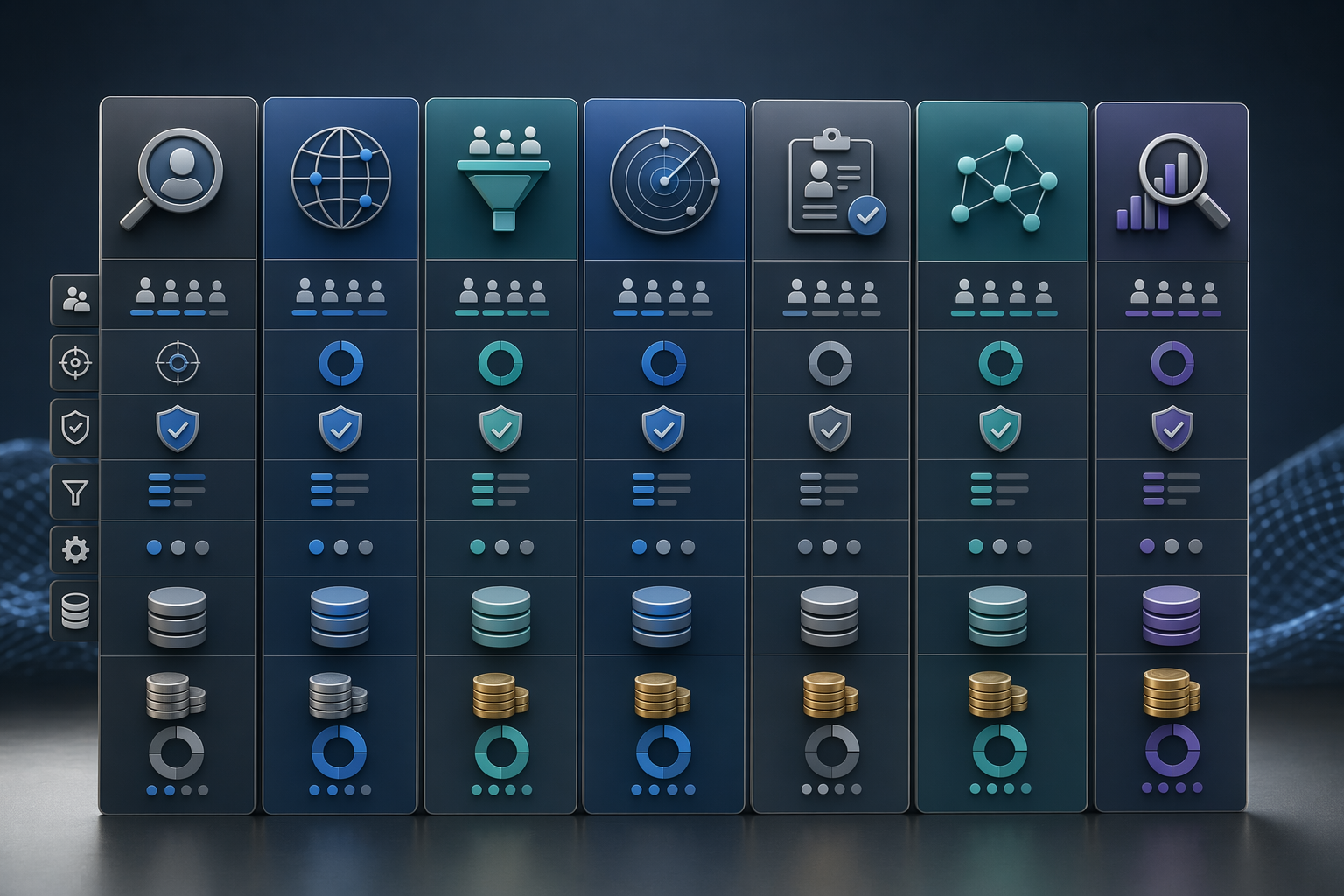
The table below compares seven LinkedIn contact discovery platforms across accuracy claims, database size, pricing, and verification approach. Data sourced from manufacturer websites, independent reviews, and aggregator comparisons as of June 2026.
| Platform | LinkedIn Profile Accuracy | Database Size | Pricing (Starting) | Verification Method | Best For |
|---|---|---|---|---|---|
| PeakAi | 91% (phone & email) | 500M+ profiles | ₹675 for 50 verified contacts (pay-as-you-go) | Real-time verification, pay-per-verified-contact | Teams prioritizing cost control and regional data quality |
| ZoomInfo | 92% (email) | 260M–300M+ contacts | $14,995+/year | Static database with intent data layers | Enterprise teams needing firmographic and intent signals |
| Apollo.io | 87–95% (email) | 250M–275M+ contacts | $49/user/month | Static database with 10,000 lead credits monthly | All-in-one prospecting plus email outreach on a budget |
| Snov.io | 88% (email) | 200M+ contacts | $39/month | Static database with 50 lookups/month free tier | Budget-conscious teams testing contact discovery |
| Lusha | 85–90% (email) | 100M–150M+ contacts | $29–$37/user/month | Static database with Chrome extension | Solo SDRs and small teams seeking ease of use |
| Cognism | 87% connect rate (Diamond Data phones) | Not disclosed | Custom pricing | Human-verified direct dials for EU compliance | GDPR-sensitive outbound teams in Europe |
| SignalHire | Not disclosed | Access to millions of contacts | Not publicly disclosed | Chrome extension with real-time lookup | Recruiters sourcing individual profiles at scale |
ZoomInfo brings the largest enterprise contact database with direct-dial phone numbers and intent data [6], making it the strongest option for teams requiring deep firmographic layers. Apollo.io bundles prospecting and engagement in one affordable platform [6], offering the best cost-per-contact ratio for startups and mid-market teams. According to Balachandran N S [5], ZoomInfo's email accuracy runs 92 to 95%, while Apollo.io achieves 87 to 91%, a gap that narrows when factoring in Apollo's $49/month entry price versus ZoomInfo's roughly $15,000 annual commitment. PeakAi claims 91% accuracy for verified phone numbers and emails discovered from LinkedIn profiles, positioning it competitively on accuracy while offering a pay-as-you-go credit model with no annual lock-in. Lusha and Snov.io serve budget-conscious teams, with Lusha's Chrome extension providing 50 email credits monthly [9] and Snov.io offering 50 lookups per month on its free tier.
Cost-Per-Usable-Contact Analysis
Advertised per-credit pricing hides the true cost when factoring in match rates and verification burn. Credit-based models charge per contact revealed, with burn rates varying from 50 to 65% match for phone numbers to 75 to 80% for emails [1]. For illustration, a team purchasing 1,000 credits at $0.50 each expecting full email coverage may receive only 750 to 800 usable emails after match-rate losses, raising the effective cost per usable contact from $0.50 to $0.63, $0.67. Pre-download verification models mitigate this by charging only for verified contacts, aligning cost with value delivered. PeakAi's pay-as-you-go pricing starts at ₹675 for 50 verified contacts, offering predictable per-contact economics for teams managing tight budgets.
LinkedIn Compliance and Scraping Risks
LinkedIn's Terms of Service explicitly prohibit automated scraping, profile crawling, and bulk data extraction [1]. Platforms using scraping-based architectures risk account suspension and legal exposure, while enrichment-based tools avoid LinkedIn ToS violations because no automated profile scraping occurs within the LinkedIn platform itself [1]. Buyers evaluating compliance risk should ask vendors whether their data-collection method involves direct LinkedIn scraping or relies on third-party enrichment sources. Cognism, for example, emphasizes GDPR compliance and human-verified direct dials to meet European regulatory standards [1].
When to Choose Pay-Per-Contact vs Subscription Models
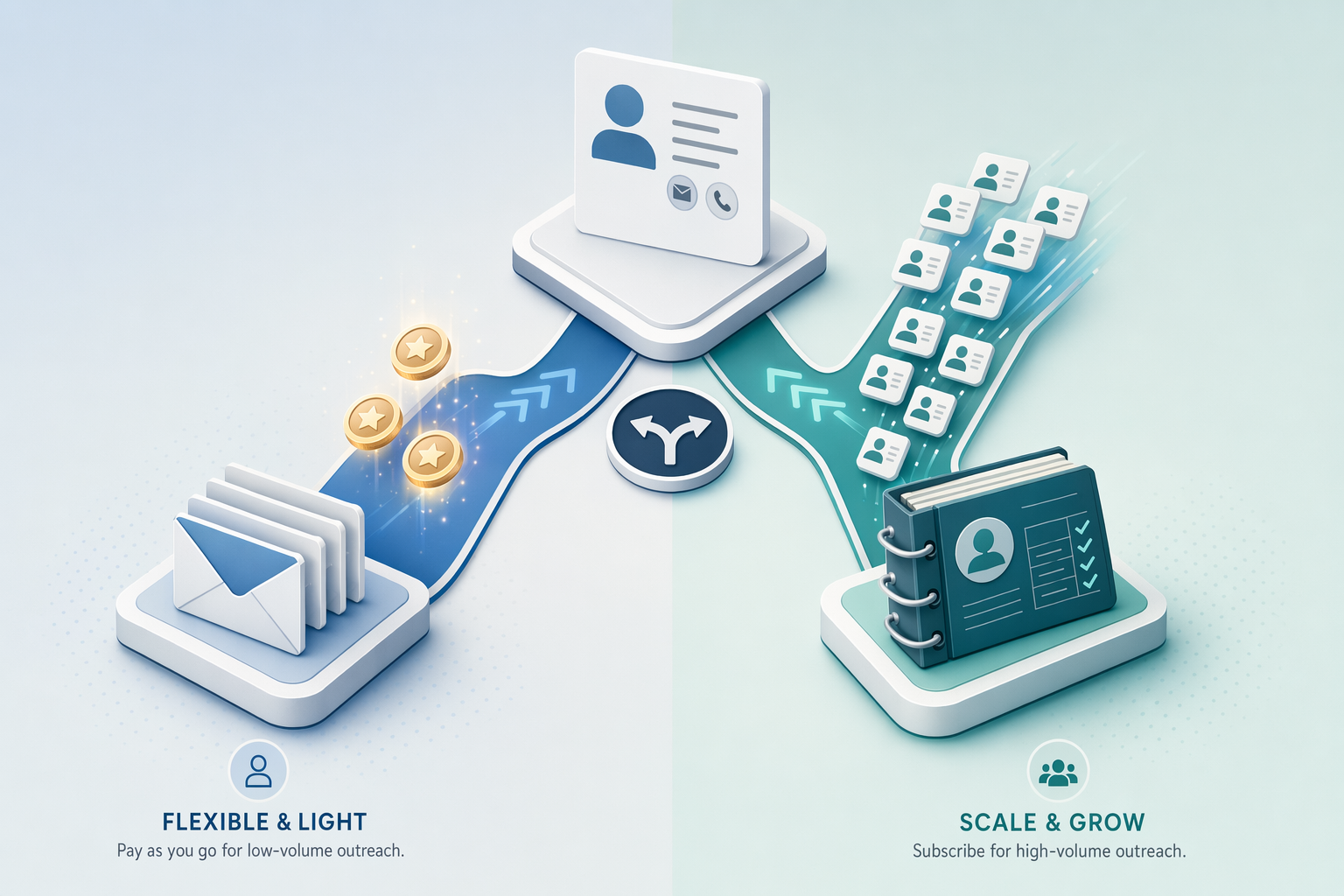
Pay-Per-Contact (Credit-Based) Pricing
Credit-based models suit teams with variable prospecting volume or those testing contact discovery for the first time. According to Topo.io [9], Hunter.io's paid plans start at $49/month for 2,000 credits, where one credit equals one email found and 0.5 credits verify an email, allowing precise cost control. Pay-per-contact pricing eliminates waste from unused subscription seats and aligns spending with actual outreach activity. The risk: per-contact costs rise quickly at scale, making subscriptions more economical for teams exporting hundreds of contacts monthly. PeakAi offers a Chrome extension for LinkedIn profile contact discovery with a credit-based model, targeting teams that prioritize flexibility over fixed monthly commitments.
Subscription (Seat-Based) Pricing
Subscription models deliver predictable monthly costs and unlimited or high-volume contact exports, making them ideal for teams with consistent prospecting cadences. Apollo.io's $49/user/month plan includes unlimited emails with limited features [1], while ZoomInfo's enterprise pricing starts around $14,995 per year for 5,000 annual credits and up to three users [10]. Subscriptions provide better unit economics at scale but require accurate seat forecasting, overpaying for unused licenses wastes budget, while underpaying throttles outreach capacity. According to Oppora.ai [3], LinkedIn prospecting tools cut outreach time by up to 50%, justifying subscription investment for teams spending significant hours on manual research.
Hybrid Models and Free Tiers
Several platforms blend subscription access with per-contact credits or offer free tiers for testing. Hunter.io's free plan gives 50 email credits monthly [9], allowing solo SDRs to validate the tool before upgrading. Snov.io provides 50 lookups per month on its free Chrome-extension tier, while ZoomInfo offers free-to-start consumption credits based on usage. Hybrid models reduce switching costs and let buyers test accuracy claims with real data before committing to annual contracts. Teams should test free tiers across multiple platforms to benchmark accuracy and UI fit before locking into long-term agreements.
How to Test Accuracy Before Committing to a Platform
Run a Controlled Sample Test
Export a sample of 50 to 100 contacts from a known target list (such as conference attendees or LinkedIn Sales Navigator search results) and validate the provided emails and phone numbers manually. Track bounce rates for emails using a test campaign, and measure phone-number reachability by calling a random 10% subset. Compare results across two or three platforms to identify which delivers the highest connect rate. This test reveals gaps between advertised accuracy and real-world performance, especially for region-specific data quality.

Check Data-Freshness Indicators
Platforms that surface last-verified dates or confidence scores before download allow buyers to assess data freshness. Export contacts with varying confidence tiers and compare bounce rates across high-, medium-, and low-confidence segments. Tools with transparent freshness indicators typically maintain tighter accuracy ranges, while platforms providing no timestamp metadata may deliver stale records mixed with current data. PeakAi supports CRM integrations including native connections with 20+ platforms such as Salesforce, HubSpot, Pipedrive, Zoho, and Leadsquared, plus CSV and API export, enabling automated freshness tracking through CRM sync timestamps.
Evaluate Chrome Extension UX and Speed
Chrome extensions that integrate directly into LinkedIn profiles reduce context-switching and speed up prospecting workflows. Test extension latency by timing how long it takes to retrieve contact data for 10 consecutive profiles. SignalHire's Chrome extension serves 300,000 users [2], indicating strong adoption, while Lusha's extension is widely reviewed for ease of use [1]. Extensions with sub-two-second retrieval times fit seamlessly into high-volume prospecting, while slower tools disrupt cadence and reduce daily contact output.
The following questions address common concerns about LinkedIn contact discovery platform selection, accuracy evaluation, and pricing models.
Frequently Asked Questions
What is the most accurate contact discovery platform for LinkedIn profiles?
ZoomInfo leads on advertised email accuracy (92 to 95%) and database size (300M+ contacts), making it the strongest choice for enterprise teams. Apollo.io offers 87 to 95% email accuracy at a more accessible $49/month entry price. PeakAi claims 91% accuracy for phone and email with a pay-per-verified-contact model.
Why do I get 30% bounce rates with most contact discovery platforms?
Contact data decays roughly 2% per month, so platforms with slow refresh cycles (quarterly or annual) accumulate stale records. Static databases drop from 90% accuracy to 75% within five months if not refreshed weekly. Credit-based models also charge per contact revealed, with only 50 to 65% phone match and 75 to 80% email match.
Why do most contact discovery tools give me outdated phone numbers?
Phone numbers decay at 2 to 3% monthly as professionals change jobs and carriers. Tools relying on static databases updated quarterly or annually deliver outdated numbers by the time you export them. Real-time verification platforms query external sources at export, ensuring current data but at higher per-contact cost.
What is the difference between real-time and static-database contact verification?
Real-time verification queries external data sources at the moment of export, checking SMTP validity and carrier lookup instantly. Static databases pre-collect and store contacts, refreshing on fixed schedules (weekly, monthly, quarterly). Real-time ensures current data; static databases offer faster queries and lower costs but depend on refresh cadence.
How do I test a LinkedIn contact discovery platform before buying?
Export a sample of 50 to 100 contacts from a known target list and manually validate emails and phone numbers. Track email bounce rates using a test campaign and call a random 10% of phone numbers to measure reachability. Compare results across two or three platforms to identify which delivers the highest connect rate.
Are LinkedIn contact discovery platforms compliant with LinkedIn's Terms of Service?
LinkedIn's Terms of Service prohibit automated scraping, profile crawling, and bulk data extraction. Platforms using scraping-based architectures risk account suspension and legal exposure. Enrichment-based tools avoid ToS violations by not scraping LinkedIn directly, instead pulling data from third-party sources outside the LinkedIn platform.
Should I choose pay-per-contact or subscription pricing for LinkedIn contact discovery?
Pay-per-contact suits teams with variable prospecting volume or those testing tools for the first time, offering precise cost control. Subscription models deliver better unit economics at scale, ideal for teams exporting hundreds of contacts monthly. Hybrid models with free tiers let buyers test accuracy before committing to annual contracts.
Sources
- Best Contact Finding Tools for B2B Sales Teams in 2026 - lagrowthmachine.com (2026)
- SignalHire - find email or phone number - Chrome Web Store - chromewebstore.google.com
- 15 LinkedIn Prospecting Tools That Cut Outreach Time by 50% - oppora.ai (2026)
- Which B2B Lead Gen Brands Have the Most Accurate Data? - syncgtm.com
- Apollo.io vs. ZoomInfo vs. LinkedIn Sales Navigator (2026): Which B2B Prospecting Tool Actually Delivers ROI? - balachandransomu.com (2026)
- ZoomInfo vs Apollo: Features, Pricing, Reviews (2026) - salesmotion.io (2026)
- Best B2B Contact Database Providers: 2025 Comparison Guide - ai-ark.com (2026)
- Best B2B Data Enrichment Tools in 2026 - heyreach.io (2026)
- The Best Email Finder Tools in 2025 - topo.io (2026)
- Best B2B Data Providers for Prospecting in 2026: ZoomInfo vs Apollo vs PDL - starnus.com
