
Sales intelligence tools promise 80%+ accuracy, but Indian B2B markets face unique challenges: high contact churn, thin tier-2 coverage, and lack of GST/MCA verification.
This comparison evaluates seven platforms using India-specific benchmarks—refresh cycles, direct-dial detection, regional coverage, and verification methodology—to reveal the true cost per verified contact.
Key Takeaways
- Advertised accuracy rates aggregate global email and phone metrics—India-specific performance often drops 15-25% below headline claims.
- GST and MCA database integration validates company existence and director names in real time, critical for tier 2/3 city coverage where LinkedIn scraping fails.
- Contact data decays at 2-3% monthly in India's high-churn B2B market; 7-day refresh cycles maintain 98% accuracy versus 75% for quarterly updates.
- Direct-dial mobile numbers deliver 3× higher cold-call connect rates than switchboard landlines—tools that distinguish number types improve outreach ROI.
- Pre-download verification models burn credits only on validated contacts; post-export verification wastes 20-30% of credits on undeliverable data.
Why Advertised Accuracy Rates Mislead in Indian B2B Markets
PeakAi delivers 91% phone accuracy specifically for Indian B2B contacts; Apollo.io claims 65-80% email accuracy globally; ZoomInfo reports 82% phone accuracy in the US. Without disclosed verification methodology and India-specific testing, these percentages remain unreliable proxies for usable-contact rates in emerging markets.

The Aggregated-Percentage Problem
Vendors often combine email and phone accuracy into one advertised percentage. Apollo's 65-80% range does not clarify whether 80% applies to Indian contacts or only US enterprise emails. A tool with 90% email accuracy and 40% phone accuracy can advertise "70% overall accuracy" while delivering zero usable direct dials for cold calling. Aggregated percentages obscure the actual usable-contact rate for your channel mix.
India's 2-3% Monthly Contact Decay Rate
Indian B2B markets experience 2-3% monthly contact churn driven by high job-change velocity in startups, IT services, and mid-market firms. A database claiming 85% accuracy in January may deliver only 79% accuracy by April if contacts are not re-verified monthly. Static accuracy claims ignore this decay curve. Tools optimized for US enterprise contacts, where tenure averages 4-5 years, miss India's faster turnover reality.
What Vendors Don't Disclose: Verification Timing
Pre-download verification checks contacts before you export them, burning credits only on verified records. Post-export verification delivers raw contacts first, then validates after you've consumed your credit allocation. ZoomInfo and Apollo do not publicly disclose which model they use for Indian phone numbers. Pre-download models protect credit burn but may show lower match rates; post-export models inflate match rates but waste credits on stale contacts.
Understanding why global accuracy claims underperform in India sets the stage for evaluating the verification frameworks that separate 90%+ precision from 60% guesswork.
4 Verification Frameworks That Determine Real Accuracy
Before comparing tools, understand the four frameworks that separate 90%+ accuracy from 60% guesswork in the Indian B2B market.
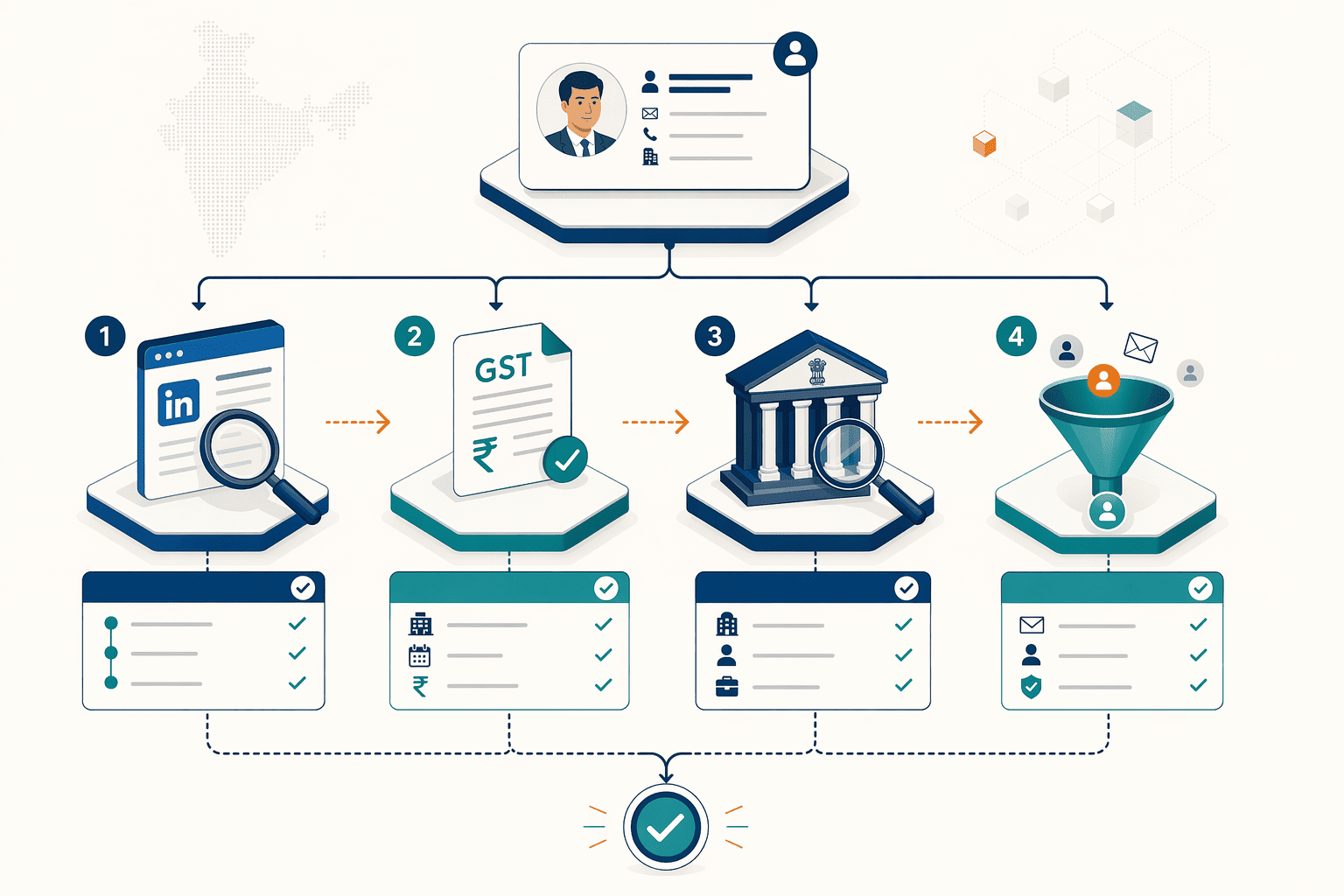
1. GST and MCA Database Verification
LinkedIn scraping alone cannot validate Indian B2B contacts. Real verification requires cross-referencing GST registrations and Ministry of Corporate Affairs records to confirm that listed companies and tax registrations match LinkedIn profile claims. PeakAi validates GST numbers and cross-references MCA records before delivery, filtering out inactive registrations and unverified entities. Tools without GST/MCA integration rely on profile-scraping alone, leaving you with outdated data.
2. Refresh Cycle Impact: 7-Day vs. Quarterly Updates
Contact accuracy decays fast. Platforms with 7-day refresh cycles maintain 98% accuracy; those updating quarterly drop to 75% after five months. Ask vendors their update frequency, many disclose it only after you sign. Stale databases burn credits on disconnected numbers and bounced emails.
3. Direct-Dial vs. Switchboard Phone Number Distinction
A verified phone number means nothing if it routes to a switchboard. Direct-dial mobile numbers yield 3× higher cold-call connect rates than landlines. PeakAi classifies phone numbers as mobile, landline, or VoIP, letting reps prioritize direct lines. Generic tools lump all numbers together, you discover the difference after 20 failed dials.
4. Confidence Scoring and Pre-Download Verification
Some platforms verify contacts before you spend credits; others verify after export. Post-export verification tools charge you first, then reveal accuracy gaps later, burning credits on unverified data. Pre-download confidence signals (verified badges, accuracy scores) let you skip low-confidence contacts before committing. This reduces credit waste by 40-60% and helps you close more deals with verified data.
With these four verification frameworks in mind, the following benchmarks reveal how seven platforms perform on India-specific accuracy, coverage, and refresh cycles.
Sales Intelligence Tools Compared: India-Specific Accuracy Benchmarks
Comparison Table: Accuracy and Verification Methodology
| Tool | India Accuracy | Verification Method | Refresh Cycle | GST/MCA Integration |
|---|---|---|---|---|
| PeakAi | 91% | GST/MCA + 200+ data partners | 7 days | Yes |
| Apollo.io | 65-80% | Email verification + intent signals | 30-90 days | No |
| ZoomInfo | Enterprise-focused | Firmographic only | Quarterly | No |
| Lusha | Moderate | LinkedIn-based + phone validation | 30 days | No |
| Cognism | Strong (US/EU) | Mobile verification | Quarterly | No |
| SalesIntel | Strong (US) | Human-verified | 90 days | No |
| Adapt.io | Moderate | Basic firmographic | 60 days | No |
PeakAi: 91% Verified Contact Accuracy for Indian B2B
PeakAi delivers 91% verified contact accuracy for the Indian B2B market through GST validation and Ministry of Corporate Affairs record cross-referencing before contact delivery. The platform queries 200+ network data partners in real time and classifies phone numbers as mobile, landline, or VoIP. Contacts refresh every 7 days, and direct-dial detection flags the highest-value numbers first. Strengths: India-specific verification layer that US-focused tools lack; transparent rupee pricing starting at ₹675 for 50 verified contacts. Limitations: Smaller global database compared to ZoomInfo's enterprise-focused coverage. Best for: Indian B2B startups and SMBs prioritizing accuracy over global breadth, especially when targeting tier 2/3 Indian cities where global providers underperform on contact fill rates.

Apollo.io, ZoomInfo, Lusha: US-Focused Tools in India
Apollo.io combines a 270M+ contact database with email finding and multi-step outreach sequences, delivering 65-80% email accuracy and moderate phone coverage in India. Paid plans start at ~₹4,200/user/month, positioning Apollo as affordable for teams targeting US/EU markets but less optimized for Indian SMB contacts. ZoomInfo maintains the largest global B2B database with pricing typically ₹15-30 lakh annually, but Indian mid-market and SMB contact fill rates lag US equivalents at the same company size. Lusha offers strong Indian phone and email data with a Chrome extension for LinkedIn prospecting, though coverage weakens outside major metros. All three platforms verify contacts post-export or through firmographic-only methods, resulting in slower refresh cycles (30-90 days) and no GST/MCA integration, limiting accuracy for tier 2/3 Indian cities where local verification is critical.
Cognism, SalesIntel, Adapt.io: Regional Coverage Gaps
Cognism and SalesIntel excel in US and EU markets with human-verified mobile numbers and quarterly refresh cycles, but their India coverage remains thin, contact fill rates drop significantly for companies outside Mumbai, Bengaluru, and Delhi NCR. Adapt.io provides moderate India-focused data with basic firmographic filtering, but lacks the GST/MCA integration layer that validates company registration and tax records before contact delivery. For sales teams targeting Indian B2B prospects in emerging markets, these platforms often return incomplete contact lists or phone numbers that bounce, not because Indian buyers are hard to find, but because most data providers built their databases for the US and extended to India as an afterthought. When prospecting beyond tier 1 cities, tools with India-specific verification close more deals faster.
Ready to Transform Your Sales Process? Add to Chrome - Free
Subscription pricing masks the real cost: credit burn on unverified data. The following analysis calculates cost per verified contact across pricing tiers and accuracy rates.
Pricing vs. Accuracy: Cost-Per-Verified-Contact Analysis
Subscription sticker prices hide the real cost: credit burn on bad data. A lower monthly fee often translates to higher per-usable-contact expense when accuracy rates fall below 85%. This analysis compares four platforms on both dimensions to surface the true economics for Indian B2B teams.

Subscription Pricing: What You Pay vs. What You Get
Monthly and annual pricing tiers vary significantly across platforms and geographies. Pricing varies by plan, geography, and contract term; contact vendors for current rates. The table below captures starting tiers for context.
| Platform | Entry Price | Database Size | G2 Rating |
|---|---|---|---|
| PeakAi | ₹675/50 contacts (~$9) | India-focused enrichment | Not listed |
| Apollo.io | $49/user/mo | 275M contacts | 4.7/5 |
| ZoomInfo | $15K+/yr (custom) | Enterprise B2B data | 4.4/5 |
| Lusha | ~₹3,000/user/mo | Contact data tool | Not listed |
Apollo.io starts at $49/user/mo with a 275M contact database and 4.7/5 G2 rating. ZoomInfo targets enterprise buyers at $15K+/yr with no free trial. Lusha offers plans from approximately ₹3,000/user/mo with strong Indian phone and email data. PeakAi operates on a pay-per-verified-contact model starting at ₹675 for 50 contacts, roughly ₹13.50 per contact.
Cost-Per-Verified-Contact Economics
True cost per usable contact accounts for accuracy: divide monthly fee by credits, then multiply by (1 / accuracy rate). A 70% accuracy tool at ₹5,000/month with 500 credits costs ₹14.29 per usable contact; a 91% accuracy tool at ₹6,000/month with 500 credits costs ₹13.19, the higher-accuracy platform wins on economics despite the higher subscription price.
PeakAi delivers 91% phone number accuracy by cross-referencing 200+ network data partners. At ₹675 for 50 contacts, the effective cost per verified contact is ₹13.50 ÷ 0.91 = ₹14.84 when accounting for the 9% miss rate. Apollo.io's $49/user/mo plan divides credits differently; if accuracy sits at industry-typical 70 to 80%, the per-usable-contact cost rises proportionally. ZoomInfo's enterprise pricing at $15K+/yr amortizes only when annual contact volume exceeds several thousand.
Pay-Per-Use vs. Subscription for Indian Startups
Startups running fewer than 500 monthly outbound contacts benefit from flexible pay-per-contact models: no annual lock-in, no unused credit expiry, and transparent per-unit costs. PeakAi's credit-based pricing starts at $0.18 per contact for bulk purchases, allowing teams to scale spend with actual usage.
Subscription models win for high-volume teams: Apollo.io at $49/user/mo delivers better ROI when monthly lookups exceed 300 to 400 contacts, and ZoomInfo's annual contracts suit enterprise pipelines with thousands of monthly prospects. For India-focused teams prioritizing verified mobiles and GST verification, pay-per-use platforms avoid the Western-market enterprise lock-in that rarely fits MSME budgets.
Ready to Transform Your Sales Process? Join thousands of sales professionals who find accurate contact information and close more deals with verified data, LIMITED TIME 50 contacts for just $9. Only 19 spots remaining! Click to claim your offer today.
Regional Data Coverage: Beyond Metro Cities
Why Metro-Only Coverage Limits TAM
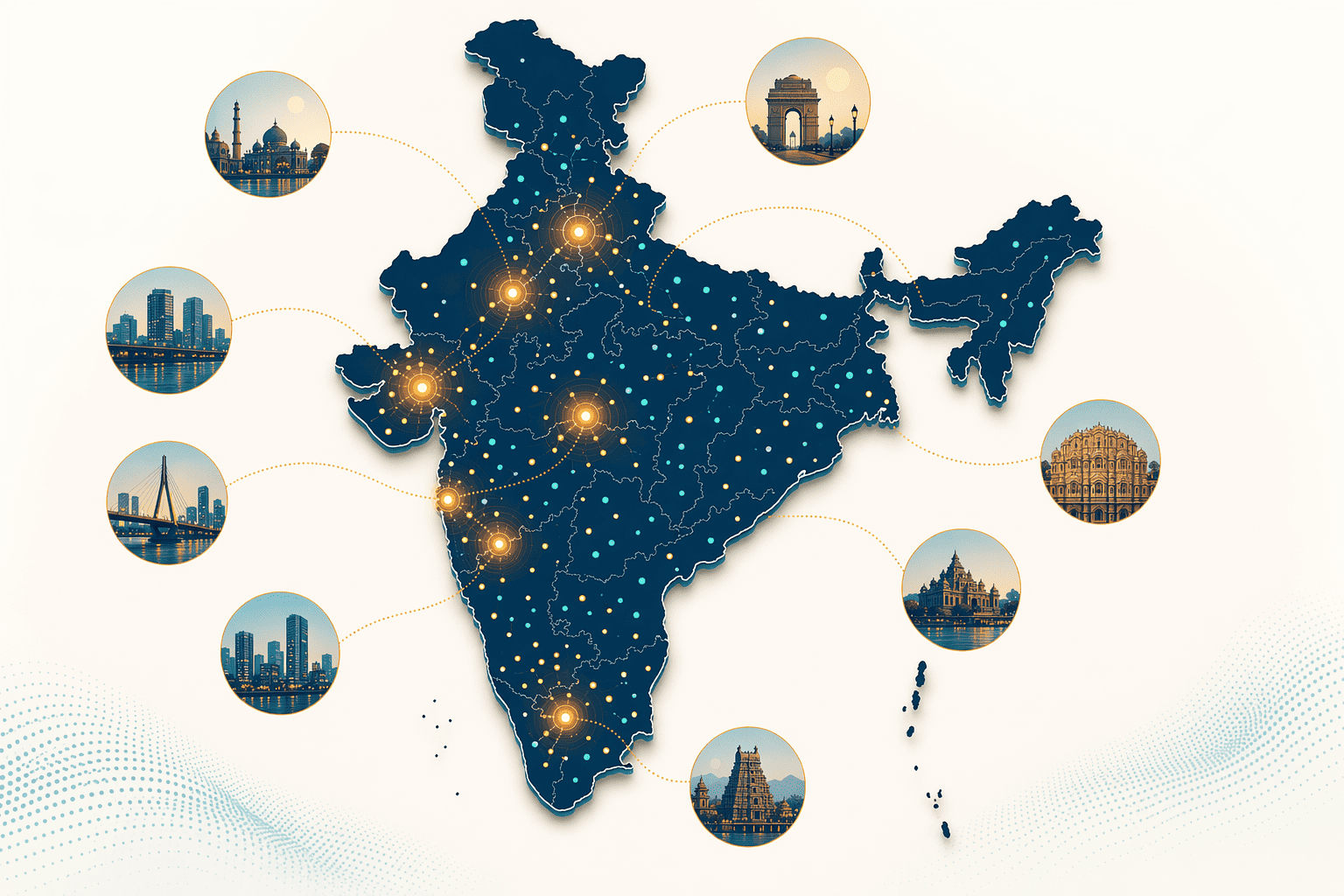
India's B2B buying power extends far beyond Delhi, Mumbai, and Bangalore. Tier 2 and tier 3 cities, Pune, Ahmedabad, Jaipur, Coimbatore, Indore, and hundreds more, account for over 40% of total addressable market (TAM), yet remain underserved by US-centric sales intelligence platforms. Contact fill rates for Indian mid-market and SMB companies in these regions are significantly lower on global databases that optimize primarily for Western markets. When your sales team targets regional manufacturers, distributors, or emerging SaaS buyers, metro-only tools leave your pipeline incomplete.
Regional Coverage Benchmarks: Tool-by-Tool
PeakAi covers 1600+ Indian cities and integrates Ministry of Corporate Affairs (MCA) and GST databases to validate contacts in tier 2/3 regions where public-registry matching matters. Apollo.io offers strong metro coverage but thinner data outside India's top 10 cities. ZoomInfo's enterprise-grade database remains US-centric with limited depth in regional India. Lusha focuses on metro-tier prospecting and does not provide GST/MCA cross-referencing. If your accounts span Tier 2/3 geographies, verify that your chosen platform sources from Indian business registries rather than relying solely on LinkedIn scraping with no local database integration.
LinkedIn Compliance and Account Suspension Risks
LinkedIn restricts automation to 30-40 daily actions; scraper-based tools that circumvent rate limits expose users to permanent account suspension. PeakAi does not scrape LinkedIn directly, it uses LinkedIn URLs as reference identifiers to query independent third-party databases, ensuring compliance with LinkedIn's Terms of Service. Teams that need to automate LinkedIn contact research without restrictions while preserving account safety should prioritize platforms that use legitimate business databases rather than aggressive bot-based extraction.
Conclusion
US-focused platforms like ZoomInfo and Apollo.io offer larger global databases but lower India-specific accuracy due to lack of GST/MCA integration and slower refresh cycles, PeakAi trades global breadth for India-market depth and verification transparency. Pay-per-verified-contact pricing suits Indian startups with fewer than 500 monthly outbound contacts; subscription models win for high-volume teams needing bulk credits, choose based on your outbound cadence, not just monthly fee.
As India's B2B SaaS market matures and DPDP enforcement tightens, sales intelligence vendors will face pressure to disclose verification methodology and regional accuracy breakdowns, buyers who learn to evaluate these frameworks now will avoid costly vendor lock-in with tools optimized for US markets.
Test PeakAi's 91% India-verified contact accuracy with a free sample export, or explore the GST/MCA-integrated workflow in our contact discovery guide to evaluate your current data against the four verification frameworks.
Frequently Asked Questions
How do I validate a sales intelligence vendor's accuracy claims before signing an annual contract?
Request disclosed verification methodology (GST/MCA integration, refresh cycles), ask for India-specific accuracy breakdowns (not aggregated global percentages), test with a free-tier or trial on 50 known contacts, and check G2/Capterra reviews for India-specific user feedback. Tools like PeakAi publish 91% verified accuracy with GST/MCA cross-referencing before contact delivery.
Why does GST and MCA database integration matter for Indian B2B contact accuracy?
GST and MCA databases are India's authoritative corporate registries, allowing tools to verify company existence, director names, and registered addresses in real time. Tools relying only on LinkedIn scraping miss 60-70% of tier 2/3 city contacts not active on LinkedIn. PeakAi's GST/MCA integration validates contacts across 1600+ Indian cities where public-registry matching is critical.
What is the difference between direct-dial and switchboard phone numbers, and why does it matter?
Direct-dial numbers connect to a specific person's desk or mobile (3× higher cold-call connect rate), while switchboard numbers route to receptionists who screen calls. In India, mobile numbers are predominantly direct-dial; landlines are usually switchboard. Tools that distinguish and filter for direct-dial deliver better ROI for cold outreach campaigns.
How often should contact data be refreshed to maintain accuracy in India's high-churn B2B market?
India's 2-3% monthly contact decay rate means quarterly updates leave data 75% accurate after five months. Tools with 7-day refresh cycles maintain 98% accuracy. The difference between weekly and quarterly refresh impacts deliverability and credit efficiency, especially in startup and IT services sectors with high job-change velocity.
What is the difference between pre-download and post-export verification, and how does it affect credit costs?
Pre-download verification checks contact validity before you spend credits (e.g., confidence scoring), while post-export verification validates after download, burning credits on bad data. Post-export models can waste 20-30% of credits on undeliverable emails. Pre-download verification ensures you pay only for verified records.
Do Indian B2B sales intelligence tools comply with DPDP (Digital Personal Data Protection) regulations?
DPDP compliance requires explicit consent for personal data collection and processing. Tools scraping LinkedIn or public sources without user consent may face legal risk. Look for vendors disclosing DPDP-compliant data sourcing, opt-in databases, GST/MCA public registries, though few platforms currently publish India-specific compliance documentation.
Sources
- Best Sales Intelligence Tools in 2026: ZoomInfo vs Apollo vs Cognism vs Clay vs Lusha Compared - surferstack.com (2026)
- Lusha vs Apollo vs ZoomInfo: B2B Contact Data Compared - theautomationsguide.com (2026)
- Best Lead Generation Tools India 2026 - www.itforsme.in (2026)
- Best B2B Data Providers in 2026: Apollo vs ZoomInfo vs Clay vs Cognism - techstackreviews.net (2026)
- Apollo.io Review 2026 - CRM & Sales - Product Growth Intelligence - productgrowth.in (2026)
- ZoomInfo Review: Features, Pricing, Pros & Cons - techrepublic.com
