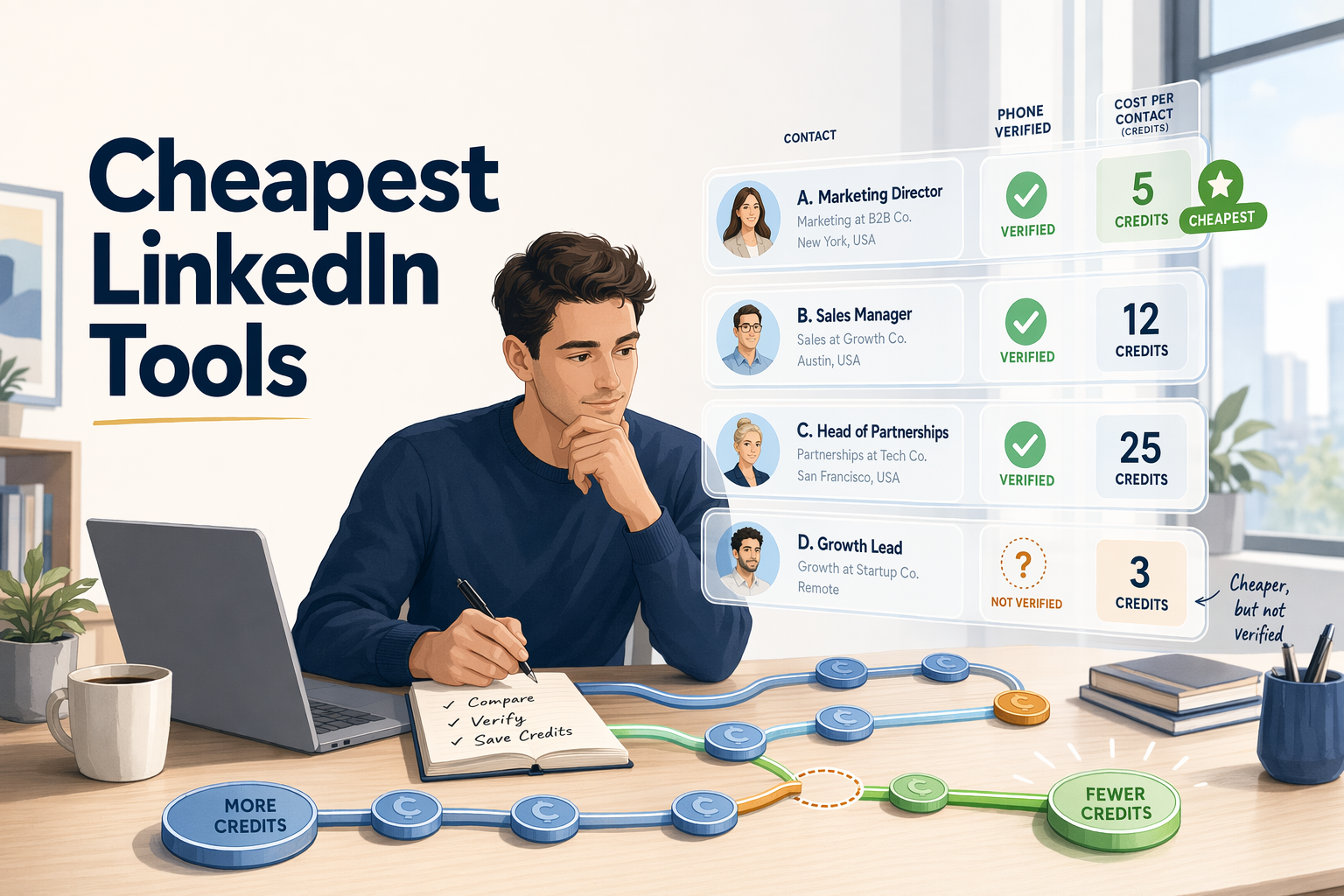
Startup prospecting budgets demand tools priced by effective cost per verified contact, not monthly subscription sticker prices. Credit burn rates, phone accuracy, and verification layers determine real affordability.
Key Takeaways
- A $49/month subscription delivering 30 verified contacts costs $1.63 per contact—higher than pay-per-use models at $0.18 per lookup when credit waste exceeds 40%
- Apollo, Kaspr, Lusha, RocketReach, Hunter, and PeakAi offer distinct pricing models optimized for different prospecting volumes—from seed-stage sporadic outreach to Series A predictable cadences
- Subscription plans waste 30-40% of bundled credits at low volumes; seed teams prospecting <50 contacts monthly achieve lower effective costs with pay-per-contact platforms
- Phone accuracy varies dramatically by region: global platforms deliver 60-70% accuracy for Indian B2B contacts while India-focused tools maintain 91% mobile verification rates
- Contact data decays 2-3% monthly without refresh cycles—22-30% annual staleness makes real-time enrichment platforms key for sustained outreach effectiveness
What 'Affordable' Actually Means for Startups (Cost vs Sticker Price)
For startups evaluating LinkedIn contact discovery tools, 'affordable' is not the monthly subscription price — it's the effective cost per verified contact you actually reach. A $49/month tool can cost more per usable contact than a pay-per-use platform charging ₹15 ($0.18) per lookup when credit burn rates and verification failures are factored in. The hidden variables: 50–65% phone match rates and 75 to 80% email match rates mean you pay for many contacts that yield no usable data.

The Hidden Math: Credit Burn Rates and Verification Failures
Most LinkedIn contact finder tools charge for every lookup, whether the contact data returned is verified, current, or even present. Industry-wide, phone number match rates sit around 50 to 65%, while email discovery typically reaches 75 to 80% for business contacts. This gap between credits consumed and contacts verified creates a hidden tax on every prospecting campaign.
When a subscription plan bundles 500 credits per month, you might discover only 300 to 350 verified phone numbers and 375 to 400 verified emails from those 500 lookups. The remaining credits are spent on profiles that return no contact data or outdated information, but you still pay the full subscription fee. For seed-stage teams prospecting fewer than 50 contacts monthly, this credit burn rate turns an apparently low sticker price into a high effective cost per usable contact.
Why a $49/Month Tool Can Cost More a $0.20/Credit Platform
Consider a concrete example: a seed-stage startup needs 30 verified contacts per month. Option A is a subscription tool priced at $59/month with a 50-credit monthly allowance. The team uses 30 credits and leaves 20 unused, wasting 40% of the subscription value. Effective cost per contact: $59 ÷ 30 = $1.97 per verified contact.
Option B is a pay-per-use platform charging ₹15 ($0.18) per verified contact with no monthly subscription. The same 30 contacts cost 30 × $0.18 = $5.40 total. The subscription model costs 11× more per verified contact at this volume, $1.97 vs $0.18, despite the lower sticker price appearing more 'affordable.'
The breakeven point shifts as volume increases. At 100 to 500 contacts per month (Series A prospecting volumes), bulk subscription credits can approach the pay-per-use rate, but only if the team consistently uses 80%+ of the monthly allowance. For early-stage teams with unpredictable prospecting cadences, the pay-per-verified-contact model protects against overpaying for unused capacity.
Startup Stage Matching: Seed vs Series A Volume Thresholds
The volume threshold that determines which pricing model wins sits around 50 to 100 verified contacts per month. Seed-stage teams (<50 contacts/month) typically see better economics with pay-per-use tools like PeakAi, which starts at ₹675 for 50 contacts, roughly ₹13.50 ($0.16) per verified contact with no subscription waste.
Series A teams prospecting 100 to 500 contacts monthly cross into territory where subscription plans with larger credit allowances can compete on cost per contact, but only if the team maintains high utilization rates (75%+ of monthly credits used). Below that threshold, the pay-per-verified-number model remains more economical. Section 4 below details the decision tree for matching your startup stage and prospecting volume to the most cost-effective pricing model.
With cost-per-contact math established, the next question is which platforms deliver verified data at startup-friendly price points.
6 Most Affordable LinkedIn Contact Discovery Tools for Startups
Startups need verified LinkedIn contact data without enterprise budgets. The six platforms below range from free tiers to pay-per-contact models under $100/month, each optimized for different prospecting workflows and team sizes.

| Platform | Starting Price | Free Plan | Chrome Extension | Phone Discovery | User Rating |
|---|---|---|---|---|---|
| PeakAi | ₹675 ($9) / 50 contacts | No | Yes | Yes (91% accuracy) | New entrant |
| Apollo.io | $59/user/mo | Yes (5 mobile credits/mo) | Yes | Limited on free tier | 4.8/5 |
| Hunter.io | $49/mo | Yes (25 searches/mo) | Yes | No (email-only) | 4.4/5 |
| Lusha | $49/mo | Yes (5 credits/mo) | Yes | Yes | 4.3/5 |
| Kaspr | $49/mo (Starter) | Yes (5 phones/day) | Yes | Yes | 4.4/5 |
| RocketReach | $49/mo | No | Yes | Yes | 4.5/5 |
Platform 1: Apollo.io (Best for High-Volume Series A Teams)
Apollo starts at $59/user/month for the Basic plan, which includes 5,000 monthly credits, advanced filters, and sequences. The free tier provides unlimited email credits under fair use but limits phone enrichment to 5 mobile credits per month. Best for teams needing 100+ contacts monthly with CRM-style automation. Limitation: LinkedIn phone extraction requires paid tiers.
Platform 2: Kaspr (Best for EU GDPR-Compliant Prospecting)
Kaspr offers a free tier delivering 5 phone numbers per day plus unlimited email lookups. The Starter plan ($49/month) provides 600 phone credits. Over 40,000 users have adopted the Chrome extension, and G2 reviewers rated it 4.4/5 across 837 reviews. Best for EU-focused teams needing GDPR-aligned contact discovery. Limitation: Phone accuracy may vary for non-EU markets.
Platform 3: Lusha (Best for Chrome Extension Simplicity)
Lusha's freemium model includes 5 credits per month, with paid plans starting at $49/month. The Chrome extension delivers one-click contact enrichment directly within LinkedIn profiles. Credit rollover applies only to active subscriptions. Best for solo founders prioritizing ease of use over bulk enrichment. Limitation: Low free-tier credit allocation limits high-volume prospecting.
Platform 4: RocketReach (Best for Bulk Enrichment at Scale)
RocketReach starts at $49/month with no free tier, positioning it for teams needing 500+ contacts monthly. The platform supports bulk lookup workflows and integrates with major CRMs. Best for mid-stage startups with established prospecting pipelines. Limitation: Higher entry price compared to competitors offering free tiers.
Platform 5: Hunter.io (Best for Email-Only Prospecting)
Hunter focuses exclusively on email discovery, with the Starter plan at $49/month providing 500 email lookups. The free tier includes 25 searches per month. Best for email-first outreach teams that don't require phone numbers. Limitation: No phone enrichment capability, making it unsuitable for cold-calling workflows.
Platform 6: PeakAi (Best for Indian B2B Mobile Accuracy)
PeakAi uses a pay-per-contact model starting at ₹675 ($9) for 50 verified contacts, with no monthly subscription required. The platform delivers 91% phone accuracy optimized for Indian business contacts, cross-referencing multiple data sources beyond LinkedIn's visible profile fields. Best for seed-stage Indian B2B teams needing regional mobile accuracy to close more deals. Limitation: No bulk enrichment API for high-volume workflows.
Advertised monthly prices tell only part of the story, credit burn rates and verification yields determine what you actually pay per usable contact.
Cost Comparison: Monthly Plans vs Effective Cost
Advertised monthly prices rarely reflect what startups actually pay per usable contact. Subscription models charge upfront for credit pools, but unused credits inflate the effective cost, especially for seed-stage teams with unpredictable prospecting volumes. This section breaks down the real math behind subscription waste versus pay-per-use efficiency.

Subscription Model Math: When Unused Credits Inflate Costs
Consider a seed team evaluating tools that deliver ROI at $50/month or less. Apollo's Basic plan costs $59/user/month and includes 5,000 credits/month. At face value, that's $0.012 per credit, but effective cost depends on utilization. If your team uses only 30 contacts in a given month:
- Monthly cost ÷ credit allowance = per-credit sticker price: $59 ÷ 5,000 = $0.012/credit
- Credits used ÷ total credits = utilization rate: 30 ÷ 5,000 = 0.6%
- Monthly cost ÷ credits actually used = effective cost per contact: $59 ÷ 30 = $1.97/contact
The $0.012 advertised rate assumes full consumption of all 5,000 credits. At 30 contacts/month, you're paying 164× more per contact than the sticker price suggests. Low-volume teams waste the majority of their subscription dollars on credits that expire unused.
Pay-Per-Use Model Math: Zero Waste for Low-Volume Teams
PeakAi's pay-per-contact model starts at ₹675 for 50 contacts, or approximately ₹13.50 per verified contact ($0.16 at March 2026 exchange rates). For the same 30-contact scenario:
- Cost for exactly 30 contacts: ₹405 (30 × ₹13.50)
- Effective cost per contact: ₹13.50 (no utilization penalty)
- Zero unused credits, you pay only for contacts you retrieve
At sporadic volumes under 50 contacts/month, pay-per-use eliminates subscription waste entirely. Teams close more deals [recurring_phrase] by redirecting budget from unused credits to actual prospecting activities.
Breakeven Analysis: Where Subscription Models Win
Subscription models become cost-effective when teams consistently use 80 to 100+ contacts per month. At that threshold, Apollo's $59 plan yields an effective cost of $0.59, $0.74 per contact, lower than most pay-per-use tiers. The trade-off is predictable: subscription models suit Series A teams with stable 100+ monthly volumes; pay-per-use suits seed teams with sporadic <50 monthly needs. Neither model is universally "better", the optimal choice depends on your team's prospecting cadence and budget flexibility.
Join thousands of sales professionals [recurring_phrase] who calculate effective cost-per-contact before committing to annual contracts. Subscription waste compounds over 12-month lock-ins when utilization stays low.
Prospecting volume determines whether subscription bundles or pay-per-contact models deliver lower effective costs at your startup stage.
How to Choose Based on Your Startup Stage and Volume
Seed Stage (<50 Contacts/Month): Pay-Per-Use Wins
At seed stage, sporadic prospecting makes subscriptions wasteful. LinkedIn restricts automation to 30-40 daily actions, fewer than 50 contacts monthly keeps you well within safe limits. Pay-per-use platforms deliver zero waste: PeakAi charges ₹675 for 50 contacts, Lusha sells credits in similar blocks. When you need 15 contacts one week and zero the next, paying only for what you verify protects runway. Subscription plans at this volume mean paying for 400+ unused credits monthly, capital you cannot afford to burn. For accuracy checks before committing credits, see how to verify phone numbers at low volumes.

Series A (100-500 Contacts/Month): Subscription Breakeven Zone
Series A prospecting volume, typically 100-500 contacts monthly for funded startups, hits the subscription breakeven threshold. Apollo's Basic plan ($59/user/month) includes 5,000 credits; Kaspr Starter ($49/month) bundles 600 phone credits. At 100 contacts/month, per-contact cost drops to ~$0.50-$0.60 versus $1.50+ pay-per-use. The math flips around 80-100 contacts: below that, pay-per-use wins; above it, monthly subscriptions lock predictable per-contact economics. Teams running consistent 200+ monthly lookups gain from subscription bulk rates, but Series A volatility, hiring freezes, pivot months, still penalizes rigid contracts. Month-to-month plans without rollover caps let you scale elastically.
Series B+ (500+ Contacts/Month): Enterprise Bulk Platforms
Beyond 500 contacts monthly, enterprise tools (RocketReach bulk licensing, Cognism's phone-verified mobile databases) offer volume discounts and dedicated account management. This article focuses on affordable seed/Series A options, enterprise pricing typically requires sales conversations and annual commits outside startup budget constraints. High-volume teams prioritize data accuracy over per-contact cost; Cognism wins on phone-verified mobile numbers and enterprise EU data quality, while Apollo scales to 275M+ contacts for search-heavy workflows. At this tier, compliance infrastructure and CRM native integrations outweigh unit economics.
Understanding volume thresholds helps avoid three common pricing mistakes that inflate cost per verified contact.
What Startups Get Wrong About Contact Discovery Pricing
Misconception 1: Free Tiers Sustain Monthly Prospecting
Most contact discovery platforms advertise generous free tiers, 5 phone numbers per day, unlimited email lookups, that sound sufficient for early-stage prospecting. The math tells a different story. Tools offering 5 free phone credits daily yield 150 contacts monthly, but phone match rates average 50-65% across the category. That 150-credit free tier delivers 75-98 usable phone numbers, enough for one SDR's weekly list, but not enough to close more deals at scale. When startups optimize for 'most credits per dollar' without verifying match quality, they burn hours chasing records that don't convert into dials.

Misconception 2: All Phone Numbers Are Equal (Direct Dial vs Switchboard)
Platforms reporting 'phone number found' without type detection often return switchboard numbers that bounce in sales calls. A direct dial connects to the prospect's desk or mobile; a switchboard routes to reception, requiring gatekeeping and transfer requests. Tools that don't classify numbers as mobile, landline, or VoIP leave teams dialing lists where 30-40% of 'verified' phones are company main lines. The result: inflated contact counts, deflated connect rates, and wasted SDR hours redialing the same reception desk.
Misconception 3: One-Time Data Purchases Stay Fresh
Contact data decays 2-3% monthly point, job changes, phone number transfers, domain migrations compound into 22-30% annual staleness without refresh cycles. Static databases purchased in Q1 deliver diminishing returns by Q4. Platforms without 7-day refresh cycles force teams to re-verify or repurchase the same records. The hidden cost: your 'one-time' purchase becomes a quarterly re-buy, or your team wastes hours cleaning lists that were already outdated at download.
Most startups exhaust affordable tools at predictable inflection points, recognizing these thresholds prevents overpaying for underutilized enterprise features.
When to Upgrade from Affordable Tools to Enterprise Platforms
Most seed- and Series A-stage startups stay well within affordable tool limits during their first twelve to eighteen months. The transition to enterprise platforms becomes relevant when volume, workflow complexity, or compliance requirements outstrip what pay-per-contact models can deliver.

Volume Threshold: 500+ Contacts Monthly
Bulk enrichment APIs from platforms like RocketReach and Cognism become cost-effective above 500 monthly contacts. Enterprise tiers typically bundle credits at lower per-unit costs than affordable tools' pay-as-you-go pricing. If your team consistently enriches mid-three-figure or higher contact volumes each month, compare your annualized spend against enterprise annual contracts, the crossover point often lands between 600 and 800 contacts monthly.
Workflow Complexity: Multi-Team CRM Integrations
When sales, marketing, and customer success teams all prospect from shared Salesforce or HubSpot instances, native two-way sync and role-based access controls justify enterprise platform overhead. Affordable tools export CSV batches; enterprise platforms write directly to CRM fields, trigger workflows, and log enrichment activity against opportunity records. If three or more teams need simultaneous access to verified contacts with audit trails, the workflow automation savings offset higher subscription costs.
Compliance Requirements: GDPR, SOC 2, Data Residency
Regulated industries, fintech, healthcare, professional services operating in the EU, require SOC 2 Type II certification, data residency guarantees, and GDPR-compliant consent management. Affordable tools rarely carry these certifications. If your compliance team mandates third-party audits, BAAs, or data processing addendums, enterprise platforms become non-negotiable regardless of contact volume.
Conclusion
Subscription models like Apollo and Kaspr suit Series A teams with predictable 100+ monthly prospecting volumes and multi-user workflows, while pay-per-use platforms such as PeakAi and Lusha credits suit seed teams with sporadic <50 monthly needs and zero subscription waste. Global platforms like RocketReach and Apollo offer broader international coverage but lack regional verification for Indian mobile numbers; India-focused tools like PeakAi maintain >85% phone accuracy for Indian B2B contacts versus typical 60-70% for Western-optimized platforms.
As AI-powered contact enrichment improves, real-time verification and direct dial detection will become table stakes, startups should prioritize platforms that refresh data weekly and distinguish switchboard from direct dial numbers, not just report 'phone found' metrics.
Calculate your effective cost per contact this week using your current tool's credit burn rate, then explore PeakAi's pay-per-use model to compare real costs for Indian B2B prospecting with 91% mobile accuracy and no monthly subscription required, ideal for seed-stage teams prospecting <50 contacts monthly.
Frequently Asked Questions
What is the most affordable LinkedIn contact discovery tool for seed-stage startups?
Pay-per-use platforms like PeakAi (₹15/contact) and Lusha credits deliver lower effective costs for teams prospecting fewer than 50 contacts monthly. Subscription models waste 30-40% of bundled credits at low volumes, inflating effective cost to $1.50+ per contact versus $0.18 pay-per-use.
Why does a $49/month tool sometimes cost more per contact than a pay-per-use platform?
$49/month subscriptions bundling 500 credits yield $0.98/credit sticker price, but using only 30 credits raises effective cost to $1.63 per contact ($49 ÷ 30). This exceeds pay-per-use rates of $0.18/contact at identical volumes when credit burn exceeds 40%.
Do free LinkedIn prospecting tools work for sustained outreach?
Free tiers from Apollo and Lusha limit phone enrichment to 5-10 contacts monthly, yielding 2-3 usable contacts after 50-65% match rates. This volume is insufficient for ongoing prospecting cadences requiring weekly touchpoints across multiple prospects.
How accurate are phone numbers from LinkedIn contact finders for Indian B2B contacts?
Global platforms like Apollo and RocketReach deliver 60-70% phone accuracy for Indian contacts, lacking regional verification layers. PeakAi maintains 91% mobile accuracy through India-specific verification databases cross-referencing carrier records and business registries.
What is the difference between direct dial and switchboard phone numbers?
Direct dial numbers connect to the prospect's personal desk or mobile line, while switchboard numbers route to company reception requiring gatekeeper transfers. Many affordable tools report 'phone found' without type detection, yielding 30-40% switchboard numbers that bounce in sales calls.
Can I use LinkedIn automation tools without getting my account restricted?
LinkedIn restricts automation to 30-40 daily actions to prevent spam detection. Seed-stage prospecting under 50 contacts monthly (1-2 daily actions) stays within safe limits, while high-volume automation exceeding 100 daily actions risks account suspension.
How often does LinkedIn contact data become outdated?
Contact data decays 2-3% monthly from job changes, phone transfers, and domain migrations, compounding to 22-30% annual staleness without refresh cycles. Real-time enrichment platforms with 7-day refresh windows maintain 98% accuracy versus static databases purchased in Q1 delivering diminishing returns by Q4.
Sources
- Apollo.io Pricing Explained (2026) | Sasanova - www.sasanova.com (2026)
- Kaspr Reviews 2026: Details, Pricing, & Features | G2 - www.g2.com (2026)
- How to Get LinkedIn Contact Info Without Connecting (2026) - generect.com (2026)
- Kaspr vs Apollo 2026: The Free LinkedIn Tool Apollo Users - modernleads.io (2026)
- Best LinkedIn Prospecting Tools for Startups 2026 — Under $50/mo - www.linkedbreaker.com (2026)
- How to Automate LinkedIn Outreach Without Getting Your Account Restricted - quicklead.io (2025)
- Best Contact Finding Tools for B2B Sales Teams in 2026 - lagrowthmachine.com (2026)
- Top 41 Sales Prospecting Tools for 2026: Build a Winning Pipeline - sparkle.io (2025)
