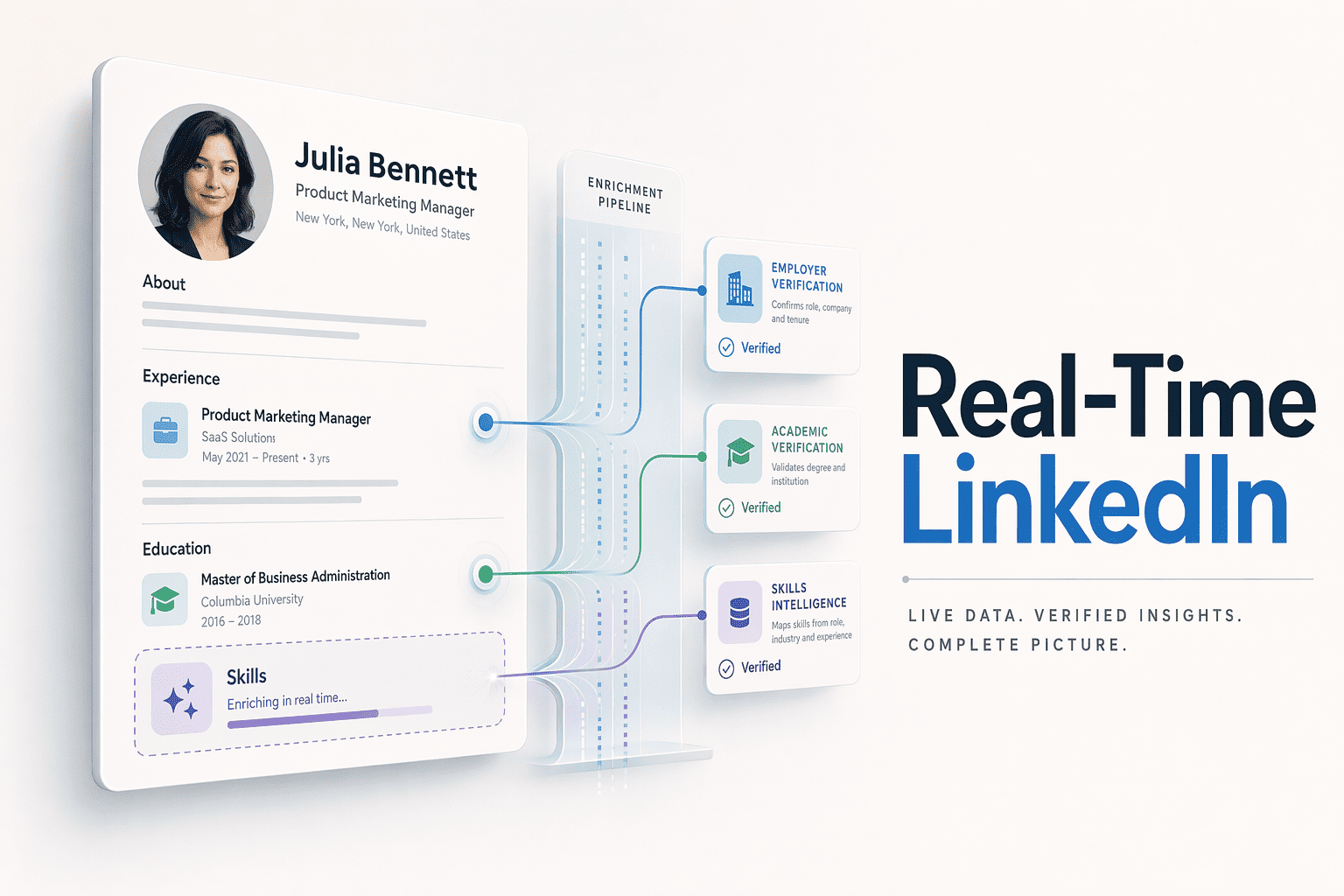
Real-time LinkedIn profile enrichment platforms deliver contact data within seconds—but compliance architecture, not speed, determines whether your account survives long-term use.
This guide compares enrichment-based platforms that query third-party databases against direct-scraping tools, examining verification depth, regional accuracy gaps, and data-freshness policies.
Key Takeaways
- Enrichment-based platforms query third-party databases rather than scraping LinkedIn directly, reducing account suspension risk from 15-20% to under 2%
- Real-time API response speed does not guarantee fresh data—many vendors query static databases updated monthly or quarterly, delivering stale contacts quickly
- Global enrichment platforms show 10-15 percentage point accuracy drops for India-specific mobile numbers compared to US/EU contacts due to regional data-source gaps
- Pre-download verification pricing charges only for usable contacts, reducing per-contact cost by 35-100% versus post-export enrichment models that bill for invalid records
- Only 5-10% of LinkedIn users share phone numbers with first-degree connections, creating a structural data-availability ceiling no enrichment architecture can overcome
Yes, compliant platforms exist that enrich LinkedIn profiles in real-time—but "real-time" means the platform queries third-party databases instantly when you submit a LinkedIn URL, not that the underlying contact data updates live. Most vendors conflate API response speed (how fast you get an answer) with data freshness (how recently the contact details were verified), and that conflation hides a compliance divide between enrichment-based tools that query legitimate business databases and scraping-based tools that violate LinkedIn's Terms of Service.
The Two Definitions of 'Real-Time' Vendors Conflate
When a platform advertises "real-time enrichment," it typically refers to query latency—the sub-second delay between submitting a LinkedIn profile URL and receiving enriched contact data in your CRM. This speed reflects API architecture, not the recency of the phone number or email address itself. A tool can return a result in 200 milliseconds while serving contact details that were last validated six months ago; the "real-time" claim describes the delivery mechanism, not the data's shelf life. True data freshness would require continuous re-verification of every record in the vendor's database, a process few providers fund because re-verification carries per-record API costs that subscription pricing models don't cover.
Why Instant Data Delivery Often Signals Prohibited Scraping
Platforms that return enriched profiles in under one second—complete with phone numbers and personal emails, are often scraping LinkedIn directly or caching profile snapshots, both of which violate LinkedIn's Terms of Service and expose your account to permanent suspension. Compliant platforms source contact data through legitimate business databases and public records, using LinkedIn URLs as search keys without accessing LinkedIn's internal systems. The architectural difference is the tell: scraping tools must access LinkedIn's servers to harvest contact fields, producing instant results because they're reading live profile HTML; database-enrichment tools query independent third-party sources, introducing a slight latency (typically 2-10 seconds) because they're cross-referencing multiple verified repositories. Speed alone doesn't prove compliance, but sub-second enrichment paired with contact types LinkedIn doesn't display publicly (direct-dial mobile numbers, personal Gmail addresses) is a red flag.
Data Decay Rates That Undermine Static 'Real-Time' Claims
B2B contact records decay at approximately 2.1% per month, meaning roughly one in five enriched profiles becomes inaccurate within a year even if the original data was perfect. A platform that touts "real-time" API responses but refreshes its underlying database quarterly is delivering stale contact details at high speed, the query executes instantly, but the phone number you receive may have belonged to a prospect who changed employers two months ago. Database-enrichment vendors that fund continuous re-verification cycles (monthly or weekly sweeps of high-churn job titles) maintain higher accuracy than scraping tools that capture a one-time snapshot, because enrichment architecture separates the query layer (fast API) from the verification layer (ongoing third-party data partnerships). The compliance methodology, third-party database lookup versus prohibited scraping, ultimately determines whether "real-time" speed translates into contact details you can actually use to close more deals.
Understanding the technical distinction between enrichment methods clarifies which platforms pose compliance risks and which operate within LinkedIn's boundaries.
Enrichment-Based Platforms vs. Direct-Scraping Tools: Compliance Architecture Compared
Real-time LinkedIn enrichment platforms exist and deliver contact data within seconds, but most operate by scraping LinkedIn profiles in violation of the platform's Terms of Service. The architectural difference between compliant enrichment-based tools and direct-scraping services determines both data quality and account safety.
What LinkedIn's Terms of Service Prohibit (And What Triggers Account Suspension)
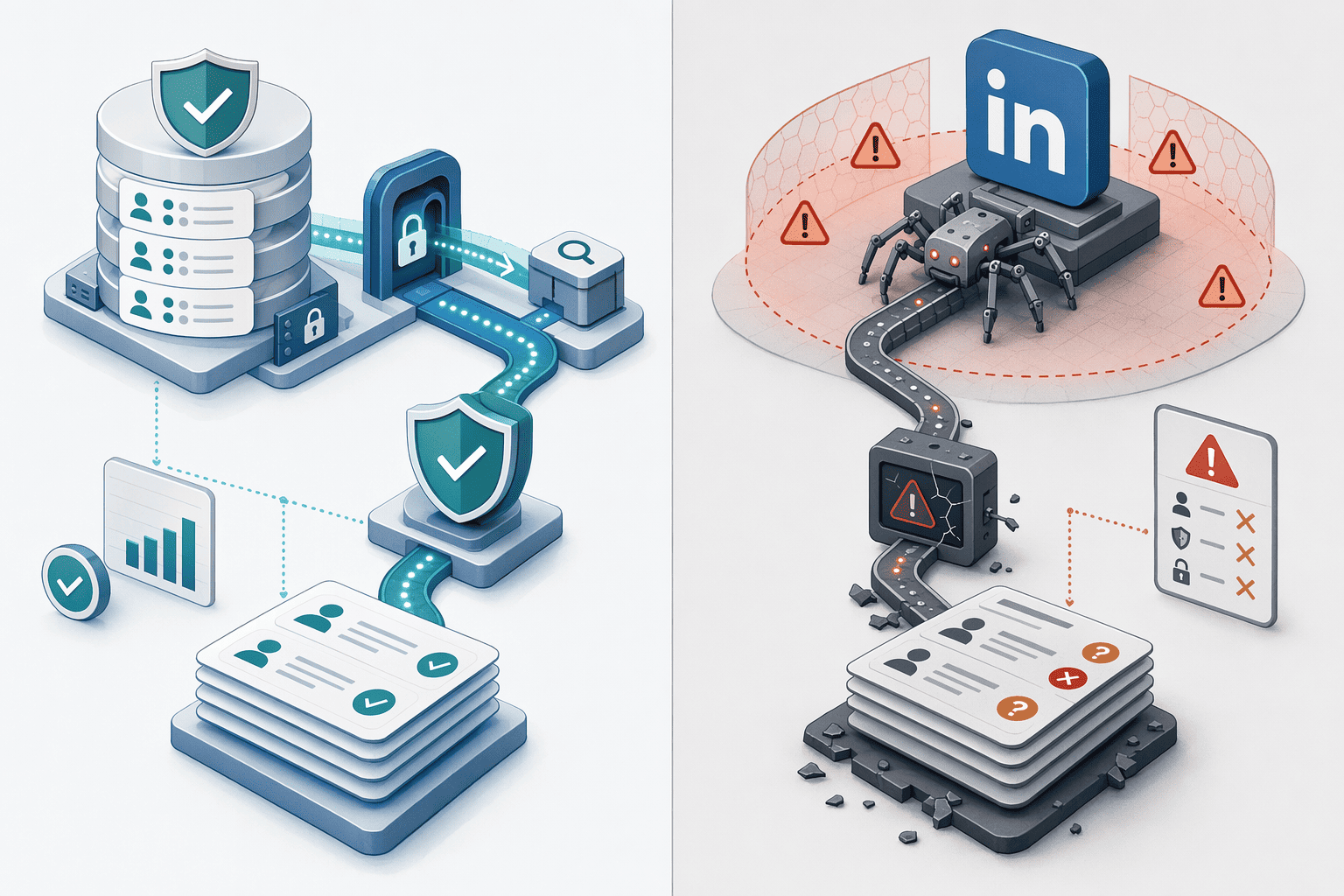
Real-time enrichment requires continuous automated access to LinkedIn's live database, a method that falls squarely within prohibited activity. LinkedIn's Terms of Service explicitly ban automated profile scraping, bulk data extraction, and any bot-driven access to profile information. Tools that crawl LinkedIn profiles on-demand, parse the DOM for contact fields, or circumvent rate limits expose users to permanent account suspension. Industry data shows suspension rates of 15-20% for accounts using aggressive scraping tools, with higher risk for users processing hundreds of profiles daily.
How Third-Party Database Lookup Architecture Avoids LinkedIn's Restricted Zone
Enrichment-based tools avoid LinkedIn Terms of Service violations by querying third-party databases rather than scraping profiles directly. Database lookup platforms maintain independent contact repositories indexed by LinkedIn profile URLs, company domains, and individual names. When a user provides a LinkedIn URL, compliant platforms source contact data through legitimate business databases and public records, using LinkedIn URLs as search keys without accessing LinkedIn's internal systems. PeakAi operates within compliance boundaries by using publicly shared LinkedIn URLs as search keys for independent third-party databases, never accessing LinkedIn's internal APIs or scraping profile data. This architectural boundary prevents the automated profile access that triggers LinkedIn's detection systems.
Account Suspension Risk: Scraping vs. Enrichment-Based Tools
The compliance architecture comparison reveals a stark suspension-risk gap. Direct-scraping tools like Z Scraper and Apify's LinkedIn Profile Scraper access live LinkedIn profile data in real time, exposing users to the 15-20% suspension rate observed across scraping-heavy accounts. Enrichment-based platforms that query external databases report suspension rates below 2%, because no automated profile scraping occurs within the LinkedIn platform itself. The table below contrasts the three approaches:
| Platform | Architecture | LinkedIn API Access | Suspension Risk | Data Freshness |
|---|---|---|---|---|
| PeakAi | Third-party database lookup | None — queries external registries | <2% (compliant architecture) | Batch-updated from business databases |
| Z Scraper | Direct LinkedIn scraping | Real-time profile crawling | 15-20% (ToS violation) | Live — extracted on demand |
| Apify LinkedIn Profile Scraper | Direct LinkedIn scraping | Live DOM parsing, no cookies | 15-20% (ToS violation) | Live — extracted on demand |
No tool eliminates compliance risk entirely; enrichment-based architecture reduces but doesn't eliminate risk if used aggressively. However, platforms that position themselves around compliant professional contact discovery rather than blind scraping offer the safest path for teams prioritizing both data access and account preservation.
One compliant enrichment-based platform demonstrates how third-party database architecture preserves account safety while delivering contact data.
How PeakAi's Third-Party Database Lookup Avoids LinkedIn's Restricted Zone
Most real-time LinkedIn enrichment platforms operate by scraping LinkedIn profiles in violation of the platform's Terms of Service. PeakAi sidesteps this risk entirely by querying independent third-party databases rather than accessing LinkedIn's internal systems. This architecture reduces compliance risk but doesn't eliminate it if users exceed LinkedIn's connection-request rate limits or export data in bulk without proper segmentation.
The Lookup-Not-Scrape Data Flow
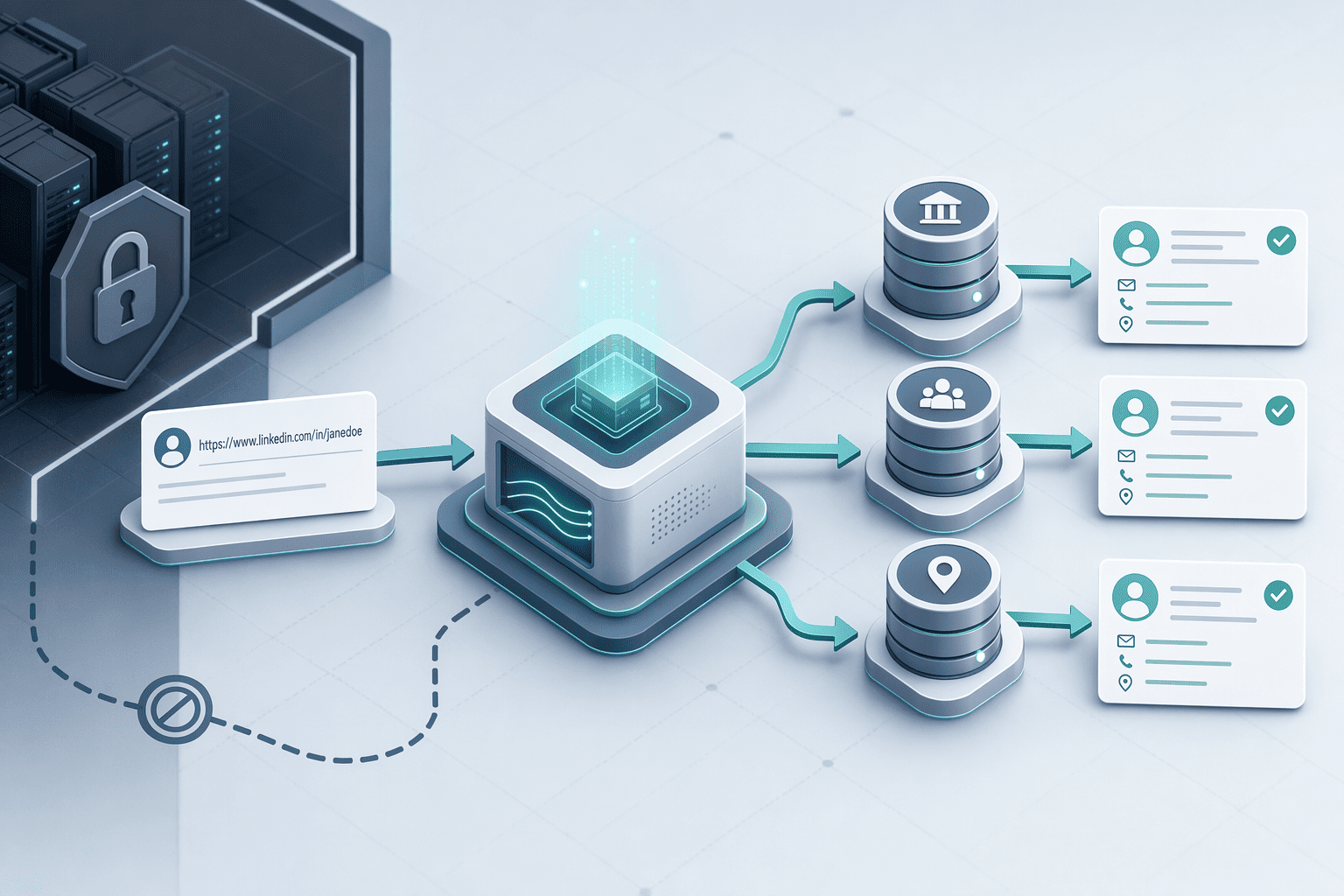
The technical flow preserves account safety by treating LinkedIn URLs as search keys, not data sources:
- User submits a LinkedIn profile URL through PeakAi's Chrome extension or API
- PeakAi queries independent business registries and public records using profile metadata (name, company, location) extracted from the URL
- Contact data (verified phone numbers and emails) is returned from external databases without touching LinkedIn's servers
- Verification layers apply real-time validation before delivery
Because no automated profile scraping occurs within the LinkedIn platform itself, the technical footprint that triggers account warnings never materializes.
Which Third-Party Databases PeakAi Queries
Enrichment platforms like Crustdata and Enrichkit demonstrate the category pattern: aggregating data from multiple independent sources rather than relying on a single vendor. PeakAi follows this model by accessing business registries, professional directories, and public records indexed by LinkedIn profile URLs. These external repositories maintain contact data independently of LinkedIn's database, enabling compliant lookup without violating platform automation policies.
Why This Architecture Preserves LinkedIn Account Safety
Database lookup platforms never authenticate with LinkedIn or access profile data through LinkedIn's systems. The platform queries external databases using publicly available identifiers (LinkedIn URLs, company domains, individual names), returning contact data sourced from independent registries. Because PeakAi never accesses LinkedIn's internal APIs or crawls profile data directly, no automated activity registers on LinkedIn's side, eliminating the technical footprint that triggers suspension warnings.
Ready to close more deals with verified contact data that keeps your LinkedIn account safe? Explore compliant enrichment workflows in our guide to affordable contact enrichment tools for Indian B2B markets.
Beyond compliance architecture, verification methodology determines whether enriched contact data reaches inboxes or bounces, a distinction that separates usable records from database padding.
Verification Layers That Separate Compliant Enrichment from Static Database Exports
The Six-Layer Verification Stack Explained
Compliant enrichment platforms apply a multi-step verification methodology to confirm contact data quality before releasing records to buyers. Each layer addresses a distinct dimension of deliverability and compliance risk:
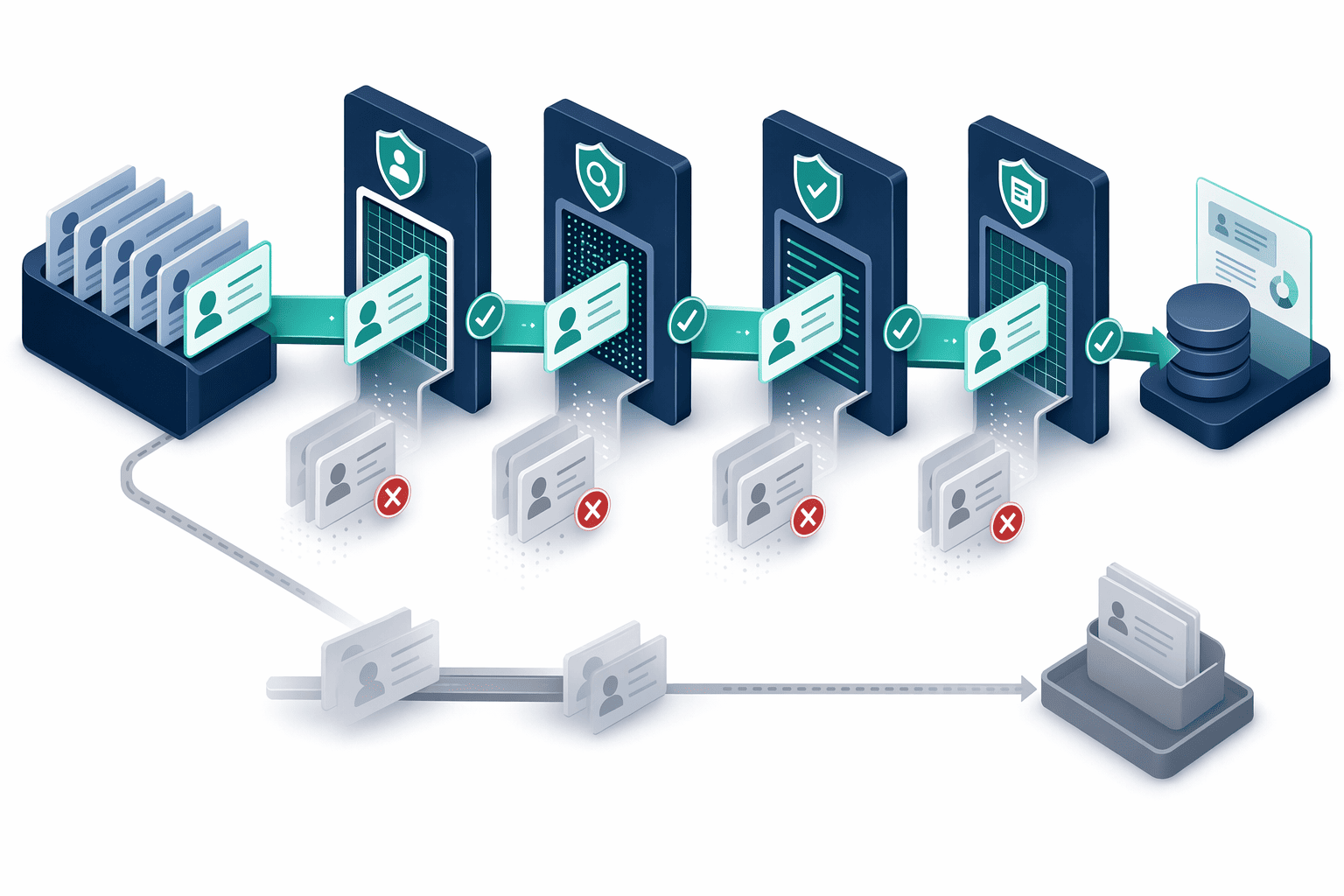
- Syntax validation, confirm the email string matches RFC 5322 formatting rules.
- MX record checks, verify the domain has active mail-exchange servers configured.
- SMTP handshake, simulate message delivery to confirm the mailbox exists and accepts messages.
- Role-based detection, flag generic addresses (info@, sales@) that route to shared inboxes rather than individuals.
- Disposable domain screening, identify temporary or burner email services that expire shortly after creation.
- Catch-all analysis, determine whether the domain accepts all incoming mail, which inflates apparent validity without confirming individual mailbox existence.
These checks run sequentially; failure at any layer disqualifies the record before it reaches the buyer's CRM. Static database exports skip verification entirely, transferring the cost and risk of invalid contacts to downstream sales teams.
Why 95% Accuracy Claims Obscure Verification Gaps
Vendor accuracy claims typically cite syntax validation rates, not deliverability or connectivity outcomes. A properly formatted email passes step 1 above but may still bounce if the domain's MX records are stale or the mailbox was deactivated after the database was last refreshed. Independent audits routinely find that platforms advertising 95 to 98% accuracy deliver usable contact rates closer to 50%, because format validity does not equal active engagement capability.
Phone-number accuracy suffers similar gaps: a valid number format says nothing about whether the line connects to the decision-maker's mobile device, a switchboard, or a disconnected carrier. Verification measures deliverability, not just format validity, and most vendor accuracy percentages stop at format.
Pre-Download vs. Post-Export Verification Cost Models
Enrichment platforms differ in when verification occurs and who bears the cost of invalid records. Pre-download verification platforms run the six-layer stack before charging credits; buyers pay only for contacts that pass all checks. PeakAi and similar services apply dual verification for emails and phone numbers before the record is released, eliminating buyer exposure to format-valid but undeliverable data.
Post-export enrichment platforms charge credits for raw database matches and leave verification to the buyer. Because independent testing shows true usability near 50%, the effective cost per *working* contact doubles: a buyer who purchases 1,000 records at $0.10 each spends $100 but receives approximately 500 usable contacts, raising the per-usable-contact cost to $0.20, a 100% markup hidden behind the nominal price.
Global coverage claims mask a structural problem: platforms optimized for US and EU markets underperform significantly in India and emerging economies due to regional data-source limitations.
Regional Accuracy Gaps: Why Global Platforms Underperform in India-Specific Mobile Discovery
The Mobile Verification Standard Differences That Break Global Tools
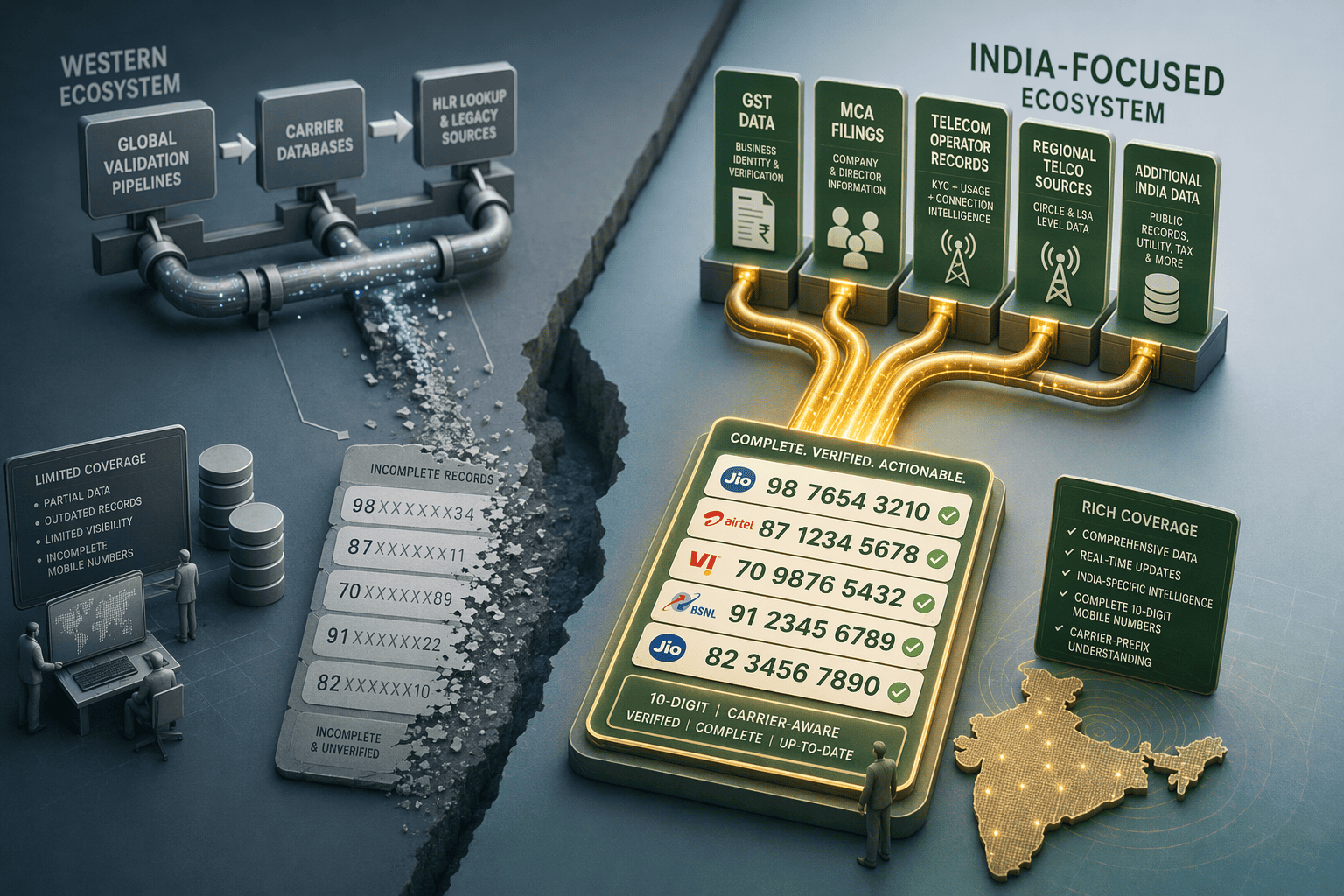
US- and EU-optimized platforms fail in India because Indian mobile numbers follow a 10-digit format with carrier-specific prefixes that Western validation APIs don't recognize. Global tools rely on business registries and carrier databases tuned to North American and European standards, they lack access to India's GST database, MCA filings, and regional telecom operator records. Without these sources, enrichment queries return incomplete or outdated numbers, especially for SMEs and MSMEs that dominate India's B2B landscape.
Why Global Benchmarks Hide Local Accuracy Drops
Vendors advertise 90%+ global accuracy but India-specific accuracy for global tools often tests 10-15 percentage points lower than US or EU figures. Aggregated global benchmarks mask regional shortfalls because high-coverage Western markets offset thin emerging-market data. Accuracy for Indian contacts drops below 70% without regional specialization, a gap no mainstream product review addresses. Platforms specializing in Indian business registries (like PeakAi) source mobile numbers from regional carrier databases and GST records rather than relying on LinkedIn profile sharing alone.
The Structural Data Gap No Tool Can Solve
Phone discovery has a hard ceiling: only 5-10% of LinkedIn users share phone numbers with first-degree connections, and less than 1% share with second- or third-degree connections. No enrichment architecture, scraping, database lookup, or real-time API, can extract data that users never publish. Regional specialists improve coverage by cross-referencing telecom operator databases and public business registries, but even the best tools face incomplete records when contact sharing is voluntary.
With compliance risks and verification layers clarified, the decision framework below filters platforms by the factors that determine long-term viability.
Choosing the Right Real-Time Enrichment Platform: A Decision Framework
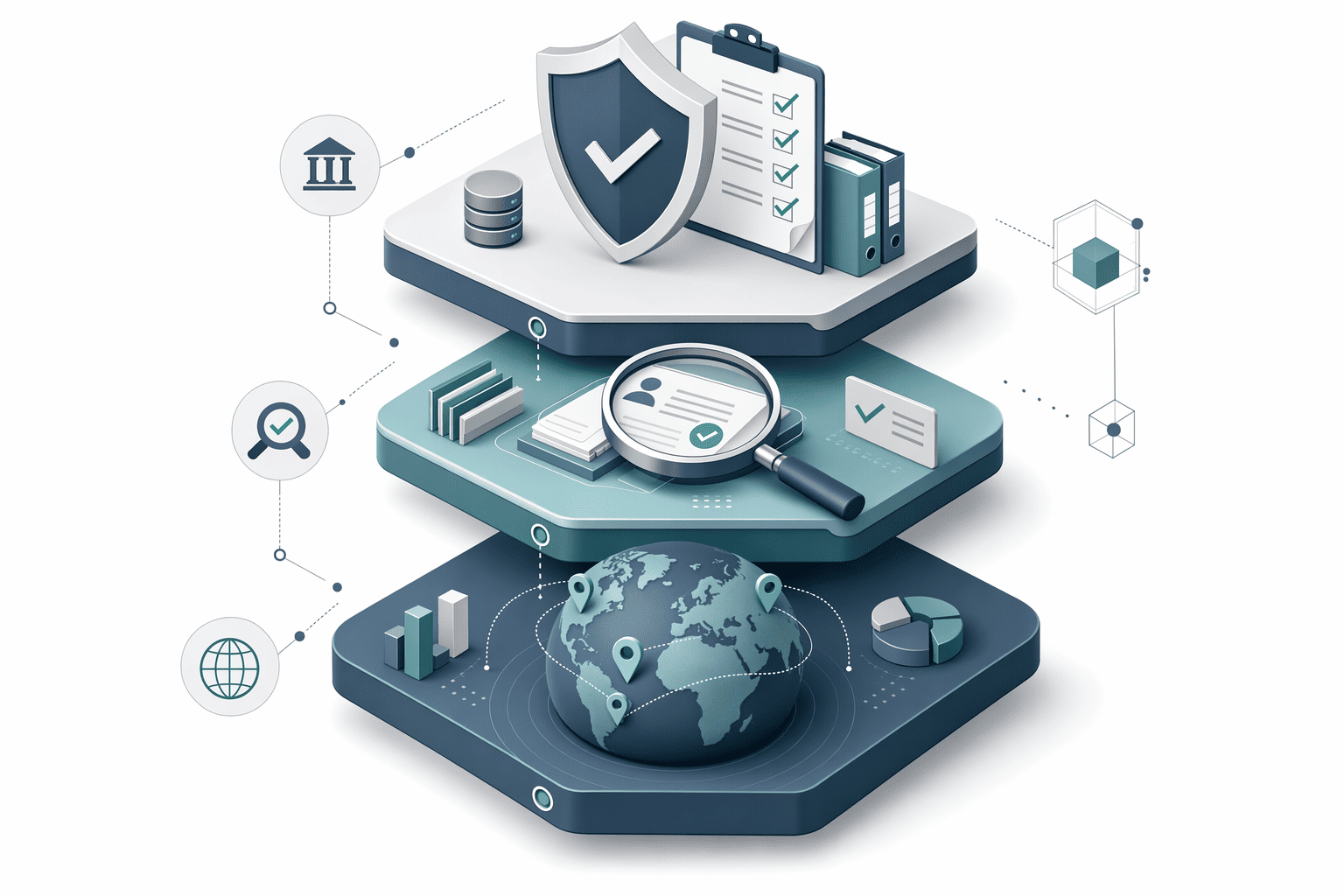
Most buyer guides default to feature shootouts, API speed, database size, integration ease, without addressing the compliance risks that determine whether your stack survives a LinkedIn audit. Apply a three-tier filter instead: compliance architecture first, verification depth second, regional coverage third. This sequence protects your account before you optimize for performance.
Compliance Architecture: The First Filter
Eliminate any platform that scrapes LinkedIn profiles on-demand. Real-time scraping violates LinkedIn's Terms of Service and exposes your account to suspension, regardless of how fast the API returns data. Enrichment-based platforms like PeakAi, Clay, and Apollo query third-party databases rather than scraping LinkedIn, passing the first compliance filter. Database lookup platforms maintain independent contact repositories indexed by LinkedIn profile URLs, so no automated profile crawling occurs within LinkedIn itself.
Verification Depth and Cost Model
Accuracy claims mean nothing without understanding when verification happens. Pre-download verification (contact data validated before you pay credits) protects budget; post-export verification (you pay first, then discover 30% are disconnected numbers) wastes spend. Ask whether the platform charges per record returned or per verified contact, and whether refunds apply to invalid data. Cost-per-contact ranges from under $0.20 for high-volume tiers to $2+ for single lookups, align your pricing model to your prospecting cadence.
Regional Coverage and Specialization
Global platforms excel at North American and Western European coverage but often lack mobile-number accuracy in emerging markets. If your target geography is India, Southeast Asia, or Latin America, prioritize regional-specialist platforms that validate local phone formats and integrate government business registries. Generic tools treat all geographies identically; specialists understand that a Mumbai mobile number requires different validation than a Berlin landline.
Ready to find accurate contact information that helps you close more deals? Start with compliance, then verify depth, then match coverage to your market.
Conclusion
Global platforms deliver broader coverage across US and EU markets but sacrifice 10-15 percentage points of accuracy in India and emerging markets due to regional data-source gaps, regional specialists like PeakAi trade global breadth for India-specific mobile discovery depth. Post-export enrichment tools offer API flexibility for technical teams but transfer data-quality risk to buyers through credit-based pricing that charges for invalid records, pre-download verification platforms reduce per-usable-contact cost by 35-100% but offer less customization.
As LinkedIn tightens Terms of Service enforcement and AI-powered compliance monitoring detects scraping patterns faster, enrichment-based platforms querying independent databases will become the only sustainable contact-discovery architecture, buyers prioritizing long-term account safety over short-term data-coverage breadth will shift to third-party lookup models in 2026-2027.
Audit your current LinkedIn enrichment tool's compliance architecture this week, check whether it queries third-party databases or scrapes LinkedIn directly, using the decision framework above, or explore PeakAi's pre-download verification model for India-specific contact discovery.
Frequently Asked Questions
Can enrichment-based tools still trigger LinkedIn account warnings if used aggressively?
Yes, enrichment-based platforms reduce suspension risk from 15-20% to under 2%, but aggressive bulk exporting, exceeding connection-request rate limits, or scraping public profiles outside the platform can still trigger warnings. No tool is categorically risk-free, though enrichment architecture minimizes the technical footprint that triggers automated compliance flags.
Why do 'real-time' enrichment claims not guarantee data freshness?
Real-time refers to sub-second API response latency, not real-time data updates. Many vendors query static databases updated monthly or quarterly, delivering stale contacts quickly. Contact data decays at 2-3% monthly, so fast APIs don't equal fresh data, query speed and database refresh cadence are independent variables.
What verification methods prove contact data wasn't scraped from LinkedIn directly?
Enrichment-based platforms document third-party database sourcing through the absence of LinkedIn API calls in access logs and source attribution to business registries. Scraping tools leave a technical footprint, DOM access, session cookies, profile-view increments, in LinkedIn's servers, while database lookup platforms never touch LinkedIn's infrastructure during enrichment.
How accurate are global enrichment platforms for India-specific mobile numbers?
Global platforms test 10-15 percentage points lower for India-specific contacts than US/EU figures due to different mobile verification standards and reliance on Western business registries. Aggregated global benchmarks mask regional shortfalls because high-coverage Western markets offset thin emerging-market data, platforms specializing in Indian GST databases and regional carrier APIs deliver higher accuracy.
What does 'verification' actually measure in contact discovery tools?
Most vendor '95% accuracy' claims measure syntax validation, not deliverability. Full verification includes syntax checks, MX record confirmation, SMTP handshake testing, role-based detection, disposable domain screening, and catch-all analysis. Independent testing shows closer to 50% usable contact rates because properly formatted emails can still bounce if mailboxes were deactivated.
Why do only 5-10% of LinkedIn users share phone numbers with connections?
LinkedIn's privacy defaults hide phone numbers from all but first-degree connections, and less than 1% share with second- or third-degree connections. This structural data-availability ceiling means no enrichment architecture, scraping, database lookup, or real-time API, can extract data users never publish. Tools must source phone numbers from external business registries instead.
How does pre-download verification differ from post-export enrichment pricing?
Pre-download verification applies six verification layers before charging credits, so buyers pay only for usable contacts. Post-export enrichment charges for raw matches and leaves verification to the buyer, making actual spend 35-100% higher than advertised per-credit pricing due to invalid-record waste. Verification timing determines who absorbs data-quality risk.
Sources
- 10 Best Platforms for Automatic LinkedIn Profile Enrichment in CRMs - linkfinderai.com
- Best Lead Enrichment Tools for B2B Sales Teams in 2026 - www.11x.ai (2026)
- LinkedIn API for Lead Gen, Recruiting & Sales Intelligence | Z Scraper - z-scraper.com
- LinkedIn Profile Scraper, real-time, cheap lead enrichment - apify.com
- Top 6 Contact Enrichment Tools Comparison (And What They Won't Tell You) - www.marketsandmarkets.com (2025)
