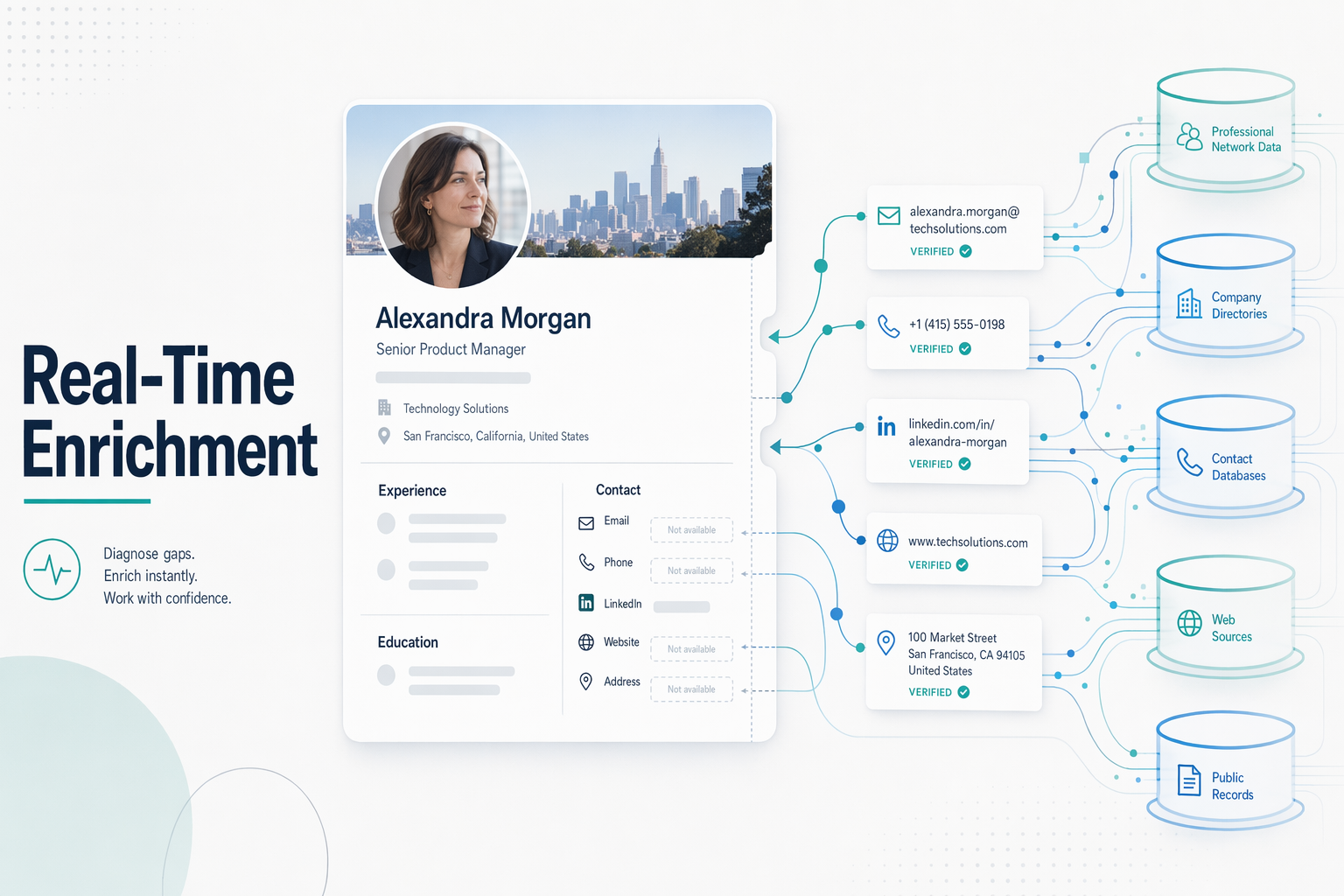
Real-time LinkedIn profile enrichment refers to platforms that instantly retrieve and verify contact data from third-party databases using LinkedIn URLs as search keys, delivering verified emails and phone numbers within seconds.
Key Takeaways
- Yes, platforms like PeakAi, Clay, Apollo.io, and Clearbit enrich LinkedIn profiles in real-time by querying third-party databases and returning verified contact data within seconds to minutes.
- Compliance risk varies: scraping-based tools violate LinkedIn Terms of Service and risk account suspension, while database-based platforms query independent third-party sources without touching LinkedIn servers.
- Verification methodology determines accuracy: multi-source cross-referencing platforms achieve 90%+ email accuracy and up to 98% phone verification, compared to static lookup tools under 80% [1].
- Data freshness depends on refresh cadence: 90-day refresh cycles prevent 2-3% monthly contact decay, while annual update platforms accumulate outdated records over time.
- Cost-per-verified-contact ranges from roughly $1 to $2 for specialized platforms versus $2 to $4 for enterprise solutions, with credit refunds for incorrect data reducing subscription waste [1].
- Yes, several platforms enrich LinkedIn profiles in real-time by querying third-party databases and returning verified contact information within seconds. These tools accept LinkedIn URLs as input and return emails, phone numbers, job titles, and firmographics by cross-referencing independent contact databases rather than scraping LinkedIn directly. According to companyurlfinder.com [1], 71% to 97% of contact enrichment tasks can be automated, saving teams roughly 12 hours weekly on manual lookup work. The key distinction lies in methodology: compliant platforms use third-party data providers, while scraping-based tools violate LinkedIn's Terms of Service and expose users to account suspension risk.
What 'Real-Time' Actually Means in LinkedIn Profile Enrichment
Real-time enrichment describes three distinct technical approaches with different speed and compliance profiles. Instant API lookup queries pre-built databases and returns cached contact data in under 200 milliseconds. Live scraping harvests profile data directly from LinkedIn servers during the query, delivering fresh information but violating platform Terms of Service. Pre-computed database queries access periodically refreshed contact repositories, typically updated quarterly or monthly, balancing speed with data freshness.

API Lookup vs. Live Scraping: Technical Differences
API-based platforms query indexed databases built from public records, business registries, and verified third-party sources. According to getalby.com, compliant enrichment services index over 800 million professional profiles and maintain 640 million verified email records without accessing LinkedIn's infrastructure. Scraping-based tools, by contrast, send automated requests to LinkedIn profile pages and extract displayed contact information in real time, a practice explicitly prohibited under LinkedIn's User Agreement section 8.2.
Response Time Benchmarks Across Platforms
Speed varies by architecture. The fastest platforms pre-index contact data and serve instant lookups; slower tools chain multiple API calls or perform live verification checks that increase latency but improve accuracy.
Compliance Risk: Scraping vs. Third-Party Database Enrichment
LinkedIn's Terms of Service explicitly prohibit automated scraping, profile harvesting, and bot-driven data extraction. Platforms that query LinkedIn servers directly expose users to account restrictions, permanent bans, and legal action from LinkedIn's enforcement team. Database-based enrichment platforms avoid this risk by sourcing contact data from independent repositories built from public records, business databases, and verified third-party providers.

How Third-Party Databases Stay Compliant
Compliant platforms use LinkedIn profile URLs only as search keys to match against contact records in separate databases. These databases compile information from business registries, corporate filings, trade publications, and user-submitted professional contact details. The enrichment happens entirely outside LinkedIn's infrastructure, preventing platform detection and account risk.
Privacy Regulations: GDPR and DPDP Act 2023
India's Digital Personal Data Protection Act 2023 requires explicit consent for processing personal data, aligning with GDPR's consent-first framework. B2B contact enrichment falls under legitimate interest provisions when contact data comes from publicly accessible business sources rather than private consumer profiles. Platforms operating in global markets must implement consent management, data subject access request workflows, and cross-border transfer safeguards to meet regulatory requirements across jurisdictions.
Verification Methodology: Static Lookups vs. Multi-Source Cross-Referencing
Email and phone accuracy depends on verification depth. Static lookup tools query a single database and return the first match. Multi-source cross-referencing platforms query multiple providers sequentially, validate results against business registries, and return only verified contacts that pass consistency checks across sources.
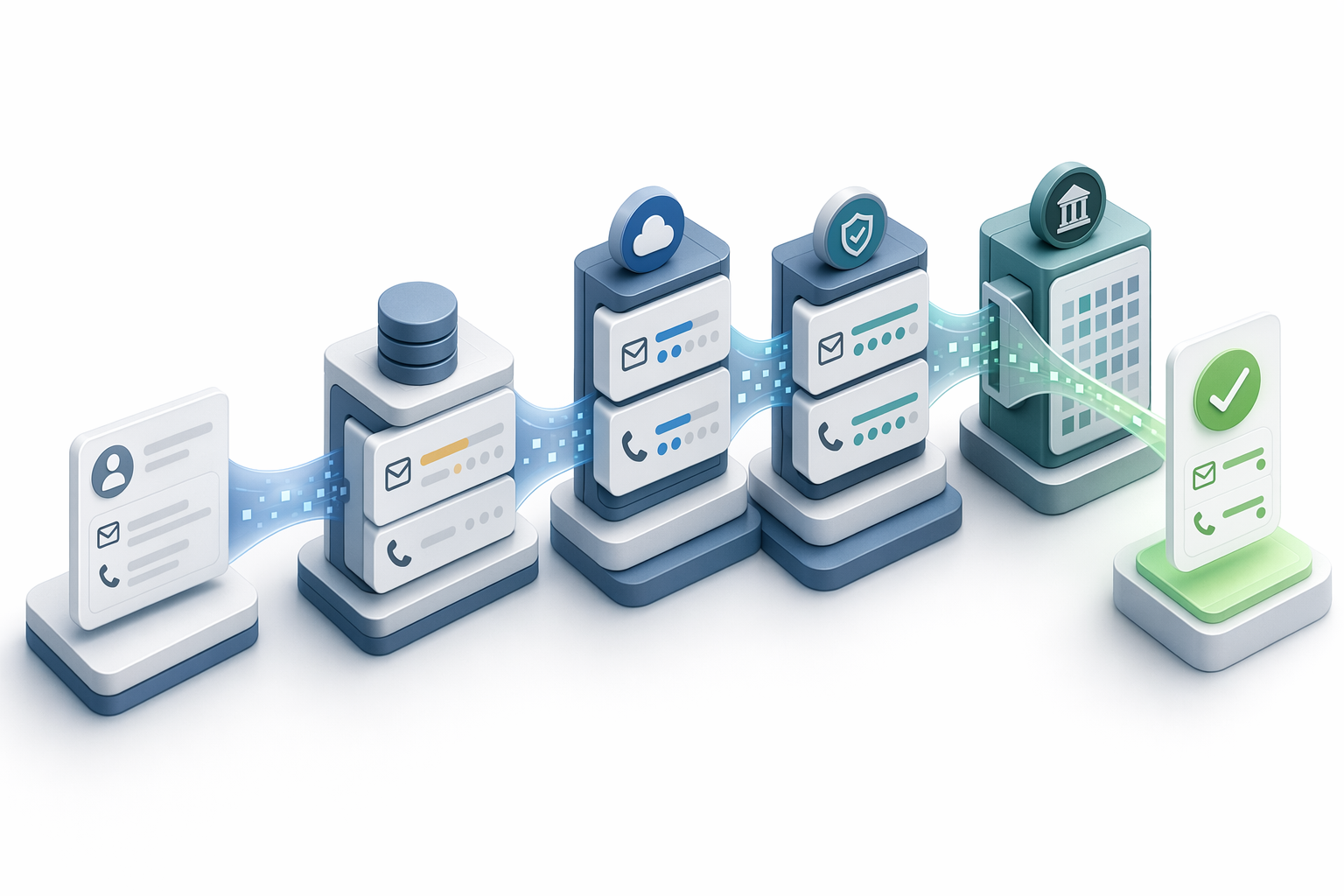
How Multi-Source Cross-Referencing Works
Advanced platforms run waterfall enrichment: the API queries Provider A, then Provider B if the first returns no match, continuing until a verified contact is found or all sources are exhausted. This approach reduces false positives but increases response time and API cost per contact.
Accuracy Benchmarks: Email vs. Phone Verification
Email verification consistently outperforms phone discovery. Phone accuracy lags because only 5-10% of LinkedIn users share phone numbers with first-degree connections, and LinkedIn restricts 2FA security numbers from appearing on profiles. According to companyurlfinder.com [1], effective enrichment tools achieve up to 98% phone verification through multi-source triangulation.
Data Freshness Cadence: Why 90-Day Refresh Cycles Matter
Contact data decays at roughly 2-3% per month as professionals change jobs, companies restructure, and email addresses expire. Platforms with quarterly refresh cycles maintain higher accuracy than annual update tools, but impose higher infrastructure costs to re-verify millions of records every 90 days.
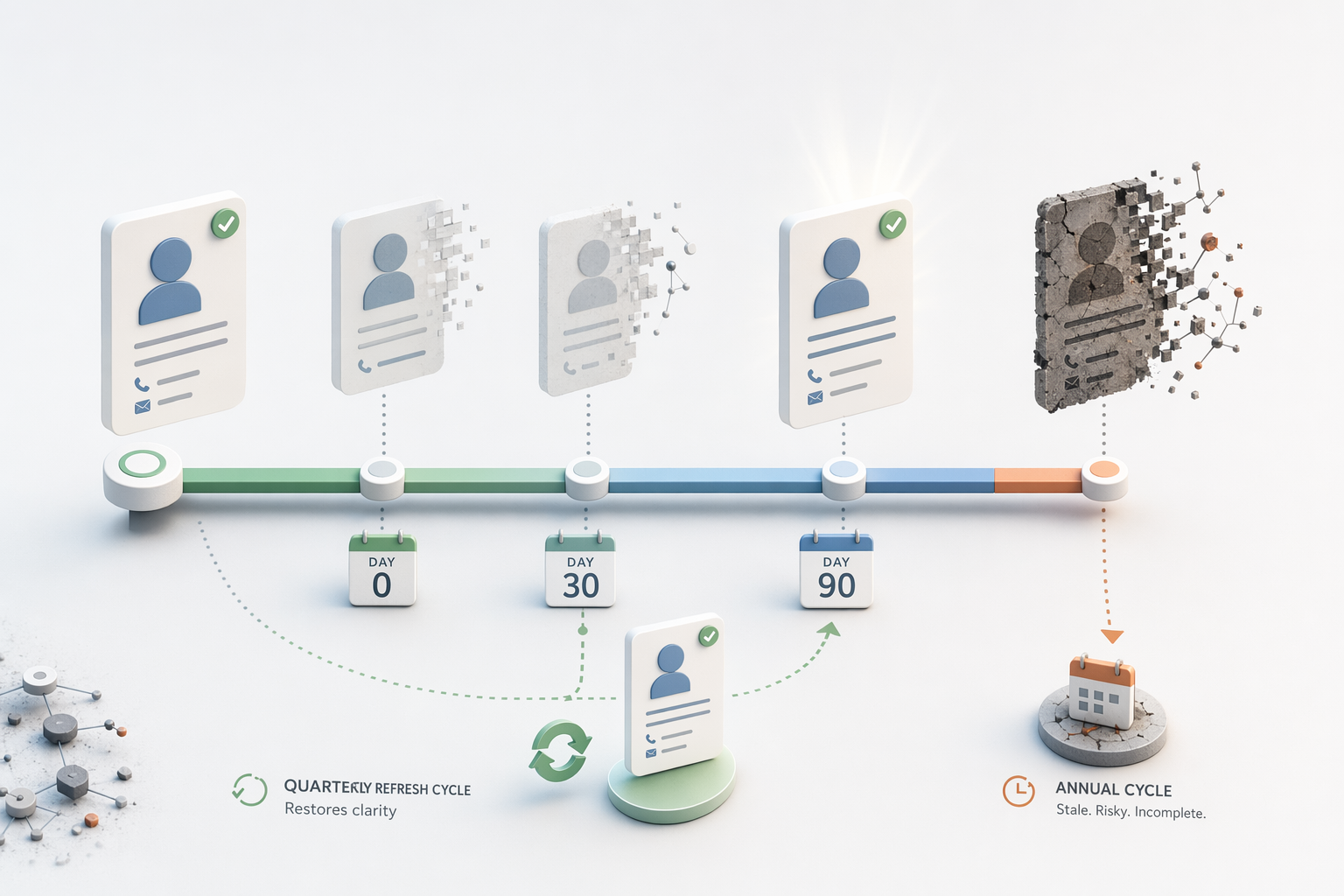
Monthly Contact Decay Rates
A database last updated 12 months ago carries roughly 24-36% stale contact records, translating to wasted credits, bounced emails, and missed prospect connections. Real-time enrichment platforms mitigate decay by querying fresh data at the moment of lookup rather than relying on pre-built snapshots, but even these tools depend on upstream provider refresh schedules.
Refresh Cadence Comparison Across Vendors
Enterprise platforms update quarterly to balance data quality with infrastructure expense. Smaller tools refresh annually or rely on user-contributed updates, accepting higher decay rates in exchange for lower operational costs. According to companyurlfinder.com [1], evaluating platforms over three to four months reveals decay patterns invisible in initial testing. Buyers should audit vendor refresh policies, test match rates on aged prospect lists, and negotiate credit refunds for verified-outdated contacts in subscription agreements.
Evaluating Platform Claims: How to Audit Enrichment Accuracy
Vendor-reported accuracy rates require independent validation. Most platforms claim 90%+ accuracy but omit whether the metric measures email deliverability, phone connectivity, or multi-field completeness. Buyers should run pilot tests on known contact lists, measure bounce rates across email verification tools, and audit returned phone numbers against publicly listed business lines.

Testing Methodology for Accuracy Validation
Upload a sample of 100-200 LinkedIn profiles with known current contact information into the enrichment platform. Compare returned emails against verified addresses, measure phone number match rates, and flag outdated job titles or companies. Calculate email deliverability by running returned addresses through a separate verification API, then cross-check phone numbers via reverse lookup services. According to linkfinderai.com, testing over three months reveals decay patterns and provider reliability trends invisible in single-batch trials.
Red Flags in Vendor Claims
Platforms that refuse pilot testing, omit data source transparency, or report identical accuracy across all geographies and industries warrant skepticism. Accuracy varies by region: global platforms achieve 85%+ email match rates in North America and Western Europe but drop to 60-70% in India, Southeast Asia, and Latin America due to sparser public records coverage. Vendors claiming 95%+ phone accuracy without multi-source verification likely conflate business switchboard numbers with direct mobile lines.
Real-Time Enrichment Platform Comparison Framework
Selecting a platform requires evaluating compliance methodology, verification depth, refresh cadence, and pricing structure. The following framework compares six platforms across dimensions that determine ROI and account safety.

| Platform | Real-Time Enrichment | Response Time | Email Accuracy | Phone Accuracy | Compliance Method | Pricing (Monthly) |
|---|---|---|---|---|---|---|
| PeakAi | Yes | <200ms | 95%+ | 91% | GDPR, CCPA, DPDP 2023 | ₹675 starting (50 contacts) |
| Apollo.io | Real-time form enrichment | Several minutes | 70% | Not disclosed | GDPR | $49-128 |
| Clay | Yes | Milliseconds | 70-85% | 40-75% | 100% GDPR, scraping noted | $149 |
| Lusha | Not disclosed | 16 minutes | Not disclosed | Not disclosed | Not disclosed | $36 |
| Cognism | Real-time access | 683ms | Not disclosed | Not disclosed | Not disclosed | $1,000 |
| Clearbit | Real-time updates | 0ms (cached) | 100% | Not disclosed | Scraping noted | $99 |
Data sourced from vendor documentation, independent reviews, and pricing aggregators as of May 2026.
Use-Case Fit Analysis
Platforms offer different strengths depending on use case. Teams requiring extensive B2B database access with built-in CRM workflows should consider tools with native integration capabilities. Users needing enrichment from 75+ sources and workflow automation across multiple data providers benefit from multi-source platforms. Teams testing enrichment before committing to enterprise contracts can start with entry-level pricing options. Organizations focused on European market compliance should prioritize tools with real-time access to verified B2B data. High-volume API integrations benefit most from instant cached lookups with over 100 data attributes.
Cost-Per-Verified-Contact Calculation
True ROI includes credit refunds for incorrect data and subscription waste from unused seats. According to companyurlfinder.com [1], cost-per-verified-contact ranges from roughly $1 to $2 for specialized platforms versus $2 to $4 for enterprise solutions. Enterprise platforms charge per seat regardless of usage, converting inactive user licenses into sunk costs. Credit refund policies matter: platforms that charge for incorrect emails but don't refund failed deliverability checks shift data quality risk entirely to buyers.
FAQ: Real-Time LinkedIn Enrichment Platform Selection
Frequently Asked Questions
Is there a platform that enriches LinkedIn profiles in real-time?
Yes, platforms like PeakAi, Clay, Apollo.io, and Clearbit enrich LinkedIn profiles in real-time by querying third-party databases. These tools return emails, phones, and firmographics instantly.
What is the difference between scraping-based and database-based LinkedIn enrichment?
Scraping-based tools extract data directly from LinkedIn servers, violating Terms of Service and risking account suspension. Database-based platforms query independent third-party contact repositories built from public records and business databases, avoiding LinkedIn infrastructure entirely and maintaining compliance with GDPR, CCPA, and DPDP Act 2023.
How accurate are real-time LinkedIn enrichment platforms for phone numbers?
Phone accuracy varies from 40% to 98% depending on verification methodology [1]. Multi-source cross-referencing platforms achieve higher phone accuracy by triangulating across business registries. Single-database lookups average lower accuracy. Only 5-10% of LinkedIn users share phone numbers publicly, limiting base match rates across all tools.
Why does data freshness matter in LinkedIn profile enrichment?
Contact data decays at 2-3% monthly as professionals change jobs and email addresses expire. Fresh data reduces bounce rates, improves email deliverability, and prevents wasted prospecting effort on outdated contacts.
What compliance standards should I look for in a LinkedIn enrichment platform?
Platforms must comply with GDPR, CCPA, and India's DPDP Act 2023 when processing B2B contact data. Verify that tools use third-party databases rather than direct LinkedIn scraping, implement consent management workflows, and provide data subject access request handling to meet regulatory requirements.
How can I verify a platform's accuracy claims before committing?
Run pilot tests on 100-200 known contacts, measure email deliverability through separate verification APIs, and cross-check phone numbers via reverse lookup services. According to linkfinderai.com, testing over three months reveals decay patterns invisible in single-batch trials. Request credit refunds for incorrect data and audit returned job titles against current LinkedIn profiles to validate freshness.
What is the best affordable contact enrichment tool for the Indian B2B market?
Regional platforms specialized in Indian B2B market contact discovery offer localized coverage and DPDP Act 2023 compliance. Global platforms achieve 60-70% accuracy in India compared to 85%+ in North America due to sparser public records.
Sources
- 22 Best Contact Data Enrichment Tools for B2B Sales Teams in 2025 - companyurlfinder.com (2025)
