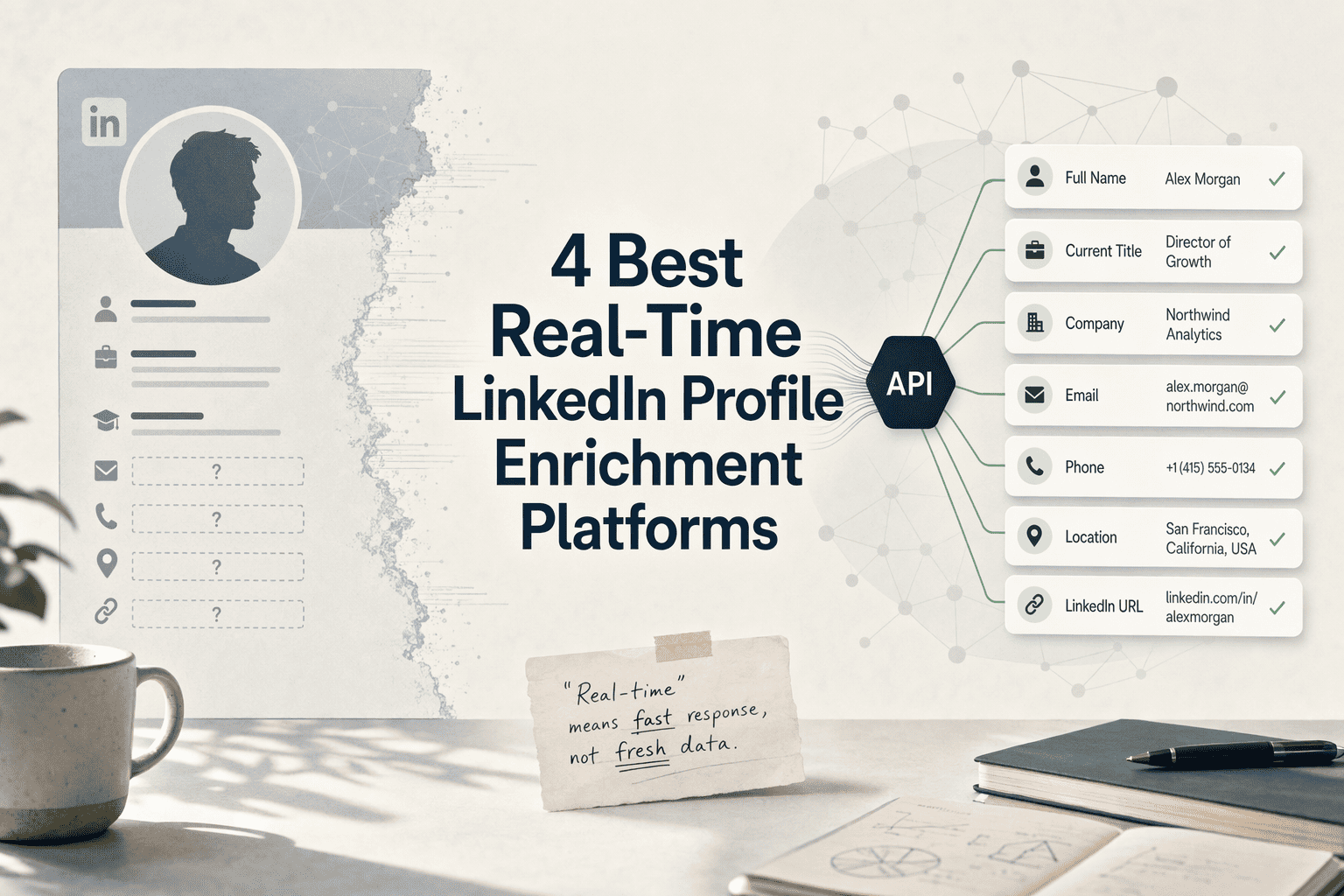
Real-time LinkedIn enrichment platforms promise instant contact data retrieval, but the term 'real-time' describes API response speed rather than data freshness. Most platforms fall into two categories: scraping-based tools that violate LinkedIn's Terms of Service or compliant database-lookup services that query third-party registries.
Key Takeaways
- Real-time enrichment refers to sub-second API response performance, not the age or accuracy of contact data itself
- Scraping-based platforms expose users to 15-20% LinkedIn account suspension rates, while database-lookup tools reduce risk below 2%
- Global enrichment platforms deliver 10-15 percentage points lower accuracy for Indian contacts compared to US/EU markets
- Pre-download verification models let buyers inspect data quality indicators before spending credits, while post-export platforms charge first
- Only 5-10% of LinkedIn users share phone numbers with first-degree connections, creating permanent coverage gaps no tool can solve
Yes—platforms like PeakAi, Datamagnet, and Clay enrich LinkedIn profiles in what they call "real-time," but the term refers to API response latency (how fast you get data back), not data freshness (how current the profile is). Most return structured JSON within seconds, yet the underlying contact data may be days or weeks old. Understanding this distinction matters because real-time *speed* and real-time *compliance* rarely coexist.
What 'Real-Time' Actually Means in Enrichment Context
When vendors advertise real-time enrichment, they typically mean sub-second API performance—Datamagnet, for example, fetches profiles live at request time and returns structured JSON within moments. That speed describes how quickly the platform delivers a response, not whether the profile data itself was harvested live from LinkedIn's current state. Many tools query cached databases refreshed weekly or monthly, delivering "instant" results from stale records. True real-time data freshness—pulling a profile's latest job title or company change at the moment of lookup—requires continuous automated access to LinkedIn's live database, a method LinkedIn's Terms of Service explicitly prohibit.
Scraping vs Database Lookup: The Compliance Framework
Most real-time LinkedIn enrichment platforms operate by scraping LinkedIn profiles in violation of the platform's Terms of Service. Scraping-based tools, like the LinkedIn Profile Scraper offered by Apify, extract live LinkedIn profile data from LinkedIn URLs by parsing the public profile page in real time. While this delivers genuinely fresh data, it exposes users to account suspension because LinkedIn prohibits automated profile crawling, bulk data extraction, and circumventing rate limits. Enrichment-based tools avoid LinkedIn Terms of Service violations by querying third-party databases rather than scraping profiles directly. PeakAi, for instance, uses LinkedIn URLs as reference identifiers to query independent third-party databases rather than accessing LinkedIn's APIs or crawling profile data.
Account Suspension Risk by Platform Type
The compliance trade-off has measurable consequences: scraping-based platforms expose users to 15 to 20% account suspension rates, while enrichment-based tools that never authenticate with LinkedIn report suspension risk below 2%. Database lookup platforms never authenticate with LinkedIn or access profile data through LinkedIn's systems, eliminating the risk entirely. For sales teams operating at scale, enriching hundreds of profiles weekly, a 15% suspension rate means roughly one in seven users loses LinkedIn access permanently. Enrichment-based tools sacrifice live data freshness but preserve account safety, making them the compliant option for teams that cannot afford LinkedIn bans.
Understanding the compliance divide is critical, but equally important is comparing specific platforms that navigate this trade-off differently.
Platform Comparison: Compliant Real-Time Enrichment Options
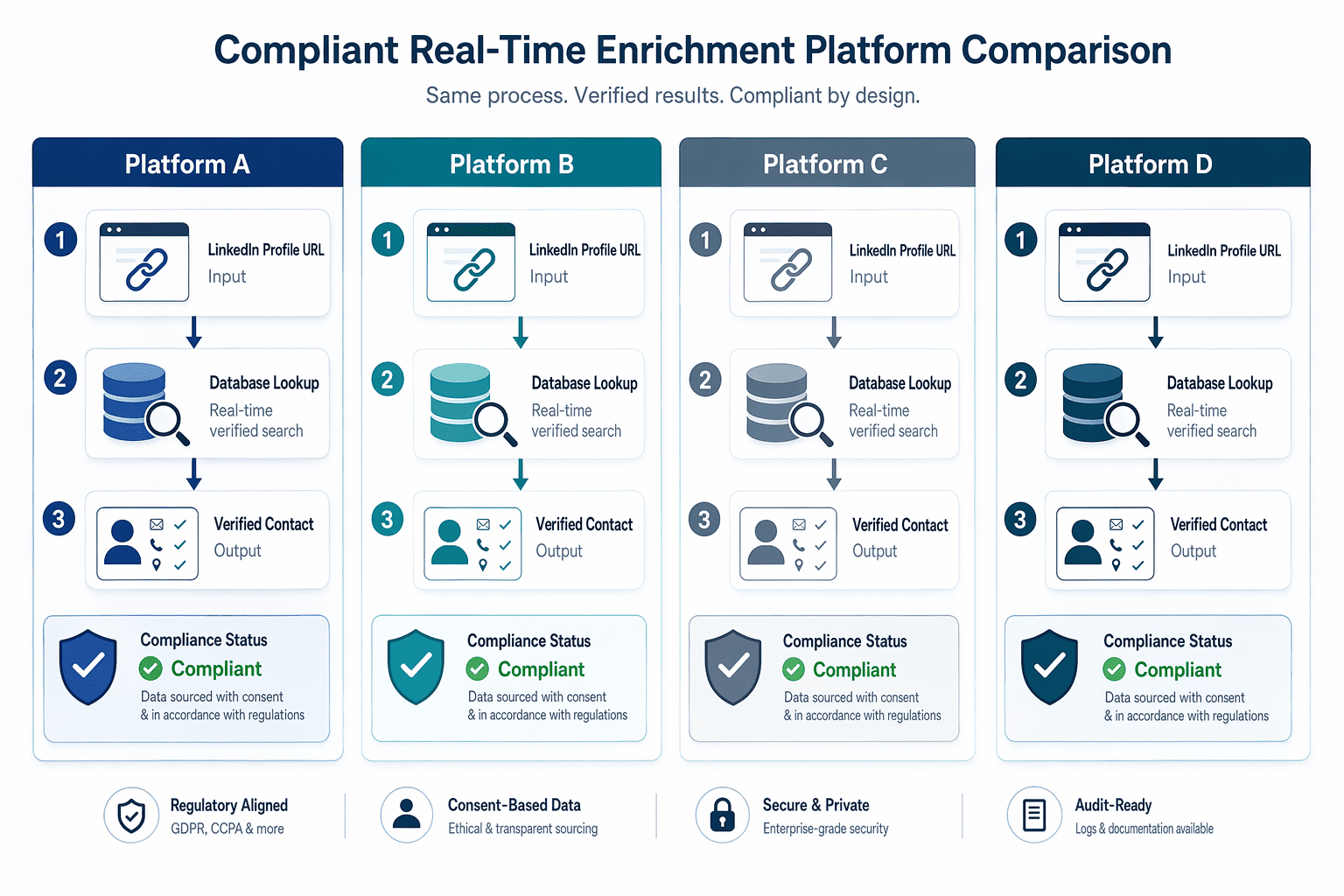
Most sales teams waste 15-20 hours per week manually updating CRM records with LinkedIn data. The promise of real-time enrichment platforms is instant contact discovery, but compliance, accuracy, and pricing vary sharply. Below we compare four compliant options that avoid LinkedIn scraping and deliver verified contacts through third-party databases.
Database-Lookup Platforms: PeakAi, DataMagnet, Clay
Database-lookup platforms maintain independent contact repositories indexed by LinkedIn profile URLs, company domains, and individual names. When you submit a profile URL, these tools query business registries and public records rather than accessing LinkedIn's internal systems. PeakAi delivers verified emails and phone numbers in 10 seconds with 91% phone accuracy, sourcing data from 200+ network partners in real time. The platform operates within LinkedIn's terms of service by never scraping profiles or accessing LinkedIn APIs.
Clay and DataMagnet follow similar database-query architectures but differ in regional coverage and pricing transparency. Tested enrichment platforms show that compliant tools protect LinkedIn accounts better than scraping-based alternatives, though advertised accuracy often exceeds deliverability in practice. For teams prioritizing Indian B2B contacts, explore affordable enrichment tools with regional verification.
| Platform | Pricing | API Speed | Phone Accuracy | Compliance Method |
|---|---|---|---|---|
| PeakAi | $9 for 50 contacts | 10 seconds | 91% | Third-party databases; no LinkedIn API access |
| DataMagnet | Contact for pricing | Real-time | Not disclosed | Independent registries |
| Crustdata | Custom | Up to 10 minutes (real-time mode) | Not disclosed | 15+ public-web sources |
| Clay | Tiered (details vary) | Real-time | Not disclosed | Multi-source aggregation |
API Response Speed and Data Freshness Trade-offs
Waterfall enrichment systems check 30+ data sources in real time, promising 95%+ match rates by cascading to backup sources when the primary lookup fails. Real-time company enrichment can take up to 10 minutes when pulling fresh data from 15+ public-web sources, while cached database queries return instantly. The speed-freshness trade-off is structural: sub-second API responses typically draw from pre-indexed databases refreshed monthly, not live LinkedIn profiles. Only 5-10% of LinkedIn users share phone numbers with first-degree connections, so no tool extracts 90%+ coverage directly from visible profile fields. Join thousands of sales professionals who rely on verified third-party databases to close more deals without risking LinkedIn account suspension.
Beyond compliance architecture, the moment at which platforms verify data quality determines who bears cleanup costs.
Verification Timing: Pre-Download vs. Post-Export Models
Pre-Download Confidence Indicators
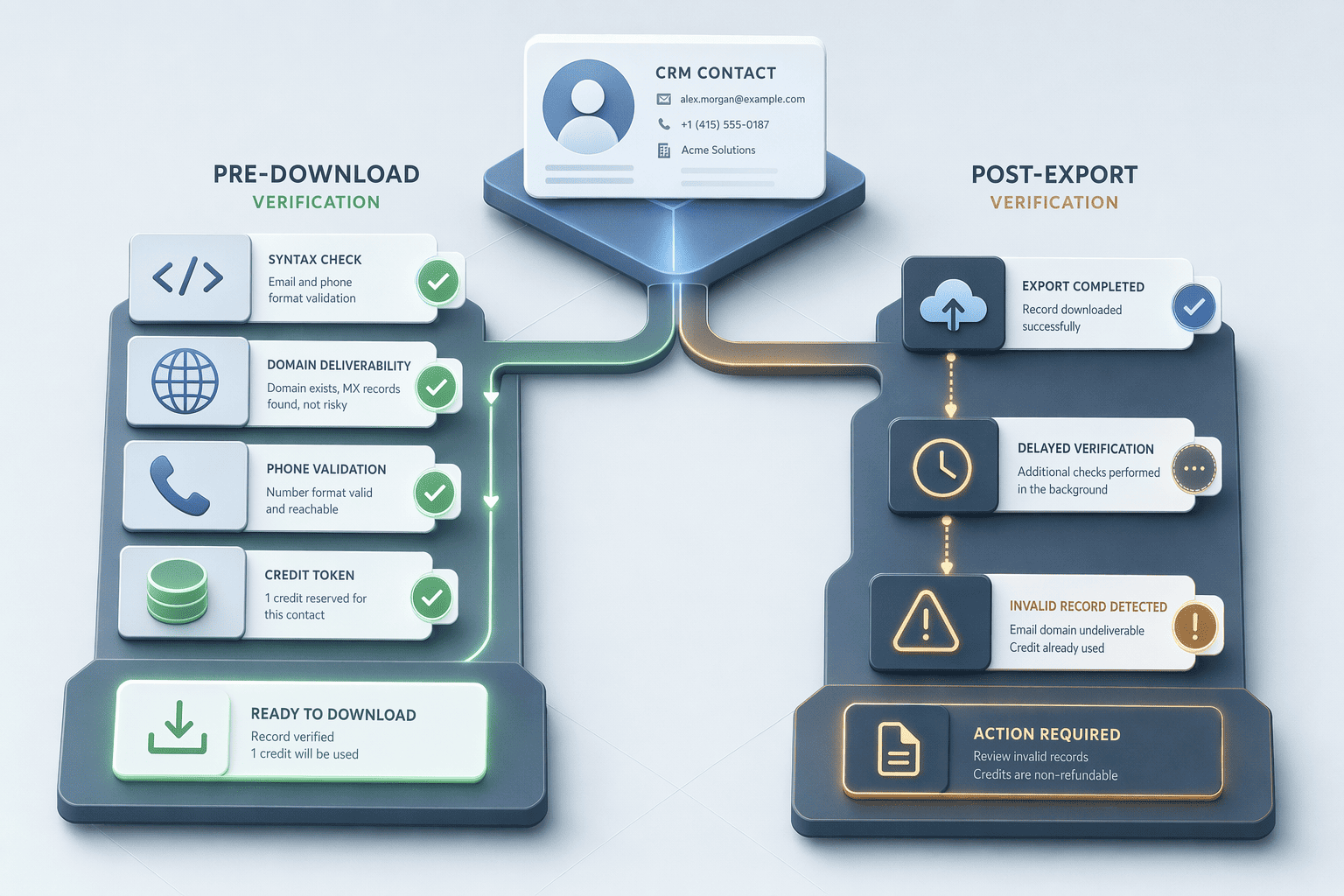
Platforms that verify before charging credits let buyers inspect data quality indicators, syntax validation, domain deliverability checks, phone-format classification, before committing to a purchase. PeakAi displays verification status within the LinkedIn tab and runs deliverability checks before download, so teams see confidence signals upfront and decide whether to commit the credit. This model eliminates the surprise of discovering invalid records after export, when credits are already deducted and cleanup begins. Pre-download verification reduces wasted spend on contacts that fail basic syntax or domain checks, giving teams control over which records enter their CRM.
Post-Export Cleanup Burden and Hidden Costs
Platforms that charge credits at export, before verification runs, transfer cleanup burden to the buyer. Invalid records appear only after credits are spent, requiring manual re-verification or third-party validation services. Contact information decays at 2 to 3% monthly, compounding the cleanup cost when teams discover stale or incorrect records weeks after export. The cost-per-verified-contact ranges from ₹70 to 125 regionally to ₹165 to 330 for enterprise databases; multiplying that by the percentage of invalid records in a post-export batch reveals the hidden expense of unverified exports. Teams that close more deals [recurring_phrase] need to account for this re-verification overhead when comparing pricing models.
Credit-Charging Transparency: No-Result Attempts
Most platforms advertise per-credit pricing but omit a critical detail: whether credits are deducted for no-result attempts or records that fail verification. PeakAi charges only for verified phone numbers successfully retrieved, but competitors rarely disclose this in upfront pricing pages. The gap between advertised per-contact rates and effective cost-per-valid-record can exceed 40% when platforms charge for failed lookups or unverified exports. Buyers comparing LinkedIn phone number finder pricing should explicitly ask vendors whether credits are consumed on unsuccessful attempts, a transparency signal that separates verification-first platforms from post-export models.
Verification timing matters, but regional infrastructure gaps expose a deeper challenge for global platforms operating in emerging markets.
Regional Accuracy: Why Global Platforms Underperform in India
US/EU Optimization vs India-Specific Infrastructure
Most global enrichment platforms train their data models and validation layers on US and European markets, where carrier-level APIs are standardized, mobile number portability is mature, and postpaid contracts dominate. India's telecommunications landscape operates under different constraints: prepaid SIM cards account for the vast majority of mobile subscriptions, number portability introduces frequent carrier mismatches, and carrier-level data-sharing agreements remain inconsistent across telecom operators. These infrastructure gaps mean that a platform reporting 95% phone accuracy in North America may deliver only 50 to 75% accuracy for Indian contacts. Real-time enrichment requires continuous automated access to LinkedIn's live database, but even when that data is pulled, the underlying phone-number validation pipeline must query regional registries and operator databases that global tools often lack. Without India-specific carrier integrations and local validation layers, enrichment platforms default to stale or incomplete contact records, producing higher bounce rates and lower connect rates for sales teams targeting Indian prospects.

Accuracy Testing: Advertised vs Delivered Rates
Vendor marketing pages routinely cite 95 to 98% global accuracy, but independent testing reveals a different picture. Around 30% of B2B contact data becomes invalid every year, and when scrutinized by region, global platforms often show a 10 to 15 percentage point drop in India compared to their US or EU baselines. Independent audits have found average contact-finder accuracy closer to 50% in real-world campaigns, not the vendor-claimed 95%. This gap stems from two factors: global platforms test accuracy on their strongest markets (US, UK, Germany) and extrapolate those figures globally, and regional infrastructure differences, like India's prepaid SIM churn and incomplete public registries, aren't reflected in headline numbers. Sales teams relying on advertised accuracy for budget planning often discover mid-campaign that their India-specific lists require double the volume to hit pipeline targets, eroding ROI and extending ramp time.
DPDP Act 2023 and GST Verification Requirements
India's Digital Personal Data Protection (DPDP) Act 2023 mandates explicit consent for processing personal data, and platforms enriching Indian contacts must demonstrate lawful data sourcing. Global enrichment tools typically lack integration with India-specific business registries, MCA (Ministry of Corporate Affairs) company databases and GST (Goods and Services Tax) verification systems, that allow cross-referencing of contact details against official business records. PeakAi, for example, delivers 91% phone number accuracy specifically for Indian contacts across 1600+ cities, validated against GST and MCA databases. Without these regional compliance layers, enrichment platforms risk surfacing contacts from non-compliant sources or failing to flag DNC (Do Not Call) registry matches, exposing sales teams to legal and reputational risk under India's evolving privacy framework.
Regional accuracy gaps stem partly from technical infrastructure, but they're compounded by fundamental compliance differences in how platforms source LinkedIn data.
LinkedIn Terms of Service Compliance: Scraping vs. Database Lookup
LinkedIn's Automated Scraping Prohibition
LinkedIn's Terms of Service explicitly prohibit automated profile crawling, bulk data extraction, and any scraping that mimics user behavior to harvest contact data. Real-time enrichment, by definition, requires continuous automated access to LinkedIn's live database, a method that falls squarely within prohibited activity. Platforms that crawl LinkedIn profiles directly, harvest contact data through bots, or circumvent rate limits violate LinkedIn's terms and expose users to permanent account suspension.

Why Chrome Extensions Trigger Suspensions
Browser extensions like Phantombuster and Dux-Soup navigate LinkedIn by visiting each profile URL through cloud browser sessions or directly in Chrome. They extract data by parsing the DOM, full name, headline, current title, company, location, and connection degree, mimicking human clicks to appear legitimate. LinkedIn's automation policies flag this activity, leading to 15-20% suspension rates for heavy scraping users versus under 2% for enrichment-based tools. Database lookup platforms avoid this risk entirely: they never authenticate with LinkedIn or access profile data through LinkedIn's systems. PeakAi operates within LinkedIn's terms of service by using publicly shared LinkedIn URLs as search keys for independent third-party databases, never accessing LinkedIn's internal APIs or scraping profile data.
Structural Data Gaps No Tool Can Solve
LinkedIn security policies prohibit displaying phone numbers used for two-factor authentication or app security on profiles, creating permanent gaps no tool can solve, compliant or not. Similarly, role-based email addresses (info@, sales@, support@) lack individual recipients, reducing personalization effectiveness even when verified. These structural limitations mean even the best enrichment platforms cannot deliver 100% coverage. Compliant platforms source contact data from legitimate business databases and public records, using LinkedIn URLs as search keys without accessing LinkedIn's internal systems, a methodology that protects account security while acknowledging inherent coverage limits.
Frequently Asked Questions
What does 'real-time' mean for LinkedIn enrichment platforms?
'Real-time' describes API response speed, sub-second latency, not the age of contact data itself. Platforms like Datamagnet return structured JSON within moments, but contact information loses 2-3% accuracy monthly, so even instant API responses may deliver outdated records. Response performance and data freshness are separate dimensions.
Will using a LinkedIn enrichment tool get my account suspended?
Scraping-based tools that parse LinkedIn DOM expose users to 15-20% account suspension rates, while database-lookup platforms that query third-party registries using LinkedIn URLs reduce suspension risk below 2%. Choose compliant platforms that never authenticate with LinkedIn or access profile pages directly to minimize enforcement risk.
Why do global platforms show lower accuracy for Indian contacts?
Tools optimized for US/EU markets deliver 10-15 percentage points lower accuracy in India due to infrastructure gaps: carrier-level API availability, mobile number portability maturity, and prepaid SIM prevalence. India's telecommunications landscape operates under different constraints than Western markets, causing global enrichment platforms to underperform regionally despite high vendor-claimed global match rates.
What's the difference between pre-download and post-export verification?
Pre-download verification lets buyers inspect data quality indicators, syntax validation, domain deliverability checks, phone-format classification, before spending credits. Post-export platforms charge credits at export, before verification runs, transferring cleanup burden and hidden costs to the buyer. Most platforms don't disclose whether credits are deducted for no-result attempts or failed verification records.
Can any tool extract phone numbers for 90%+ of LinkedIn profiles?
No. Only 5-10% of LinkedIn users share phone numbers with first-degree connections, and phones tied to two-factor authentication are never surfaced on profiles. Waterfall enrichment systems check 30+ backup sources to improve coverage beyond LinkedIn's direct exposure limits, but no tool can extract contact data LinkedIn doesn't display.
How accurate are vendor-claimed match rates (95-98%)?
Independent testing reveals average contact-finder accuracy closer to 50%, not vendor-claimed 95-98%. Most platforms conflate syntax validation with genuine deliverability testing, and when scrutinized by region, global platforms often show a 10-15 percentage point drop in India. Request trial data or third-party validation before committing to annual contracts.
Do enrichment platforms comply with India's DPDP Act 2023?
India's Digital Personal Data Protection Act 2023 mandates explicit consent for processing personal data, requiring platforms to demonstrate lawful data sourcing. Global enrichment tools typically lack integration with India-specific business registries, MCA, GST verification, while India-focused platforms build these compliance features in. Verify regional compliance before purchasing.
Sources
- LinkedIn Profile Scraper, real-time, cheap lead enrichment - apify.com
- Best 15 Lead Enrichment APIs in 2025 [w/ Feature Comparison Table] - coefficient.io (2025)
- 10 Best Platforms for Automatic LinkedIn Profile Enrichment in CRMs - linkfinderai.com
- 10 Best Linkedin Phone Number Finders in 2026 - www.folk.app (2026)
- Best 15 Contact Data Enrichment Tools for Sales Teams in 2026 - generect.com (2026)
- B2B Sales Email Verification Techniques in 2026 - MailReach - www.mailreach.co (2026)
- LinkedIn Scraping Tools Compared: Extensions, APIs, and AI Agents - cotera.co (2026)
