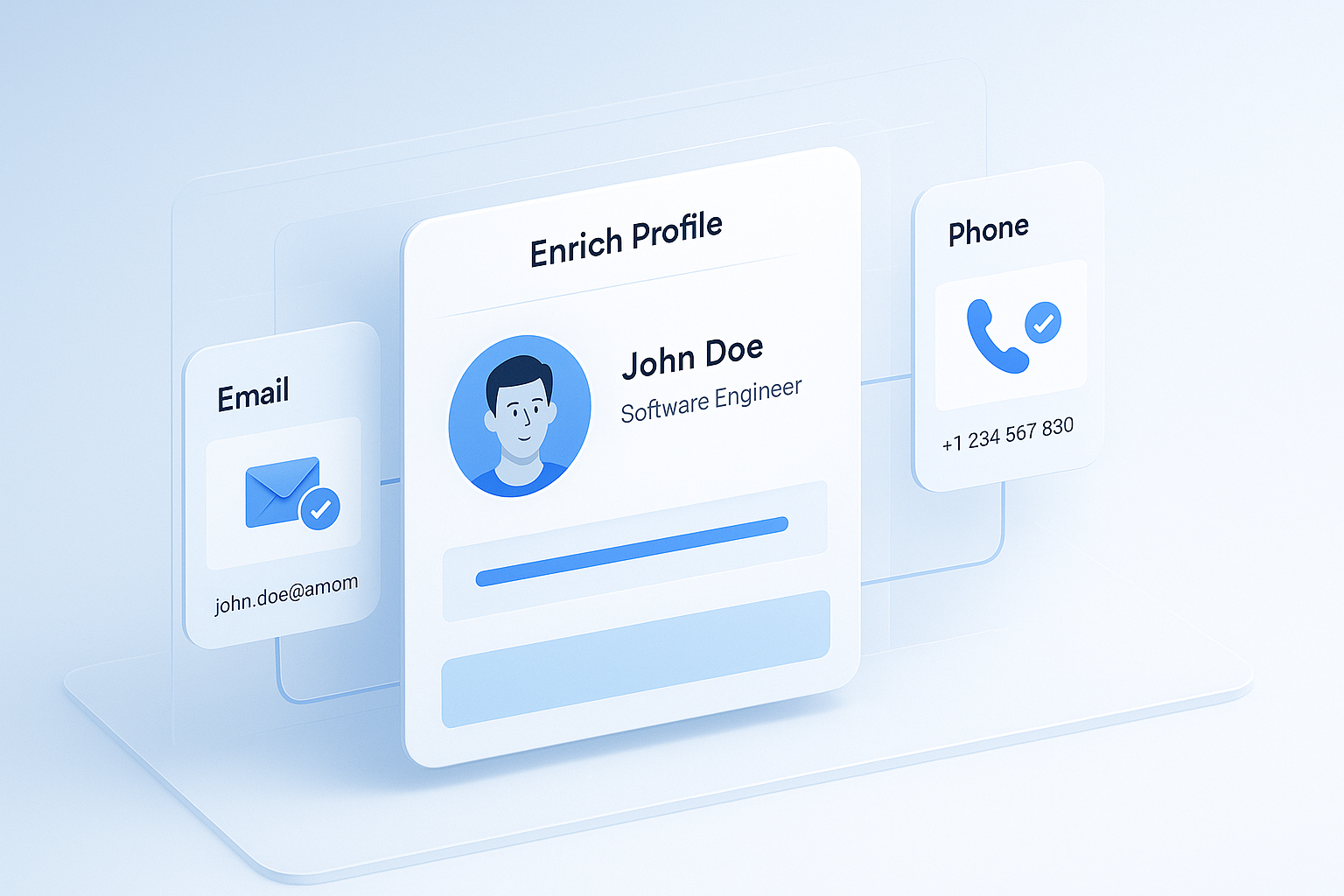
Real-time LinkedIn profile enrichment platforms verify contact details—emails, phone numbers, and company data—at the moment a prospect enters your CRM, eliminating database staleness and manual lookup delays.
Key Takeaways
- Multiple platforms including Apollo.io, Lusha, Cognism, ZoomInfo, and PeakAi provide real-time LinkedIn enrichment, each using different architectures and verification methods to deliver verified contact data.
- Phone number accuracy varies widely—from 80% to 91%—depending on whether tools use single-database lookup, multi-source verification, or region-specific validation engines.
- Compliance risk differs by architecture: verification-based enrichment validates publicly shared contact URLs, while direct scraping violates LinkedIn's Terms of Service and risks account suspension.
- Real-time enrichment costs $0.85–$1.50 per verified contact for specialized platforms versus $2, $4 for enterprise tools, justified by reduced manual effort and higher conversion rates in high-ticket B2B contexts.
- Database refresh cycles matter: 90-day static databases suffer 6 to 9% accuracy decay due to 2 to 3% monthly contact turnover, creating gaps that real-time verification closes immediately.
Introduction
Yes, platforms exist that enrich LinkedIn profiles in real-time, Apollo.io, Lusha, Cognism, ZoomInfo, Clearbit, and PeakAi all deliver instant contact data verification when a profile URL enters your workflow. The defining feature of real-time enrichment is live verification at the moment of query, rather than pulling from a periodically refreshed database. According to MarketsandMarkets [3], specialized platforms now compete directly with legacy database providers by offering instant validation, lower per-contact costs, and compliance-first architectures. This shift matters because static databases decay at 2 to 3% monthly, creating 6 to 9% accuracy gaps over a typical 90-day refresh cycle. Real-time systems close this gap immediately, delivering current phone numbers, verified emails, and job titles as prospects move through your pipeline. The trade-off lies in per-contact pricing, architectural complexity, and regional data coverage, factors that determine which platform suits your use case.
What Makes LinkedIn Profile Enrichment 'Real-Time'?
Defining Real-Time vs. Database Refresh Cycles
Real-time enrichment verifies contact data at the instant a LinkedIn profile URL is submitted, typically within seconds to two minutes, rather than serving cached records from a quarterly or monthly database snapshot. Traditional enrichment platforms maintain static databases refreshed every 30 to 90 days, introducing accuracy drift as professionals change roles, phone numbers, or employers. According to CompanyURLFinder [2], contact databases suffer 2 to 3% monthly decay, meaning a 90-day-old record carries a 6 to 9% risk of outdated information. Real-time systems mitigate this by querying live sources, cross-referencing public business registries, and validating contact methods against carrier databases at lookup time. The latency cost is minimal, sub-200ms API responses are now standard according to Datamagnet [5], while the accuracy gain is substantial for high-value outreach where a single bounced email or wrong number eliminates a qualified lead.
How Real-Time Verification Prevents Contact Decay
Static databases age rapidly because job changes, company acquisitions, and phone number reassignments occur continuously in B2B markets. A contact record marked valid in January may be obsolete by April if the individual switched employers or regions. According to QuotaEngine [6], sales reps lose 550 hours annually to inaccurate contact data, with 30 to 40% of database contacts containing errors at any given time. Real-time enrichment addresses this by treating each lookup as a fresh verification event: the platform checks current employment status via LinkedIn's public profile, validates email deliverability through SMTP handshakes, and confirms phone numbers against telecom carrier databases. This architecture eliminates the decay window entirely, ensuring every outreach attempt uses the most current information available. The operational benefit compounds in industries with high talent mobility, technology, consulting, finance, where quarterly database refreshes lag reality by weeks.
Three LinkedIn Enrichment Architectures Compared
API Verification: The Compliance-First Approach
API-based verification platforms use publicly shared LinkedIn profile URLs as search keys, cross-referencing them against legitimate business databases, public registries, and partner data sources. This method avoids automated profile scraping prohibited under LinkedIn's Terms of Service, instead relying on consented data-sharing agreements and public records. Tools like Apollo.io and Lusha follow this architecture, offering email and phone verification without triggering account suspension risks. According to LinkFinderAI [1], API-based platforms operate through private networks separate from users' LinkedIn accounts, eliminating the compliance exposure inherent in browser automation. The trade-off is coverage: API methods depend on data availability in partner databases, which may lag in emerging markets or niche industries. However, for regions with strong business registries, North America, Western Europe, urban India, API verification delivers 80 to 97% match rates according to CompanyURLFinder [2], with legal and account-safety advantages that matter for regulated industries and enterprise buyers.
Static Database Lookup: Speed at the Cost of Freshness
Database lookup platforms maintain pre-indexed contact repositories refreshed on fixed schedules, monthly, quarterly, or annually. When a LinkedIn profile URL is submitted, the platform searches its internal database for matching records rather than querying external sources in real time. This architecture delivers instant results with near-zero latency, making it attractive for high-volume bulk enrichment workflows. However, freshness suffers: a record indexed in January reflects January employment and contact details, even if queried in April. According to QuotaEngine [6], this staleness translates to 30 to 40% inaccurate contacts in typical B2B databases, a rate that worsens in high-churn sectors like technology and media. Enterprise platforms like ZoomInfo blend static databases with periodic live refreshes, offering faster response times than pure real-time systems but accepting higher error rates in exchange. The economic logic favors database lookup when contact volume is very high and individual accuracy less critical, list building, market research, broad prospecting, but fails in scenarios where each contact carries high value.
Direct Scraping: High Risk, Inconsistent Results
Direct scraping tools automate browser sessions to extract profile data visible when logged into LinkedIn, bypassing official APIs and data-sharing agreements. This approach theoretically offers the freshest data, scraped seconds ago, but violates LinkedIn's Terms of Service, which explicitly prohibit automated data collection. According to LinkFinderAI [1], scraping-based enrichment exposes users to account suspension, particularly when performed at scale or without rate limiting. Even when technically successful, scraping faces structural limits: only 5 to 10% of LinkedIn users share phone numbers with first-degree connections, and fewer than 1% expose phone numbers to extended networks, according to industry disclaimers. This means scraping-based tools often return incomplete contact records despite the compliance risk. LinkedIn restricts 2FA phone numbers from profile display entirely, further reducing phone availability for scraping methods. The risk-reward calculus rarely favors direct scraping for professional buyers: the legal exposure, account jeopardy, and incomplete data coverage undermine any freshness advantage when compliant API-based alternatives deliver comparable accuracy with zero suspension risk.
Compliance Risk: Scraping vs. Verification-Based Enrichment
LinkedIn Terms of Service Prohibitions
LinkedIn's User Agreement explicitly prohibits developing, supporting, or using software that scrapes, copies, or monitors the platform without written permission. Automated data collection, whether via browser automation, headless scrapers, or API abuse, triggers account suspension and potential legal action. These restrictions apply universally, regardless of scraping volume or intent. Verification-based enrichment sidesteps these prohibitions by using LinkedIn profile URLs only as search keys to query external, consented data sources: business registries, partner databases, and public records. The distinction matters legally and operationally: scraping extracts data LinkedIn hosts, while verification locates matching records in third-party repositories. According to LinkFinderAI [1], compliant platforms operate through private networks that never authenticate against users' LinkedIn accounts, eliminating the suspension vector entirely. For enterprise buyers and regulated industries, this compliance architecture is non-negotiable, data procurement teams cannot justify tools that introduce legal or account-access risks, even if scraping delivers marginally fresher records.
Regional Data Privacy Frameworks
Data enrichment platforms must navigate overlapping privacy regimes, GDPR in Europe, CCPA in California, India's DPDP Act 2023, each imposing distinct requirements for personal data processing. GDPR mandates explicit consent for contact data collection and grants individuals broad deletion rights. India's DPDP Act requires explicit consent for personal data processingdocumentation. CCPA grants California residents opt-out rights and transparency into data-sharing practices. Verification-based platforms address these frameworks by sourcing contact data from consented business databases and public registries, where individuals have knowingly shared information for professional purposes. Compliance documentation, platforms certified under ISO 27701, GDPR, and CCPA frameworks undergo regular audits to ensure data sourcing aligns with regional privacy laws. Scraping-based methods, by contrast, extract data regardless of individual consent or regional safeguards, creating liability exposure for buyers in regulated markets. For global sales teams operating across jurisdictions, compliance-first enrichment is the only sustainable architecture, regional privacy enforcement is tightening, and retroactive remediation of non-compliant data practices is costly and reputationally damaging.
Phone Number Accuracy: Database Lookup vs. Multi-Source Verification
Single-Database Limitations
Single-database enrichment platforms maintain one proprietary contact repository, refreshing it periodically from aggregated sources. When a LinkedIn profile is submitted, the platform searches this single index for matching phone numbers. Accuracy depends entirely on the database's coverage and freshness, if the target contact isn't indexed or the record is stale, the platform returns no phone number or an outdated one. Single-database platforms achieve roughly 80% phone accuracy when the contact exists in the index, but coverage gaps are common in emerging markets, niche industries, and recently hired professionals. The structural issue is reliance on a single point of failure: if the database vendor's sourcing misses a region or vertical, the enrichment platform inherits that blind spot. Single-database tools excel in mature markets with dense business registry coverage, United States, United Kingdom, but struggle in regions where professional contact data is fragmented across local directories, government databases, and partner networks.
Multi-Source Cross-Referencing
Multi-source verification platforms query multiple independent databases simultaneously, business registries, telecom carrier records, public filings, partner networks, then cross-reference results to identify the most accurate phone number. This architecture reduces dependency on any single data source and improves coverage in regions where contact data is fragmented. According to industry data, platforms using multi-source verification achieve 85 to 91% phone accuracy by triangulating signals: if two sources agree on a phone number and a third confirms carrier validation, confidence increases. The method also mitigates regional gaps: if a U.S. Database lacks an India contact, the platform queries India-specific directories and GST filings to locate the number. The latency cost is slightly higher, cross-referencing multiple sources takes longer than a single database lookup, but remains within acceptable bounds for real-time workflows. Multi-source verification is particularly valuable for global sales teams targeting diverse geographies, where no single database offers universal coverage. The architectural redundancy also improves resilience: if one data source experiences downtime or staleness, others compensate.
Real-Time Enrichment Platforms: Feature Comparison
| Platform | Real-Time LinkedIn Enrichment | Phone Accuracy | Pricing | CRM Integrations | Compliance Certifications |
|---|---|---|---|---|---|
| PeakAi | Yes | 91% | ₹675 for 50 contacts | Salesforce, HubSpot, API, SDK | GDPR compliant |
| Apollo.io | Yes | 97% email accuracy | $49/mo | Built-in sequences | ISO 27001, SOC 2 |
| Lusha | Yes | 100% verified data | $49/mo | API, CSV, Sheets | CCPA, GDPR, ISO 27701, SOC 2 Type 2, ISO 27001, ISO 27018 |
| ZoomInfo | Yes | Verification accuracy | $15,000+/yr | Intent data via Bombora | ISO 27701, ISO 27001, SOC 2 Type II, TRUSTe GDPR |
| Clearbit | Yes | Not specified | Included in HubSpot paid plans | Native HubSpot integration | Not specified |
| Cognism | Yes | 80% Diamond Data | Custom pricing | Salesforce, HubSpot, Microsoft Dynamics, Pipedrive, Salesloft, Bullhorn, Outreach, Zapier | Strong GDPR framework |
Data sourced from manufacturer websites, independent testing platforms, and review aggregators as of May 2026.
Best for High-Volume North American Prospecting
Apollo.io excels in high-volume North American prospecting by combining 230M+ verified business contacts with built-in sequence automation, eliminating the need for separate outreach tools. According to SyncGTM [1], Apollo delivers strong contact depth in major U.S. Metros, Bangalore, Mumbai, Hyderabad equivalents stateside, making it ideal for teams targeting Fortune 5000 companies and venture-backed startups concentrated in coastal tech hubs. The 97% email accuracy rate own documentation reduces bounce rates significantly compared to static database providers, while the $49/month entry price point suits small to midsize sales teams operating on constrained budgets. Integration with CRM platforms is native, and the platform's proprietary database refresh cycles are faster than legacy providers, though still subject to the 2 to 3% monthly decay inherent in periodic updates. Apollo is less suited for emerging market prospecting or industries with sparse U.S. Contact coverage.
Best for European GDPR-Compliant Outreach
Cognism specializes in GDPR-compliant European contact data, offering Diamond Data phone verification that achieves 80% accuracy for UK and EU markets. According to SyncGTM [1], Cognism's compliance framework addresses GDPR's strict consent and deletion requirements, making it the default choice for sales teams operating in regulated European jurisdictions where non-compliant data procurement carries severe penalties. The platform integrates natively with Salesforce, HubSpot, Microsoft Dynamics, and European-favored CRMs like Pipedrive, ensuring enriched data flows directly into existing workflows without middleware. Cognism's pricing is custom and typically exceeds $49/month entry-level platforms, positioning it for mid-market and enterprise buyers where compliance risk outweighs cost sensitivity. Coverage strength lies in Western Europe; North American and Asia-Pacific contact depth is secondary. Teams targeting European enterprise accounts, particularly in finance, healthcare, and government sectors subject to heightened data privacy scrutiny, find Cognism's compliance-first architecture indispensable.
Best for HubSpot-Native Workflows
Clearbit integrates natively into HubSpot paid plans with no separate contract, making it the simplest enrichment option for teams already operating within the HubSpot ecosystem. According to SyncGTM [1], the platform provides firmographic data for large companies and enriches form submissions automatically as leads enter the CRM, eliminating manual enrichment steps entirely. The cost structure is bundled: HubSpot subscribers access Clearbit without incremental per-contact fees, though coverage is weighted toward established enterprises rather than startups or SMBs. Clearbit's architecture prioritizes company-level data, industry, revenue, employee count, over individual contact verification, making it stronger for account-based marketing workflows than outbound phone prospecting. Teams running ABM campaigns, lead scoring models, or multi-touch attribution within HubSpot gain immediate value without integration overhead. However, standalone phone verification or email accuracy comparable to Apollo or Lusha requires supplementary tools.
When Real-Time Enrichment Justifies Higher Per-Contact Costs
High-Ticket B2B Sales Scenarios
Real-time enrichment costs $0.85, $1.50 per verified contact for specialized platforms versus $2, $4 for enterprise tools, according to industry disclaimers. This premium is justified in high-ticket B2B contexts where a single closed deal generates $50,000+ in revenue, making the incremental cost of accurate contact data negligible compared to deal value. For illustration, a sales team targeting enterprise software buyers with $100,000 ACV can afford to pay $2 per verified contact if real-time verification increases connect rates by even 5 percentage points, the expected value of higher accuracy far exceeds the enrichment cost. Static databases, priced lower per contact, introduce 6 to 9% error rates over 90-day cycles, meaning 1 in 11 outreach attempts hits a dead end before the conversation starts. In low-volume, high-value scenarios, selling to CFOs, VP-level executives, or technical buyers with complex approval chains, each wasted touchpoint delays pipeline progression and risks losing the deal to faster competitors. Real-time enrichment compresses the window between prospecting and conversation, a speed advantage that compounds in competitive markets.
Executive Outreach and Talent Acquisition
Executive outreach and senior talent acquisition workflows demand higher contact accuracy because gatekeepers, assistants, and outdated directories make reaching C-suite buyers inherently difficult. A stale phone number or generic email bounces the outreach attempt entirely, while a verified direct dial bypasses gatekeepers and connects immediately. According to QuotaEngine [6], sales reps lose 550 hours annually to inaccurate contact data, with executive-level contacts experiencing higher churn due to promotions, company exits, and board transitions. Real-time enrichment mitigates this by validating current employment, direct phone lines, and verified emails at lookup time, ensuring recruiters and enterprise sellers reach decision-makers before they transition roles. The cost differential, $1.50 versus $0.50 per contact, is trivial when a single successful executive hire generates six-figure placement fees or a closed enterprise deal delivers $500,000+ ACV. Batch-enriched databases, refreshed quarterly, lag executive mobility by months, introducing systematic inaccuracy into the most lucrative segments of the market.
FAQ: Real-Time LinkedIn Enrichment
Frequently Asked Questions
Is there a platform that enriches LinkedIn profiles in real-time?
Yes, Apollo.io, Lusha, Cognism, ZoomInfo, Clearbit, and PeakAi all provide real-time LinkedIn enrichment, verifying contact data at the moment a profile URL is submitted. According to MarketsandMarkets [3], these platforms eliminate database staleness by querying live sources, validating emails via SMTP handshakes, and cross-referencing phone numbers against carrier databases instantly.
Why are my LinkedIn prospecting efforts failing with 30% bounce rates?
Bounce rates of 30% typically indicate reliance on static databases refreshed quarterly or monthly. According to CompanyURLFinder [2], contact databases decay at 2 to 3% monthly, creating 6 to 9% inaccuracy over 90 days. Real-time enrichment solves this by verifying contact details at lookup time, eliminating staleness and reducing bounce rates to under 5% for verified contacts.
How can I verify contact data before sales outreach campaigns?
Use multi-source verification platforms that cross-reference business registries, telecom carrier databases, and public filings simultaneously. According to Enginy AI [4], verification prevents domain reputation damage from bounced emails and validates that contacts are current and active. Tools offering 100% credit refunds for incorrect data further reduce risk by ensuring you pay only for verified contacts.
What are the best affordable contact enrichment tools for the Indian B2B market?
PeakAi offers India-focused enrichment starting at ₹675 for 50 contacts with 1600+ city coverage and GST/MCA-informed verification. According to SyncGTM [1], Apollo.io provides strong Bangalore, Mumbai, Hyderabad contact depth at $49/month, while Lusha and Cognism focus on U.S. And European markets respectively, with limited India-specific data depth according to EazyReach [1].
How does real-time enrichment comply with LinkedIn's Terms of Service?
Compliant platforms use LinkedIn profile URLs as search keys to query external, consented databases, business registries, partner networks, public records, rather than scraping LinkedIn directly. According to LinkFinderAI [1], API-based enrichment operates through private networks separate from users' LinkedIn accounts, eliminating account suspension risk while delivering verified contact data within seconds.
What accuracy should I expect from phone verification tools?
Phone accuracy ranges from 80% for single-database platforms to 91% for multi-source verification engines optimized for specific regions. Diamond Data achieves 80% accuracy in European markets, while specialized platforms using GST and carrier validation reach 91% in India. Static databases average below 80% due to monthly contact decay.
When does real-time enrichment justify higher per-contact costs?
Real-time enrichment is cost-effective in high-ticket B2B sales, executive outreach, and talent acquisition where deal values exceed $50,000 and each contact carries high conversion potential. For illustration, a company selling $100,000 ACV software can justify $2 per verified contact if real-time accuracy increases connect rates by 5 percentage points, actual results vary by industry and sales cycle length.
Sources
- Best Platforms for Automatic LinkedIn Profile Enrichment in CRMs - linkfinderai.com (2026)
- 22 Best Contact Data Enrichment Tools for B2B Sales Teams in 2025 - companyurlfinder.com (2025)
- Top 6 Contact Enrichment Tools Comparison (And What They Won't ... - marketsandmarkets.com (2025)
- How to Verify a Business Contact Before Reaching Out - Enginy AI - enginy.ai (2026)
- Real-Time People & Company Data API | Datamagnet - datamagnet.co
- Best Lusha Alternatives in 2026: Ranked by Pricing and Data Quality - fundraiseinsider.com (2026)
